

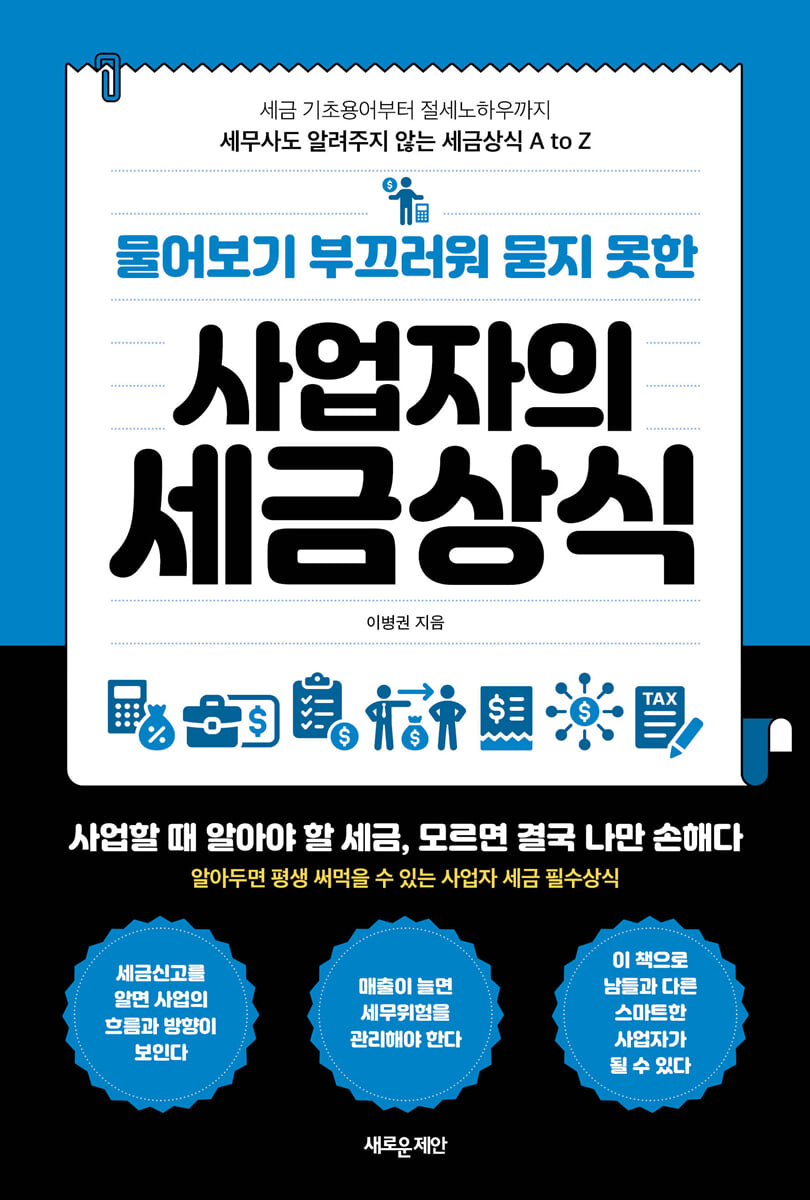
Tax knowledge for business owners who are too embarrassed to ask
 |
Description
Book Introduction
There is a big difference between paying taxes knowingly and paying taxes simply because someone else told you to.
Because important tax-saving points are hidden in the tax calculation process.
The reality is that most business owners leave bookkeeping and tax reporting entirely to tax accountants without even knowing the specifics, and pay taxes according to the amount they are told to pay.
However, business owners themselves must also have a basic understanding of the process and calculation of business-related taxes, such as income tax and value-added tax.
This book not only addresses tax-related questions and concerns that business owners, including aspiring entrepreneurs planning to start a business, face at each stage of their business journey, but also provides tips on reducing tax risks and saving money.
In particular, based on the author's experience in providing on-site lectures to business owners over the past 10 years, he explains difficult tax laws with relatively easy explanations and examples so that even beginners can easily understand them.
Because important tax-saving points are hidden in the tax calculation process.
The reality is that most business owners leave bookkeeping and tax reporting entirely to tax accountants without even knowing the specifics, and pay taxes according to the amount they are told to pay.
However, business owners themselves must also have a basic understanding of the process and calculation of business-related taxes, such as income tax and value-added tax.
This book not only addresses tax-related questions and concerns that business owners, including aspiring entrepreneurs planning to start a business, face at each stage of their business journey, but also provides tips on reducing tax risks and saving money.
In particular, based on the author's experience in providing on-site lectures to business owners over the past 10 years, he explains difficult tax laws with relatively easy explanations and examples so that even beginners can easily understand them.
- You can preview some of the book's contents.
Preview
index
Chapter 1: Business Preparation - Thorough Preparation Before Starting
01 You shouldn't start a business without thinking.
02 Methods of raising business funds
03 How much startup capital is acceptable from parents?
04 How much startup capital can I borrow from my parents without incurring gift tax?
05 Can I run a business in a commercial building owned by my parents without paying rent?
06 Business Registration: Which is better, individual or corporation?
07 Incorporation (Registration) Procedures: Easy Once You Know Them
08 What is the difference between a taxable business and a tax-exempt business?
09 Registering as a simplified taxpayer reduces your value-added tax burden.
If you change from a simple to a general account, you should receive a tax refund.
Chapter 2: Early Stages of Business - Even if sales are low and there isn't much to pay in taxes, you still need to manage.
01 Difference between value-added tax and income tax
02 What is the difference between a high value-added business and a low value-added business?
03 Understanding Value Added Tax
04 Management is just as important as sales.
05 In the early stages of starting a business, income tax and corporate tax are reduced for 5 years.
06 Can franchise fees, key money, and goodwill payments be treated as expenses?
07 Even if you don't make a profit, you must file an accounting and tax return.
08 You can calculate taxes without accounting.
09 In the early stages of business, simple accounting and tax reporting
Know and manage the 10 major expense items.
11 Unsold inventory can be expensed.
12. How to Prepare for Health Insurance Premiums for Sole Proprietors
Chapter 3: Business Settlement - As Profits Begin to Show, Taxes Are No Small Matter
01 Remember the tax month and prepare in advance.
02 If you earn 2-3 times more money, your taxes will be 3-6 times more.
03 Document management is the basis of tax saving law.
04 How to Use Your Card Wisely
05 There are cases where loan interest is not recognized as a business expense.
06 Is the passenger vehicle used by a business owner for business or non-business purposes?
07 Which is more advantageous, buying or renting?
08 Distinguish between business expenses and welfare expenses.
09 Daily worker wages must also be reported to be recognized as expenses.
Labor costs paid to 10 families are also recognized as expenses.
11. Self-employed individuals do not pay income tax even if they sell business assets.
12 It is convenient not to reflect asset valuation and reserve costs.
13. Enroll in a retirement pension plan to have your employees' retirement pay recognized as an expense in advance.
14 If you hire workers, you must receive tax deductions.
Chapter 4: The Prosperous Business - The more you earn, the more you lose, so taxes are scary and tax savings are a shame.
01 At what level of sales will the National Tax Service take interest and keep an eye on it?
02 When sales exceed a certain level, these things change.
03 Why are YouTubers being hit with a tax bomb?
04 When you have been charged for an overdue payment, be sure to get proof first.
05 Don't be hit by the tax bomb
06 It is safer to match the National Tax Service's standards as much as possible.
07 Most of the reasons for additional collection are due to unrelated expenses.
08 Save money for retirement to save on taxes.
09 Donations and health insurance premiums are also recognized as business expenses.
10. You can control your taxes with depreciation.
11. Actively utilize business promotion expenses.
12 Tax collection also has an expiration date.
13 Will doing business together reduce taxes?
14 It is better to change to a corporation than to receive confirmation of honest reporting.
15 Unique tax calculation method for rental business operators
16 Corporations should not be left in a state of extreme obesity.
17 Should I buy stocks with my spare money?
18 Precautions when a corporate representative lends or borrows money from a corporation
19 There is a deep meaning hidden in family businesses.
Chapter 5: Business Closure - Once you have your retirement funds in place, consider transferring your assets.
01 Closure, Business Transfer, and Corporate Liquidation Procedures
02 Can business owners also receive severance pay?
03 Pensions are also subject to taxes and health insurance premiums.
04 If you don't manage your interest and dividend income, it will all be lost to taxes and health insurance premiums.
05 When should donations begin?
06 How much tax will I have to pay if I inherit or gift corporate stock?
07 If you transfer corporate stock, you must report capital gains tax.
01 You shouldn't start a business without thinking.
02 Methods of raising business funds
03 How much startup capital is acceptable from parents?
04 How much startup capital can I borrow from my parents without incurring gift tax?
05 Can I run a business in a commercial building owned by my parents without paying rent?
06 Business Registration: Which is better, individual or corporation?
07 Incorporation (Registration) Procedures: Easy Once You Know Them
08 What is the difference between a taxable business and a tax-exempt business?
09 Registering as a simplified taxpayer reduces your value-added tax burden.
If you change from a simple to a general account, you should receive a tax refund.
Chapter 2: Early Stages of Business - Even if sales are low and there isn't much to pay in taxes, you still need to manage.
01 Difference between value-added tax and income tax
02 What is the difference between a high value-added business and a low value-added business?
03 Understanding Value Added Tax
04 Management is just as important as sales.
05 In the early stages of starting a business, income tax and corporate tax are reduced for 5 years.
06 Can franchise fees, key money, and goodwill payments be treated as expenses?
07 Even if you don't make a profit, you must file an accounting and tax return.
08 You can calculate taxes without accounting.
09 In the early stages of business, simple accounting and tax reporting
Know and manage the 10 major expense items.
11 Unsold inventory can be expensed.
12. How to Prepare for Health Insurance Premiums for Sole Proprietors
Chapter 3: Business Settlement - As Profits Begin to Show, Taxes Are No Small Matter
01 Remember the tax month and prepare in advance.
02 If you earn 2-3 times more money, your taxes will be 3-6 times more.
03 Document management is the basis of tax saving law.
04 How to Use Your Card Wisely
05 There are cases where loan interest is not recognized as a business expense.
06 Is the passenger vehicle used by a business owner for business or non-business purposes?
07 Which is more advantageous, buying or renting?
08 Distinguish between business expenses and welfare expenses.
09 Daily worker wages must also be reported to be recognized as expenses.
Labor costs paid to 10 families are also recognized as expenses.
11. Self-employed individuals do not pay income tax even if they sell business assets.
12 It is convenient not to reflect asset valuation and reserve costs.
13. Enroll in a retirement pension plan to have your employees' retirement pay recognized as an expense in advance.
14 If you hire workers, you must receive tax deductions.
Chapter 4: The Prosperous Business - The more you earn, the more you lose, so taxes are scary and tax savings are a shame.
01 At what level of sales will the National Tax Service take interest and keep an eye on it?
02 When sales exceed a certain level, these things change.
03 Why are YouTubers being hit with a tax bomb?
04 When you have been charged for an overdue payment, be sure to get proof first.
05 Don't be hit by the tax bomb
06 It is safer to match the National Tax Service's standards as much as possible.
07 Most of the reasons for additional collection are due to unrelated expenses.
08 Save money for retirement to save on taxes.
09 Donations and health insurance premiums are also recognized as business expenses.
10. You can control your taxes with depreciation.
11. Actively utilize business promotion expenses.
12 Tax collection also has an expiration date.
13 Will doing business together reduce taxes?
14 It is better to change to a corporation than to receive confirmation of honest reporting.
15 Unique tax calculation method for rental business operators
16 Corporations should not be left in a state of extreme obesity.
17 Should I buy stocks with my spare money?
18 Precautions when a corporate representative lends or borrows money from a corporation
19 There is a deep meaning hidden in family businesses.
Chapter 5: Business Closure - Once you have your retirement funds in place, consider transferring your assets.
01 Closure, Business Transfer, and Corporate Liquidation Procedures
02 Can business owners also receive severance pay?
03 Pensions are also subject to taxes and health insurance premiums.
04 If you don't manage your interest and dividend income, it will all be lost to taxes and health insurance premiums.
05 When should donations begin?
06 How much tax will I have to pay if I inherit or gift corporate stock?
07 If you transfer corporate stock, you must report capital gains tax.
Detailed image

Publisher's Review
In an era of 8 million self-employed individuals, only smart businesses will survive!
Taxes are paid on business performance, and accounting is required to calculate performance.
Therefore, in order to manage taxes, you need to look at accounting numbers, and through these you can read the business flow.
The assistance of a tax expert is more effective when I have some knowledge.
Moreover, the current tax agency market is overflowing with low-cost agents due to fierce competition in fees, and the resulting damage is entirely borne by taxpayers.
Because all responsibility for paying taxes lies with the taxpayer, not the tax agent.
When tax avoidance crosses the line, it becomes tax evasion. To maintain a sense of balance between tax avoidance and tax evasion and overcome the fear marketing of tax agents, I, as a business owner, must first understand myself.
Through this book, business owners and aspiring entrepreneurs will be able to understand business processes from a tax perspective, improve their businesses, and discover their own tax-saving strategies, becoming smart business owners.
Chapter 1.
Business Preparation - Thorough Preparation Before Starting
Any business you jump into without thorough preparation is likely to fail.
We provide detailed information on what to keep in mind when starting a business, from raising business funds to registering a business and incorporating a corporation.
In particular, before starting a business, it is necessary to diagnose the business feasibility in advance through break-even point analysis.
It is essential to estimate costs that will occur after starting a business, such as fixed and variable costs, and to estimate profits and losses. Therefore, this method is explained through examples.
In addition, it explains the pros and cons of individual and corporate business operators, the differences between value-added tax payers and exempt businesses, the differences between general taxpayers and simplified taxpayers, and which one is more advantageous.
Chapter 2.
Early stages of business - Even if sales are low and there is not much to pay in taxes, you still need to manage.
Don't neglect management just because sales are low in the early stages of a business.
It is essential to recover the key money, franchise fees, and depreciation costs for facility investments paid in the early stages of starting a business.
We will look into expenses that business owners must cover themselves, such as depreciation, labor costs, rent, and operating expenses, and also check tax issues.
We will also learn about the simple expense ratio system (applicable subjects and reporting method) that allows you to report taxes without having to keep books when sales are low in the early stages of a business.
In addition, for losses incurred in the early stages of a business, tax deduction benefits provided under tax law must be received. Therefore, business owners should not rely solely on tax accounting firms for all of these matters, but should develop the habit of taking care of them themselves.
In other words, a management mindset is not formed overnight, so if you develop the habit of managing your own sales and expenses from the beginning of your business, you will be able to easily cope with it when the business grows in size.
Chapter 3.
Business Settlement - As Profits Begin to Show, Taxes Are No Small Matter
As your business begins to settle in, sales and profits will gradually increase, but this is when taxes become a burden and a concern.
If you understand the meaning and explosive power of progressive taxation, you must properly understand and utilize methods such as managing expenditure documentation for tax savings, using business cards, and using business promotion expenses.
We also examine the criteria for expense accounting for loan interest and car-related expenses, as well as why leasing or renting a car is more advantageous.
We explain why accounting profit and taxable income are different, and also explore the meaning and process of tax adjustment.
As your business grows at this stage, you'll need to hire more employees. Don't forget to consider how to account for family and daily worker wages as expenses, and how to receive tax deductions when hiring new employees.
Chapter 4.
The booming business - the more you earn, the more you lose, so taxes are scary and tax savings are a shame.
As your business prospers, tax risk comes with increased sales revenue.
As sales exceed a certain level, bookkeeping becomes mandatory, and the standards for honest reporting become stricter. The National Tax Service also takes a closer look, so much more careful management is required than before.
Because if you're not careful, you could get hit with a surcharge bomb.
It explains the meaning of the value-added rate and income rate, the two standards used by the National Tax Service to determine whether or not a report has been filed honestly, and also shows reporting data by industry based on National Tax Service statistics.
By comparing this, you can gauge how faithfully you are reporting your taxes to the National Tax Service's standards.
Especially from this time on, taxes will increase rapidly, so tax saving is very necessary. We will tell you specifically how to save taxes through which items.
Chapter 5.
Business closure....
Once you have your retirement funds ready, consider transferring your assets.
The final stage of business is closure and corporate liquidation. This section explains the procedures and tax considerations, such as paying value-added tax on remaining inventory.
In the case of corporate representatives, they must prepare their own retirement funds through retirement pay, and in the case of self-employed individuals, they must prepare their own retirement funds through pension savings and retirement pensions. Therefore, the taxes they must pay after retirement are pension income tax, financial income tax, and health insurance premiums.
We'll explain strategies to minimize these and explore the broader context of inheritance and gifting, the process of securing retirement funds and transferring remaining funds.
In particular, we explain through examples the points to be careful about when transferring corporate stocks to children through gifts or transfers.
Taxes are paid on business performance, and accounting is required to calculate performance.
Therefore, in order to manage taxes, you need to look at accounting numbers, and through these you can read the business flow.
The assistance of a tax expert is more effective when I have some knowledge.
Moreover, the current tax agency market is overflowing with low-cost agents due to fierce competition in fees, and the resulting damage is entirely borne by taxpayers.
Because all responsibility for paying taxes lies with the taxpayer, not the tax agent.
When tax avoidance crosses the line, it becomes tax evasion. To maintain a sense of balance between tax avoidance and tax evasion and overcome the fear marketing of tax agents, I, as a business owner, must first understand myself.
Through this book, business owners and aspiring entrepreneurs will be able to understand business processes from a tax perspective, improve their businesses, and discover their own tax-saving strategies, becoming smart business owners.
Chapter 1.
Business Preparation - Thorough Preparation Before Starting
Any business you jump into without thorough preparation is likely to fail.
We provide detailed information on what to keep in mind when starting a business, from raising business funds to registering a business and incorporating a corporation.
In particular, before starting a business, it is necessary to diagnose the business feasibility in advance through break-even point analysis.
It is essential to estimate costs that will occur after starting a business, such as fixed and variable costs, and to estimate profits and losses. Therefore, this method is explained through examples.
In addition, it explains the pros and cons of individual and corporate business operators, the differences between value-added tax payers and exempt businesses, the differences between general taxpayers and simplified taxpayers, and which one is more advantageous.
Chapter 2.
Early stages of business - Even if sales are low and there is not much to pay in taxes, you still need to manage.
Don't neglect management just because sales are low in the early stages of a business.
It is essential to recover the key money, franchise fees, and depreciation costs for facility investments paid in the early stages of starting a business.
We will look into expenses that business owners must cover themselves, such as depreciation, labor costs, rent, and operating expenses, and also check tax issues.
We will also learn about the simple expense ratio system (applicable subjects and reporting method) that allows you to report taxes without having to keep books when sales are low in the early stages of a business.
In addition, for losses incurred in the early stages of a business, tax deduction benefits provided under tax law must be received. Therefore, business owners should not rely solely on tax accounting firms for all of these matters, but should develop the habit of taking care of them themselves.
In other words, a management mindset is not formed overnight, so if you develop the habit of managing your own sales and expenses from the beginning of your business, you will be able to easily cope with it when the business grows in size.
Chapter 3.
Business Settlement - As Profits Begin to Show, Taxes Are No Small Matter
As your business begins to settle in, sales and profits will gradually increase, but this is when taxes become a burden and a concern.
If you understand the meaning and explosive power of progressive taxation, you must properly understand and utilize methods such as managing expenditure documentation for tax savings, using business cards, and using business promotion expenses.
We also examine the criteria for expense accounting for loan interest and car-related expenses, as well as why leasing or renting a car is more advantageous.
We explain why accounting profit and taxable income are different, and also explore the meaning and process of tax adjustment.
As your business grows at this stage, you'll need to hire more employees. Don't forget to consider how to account for family and daily worker wages as expenses, and how to receive tax deductions when hiring new employees.
Chapter 4.
The booming business - the more you earn, the more you lose, so taxes are scary and tax savings are a shame.
As your business prospers, tax risk comes with increased sales revenue.
As sales exceed a certain level, bookkeeping becomes mandatory, and the standards for honest reporting become stricter. The National Tax Service also takes a closer look, so much more careful management is required than before.
Because if you're not careful, you could get hit with a surcharge bomb.
It explains the meaning of the value-added rate and income rate, the two standards used by the National Tax Service to determine whether or not a report has been filed honestly, and also shows reporting data by industry based on National Tax Service statistics.
By comparing this, you can gauge how faithfully you are reporting your taxes to the National Tax Service's standards.
Especially from this time on, taxes will increase rapidly, so tax saving is very necessary. We will tell you specifically how to save taxes through which items.
Chapter 5.
Business closure....
Once you have your retirement funds ready, consider transferring your assets.
The final stage of business is closure and corporate liquidation. This section explains the procedures and tax considerations, such as paying value-added tax on remaining inventory.
In the case of corporate representatives, they must prepare their own retirement funds through retirement pay, and in the case of self-employed individuals, they must prepare their own retirement funds through pension savings and retirement pensions. Therefore, the taxes they must pay after retirement are pension income tax, financial income tax, and health insurance premiums.
We'll explain strategies to minimize these and explore the broader context of inheritance and gifting, the process of securing retirement funds and transferring remaining funds.
In particular, we explain through examples the points to be careful about when transferring corporate stocks to children through gifts or transfers.
GOODS SPECIFICS
- Date of issue: April 22, 2024
- Page count, weight, size: 320 pages | 152*225*15mm
- ISBN13: 9788955336535
- ISBN10: 8955336535
You may also like
카테고리
korean


korean

![GQ KOREA Mark (Monthly): December [2025]](http://librairie.coreenne.fr/cdn/shop/files/8ef265dbbfbf186523ed75ba7319009d.jpg?v=1765340328&width=3840)


