

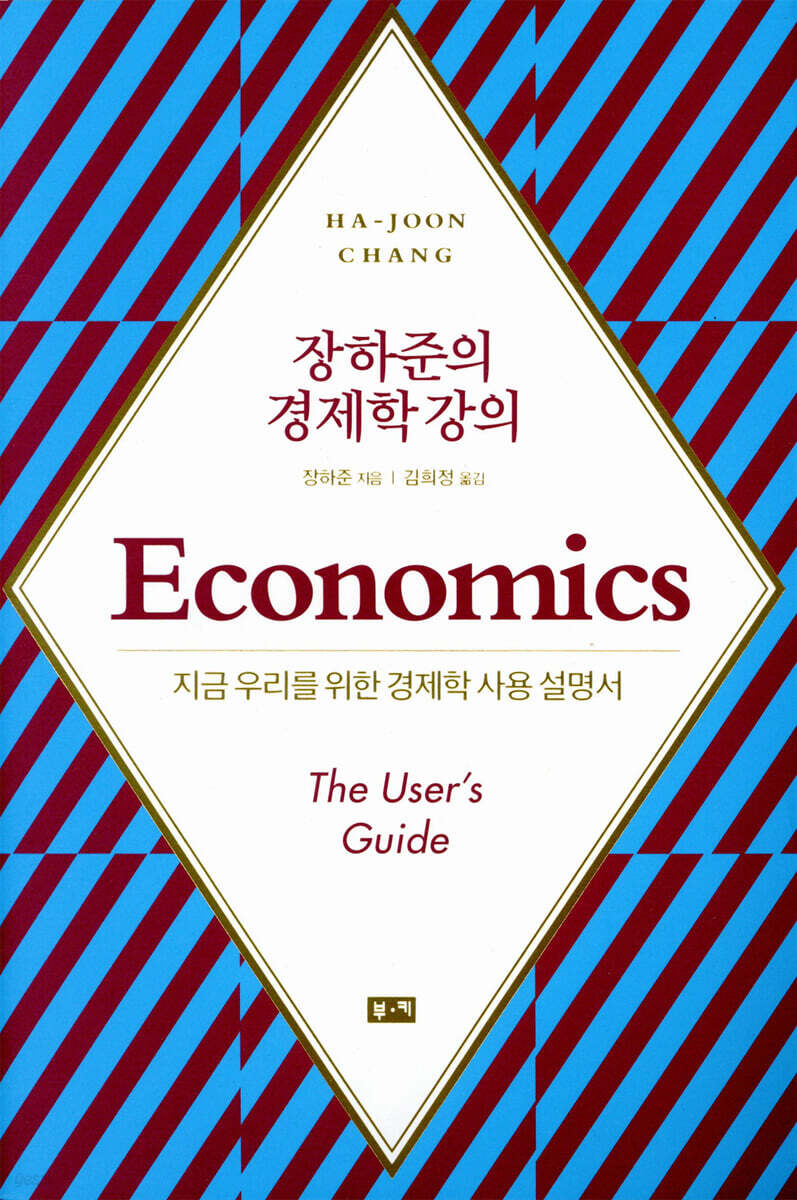
Ha-Joon Chang's economics lecture
 |
Description
Book Introduction
The easiest, friendliest, and most clear economics user guide!
An introduction to economics for the general public, written by world-renowned economist Professor Ha-Joon Chang.
Starting with what the economy is and why we need to know economics, it briefly reviews the economic history of how the capitalist economy reached its current state. It then introduces various schools of economics and explains their strengths and weaknesses point by point.
It also broadens our perspective on the overall economy, encompassing issues closely related to our lives, such as work, income, and happiness, as well as the roles of government and businesses and international trade.
Above all, it vividly shows the real economy through actual statistical numbers, while also sharply pointing out what the numbers cannot explain (or hide).
This is an economics user manual that you can easily learn by following along, just like riding a bicycle or using a smartphone.
Part 1, "Getting Familiar with Economics," discusses what economics is and why we need to know economics. It then briefly examines the economic history of the capitalist economy, detailing how it evolved and evolved to become what it is today.
Next, it introduces nine major schools of economics, including neoclassical, classical, Marxist, Austrian, Keynesian, Schumpeterian, developmental, institutional, and behavioral economics, and explains their strengths and weaknesses in detail.
Part 2, "Using Economics," then teaches us how to "use" economics, covering topics closely related to our lives, such as work, unemployment, inequality, and poverty, as well as the roles of government and businesses and international trade, all of which are neglected in mainstream neoclassical economics.
Furthermore, it helps us develop a proper perspective on the economy by vividly showing the economy through familiar real-world topics such as working hours, poverty rates, and GDP, rather than complex formulas or models.
An introduction to economics for the general public, written by world-renowned economist Professor Ha-Joon Chang.
Starting with what the economy is and why we need to know economics, it briefly reviews the economic history of how the capitalist economy reached its current state. It then introduces various schools of economics and explains their strengths and weaknesses point by point.
It also broadens our perspective on the overall economy, encompassing issues closely related to our lives, such as work, income, and happiness, as well as the roles of government and businesses and international trade.
Above all, it vividly shows the real economy through actual statistical numbers, while also sharply pointing out what the numbers cannot explain (or hide).
This is an economics user manual that you can easily learn by following along, just like riding a bicycle or using a smartphone.
Part 1, "Getting Familiar with Economics," discusses what economics is and why we need to know economics. It then briefly examines the economic history of the capitalist economy, detailing how it evolved and evolved to become what it is today.
Next, it introduces nine major schools of economics, including neoclassical, classical, Marxist, Austrian, Keynesian, Schumpeterian, developmental, institutional, and behavioral economics, and explains their strengths and weaknesses in detail.
Part 2, "Using Economics," then teaches us how to "use" economics, covering topics closely related to our lives, such as work, unemployment, inequality, and poverty, as well as the roles of government and businesses and international trade, all of which are neglected in mainstream neoclassical economics.
Furthermore, it helps us develop a proper perspective on the economy by vividly showing the economy through familiar real-world topics such as working hours, poverty rates, and GDP, rather than complex formulas or models.
- You can preview some of the book's contents.
Preview
index
Acknowledgements
Prologue: Why bother…? Why should I learn economics?
Why Don't People Care About Economics? │How Is This Book Different?
Part 1: Getting Familiar with Economics
Chapter 1 Life, the Universe, and Everything: What is Economics?
Is economics the study of rational human choice? Or is it the study of the economy? Conclusion: Economics as the study of the economy.
Chapter 2 From Pin to Pin Number: Capitalism in 1776 and Capitalism in 2014
From PIN to PIN Number│Everything Changes: How the Subjects and Institutions of Capitalism Have Changed│Conclusion: The Changing Real World and Economic Theories
Chapter 3: How We Got Here: A Brief History of Capitalism
A Continuation of the Damned: Why Study History? │Turtle vs. Snail: The World Economy Before Capitalism │The Dawn of Capitalism: 1500–1820 │1820–1870: The Industrial Revolution │1870–1913: The Crucial High Noon Period │1914–1945: The Turbulent Times │1945–1973: The Golden Age of Capitalism │1973–1979: The Transition Period │1980–Present: The Rise and Fall of Neoliberalism
Chapter 4: Baekhwajebang: How to 'Do' Economics
The One Ring to Rule All Rings?: Various Approaches to Economics│A Cocktail of Economic Schools: How to Read This Chapter│Classical│Neoclassical│Marxist│Developmentalist Tradition│Austrian│(Neo)Schumpeterian│Keynesian│Institutional Schools: New Institutional? Old Institutional?│Behavioral School│Conclusion: How Can We Improve Economics?
Chapter 5 Dramatis Personae: Characters of the Economy
The Protagonist is the Individual│The Real Protagonist is the Organization: The Reality of Economic Decision-Making│Even Individuals Differ from Theory│Conclusion: Only Imperfect Individuals Can Make True Choices
Part 2 Using Economics
Chapter 6: “How Much Do You Want?”: Production, Income, and Happiness
Production │ Actual Numbers │ Income │ Actual Numbers │ Happiness │ Actual Numbers │ Conclusion: Why the numbers in economics can never be objective
Chapter 7: How Everything in the World is Made: The World of Production
Economic Growth and Economic Development | Real Numbers | Industrialization and Deindustrialization | Real Numbers | Is the Earth Running Out?: Sustainable Growth and Environmental Protection | Conclusion: Why We Need More Focus on Production
Chapter 8: Fidelity Financial Bank in Chaos: Finance
Banks and the 'traditional' financial system│Investment banks and the birth of a new financial system│Real numbers│The new financial system and its impact│Real numbers│Conclusion: Finance is so important.
That's why it needs to be strictly regulated.
Chapter 9: If Boris's Goat Had Just Fallen Down and Died: Inequality and Poverty
Inequality | Real Numbers | Poverty | Real Numbers | Conclusion: Poverty and inequality are within human control.
Chapter 10: What Anyone Who Has Ever Worked Knows: Work and Unemployment
Work | Actual Numbers | Unemployment | Actual Numbers | Conclusion: Take Work Seriously
Chapter 11: Leviathan or Philosopher King?: The Role of Government
Government and Economics | The Morality of State Intervention | Market Failure | Government Failure | Markets and Politics | What Government Does | The Real Numbers | Conclusion: Economics is a Political Debate
Chapter 12: The Great Earth: International Dimensions
International Trade │ Real Numbers │ Balance of Payments │ Real Numbers │ Foreign Direct Investment and Multinational Corporations │ Real Numbers │ Immigration and Worker Remittances │ Real Numbers │ Conclusion: The Best of All Possible Worlds?
Epilogue: So now? How can we use economics to make the economy better?
How to 'Use' Economics? │So What?: Economics is too important to be left to economists alone. │A Final Request: It's Easier Than You Think.
Further Reading
main
Search
Prologue: Why bother…? Why should I learn economics?
Why Don't People Care About Economics? │How Is This Book Different?
Part 1: Getting Familiar with Economics
Chapter 1 Life, the Universe, and Everything: What is Economics?
Is economics the study of rational human choice? Or is it the study of the economy? Conclusion: Economics as the study of the economy.
Chapter 2 From Pin to Pin Number: Capitalism in 1776 and Capitalism in 2014
From PIN to PIN Number│Everything Changes: How the Subjects and Institutions of Capitalism Have Changed│Conclusion: The Changing Real World and Economic Theories
Chapter 3: How We Got Here: A Brief History of Capitalism
A Continuation of the Damned: Why Study History? │Turtle vs. Snail: The World Economy Before Capitalism │The Dawn of Capitalism: 1500–1820 │1820–1870: The Industrial Revolution │1870–1913: The Crucial High Noon Period │1914–1945: The Turbulent Times │1945–1973: The Golden Age of Capitalism │1973–1979: The Transition Period │1980–Present: The Rise and Fall of Neoliberalism
Chapter 4: Baekhwajebang: How to 'Do' Economics
The One Ring to Rule All Rings?: Various Approaches to Economics│A Cocktail of Economic Schools: How to Read This Chapter│Classical│Neoclassical│Marxist│Developmentalist Tradition│Austrian│(Neo)Schumpeterian│Keynesian│Institutional Schools: New Institutional? Old Institutional?│Behavioral School│Conclusion: How Can We Improve Economics?
Chapter 5 Dramatis Personae: Characters of the Economy
The Protagonist is the Individual│The Real Protagonist is the Organization: The Reality of Economic Decision-Making│Even Individuals Differ from Theory│Conclusion: Only Imperfect Individuals Can Make True Choices
Part 2 Using Economics
Chapter 6: “How Much Do You Want?”: Production, Income, and Happiness
Production │ Actual Numbers │ Income │ Actual Numbers │ Happiness │ Actual Numbers │ Conclusion: Why the numbers in economics can never be objective
Chapter 7: How Everything in the World is Made: The World of Production
Economic Growth and Economic Development | Real Numbers | Industrialization and Deindustrialization | Real Numbers | Is the Earth Running Out?: Sustainable Growth and Environmental Protection | Conclusion: Why We Need More Focus on Production
Chapter 8: Fidelity Financial Bank in Chaos: Finance
Banks and the 'traditional' financial system│Investment banks and the birth of a new financial system│Real numbers│The new financial system and its impact│Real numbers│Conclusion: Finance is so important.
That's why it needs to be strictly regulated.
Chapter 9: If Boris's Goat Had Just Fallen Down and Died: Inequality and Poverty
Inequality | Real Numbers | Poverty | Real Numbers | Conclusion: Poverty and inequality are within human control.
Chapter 10: What Anyone Who Has Ever Worked Knows: Work and Unemployment
Work | Actual Numbers | Unemployment | Actual Numbers | Conclusion: Take Work Seriously
Chapter 11: Leviathan or Philosopher King?: The Role of Government
Government and Economics | The Morality of State Intervention | Market Failure | Government Failure | Markets and Politics | What Government Does | The Real Numbers | Conclusion: Economics is a Political Debate
Chapter 12: The Great Earth: International Dimensions
International Trade │ Real Numbers │ Balance of Payments │ Real Numbers │ Foreign Direct Investment and Multinational Corporations │ Real Numbers │ Immigration and Worker Remittances │ Real Numbers │ Conclusion: The Best of All Possible Worlds?
Epilogue: So now? How can we use economics to make the economy better?
How to 'Use' Economics? │So What?: Economics is too important to be left to economists alone. │A Final Request: It's Easier Than You Think.
Further Reading
main
Search
Detailed image

Into the book
Gregory Mankiw, a professor of economics at Harvard University and author of one of the most widely used economics textbooks, says:
“Economists like to pretend to be scientists.
I know because I often do it too.
When I teach undergraduates, I consciously portray economics as a science.
This is so as not to give my students the impression that they have entered some vague academic field.” However, as will become clearer throughout this book, it is impossible for economics to be a science in the sense of physics or chemistry.
Economics has many different theories, each focusing on different aspects of complex reality, applying different moral and political value judgments, and ultimately reaching different conclusions.
Moreover, economic theories have consistently failed to accurately predict real-world events, even in their respective fields of focus.
Unlike molecules in chemistry or objects in physics, humans are beings with free will.
If there is more than one right answer to economic problems, we can no longer leave these issues solely in the hands of experts.
This means that all responsible citizens must have some level of economic knowledge.
This does not mean that you should unconditionally absorb a specific economic perspective by reading a thick economics textbook.
What we need is to learn economics so that we can recognize that there are various economic debates and develop a critical perspective that allows us to judge which economic perspective is most helpful in solving problems under specific economic circumstances and given specific moral values and political objectives.
(Note that I did not use the expression 'which economic perspective is correct' here.) To achieve this, we need a book that talks about economics in a different way than before.
I believe this book is just that kind of book.
---From "Prologue: Why bother…? Why should I learn economics?"
It is true that the titles of these books are exaggerated.
The problem, however, is that the exaggeration always points in a certain direction.
For example, isn't it more common to say, "Everything about the economy can be explained by economics," rather than, "Not just the economy, but everything else can be explained by economics"? This kind of exaggeration stems from the neoclassical school, the current mainstream in economics, which defines economics.
The neoclassical definition of economics has been used with some modifications since it was first defined by Lionel Robbins in his 1932 book, "Essays on the Nature and Significance of Economics."
Robbins defined economics as "the science that studies human behavior as a relationship between means and ends, which are scarce and available for different uses."
According to this view, economics is defined by its theoretical approaches rather than by the subjects it deals with.
They define economics as the study of rational choice, and they say that rational choice is a choice made by intentionally and systematically calculating how to achieve the maximum effect using means that are inevitably scarce.
The subjects of this calculation are not only the typical "economic" issues that people think of, such as jobs, money, or trade, but also everything from marriage and childbirth to crime and drug addiction, as studied extensively by the famous Chicago School economist Gary Becker, winner of the 1992 Nobel Prize in Economics.
Becker's title for his 1976 book, An Economic Approach to Human Behavior, effectively declared that economics was about everything.
Critics accuse the application of the so-called economic approach to everything of being “imperialism in economics.”
---From "Chapter 1 Life, the Universe, and Everything: What is Economics?"
As we have seen by comparing Adam Smith's time with the present, capitalism has undergone tremendous changes over the past two and a half centuries.
Some of Adam Smith's basic principles may still be valid, but only at a very general level.
For example, competition among profit-seeking businesses, as in Adam Smith's world, may still be an important driving force behind capitalism in modern times.
But it's no longer about small, anonymous companies taking consumers' tastes at face value and competing by using established technologies to increase efficiency.
Today, competition is between giant multinational corporations (transnational corporations), which not only influence prices but also change the technology itself in very short periods of time.
(The fight between Apple and Samsung is a good example.) Even consumers' tastes are manipulated by these companies' brand image campaigns and advertisements.
No matter how great an economic theory is, it is only valid in a specific time and space.
Therefore, to effectively apply economic theory, knowledge of the technical and institutional factors that define the characteristics of the specific market, industry, or country being analyzed using that theory is necessary.
This is precisely why, in order to understand various economic theories in the context in which they are appropriately applied, it is necessary to understand how capitalism evolved.
---From "Chapter 2: From Pin to Pin Number: Capitalism in 1776 and Capitalism in 2014"
Chapter 3: How We Got Here: A Brief History of Capitalism
Knowing that many things that are impossible to buy and sell today—such as human beings (slaves), child labor, and government positions—were once legally traded in the marketplace, will force us to abandon the notion that the boundaries of the "free market" are determined by timeless scientific methods, and to accept that even the boundaries of the market we currently take for granted can change.
Knowing that advanced capitalist countries grew most rapidly during the 1950s to 1970s, a period of high regulation and high taxes, will quickly cast a critical eye on the idea that cutting taxes and bureaucracy will spur growth.
Capitalism was born in the 16th century.
But the speed is so slow that it's hard to detect what's happening just by looking at the numbers.
Between 1500 and 1820, the per capita income growth rate in Western Europe was still only 0.14 percent, essentially unchanged in almost all respects from the period 1000–1500 (0.12 percent).
However, in England and the Netherlands, by the end of the 18th century, accelerated growth began to be noticeable, centered on the cotton spinning and iron manufacturing sectors.
As a result, between 1500 and 1820, England and the Netherlands achieved per capita economic growth rates of 0.27 percent and 0.28 percent, respectively.
Although this is extremely low by today's standards, it was twice the Western European average at the time.
There were several changes behind the scenes.
---p.58
There is a widespread view that the development of capitalism in Western European countries and Western European-derived societies in the 19th century was due to the spread of free trade and free markets.
Capitalism was able to develop because the governments of these countries did not impose taxes or restrict international trade (free trade) and, more broadly, did not intervene in market activities (free market).
The argument is that Britain and the United States were able to get ahead of other countries because they adopted free markets and, above all, free trade.
But it would be hard to find a claim more untrue than this.
This is because in the early days of capitalism in Britain and the United States, as well as in other Western European countries, the government took the lead and played a leading role in directing economic development.
---p.66
The period from 1945, the end of World War II, to the first oil shock in 1973 is often called the "golden age of capitalism."
It's a fitting title, considering that this period saw the highest growth rates in history.
Between 1950 and 1973, Western Europe's per capita income grew at a remarkable 4.1 percent per year.
The United States achieved a slower but unprecedented 2.5 percent, while West Germany achieved 5.0 percent, earning it the nickname "Miracle on the Rhine."
Japan recorded an even higher 8.1 percent, becoming a pioneer of the "economic miracle" that would occur in East Asia over the next half century.
High growth rates were not the only thing achieved during the golden age.
Unemployment, the greatest concern of the working class, has virtually disappeared in advanced capitalist countries such as Western Europe, Japan, and the United States (see Chapter 10).
The economies of these countries were remarkably stable in many respects, including production (and therefore employment), prices, and finance.
Compared to previous periods, there were far fewer fluctuations in production, largely due to Keynesian fiscal policy, which involved increasing government spending when the economy was on a downward curve and reducing it when it was on an upward curve.
The inflation rate was also relatively low.
In addition, the stability of the financial sector was extremely high.
Few countries experienced banking crises during their golden years.
In contrast, with the exception of a few years in the mid-2000s, between 5 and 35 percent of countries have experienced banking crises every year since 1975, without exception.
---p.85
The initial reactions of major advanced economies to the financial crisis were very different from those immediately following the Great Depression.
The macroeconomic policies they adopted were Keynesian in the sense that they ran huge budget deficits.
At least many countries did not reduce spending to match the reduced tax revenues, and some even increased government spending.
(China has been the most aggressive in implementing this policy.) Major financial institutions such as the Royal Bank of Scotland in the UK and industrial companies such as General Motors (GM) and Chrysler in the US have been bailed out with public funds.
Central banks around the world have cut interest rates to their lowest levels in history.
For example, the Bank of England in the UK has cut interest rates to their lowest level since the bank was founded in 1694.
When interest rates reached a point where they could no longer be lowered, banks resorted to a measure known as quantitative easing.
Quantitative easing refers to a central bank injecting money into the market by printing new money and purchasing mainly government bonds.
But it wasn't long before free-market principles returned with a vengeance.
May 2010 was the turning point.
The principle of balanced budgets returned with the election of a Conservative-led coalition government in the UK and the launch of the eurozone's bailout program for Greece.
Austerity budgets, with deep spending cuts, were implemented in the UK and the so-called PIIGS countries (Portugal, Italy, Ireland, Greece and Spain).
In 2011, Republicans in the United States pressured the Obama administration to accept a massive spending cut program, and major European countries pushed the situation further in the direction of free market policies by reaffirming their anti-deficit bias through the 2012 European Fiscal Pact.
In all these countries, especially in Britain, the political right has even resorted to radical cuts to the welfare state, something they have always wanted to do, under the pretext of balanced budgets.
---p.108~109
Chapter 4: Baekhwajebang: How to 'Do' Economics
Contrary to what most economists say, there is more than just one kind of economics: neoclassical economics.
There are nine schools of thought introduced in this chapter alone.
However, these schools are not in an irreconcilable hostile relationship with each other.
In fact, the boundaries between each school are not very clear.
However, it is important to recognize that there are several distinct ways to conceptualize and explain the economy, or to 'do' economics.
And no school can claim to be superior to another, much less to have a monopoly on the truth.
---p.115
The Heckscher-Olin-Samuelson theory begins its discussion by assuming that every country has the technological and organizational capacity to produce everything.
The reason why each country chooses different products to specialize in is simply because each product requires a different combination of capital and labor to produce, and because each country has different relative amounts of capital and labor.
These assumptions ultimately lead to unrealistic conclusions.
In other words, the reason Guatemala doesn't produce cars like BMWs is not because it doesn't have the ability to produce them, but because it's not economical to produce them. Producing a BMW requires a lot of capital and little labor, while Guatemala has plenty of labor and little capital.
Some of the classical theories are simply wrong.
Because they were so fixated on the 'law of three', they were unable to address macroeconomic issues related to the overall economic condition, such as recessions and unemployment.
Microeconomic theory, which deals with problems at the level of individual economic entities, was also very limited.
There was no theoretical tool to explain why unrestricted competition in the market might not produce socially desirable outcomes.
Some classical theories, even if logically correct, have limitations in their application to the present.
Because it was modeled after a world completely different from today.
---p.123
Despite these differences, neoclassical school inherited and developed two central ideas of classical school.
First, the idea is that although economic agents are motivated by selfish motives, their actions, due to market competition, produce outcomes that are beneficial to society as a whole.
Another is the idea that markets balance themselves.
Like the classical school, neoclassical economists conclude that capitalism, or (to borrow the term preferred by neoclassical economists) a market economy, has a tendency to automatically achieve equilibrium and is therefore best left alone.
This laissez-faire conclusion was further strengthened by important theoretical developments in the early 20th century designed to provide objective criteria for judging social improvement.
This is the Pareto criterion.
Vilfredo Pareto (1848-1923) argued that if the rights of all individuals with independent will are respected, social change can be called improvement only when the conditions of some members of society improve without worsening the conditions of any other member.
This is the view that there should no longer be individual sacrifices in the name of the 'good of the majority', and this concept, called the Pareto criterion, has become established as a standard for judging whether society is improving in modern neoclassical economics.
Unfortunately, in the real world, there are very few changes that don't harm someone.
Therefore, the Pareto criterion has become a prescription that justifies a laissez-faire attitude of maintaining the status quo and not intervening in anything.
By adopting the Pareto criterion, neoclassical school became extremely conservative.
---p.126~127
Keynesian economics developed an economic theory more appropriate to the advanced capitalist societies of the 20th century than classical or neoclassical economics.
Keynesian macroeconomic theory began with the recognition that, since the late 19th century, the structural separation of savers and investors has made it difficult for savings and investment to be equal, and thus, it has become more difficult to achieve full employment.
In addition, Keynesianism properly emphasizes the important role that finance plays in modern capitalist society.
The classical school did not pay much attention to finance because the financial market was still in its primitive stage when the theory was formed.
Neoclassical economics developed in a similar context to Keynes's time, but because of its refusal to accept uncertainty, it considered money to be a less important factor.
In contrast, in Keynesian theory, finance plays a central role.
This is why Keynesian theory was so useful in understanding phenomena such as the Great Depression of 1929 and the global financial crisis of 2008.
However, as Keynes himself famously summarized with the statement, “In the long run, we are all dead,” Keynesianism is difficult to avoid criticism for focusing too much on short-term problems.
Of course, Keynes was absolutely correct in emphasizing that economic policy cannot be based solely on the hope that "fundamental" forces such as technology or demographic change will solve all problems in the long run, as classical economists argued.
However, because Keynesian economics focuses on short-term macroeconomic variables, it is quite vulnerable to long-term problems such as technological advancement or institutional change.
---p.153~154
Some schools of thought that are clearly intellectually close have already engaged in cross-breeding.
The developmentalist tradition and Schumpeterianism have influenced each other and have reaped great benefits.
The developmentalist tradition provided a theory that could understand technological development in a larger context, while the Schumpeterian tradition provided a more detailed theory of how technological innovation occurs.
It has been a long time since the Marxist, institutionalist, and behaviorist schools began to interact.
They influenced the internal workings of the enterprise and especially the capitalist-labor relationship within the enterprise, sometimes in a hostile atmosphere.
While Keynesian and behavioral finance have always shared a common denominator in emphasizing psychological factors, a particularly notable cross-breeding has occurred recently in the new field of behavioral finance.
However, crossbreeding can also occur between schools of thought that most people consider completely incompatible.
The classical school (right), Keynesian school (center), and Marxist school (left), which show significant political differences, all share the view that society is analyzed based on class.
Although the Austrian and Keynesian schools have been enemies since the 1930s, they agree (along with the behavioral and institutional schools) that the world is extremely complex and uncertain, while our rationality in dealing with it is extremely limited.
On the other hand, some Austrian economists may think of institutional and behavioral economists as leftists who do not want to deal with them, but they share the recognition that humans are complex beings made up of instincts, habits, beliefs, and reason (to borrow the term from institutional economists).
---p.165
Chapter 5 Dramatis Personae: Characters of the Economy
From a political perspective, the link between a country's political freedom and its economic freedom is not clear.
While many dictators have adopted policies that are extremely free-market, there are also many democratic countries, such as the Scandinavian countries, that have limited economic freedom due to high taxes and heavy regulations.
In fact, many people who believe in individualism believe that it is better to sacrifice political freedom in order to preserve economic freedom.
(This is precisely why Hayek praised the Pinochet dictatorship in Chile.) There are also problems from a moral standpoint.
As discussed in Chapter 4, which explores market failures based on the individualistic perspective of neoclassical economics, unregulated self-interest in the market often fails to produce socially desirable economic outcomes.
Given that these limitations were well known before the rise of the individualist perspective, its current prevalence can be explained, at least in part, by the politics of ideology.
The individualistic perspective enjoys far more support and acceptance from those who possess money, power, and therefore greater influence than other perspectives, especially those based on class, such as those of Marx or Keynes.
---p.178
This gave rise to the principal-agent problem.
This refers to the phenomenon in which an agent (professional manager) runs a company in a way that pursues his own interests rather than the interests of the owner (shareholder).
In other words, professional managers may prioritize maximizing sales over profits or over-inflating internal bureaucracy.
This is because the status of a manager is proportional to the size of the company as measured by sales volume and the number of employees he or she leads.
This is the very practice that Gordon Gekko criticized in the movie “Wall Street” in Chapter 3.
In the film, Gekko points out that a company he is trying to acquire has 33 vice presidents, but no one knows what they do.
Many pro-market economists, notably Michael Jensen and Eugene Fama, winner of the 2013 Nobel Prize in Economic Sciences, have argued that the principal-agent problem could be eliminated or reduced entirely by more closely aligning managers' interests with those of shareholders.
There were two methods they proposed.
One is to make it easier to acquire companies and replace management that is not satisfying shareholders.
(I can't help but think of Gordon Gekko again.) Another idea is to make executives think from the perspective of shareholders by paying their salaries in stocks (stock options) of the companies they manage.
This idea is well summarized in the term shareholder value maximization, coined by Jack Welch, who took office as CEO and chairman of General Electric (GE) in 1981.
This concept originated in Anglo-American companies and gradually came to dominate corporate sectors around the world.
---p.182
What international organizations? How should I put it? They're important because they hold the "money."
The World Bank and other "regional" multilateral banks, mainly owned by rich country governments, lend money to developing countries.
These banks lend on better terms (lower interest rates, longer repayment terms) than private sector banks.
The International Monetary Fund (IMF) provides large, short-term loans to countries experiencing financial crises that are unable to borrow money in private markets.
The World Bank, the IMF, and similar multilateral financial institutions require the countries they lend to adopt certain economic policies.
Of course, any loan always comes with conditions.
However, the World Bank and the IMF are often criticized for imposing conditions that rich countries deem favorable rather than truly helping the countries receiving loans.
This is because they are 'companies' that follow the one-won-one-vote principle.
Since rich countries own the majority of the stocks, they also decide what to do.
Most importantly, the United States has a de facto veto in the World Bank and the IMF.
Most important decisions require an 85 percent majority, as the United States owns 18 percent of the shares.
Some international organizations are powerful because they can set the rules.
The Bank for International Settlements (BIS), which sets international standards for financial regulation, is one example.
However, among the international rule-making bodies, the World Trade Organization (WTO) is arguably the most important. The WTO sets the rules for international economic interaction, encompassing everything from international trade and investment to the protection of intellectual property rights like patents and copyrights.
---p.190~191
Paradoxically, when we view individuals as profoundly imperfect beings, possessing limited rationality, complex and contradictory motivations, gullibility, socialization, and even internal conflict, each individual becomes more meaningful.
Because we recognize that individuals are products of society, we come to have a deeper respect for the free will of those who make choices that defy social conventions, dominant ideologies, or class backgrounds.
Once we accept the limitations of human rationality, we can more readily applaud the courage of entrepreneurs who embark on "irrational" ventures that everyone assumes will fail (but which, if successful, are called innovations).
In other words, only after acknowledging human imperfection can we talk about 'true' choices.
A true choice, not a mechanical choice made by a perfect human being who always knows which path is the best choice.
---p.200~201
Chapter 6: “How Much Do You Want?”: Production, Income, and Happiness
The GDP of very poor, small developing countries with populations of about 5 to 10 million, such as the Central African Republic or Liberia, is usually around $1 to $2 billion.
That's less than 0.01 percent of the U.S. GDP, which was $14.4 trillion in 2010.
According to the World Bank's standards, the 35 countries classified as "low-income countries" with a per capita GDP of less than $1,005 in 2010 have a combined GDP of only $420 billion.
This represents only 0.66 percent of the world economy and 2.9 percent of the U.S. economy. Developing countries with larger populations (30-50 million) and moderate incomes, such as Colombia and South Africa, have GDPs of around $300-400 billion.
That's roughly the same size as the GDP of a mid-sized U.S. state like Washington or Minnesota.
---p.215
More importantly, it is unclear whether we can trust people's judgments about their own happiness.
People often reinterpret situations to make them more bearable.
There are several types of adaptive preferences.
The classic example of this is 'new grapes', the belief that what you can't get must not be so good.
Many people who are oppressed, exploited or discriminated against report being happy.
And the answer is not a lie.
Many of them even oppose changes that could improve their circumstances.
For example, in the early 20th century, many women in Europe opposed granting women the right to vote.
Some of them also directly participate in perpetuating unjust situations and committing cruel acts.
In the movie Django Unchained, Samuel L.
Just as a slave named Stephen, played by Jackson, took the lead in oppressing other slaves.
They think they are happy because they have accepted (or, in technical terms, “internalized”) the values of their oppressor/discriminator.
Marxists call this false consciousness.
---p.226~227
Chapter 7: How Everything in the World is Made: The World of Production
In theory, there is no upper limit to economic growth.
But in reality, it is not easy for the economy to grow even a little.
In Chapter 3, we saw that by the end of the eighteenth century, annual per capita output growth rates in almost all regions were close to zero percent.
With the advent of the Industrial Revolution, this figure rose to 1 percent per year, and during the 'golden age of capitalism', it rose to 3-4 percent per person.
When East Asian countries reached the peak of their "miraculous" growth period of 30 to 40 years, their growth rates were 8 to 10 percent. A rough rule of thumb is that a per capita output growth rate of 3 percent or more is considered good, and 6 percent or more is considered "miraculous."
If an economy sustains a growth rate exceeding 10 percent for an extended period (say, 10 years or more), it is likely to be one that has discovered natural resources, like Equatorial Guinea, mentioned earlier, or one that is recovering from war, like Bosnia and Herzegovina over the past 15 years.
---p.245
At the peak of their manufacturing industries in Western industrialized Europe and the United States (sometimes between the 1950s and 1970s, although this varies by country), nearly 40 percent of the workforce worked in manufacturing.
For all industries combined, this figure is nearly 50 percent.
In most rich countries today, less than 15 percent of workers are employed in manufacturing.
Exceptions include Taiwan, Slovenia and Germany, where manufacturing still accounts for up to 20 percent of employment.
On the other hand, the proportion in countries such as the UK, the Netherlands, the US, and Canada is only 9 to 10 percent.
The decline in the manufacturing sector's share of employment occurred alongside a decline in the manufacturing sector's share of total output.
In countries like Austria, Finland, and Japan, manufacturing production accounted for 25 percent of GDP until the 1970s, but now no developed country exceeds 20 percent.
As explained earlier, the reason why the manufacturing sector's share in GDP has decreased significantly is because the manufacturing sector's productivity has improved rapidly, allowing it to lower prices relatively more than other sectors (services or agricultural products).
This means that the share of manufacturing can vary significantly depending on whether production is calculated at constant prices (continuing to apply prices from the first year of the survey) or at current prices (current prices).
Over the past two decades, the manufacturing share of GDP in rich countries like Germany, Italy, and France has declined significantly when calculated at current prices (20 percent in Germany, 30 percent in Italy, and 40 percent in France). However, when calculated at constant prices, the declines in all three countries are less significant, at less than 10 percent.
In some rich countries, the share of manufacturing has actually increased when calculated at constant prices.
The United States and Switzerland have seen manufacturing increase its share of total output by around 5 percent over the past two decades, while Finland and Sweden have seen manufacturing increase its share of total output by as much as 50 percent over the past few decades.
It is noteworthy that Britain is an exception to this trend.
Even at constant prices, the UK's share of manufacturing has declined dramatically over the past 10 to 20 years.
This suggests that Britain's deindustrialization was not due to a decline in the prices of manufactured goods as a result of relatively rapid productivity gains in manufacturing, but rather to the absolute decline of Britain's manufacturing industry, which lost its competitiveness.
---p.257~258
Chapter 8: Fidelity Financial Bank in Chaos: Finance
Strictly speaking, credit fraud involves making the victim believe a lie.
What makes banks different from other scams is that they try to get people to believe what they say, but depending on how many people believe it, it can be true or false.
If enough depositors entrust their money to a bank and trust that they can withdraw their money whenever they want, the bank will have that ability.
However, if there are not enough depositors, that ability is lost.
Some argue that we should practice 'narrow banking' because banks are (a type of) scams.
That is, the bank should hold enough cash to pay out money to all depositors at the same time.
But if you think about it, credit fraud is precisely why banks exist.
We all desire the flexibility and liquidity that cash provides, but isn't it the job of banks to create more money than they hold, taking advantage of the fact that we don't need that money all the time? The ability of banks to create more money (i.e., credit) is possible precisely because they bear the cost of instability: the risk of a run on deposits.
However, the fact that a run on deposits at some banks could contagiously spread to other banks adds to the difficulty.
---p.274
The most common argument used to defend derivatives is that economic entities can use derivatives to 'hedge' against future risks.
If I own an oil refinery and buy the futures contracts I just mentioned as an example, I can hedge against the risk that the price of crude oil will rise above $100 per barrel in a year.
On the other hand, if the price of crude oil falls below $100 per barrel, you will incur a loss.
(Because if I hadn't sold this futures contract to someone else, I would have to buy it at $100 even if the price of crude oil were $90 per barrel.) Naturally, I would only buy such a contract if I judged that there was a very low probability that the price of crude oil would fall below $100 per barrel in a year.
Such protective or hedging functions are not the only functions of derivatives.
(It seems that even its main function has been lost these days.) Also, derivatives allow for speculation, or gambling, on fluctuations in the price of crude oil, for example.
In other words, it allows people who are neither involved in oil refineries nor consumers with any stake in crude oil prices to bet on fluctuations in crude oil prices.
Financial activist Brett Scott made a provocative but insightful point about this:
“[Saying] that derivatives exist to hedge risk is like saying that the horse-racing industry exists to hedge the risk of a horse owner losing a race.”
---p.288
This financial deregulation movement, which began in the United States and the United Kingdom in the early 1980s, spread around the world, with countries competing to take the path of widespread deregulation or abolition.
Among the prudential regulations on commercial banks, particularly those regarding liquidity and leverage, caps on the interest rates that lenders can charge, limits on the types of assets that each financial firm can hold (for example, before the 1980s, even in the United States, savings and loan associations were prohibited from making consumer loans or commercial real estate mortgage loans), and restrictions on how aggressively they can lend (for example, restrictions on the loan-to-value ratio for mortgage loans) have all been relaxed, and restrictions on the movement of capital across borders have also been relaxed or eliminated in many cases.
(More details are discussed in Chapter 12.) The result has been a surge in unprecedented intertwining of sectors within the financial system.
This phenomenon occurred not only between different sectors, as commercial banks and insurance companies became deeply involved in derivatives trading, but also across borders.
Signs of trouble with U.S. collateralized debt securities first emerged in 2008 at German and Swiss banks that had bought them.
As interconnectedness increased, problems in one area rapidly spread to others, leading to widespread instability throughout the system.
The crucial point is that no matter how cleverly the products are bundled, structured, and derivatives designed, the underlying premise of all these new financial products is that the borrower with a subprime mortgage in Florida, or a small business in Nagoya, or a young man in Nantes who borrowed money to buy a car, will ultimately have to repay the money.
---p.295
Chapter 9: If Boris's Goat Had Just Fallen Down and Died: Inequality and Poverty
Over the past several decades, free-market advocates have successfully promoted the argument that funneling a large portion of national income to the top earners benefits all members of society.
The adage “A rising tide lifts all boats” is a favorite slogan of free market advocates.
Originally John F.
This quote by Kennedy became famous recently when it was reiterated by Robert Rubin, who served as Treasury Secretary under Bill Clinton.
When the rich get more money, they invest more, which means more income goes to others.
They will hire more people for the businesses they run and buy more parts from subcontractors.
Rich people with higher personal incomes spend more, generating income for businesses that sell sports cars and designer clothes, for example.
These companies increase demand for auto parts and textiles, and the workers employed by these companies also see higher wages, allowing them to spend more on food and clothing (though not necessarily designer clothing).
The logic is that as incomes at the top increase, money will eventually trickle down to the rest of the economy, making everyone better off than before.
Even if the proportion of national income that goes to the poor is smaller, in absolute terms they are better off.
The following statement by Milton Friedman, an authority on free market economics, also conveys this meaning:
“Most economic errors… stem from assuming that the pie is a fixed size, and that if one side takes more of the pie, the other side gets less.” Over the past 30 years, many governments have implemented policies that favor the rich, believing in the trickle-down effect.
There have been governments that have justified their policies using this as an excuse, even if they do not truly believe in its effectiveness.
As a result, regulations on production, labor, and financial markets were relaxed, creating an environment in which it was easier for the rich to make money.
Tax cuts for corporations and high-income earners have made it easier for them to hold on to their earnings.
---p.308~309
The current international (absolute) poverty line is $1.25 per day in purchasing power parity.
Those who fall below this level are considered to have too little income to afford even the bare minimum of nutrition.
This standard was used by Oxfam, an international poverty relief NGO, in its “Make Poverty a Thing of the Past” campaign, and was also used by world leaders when they declared the United Nations’ Millennium Development Goals to “eradicate extreme poverty and hunger.”
Converting this to annual purchasing power parity income, it comes to $456.
This means that the average purchasing power parity income of the three poorest countries in the world, the Democratic Republic of the Congo, Liberia, and Burundi, falls below the absolute poverty line.
Currently, 1.4 billion people, or one in five people on the planet, live on less than $1.25 a day.
In terms of multidimensional poverty, the number of people living in absolute poverty increases to 1.7 billion, or one in four.
But contrary to popular belief, the majority of these people do not live in the poorest countries.
More than 70 percent of people living in absolute poverty live in middle-income countries.
As of the mid-2000s, more than 170 million people, or 13 percent of China's population, and more than 450 million people, or 42 percent of India's population, lived below the international poverty line.
---p.329~330
Chapter 10: What Anyone Who Has Ever Worked Knows: Work and Unemployment
When looking at data on working hours, one thing we must keep in mind is that all numbers are averages.
In many countries, some groups work excessively long hours (more than 48 hours per week by ILO standards), potentially putting their health at risk.
On the other hand, some people are in a state of time-related underemployment.
This is the case for people who want to work full-time but can only find part-time jobs, and the number of such people has increased since the global financial crisis in 2008.
In developing countries, many people are disguised unemployed.
This refers to working to earn some income, even though it contributes little or nothing to production.
Good examples include when too many people work together on a family-owned farm, or when poor people work in the informal sector (small, unregistered jobs often run by one person), doing things that may not look like begging but are actually very similar to begging.
(I'll talk more about this later.) These are people who literally 'cannot survive if they remain unemployed.'
The countries with the highest proportion of people working excessively long hours among the total workforce are Indonesia (51 percent) and South Korea (50 percent), followed by Thailand, Pakistan, and Ethiopia, all of which exceed 40 percent.
---p.344
How do we actually measure unemployment? The most obvious way would be to count the number of people in a country who are not working.
But this is not how we actually define and measure unemployment.
Some people are too young or too old to work.
Therefore, when calculating the unemployment rate, the working-age population is taken into account.
All countries exclude children from the working age group.
However, the definition of a child varies from country to country.
The most commonly used age limit is 15, but in some countries (India, Nepal) the limit is lowered to 5.
Some countries even exclude elderly people from their working-age population.
The most commonly used cutoff is 64-74 years, but this can also be lowered to 63 or raised to 79.
Even if a person is of working age, not everyone who does not work is classified as unemployed.
Some people, such as students, unpaid domestic workers, or those caring for relatives, may not want to work for pay.
Therefore, to be classified as unemployed, one must be 'actively' seeking work.
That means you must have applied for a paid job recently (usually within the past 4 weeks).
The economically active population is the number of people who are not actively seeking work minus the number of people who are capable of working.
Only those who are economically active (in the sense of actively seeking work) but not working are classified as unemployed. This definition of unemployed, known as the ILO definition, is used (with minor modifications) in all countries, but it is not without serious problems.
One of them is that we define "working" very leniently as working for more than one hour a week and getting paid.
Another problem is that, to be classified as unemployed, one must be actively seeking work, which means that discouraged workers (those who want to work but have given up looking for work after repeated failures) are left out of unemployment statistics.
---p.355~356
Chapter 11: Leviathan or Philosopher King?: The Role of Government
Government failure theory argues that economics, or the logic of the market, should take precedence over politics, and even over other aspects of human life, such as art and scholarship.
This logic has become so widely accepted these days that people take it for granted.
But this is a seriously wrong claim.
Above all, there is no reason why the logic of the market should be applied to other aspects of our lives.
(This may seem obvious to the average person, but many economists find it difficult to accept.) We don't live by bread alone, do we? Furthermore, this argument assumes that there is a single, correct, "scientific" way to determine what belongs in the realm of the market and what belongs in the realm of politics.
For example, government failure theorists argue that policies like minimum wage laws or protective tariffs for infant industries are "politically" intrusions into the sacrosanct realm of the market.
However, there are economic theories that view this policy as justified.
Considering this, economists who support the government failure theory are in effect labeling other economic theories as “political” and treating them as inferior, while implicitly claiming that their economic theory is the correct theory and even the “only” economic theory.
Even if we accept as correct the economic theories put forward by those who argue for government failure, it is impossible to draw a clear line between economics and politics.
This is because the boundaries of the market are not determined by a specific economic theory (regardless of which school of economics it is), but rather are determined politically.
---p.381~382
Chapter 12: The Great Earth: International Dimensions
International trade is particularly important to developing countries.
To develop their economies by increasing their productive capacity, developing countries must acquire better technologies.
While theoretically, such technology could be developed independently, how many examples of relatively underdeveloped economies actually developing new technologies on their own? While there are rare examples, like North Korea's Vinalon mentioned in Chapter 7, it's no exaggeration to say they're virtually nonexistent.
Therefore, it would be madness for developing countries not to take advantage of the technology they can import.
Whether it's a machine, a technology license for purchasing the right to use patented technology, or technology consulting, it should be utilized to the fullest extent possible.
However, for developing countries to import technology, they must first export it and earn a universally accepted "hard currency" such as the US dollar or the euro.
Because no country accepts the currency of a developing country as a means of payment.
Therefore, international trade is essential for economic development.
There is no room for debate about the necessity of international trade.
But that doesn't mean free trade is always best, especially (though not necessarily only) for developing countries.
As discussed in previous chapters, free trade can hinder developing countries from developing their own productive capacities.
The argument that international trade is essential should never be confused with the argument that free trade is the best way to do international trade.
---p.399~400
In the long run, the most important negative impact of foreign direct investment is that it makes it more difficult for the host country to improve its productive capacity.
Once multinational corporations establish themselves in a target country, it becomes difficult for local companies to survive.
It is for this very reason that many of today's wealthy countries (notably Japan, South Korea, Taiwan, and Finland) have severely restricted foreign direct investment until their domestic companies can compete in the global market.
For example, if the Japanese government had allowed foreign direct investment in the automobile industry in the late 1950s, as many experts advised after Toyota's first attempt to export automobiles to the United States ended in a fiasco, given the state of the Japanese automobile industry at the time, Japanese companies would have been wiped out by American or European multinationals.
In 1955, GM alone produced 3.5 million cars, while the entire Japanese auto industry combined produced only 70,000 cars.
---p.416
Epilogue: So what now?
Economics is a political debate.
It is not science, and it never will be science.
In economics, there is no objective truth that can be established free from political and moral judgment.
So when we approach economic debates, we must ask the age-old question:
“Cui bono (Who benefits)?” said Marcus Tullius Cicero, a Roman politician and famous orator.
---p.435
Acknowledging the difficulty of changing the existing economic order does not mean we should give up the fight to create a more dynamic, more stable, more equitable, and more sustainable system than the one that has dominated the world for the past three decades.
Yes, change is difficult.
But in the long run, when enough people fight for a single goal, even the 'impossible' becomes possible.
Let's remember.
Two hundred years ago, many Americans thought it was unrealistic to abolish slavery.
A hundred years ago, the British government imprisoned women who demanded the right to vote.
Fifty years ago, most of the founding fathers of today's developing countries were wanted by the British or French governments as 'terrorists'.
As the Italian Marxist Antonio Gramsci said, we need to be pessimistic intellectually and optimistic at will.
“Economists like to pretend to be scientists.
I know because I often do it too.
When I teach undergraduates, I consciously portray economics as a science.
This is so as not to give my students the impression that they have entered some vague academic field.” However, as will become clearer throughout this book, it is impossible for economics to be a science in the sense of physics or chemistry.
Economics has many different theories, each focusing on different aspects of complex reality, applying different moral and political value judgments, and ultimately reaching different conclusions.
Moreover, economic theories have consistently failed to accurately predict real-world events, even in their respective fields of focus.
Unlike molecules in chemistry or objects in physics, humans are beings with free will.
If there is more than one right answer to economic problems, we can no longer leave these issues solely in the hands of experts.
This means that all responsible citizens must have some level of economic knowledge.
This does not mean that you should unconditionally absorb a specific economic perspective by reading a thick economics textbook.
What we need is to learn economics so that we can recognize that there are various economic debates and develop a critical perspective that allows us to judge which economic perspective is most helpful in solving problems under specific economic circumstances and given specific moral values and political objectives.
(Note that I did not use the expression 'which economic perspective is correct' here.) To achieve this, we need a book that talks about economics in a different way than before.
I believe this book is just that kind of book.
---From "Prologue: Why bother…? Why should I learn economics?"
It is true that the titles of these books are exaggerated.
The problem, however, is that the exaggeration always points in a certain direction.
For example, isn't it more common to say, "Everything about the economy can be explained by economics," rather than, "Not just the economy, but everything else can be explained by economics"? This kind of exaggeration stems from the neoclassical school, the current mainstream in economics, which defines economics.
The neoclassical definition of economics has been used with some modifications since it was first defined by Lionel Robbins in his 1932 book, "Essays on the Nature and Significance of Economics."
Robbins defined economics as "the science that studies human behavior as a relationship between means and ends, which are scarce and available for different uses."
According to this view, economics is defined by its theoretical approaches rather than by the subjects it deals with.
They define economics as the study of rational choice, and they say that rational choice is a choice made by intentionally and systematically calculating how to achieve the maximum effect using means that are inevitably scarce.
The subjects of this calculation are not only the typical "economic" issues that people think of, such as jobs, money, or trade, but also everything from marriage and childbirth to crime and drug addiction, as studied extensively by the famous Chicago School economist Gary Becker, winner of the 1992 Nobel Prize in Economics.
Becker's title for his 1976 book, An Economic Approach to Human Behavior, effectively declared that economics was about everything.
Critics accuse the application of the so-called economic approach to everything of being “imperialism in economics.”
---From "Chapter 1 Life, the Universe, and Everything: What is Economics?"
As we have seen by comparing Adam Smith's time with the present, capitalism has undergone tremendous changes over the past two and a half centuries.
Some of Adam Smith's basic principles may still be valid, but only at a very general level.
For example, competition among profit-seeking businesses, as in Adam Smith's world, may still be an important driving force behind capitalism in modern times.
But it's no longer about small, anonymous companies taking consumers' tastes at face value and competing by using established technologies to increase efficiency.
Today, competition is between giant multinational corporations (transnational corporations), which not only influence prices but also change the technology itself in very short periods of time.
(The fight between Apple and Samsung is a good example.) Even consumers' tastes are manipulated by these companies' brand image campaigns and advertisements.
No matter how great an economic theory is, it is only valid in a specific time and space.
Therefore, to effectively apply economic theory, knowledge of the technical and institutional factors that define the characteristics of the specific market, industry, or country being analyzed using that theory is necessary.
This is precisely why, in order to understand various economic theories in the context in which they are appropriately applied, it is necessary to understand how capitalism evolved.
---From "Chapter 2: From Pin to Pin Number: Capitalism in 1776 and Capitalism in 2014"
Chapter 3: How We Got Here: A Brief History of Capitalism
Knowing that many things that are impossible to buy and sell today—such as human beings (slaves), child labor, and government positions—were once legally traded in the marketplace, will force us to abandon the notion that the boundaries of the "free market" are determined by timeless scientific methods, and to accept that even the boundaries of the market we currently take for granted can change.
Knowing that advanced capitalist countries grew most rapidly during the 1950s to 1970s, a period of high regulation and high taxes, will quickly cast a critical eye on the idea that cutting taxes and bureaucracy will spur growth.
Capitalism was born in the 16th century.
But the speed is so slow that it's hard to detect what's happening just by looking at the numbers.
Between 1500 and 1820, the per capita income growth rate in Western Europe was still only 0.14 percent, essentially unchanged in almost all respects from the period 1000–1500 (0.12 percent).
However, in England and the Netherlands, by the end of the 18th century, accelerated growth began to be noticeable, centered on the cotton spinning and iron manufacturing sectors.
As a result, between 1500 and 1820, England and the Netherlands achieved per capita economic growth rates of 0.27 percent and 0.28 percent, respectively.
Although this is extremely low by today's standards, it was twice the Western European average at the time.
There were several changes behind the scenes.
---p.58
There is a widespread view that the development of capitalism in Western European countries and Western European-derived societies in the 19th century was due to the spread of free trade and free markets.
Capitalism was able to develop because the governments of these countries did not impose taxes or restrict international trade (free trade) and, more broadly, did not intervene in market activities (free market).
The argument is that Britain and the United States were able to get ahead of other countries because they adopted free markets and, above all, free trade.
But it would be hard to find a claim more untrue than this.
This is because in the early days of capitalism in Britain and the United States, as well as in other Western European countries, the government took the lead and played a leading role in directing economic development.
---p.66
The period from 1945, the end of World War II, to the first oil shock in 1973 is often called the "golden age of capitalism."
It's a fitting title, considering that this period saw the highest growth rates in history.
Between 1950 and 1973, Western Europe's per capita income grew at a remarkable 4.1 percent per year.
The United States achieved a slower but unprecedented 2.5 percent, while West Germany achieved 5.0 percent, earning it the nickname "Miracle on the Rhine."
Japan recorded an even higher 8.1 percent, becoming a pioneer of the "economic miracle" that would occur in East Asia over the next half century.
High growth rates were not the only thing achieved during the golden age.
Unemployment, the greatest concern of the working class, has virtually disappeared in advanced capitalist countries such as Western Europe, Japan, and the United States (see Chapter 10).
The economies of these countries were remarkably stable in many respects, including production (and therefore employment), prices, and finance.
Compared to previous periods, there were far fewer fluctuations in production, largely due to Keynesian fiscal policy, which involved increasing government spending when the economy was on a downward curve and reducing it when it was on an upward curve.
The inflation rate was also relatively low.
In addition, the stability of the financial sector was extremely high.
Few countries experienced banking crises during their golden years.
In contrast, with the exception of a few years in the mid-2000s, between 5 and 35 percent of countries have experienced banking crises every year since 1975, without exception.
---p.85
The initial reactions of major advanced economies to the financial crisis were very different from those immediately following the Great Depression.
The macroeconomic policies they adopted were Keynesian in the sense that they ran huge budget deficits.
At least many countries did not reduce spending to match the reduced tax revenues, and some even increased government spending.
(China has been the most aggressive in implementing this policy.) Major financial institutions such as the Royal Bank of Scotland in the UK and industrial companies such as General Motors (GM) and Chrysler in the US have been bailed out with public funds.
Central banks around the world have cut interest rates to their lowest levels in history.
For example, the Bank of England in the UK has cut interest rates to their lowest level since the bank was founded in 1694.
When interest rates reached a point where they could no longer be lowered, banks resorted to a measure known as quantitative easing.
Quantitative easing refers to a central bank injecting money into the market by printing new money and purchasing mainly government bonds.
But it wasn't long before free-market principles returned with a vengeance.
May 2010 was the turning point.
The principle of balanced budgets returned with the election of a Conservative-led coalition government in the UK and the launch of the eurozone's bailout program for Greece.
Austerity budgets, with deep spending cuts, were implemented in the UK and the so-called PIIGS countries (Portugal, Italy, Ireland, Greece and Spain).
In 2011, Republicans in the United States pressured the Obama administration to accept a massive spending cut program, and major European countries pushed the situation further in the direction of free market policies by reaffirming their anti-deficit bias through the 2012 European Fiscal Pact.
In all these countries, especially in Britain, the political right has even resorted to radical cuts to the welfare state, something they have always wanted to do, under the pretext of balanced budgets.
---p.108~109
Chapter 4: Baekhwajebang: How to 'Do' Economics
Contrary to what most economists say, there is more than just one kind of economics: neoclassical economics.
There are nine schools of thought introduced in this chapter alone.
However, these schools are not in an irreconcilable hostile relationship with each other.
In fact, the boundaries between each school are not very clear.
However, it is important to recognize that there are several distinct ways to conceptualize and explain the economy, or to 'do' economics.
And no school can claim to be superior to another, much less to have a monopoly on the truth.
---p.115
The Heckscher-Olin-Samuelson theory begins its discussion by assuming that every country has the technological and organizational capacity to produce everything.
The reason why each country chooses different products to specialize in is simply because each product requires a different combination of capital and labor to produce, and because each country has different relative amounts of capital and labor.
These assumptions ultimately lead to unrealistic conclusions.
In other words, the reason Guatemala doesn't produce cars like BMWs is not because it doesn't have the ability to produce them, but because it's not economical to produce them. Producing a BMW requires a lot of capital and little labor, while Guatemala has plenty of labor and little capital.
Some of the classical theories are simply wrong.
Because they were so fixated on the 'law of three', they were unable to address macroeconomic issues related to the overall economic condition, such as recessions and unemployment.
Microeconomic theory, which deals with problems at the level of individual economic entities, was also very limited.
There was no theoretical tool to explain why unrestricted competition in the market might not produce socially desirable outcomes.
Some classical theories, even if logically correct, have limitations in their application to the present.
Because it was modeled after a world completely different from today.
---p.123
Despite these differences, neoclassical school inherited and developed two central ideas of classical school.
First, the idea is that although economic agents are motivated by selfish motives, their actions, due to market competition, produce outcomes that are beneficial to society as a whole.
Another is the idea that markets balance themselves.
Like the classical school, neoclassical economists conclude that capitalism, or (to borrow the term preferred by neoclassical economists) a market economy, has a tendency to automatically achieve equilibrium and is therefore best left alone.
This laissez-faire conclusion was further strengthened by important theoretical developments in the early 20th century designed to provide objective criteria for judging social improvement.
This is the Pareto criterion.
Vilfredo Pareto (1848-1923) argued that if the rights of all individuals with independent will are respected, social change can be called improvement only when the conditions of some members of society improve without worsening the conditions of any other member.
This is the view that there should no longer be individual sacrifices in the name of the 'good of the majority', and this concept, called the Pareto criterion, has become established as a standard for judging whether society is improving in modern neoclassical economics.
Unfortunately, in the real world, there are very few changes that don't harm someone.
Therefore, the Pareto criterion has become a prescription that justifies a laissez-faire attitude of maintaining the status quo and not intervening in anything.
By adopting the Pareto criterion, neoclassical school became extremely conservative.
---p.126~127
Keynesian economics developed an economic theory more appropriate to the advanced capitalist societies of the 20th century than classical or neoclassical economics.
Keynesian macroeconomic theory began with the recognition that, since the late 19th century, the structural separation of savers and investors has made it difficult for savings and investment to be equal, and thus, it has become more difficult to achieve full employment.
In addition, Keynesianism properly emphasizes the important role that finance plays in modern capitalist society.
The classical school did not pay much attention to finance because the financial market was still in its primitive stage when the theory was formed.
Neoclassical economics developed in a similar context to Keynes's time, but because of its refusal to accept uncertainty, it considered money to be a less important factor.
In contrast, in Keynesian theory, finance plays a central role.
This is why Keynesian theory was so useful in understanding phenomena such as the Great Depression of 1929 and the global financial crisis of 2008.
However, as Keynes himself famously summarized with the statement, “In the long run, we are all dead,” Keynesianism is difficult to avoid criticism for focusing too much on short-term problems.
Of course, Keynes was absolutely correct in emphasizing that economic policy cannot be based solely on the hope that "fundamental" forces such as technology or demographic change will solve all problems in the long run, as classical economists argued.
However, because Keynesian economics focuses on short-term macroeconomic variables, it is quite vulnerable to long-term problems such as technological advancement or institutional change.
---p.153~154
Some schools of thought that are clearly intellectually close have already engaged in cross-breeding.
The developmentalist tradition and Schumpeterianism have influenced each other and have reaped great benefits.
The developmentalist tradition provided a theory that could understand technological development in a larger context, while the Schumpeterian tradition provided a more detailed theory of how technological innovation occurs.
It has been a long time since the Marxist, institutionalist, and behaviorist schools began to interact.
They influenced the internal workings of the enterprise and especially the capitalist-labor relationship within the enterprise, sometimes in a hostile atmosphere.
While Keynesian and behavioral finance have always shared a common denominator in emphasizing psychological factors, a particularly notable cross-breeding has occurred recently in the new field of behavioral finance.
However, crossbreeding can also occur between schools of thought that most people consider completely incompatible.
The classical school (right), Keynesian school (center), and Marxist school (left), which show significant political differences, all share the view that society is analyzed based on class.
Although the Austrian and Keynesian schools have been enemies since the 1930s, they agree (along with the behavioral and institutional schools) that the world is extremely complex and uncertain, while our rationality in dealing with it is extremely limited.
On the other hand, some Austrian economists may think of institutional and behavioral economists as leftists who do not want to deal with them, but they share the recognition that humans are complex beings made up of instincts, habits, beliefs, and reason (to borrow the term from institutional economists).
---p.165
Chapter 5 Dramatis Personae: Characters of the Economy
From a political perspective, the link between a country's political freedom and its economic freedom is not clear.
While many dictators have adopted policies that are extremely free-market, there are also many democratic countries, such as the Scandinavian countries, that have limited economic freedom due to high taxes and heavy regulations.
In fact, many people who believe in individualism believe that it is better to sacrifice political freedom in order to preserve economic freedom.
(This is precisely why Hayek praised the Pinochet dictatorship in Chile.) There are also problems from a moral standpoint.
As discussed in Chapter 4, which explores market failures based on the individualistic perspective of neoclassical economics, unregulated self-interest in the market often fails to produce socially desirable economic outcomes.
Given that these limitations were well known before the rise of the individualist perspective, its current prevalence can be explained, at least in part, by the politics of ideology.
The individualistic perspective enjoys far more support and acceptance from those who possess money, power, and therefore greater influence than other perspectives, especially those based on class, such as those of Marx or Keynes.
---p.178
This gave rise to the principal-agent problem.
This refers to the phenomenon in which an agent (professional manager) runs a company in a way that pursues his own interests rather than the interests of the owner (shareholder).
In other words, professional managers may prioritize maximizing sales over profits or over-inflating internal bureaucracy.
This is because the status of a manager is proportional to the size of the company as measured by sales volume and the number of employees he or she leads.
This is the very practice that Gordon Gekko criticized in the movie “Wall Street” in Chapter 3.
In the film, Gekko points out that a company he is trying to acquire has 33 vice presidents, but no one knows what they do.
Many pro-market economists, notably Michael Jensen and Eugene Fama, winner of the 2013 Nobel Prize in Economic Sciences, have argued that the principal-agent problem could be eliminated or reduced entirely by more closely aligning managers' interests with those of shareholders.
There were two methods they proposed.
One is to make it easier to acquire companies and replace management that is not satisfying shareholders.
(I can't help but think of Gordon Gekko again.) Another idea is to make executives think from the perspective of shareholders by paying their salaries in stocks (stock options) of the companies they manage.
This idea is well summarized in the term shareholder value maximization, coined by Jack Welch, who took office as CEO and chairman of General Electric (GE) in 1981.
This concept originated in Anglo-American companies and gradually came to dominate corporate sectors around the world.
---p.182
What international organizations? How should I put it? They're important because they hold the "money."
The World Bank and other "regional" multilateral banks, mainly owned by rich country governments, lend money to developing countries.
These banks lend on better terms (lower interest rates, longer repayment terms) than private sector banks.
The International Monetary Fund (IMF) provides large, short-term loans to countries experiencing financial crises that are unable to borrow money in private markets.
The World Bank, the IMF, and similar multilateral financial institutions require the countries they lend to adopt certain economic policies.
Of course, any loan always comes with conditions.
However, the World Bank and the IMF are often criticized for imposing conditions that rich countries deem favorable rather than truly helping the countries receiving loans.
This is because they are 'companies' that follow the one-won-one-vote principle.
Since rich countries own the majority of the stocks, they also decide what to do.
Most importantly, the United States has a de facto veto in the World Bank and the IMF.
Most important decisions require an 85 percent majority, as the United States owns 18 percent of the shares.
Some international organizations are powerful because they can set the rules.
The Bank for International Settlements (BIS), which sets international standards for financial regulation, is one example.
However, among the international rule-making bodies, the World Trade Organization (WTO) is arguably the most important. The WTO sets the rules for international economic interaction, encompassing everything from international trade and investment to the protection of intellectual property rights like patents and copyrights.
---p.190~191
Paradoxically, when we view individuals as profoundly imperfect beings, possessing limited rationality, complex and contradictory motivations, gullibility, socialization, and even internal conflict, each individual becomes more meaningful.
Because we recognize that individuals are products of society, we come to have a deeper respect for the free will of those who make choices that defy social conventions, dominant ideologies, or class backgrounds.
Once we accept the limitations of human rationality, we can more readily applaud the courage of entrepreneurs who embark on "irrational" ventures that everyone assumes will fail (but which, if successful, are called innovations).
In other words, only after acknowledging human imperfection can we talk about 'true' choices.
A true choice, not a mechanical choice made by a perfect human being who always knows which path is the best choice.
---p.200~201
Chapter 6: “How Much Do You Want?”: Production, Income, and Happiness
The GDP of very poor, small developing countries with populations of about 5 to 10 million, such as the Central African Republic or Liberia, is usually around $1 to $2 billion.
That's less than 0.01 percent of the U.S. GDP, which was $14.4 trillion in 2010.
According to the World Bank's standards, the 35 countries classified as "low-income countries" with a per capita GDP of less than $1,005 in 2010 have a combined GDP of only $420 billion.
This represents only 0.66 percent of the world economy and 2.9 percent of the U.S. economy. Developing countries with larger populations (30-50 million) and moderate incomes, such as Colombia and South Africa, have GDPs of around $300-400 billion.
That's roughly the same size as the GDP of a mid-sized U.S. state like Washington or Minnesota.
---p.215
More importantly, it is unclear whether we can trust people's judgments about their own happiness.
People often reinterpret situations to make them more bearable.
There are several types of adaptive preferences.
The classic example of this is 'new grapes', the belief that what you can't get must not be so good.
Many people who are oppressed, exploited or discriminated against report being happy.
And the answer is not a lie.
Many of them even oppose changes that could improve their circumstances.
For example, in the early 20th century, many women in Europe opposed granting women the right to vote.
Some of them also directly participate in perpetuating unjust situations and committing cruel acts.
In the movie Django Unchained, Samuel L.
Just as a slave named Stephen, played by Jackson, took the lead in oppressing other slaves.
They think they are happy because they have accepted (or, in technical terms, “internalized”) the values of their oppressor/discriminator.
Marxists call this false consciousness.
---p.226~227
Chapter 7: How Everything in the World is Made: The World of Production
In theory, there is no upper limit to economic growth.
But in reality, it is not easy for the economy to grow even a little.
In Chapter 3, we saw that by the end of the eighteenth century, annual per capita output growth rates in almost all regions were close to zero percent.
With the advent of the Industrial Revolution, this figure rose to 1 percent per year, and during the 'golden age of capitalism', it rose to 3-4 percent per person.
When East Asian countries reached the peak of their "miraculous" growth period of 30 to 40 years, their growth rates were 8 to 10 percent. A rough rule of thumb is that a per capita output growth rate of 3 percent or more is considered good, and 6 percent or more is considered "miraculous."
If an economy sustains a growth rate exceeding 10 percent for an extended period (say, 10 years or more), it is likely to be one that has discovered natural resources, like Equatorial Guinea, mentioned earlier, or one that is recovering from war, like Bosnia and Herzegovina over the past 15 years.
---p.245
At the peak of their manufacturing industries in Western industrialized Europe and the United States (sometimes between the 1950s and 1970s, although this varies by country), nearly 40 percent of the workforce worked in manufacturing.
For all industries combined, this figure is nearly 50 percent.
In most rich countries today, less than 15 percent of workers are employed in manufacturing.
Exceptions include Taiwan, Slovenia and Germany, where manufacturing still accounts for up to 20 percent of employment.
On the other hand, the proportion in countries such as the UK, the Netherlands, the US, and Canada is only 9 to 10 percent.
The decline in the manufacturing sector's share of employment occurred alongside a decline in the manufacturing sector's share of total output.
In countries like Austria, Finland, and Japan, manufacturing production accounted for 25 percent of GDP until the 1970s, but now no developed country exceeds 20 percent.
As explained earlier, the reason why the manufacturing sector's share in GDP has decreased significantly is because the manufacturing sector's productivity has improved rapidly, allowing it to lower prices relatively more than other sectors (services or agricultural products).
This means that the share of manufacturing can vary significantly depending on whether production is calculated at constant prices (continuing to apply prices from the first year of the survey) or at current prices (current prices).
Over the past two decades, the manufacturing share of GDP in rich countries like Germany, Italy, and France has declined significantly when calculated at current prices (20 percent in Germany, 30 percent in Italy, and 40 percent in France). However, when calculated at constant prices, the declines in all three countries are less significant, at less than 10 percent.
In some rich countries, the share of manufacturing has actually increased when calculated at constant prices.
The United States and Switzerland have seen manufacturing increase its share of total output by around 5 percent over the past two decades, while Finland and Sweden have seen manufacturing increase its share of total output by as much as 50 percent over the past few decades.
It is noteworthy that Britain is an exception to this trend.
Even at constant prices, the UK's share of manufacturing has declined dramatically over the past 10 to 20 years.
This suggests that Britain's deindustrialization was not due to a decline in the prices of manufactured goods as a result of relatively rapid productivity gains in manufacturing, but rather to the absolute decline of Britain's manufacturing industry, which lost its competitiveness.
---p.257~258
Chapter 8: Fidelity Financial Bank in Chaos: Finance
Strictly speaking, credit fraud involves making the victim believe a lie.
What makes banks different from other scams is that they try to get people to believe what they say, but depending on how many people believe it, it can be true or false.
If enough depositors entrust their money to a bank and trust that they can withdraw their money whenever they want, the bank will have that ability.
However, if there are not enough depositors, that ability is lost.
Some argue that we should practice 'narrow banking' because banks are (a type of) scams.
That is, the bank should hold enough cash to pay out money to all depositors at the same time.
But if you think about it, credit fraud is precisely why banks exist.
We all desire the flexibility and liquidity that cash provides, but isn't it the job of banks to create more money than they hold, taking advantage of the fact that we don't need that money all the time? The ability of banks to create more money (i.e., credit) is possible precisely because they bear the cost of instability: the risk of a run on deposits.
However, the fact that a run on deposits at some banks could contagiously spread to other banks adds to the difficulty.
---p.274
The most common argument used to defend derivatives is that economic entities can use derivatives to 'hedge' against future risks.
If I own an oil refinery and buy the futures contracts I just mentioned as an example, I can hedge against the risk that the price of crude oil will rise above $100 per barrel in a year.
On the other hand, if the price of crude oil falls below $100 per barrel, you will incur a loss.
(Because if I hadn't sold this futures contract to someone else, I would have to buy it at $100 even if the price of crude oil were $90 per barrel.) Naturally, I would only buy such a contract if I judged that there was a very low probability that the price of crude oil would fall below $100 per barrel in a year.
Such protective or hedging functions are not the only functions of derivatives.
(It seems that even its main function has been lost these days.) Also, derivatives allow for speculation, or gambling, on fluctuations in the price of crude oil, for example.
In other words, it allows people who are neither involved in oil refineries nor consumers with any stake in crude oil prices to bet on fluctuations in crude oil prices.
Financial activist Brett Scott made a provocative but insightful point about this:
“[Saying] that derivatives exist to hedge risk is like saying that the horse-racing industry exists to hedge the risk of a horse owner losing a race.”
---p.288
This financial deregulation movement, which began in the United States and the United Kingdom in the early 1980s, spread around the world, with countries competing to take the path of widespread deregulation or abolition.
Among the prudential regulations on commercial banks, particularly those regarding liquidity and leverage, caps on the interest rates that lenders can charge, limits on the types of assets that each financial firm can hold (for example, before the 1980s, even in the United States, savings and loan associations were prohibited from making consumer loans or commercial real estate mortgage loans), and restrictions on how aggressively they can lend (for example, restrictions on the loan-to-value ratio for mortgage loans) have all been relaxed, and restrictions on the movement of capital across borders have also been relaxed or eliminated in many cases.
(More details are discussed in Chapter 12.) The result has been a surge in unprecedented intertwining of sectors within the financial system.
This phenomenon occurred not only between different sectors, as commercial banks and insurance companies became deeply involved in derivatives trading, but also across borders.
Signs of trouble with U.S. collateralized debt securities first emerged in 2008 at German and Swiss banks that had bought them.
As interconnectedness increased, problems in one area rapidly spread to others, leading to widespread instability throughout the system.
The crucial point is that no matter how cleverly the products are bundled, structured, and derivatives designed, the underlying premise of all these new financial products is that the borrower with a subprime mortgage in Florida, or a small business in Nagoya, or a young man in Nantes who borrowed money to buy a car, will ultimately have to repay the money.
---p.295
Chapter 9: If Boris's Goat Had Just Fallen Down and Died: Inequality and Poverty
Over the past several decades, free-market advocates have successfully promoted the argument that funneling a large portion of national income to the top earners benefits all members of society.
The adage “A rising tide lifts all boats” is a favorite slogan of free market advocates.
Originally John F.
This quote by Kennedy became famous recently when it was reiterated by Robert Rubin, who served as Treasury Secretary under Bill Clinton.
When the rich get more money, they invest more, which means more income goes to others.
They will hire more people for the businesses they run and buy more parts from subcontractors.
Rich people with higher personal incomes spend more, generating income for businesses that sell sports cars and designer clothes, for example.
These companies increase demand for auto parts and textiles, and the workers employed by these companies also see higher wages, allowing them to spend more on food and clothing (though not necessarily designer clothing).
The logic is that as incomes at the top increase, money will eventually trickle down to the rest of the economy, making everyone better off than before.
Even if the proportion of national income that goes to the poor is smaller, in absolute terms they are better off.
The following statement by Milton Friedman, an authority on free market economics, also conveys this meaning:
“Most economic errors… stem from assuming that the pie is a fixed size, and that if one side takes more of the pie, the other side gets less.” Over the past 30 years, many governments have implemented policies that favor the rich, believing in the trickle-down effect.
There have been governments that have justified their policies using this as an excuse, even if they do not truly believe in its effectiveness.
As a result, regulations on production, labor, and financial markets were relaxed, creating an environment in which it was easier for the rich to make money.
Tax cuts for corporations and high-income earners have made it easier for them to hold on to their earnings.
---p.308~309
The current international (absolute) poverty line is $1.25 per day in purchasing power parity.
Those who fall below this level are considered to have too little income to afford even the bare minimum of nutrition.
This standard was used by Oxfam, an international poverty relief NGO, in its “Make Poverty a Thing of the Past” campaign, and was also used by world leaders when they declared the United Nations’ Millennium Development Goals to “eradicate extreme poverty and hunger.”
Converting this to annual purchasing power parity income, it comes to $456.
This means that the average purchasing power parity income of the three poorest countries in the world, the Democratic Republic of the Congo, Liberia, and Burundi, falls below the absolute poverty line.
Currently, 1.4 billion people, or one in five people on the planet, live on less than $1.25 a day.
In terms of multidimensional poverty, the number of people living in absolute poverty increases to 1.7 billion, or one in four.
But contrary to popular belief, the majority of these people do not live in the poorest countries.
More than 70 percent of people living in absolute poverty live in middle-income countries.
As of the mid-2000s, more than 170 million people, or 13 percent of China's population, and more than 450 million people, or 42 percent of India's population, lived below the international poverty line.
---p.329~330
Chapter 10: What Anyone Who Has Ever Worked Knows: Work and Unemployment
When looking at data on working hours, one thing we must keep in mind is that all numbers are averages.
In many countries, some groups work excessively long hours (more than 48 hours per week by ILO standards), potentially putting their health at risk.
On the other hand, some people are in a state of time-related underemployment.
This is the case for people who want to work full-time but can only find part-time jobs, and the number of such people has increased since the global financial crisis in 2008.
In developing countries, many people are disguised unemployed.
This refers to working to earn some income, even though it contributes little or nothing to production.
Good examples include when too many people work together on a family-owned farm, or when poor people work in the informal sector (small, unregistered jobs often run by one person), doing things that may not look like begging but are actually very similar to begging.
(I'll talk more about this later.) These are people who literally 'cannot survive if they remain unemployed.'
The countries with the highest proportion of people working excessively long hours among the total workforce are Indonesia (51 percent) and South Korea (50 percent), followed by Thailand, Pakistan, and Ethiopia, all of which exceed 40 percent.
---p.344
How do we actually measure unemployment? The most obvious way would be to count the number of people in a country who are not working.
But this is not how we actually define and measure unemployment.
Some people are too young or too old to work.
Therefore, when calculating the unemployment rate, the working-age population is taken into account.
All countries exclude children from the working age group.
However, the definition of a child varies from country to country.
The most commonly used age limit is 15, but in some countries (India, Nepal) the limit is lowered to 5.
Some countries even exclude elderly people from their working-age population.
The most commonly used cutoff is 64-74 years, but this can also be lowered to 63 or raised to 79.
Even if a person is of working age, not everyone who does not work is classified as unemployed.
Some people, such as students, unpaid domestic workers, or those caring for relatives, may not want to work for pay.
Therefore, to be classified as unemployed, one must be 'actively' seeking work.
That means you must have applied for a paid job recently (usually within the past 4 weeks).
The economically active population is the number of people who are not actively seeking work minus the number of people who are capable of working.
Only those who are economically active (in the sense of actively seeking work) but not working are classified as unemployed. This definition of unemployed, known as the ILO definition, is used (with minor modifications) in all countries, but it is not without serious problems.
One of them is that we define "working" very leniently as working for more than one hour a week and getting paid.
Another problem is that, to be classified as unemployed, one must be actively seeking work, which means that discouraged workers (those who want to work but have given up looking for work after repeated failures) are left out of unemployment statistics.
---p.355~356
Chapter 11: Leviathan or Philosopher King?: The Role of Government
Government failure theory argues that economics, or the logic of the market, should take precedence over politics, and even over other aspects of human life, such as art and scholarship.
This logic has become so widely accepted these days that people take it for granted.
But this is a seriously wrong claim.
Above all, there is no reason why the logic of the market should be applied to other aspects of our lives.
(This may seem obvious to the average person, but many economists find it difficult to accept.) We don't live by bread alone, do we? Furthermore, this argument assumes that there is a single, correct, "scientific" way to determine what belongs in the realm of the market and what belongs in the realm of politics.
For example, government failure theorists argue that policies like minimum wage laws or protective tariffs for infant industries are "politically" intrusions into the sacrosanct realm of the market.
However, there are economic theories that view this policy as justified.
Considering this, economists who support the government failure theory are in effect labeling other economic theories as “political” and treating them as inferior, while implicitly claiming that their economic theory is the correct theory and even the “only” economic theory.
Even if we accept as correct the economic theories put forward by those who argue for government failure, it is impossible to draw a clear line between economics and politics.
This is because the boundaries of the market are not determined by a specific economic theory (regardless of which school of economics it is), but rather are determined politically.
---p.381~382
Chapter 12: The Great Earth: International Dimensions
International trade is particularly important to developing countries.
To develop their economies by increasing their productive capacity, developing countries must acquire better technologies.
While theoretically, such technology could be developed independently, how many examples of relatively underdeveloped economies actually developing new technologies on their own? While there are rare examples, like North Korea's Vinalon mentioned in Chapter 7, it's no exaggeration to say they're virtually nonexistent.
Therefore, it would be madness for developing countries not to take advantage of the technology they can import.
Whether it's a machine, a technology license for purchasing the right to use patented technology, or technology consulting, it should be utilized to the fullest extent possible.
However, for developing countries to import technology, they must first export it and earn a universally accepted "hard currency" such as the US dollar or the euro.
Because no country accepts the currency of a developing country as a means of payment.
Therefore, international trade is essential for economic development.
There is no room for debate about the necessity of international trade.
But that doesn't mean free trade is always best, especially (though not necessarily only) for developing countries.
As discussed in previous chapters, free trade can hinder developing countries from developing their own productive capacities.
The argument that international trade is essential should never be confused with the argument that free trade is the best way to do international trade.
---p.399~400
In the long run, the most important negative impact of foreign direct investment is that it makes it more difficult for the host country to improve its productive capacity.
Once multinational corporations establish themselves in a target country, it becomes difficult for local companies to survive.
It is for this very reason that many of today's wealthy countries (notably Japan, South Korea, Taiwan, and Finland) have severely restricted foreign direct investment until their domestic companies can compete in the global market.
For example, if the Japanese government had allowed foreign direct investment in the automobile industry in the late 1950s, as many experts advised after Toyota's first attempt to export automobiles to the United States ended in a fiasco, given the state of the Japanese automobile industry at the time, Japanese companies would have been wiped out by American or European multinationals.
In 1955, GM alone produced 3.5 million cars, while the entire Japanese auto industry combined produced only 70,000 cars.
---p.416
Epilogue: So what now?
Economics is a political debate.
It is not science, and it never will be science.
In economics, there is no objective truth that can be established free from political and moral judgment.
So when we approach economic debates, we must ask the age-old question:
“Cui bono (Who benefits)?” said Marcus Tullius Cicero, a Roman politician and famous orator.
---p.435
Acknowledging the difficulty of changing the existing economic order does not mean we should give up the fight to create a more dynamic, more stable, more equitable, and more sustainable system than the one that has dominated the world for the past three decades.
Yes, change is difficult.
But in the long run, when enough people fight for a single goal, even the 'impossible' becomes possible.
Let's remember.
Two hundred years ago, many Americans thought it was unrealistic to abolish slavery.
A hundred years ago, the British government imprisoned women who demanded the right to vote.
Fifty years ago, most of the founding fathers of today's developing countries were wanted by the British or French governments as 'terrorists'.
As the Italian Marxist Antonio Gramsci said, we need to be pessimistic intellectually and optimistic at will.
---p.444
Publisher's Review
* 2014 Kyobo Bookstore JoongAng Ilbo Book of the Year
* 2014 Yes24 Book of the Year
* 2014 Interpark Self-Development Golden Book Awards
* 2014 Chosun Ilbo Weekly Biz Business Book of the Year
* 2014 Kyunghyang Shinmun Author of the Year
* 2014 Hankyoreh Book of the Year
* Must-read books for office workers selected by Kyobo Book Mentor
* Top 5 best-selling books, #1 in economics and management
The 'new' economics introduction we've all been waiting for
On November 2, 2011, dozens of students gathered in front of Sanders Hall at Harvard University, boycotted classes, and read a 'Letter of Protest to the Professor.'
“Your lecture is too biased.
“Isn’t the economics you are instilling in us the same ideology that perpetuated the wealth gap in American society and caused the global financial crisis?” The professor who was humiliated by his students was none other than Gregory Mankiw, author of “Mankiw’s Economics.”
However, despite criticism from students, his book is still used as a basic economics textbook at Harvard University and many other universities around the world, which is an ironic reality.
Since the global financial crisis of 2008, criticism and skepticism have spread toward neoliberalism, which preached the omnipotence of the market, and the neoclassical economics that supported it.
Because even though the biggest financial crisis since the Great Depression had occurred, most economists could not even explain its causes.
The movement to change the economics curriculum at each university has spread into the International Student Initiative for Pluralist Economics.
Dissatisfaction with mainstream economics is growing in industry and policy circles.
However, no one can readily give an opinion on exactly where and how the basic system of economics should be changed.
"Ha-Joon Chang's Economics Lectures" is an introductory economics book perfectly suited to this situation.
It is not another economics book that bears the name of an economist, like 『Mankiw's Economics』.
This is a "new economics textbook" that fundamentally overturns economics, which has hit the wall of reality, or rather, has been misleading reality, and it is an effort to return the discipline of economics, which has been relegated to the exclusive domain of some economists or an object of intellectual amusement, to the hands of ordinary citizens, the main players in production and economic activity, that is, us.
This is precisely why "Ha-Joon Chang's Economics Lectures" became the first book in the Pelican Books series to be republished after 25 years.
The Pelican Books series, which debuted in 1937 with a book by Nobel Prize winner George Bernard Shaw, led the popularization of knowledge by distributing paperbacks at one-tenth the price of books at the time.
After folding its wings in 1989, it took flight again in 2014, naming Professor Ha-Joon Chang as its first author.
Professor Ha-Joon Chang is one of the economists closest to the public, having been ranked 18th in 2013 on the list of the '50 World Thinkers' published annually by the British political journal Prospect, and 9th in 2014, ahead of Jurgen Habermas and Slavoj Zizek.
"A body blow to economics, which calls itself science."
"Ha-Joon Chang's Economics Lectures" begins with a discussion of what the economy is, what economics is, and why we need to learn about economics now.
Professor Ha-Joon Chang says that we can no longer leave the economy to experts alone, as neoclassical economics, which has reigned as "science" and truth, offers no solution to the current financial crisis.
To that end, Part 1 is structured as 'Getting Familiar with Economics' so that all of us, ordinary citizens, can become familiar with the economy.
First, in Chapter 1, “Life, the Universe, and Everything,” a powerful “body blow” is delivered to mainstream economics, which claims to be able to explain life, the universe, and everything.
Chapter 2, “From Pin to Pin Number,” shows how today’s capitalism differs from the era of Adam Smith, who advocated the “invisible hand,” in terms of capitalists, workers, and systems, and emphasizes that economic theory cannot help but change as the world changes.
This shift can be seen in Chapter 3, “How Did We Get Here?”
From 1500 to 2014, the transformation of capitalism, which sometimes ran like a turtle and sometimes like a turbo engine, unfolds vividly.
Chapter 4, “Baekhwajebang,” introduces various approaches to economics.
We define in an easy-to-understand way the nine major economic schools that we must know, including the neoclassical school (N), which is the mainstream of today's economics, as well as the Austrian school (A), behavioral school (B), classical school (C), developmental tradition (D), institutional school (I), Keynesian school (K), Marxist school (M), and Schumpeterian school (S).
First, the core of each school of economics is summarized in one sentence, and then the background of its emergence and its strengths and limitations are concisely summarized. For example, the neoclassical school is explained to have its own strengths of high accuracy and clear logic, but also to have a conservative tendency due to excessive acceptance of the current situation.
There is also an interesting backstory that neoclassical and Marxist schools are 'half-brothers' in that they inherited the classical school.
Professor Ha-Joon Chang emphasizes that we should create and taste a "cocktail of economic schools" that combines the strengths and weaknesses of various schools of thought, depending on the needs of reality.
For example, if you want to sample different views on the vitality and viability of capitalism, try the CMSI cocktail, and if you want to understand why government intervention is sometimes necessary, try the NDK cocktail.
The important thing here is that all economic theories have their own utility, and there is no 'ultimate ring' theory that reigns supreme over all theories.
Finally, Chapter 5, “Characters of the Economy,” examines the roles of corporations, governments, and international organizations, showing how the “rational and selfish individual” assumed in neoclassical economics does not correspond to reality.
In this way, Part 1 points out that the neoclassical school, which has reigned as the sole truth and has led to "economic imperialism," is just one of many theories, and by showing that various economic theories can be used whenever necessary, it eliminates the distance from economics itself.
The Guardian thus praised the book, saying it “can be used as an introduction to economics, a reference book, and a brief history of the global economy,” and that it was “a powerful body blow to economics, which calls itself a science.”
Light, fun, and the most 'user-friendly' guidebook
The following part 2 shows how to 'use' economics to understand the real-world economy.
It is literally a 'User's Guide', or an instruction manual.
Chapter 6, "How Much Do You Want?", explores production, income, and happiness. Chapter 7, "How Is Everything Made?", delves into the all-important world of production. Chapter 8, "Fidelity Financial Bank in Trouble," explains finance, a growing factor in economic instability.
Chapter 9, “If Boris’s Goat Had Just Fallen Down and Died,” provides a correct perspective on the issues of inequality and poverty, Chapter 10, “How Many People Who Have Worked Know?” explains the issues of work and unemployment, Chapter 11, “Leviathan or Philosopher King?” deals with the role of government, and finally Chapter 12, “The Land and the Water,” deals with various issues of the international economy, including international trade, the balance of payments, transnational corporations and foreign direct investment, and immigration.
Therefore, a considerable number of numbers appear in each chapter.
But there is no need to be afraid.
Because it shows only the numbers necessary to understand economic reality, rather than complex formulas, functions, or graphs that cause economic phobia.
For example, when talking about poverty, it is explained that one in five people in the world lives on less than $1.25 a day, and that, contrary to what we think, most of them are not from poor countries, but from developing countries like China and India.
Professor Ha-Joon Chang also uses the achievements and experiences of various economic theories, such as behavioral finance and evolutionary economics, rather than high-level economic mathematics, as well as familiar cases from psychology and movies, to explain in a way that even readers who know nothing about economics can easily and enjoyably understand.
For example, the problem of 'adapted preferences' and false consciousness, which hinder happiness research, is solved through Aesop's fable 'The Fox and the Grapes' and the movie 'The Matrix'.
How 'user-friendly' this book is can be seen just by comparing its table of contents with that of 'Mankiw's Economics', which is used as an introductory economics textbook in most universities.
"Mankiw's Economics" begins with an introduction, then moves on to the main text, "Part 2: How the Market Works," and then to "Part 3: Markets and Economic Welfare," and finally to "Part 4: Public Economics," beginning with an abstract discussion of the market.
On the other hand, 『Ha-Joon Chang's Economics Lectures』 explains in everyday language the things that economically active citizens feel and consider important, such as income and happiness, making it easy for users to understand.
Anyone who has been dissatisfied with the current economic situation but has been unable to take on economics because it is too difficult can now relieve their frustration through "Ha-Joon Chang's Economics Lectures."
Just like learning to ride a bike or learn to use a new smartphone, if you read each page, by the time you turn the last page, you'll have a "feel" for how the real economy works.
* 2014 Yes24 Book of the Year
* 2014 Interpark Self-Development Golden Book Awards
* 2014 Chosun Ilbo Weekly Biz Business Book of the Year
* 2014 Kyunghyang Shinmun Author of the Year
* 2014 Hankyoreh Book of the Year
* Must-read books for office workers selected by Kyobo Book Mentor
* Top 5 best-selling books, #1 in economics and management
The 'new' economics introduction we've all been waiting for
On November 2, 2011, dozens of students gathered in front of Sanders Hall at Harvard University, boycotted classes, and read a 'Letter of Protest to the Professor.'
“Your lecture is too biased.
“Isn’t the economics you are instilling in us the same ideology that perpetuated the wealth gap in American society and caused the global financial crisis?” The professor who was humiliated by his students was none other than Gregory Mankiw, author of “Mankiw’s Economics.”
However, despite criticism from students, his book is still used as a basic economics textbook at Harvard University and many other universities around the world, which is an ironic reality.
Since the global financial crisis of 2008, criticism and skepticism have spread toward neoliberalism, which preached the omnipotence of the market, and the neoclassical economics that supported it.
Because even though the biggest financial crisis since the Great Depression had occurred, most economists could not even explain its causes.
The movement to change the economics curriculum at each university has spread into the International Student Initiative for Pluralist Economics.
Dissatisfaction with mainstream economics is growing in industry and policy circles.
However, no one can readily give an opinion on exactly where and how the basic system of economics should be changed.
"Ha-Joon Chang's Economics Lectures" is an introductory economics book perfectly suited to this situation.
It is not another economics book that bears the name of an economist, like 『Mankiw's Economics』.
This is a "new economics textbook" that fundamentally overturns economics, which has hit the wall of reality, or rather, has been misleading reality, and it is an effort to return the discipline of economics, which has been relegated to the exclusive domain of some economists or an object of intellectual amusement, to the hands of ordinary citizens, the main players in production and economic activity, that is, us.
This is precisely why "Ha-Joon Chang's Economics Lectures" became the first book in the Pelican Books series to be republished after 25 years.
The Pelican Books series, which debuted in 1937 with a book by Nobel Prize winner George Bernard Shaw, led the popularization of knowledge by distributing paperbacks at one-tenth the price of books at the time.
After folding its wings in 1989, it took flight again in 2014, naming Professor Ha-Joon Chang as its first author.
Professor Ha-Joon Chang is one of the economists closest to the public, having been ranked 18th in 2013 on the list of the '50 World Thinkers' published annually by the British political journal Prospect, and 9th in 2014, ahead of Jurgen Habermas and Slavoj Zizek.
"A body blow to economics, which calls itself science."
"Ha-Joon Chang's Economics Lectures" begins with a discussion of what the economy is, what economics is, and why we need to learn about economics now.
Professor Ha-Joon Chang says that we can no longer leave the economy to experts alone, as neoclassical economics, which has reigned as "science" and truth, offers no solution to the current financial crisis.
To that end, Part 1 is structured as 'Getting Familiar with Economics' so that all of us, ordinary citizens, can become familiar with the economy.
First, in Chapter 1, “Life, the Universe, and Everything,” a powerful “body blow” is delivered to mainstream economics, which claims to be able to explain life, the universe, and everything.
Chapter 2, “From Pin to Pin Number,” shows how today’s capitalism differs from the era of Adam Smith, who advocated the “invisible hand,” in terms of capitalists, workers, and systems, and emphasizes that economic theory cannot help but change as the world changes.
This shift can be seen in Chapter 3, “How Did We Get Here?”
From 1500 to 2014, the transformation of capitalism, which sometimes ran like a turtle and sometimes like a turbo engine, unfolds vividly.
Chapter 4, “Baekhwajebang,” introduces various approaches to economics.
We define in an easy-to-understand way the nine major economic schools that we must know, including the neoclassical school (N), which is the mainstream of today's economics, as well as the Austrian school (A), behavioral school (B), classical school (C), developmental tradition (D), institutional school (I), Keynesian school (K), Marxist school (M), and Schumpeterian school (S).
First, the core of each school of economics is summarized in one sentence, and then the background of its emergence and its strengths and limitations are concisely summarized. For example, the neoclassical school is explained to have its own strengths of high accuracy and clear logic, but also to have a conservative tendency due to excessive acceptance of the current situation.
There is also an interesting backstory that neoclassical and Marxist schools are 'half-brothers' in that they inherited the classical school.
Professor Ha-Joon Chang emphasizes that we should create and taste a "cocktail of economic schools" that combines the strengths and weaknesses of various schools of thought, depending on the needs of reality.
For example, if you want to sample different views on the vitality and viability of capitalism, try the CMSI cocktail, and if you want to understand why government intervention is sometimes necessary, try the NDK cocktail.
The important thing here is that all economic theories have their own utility, and there is no 'ultimate ring' theory that reigns supreme over all theories.
Finally, Chapter 5, “Characters of the Economy,” examines the roles of corporations, governments, and international organizations, showing how the “rational and selfish individual” assumed in neoclassical economics does not correspond to reality.
In this way, Part 1 points out that the neoclassical school, which has reigned as the sole truth and has led to "economic imperialism," is just one of many theories, and by showing that various economic theories can be used whenever necessary, it eliminates the distance from economics itself.
The Guardian thus praised the book, saying it “can be used as an introduction to economics, a reference book, and a brief history of the global economy,” and that it was “a powerful body blow to economics, which calls itself a science.”
Light, fun, and the most 'user-friendly' guidebook
The following part 2 shows how to 'use' economics to understand the real-world economy.
It is literally a 'User's Guide', or an instruction manual.
Chapter 6, "How Much Do You Want?", explores production, income, and happiness. Chapter 7, "How Is Everything Made?", delves into the all-important world of production. Chapter 8, "Fidelity Financial Bank in Trouble," explains finance, a growing factor in economic instability.
Chapter 9, “If Boris’s Goat Had Just Fallen Down and Died,” provides a correct perspective on the issues of inequality and poverty, Chapter 10, “How Many People Who Have Worked Know?” explains the issues of work and unemployment, Chapter 11, “Leviathan or Philosopher King?” deals with the role of government, and finally Chapter 12, “The Land and the Water,” deals with various issues of the international economy, including international trade, the balance of payments, transnational corporations and foreign direct investment, and immigration.
Therefore, a considerable number of numbers appear in each chapter.
But there is no need to be afraid.
Because it shows only the numbers necessary to understand economic reality, rather than complex formulas, functions, or graphs that cause economic phobia.
For example, when talking about poverty, it is explained that one in five people in the world lives on less than $1.25 a day, and that, contrary to what we think, most of them are not from poor countries, but from developing countries like China and India.
Professor Ha-Joon Chang also uses the achievements and experiences of various economic theories, such as behavioral finance and evolutionary economics, rather than high-level economic mathematics, as well as familiar cases from psychology and movies, to explain in a way that even readers who know nothing about economics can easily and enjoyably understand.
For example, the problem of 'adapted preferences' and false consciousness, which hinder happiness research, is solved through Aesop's fable 'The Fox and the Grapes' and the movie 'The Matrix'.
How 'user-friendly' this book is can be seen just by comparing its table of contents with that of 'Mankiw's Economics', which is used as an introductory economics textbook in most universities.
"Mankiw's Economics" begins with an introduction, then moves on to the main text, "Part 2: How the Market Works," and then to "Part 3: Markets and Economic Welfare," and finally to "Part 4: Public Economics," beginning with an abstract discussion of the market.
On the other hand, 『Ha-Joon Chang's Economics Lectures』 explains in everyday language the things that economically active citizens feel and consider important, such as income and happiness, making it easy for users to understand.
Anyone who has been dissatisfied with the current economic situation but has been unable to take on economics because it is too difficult can now relieve their frustration through "Ha-Joon Chang's Economics Lectures."
Just like learning to ride a bike or learn to use a new smartphone, if you read each page, by the time you turn the last page, you'll have a "feel" for how the real economy works.
GOODS SPECIFICS
- Date of issue: March 30, 2023
- Page count, weight, size: 496 pages | 726g | 152*225*24mm
- ISBN13: 9788960519770
- ISBN10: 8960519774
You may also like
카테고리
korean


korean

![GQ KOREA Mark (Monthly): December [2025]](http://librairie.coreenne.fr/cdn/shop/files/8ef265dbbfbf186523ed75ba7319009d.jpg?v=1765340328&width=3840)


