

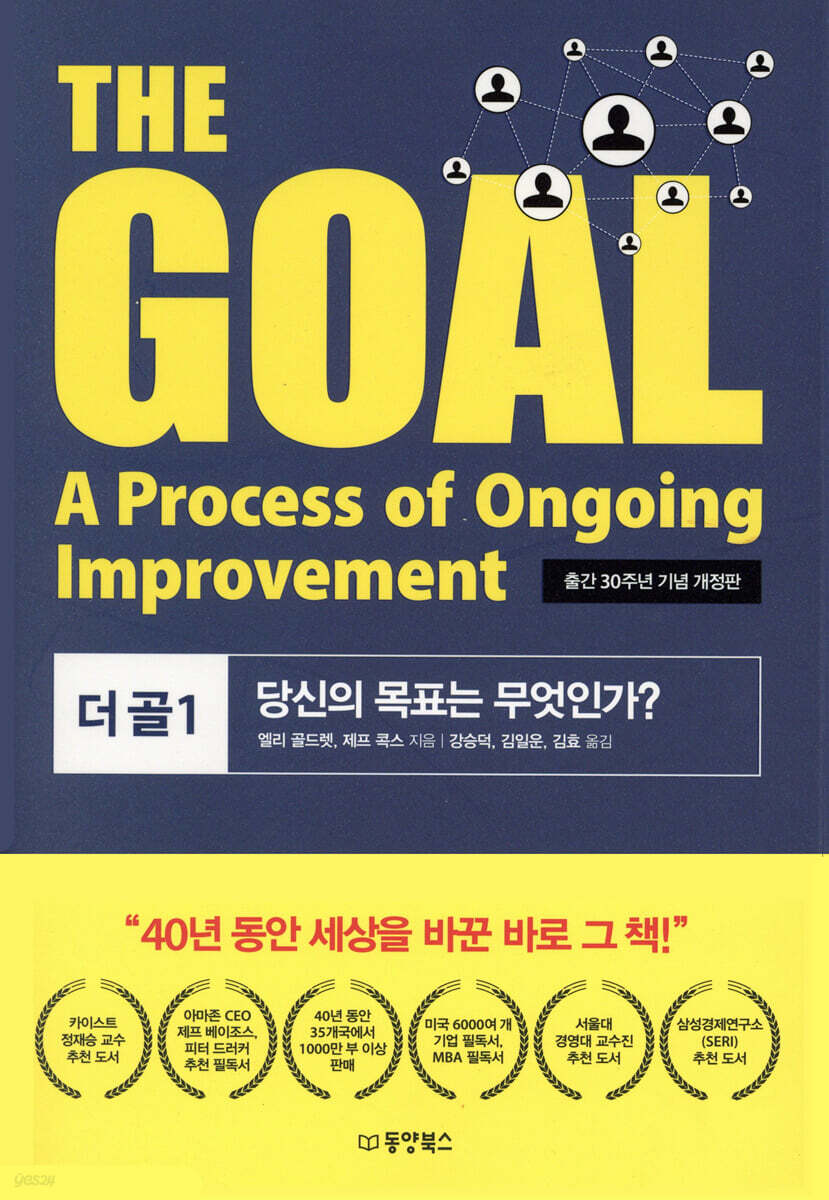
THE GOAL The Goal 1
 |
Description
Book Introduction
From the Age of Electricity to the Age of Artificial Intelligence The one management book that changed human life for over 30 years 30th Anniversary Revised Edition Translation The latest revised edition of 『The Goal 1』, a classic in economics and management that has sold over 10 million copies in 35 countries over the past 30 years, has been published in 2019. This book, which has been recommended by scholars and business leaders worldwide, including Jeff Bezos, CEO of Amazon, a company that has conquered the world, Peter Drucker, the founder of modern management, and professors at Seoul National University's School of Business and the Samsung Economic Research Institute (SERI), is an unprecedented bestseller in economics and management that has changed the paradigm of countless companies for over 30 years. This 2019 revised edition is a further revision and publication of the 2015 edition. Based on the original published in the United States as a 30th-anniversary revised edition, the content has been revised and supplemented, and an introduction by Professor Jaeseung Jeong of KAIST has been added. It is characterized by a living conversational style, making the most of economic terms and modern language actually used in our reality, and neatly organizing foreign language notation, proofreading, etc. based on the latest spelling conventions. Professor Jeong Jae-seung, who wrote the commentary, said, “Paradoxically, the ‘sense of purpose’ that Eli Goldratt so emphasized, which is like common sense, and the approach that made it ‘empathetic’ in the language of the novel will shine even brighter after he passes away. “Now, we are all faced with a situation where we must look at this book again, along with the technical book of complex formulas, and precisely define the goals of our companies,” he said, predicting that the value of this book will continue to shine not only in the present but also in the era of the Fourth Industrial Revolution and the era of artificial intelligence that will unfold in the future. |
- You can preview some of the book's contents.
Preview
index
Revised Edition Release: The Power of Self-Created Goals, Not Given Goals _Jeong Jae-seung
Preface to the Revised Edition: Question the 'Always-Do-It-Yourself'!
Preface to the First Edition How can a workplace infected with a loss of motivation be transformed into a workplace filled with passion?
Act 1: Order to close the factory
“Where on earth did things go wrong?”
Act 2: Meeting Socrates
“What is the goal of your factory?”
Act 3: Finding New Operating Indicators
“Is a company where employees work tirelessly truly efficient?”
Solving the Mystery on Act 4 Hiking
“Why does the line get slower even though we are walking at the same speed?”
Act 5: Searching for bottleneck resources
“Why are companies with optimal supply and demand closer to bankruptcy?”
Act 6: Lost in the Foggy Forest
“Why does solving one problem create another?”
Act 7: Taking the First Step to Success
“How can I make sustainable profits?”
Act 8: Common Sense, Yet Truth Beyond Common Sense
“The answer was inside me, why didn’t I see it?”
Translator's Note: The answer already exists in common sense.
Appendix - Special Contribution by Eli Goldratt: Thinking on the Shoulders of Giants
Glossary of Key Terms
Preface to the Revised Edition: Question the 'Always-Do-It-Yourself'!
Preface to the First Edition How can a workplace infected with a loss of motivation be transformed into a workplace filled with passion?
Act 1: Order to close the factory
“Where on earth did things go wrong?”
Act 2: Meeting Socrates
“What is the goal of your factory?”
Act 3: Finding New Operating Indicators
“Is a company where employees work tirelessly truly efficient?”
Solving the Mystery on Act 4 Hiking
“Why does the line get slower even though we are walking at the same speed?”
Act 5: Searching for bottleneck resources
“Why are companies with optimal supply and demand closer to bankruptcy?”
Act 6: Lost in the Foggy Forest
“Why does solving one problem create another?”
Act 7: Taking the First Step to Success
“How can I make sustainable profits?”
Act 8: Common Sense, Yet Truth Beyond Common Sense
“The answer was inside me, why didn’t I see it?”
Translator's Note: The answer already exists in common sense.
Appendix - Special Contribution by Eli Goldratt: Thinking on the Shoulders of Giants
Glossary of Key Terms
Detailed image
Into the book
Alex, this isn't a story you tell just anyone.
Listen to me carefully.
The efficiency of a factory where all employees work without rest is the worst.
--- p.167
Don't be surprised.
It's very simple.
The more you try to create a balanced factory, the closer you get to bankruptcy.
--- p.170
Having two bottleneck resources doesn't mean you can't make money.
In fact, it's quite the opposite.
Most manufacturing plants don't have bottleneck resources.
They have enormous excess production capacity.
But they need to have bottleneck resources.
That means they have to have a bottleneck resource for every part they produce.
--- p.274~275
Look closely at that pile of monsters you've created.
They didn't just happen.
You guys have created such a huge inventory on your own.
This result is also due to managers' incorrect stereotypes.
This is because of the misconception that employees' working hours should be utilized 100 percent and that they should be fired to cut costs. --- p.367
By pouring in raw materials, obsessed with the myth of 100 percent capacity, we ended up creating yet another, albeit temporary, bottleneck. --- p.369
When we accept a fact as common sense, it means that we at least knew it intuitively.
So why do we need external factors to confirm what we already know intuitively? --- p.447
When a company's vision is unclear or progress is stalled, a common tactic used by CEOs is to restructure the organization.
Isn't that a brilliant solution? A carousel of reorganization! --- p.
476
Things are starting to connect with each other.
Things that seem completely unrelated eventually become connected.
One seemingly ordinary and simple fact can be the cause of countless outcomes.
It is the same principle that order of things comes from chaos.
Isn't it amazing?
Listen to me carefully.
The efficiency of a factory where all employees work without rest is the worst.
--- p.167
Don't be surprised.
It's very simple.
The more you try to create a balanced factory, the closer you get to bankruptcy.
--- p.170
Having two bottleneck resources doesn't mean you can't make money.
In fact, it's quite the opposite.
Most manufacturing plants don't have bottleneck resources.
They have enormous excess production capacity.
But they need to have bottleneck resources.
That means they have to have a bottleneck resource for every part they produce.
--- p.274~275
Look closely at that pile of monsters you've created.
They didn't just happen.
You guys have created such a huge inventory on your own.
This result is also due to managers' incorrect stereotypes.
This is because of the misconception that employees' working hours should be utilized 100 percent and that they should be fired to cut costs. --- p.367
By pouring in raw materials, obsessed with the myth of 100 percent capacity, we ended up creating yet another, albeit temporary, bottleneck. --- p.369
When we accept a fact as common sense, it means that we at least knew it intuitively.
So why do we need external factors to confirm what we already know intuitively? --- p.447
When a company's vision is unclear or progress is stalled, a common tactic used by CEOs is to restructure the organization.
Isn't that a brilliant solution? A carousel of reorganization! --- p.
476
Things are starting to connect with each other.
Things that seem completely unrelated eventually become connected.
One seemingly ordinary and simple fact can be the cause of countless outcomes.
It is the same principle that order of things comes from chaos.
Isn't it amazing?
--- p.
525
525
Publisher's Review
The very book whose translation was banned for 17 years!
The Goal 1, which depicts the story of Alex Rogo, the factory manager of the Bearington factory, who is on the verge of closure and being forced out onto the streets if he fails to make a profit within three months, and his employees, who look back on the causes of the crisis they have faced and solve the problems one by one, starts from this very question.
“What is the goal of your factory?”
Professor Jonah, a character projected by Eli Goldratt, responds to his former student Alex's question for advice with this question instead of answering it.
Through this line, he is saying that the first step in solving a problem is not to solve each and every tangled problem one by one, but to accurately define the core of the problem.
This is in line with Einstein's thinking, who said, "If I had one hour to save the planet, I would spend 55 minutes defining the problem and the other 5 minutes finding a solution."
This means that it is important to identify the root cause.
Moreover, it is hard to believe that 『The Goal 1』 was published over 30 years ago, as it tackles issues that are still controversial.
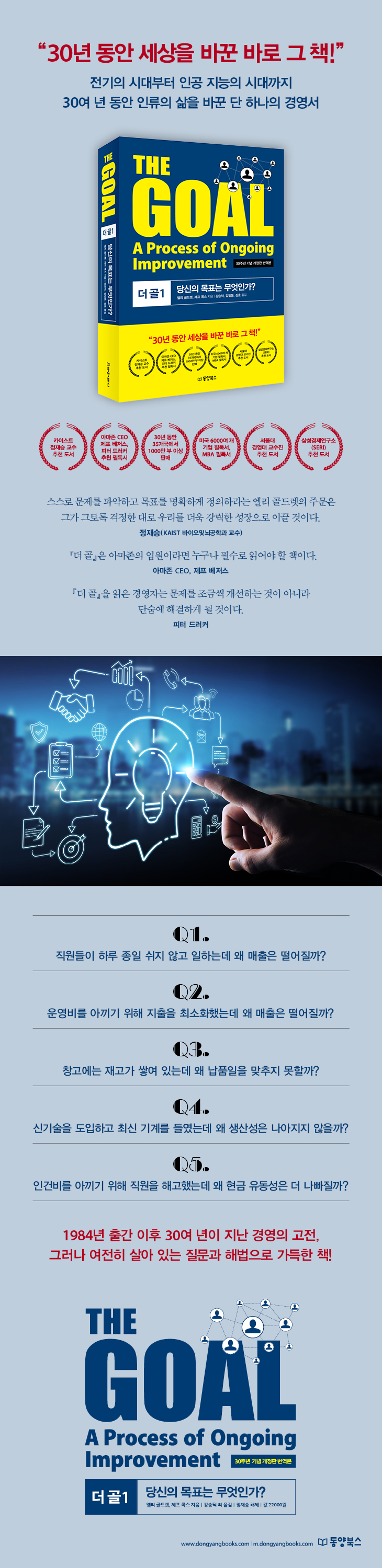
Why do sales drop when employees work tirelessly all day?
I've minimized spending to save on operating costs, so why are my sales falling?
There's a lot of inventory in the warehouse, so why can't we meet the delivery date?
We've introduced new technologies and installed the latest machinery, so why isn't productivity improving?
I laid off employees to save on labor costs, so why did my cash flow get worse?
Eli Goldratt poses this question, which is by no means pleasant from a manager's perspective, and tries to answer it with a theory called TOC (Theory of Constraints).
To understand this theory, we must first examine two phenomena that occur within an organization, which are surprisingly simple and ordinary.
The first is that most of what we do in a group involves connecting with many other people.
In other words, these are the dependent events mentioned in this book (see page 171).
And the other thing is that no matter how accurate the statistics are, unpredictable variables will inevitably arise when planning and carrying out work.
In other words, this is the statistical fluctuations (see page 172 of the text) mentioned in this book.
These two phenomena cause imbalances in any company or organization, and because of these imbalances, bottleneck resources, or constraints, such as processes with relatively high workloads, numerical errors, incorrect work evaluation methods, outdated organizational practices, and managers' misjudgments, occur.
For example, no matter how hard you try to adjust the production of a product to precisely match market demand, there will always be statistical fluctuations in market demand, and when some kind of statistical fluctuation occurs in one department that produces the product, a dependent event that affects other departments is bound to occur.
So, it is argued that 100 percent optimization of supply and demand is dangerous and that the speed of supply (i.e. production speed) should be adjusted slightly later than the speed of demand.
"If production rates and market demand remain equal, and market demand bears the brunt of the losses, who ultimately loses? The producers.
So, what this means is that the producer must also play a role in controlling the speed.” (Page 258)
In fact, after introducing this TOC theory to corporate management, astonishing success stories emerged, over 6,000 American companies selected "The Goal 1" as required reading, and it is still required reading at leading business schools and MBAs around the world.
There is a reason why this book was not published in Japan or Korea for 17 years after its publication, and in fact, it was due to Eli Goldratt's strong will.
In the 1980s, when it was first published, American companies were struggling in the midst of an economic downturn, while the economies of Asian countries, led by Japan, were experiencing significant growth.
Eli Goldratt was concerned that if Japanese or Korean companies adopted TOC and accelerated their growth, it would pose a major threat to the American economy, so he refused to grant permission for translation or publication for a full 17 years, despite repeated requests for copyright.
Explaining the mechanics of management with the absorbing power of a mystery novel.
The greatest appeal of "The Goal 1" is its captivating power that makes you curious about the next story, as if you were reading an exciting mystery novel.
Readers are constantly lost in thought as they ponder Professor Jonah's questions and, as they infer the answers, they find themselves becoming the main characters, trying to find the answers themselves.
It's like being immersed in an exciting mystery novel and trying to figure out who the culprit is.
And this method is actually a direct reproduction of the 'Socratic technique' that Eli Goldratt used in his corporate consulting work. It is a technique that naturally leads members to solve problems on their own by asking pointed questions without providing answers.
A life philosophy book that goes beyond management.
Another appealing aspect of this book is that it transcends the limitations of being a management book and talks about the philosophy of life.
This is where the genius of Eli Goldratt, who is called the 'master of management' but was also a physicist, scientist, and philosopher, shines. One of the core logics of TOC that he advocated, dependent events, is actually very similar to the theory of dependent origination in Buddhism, and statistical fluctuations are in line with Einstein's theory of relativity.
Furthermore, the fact that the institutional devices and regulations created to solve the problem of bottleneck resources actually cause other constraints reminds us of the Eastern philosophical idea that "nothing in the world is constant; everything goes around and around."
The scene where Alex, who had already known everything through common sense and intuition but tried to solve the problem by relying on the authority of Professor Jonah, realizes this fact shows his humanistic philosophy of trying to embody a 'thinking human'.
Furthermore, by simultaneously depicting a crisis not only at work but also at home, he reveals that the company's goals and the family's goals, that is, the individual's goals, are not antagonistic but rather mutually beneficial, and leaves readers with a lingering question about what the true goal of life is. This clearly shows how philosophical and flexible his way of thinking is.
An era of low growth, low interest rates, and recession
Amazing things that happened to companies after introducing TOC.
Eli Goldratt said at the 2004 Korea TOC Conference, “TOC is what can make current sales equal to net income in four years,” and introduced the case of how he saved GM’s Cadillac division from a crisis situation on the verge of closure to a profitable company.
In addition, numerous American companies, including GE, Ford, Boeing, Philips, the US Navy and Air Force, P&G, Delta Air Lines, HP, and BHP, achieved an average net profit growth of 73 percent within a year of adopting TOC, the core theory featured in 『The Goal 1』.
So, what are the actual examples of Korean companies? Many companies, including LG Electronics, Samsung Electro-Mechanics, Hanwha Techwin (formerly Samsung Techwin), Schaeffler Korea (formerly Hanwha Group), and Woongjin Foods, have adopted TOC and achieved significant results.
Among them, LG Electronics PCB Business Division saw an increase in sales as additional orders increased as the lead time increased from 34 days to 21 days and the delivery compliance rate increased from 51 percent to 81 percent after introduction. In addition, CAPA (production capacity) was also improved, saving 1.1 billion won in outsourcing costs annually.
As a result, TOC was expanded from the Osan plant to the Cheongju plant.
LG Electronics employees unanimously testify that the biggest achievement was the union's drastic relaxation of strict standards for the movement of personnel between processes (for example, when a bottleneck occurs in a process, personnel from other processes are immediately transferred to the process in question) and the change to an atmosphere of mutual assistance and harmony.
In the case of Hanwha Techwin, which manufactures semiconductor lead frames, the average lead time increased from 12 days to 6.6 days, the delivery compliance rate increased from 27 percent to 70 percent, and inventory decreased by 57 percent in just four months after applying TOC, leading to an increase in additional orders and safely overcoming the financial crisis that originated in the U.S.
Among small and medium-sized enterprises, there is Saehan Tungsten, a lighting components manufacturer, which transformed from a four-year deficit company to a profitable one in just three months and continues to generate profits.
Even more noteworthy is the case of Coavis, a manufacturer of automotive fuel pumps, which drastically reduced its lead time from 31.4 days to 3.3 days, even after eliminating overtime, special work, and weekend work.
Meanwhile, the on-time delivery rate increased from 72 percent to 96 percent, resulting in the signing of a new supply contract for 1.2 million units per year with Volkswagen.
The Goal 1, which depicts the story of Alex Rogo, the factory manager of the Bearington factory, who is on the verge of closure and being forced out onto the streets if he fails to make a profit within three months, and his employees, who look back on the causes of the crisis they have faced and solve the problems one by one, starts from this very question.
“What is the goal of your factory?”
Professor Jonah, a character projected by Eli Goldratt, responds to his former student Alex's question for advice with this question instead of answering it.
Through this line, he is saying that the first step in solving a problem is not to solve each and every tangled problem one by one, but to accurately define the core of the problem.
This is in line with Einstein's thinking, who said, "If I had one hour to save the planet, I would spend 55 minutes defining the problem and the other 5 minutes finding a solution."
This means that it is important to identify the root cause.
Moreover, it is hard to believe that 『The Goal 1』 was published over 30 years ago, as it tackles issues that are still controversial.
Why do sales drop when employees work tirelessly all day?
I've minimized spending to save on operating costs, so why are my sales falling?
There's a lot of inventory in the warehouse, so why can't we meet the delivery date?
We've introduced new technologies and installed the latest machinery, so why isn't productivity improving?
I laid off employees to save on labor costs, so why did my cash flow get worse?
Eli Goldratt poses this question, which is by no means pleasant from a manager's perspective, and tries to answer it with a theory called TOC (Theory of Constraints).
To understand this theory, we must first examine two phenomena that occur within an organization, which are surprisingly simple and ordinary.
The first is that most of what we do in a group involves connecting with many other people.
In other words, these are the dependent events mentioned in this book (see page 171).
And the other thing is that no matter how accurate the statistics are, unpredictable variables will inevitably arise when planning and carrying out work.
In other words, this is the statistical fluctuations (see page 172 of the text) mentioned in this book.
These two phenomena cause imbalances in any company or organization, and because of these imbalances, bottleneck resources, or constraints, such as processes with relatively high workloads, numerical errors, incorrect work evaluation methods, outdated organizational practices, and managers' misjudgments, occur.
For example, no matter how hard you try to adjust the production of a product to precisely match market demand, there will always be statistical fluctuations in market demand, and when some kind of statistical fluctuation occurs in one department that produces the product, a dependent event that affects other departments is bound to occur.
So, it is argued that 100 percent optimization of supply and demand is dangerous and that the speed of supply (i.e. production speed) should be adjusted slightly later than the speed of demand.
"If production rates and market demand remain equal, and market demand bears the brunt of the losses, who ultimately loses? The producers.
So, what this means is that the producer must also play a role in controlling the speed.” (Page 258)
In fact, after introducing this TOC theory to corporate management, astonishing success stories emerged, over 6,000 American companies selected "The Goal 1" as required reading, and it is still required reading at leading business schools and MBAs around the world.
There is a reason why this book was not published in Japan or Korea for 17 years after its publication, and in fact, it was due to Eli Goldratt's strong will.
In the 1980s, when it was first published, American companies were struggling in the midst of an economic downturn, while the economies of Asian countries, led by Japan, were experiencing significant growth.
Eli Goldratt was concerned that if Japanese or Korean companies adopted TOC and accelerated their growth, it would pose a major threat to the American economy, so he refused to grant permission for translation or publication for a full 17 years, despite repeated requests for copyright.
Explaining the mechanics of management with the absorbing power of a mystery novel.
The greatest appeal of "The Goal 1" is its captivating power that makes you curious about the next story, as if you were reading an exciting mystery novel.
Readers are constantly lost in thought as they ponder Professor Jonah's questions and, as they infer the answers, they find themselves becoming the main characters, trying to find the answers themselves.
It's like being immersed in an exciting mystery novel and trying to figure out who the culprit is.
And this method is actually a direct reproduction of the 'Socratic technique' that Eli Goldratt used in his corporate consulting work. It is a technique that naturally leads members to solve problems on their own by asking pointed questions without providing answers.
A life philosophy book that goes beyond management.
Another appealing aspect of this book is that it transcends the limitations of being a management book and talks about the philosophy of life.
This is where the genius of Eli Goldratt, who is called the 'master of management' but was also a physicist, scientist, and philosopher, shines. One of the core logics of TOC that he advocated, dependent events, is actually very similar to the theory of dependent origination in Buddhism, and statistical fluctuations are in line with Einstein's theory of relativity.
Furthermore, the fact that the institutional devices and regulations created to solve the problem of bottleneck resources actually cause other constraints reminds us of the Eastern philosophical idea that "nothing in the world is constant; everything goes around and around."
The scene where Alex, who had already known everything through common sense and intuition but tried to solve the problem by relying on the authority of Professor Jonah, realizes this fact shows his humanistic philosophy of trying to embody a 'thinking human'.
Furthermore, by simultaneously depicting a crisis not only at work but also at home, he reveals that the company's goals and the family's goals, that is, the individual's goals, are not antagonistic but rather mutually beneficial, and leaves readers with a lingering question about what the true goal of life is. This clearly shows how philosophical and flexible his way of thinking is.
An era of low growth, low interest rates, and recession
Amazing things that happened to companies after introducing TOC.
Eli Goldratt said at the 2004 Korea TOC Conference, “TOC is what can make current sales equal to net income in four years,” and introduced the case of how he saved GM’s Cadillac division from a crisis situation on the verge of closure to a profitable company.
In addition, numerous American companies, including GE, Ford, Boeing, Philips, the US Navy and Air Force, P&G, Delta Air Lines, HP, and BHP, achieved an average net profit growth of 73 percent within a year of adopting TOC, the core theory featured in 『The Goal 1』.
So, what are the actual examples of Korean companies? Many companies, including LG Electronics, Samsung Electro-Mechanics, Hanwha Techwin (formerly Samsung Techwin), Schaeffler Korea (formerly Hanwha Group), and Woongjin Foods, have adopted TOC and achieved significant results.
Among them, LG Electronics PCB Business Division saw an increase in sales as additional orders increased as the lead time increased from 34 days to 21 days and the delivery compliance rate increased from 51 percent to 81 percent after introduction. In addition, CAPA (production capacity) was also improved, saving 1.1 billion won in outsourcing costs annually.
As a result, TOC was expanded from the Osan plant to the Cheongju plant.
LG Electronics employees unanimously testify that the biggest achievement was the union's drastic relaxation of strict standards for the movement of personnel between processes (for example, when a bottleneck occurs in a process, personnel from other processes are immediately transferred to the process in question) and the change to an atmosphere of mutual assistance and harmony.
In the case of Hanwha Techwin, which manufactures semiconductor lead frames, the average lead time increased from 12 days to 6.6 days, the delivery compliance rate increased from 27 percent to 70 percent, and inventory decreased by 57 percent in just four months after applying TOC, leading to an increase in additional orders and safely overcoming the financial crisis that originated in the U.S.
Among small and medium-sized enterprises, there is Saehan Tungsten, a lighting components manufacturer, which transformed from a four-year deficit company to a profitable one in just three months and continues to generate profits.
Even more noteworthy is the case of Coavis, a manufacturer of automotive fuel pumps, which drastically reduced its lead time from 31.4 days to 3.3 days, even after eliminating overtime, special work, and weekend work.
Meanwhile, the on-time delivery rate increased from 72 percent to 96 percent, resulting in the signing of a new supply contract for 1.2 million units per year with Volkswagen.
GOODS SPECIFICS
- Date of issue: August 15, 2019
- Page count, weight, size: 600 pages | 880g | 153*224*35mm
- ISBN13: 9791157685301
- ISBN10: 1157685307
You may also like
카테고리
korean


korean

![GQ KOREA Mark (Monthly): December [2025]](http://librairie.coreenne.fr/cdn/shop/files/8ef265dbbfbf186523ed75ba7319009d.jpg?v=1765340328&width=3840)


