

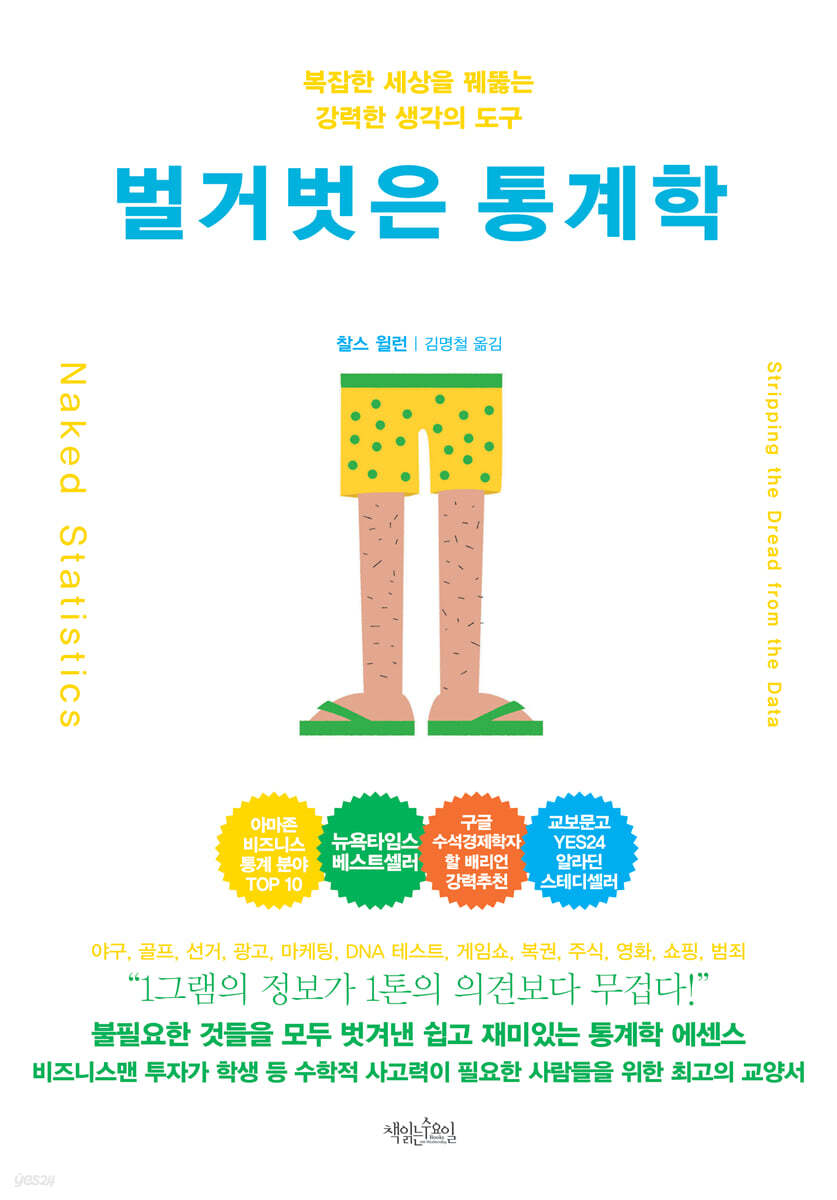
Naked Statistics (Recovery Edition)
 |
Description
Book Introduction
Read today's flow and predict tomorrow.
Statistics is a fascinating and very useful tool for navigating the complex world.
Charles Wheelan, author of "Naked Economics," which has been highly praised by economists and the media around the world, analyzes economic trends and social phenomena with his unique insight and statistical tools.
From baseball and golf to advertising and elections, from movie theaters to department stores, banks, and game shows, we interpret the meaning of numbers, seeking to uncover the truth behind the news and the connections between data.
The answer to how companies mislead consumers and who uses statistics to lie and profit is in the numbers.
Therefore, by looking closely at numerical data, such as a baseball player's batting average or an investment professional's return, you can discover the information necessary to develop mathematical insight.
Anyone who wants to master the power of statistics to accurately read today's trends and predict tomorrow's changes will find this book helpful.
It will also serve as a guide for rational decision-making for salespeople, planners, investors, analysts, advertisers, and politicians.
Statistics is a fascinating and very useful tool for navigating the complex world.
Charles Wheelan, author of "Naked Economics," which has been highly praised by economists and the media around the world, analyzes economic trends and social phenomena with his unique insight and statistical tools.
From baseball and golf to advertising and elections, from movie theaters to department stores, banks, and game shows, we interpret the meaning of numbers, seeking to uncover the truth behind the news and the connections between data.
The answer to how companies mislead consumers and who uses statistics to lie and profit is in the numbers.
Therefore, by looking closely at numerical data, such as a baseball player's batting average or an investment professional's return, you can discover the information necessary to develop mathematical insight.
Anyone who wants to master the power of statistics to accurately read today's trends and predict tomorrow's changes will find this book helpful.
It will also serve as a guide for rational decision-making for salespeople, planners, investors, analysts, advertisers, and politicians.
- You can preview some of the book's contents.
Preview
index
Entering.
A gram of information is worth a ton of opinion!
Chapter 1: Truth, Lies, and Detectives
Chapter 2: Major League Baseball: Who is the greatest baseball player of all time?
Chapter 3: The Number Trap: Very Clever Lies That Distort the Facts
Chapter 4: How does Netflix find the movies I like?
Chapter 5: Don't Spend Money on Extended Warranties
Chapter 5 1/2 Monty Hall's Dilemma - Where are the goats and the cars?
Chapter 6: The Probability Masters Who Ruined the International Financial System
Chapter 7: If you put garbage in, garbage comes out.
Chapter 8: Remember the LeBron James of Statistics
Chapter 9: Why did the professor think I cheated?
Chapter 10: How to More Accurately Understand Public Opinion
Chapter 11: The Miracle Panacea for Data Analysis
Chapter 12: Don't Forget Logic Even in the Face of Clear Data
Chapter 13: Will Going to Harvard Really Change Your Life?
Five Questions That Statistics Can Answer
A gram of information is worth a ton of opinion!
Chapter 1: Truth, Lies, and Detectives
Chapter 2: Major League Baseball: Who is the greatest baseball player of all time?
Chapter 3: The Number Trap: Very Clever Lies That Distort the Facts
Chapter 4: How does Netflix find the movies I like?
Chapter 5: Don't Spend Money on Extended Warranties
Chapter 5 1/2 Monty Hall's Dilemma - Where are the goats and the cars?
Chapter 6: The Probability Masters Who Ruined the International Financial System
Chapter 7: If you put garbage in, garbage comes out.
Chapter 8: Remember the LeBron James of Statistics
Chapter 9: Why did the professor think I cheated?
Chapter 10: How to More Accurately Understand Public Opinion
Chapter 11: The Miracle Panacea for Data Analysis
Chapter 12: Don't Forget Logic Even in the Face of Clear Data
Chapter 13: Will Going to Harvard Really Change Your Life?
Five Questions That Statistics Can Answer
Into the book
When I was a kid, there was a popular television program called "Let's Make a Deal" hosted by the famous host Monty Hall.
At the end of each show, the last contestant left is shown three large doors with the numbers 1, 2, and 3 written on them, along with Monty.
…let’s say the participant chooses door number 1.
Monty Hall opens door number 3 and reveals a goat inside.
At this time, doors 1 and 2 are still closed.
If there is a car behind door 1, the contestant receives the car; if there is a car behind door 2, the contestant loses the game.
But from now on, things get even more interesting.
Monty gives the contestant another chance to choose if he changes his mind and chooses a different door.
Participants can change their choice from door 1 to door 2.
Remember, both doors are still closed.
The only new information the contestant gains is that there is a goat on one of the two doors he did not choose.
Should the participant change his/her choice?---「Entering.
"A gram of information is worth more than a ton of opinion!"
Smokers tend to have other habits that can lead to negative health outcomes, such as drinking too much alcohol or eating poorly.
If smokers are particularly unhealthy at their reunion 20 years later, it's unclear whether that's because of smoking or because of other unhealthy habits common to many smokers.
There may also be problems with the data that forms the basis of the analysis.
Seriously ill smokers will not be able to attend their class reunion in 20 years.
Of course, dead smokers will not be able to appear either.
Because the majority of alumni will be healthy, any analysis of the health of reunion attendees 20 years later (in relation to smoking or other factors) is seriously flawed.
There will be more serious distortions at gatherings that occur much later, such as 40 or 50 year reunions.
---「Chapter 1.
“Truth, Lies, and Detectives”
What do traditional mutual fund companies do? They manipulate data to save their companies! Let's examine how they make their performance look good even when it's actually worse than the market.
Large mutual fund companies will launch a variety of new active fund products.
For example, let's say a mutual fund company launches 20 new funds, and each fund product has a 50 percent chance of outperforming the S&P 500.
This assumption is consistent with long-term data.
According to basic probability, only ten new fund products will outperform the S&P 500 in their first year.
The number of funds that can do so in the second year has decreased to five, and only two or three funds that can outperform the S&P 500 for three consecutive years.
---「Chapter 7.
"Garbage in, garbage out."
Linda Cooper, a woman from South Carolina, has been struck by lightning four times.
According to estimates from the Federal Emergency Management Agency, the odds of being struck by lightning are one in 600,000.
Linda Cooper's insurance company cannot deny coverage simply because it appears statistically impossible.
Even in my statistics exams during college, my professor had reason to be suspicious.
We discovered a very suspicious pattern.
This is the same method investigators use to detect cheating on standardized tests or the SEC uses to catch insider trading.
But a suspicious pattern is just a suspicious pattern unless supported by other evidence.
---「Chapter 9.
"Why did the professor think I cheated?"
The New York Times Magazine reported the story of a Minneapolis man who walked into a Target store and asked to see a manager.
He was furious that Target had sent his high school-aged daughter a bunch of coupons for baby products.
The man asked:
“My daughter is still in high school.
"Why are you sending your daughter coupons for baby clothes and cribs? You're really trying to get her pregnant."
The store manager apologized politely.
A few days after that incident, I called again to apologize.
But the man who answered the phone had calmed down, and this time he apologized instead.
“I didn’t know much about housework.
“My daughter is due in August.”
At the end of each show, the last contestant left is shown three large doors with the numbers 1, 2, and 3 written on them, along with Monty.
…let’s say the participant chooses door number 1.
Monty Hall opens door number 3 and reveals a goat inside.
At this time, doors 1 and 2 are still closed.
If there is a car behind door 1, the contestant receives the car; if there is a car behind door 2, the contestant loses the game.
But from now on, things get even more interesting.
Monty gives the contestant another chance to choose if he changes his mind and chooses a different door.
Participants can change their choice from door 1 to door 2.
Remember, both doors are still closed.
The only new information the contestant gains is that there is a goat on one of the two doors he did not choose.
Should the participant change his/her choice?---「Entering.
"A gram of information is worth more than a ton of opinion!"
Smokers tend to have other habits that can lead to negative health outcomes, such as drinking too much alcohol or eating poorly.
If smokers are particularly unhealthy at their reunion 20 years later, it's unclear whether that's because of smoking or because of other unhealthy habits common to many smokers.
There may also be problems with the data that forms the basis of the analysis.
Seriously ill smokers will not be able to attend their class reunion in 20 years.
Of course, dead smokers will not be able to appear either.
Because the majority of alumni will be healthy, any analysis of the health of reunion attendees 20 years later (in relation to smoking or other factors) is seriously flawed.
There will be more serious distortions at gatherings that occur much later, such as 40 or 50 year reunions.
---「Chapter 1.
“Truth, Lies, and Detectives”
What do traditional mutual fund companies do? They manipulate data to save their companies! Let's examine how they make their performance look good even when it's actually worse than the market.
Large mutual fund companies will launch a variety of new active fund products.
For example, let's say a mutual fund company launches 20 new funds, and each fund product has a 50 percent chance of outperforming the S&P 500.
This assumption is consistent with long-term data.
According to basic probability, only ten new fund products will outperform the S&P 500 in their first year.
The number of funds that can do so in the second year has decreased to five, and only two or three funds that can outperform the S&P 500 for three consecutive years.
---「Chapter 7.
"Garbage in, garbage out."
Linda Cooper, a woman from South Carolina, has been struck by lightning four times.
According to estimates from the Federal Emergency Management Agency, the odds of being struck by lightning are one in 600,000.
Linda Cooper's insurance company cannot deny coverage simply because it appears statistically impossible.
Even in my statistics exams during college, my professor had reason to be suspicious.
We discovered a very suspicious pattern.
This is the same method investigators use to detect cheating on standardized tests or the SEC uses to catch insider trading.
But a suspicious pattern is just a suspicious pattern unless supported by other evidence.
---「Chapter 9.
"Why did the professor think I cheated?"
The New York Times Magazine reported the story of a Minneapolis man who walked into a Target store and asked to see a manager.
He was furious that Target had sent his high school-aged daughter a bunch of coupons for baby products.
The man asked:
“My daughter is still in high school.
"Why are you sending your daughter coupons for baby clothes and cribs? You're really trying to get her pregnant."
The store manager apologized politely.
A few days after that incident, I called again to apologize.
But the man who answered the phone had calmed down, and this time he apologized instead.
“I didn’t know much about housework.
“My daughter is due in August.”
---「Conclusion.
From “Five Questions That Can Be Answered with Statistics”
From “Five Questions That Can Be Answered with Statistics”
Publisher's Review
Charles Wheelan, who has been praised by economists and the media around the world, returns with "Naked Statistics," an Amazon nonfiction bestseller and New York Times bestseller.
It contains everything about statistics that can be easily and enjoyably understood by not only the general public who frequently encounters statistics and probabilities in various fields such as baseball, elections, games, advertising, marketing, lotteries, stocks, and shopping, but also salespeople, planners, investors, analysts, advertisers, politicians, and others who must analyze diverse data to make rational decisions.
You'll discover the mathematical insights you need to understand why batting average alone isn't enough to explain a baseball player's ability, why you shouldn't trust the high returns of investment experts, and why poll predictions sometimes differ from actual results.
A gram of information is worth more than a ton of opinion.
Charles Wheelan, author of 'Naked Economics', which was selected as the best economics book by the American economics and management website '800-CEO-READ', has returned after 10 years.
In another bestseller, Naked Statistics, he proves that statistics is a fascinating and very useful tool for navigating the complex world.
He analyzes economic trends and social phenomena with his unique insight and statistical tools.
From baseball and golf to advertising and elections, from movie theaters to department stores, banks, and game shows, we interpret the meaning of numbers, uncovering the truth behind the news and the connections between data.
The power to accurately read today's flow and predict tomorrow's changes
We uncover how companies use numbers to deceive consumers and who uses statistics to lie and profit.
It also tells you which data is important for more accurate analysis and which data should be boldly erased from your mind.
This book will be helpful to anyone who wants to master the power of statistics to accurately read today's trends and predict tomorrow's changes.
It will serve as a guide for rational decision-making for salespeople, planners, investors, analysts, advertisers, and politicians.
Mathematical insights and intuition recommended by economists and media around the world
This book, which The Economist praised as “developing the intuition to read the flow of the world!”, became an Amazon non-fiction bestseller and a New York Times bestseller immediately after its publication.
Praise also poured in from academia and the media.
The New York Times commented that it “provides a true appreciation of the power of statistical thinking.”
Hal Varian, Google's chief economist, recommended it as "the essence of statistics stripped of all the unnecessary details," and Jacob Goldstein of National Radio's Planet Money recommended it as "a powerful tool for understanding the world."
Recommendation
Develop your intuition to read the world's trends! - The Economist
Even people who feel averse to math can easily read it.
It really gives you a sense of the power of statistical thinking.
-The New York Times
From salespeople's information manipulation to market and opinion polls, this definitive introduction to statistics covers how statistics intertwine with everyday life.
-「Nature」
Minimal mathematical elements, satirical writing, and above all, easy and fun.
-Publisher's Weekly
It contains everything about statistics that can be easily and enjoyably understood by not only the general public who frequently encounters statistics and probabilities in various fields such as baseball, elections, games, advertising, marketing, lotteries, stocks, and shopping, but also salespeople, planners, investors, analysts, advertisers, politicians, and others who must analyze diverse data to make rational decisions.
You'll discover the mathematical insights you need to understand why batting average alone isn't enough to explain a baseball player's ability, why you shouldn't trust the high returns of investment experts, and why poll predictions sometimes differ from actual results.
A gram of information is worth more than a ton of opinion.
Charles Wheelan, author of 'Naked Economics', which was selected as the best economics book by the American economics and management website '800-CEO-READ', has returned after 10 years.
In another bestseller, Naked Statistics, he proves that statistics is a fascinating and very useful tool for navigating the complex world.
He analyzes economic trends and social phenomena with his unique insight and statistical tools.
From baseball and golf to advertising and elections, from movie theaters to department stores, banks, and game shows, we interpret the meaning of numbers, uncovering the truth behind the news and the connections between data.
The power to accurately read today's flow and predict tomorrow's changes
We uncover how companies use numbers to deceive consumers and who uses statistics to lie and profit.
It also tells you which data is important for more accurate analysis and which data should be boldly erased from your mind.
This book will be helpful to anyone who wants to master the power of statistics to accurately read today's trends and predict tomorrow's changes.
It will serve as a guide for rational decision-making for salespeople, planners, investors, analysts, advertisers, and politicians.
Mathematical insights and intuition recommended by economists and media around the world
This book, which The Economist praised as “developing the intuition to read the flow of the world!”, became an Amazon non-fiction bestseller and a New York Times bestseller immediately after its publication.
Praise also poured in from academia and the media.
The New York Times commented that it “provides a true appreciation of the power of statistical thinking.”
Hal Varian, Google's chief economist, recommended it as "the essence of statistics stripped of all the unnecessary details," and Jacob Goldstein of National Radio's Planet Money recommended it as "a powerful tool for understanding the world."
Recommendation
Develop your intuition to read the world's trends! - The Economist
Even people who feel averse to math can easily read it.
It really gives you a sense of the power of statistical thinking.
-The New York Times
From salespeople's information manipulation to market and opinion polls, this definitive introduction to statistics covers how statistics intertwine with everyday life.
-「Nature」
Minimal mathematical elements, satirical writing, and above all, easy and fun.
-Publisher's Weekly
GOODS SPECIFICS
- Date of publication: October 25, 2013
- Page count, weight, size: 447 pages | 616g | 151*215*30mm
- ISBN13: 9788962605952
- ISBN10: 8962605953
You may also like
카테고리
korean


korean

![GQ KOREA Mark (Monthly): December [2025]](http://librairie.coreenne.fr/cdn/shop/files/8ef265dbbfbf186523ed75ba7319009d.jpg?v=1765340328&width=3840)


