

Antifragile
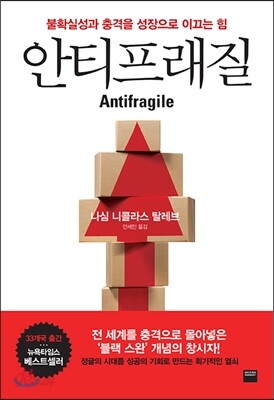 |
Description
Book Introduction
- A word from MD
-
Use uncertainty and shock as opportunities for growth.Antifragility means that when you are shocked, you become stronger.
Nassim Taleb suggests that we should not avoid uncertainty and shocks like 'black swans', but rather use them as engines of growth.
The candles are blown out by the wind, but the bonfire burns brightly.
Let's become fire and face the wind.
Achieve antifragility by leveraging the barbell strategy.
It is said that no matter how sophisticated the calculation method, the risk and probability of an impact cannot be predicted.
Especially when faced with small probability problems, model errors become much larger, making rare events more difficult to handle.
Fragility, on the other hand, can be detected.
Since fragility or antifragility is a part of the current characteristics of an object, such as a company, industry, or political system, it is possible to compare B to A when an event occurs.
Therefore, rather than predicting future risks that cannot be accurately predicted, it is far more advantageous for individuals and companies to detect current fragility and antifragility and develop strategies accordingly. Nassim Nicholas Taleb, the author of "The Black Swan," which created a global sensation, introduced the concept of "antifragility" as an antidote to the Black Swan phenomenon, urging us to actively utilize uncertainty, randomness, variability, and disorder rather than avoid them.
Moreover, it introduces the characteristics of antifragility and methods for becoming antifragile, covering a wide range of fields, including mythology, innovation, politics, urban planning, war, finance, economic systems, and medicine.
He introduces the barbell strategy as a way to secure antifragility.
The barbell strategy, which seeks a combination of extremes and avoids the middle ground, can be a dualistic strategy that avoids making mistakes at the midpoint.
The barbell strategy addresses the problem of incalculable risks of rare events and fragility to measurement errors, thereby achieving antifragility by preventing downturns and protecting itself from extreme damage.
Drawing on these rich case studies, the book advises readers to cultivate an antifragile constitution that fosters growth as they face change and shock in all areas of life.
It is said that no matter how sophisticated the calculation method, the risk and probability of an impact cannot be predicted.
Especially when faced with small probability problems, model errors become much larger, making rare events more difficult to handle.
Fragility, on the other hand, can be detected.
Since fragility or antifragility is a part of the current characteristics of an object, such as a company, industry, or political system, it is possible to compare B to A when an event occurs.
Therefore, rather than predicting future risks that cannot be accurately predicted, it is far more advantageous for individuals and companies to detect current fragility and antifragility and develop strategies accordingly. Nassim Nicholas Taleb, the author of "The Black Swan," which created a global sensation, introduced the concept of "antifragility" as an antidote to the Black Swan phenomenon, urging us to actively utilize uncertainty, randomness, variability, and disorder rather than avoid them.
Moreover, it introduces the characteristics of antifragility and methods for becoming antifragile, covering a wide range of fields, including mythology, innovation, politics, urban planning, war, finance, economic systems, and medicine.
He introduces the barbell strategy as a way to secure antifragility.
The barbell strategy, which seeks a combination of extremes and avoids the middle ground, can be a dualistic strategy that avoids making mistakes at the midpoint.
The barbell strategy addresses the problem of incalculable risks of rare events and fragility to measurement errors, thereby achieving antifragility by preventing downturns and protecting itself from extreme damage.
Drawing on these rich case studies, the book advises readers to cultivate an antifragile constitution that fosters growth as they face change and shock in all areas of life.
- You can preview some of the book's contents.
Preview
Publisher's Review
An amazing concept that has captured the attention of the times with 'Black Swan'!
A New York Times and Amazon long-time bestseller, now published in 33 countries!
Nassim Nicholas Taleb, author of the bestseller "Black Swan" and one of the foremost thinkers of our time, presents an antidote to an age filled with uncertainty!
Just as human bones become stronger under stress, and rumors and riots spread more violently the more they are suppressed, so many things in the world benefit from stress, disorder, and volatility.
Antifragility is a neologism coined by Taleb by adding the prefix anti, meaning "opposite," to the word "fragile," which means "easy to break." It refers to the characteristic of not only benefiting from disorder and uncertainty, but also desiring disorder in order to survive and thrive.
“The wind blows out a candle, but keeps a bonfire alive.”
The same goes for randomness, uncertainty, and chaos.
I want you to take advantage of these things rather than avoid them.
“Become fire and face the wind.” (Page 13)
In his previous work, "The Black Swan," which predicted the 2008 financial crisis, Taleb showed how highly improbable events can occur and have a decisive impact on us, earning him the nicknames "The Sage of Wall Street" and "The Nostradamus of Wall Street."
In his latest work, Antifragile, which has created a sensation around the world, he introduces the concept of 'antifragility' as an antidote to the Black Swan phenomenon, and urges us to actively utilize uncertainty, randomness, variability, and disorder rather than avoid them.
Moreover, it presents a new growth paradigm by introducing the characteristics of antifragility and methods for becoming antifragile, covering all fields, including mythology, innovation, life-or-death decisions, politics, urban planning, war, finance, economic systems, and medicine.
In "Black Swan," Taleb had to convince people that completely unexpected situations would shock us, but in "Antifragile," he emphasizes that he is addressing practical issues under the premise that the Black Swan phenomenon already dominates society and history as a whole.
Although this book was published later than "Black Swan," and the ideas in "Black Swan" are naturally taken as a given conclusion, this book will be the main book, and "Black Swan" will be a kind of supplementary book that deals with theory as an appendix.
Why is that? Because "Black Swan" is a book that puts a lot of effort into convincing people of the terrifying situation.
On the other hand, this book begins from the position that there is no need to convince us that black swan events dominate society and history, and that we do not know what will happen as a result.
So we can address practical issues right away.
(Page 32)
Daniel Kahneman praised the book, saying, “It made me see the world through different eyes,” and Malcolm Gladwell said, “The message of this book is a lesson for these rapidly changing times.”
Fortune writes, “Antifragility is not simply an economic logic or a political stance.
“It is the key to a desirable life.” The Financial Times recommended the book, saying, “Anyone who wants to survive the economic climate of 2013 should take Taleb’s words to heart.”
"Antifragile" was translated and published in 33 countries immediately after its publication and remained on the New York Times bestseller list for 12 weeks.
It ranked first in the economics and management category on Amazon even before its publication, and has remained a long-term bestseller ever since.
Risk is unpredictable, but fragility is predictable.
Achieve antifragility by leveraging the barbell strategy!
Taleb says that no matter how sophisticated the calculations, the risk and probability of an impact cannot be predicted.
Especially when faced with small probability problems, model errors become much larger, making rare events more difficult to handle.
Fragility, on the other hand, can be detected.
Since fragility or antifragility is a part of the current characteristics of an object, such as a company, industry, or political system, it is possible to compare B to A when an event occurs.
For example, when an economic crisis hits, we might expect some banks to be more fragile than others, and when political change occurs, we might say that a military dictatorship is more fragile than Switzerland, which has a bottom-up political system.
Therefore, rather than predicting future risks that cannot be accurately predicted, it is much more advantageous for individuals and companies to detect current fragility and antifragility and develop strategies accordingly.
Most people think that Taleb gained fame by predicting the financial crisis as if he were a prophet, but in fact, he did not predict the future, but rather detected the fragility of the banking system and institutions at the time.
In fact, he had already detected in 2003 that Fannie Mae Company was highly vulnerable to external shocks, and he actively publicized this in the New York Times, but was ignored, and in 2008, Fannie Mae was eventually bailed out.
I've told everyone, including taxi drivers, that Fannie Mae is "sitting on dynamite."
However, people insisted that my thoughts were wrong and unfounded, even though they tried to belabor the point by saying things like the stock price was continuing to rise.
… … Something happened to them as if it had been planned by fate.
Fannie Mae collapsed along with other banks.
It felt a little later than expected, but that didn't matter.
(Page 449)
Meanwhile, organisms have the property of becoming stronger in times of crisis.
Our bodies become weaker without stress, and we have to lift the barbell to the limit to build muscle.
The same goes for technology, economics, and business.
People in occupations like craftsmen or taxi drivers have unstable incomes, but their randomness makes them antifragile.
Small changes allow them to constantly adapt, learn, and develop the power to change.
However, this is not the case for stable employees who regularly deposit their salary into their bank accounts.
You could experience the dire situation where one phone call from HR can lead to your income being reduced to zero.
Stability is like death.
Long-term stability means accumulation of risk.
Automation in aircraft reduces pilots' attention span, leading to unintended consequences.
Pedestrians are less likely to be killed when they jaywalk than when they obey traffic signals.
This deregulation highlights the inherent antifragility inherent in the focus that comes from a sense of risk awareness and responsibility.
The same goes for soccer moms (mothers who are so passionate about their children's education that they watch their children practice after school).
Soccer Moms remove trial and error and antifragility from their children's lives, thereby turning them into idiots who must navigate the maps of an existing reality by taking them out of the ecological realm.
A moron is like a computer, except he is a good student but slow.
Moreover, they don't know what to do when they encounter an ambiguous situation.
(Page 372)
Taleb introduces the barbell strategy as a way to secure antifragility.
The barbell strategy, which seeks a combination of extremes and avoids the middle ground, can be a dualistic strategy that avoids making mistakes at the midpoint.
A barbell strategy applicable to finance is to hold 90% of your assets in safe assets protected from inflation and invest 10% in the riskiest stocks.
If you're lucky, you can make a lot of money, but even in the worst case, you won't lose more than 10%.
On the other hand, if you invest all your money in stocks with medium risk, you could lose all your money if you are unlucky.
In this way, the barbell strategy achieves antifragility by addressing the problem of incalculable risks of rare events and fragility to measurement errors, thereby protecting itself from extreme damage by cutting off downturns.
Thank you for failing - someone's failure makes the system antifragile.
Taleb talks about the natural law of antifragility, where when an individual is fragile, just as humans die but genes survive, the entire system is antifragile.
Had the Tychtanik not suffered a major accident, larger ships would have been built, and the subsequent disaster would have been far more tragic.
The lives of those who died saved more lives.
The Fukushima nuclear accident also helped us understand the problems with nuclear reactors and prevent a bigger disaster.
This shows the difference between the system's gains and individual losses.
Sadly, the benefits from failure are passed on to other people and groups.
As if individuals were predestined to fail for the greater good rather than for themselves.
Unfortunately, we tend to discuss failure without considering this layering and the transfer of fragility.
(Page 106)
The same goes for the economy.
When individual businesses become fragile, with frequent start-ups, closures, growth, and decline, the economic system becomes antifragile.
In this logic, Taleb says we should always be grateful to entrepreneurs who have failed.
The more restaurants that fail, the better the restaurant industry as a whole can grow.
Although individual restaurants are fragile, as they compete with each other to survive, restaurant groups become antifragile.
This is an inevitable phenomenon, and we need to make an effort to benefit from this process of trial and error.
Americans don't feel ashamed of failure; they believe they can just start over.
In contrast, the Japanese consider failure shameful, so they try to hide risks, whether in the economy or nuclear power.
In the end, you end up with a ticking time bomb and only get a small profit.
This attitude stands in stark contrast to their tradition of venerating fallen heroes while praising failure.
(Page 263)
Despite this model, Taleb points out that governments are actually hindering this providence and providing bailout benefits to large corporations.
The government argues that it must bail out large corporations on the grounds that their risks can affect other companies.
However, bailouts run counter to the soundness of risk-taking.
Because bailouts are designed to ensure that no one fails, they create a system that causes others to fail as well.
Only continuous failure can preserve the system.
Most government interventions and social policies hurt the weak and strengthen the incumbent.
Taleb calls this the "transfer of fragility," and criticizes it as a tactic to transfer individual fragility to the entire system, leading to its destruction or even sacrificing others.
There are many other examples of people becoming antifragile by transferring fragility to others and society.
Banks are losing unprecedented amounts of money, governments and taxpayers are buried in debt, and yet bank executives are not suffering any losses.
Bank management becomes more antifragile as volatility increases.
Because you can make cash through stock options.
When the stock price rises, they receive a huge bonus, and even if the stock price falls, they do not return the bonus they have already received.
The same goes for medical institutions and pharmaceutical companies that cause iatrogenic diseases through unnecessary surgeries, and public officials who harm citizens by being promised high-paying executive positions in private companies after retirement.
In this massive, 700-plus-page book, Taleb weaves together a wide range of case studies, theories, and ideas, offering readers compassionate advice on how to cultivate an antifragile constitution that thrives when faced with change and shock in daily life, health, economic activity, and all areas of life.
He points out that the transfer of fragility from those in power in politics, business, academia, and culture to the entire society is the most fundamental ethical issue in modern society, and proposes an original solution that can make our society and economic system antifragile.
Unafraid to confront mainstream economists and policymakers with unflinching sarcasm and surprising insights, this book truly “provides a fresh perspective on the world,” as Nobel laureate Daniel Kahneman and Nature have put it.
Recommendation
There is so much to learn from this seasoned thinker.
Above all, it allows us to observe the world from a new perspective.
That's the best way to be 'antifragile'.
-「Nature」
This bold book will change your life by providing the keys to why and how to embrace uncertainty, randomness, and trial and error.
-Newsweek
A stunning and comprehensive book! - The New York Times
Nassim Taleb surprises us once again.
-The Sunday Times
An ambitious, thought-provoking, and incredibly enjoyable book! Whether you like Taleb or not, it's a must-read.
-The Economist
Above all, Nassim Taleb's voice has the most outstanding prescience.
He is a very outstanding philosopher.
His ideas are compelling, original and true.
This alone can change the way we see the world.
-「GQ」
It changed the way of thinking of this era.
-The Times (London)
Anyone who wants to survive the economic climate of 2013 should take to heart Taleb's words that the best way to know if you're alive is to ask yourself whether you like change.
-The Financial Times
His writing is playful and humble on the one hand, and unbearably arrogant on the other.
But it remains a thought-provoking piece of writing.
-Forbes
‘Antifragility’ is not simply an economic logic or political stance.
It is the key to a desirable life.
-Fortune
A New York Times and Amazon long-time bestseller, now published in 33 countries!
Nassim Nicholas Taleb, author of the bestseller "Black Swan" and one of the foremost thinkers of our time, presents an antidote to an age filled with uncertainty!
Just as human bones become stronger under stress, and rumors and riots spread more violently the more they are suppressed, so many things in the world benefit from stress, disorder, and volatility.
Antifragility is a neologism coined by Taleb by adding the prefix anti, meaning "opposite," to the word "fragile," which means "easy to break." It refers to the characteristic of not only benefiting from disorder and uncertainty, but also desiring disorder in order to survive and thrive.
“The wind blows out a candle, but keeps a bonfire alive.”
The same goes for randomness, uncertainty, and chaos.
I want you to take advantage of these things rather than avoid them.
“Become fire and face the wind.” (Page 13)
In his previous work, "The Black Swan," which predicted the 2008 financial crisis, Taleb showed how highly improbable events can occur and have a decisive impact on us, earning him the nicknames "The Sage of Wall Street" and "The Nostradamus of Wall Street."
In his latest work, Antifragile, which has created a sensation around the world, he introduces the concept of 'antifragility' as an antidote to the Black Swan phenomenon, and urges us to actively utilize uncertainty, randomness, variability, and disorder rather than avoid them.
Moreover, it presents a new growth paradigm by introducing the characteristics of antifragility and methods for becoming antifragile, covering all fields, including mythology, innovation, life-or-death decisions, politics, urban planning, war, finance, economic systems, and medicine.
In "Black Swan," Taleb had to convince people that completely unexpected situations would shock us, but in "Antifragile," he emphasizes that he is addressing practical issues under the premise that the Black Swan phenomenon already dominates society and history as a whole.
Although this book was published later than "Black Swan," and the ideas in "Black Swan" are naturally taken as a given conclusion, this book will be the main book, and "Black Swan" will be a kind of supplementary book that deals with theory as an appendix.
Why is that? Because "Black Swan" is a book that puts a lot of effort into convincing people of the terrifying situation.
On the other hand, this book begins from the position that there is no need to convince us that black swan events dominate society and history, and that we do not know what will happen as a result.
So we can address practical issues right away.
(Page 32)
Daniel Kahneman praised the book, saying, “It made me see the world through different eyes,” and Malcolm Gladwell said, “The message of this book is a lesson for these rapidly changing times.”
Fortune writes, “Antifragility is not simply an economic logic or a political stance.
“It is the key to a desirable life.” The Financial Times recommended the book, saying, “Anyone who wants to survive the economic climate of 2013 should take Taleb’s words to heart.”
"Antifragile" was translated and published in 33 countries immediately after its publication and remained on the New York Times bestseller list for 12 weeks.
It ranked first in the economics and management category on Amazon even before its publication, and has remained a long-term bestseller ever since.
Risk is unpredictable, but fragility is predictable.
Achieve antifragility by leveraging the barbell strategy!
Taleb says that no matter how sophisticated the calculations, the risk and probability of an impact cannot be predicted.
Especially when faced with small probability problems, model errors become much larger, making rare events more difficult to handle.
Fragility, on the other hand, can be detected.
Since fragility or antifragility is a part of the current characteristics of an object, such as a company, industry, or political system, it is possible to compare B to A when an event occurs.
For example, when an economic crisis hits, we might expect some banks to be more fragile than others, and when political change occurs, we might say that a military dictatorship is more fragile than Switzerland, which has a bottom-up political system.
Therefore, rather than predicting future risks that cannot be accurately predicted, it is much more advantageous for individuals and companies to detect current fragility and antifragility and develop strategies accordingly.
Most people think that Taleb gained fame by predicting the financial crisis as if he were a prophet, but in fact, he did not predict the future, but rather detected the fragility of the banking system and institutions at the time.
In fact, he had already detected in 2003 that Fannie Mae Company was highly vulnerable to external shocks, and he actively publicized this in the New York Times, but was ignored, and in 2008, Fannie Mae was eventually bailed out.
I've told everyone, including taxi drivers, that Fannie Mae is "sitting on dynamite."
However, people insisted that my thoughts were wrong and unfounded, even though they tried to belabor the point by saying things like the stock price was continuing to rise.
… … Something happened to them as if it had been planned by fate.
Fannie Mae collapsed along with other banks.
It felt a little later than expected, but that didn't matter.
(Page 449)
Meanwhile, organisms have the property of becoming stronger in times of crisis.
Our bodies become weaker without stress, and we have to lift the barbell to the limit to build muscle.
The same goes for technology, economics, and business.
People in occupations like craftsmen or taxi drivers have unstable incomes, but their randomness makes them antifragile.
Small changes allow them to constantly adapt, learn, and develop the power to change.
However, this is not the case for stable employees who regularly deposit their salary into their bank accounts.
You could experience the dire situation where one phone call from HR can lead to your income being reduced to zero.
Stability is like death.
Long-term stability means accumulation of risk.
Automation in aircraft reduces pilots' attention span, leading to unintended consequences.
Pedestrians are less likely to be killed when they jaywalk than when they obey traffic signals.
This deregulation highlights the inherent antifragility inherent in the focus that comes from a sense of risk awareness and responsibility.
The same goes for soccer moms (mothers who are so passionate about their children's education that they watch their children practice after school).
Soccer Moms remove trial and error and antifragility from their children's lives, thereby turning them into idiots who must navigate the maps of an existing reality by taking them out of the ecological realm.
A moron is like a computer, except he is a good student but slow.
Moreover, they don't know what to do when they encounter an ambiguous situation.
(Page 372)
Taleb introduces the barbell strategy as a way to secure antifragility.
The barbell strategy, which seeks a combination of extremes and avoids the middle ground, can be a dualistic strategy that avoids making mistakes at the midpoint.
A barbell strategy applicable to finance is to hold 90% of your assets in safe assets protected from inflation and invest 10% in the riskiest stocks.
If you're lucky, you can make a lot of money, but even in the worst case, you won't lose more than 10%.
On the other hand, if you invest all your money in stocks with medium risk, you could lose all your money if you are unlucky.
In this way, the barbell strategy achieves antifragility by addressing the problem of incalculable risks of rare events and fragility to measurement errors, thereby protecting itself from extreme damage by cutting off downturns.
Thank you for failing - someone's failure makes the system antifragile.
Taleb talks about the natural law of antifragility, where when an individual is fragile, just as humans die but genes survive, the entire system is antifragile.
Had the Tychtanik not suffered a major accident, larger ships would have been built, and the subsequent disaster would have been far more tragic.
The lives of those who died saved more lives.
The Fukushima nuclear accident also helped us understand the problems with nuclear reactors and prevent a bigger disaster.
This shows the difference between the system's gains and individual losses.
Sadly, the benefits from failure are passed on to other people and groups.
As if individuals were predestined to fail for the greater good rather than for themselves.
Unfortunately, we tend to discuss failure without considering this layering and the transfer of fragility.
(Page 106)
The same goes for the economy.
When individual businesses become fragile, with frequent start-ups, closures, growth, and decline, the economic system becomes antifragile.
In this logic, Taleb says we should always be grateful to entrepreneurs who have failed.
The more restaurants that fail, the better the restaurant industry as a whole can grow.
Although individual restaurants are fragile, as they compete with each other to survive, restaurant groups become antifragile.
This is an inevitable phenomenon, and we need to make an effort to benefit from this process of trial and error.
Americans don't feel ashamed of failure; they believe they can just start over.
In contrast, the Japanese consider failure shameful, so they try to hide risks, whether in the economy or nuclear power.
In the end, you end up with a ticking time bomb and only get a small profit.
This attitude stands in stark contrast to their tradition of venerating fallen heroes while praising failure.
(Page 263)
Despite this model, Taleb points out that governments are actually hindering this providence and providing bailout benefits to large corporations.
The government argues that it must bail out large corporations on the grounds that their risks can affect other companies.
However, bailouts run counter to the soundness of risk-taking.
Because bailouts are designed to ensure that no one fails, they create a system that causes others to fail as well.
Only continuous failure can preserve the system.
Most government interventions and social policies hurt the weak and strengthen the incumbent.
Taleb calls this the "transfer of fragility," and criticizes it as a tactic to transfer individual fragility to the entire system, leading to its destruction or even sacrificing others.
There are many other examples of people becoming antifragile by transferring fragility to others and society.
Banks are losing unprecedented amounts of money, governments and taxpayers are buried in debt, and yet bank executives are not suffering any losses.
Bank management becomes more antifragile as volatility increases.
Because you can make cash through stock options.
When the stock price rises, they receive a huge bonus, and even if the stock price falls, they do not return the bonus they have already received.
The same goes for medical institutions and pharmaceutical companies that cause iatrogenic diseases through unnecessary surgeries, and public officials who harm citizens by being promised high-paying executive positions in private companies after retirement.
In this massive, 700-plus-page book, Taleb weaves together a wide range of case studies, theories, and ideas, offering readers compassionate advice on how to cultivate an antifragile constitution that thrives when faced with change and shock in daily life, health, economic activity, and all areas of life.
He points out that the transfer of fragility from those in power in politics, business, academia, and culture to the entire society is the most fundamental ethical issue in modern society, and proposes an original solution that can make our society and economic system antifragile.
Unafraid to confront mainstream economists and policymakers with unflinching sarcasm and surprising insights, this book truly “provides a fresh perspective on the world,” as Nobel laureate Daniel Kahneman and Nature have put it.
Recommendation
There is so much to learn from this seasoned thinker.
Above all, it allows us to observe the world from a new perspective.
That's the best way to be 'antifragile'.
-「Nature」
This bold book will change your life by providing the keys to why and how to embrace uncertainty, randomness, and trial and error.
-Newsweek
A stunning and comprehensive book! - The New York Times
Nassim Taleb surprises us once again.
-The Sunday Times
An ambitious, thought-provoking, and incredibly enjoyable book! Whether you like Taleb or not, it's a must-read.
-The Economist
Above all, Nassim Taleb's voice has the most outstanding prescience.
He is a very outstanding philosopher.
His ideas are compelling, original and true.
This alone can change the way we see the world.
-「GQ」
It changed the way of thinking of this era.
-The Times (London)
Anyone who wants to survive the economic climate of 2013 should take to heart Taleb's words that the best way to know if you're alive is to ask yourself whether you like change.
-The Financial Times
His writing is playful and humble on the one hand, and unbearably arrogant on the other.
But it remains a thought-provoking piece of writing.
-Forbes
‘Antifragility’ is not simply an economic logic or political stance.
It is the key to a desirable life.
-Fortune
GOODS SPECIFICS
- Date of issue: October 1, 2013
- Page count, weight, size: 756 pages | 1,100g | 153*224*40mm
- ISBN13: 9788937834332
- ISBN10: 8937834332
You may also like
카테고리
korean


korean

![GQ KOREA Mark (Monthly): December [2025]](http://librairie.coreenne.fr/cdn/shop/files/8ef265dbbfbf186523ed75ba7319009d.jpg?v=1765340328&width=3840)


