

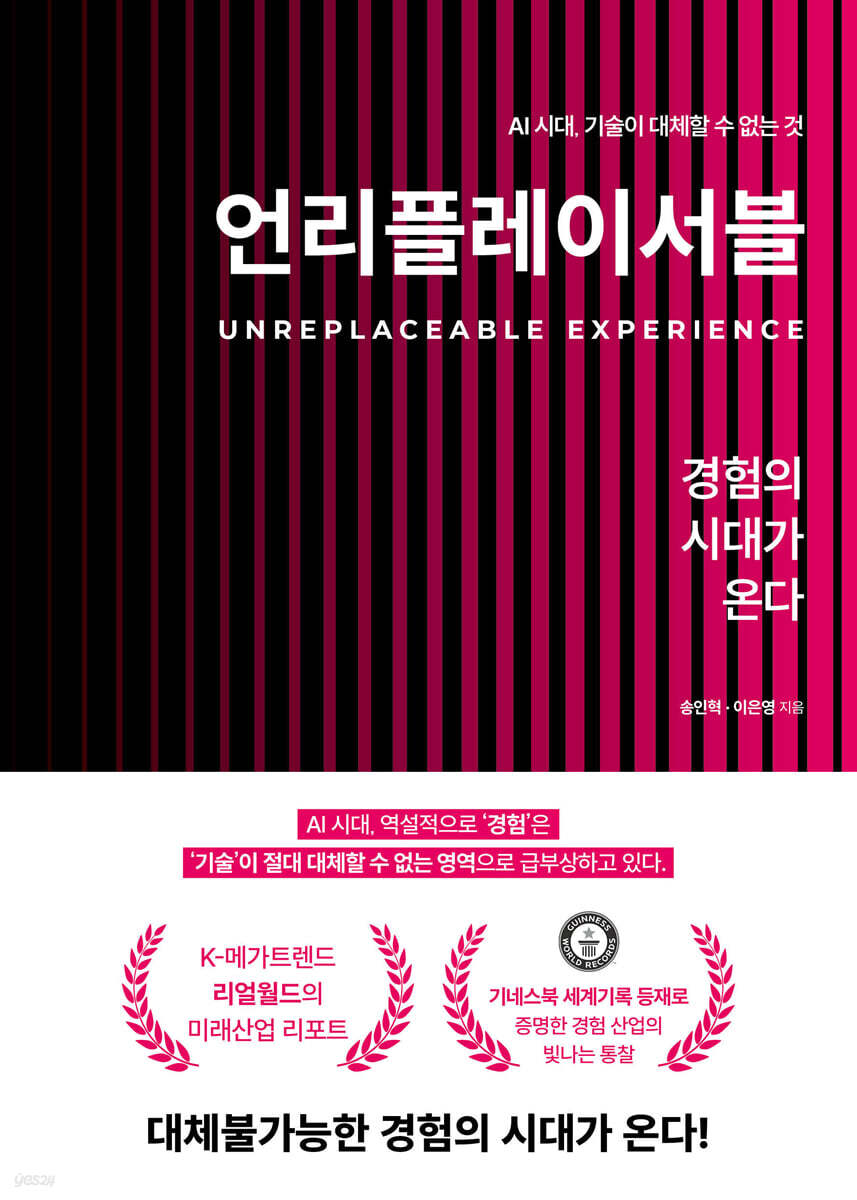
Unreplayable: The Age of Experience Has Arrived
 |
Description
Book Introduction
Questions we should pay attention to: “What are we doing today?” “What shall we do together?”
At this point lies the opportunity of a new era!
It is no exaggeration to say that human development has been achieved through 'questions'.
Humans have survived by seeking answers to the questions, “What could it be?”, “Why is that so?”, and “What should we do?”
A change in question can also become a starting point for changing the direction of the times.
That is why many thinkers say that if you want to read the changes of the times, you should pay attention to people's 'questions'.
So, what questions should we focus on in this day and age? We must identify the questions that people are clamoring for answers to, but no one has yet provided them.
AI technology, which is developing rapidly, provides appropriate answers to people's questions.
The dilemma of “What should I eat?” is solved by a delivery app, and when you open an OTT app and ask “What should I watch?”, recommended videos that suit your tastes appear.
However, there are questions that are difficult to solve even with AI.
The question is, “What should I do?”
In fact, more than 1.5 billion people worldwide travel each year in search of new experiences, but when asked about "new experiences," there's no single system or platform that comes to mind.
Businesses that answer these questions will become irreplaceable industries that AI technology cannot replace.
Becoming the Netflix of experiences is the answer to the questions of our time and the door to opportunity.
At this point lies the opportunity of a new era!
It is no exaggeration to say that human development has been achieved through 'questions'.
Humans have survived by seeking answers to the questions, “What could it be?”, “Why is that so?”, and “What should we do?”
A change in question can also become a starting point for changing the direction of the times.
That is why many thinkers say that if you want to read the changes of the times, you should pay attention to people's 'questions'.
So, what questions should we focus on in this day and age? We must identify the questions that people are clamoring for answers to, but no one has yet provided them.
AI technology, which is developing rapidly, provides appropriate answers to people's questions.
The dilemma of “What should I eat?” is solved by a delivery app, and when you open an OTT app and ask “What should I watch?”, recommended videos that suit your tastes appear.
However, there are questions that are difficult to solve even with AI.
The question is, “What should I do?”
In fact, more than 1.5 billion people worldwide travel each year in search of new experiences, but when asked about "new experiences," there's no single system or platform that comes to mind.
Businesses that answer these questions will become irreplaceable industries that AI technology cannot replace.
Becoming the Netflix of experiences is the answer to the questions of our time and the door to opportunity.
- You can preview some of the book's contents.
Preview
index
Prologue | Find the clues to the times hidden in the changing questions 4
Chapter 1: The Age of Experience Industry Has Arrived
The Great Transition from Digital to Physical 16
24 from connection to contact
The Advent of an Era of Connected Consciousness 32
The Great Transition to the Experience Industry Era 40
LBE 48: The Key to K-Content's Global Powerhouse
Chapter 2: The City Becomes the World's Largest Theme Park
Why Seongsu Became a Hip Place 62
A treasure hunt festival enjoyed by 20 million people unfolds 72
Abandoned city center earns Guinness World Records for largest crowd gathering
Innovation begins when content defines space. 94
Complex space is falling, simultaneous space is coming 102
A small 70-pyeong building transforms into a theme park.
Experience Film in an Abandoned Warehouse: UK's Secret Cinema 120
A Closed Shopping Mall Turns into a Next-Generation Theme Park: Immersive Port Tokyo 132
Chapter 3: The Future of Content
Why Mystery and Detective Games Became One of the Top 3 Offline Entertainment Industries 148
Films Beyond the Screen, Transmedia 158
A drama you can experience in a TV drama, Disney Plus' "Nine Puzzle" 170
Inviting viewers into the mafia game: The Residence 176
Netflix House Launches Experience-Selling LBE Business 182
Still New After 100 Views: Immersive Replay 188
Chapter 4 The Future of Education
Special Mission: Safely Deliver Independence Funds! The City Becomes the Game Stage 202
Playing History: The Success of a History Gamebook That Sold 1.2 Million Copies 210
Libraries Refilled with Imagination: "The Lost Library" Project 218
A Closed School Turns into a Math Theme Park 226
Chapter 5: The Future of Tourism
Become an independence activist and escape Seodaemun Prison! 238
Museums Become RPG Playgrounds 244
A massive escape room game set in an entire city 252
A vanished city transforms into a top-notch theme park. 258
A hospital abandoned for 30 years becomes a miracle in the tourism industry. 270
Breathing the Magic of Imagination into Abandoned Spaces: Mio Wolf 278
290 Innovations in Gangneung Hanok Village Featured in the World's No. 1 SSCI Paper
Writing the Myth of Local Hotels with a Play on Staying 300
Chapter 6: Advice for the Irreplaceable You
G-Dragon's "Übermensch": 312 Words That Summon My Irreplaceable Self Today
Stay Curious, Be the Change 320
Epilogue | What Technology Can't Replace: Experience 332
Chapter 1: The Age of Experience Industry Has Arrived
The Great Transition from Digital to Physical 16
24 from connection to contact
The Advent of an Era of Connected Consciousness 32
The Great Transition to the Experience Industry Era 40
LBE 48: The Key to K-Content's Global Powerhouse
Chapter 2: The City Becomes the World's Largest Theme Park
Why Seongsu Became a Hip Place 62
A treasure hunt festival enjoyed by 20 million people unfolds 72
Abandoned city center earns Guinness World Records for largest crowd gathering
Innovation begins when content defines space. 94
Complex space is falling, simultaneous space is coming 102
A small 70-pyeong building transforms into a theme park.
Experience Film in an Abandoned Warehouse: UK's Secret Cinema 120
A Closed Shopping Mall Turns into a Next-Generation Theme Park: Immersive Port Tokyo 132
Chapter 3: The Future of Content
Why Mystery and Detective Games Became One of the Top 3 Offline Entertainment Industries 148
Films Beyond the Screen, Transmedia 158
A drama you can experience in a TV drama, Disney Plus' "Nine Puzzle" 170
Inviting viewers into the mafia game: The Residence 176
Netflix House Launches Experience-Selling LBE Business 182
Still New After 100 Views: Immersive Replay 188
Chapter 4 The Future of Education
Special Mission: Safely Deliver Independence Funds! The City Becomes the Game Stage 202
Playing History: The Success of a History Gamebook That Sold 1.2 Million Copies 210
Libraries Refilled with Imagination: "The Lost Library" Project 218
A Closed School Turns into a Math Theme Park 226
Chapter 5: The Future of Tourism
Become an independence activist and escape Seodaemun Prison! 238
Museums Become RPG Playgrounds 244
A massive escape room game set in an entire city 252
A vanished city transforms into a top-notch theme park. 258
A hospital abandoned for 30 years becomes a miracle in the tourism industry. 270
Breathing the Magic of Imagination into Abandoned Spaces: Mio Wolf 278
290 Innovations in Gangneung Hanok Village Featured in the World's No. 1 SSCI Paper
Writing the Myth of Local Hotels with a Play on Staying 300
Chapter 6: Advice for the Irreplaceable You
G-Dragon's "Übermensch": 312 Words That Summon My Irreplaceable Self Today
Stay Curious, Be the Change 320
Epilogue | What Technology Can't Replace: Experience 332
Detailed image

Into the book
In an age where everything changes, the saying that the only constant truth in the world is that “everything changes” feels very real these days.
…Looking only at the point and not the direction is ultimately just like ‘seeking a sword while carving a boat.’
What should we do? Many entrepreneurs and management thinkers have a common opinion on this matter.
If you want to read the era of change, pay attention to people's 'questions'.
--- p.
4, from "Prologue: Find the clues to the times hidden in the changing questions"
In the age of AI, paradoxically, experience is rapidly emerging as an area that technology can never replace.
Experience is what I feel when my emotions, my consciousness, my being, and my world are connected to people, because this is the realm of existence.
Because of this, you can seize the opportunity at the point of “What should I do today?”
What we need to approach is, 'Why are these questions arising now?'
The moment we answer that question, we arrive at the crossroads of the future first.
--- p.
8, from "Prologue: Find the clues to the times hidden in the changing questions"
The reasons why they are moving beyond digital are clear.
Because digital cannot fully satisfy all the senses.
Something that you can touch with your hands, feel with your body, hear with your ears, and laugh and cry with.
The emotional fulfillment that only real experiences can provide.
This is why they are so enthusiastic about amusement parks, exhibitions, pop-up stores, and experiential content.
It is not just about consuming content, but a 'performance in reality' that creates one's own narrative and records and disseminates that narrative in real time.
--- p.
20, from “Chapter 1: The Age of Experience Industry is Coming”
In an age where technology can replicate and replace most aspects of human life, one fact becomes even more evident.
It is an 'experience' that expresses unique human emotions that technology cannot reach.
People are no longer satisfied with simply owning a product or acquiring information, but place greater value on the very act of ‘experiencing’ something.
And only when that experience is connected to our own narrative do we become emotionally moved, act, and immersed in it.
Therefore, recent tremendous technological advancements, including AI, should not be viewed solely from a functional perspective of increased productivity and replacement of human labor, but rather as a new "expansion of time" and "opportunities" beyond that.
More time means more experiences, and how we fill those experiences will determine the future of the industry.
Therefore, we are not simply at a turning point in an industry, but at the prelude to a true "age of experience," where essential human needs become the center of industry.
--- p.
46-47, from “Chapter 1: The Age of Experience Industry Has Arrived”
Cities can become platforms for new experiences.
A city not as a place to gather to sell something, but as a place to create and experience something together.
Just as with a play, the same script can create completely different emotions depending on the stage, the stage called a city creates infinite variations.
A city goes beyond the density of buildings or the boundaries of administrative districts.
Cities are places where people gather and disperse, create stories and gain experiences.
So how should we use our cities? When we treat the entire city as our playground, our daily lives become adventures.
Thus, the city becomes the stage for the most fun games.
--- p.93, from “Chapter 2: The City Becomes the World’s Largest Theme Park”
In the digital age, physical space is now being redefined by content.
Even with the same area, the length of time visitors spend on the site, their satisfaction, and the density of their memories can vary depending on the content they fill.
This means that physical space no longer has a fixed meaning, and we have entered an era where content defines space.
--- p.96, from “Chapter 2: The City Becomes the World’s Largest Theme Park”
Now, content is breaking that mold.
The world that was trapped inside the screen is flowing out of the screen.
No more watching movies alone or playing games alone.
Now, content is evolving into a living experience that moves and breathes together.
Content now has space.
It is expanding into a physical experience where you bump into things with your body, make choices directly, and react in reality.
Digital-based content meets offline spaces to create new business models, creating a completely new form of consumer culture.
--- p.146, from “Chapter 3: The Future of Content”
No matter how much technology develops, humans ultimately construct meaning through ‘directly experienced emotions.’
The Rat Society is a place where you can create those very emotions in reality with others.
These shifts are a powerful sign that the future of content is being reshaped around emotions, relationships, and the co-creation of narratives, not technology.
I sincerely hope that Korean IPs will also go beyond the screen and expand into cities and the world, becoming a part of the lives of young people around the world.
--- p.157, from “Chapter 3: The Future of Content”
Content that is simply “read, watch, and remember” is not suitable for the digital age, or even the AI age.
Information can be analyzed more quickly by AI, and knowledge can be structured more accurately by algorithms.
But the existence of 'me' that exists outside of all that technology, the human experience of moving, feeling, and choosing on my own, cannot be replaced.
The most irreplaceable value today lies in the moments when you move your body to solve puzzles, jump into the story and make decisions.
This book proves that possibility most clearly and most interestingly.
Let's remember.
It's not 'storytelling', it's 'storyplay'.
--- p.216-217, from “Chapter 4: The Future of Education”
Today's generation is the digital generation.
The more online-savvy children are, the more they really need offline experiences that cannot be replaced online.
When we ask, “Why does it have to be offline?” we must be able to say clearly.
“That experience is absolutely impossible online,” Semtori says.
When a space is given a story and a role, that space becomes a stage for education.
--- p.231, from “Chapter 4: The Future of Education”
The museum's exhibits are still of great value.
The problem is the viewing method.
No matter how many precious artifacts are on display, a single comment like, “Hey, there’s nothing to see here” can brand that space as a “meaningless place.”
But if I can add a narrative to that artifact and put myself in that narrative, the museum can become a playground.
What was once a static space showcasing the history of medicine has now become an interactive stage where anyone can become the main character.
A piece of playable content is redefining the local museum's raison d'être.
In other words, this space offers a new experience that this era desires through a journey to find the 'ultimate elixir.'
…If I add a narrative to the museum’s artifacts and enter into that narrative, the museum can become a playground.
--- p.250-251, from “Chapter 5: The Future of Tourism”
What needs to come first is not the creation of space, but a 'story' and 'content' in which people can become the real protagonists.
Mio Wolff showed us that imagining who might come, what they might feel, and what journey they might take to create a story is the true beginning of bringing a space back to life.
--- p.289, from “Chapter 5: The Future of Tourism”
No one moves with fancy looking hardware.
What people are really looking for is something they can only do there.
What fills the space is not hardware, but 'playable content' that tells the story of the place.
…Looking only at the point and not the direction is ultimately just like ‘seeking a sword while carving a boat.’
What should we do? Many entrepreneurs and management thinkers have a common opinion on this matter.
If you want to read the era of change, pay attention to people's 'questions'.
--- p.
4, from "Prologue: Find the clues to the times hidden in the changing questions"
In the age of AI, paradoxically, experience is rapidly emerging as an area that technology can never replace.
Experience is what I feel when my emotions, my consciousness, my being, and my world are connected to people, because this is the realm of existence.
Because of this, you can seize the opportunity at the point of “What should I do today?”
What we need to approach is, 'Why are these questions arising now?'
The moment we answer that question, we arrive at the crossroads of the future first.
--- p.
8, from "Prologue: Find the clues to the times hidden in the changing questions"
The reasons why they are moving beyond digital are clear.
Because digital cannot fully satisfy all the senses.
Something that you can touch with your hands, feel with your body, hear with your ears, and laugh and cry with.
The emotional fulfillment that only real experiences can provide.
This is why they are so enthusiastic about amusement parks, exhibitions, pop-up stores, and experiential content.
It is not just about consuming content, but a 'performance in reality' that creates one's own narrative and records and disseminates that narrative in real time.
--- p.
20, from “Chapter 1: The Age of Experience Industry is Coming”
In an age where technology can replicate and replace most aspects of human life, one fact becomes even more evident.
It is an 'experience' that expresses unique human emotions that technology cannot reach.
People are no longer satisfied with simply owning a product or acquiring information, but place greater value on the very act of ‘experiencing’ something.
And only when that experience is connected to our own narrative do we become emotionally moved, act, and immersed in it.
Therefore, recent tremendous technological advancements, including AI, should not be viewed solely from a functional perspective of increased productivity and replacement of human labor, but rather as a new "expansion of time" and "opportunities" beyond that.
More time means more experiences, and how we fill those experiences will determine the future of the industry.
Therefore, we are not simply at a turning point in an industry, but at the prelude to a true "age of experience," where essential human needs become the center of industry.
--- p.
46-47, from “Chapter 1: The Age of Experience Industry Has Arrived”
Cities can become platforms for new experiences.
A city not as a place to gather to sell something, but as a place to create and experience something together.
Just as with a play, the same script can create completely different emotions depending on the stage, the stage called a city creates infinite variations.
A city goes beyond the density of buildings or the boundaries of administrative districts.
Cities are places where people gather and disperse, create stories and gain experiences.
So how should we use our cities? When we treat the entire city as our playground, our daily lives become adventures.
Thus, the city becomes the stage for the most fun games.
--- p.93, from “Chapter 2: The City Becomes the World’s Largest Theme Park”
In the digital age, physical space is now being redefined by content.
Even with the same area, the length of time visitors spend on the site, their satisfaction, and the density of their memories can vary depending on the content they fill.
This means that physical space no longer has a fixed meaning, and we have entered an era where content defines space.
--- p.96, from “Chapter 2: The City Becomes the World’s Largest Theme Park”
Now, content is breaking that mold.
The world that was trapped inside the screen is flowing out of the screen.
No more watching movies alone or playing games alone.
Now, content is evolving into a living experience that moves and breathes together.
Content now has space.
It is expanding into a physical experience where you bump into things with your body, make choices directly, and react in reality.
Digital-based content meets offline spaces to create new business models, creating a completely new form of consumer culture.
--- p.146, from “Chapter 3: The Future of Content”
No matter how much technology develops, humans ultimately construct meaning through ‘directly experienced emotions.’
The Rat Society is a place where you can create those very emotions in reality with others.
These shifts are a powerful sign that the future of content is being reshaped around emotions, relationships, and the co-creation of narratives, not technology.
I sincerely hope that Korean IPs will also go beyond the screen and expand into cities and the world, becoming a part of the lives of young people around the world.
--- p.157, from “Chapter 3: The Future of Content”
Content that is simply “read, watch, and remember” is not suitable for the digital age, or even the AI age.
Information can be analyzed more quickly by AI, and knowledge can be structured more accurately by algorithms.
But the existence of 'me' that exists outside of all that technology, the human experience of moving, feeling, and choosing on my own, cannot be replaced.
The most irreplaceable value today lies in the moments when you move your body to solve puzzles, jump into the story and make decisions.
This book proves that possibility most clearly and most interestingly.
Let's remember.
It's not 'storytelling', it's 'storyplay'.
--- p.216-217, from “Chapter 4: The Future of Education”
Today's generation is the digital generation.
The more online-savvy children are, the more they really need offline experiences that cannot be replaced online.
When we ask, “Why does it have to be offline?” we must be able to say clearly.
“That experience is absolutely impossible online,” Semtori says.
When a space is given a story and a role, that space becomes a stage for education.
--- p.231, from “Chapter 4: The Future of Education”
The museum's exhibits are still of great value.
The problem is the viewing method.
No matter how many precious artifacts are on display, a single comment like, “Hey, there’s nothing to see here” can brand that space as a “meaningless place.”
But if I can add a narrative to that artifact and put myself in that narrative, the museum can become a playground.
What was once a static space showcasing the history of medicine has now become an interactive stage where anyone can become the main character.
A piece of playable content is redefining the local museum's raison d'être.
In other words, this space offers a new experience that this era desires through a journey to find the 'ultimate elixir.'
…If I add a narrative to the museum’s artifacts and enter into that narrative, the museum can become a playground.
--- p.250-251, from “Chapter 5: The Future of Tourism”
What needs to come first is not the creation of space, but a 'story' and 'content' in which people can become the real protagonists.
Mio Wolff showed us that imagining who might come, what they might feel, and what journey they might take to create a story is the true beginning of bringing a space back to life.
--- p.289, from “Chapter 5: The Future of Tourism”
No one moves with fancy looking hardware.
What people are really looking for is something they can only do there.
What fills the space is not hardware, but 'playable content' that tells the story of the place.
--- p.299, from “Chapter 5: The Future of Tourism”
Publisher's Review
Questions we should pay attention to: “What are we doing today?” “What shall we do together?”
At this point lies the opportunity of a new era!
It is no exaggeration to say that human development has been achieved through 'questions'.
Humans have survived by seeking answers to the questions, “What could it be?”, “Why is that so?”, and “What should we do?”
A change in question can also become a starting point for changing the direction of the times.
That is why many thinkers say that if you want to read the changes of the times, you should pay attention to people's 'questions'.
So, what questions should we focus on in this day and age? We must identify the questions that people are clamoring for answers to, but no one has yet provided them.
AI technology, which is developing rapidly, provides appropriate answers to people's questions.
The dilemma of “What should I eat?” is solved by a delivery app, and when you open an OTT app and ask “What should I watch?”, recommended videos that suit your tastes appear.
However, there are questions that are difficult to solve even with AI.
The question is, “What should I do?”
In fact, more than 1.5 billion people worldwide travel each year in search of new experiences, but when asked about "new experiences," there's no single system or platform that comes to mind.
Businesses that answer these questions will become irreplaceable industries that AI technology cannot replace.
Becoming the Netflix of experiences is the answer to the questions of our time and the door to opportunity.
A journey to find the answer to "What should I do?"
Human Cube's book, "Unreplayable: The Age of Experience is Coming," is a book that shows the age of "experience" to fill the blank space of "What should I do?"
What we need to ask the new question of “What should we do?” is an “experience” that expresses unique human emotions.
People are no longer simply looking for ways to pass the time, like through OTT or social media, but are instead looking for experiences that satisfy all five senses and engage with one another on-site.
Experience is not a luxury, but a necessity, and as the book's title suggests, it is 'unreplaceable'.
The authors of this book and co-CEOs of Unique Good Company, Song In-hyeok and Lee Eun-young, plan a treasure hunt event that has been listed in the Guinness Book of World Records and lead Real World, which attracts over 150,000 visitors every year.
Based on the experiences we've achieved through collaboration with real-world organizations and various institutions, we present a future for an industry driven by experience.
They refer to this era as the "era of the irreplaceable experience industry," and they predict that the world is moving from a knowledge-centric economy to a connection-centric economy, and that the experience industry will become central in the future, along with examples to support this.
Through this book, we explore why the world is focusing on "experience," and delve into the real world of experience to see how the experience industry unfolds.
Why 'experience'?
Human 'emotions' and 'experiences': Areas that technology cannot replace.
The "new experience" and "irreplaceable experience" mentioned in this book are not digital experiences that can create even imaginary landscapes, but rather the emotional fulfillment that only real experiences can provide.
Because technology cannot express, reproduce, or replace unique human emotions.
People are no longer satisfied with the mere sensation and experience of watching, but rather seek experiences that satisfy all five senses by seeing, hearing, touching, feeling, participating directly, and laughing together.
So what emerged was ‘phygital (Physical+Digital)’.
Netflix is trying to bring digital content into the real world with 'Netflix House' and various pop-up events, and 'Crime Scene', a mystery entertainment show that only existed on the screen, has become a reality in China and expanded into the 8 trillion won role-playing mystery game 'Jubansa((?本?)'.
A story that started digitally was implemented in a real offline space and became an ‘experience.’
This is why we need to pay attention to 'Location-Based Entertainment' or 'LBE' as it is expanding into tourism, consumption, and jobs.
A new space and industry born from narrative and role
A new era of cities, art, education, and tourism
As experiential content is implemented in reality, the concept of 'space' is inevitably being reconstructed.
Among them, what the author focused on was ‘reconstruction of urban space.’
The city is a place where people gather and disperse, create stories, and accumulate experiences. This entire urban setting has become a playground, giving birth to an attempt to turn everyday life into an adventure.
Abandoned cities and ruins around the world are being reborn as innovative and creative spaces for experiences by artists, creating the world's largest theme park.
As the reconfiguration and utilization of space became more diverse, the concept of ‘simultaneous space’ was derived.
Multiple plays are performed in one space, and visitors can have their own new experiences simultaneously in one space by participating in different plays.
Some people become spies in movies, and some people become villains.
Even though it's the same content, you can have your own unique experience, and even if you do the same content, a different narrative unfolds each time.
It is not a one-time experience, but leads to continuous return visits.
This is why one person can consume one experience content 10 or 100 times.
The strength of narrative lies in its ability to provide new immersion and experiences within the same content.
Museum artifacts, textbook lines, and famous historical sites are realized in the real world as 'phygitals', a synthesis of digital and physical space.
But with the addition of ‘my own narrative’, I become the main character.
Become the best pharmacist on par with Heo Jun and find the best medicine, become an independence activist and help heroes escape or deliver funds, and become a researcher in a lab that creates all the mathematical problems in the world.
This is called 'playable content'.
When you add your own narrative with stories and roles, boring museums and textbooks become doors to new experiences.
A narrative experience that grabs people's attention
Cities, studies, and tourism are all entering a new, living, breathing experience industry by adding 'story' or narrative.
The 'experience' people seek is not a simple action.
It is a special experience that can only be had there and only I can have it.
And this comes from ‘real experience’, from ‘narrative’.
If you want to attract people, you have to create a 'story' before space and materials.
The book "Unreplayable: The Age of Experience" explains what kind of stories bring people together and how to weave them.
"Unreplayable: The Age of Experience" will be a great milestone for readers who want to understand the trends of a new era, for those who want to experience intense, engaging experiences, and for creators who need new ideas to attract people.
At this point lies the opportunity of a new era!
It is no exaggeration to say that human development has been achieved through 'questions'.
Humans have survived by seeking answers to the questions, “What could it be?”, “Why is that so?”, and “What should we do?”
A change in question can also become a starting point for changing the direction of the times.
That is why many thinkers say that if you want to read the changes of the times, you should pay attention to people's 'questions'.
So, what questions should we focus on in this day and age? We must identify the questions that people are clamoring for answers to, but no one has yet provided them.
AI technology, which is developing rapidly, provides appropriate answers to people's questions.
The dilemma of “What should I eat?” is solved by a delivery app, and when you open an OTT app and ask “What should I watch?”, recommended videos that suit your tastes appear.
However, there are questions that are difficult to solve even with AI.
The question is, “What should I do?”
In fact, more than 1.5 billion people worldwide travel each year in search of new experiences, but when asked about "new experiences," there's no single system or platform that comes to mind.
Businesses that answer these questions will become irreplaceable industries that AI technology cannot replace.
Becoming the Netflix of experiences is the answer to the questions of our time and the door to opportunity.
A journey to find the answer to "What should I do?"
Human Cube's book, "Unreplayable: The Age of Experience is Coming," is a book that shows the age of "experience" to fill the blank space of "What should I do?"
What we need to ask the new question of “What should we do?” is an “experience” that expresses unique human emotions.
People are no longer simply looking for ways to pass the time, like through OTT or social media, but are instead looking for experiences that satisfy all five senses and engage with one another on-site.
Experience is not a luxury, but a necessity, and as the book's title suggests, it is 'unreplaceable'.
The authors of this book and co-CEOs of Unique Good Company, Song In-hyeok and Lee Eun-young, plan a treasure hunt event that has been listed in the Guinness Book of World Records and lead Real World, which attracts over 150,000 visitors every year.
Based on the experiences we've achieved through collaboration with real-world organizations and various institutions, we present a future for an industry driven by experience.
They refer to this era as the "era of the irreplaceable experience industry," and they predict that the world is moving from a knowledge-centric economy to a connection-centric economy, and that the experience industry will become central in the future, along with examples to support this.
Through this book, we explore why the world is focusing on "experience," and delve into the real world of experience to see how the experience industry unfolds.
Why 'experience'?
Human 'emotions' and 'experiences': Areas that technology cannot replace.
The "new experience" and "irreplaceable experience" mentioned in this book are not digital experiences that can create even imaginary landscapes, but rather the emotional fulfillment that only real experiences can provide.
Because technology cannot express, reproduce, or replace unique human emotions.
People are no longer satisfied with the mere sensation and experience of watching, but rather seek experiences that satisfy all five senses by seeing, hearing, touching, feeling, participating directly, and laughing together.
So what emerged was ‘phygital (Physical+Digital)’.
Netflix is trying to bring digital content into the real world with 'Netflix House' and various pop-up events, and 'Crime Scene', a mystery entertainment show that only existed on the screen, has become a reality in China and expanded into the 8 trillion won role-playing mystery game 'Jubansa((?本?)'.
A story that started digitally was implemented in a real offline space and became an ‘experience.’
This is why we need to pay attention to 'Location-Based Entertainment' or 'LBE' as it is expanding into tourism, consumption, and jobs.
A new space and industry born from narrative and role
A new era of cities, art, education, and tourism
As experiential content is implemented in reality, the concept of 'space' is inevitably being reconstructed.
Among them, what the author focused on was ‘reconstruction of urban space.’
The city is a place where people gather and disperse, create stories, and accumulate experiences. This entire urban setting has become a playground, giving birth to an attempt to turn everyday life into an adventure.
Abandoned cities and ruins around the world are being reborn as innovative and creative spaces for experiences by artists, creating the world's largest theme park.
As the reconfiguration and utilization of space became more diverse, the concept of ‘simultaneous space’ was derived.
Multiple plays are performed in one space, and visitors can have their own new experiences simultaneously in one space by participating in different plays.
Some people become spies in movies, and some people become villains.
Even though it's the same content, you can have your own unique experience, and even if you do the same content, a different narrative unfolds each time.
It is not a one-time experience, but leads to continuous return visits.
This is why one person can consume one experience content 10 or 100 times.
The strength of narrative lies in its ability to provide new immersion and experiences within the same content.
Museum artifacts, textbook lines, and famous historical sites are realized in the real world as 'phygitals', a synthesis of digital and physical space.
But with the addition of ‘my own narrative’, I become the main character.
Become the best pharmacist on par with Heo Jun and find the best medicine, become an independence activist and help heroes escape or deliver funds, and become a researcher in a lab that creates all the mathematical problems in the world.
This is called 'playable content'.
When you add your own narrative with stories and roles, boring museums and textbooks become doors to new experiences.
A narrative experience that grabs people's attention
Cities, studies, and tourism are all entering a new, living, breathing experience industry by adding 'story' or narrative.
The 'experience' people seek is not a simple action.
It is a special experience that can only be had there and only I can have it.
And this comes from ‘real experience’, from ‘narrative’.
If you want to attract people, you have to create a 'story' before space and materials.
The book "Unreplayable: The Age of Experience" explains what kind of stories bring people together and how to weave them.
"Unreplayable: The Age of Experience" will be a great milestone for readers who want to understand the trends of a new era, for those who want to experience intense, engaging experiences, and for creators who need new ideas to attract people.
GOODS SPECIFICS
- Date of issue: October 31, 2025
- Page count, weight, size: 336 pages | 576g | 150*210*20mm
- ISBN13: 9791165384692
- ISBN10: 1165384698
You may also like
카테고리
korean


korean

![GQ KOREA Mark (Monthly): December [2025]](http://librairie.coreenne.fr/cdn/shop/files/8ef265dbbfbf186523ed75ba7319009d.jpg?v=1765340328&width=3840)


