

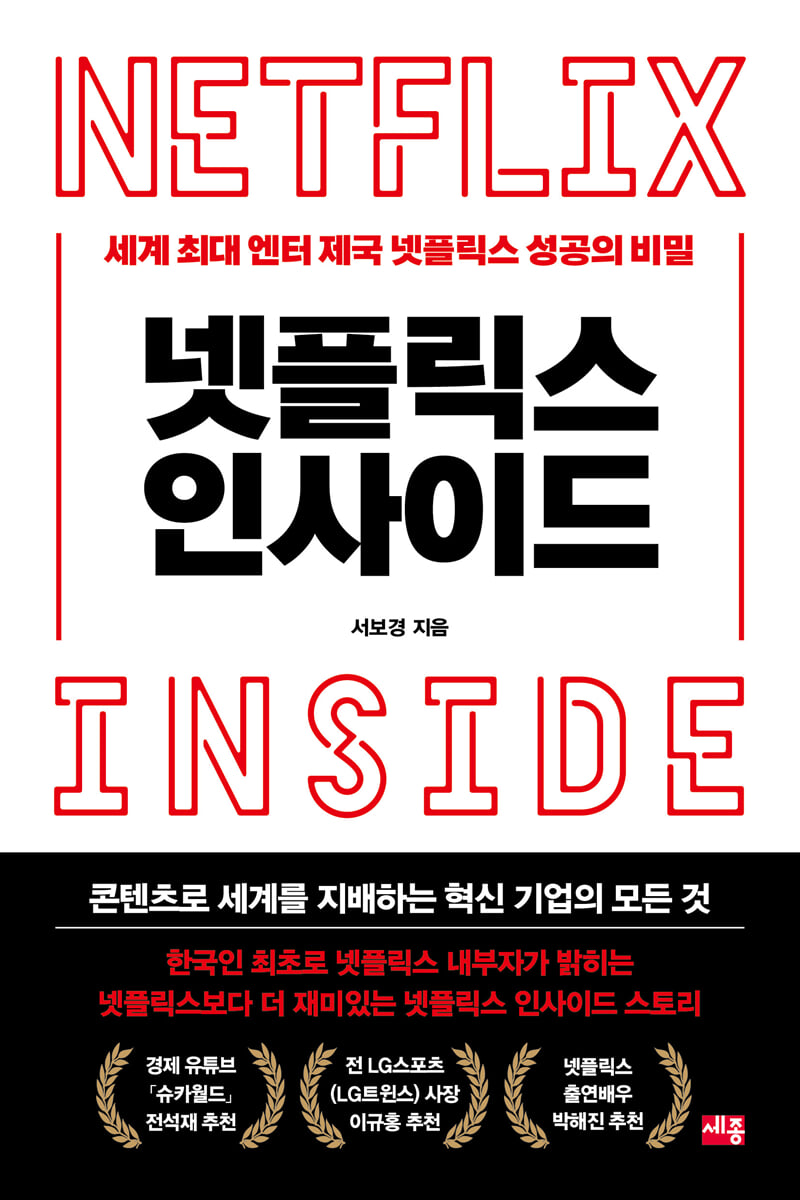
Netflix Inside
 |
Description
Book Introduction
From "Squid Game" to "Kingdom" and "K-Pop Demon Hunters"...
How Netflix Became the World's Leading Content Company
Everything you need to know about the innovative companies that are dominating the world with content!
★The first Korean Netflix insider to reveal
Netflix Inside Story: More Fun Than Netflix
★Highly recommended by YouTube's "Shuka World," actor Park Hae-jin, and former LG Sports (LG Twins) President Lee Kyu-hong!
A Korean Netflix insider sharply conveys the tension and unconventionality of Netflix culture, witnessed firsthand from his time on the Asia strategy team, from joining in 2019 until his departure in 2021.
It contains real insider experiences that you will never find in industry rumors or press articles.
This is a behind-the-scenes story that any Netflix-loving viewer would be curious about.
“We say goodbye to above-average talent.
“Only the best talents are retained.”
“We are not family.
“It’s a professional sports team.”
“We treat you with the absolute best treatment in the industry.”
The real secret isn't money or talent.
Netflix measures its performance based on the impact it has on the market and its customers, not KPIs.
Encourage shared context rather than directives from superiors, and encourage honest conversation rather than silence.
What supports this is the professional team philosophy of consistently operating recruitment, compensation, and separation in a major league manner.
This is why, despite its large size, it can operate as a fast and flexible organization like a startup.
Drawing on his consulting career at companies like the Boston Consulting Group, the author structurally analyzes this culture and offers practical solutions for how to transplant and design a Netflix-style system into Korean organizations.
This book is not simply a corporate exploration.
It is a provocative manual that forces us to re-examine the fundamentals of organizations and careers, and it is the most powerful inspiration for leaders who dream of creating "creative yet flexible organizations."
How Netflix Became the World's Leading Content Company
Everything you need to know about the innovative companies that are dominating the world with content!
★The first Korean Netflix insider to reveal
Netflix Inside Story: More Fun Than Netflix
★Highly recommended by YouTube's "Shuka World," actor Park Hae-jin, and former LG Sports (LG Twins) President Lee Kyu-hong!
A Korean Netflix insider sharply conveys the tension and unconventionality of Netflix culture, witnessed firsthand from his time on the Asia strategy team, from joining in 2019 until his departure in 2021.
It contains real insider experiences that you will never find in industry rumors or press articles.
This is a behind-the-scenes story that any Netflix-loving viewer would be curious about.
“We say goodbye to above-average talent.
“Only the best talents are retained.”
“We are not family.
“It’s a professional sports team.”
“We treat you with the absolute best treatment in the industry.”
The real secret isn't money or talent.
Netflix measures its performance based on the impact it has on the market and its customers, not KPIs.
Encourage shared context rather than directives from superiors, and encourage honest conversation rather than silence.
What supports this is the professional team philosophy of consistently operating recruitment, compensation, and separation in a major league manner.
This is why, despite its large size, it can operate as a fast and flexible organization like a startup.
Drawing on his consulting career at companies like the Boston Consulting Group, the author structurally analyzes this culture and offers practical solutions for how to transplant and design a Netflix-style system into Korean organizations.
This book is not simply a corporate exploration.
It is a provocative manual that forces us to re-examine the fundamentals of organizations and careers, and it is the most powerful inspiration for leaders who dream of creating "creative yet flexible organizations."
- You can preview some of the book's contents.
Preview
index
Recommendation
Prologue: "We're Not a Family, We're a Professional Team"
Toodum: “But is this really possible?”
Part 1.
9 Driving Forces That Propelled Netflix to World Leadership
Chapter 1.
The most expensive decision in the world
[1] Judgment | The power needed when data is silent
There is never enough data to make a definitive judgment.
When everyone says they are responsible, no one is.
The Netflix Way | The Secret to Judgment Through Uncertainty
[2] Communication | 30 minutes is enough
'101 Meetings' - Netflix's Decision-Making Formula
| The Netflix Way | A Discussion Focused on the Essentials: The 3P Frame
[3] Impact | Why We Chose Impact Over KPIs
Outstanding results, not just improved workflows
The Netflix Way | Beyond the Numbers, Seeing the Real Impact
Chapter 2.
The power to make imagination a reality
[4] Curiosity | How a Question Changed the Prediction Model
At Netflix, curiosity is the starting point of innovation.
The power of curiosity and sharing that breaks down boundaries
| The Netflix Way | How Curiosity Changes the Way We Work
[5] Innovation | The Birth of Marketing More Fun Than Drama
Netflix-style marketing: Don't tell, make people come.
The Netflix Way | If you don't change the framework, nothing changes.
[6] Courage | Give a chance to those who break the silence
Silence is not golden, transparency is.
The Netflix Way | The Company That Empowered Courage Through Systems
Chapter 3.
The persistence that captivated 200 countries around the world
[7] Passion | The identity of the force that pushes you to the end
True passion is the desire to see something through to the end.
A culture that doesn't feel uncomfortable with passion
| The Netflix Way | People are the spark, organizations are the fuel tanks
[8] Honesty | Honesty preserves relationships.
Be honest even if it's uncomfortable
The Netflix Way: Honesty is the Firewall of an Organization
[9] Altruism | When combined with curiosity, it creates impact.
There are no boundaries. The first one to move is the master.
The Netflix Way: "Our Team's Performance" Alone Won't Do It
Part 1: Conclusion | Nine Circular Engines That Create World-Class Excellence
Part 2: The World's Largest Startups
A high-performance organization driven by freedom and responsibility
Chapter 4.
There's No Such Thing as Moderation: The Conditions for Netflix-Style Super-Performance
"We're not a family, we're a professional team."
The best welfare is the 'best colleagues'
Keeper Test: “Will you fight for this person?”
The Netflix Way | A flexible organization allows everyone to work differently.
Chapter 5.
Freedom is not a privilege: it is a power with responsibilities.
Freedom to refuse, responsibility to accept
Unlimited Law Cards, Unlimited Vacations: Why True Freedom Is Stronger Than Control
The Netflix Way | Before Talking About Autonomy, What We Need to Design First
Chapter 6.
Context, No Control: What Netflix Chooses Instead of Directing
An organization that shares the "why" rather than the manual
A team that starts with questions and answers with impact
The Secret to Netflix Marketing That's as Fun as the Content
Don't give the right answer, leave the criteria to them.
The Netflix Way | The Power to Move Without Direction
Chapter 7.
Loose but Tight: Netflix-Style Connection and Collaboration
A Tightly-Knit Organization: A Startup's First Growth Curve
The Silo Trap: The Walls Large Enterprises Must Overcome
Strongly connected, loosely coupled teams: "Okay, leave it to me."
| The Netflix Way | Don't copy Netflix until you trust my people.
Chapter 8.
Money is Not the Object: The Philosophy of the World's Best Treatment
“We give you the best treatment so you can work happily.”
Remaining based on skill, not loyalty
There is no welcoming ceremony, only practice.
Creating the Market, Not Following It: Netflix's Salary Philosophy
The Netflix-style dignity of resignation
The Netflix Way: Generous support for those who excel, quick exits for those who fail.
Chapter 9.
Don't Train, Throw It into the Field: Promotion and Self-Development
Bring in the best person for the job right away
Netflix's One Question for Judging Talent
| The Netflix Way | There are no practice matches on Netflix.
Chapter 10.
Applying to Our Organization: How and to What Degree
Start with a 'partial transplant'
Feedback and transparency are the starting point of all change.
Three Conditions That Enable Autonomy: Trust, Competitive Compensation, and Bold Breakups
The standard is always one: “What's Best for the Company”
Culture comes not from documents, but from the choices and recognition of its members.
Epilogue The best welfare is the best colleagues
Prologue: "We're Not a Family, We're a Professional Team"
Toodum: “But is this really possible?”
Part 1.
9 Driving Forces That Propelled Netflix to World Leadership
Chapter 1.
The most expensive decision in the world
[1] Judgment | The power needed when data is silent
There is never enough data to make a definitive judgment.
When everyone says they are responsible, no one is.
The Netflix Way | The Secret to Judgment Through Uncertainty
[2] Communication | 30 minutes is enough
'101 Meetings' - Netflix's Decision-Making Formula
| The Netflix Way | A Discussion Focused on the Essentials: The 3P Frame
[3] Impact | Why We Chose Impact Over KPIs
Outstanding results, not just improved workflows
The Netflix Way | Beyond the Numbers, Seeing the Real Impact
Chapter 2.
The power to make imagination a reality
[4] Curiosity | How a Question Changed the Prediction Model
At Netflix, curiosity is the starting point of innovation.
The power of curiosity and sharing that breaks down boundaries
| The Netflix Way | How Curiosity Changes the Way We Work
[5] Innovation | The Birth of Marketing More Fun Than Drama
Netflix-style marketing: Don't tell, make people come.
The Netflix Way | If you don't change the framework, nothing changes.
[6] Courage | Give a chance to those who break the silence
Silence is not golden, transparency is.
The Netflix Way | The Company That Empowered Courage Through Systems
Chapter 3.
The persistence that captivated 200 countries around the world
[7] Passion | The identity of the force that pushes you to the end
True passion is the desire to see something through to the end.
A culture that doesn't feel uncomfortable with passion
| The Netflix Way | People are the spark, organizations are the fuel tanks
[8] Honesty | Honesty preserves relationships.
Be honest even if it's uncomfortable
The Netflix Way: Honesty is the Firewall of an Organization
[9] Altruism | When combined with curiosity, it creates impact.
There are no boundaries. The first one to move is the master.
The Netflix Way: "Our Team's Performance" Alone Won't Do It
Part 1: Conclusion | Nine Circular Engines That Create World-Class Excellence
Part 2: The World's Largest Startups
A high-performance organization driven by freedom and responsibility
Chapter 4.
There's No Such Thing as Moderation: The Conditions for Netflix-Style Super-Performance
"We're not a family, we're a professional team."
The best welfare is the 'best colleagues'
Keeper Test: “Will you fight for this person?”
The Netflix Way | A flexible organization allows everyone to work differently.
Chapter 5.
Freedom is not a privilege: it is a power with responsibilities.
Freedom to refuse, responsibility to accept
Unlimited Law Cards, Unlimited Vacations: Why True Freedom Is Stronger Than Control
The Netflix Way | Before Talking About Autonomy, What We Need to Design First
Chapter 6.
Context, No Control: What Netflix Chooses Instead of Directing
An organization that shares the "why" rather than the manual
A team that starts with questions and answers with impact
The Secret to Netflix Marketing That's as Fun as the Content
Don't give the right answer, leave the criteria to them.
The Netflix Way | The Power to Move Without Direction
Chapter 7.
Loose but Tight: Netflix-Style Connection and Collaboration
A Tightly-Knit Organization: A Startup's First Growth Curve
The Silo Trap: The Walls Large Enterprises Must Overcome
Strongly connected, loosely coupled teams: "Okay, leave it to me."
| The Netflix Way | Don't copy Netflix until you trust my people.
Chapter 8.
Money is Not the Object: The Philosophy of the World's Best Treatment
“We give you the best treatment so you can work happily.”
Remaining based on skill, not loyalty
There is no welcoming ceremony, only practice.
Creating the Market, Not Following It: Netflix's Salary Philosophy
The Netflix-style dignity of resignation
The Netflix Way: Generous support for those who excel, quick exits for those who fail.
Chapter 9.
Don't Train, Throw It into the Field: Promotion and Self-Development
Bring in the best person for the job right away
Netflix's One Question for Judging Talent
| The Netflix Way | There are no practice matches on Netflix.
Chapter 10.
Applying to Our Organization: How and to What Degree
Start with a 'partial transplant'
Feedback and transparency are the starting point of all change.
Three Conditions That Enable Autonomy: Trust, Competitive Compensation, and Bold Breakups
The standard is always one: “What's Best for the Company”
Culture comes not from documents, but from the choices and recognition of its members.
Epilogue The best welfare is the best colleagues
Detailed image

Into the book
"congratulations.
“You have been accepted to Netflix.”
The acceptance email that arrived two days after the final interview was different from the start.
Then, as if they had been waiting, they went straight to salary negotiations.
I still vividly remember the first words the HR representative at Netflix's Singapore office said to me.
“Please tell me the highest salary you can receive in your current position.
Let's take the highest number as the standard.”
It was hard to believe.
Typically, corporate HR managers focus on "adjusting" salaries to fit the budget.
No negotiation, no persuasion.
But this side is asking me to present the 'most expensive standard'.
So I asked back.
“Including other companies? Even our competitors?”
The person in charge nodded and said.
“Yes, any major company in the management consulting and investment industries will do.
And don't worry.
“I don’t think you’ll be disappointed with the offer you receive.”
That was actually the case.
The last words of the person in charge are still unforgettable.
--- pp.11-12
Many companies call their employees 'family.'
Those are warm words.
It is also good for emphasizing loyalty and a sense of belonging.
But Netflix is firm.
“We are not family.
“It’s a professional sports team.”
Family is based on stability and protection.
But Netflix is an organization that revolves around performance and excellence.
It's different from traditional companies that hire college graduates, train them for years, and expect them to stay with them for the long term.
The organizational model that Netflix pursues is “a sports team comprised of only the best players.”
This team's coach is not a warm guardian, but rather a professional sports coach who coldly hires and replaces players based on their skills.
--- pp.124-125
“Can you say that you want to protect this person until the end?”
Typically, corporate restructuring involves singling out the "bottom 10 percent."
But Netflix's talent strategy is the exact opposite.
Instead of asking, "Our company is struggling, so who should we let go?", constantly ask, "Is this person our best talent right now? Is there a reason we absolutely must keep this person?"
This is the “Keeper’s Test” that Netflix practices.
The team leader advises.
"If this team member were to receive a love call from a competitor, would I be prepared to fight the company to keep him?" Organization leaders are constantly asked to conduct keeper tests on their members and are given the mission to create the best organization.
Exactly, this is the question I always ask.
If the answer isn't "yes," Netflix's way of saying is to consider breaking up.
If you are just someone with a good reputation or are somewhat good at something, you do not meet this standard.
Because Netflix has no qualms about being 'pretty good'.
Only the decisive player who can elevate the entire team remains on this team.
That's how Netflix keeps the best sports teams.
--- pp.129-130
Our vision, born in this way, can be summarized in one sentence: somewhat 'cheeky but challenging'.
“Netflix Korea’s marketing campaign is more interesting than Netflix’s content.”
When even marketing becomes more engaging than content at the world's best content company, it goes beyond a simple campaign to rewriting the brand's very identity.
In a market like Korea, where the social structure is homogeneous and the power of diffusion is strong, this goal is even more meaningful because marketing itself can be perceived as a form of content.
At the time, customers in Korea and Asia were just becoming familiar with the Netflix brand.
If the perception that "Netflix marketing is more entertaining than dramas" spreads, customers' trust and affection for the brand could leap to a whole new level.
The moment we set this vision together, the team members' attitudes completely changed.
At first, there were many confusing questions like, "What on earth is conversation marketing?" and "What on earth do I want you to do?", but gradually, an atmosphere was formed where people set their own direction and proactively developed their own ideas.
The doubts disappeared, and in their place came anticipation and immersion in the future we will create.
Through this experience, I was able to personally confirm that a vision is not something that someone else sets for you, but something that you create and realize yourself.
--- pp.158-159
“But if you give everyone the best treatment, won’t the burden of labor costs increase and affect the company’s profitability?”
She answered with a meaningful smile, without a hint of fatigue.
“That’s a good question.
Instead, we create an organization where one person can do the work of three or five people.
Isn't it sometimes better to pull an all-nighter with one or two people you can communicate with than with ten people you can't communicate with? We gather these star players and form an elite team.
If you don't live up to those expectations, give yourself a generous severance pay and say goodbye.
“We both did our best, so we’re breaking up without any regrets.”
--- pp.190-191
Netflix clearly structures its hiring and compensation criteria into three questions:
· If this person goes to another company, how much will he or she receive?
· If you had to replace this person, how much would you pay the replacement?
· If this person receives a better offer, how much can we offer to keep him?
Netflix answers these questions with remarkably consistent principles.
· Give at a level that no one can suggest.
· Pay the replacement worker as much as they would have paid, or more.
· If another company offers a higher level, we will compensate you accordingly.
In other words, the core of this culture is to guarantee “the highest level of compensation that will not let you look away.”
What's surprising is that these principles aren't just slogans; they're actually applied in practice.
Most of my colleagues were receiving top-tier salaries in the industry, and the company didn't even have a "salary cap."
“You have been accepted to Netflix.”
The acceptance email that arrived two days after the final interview was different from the start.
Then, as if they had been waiting, they went straight to salary negotiations.
I still vividly remember the first words the HR representative at Netflix's Singapore office said to me.
“Please tell me the highest salary you can receive in your current position.
Let's take the highest number as the standard.”
It was hard to believe.
Typically, corporate HR managers focus on "adjusting" salaries to fit the budget.
No negotiation, no persuasion.
But this side is asking me to present the 'most expensive standard'.
So I asked back.
“Including other companies? Even our competitors?”
The person in charge nodded and said.
“Yes, any major company in the management consulting and investment industries will do.
And don't worry.
“I don’t think you’ll be disappointed with the offer you receive.”
That was actually the case.
The last words of the person in charge are still unforgettable.
--- pp.11-12
Many companies call their employees 'family.'
Those are warm words.
It is also good for emphasizing loyalty and a sense of belonging.
But Netflix is firm.
“We are not family.
“It’s a professional sports team.”
Family is based on stability and protection.
But Netflix is an organization that revolves around performance and excellence.
It's different from traditional companies that hire college graduates, train them for years, and expect them to stay with them for the long term.
The organizational model that Netflix pursues is “a sports team comprised of only the best players.”
This team's coach is not a warm guardian, but rather a professional sports coach who coldly hires and replaces players based on their skills.
--- pp.124-125
“Can you say that you want to protect this person until the end?”
Typically, corporate restructuring involves singling out the "bottom 10 percent."
But Netflix's talent strategy is the exact opposite.
Instead of asking, "Our company is struggling, so who should we let go?", constantly ask, "Is this person our best talent right now? Is there a reason we absolutely must keep this person?"
This is the “Keeper’s Test” that Netflix practices.
The team leader advises.
"If this team member were to receive a love call from a competitor, would I be prepared to fight the company to keep him?" Organization leaders are constantly asked to conduct keeper tests on their members and are given the mission to create the best organization.
Exactly, this is the question I always ask.
If the answer isn't "yes," Netflix's way of saying is to consider breaking up.
If you are just someone with a good reputation or are somewhat good at something, you do not meet this standard.
Because Netflix has no qualms about being 'pretty good'.
Only the decisive player who can elevate the entire team remains on this team.
That's how Netflix keeps the best sports teams.
--- pp.129-130
Our vision, born in this way, can be summarized in one sentence: somewhat 'cheeky but challenging'.
“Netflix Korea’s marketing campaign is more interesting than Netflix’s content.”
When even marketing becomes more engaging than content at the world's best content company, it goes beyond a simple campaign to rewriting the brand's very identity.
In a market like Korea, where the social structure is homogeneous and the power of diffusion is strong, this goal is even more meaningful because marketing itself can be perceived as a form of content.
At the time, customers in Korea and Asia were just becoming familiar with the Netflix brand.
If the perception that "Netflix marketing is more entertaining than dramas" spreads, customers' trust and affection for the brand could leap to a whole new level.
The moment we set this vision together, the team members' attitudes completely changed.
At first, there were many confusing questions like, "What on earth is conversation marketing?" and "What on earth do I want you to do?", but gradually, an atmosphere was formed where people set their own direction and proactively developed their own ideas.
The doubts disappeared, and in their place came anticipation and immersion in the future we will create.
Through this experience, I was able to personally confirm that a vision is not something that someone else sets for you, but something that you create and realize yourself.
--- pp.158-159
“But if you give everyone the best treatment, won’t the burden of labor costs increase and affect the company’s profitability?”
She answered with a meaningful smile, without a hint of fatigue.
“That’s a good question.
Instead, we create an organization where one person can do the work of three or five people.
Isn't it sometimes better to pull an all-nighter with one or two people you can communicate with than with ten people you can't communicate with? We gather these star players and form an elite team.
If you don't live up to those expectations, give yourself a generous severance pay and say goodbye.
“We both did our best, so we’re breaking up without any regrets.”
--- pp.190-191
Netflix clearly structures its hiring and compensation criteria into three questions:
· If this person goes to another company, how much will he or she receive?
· If you had to replace this person, how much would you pay the replacement?
· If this person receives a better offer, how much can we offer to keep him?
Netflix answers these questions with remarkably consistent principles.
· Give at a level that no one can suggest.
· Pay the replacement worker as much as they would have paid, or more.
· If another company offers a higher level, we will compensate you accordingly.
In other words, the core of this culture is to guarantee “the highest level of compensation that will not let you look away.”
What's surprising is that these principles aren't just slogans; they're actually applied in practice.
Most of my colleagues were receiving top-tier salaries in the industry, and the company didn't even have a "salary cap."
--- pp.194-195
Publisher's Review
Trust the best talent and treat them with the best.
How to work the Netflix way, according to a Korean insider!
Behind the Scenes of the Content King
"Squid Game", "Kingdom", "K-Pop Demon Hunters".
What kind of drama was unfolding behind the success of Netflix Originals that captivated the world?
The reality witnessed firsthand by Korean insiders, which cannot be known through media articles, is more dramatic and sometimes harsh than a drama.
The essence of the shock that made Netflix an empire with a market capitalization of 700 trillion won was not money, but their unique way of working.
While working at Boston Consulting Group (BCG) in 2019, the author received an unsolicited offer from Netflix.
"Netflix doesn't use external headhunters or mass recruiting." After just two weeks and six interviews, he was offered a lucrative salary, and he signed the contract within an hour.
The unconventional behavior continued from the first day of work.
I was completely free to choose my flight, hotel, and transportation, but on the same day, I witnessed the entire department next door disappear due to AI automation.
“Say goodbye to above-average talent.
“Only the best remain.” Behind the unregulated autonomy, there was a ruthless responsibility that could lead to expulsion within three months.
The "Squid Game" global strategy meeting symbolizes that tension.
A year before its release, despite internal skepticism and distrust, one producer insisted on its overseas success, confident that “this has to work.”
Netflix values the judgment and responsibility of its employees over formal reports and delegates full decision-making authority.
This is Netflix's unique method of sharing context and encouraging voluntary judgment, rather than top-down control.
"Netflix Inside" exclusively reveals the reality of Netflix, which is more dramatic than a drama, through the vivid experiences of an insider.
In particular, rather than simply explaining the "Culture Memo," a document containing the philosophy of the Netflix founder, the book unravels how it was implemented and conflicted in an actual organization from the perspective of a practitioner, based on vivid incidents experienced internally.
And it details the elaborate design behind the free culture, the tensions between members, and the conditions for balance created by unconventional operating methods.
Why Netflix Grew So Differently:
An ingenious system designed for freedom and responsibility
Netflix has become more than just a content company; it has become a global business landmark.
While existing books like "No Rules" and "Powerful" portrayed Netflix through an idealized lens, this book structurally dissects the reality directly experienced by a Korean insider.
Drawing on his global consulting experience, he provides insights by comparing how Netflix culture differs and how it is similar.
The core engine of Netflix's growth is Freedom & Responsibility (F&R).
It is not simple autonomy, but a sophisticated blueprint that allows one to make decisions and execute on one's own even in chaos.
The goal is clear.
“Big, fast, and flexible.” This is why a giant company with a market capitalization of 700 trillion won moves with the agility of a startup.
This system is built on a circular engine where nine core values (judgment, communication, impact, curiosity, innovation, courage, passion, honesty, and altruism) mesh like gears.
Netflix provides context, not control, so that members understand "why" something is important rather than "what to do."
Instead of giving detailed instructions, leaders transparently share strategies, goals, prerequisites, roles, interests, and decision-making processes.
Additionally, the Informed Captain system gives the project leader final decision-making authority and responsibility, regardless of rank.
This, combined with extreme transparency and intellectual curiosity, breaks down barriers between departments and accelerates collaboration and innovation.
Netflix believes that “organizations that trust information are faster and stronger than those that control it.”
This system is the driving force that enables Netflix to continuously innovate and grow in a rapidly changing market.
Not a family, but a professional team:
Everything You Need to Know About Netflix's Hyper-Performance and Survival Rules
“We are not family.
“It’s a professional sports team.” This one sentence best captures Netflix’s talent philosophy.
The standard is performance and excellence, not stability and protection.
The average is eliminated and only the best remain.
Leaders periodically conduct 'keeper tests'.
If you're not sure whether you'll fight to protect this teammate, then break up cleanly.
The author's colleague K, despite his outstanding performance and long tenure, eventually left the company when it was determined that an outside talent was better suited for the vacant position.
This is because Netflix wants people who have already proven themselves to be the best, not people who are expected to do well in the future.
I have no regrets about it being pretty good.
In this process, a generous consolation prize is given and the matter is settled coolly.
The standard for measuring performance is not KPIs, but real impact.
It's not about improving procedures, but looking at the overall results that bring about change throughout the company.
Including bonuses in the base salary is also intended to encourage long-term commitment rather than focusing on short-term goals.
Just as the legal team's lawyers go beyond legal feasibility reviews to consider strategies that maximize business impact, Netflix constantly asks every employee, "What difference will this actually make?"
Netflix chooses to share context instead of directing.
It helps members understand why something is important, not what to do, and empowers them to act autonomously.
A representative example is the speech marketing workshop that the author experienced.
When introducing new marketing concepts, rather than passively following headquarters' guidelines, we encouraged voluntary localization by asking, "How can we redefine it in the Korean market?"
In this process, he set his own 'bold' vision that "Netflix Korea's marketing campaign is more fun than Netflix content" and moved autonomously according to it.
This is the Netflix way.
Netflix also says, “Silence is not golden, transparency is.”
Regardless of rank or age, we give and receive constructive candor as real-time feedback.
The author's experience of her supervisor telling her, "I value courage more than right or wrong," after she spoke up courageously early on in her career shows that Netflix has systematized courage itself.
The power to face problems and find solutions comes from this culture.
Could this apply to our organization as well?:
Beyond simple cultural exploration, a practical and applicable manual
Of course, it is not realistically easy to transplant Netflix's culture as is.
Even Netflix says, “We’re not a company for everyone.”
However, the author emphasizes in this book that the key is to understand “why Netflix made that choice.”
If we adapt that philosophy to our context, we can develop it into a fairly realistic strategy.
· Start with a small experiment: Implement the Informed Captain system on a pilot basis in a specific department to verify the speed of decision-making and accountability.
· Ensure feedback and transparency: Instead of year-end evaluations, introduce mutual feedback at the end of each project.
Feedback should be constructive and direct for growth, not judgmental, and rewards and opportunity allocation should be based on transparency.
· Designing the conditions for autonomy: Autonomy is not a benefit, but a result of trust that meets high standards.
Trust, competitive compensation, and bold separation must come first.
· The standard of "what's best for the company": All decisions should be examined with the question, "What's best for the company?" Even KPIs require the courage to boldly adjust when necessary.
· Culture is demonstrated through action: Culture is not a slogan on a wall, but is revealed in the daily choices and recognition of who we promote and who we part ways with.
Netflix-style culture isn't about superficial things like unlimited corporate credit cards or unlimited vacation.
The essence is to understand the philosophy that made it possible and the system to which that philosophy is connected.
As the author states, “That company may not be right for everyone, but we can create our own version,” this book provides a clue to realizing the dream that “the best welfare is the best colleagues.”
How to work the Netflix way, according to a Korean insider!
Behind the Scenes of the Content King
"Squid Game", "Kingdom", "K-Pop Demon Hunters".
What kind of drama was unfolding behind the success of Netflix Originals that captivated the world?
The reality witnessed firsthand by Korean insiders, which cannot be known through media articles, is more dramatic and sometimes harsh than a drama.
The essence of the shock that made Netflix an empire with a market capitalization of 700 trillion won was not money, but their unique way of working.
While working at Boston Consulting Group (BCG) in 2019, the author received an unsolicited offer from Netflix.
"Netflix doesn't use external headhunters or mass recruiting." After just two weeks and six interviews, he was offered a lucrative salary, and he signed the contract within an hour.
The unconventional behavior continued from the first day of work.
I was completely free to choose my flight, hotel, and transportation, but on the same day, I witnessed the entire department next door disappear due to AI automation.
“Say goodbye to above-average talent.
“Only the best remain.” Behind the unregulated autonomy, there was a ruthless responsibility that could lead to expulsion within three months.
The "Squid Game" global strategy meeting symbolizes that tension.
A year before its release, despite internal skepticism and distrust, one producer insisted on its overseas success, confident that “this has to work.”
Netflix values the judgment and responsibility of its employees over formal reports and delegates full decision-making authority.
This is Netflix's unique method of sharing context and encouraging voluntary judgment, rather than top-down control.
"Netflix Inside" exclusively reveals the reality of Netflix, which is more dramatic than a drama, through the vivid experiences of an insider.
In particular, rather than simply explaining the "Culture Memo," a document containing the philosophy of the Netflix founder, the book unravels how it was implemented and conflicted in an actual organization from the perspective of a practitioner, based on vivid incidents experienced internally.
And it details the elaborate design behind the free culture, the tensions between members, and the conditions for balance created by unconventional operating methods.
Why Netflix Grew So Differently:
An ingenious system designed for freedom and responsibility
Netflix has become more than just a content company; it has become a global business landmark.
While existing books like "No Rules" and "Powerful" portrayed Netflix through an idealized lens, this book structurally dissects the reality directly experienced by a Korean insider.
Drawing on his global consulting experience, he provides insights by comparing how Netflix culture differs and how it is similar.
The core engine of Netflix's growth is Freedom & Responsibility (F&R).
It is not simple autonomy, but a sophisticated blueprint that allows one to make decisions and execute on one's own even in chaos.
The goal is clear.
“Big, fast, and flexible.” This is why a giant company with a market capitalization of 700 trillion won moves with the agility of a startup.
This system is built on a circular engine where nine core values (judgment, communication, impact, curiosity, innovation, courage, passion, honesty, and altruism) mesh like gears.
Netflix provides context, not control, so that members understand "why" something is important rather than "what to do."
Instead of giving detailed instructions, leaders transparently share strategies, goals, prerequisites, roles, interests, and decision-making processes.
Additionally, the Informed Captain system gives the project leader final decision-making authority and responsibility, regardless of rank.
This, combined with extreme transparency and intellectual curiosity, breaks down barriers between departments and accelerates collaboration and innovation.
Netflix believes that “organizations that trust information are faster and stronger than those that control it.”
This system is the driving force that enables Netflix to continuously innovate and grow in a rapidly changing market.
Not a family, but a professional team:
Everything You Need to Know About Netflix's Hyper-Performance and Survival Rules
“We are not family.
“It’s a professional sports team.” This one sentence best captures Netflix’s talent philosophy.
The standard is performance and excellence, not stability and protection.
The average is eliminated and only the best remain.
Leaders periodically conduct 'keeper tests'.
If you're not sure whether you'll fight to protect this teammate, then break up cleanly.
The author's colleague K, despite his outstanding performance and long tenure, eventually left the company when it was determined that an outside talent was better suited for the vacant position.
This is because Netflix wants people who have already proven themselves to be the best, not people who are expected to do well in the future.
I have no regrets about it being pretty good.
In this process, a generous consolation prize is given and the matter is settled coolly.
The standard for measuring performance is not KPIs, but real impact.
It's not about improving procedures, but looking at the overall results that bring about change throughout the company.
Including bonuses in the base salary is also intended to encourage long-term commitment rather than focusing on short-term goals.
Just as the legal team's lawyers go beyond legal feasibility reviews to consider strategies that maximize business impact, Netflix constantly asks every employee, "What difference will this actually make?"
Netflix chooses to share context instead of directing.
It helps members understand why something is important, not what to do, and empowers them to act autonomously.
A representative example is the speech marketing workshop that the author experienced.
When introducing new marketing concepts, rather than passively following headquarters' guidelines, we encouraged voluntary localization by asking, "How can we redefine it in the Korean market?"
In this process, he set his own 'bold' vision that "Netflix Korea's marketing campaign is more fun than Netflix content" and moved autonomously according to it.
This is the Netflix way.
Netflix also says, “Silence is not golden, transparency is.”
Regardless of rank or age, we give and receive constructive candor as real-time feedback.
The author's experience of her supervisor telling her, "I value courage more than right or wrong," after she spoke up courageously early on in her career shows that Netflix has systematized courage itself.
The power to face problems and find solutions comes from this culture.
Could this apply to our organization as well?:
Beyond simple cultural exploration, a practical and applicable manual
Of course, it is not realistically easy to transplant Netflix's culture as is.
Even Netflix says, “We’re not a company for everyone.”
However, the author emphasizes in this book that the key is to understand “why Netflix made that choice.”
If we adapt that philosophy to our context, we can develop it into a fairly realistic strategy.
· Start with a small experiment: Implement the Informed Captain system on a pilot basis in a specific department to verify the speed of decision-making and accountability.
· Ensure feedback and transparency: Instead of year-end evaluations, introduce mutual feedback at the end of each project.
Feedback should be constructive and direct for growth, not judgmental, and rewards and opportunity allocation should be based on transparency.
· Designing the conditions for autonomy: Autonomy is not a benefit, but a result of trust that meets high standards.
Trust, competitive compensation, and bold separation must come first.
· The standard of "what's best for the company": All decisions should be examined with the question, "What's best for the company?" Even KPIs require the courage to boldly adjust when necessary.
· Culture is demonstrated through action: Culture is not a slogan on a wall, but is revealed in the daily choices and recognition of who we promote and who we part ways with.
Netflix-style culture isn't about superficial things like unlimited corporate credit cards or unlimited vacation.
The essence is to understand the philosophy that made it possible and the system to which that philosophy is connected.
As the author states, “That company may not be right for everyone, but we can create our own version,” this book provides a clue to realizing the dream that “the best welfare is the best colleagues.”
GOODS SPECIFICS
- Date of issue: September 30, 2025
- Page count, weight, size: 236 pages | 320g | 140*210*15mm
- ISBN13: 9791199378735
- ISBN10: 1199378739
You may also like
카테고리
korean


korean

![GQ KOREA Mark (Monthly): December [2025]](http://librairie.coreenne.fr/cdn/shop/files/8ef265dbbfbf186523ed75ba7319009d.jpg?v=1765340328&width=3840)


