

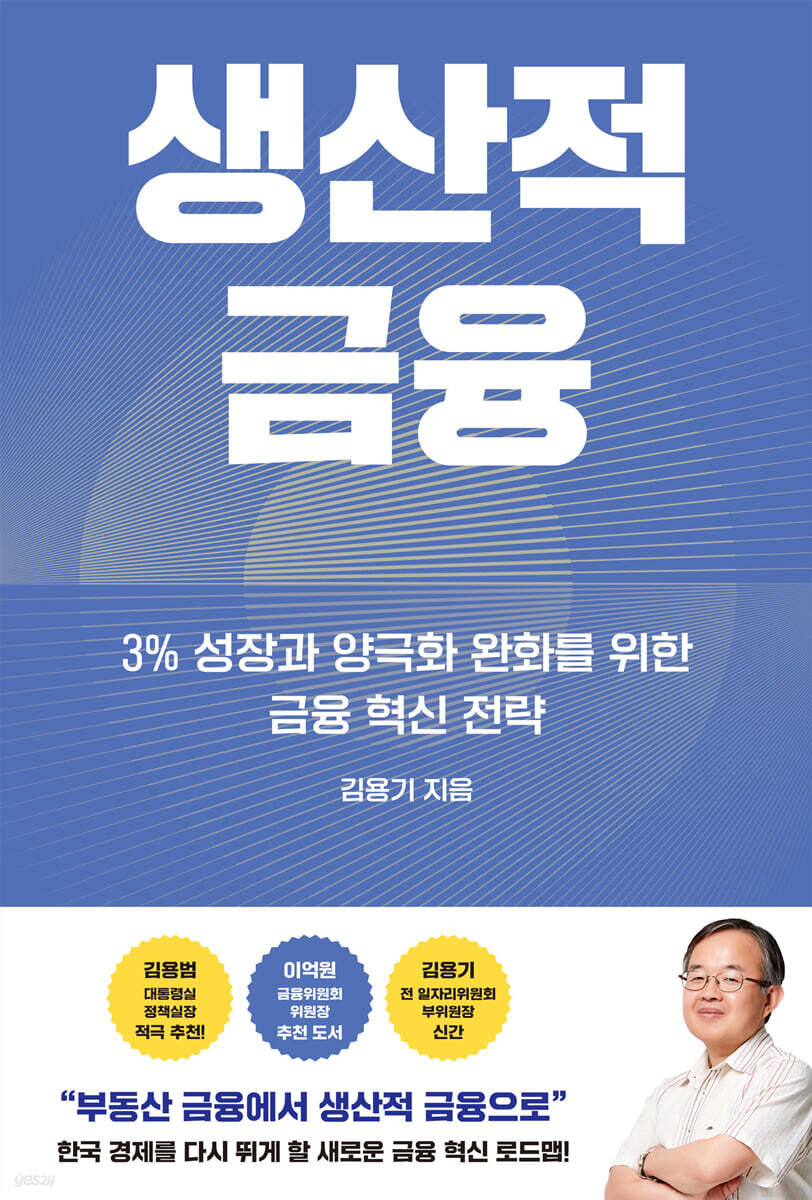
Productive Finance
 |
Description
Book Introduction
The Lee Jae-myung administration's core economic strategy: "Transition to Productive Finance."
The first book to present the theoretical foundation and implementation strategy!
Where do the problems facing the Korean economy—low growth, over-concentration in real estate, household debt, and polarization—come from, and what are the solutions? A new book, "Productive Finance," by Kim Yong-gi, a former professor at Ajou University and former vice-chairman (ministerial level) of the Presidential Committee on Job Creation under the Moon Jae-in administration, offers a comprehensive answer to these questions.
This book is in line with the direction of the "transition to productive finance" policy recently presented by the Lee Jae-myung administration as a key economic strategy.
This is also why recommendations from key figures in economic policy, such as Kim Yong-beom, policy chief of the Blue House, and Lee Eok-ok, chairman of the Financial Services Commission, followed.
'Productive finance' refers to finance that does not remain limited to real estate or asset markets, but functions as a blood vessel of 'industrial circulation' that revitalizes industries, people, and regions.
The author sharply diagnoses the reality that finance is stuck in unproductive asset markets, unable to flow into productive investment in the real economy, and proposes solutions to turn this around.
This book is not a simple commentary on government policy; it is the first work to systematically and academically systematize the national strategy of "productive finance," and it is a practical blueprint for reforming the Korean financial system.
The first book to present the theoretical foundation and implementation strategy!
Where do the problems facing the Korean economy—low growth, over-concentration in real estate, household debt, and polarization—come from, and what are the solutions? A new book, "Productive Finance," by Kim Yong-gi, a former professor at Ajou University and former vice-chairman (ministerial level) of the Presidential Committee on Job Creation under the Moon Jae-in administration, offers a comprehensive answer to these questions.
This book is in line with the direction of the "transition to productive finance" policy recently presented by the Lee Jae-myung administration as a key economic strategy.
This is also why recommendations from key figures in economic policy, such as Kim Yong-beom, policy chief of the Blue House, and Lee Eok-ok, chairman of the Financial Services Commission, followed.
'Productive finance' refers to finance that does not remain limited to real estate or asset markets, but functions as a blood vessel of 'industrial circulation' that revitalizes industries, people, and regions.
The author sharply diagnoses the reality that finance is stuck in unproductive asset markets, unable to flow into productive investment in the real economy, and proposes solutions to turn this around.
This book is not a simple commentary on government policy; it is the first work to systematically and academically systematize the national strategy of "productive finance," and it is a practical blueprint for reforming the Korean financial system.
- You can preview some of the book's contents.
Preview
index
Recommendation
In publishing the book
Introduction: Is finance the cause of low growth?
Low growth and sluggish investment in the Korean economy
Asset bias in finance
Inequality and Youth Financial Exclusion
The task of reestablishing finance
Part 1: Why Korean Finance Lost Its Way
Chapter 1: Expansion and Structural Characteristics of Korean Finance
1.
Financial assets outpacing the real economy
2.
Five Structural Factors That Drive the Rapid Growth of Financial Assets
3.
Core Problems in Korea's Financial System
4.
Transition Framework through Innovation in Industrial Finance, Policy Finance, and Capital Markets
Chapter 2: Industrial Cycle vs. Financial Cycle
1.
A cyclical perspective on capitalism
2.
The difference between industrial and financial cycles
3.
A Historical Discussion of Economic Thought on the Separation of Industry and Finance
4.
Historical Trends: The Rise of the Financial Cycle and the Weakening of the Industrial Cycle
5.
Why the financial cycle overwhelms the industrial cycle
6.
Should we suppress or restructure the financial cycle?
7.
Time to reset the direction of the cycle
Chapter 3: The Structure of a Debt Economy Centered on Mortgage Loans
1.
Financial product characteristics and current status of housing mortgage loans
2.
Why Home Mortgage Loans Became the Center of Korean Finance
3.
The Background of the Rapid Rise in Household Debt/GDP Since 2008
4.
The mechanism of mortgage loans that raise asset prices
5.
The impact of expanding mortgage lending on the overall economy
6.
Qualitative Changes in Household Debt and the Key Role of Mortgage Loans
7.
Characteristics of Korean Home Mortgage Loans in International Comparison
8.
Comparing Mortgage Loans and Derivatives: Risks and Consequences
9.
Crisis signals and the possibility of a 'slow collapse'
10.
The effects and limitations of mortgage loan regulations (LTV, DSR, etc.)
11.
Future Challenges of a Mortgage-Centric Financial System
Chapter 4: Inclusive Finance for Young People and the Asset-Loss Class
1.
Why the youth and asset-less class?
2.
International Trends and Implications for Youth Inclusive Finance
3.
Youth definancialization and financial exclusion
4.
Analysis of the Structural Causes of Financial Exclusion
5.
Youth Financial Exclusion in International Comparison
6.
The Social Consequences of Youth Financial Exclusion
7.
The Need for Youth Inclusive Finance
Chapter 5: The Role and Restructuring of Regional Finance
1.
The significance and importance of local finance
2.
Theoretical Basis of Regional Finance
3.
Why Japan's regional finance sector is thriving
4.
Structural Problems in Korean Regional Finance
5.
Best practices abroad (Japan, Germany, USA)
6.
The government's role in strengthening local finance
Part 2: Restructuring Strategies for Productive Finance
Chapter 6 What Should Finance Circulate?
1.
Money is circulating, but where does it go?
2.
Theoretical Foundation: Insights from Keynes and Schumpeter
3.
The Reality of Korean Finance: Circulating Assets Instead of Industries
4.
The social costs of financial circulation and international comparisons
5.
Criteria for production-oriented financial circulation
Chapter 7: The Separation of Industry and Finance: Causes and Consequences
1.
Turning points since the 1990s
2.
Globalization and Financial Liberalization: Korea's Structural Vulnerabilities and Consequences
3.
The structural consequence of the separation of industry and finance
Chapter 8: Possibility of Restructuring the Industrial and Financial Cycle
1.
Lessons from Korea's historical experience
2.
Lessons from overseas cases
3.
Policy Implications for Korea
4.
The direction of a productive financial system to pursue
Chapter 9: The Possibility of Private Finance's Industrial Transition
1.
Structural constraints on private finance
2.
Conditions that enable conversion
3.
Implications from Overseas Cases
4.
Four Key Challenges for Transforming Private Finance
5.
Structural Limitations and Critical Reflection
Chapter 10: The Role of Policy Finance Institutions
1.
Why do we need policy finance institutions?
2.
Types and functions of policy finance institutions
3.
The current state and role of Korea's policy finance institutions
4.
Comparison of policy finance institutions in major overseas countries
5.
The Relationship Between Policy Finance Institutions and Private Finance: Three Models and Current Status
Part 3: The Light and Shadow of the Neoliberal Financialization Era
Chapter 11: A Core Diagnosis of the Neoliberal Financial Phenomenon
1.
Ten Phenomena of the Neoliberal Financial Era
2.
The generalization of financialization
3.
Maximizing shareholder value
4.
Debt-led Growth
5.
Expansion of financial markets and derivatives
6.
Real Estate Bubble and the Wealth Effect
7.
Liberalization of capital movement and financial globalization
8.
Financialization of Monetary Policy: Central Banks' Prioritization of Financial Markets
9.
Short-term performance pressures and the rise of hedge funds and private equity firms
10.
Perpetual Crises
11.
The real economy's deepening dependence on financial institutions
Conclusion: The Path to Financial Reform for 3% Growth and an Inclusive Economy
Comprehensive Implications of Chapter 11
The historical trajectory and structural problems of the Korean financial system
The impact of external dependence and changes in the global financial environment
Weakening of industrial and regional finance and disruption of economic circulation
Vulnerability of household debt structure and financial stability risks
Combining Financial and Industrial Policy: A Condition for Sustainable Growth
Overcoming the neoliberal financial phenomenon and restoring the public nature of finance.
Comprehensive Financial Policy Recommendations for 3% Growth and an Inclusive Economy
Financial Reform Strategy to Alleviate Polarization
References
In publishing the book
Introduction: Is finance the cause of low growth?
Low growth and sluggish investment in the Korean economy
Asset bias in finance
Inequality and Youth Financial Exclusion
The task of reestablishing finance
Part 1: Why Korean Finance Lost Its Way
Chapter 1: Expansion and Structural Characteristics of Korean Finance
1.
Financial assets outpacing the real economy
2.
Five Structural Factors That Drive the Rapid Growth of Financial Assets
3.
Core Problems in Korea's Financial System
4.
Transition Framework through Innovation in Industrial Finance, Policy Finance, and Capital Markets
Chapter 2: Industrial Cycle vs. Financial Cycle
1.
A cyclical perspective on capitalism
2.
The difference between industrial and financial cycles
3.
A Historical Discussion of Economic Thought on the Separation of Industry and Finance
4.
Historical Trends: The Rise of the Financial Cycle and the Weakening of the Industrial Cycle
5.
Why the financial cycle overwhelms the industrial cycle
6.
Should we suppress or restructure the financial cycle?
7.
Time to reset the direction of the cycle
Chapter 3: The Structure of a Debt Economy Centered on Mortgage Loans
1.
Financial product characteristics and current status of housing mortgage loans
2.
Why Home Mortgage Loans Became the Center of Korean Finance
3.
The Background of the Rapid Rise in Household Debt/GDP Since 2008
4.
The mechanism of mortgage loans that raise asset prices
5.
The impact of expanding mortgage lending on the overall economy
6.
Qualitative Changes in Household Debt and the Key Role of Mortgage Loans
7.
Characteristics of Korean Home Mortgage Loans in International Comparison
8.
Comparing Mortgage Loans and Derivatives: Risks and Consequences
9.
Crisis signals and the possibility of a 'slow collapse'
10.
The effects and limitations of mortgage loan regulations (LTV, DSR, etc.)
11.
Future Challenges of a Mortgage-Centric Financial System
Chapter 4: Inclusive Finance for Young People and the Asset-Loss Class
1.
Why the youth and asset-less class?
2.
International Trends and Implications for Youth Inclusive Finance
3.
Youth definancialization and financial exclusion
4.
Analysis of the Structural Causes of Financial Exclusion
5.
Youth Financial Exclusion in International Comparison
6.
The Social Consequences of Youth Financial Exclusion
7.
The Need for Youth Inclusive Finance
Chapter 5: The Role and Restructuring of Regional Finance
1.
The significance and importance of local finance
2.
Theoretical Basis of Regional Finance
3.
Why Japan's regional finance sector is thriving
4.
Structural Problems in Korean Regional Finance
5.
Best practices abroad (Japan, Germany, USA)
6.
The government's role in strengthening local finance
Part 2: Restructuring Strategies for Productive Finance
Chapter 6 What Should Finance Circulate?
1.
Money is circulating, but where does it go?
2.
Theoretical Foundation: Insights from Keynes and Schumpeter
3.
The Reality of Korean Finance: Circulating Assets Instead of Industries
4.
The social costs of financial circulation and international comparisons
5.
Criteria for production-oriented financial circulation
Chapter 7: The Separation of Industry and Finance: Causes and Consequences
1.
Turning points since the 1990s
2.
Globalization and Financial Liberalization: Korea's Structural Vulnerabilities and Consequences
3.
The structural consequence of the separation of industry and finance
Chapter 8: Possibility of Restructuring the Industrial and Financial Cycle
1.
Lessons from Korea's historical experience
2.
Lessons from overseas cases
3.
Policy Implications for Korea
4.
The direction of a productive financial system to pursue
Chapter 9: The Possibility of Private Finance's Industrial Transition
1.
Structural constraints on private finance
2.
Conditions that enable conversion
3.
Implications from Overseas Cases
4.
Four Key Challenges for Transforming Private Finance
5.
Structural Limitations and Critical Reflection
Chapter 10: The Role of Policy Finance Institutions
1.
Why do we need policy finance institutions?
2.
Types and functions of policy finance institutions
3.
The current state and role of Korea's policy finance institutions
4.
Comparison of policy finance institutions in major overseas countries
5.
The Relationship Between Policy Finance Institutions and Private Finance: Three Models and Current Status
Part 3: The Light and Shadow of the Neoliberal Financialization Era
Chapter 11: A Core Diagnosis of the Neoliberal Financial Phenomenon
1.
Ten Phenomena of the Neoliberal Financial Era
2.
The generalization of financialization
3.
Maximizing shareholder value
4.
Debt-led Growth
5.
Expansion of financial markets and derivatives
6.
Real Estate Bubble and the Wealth Effect
7.
Liberalization of capital movement and financial globalization
8.
Financialization of Monetary Policy: Central Banks' Prioritization of Financial Markets
9.
Short-term performance pressures and the rise of hedge funds and private equity firms
10.
Perpetual Crises
11.
The real economy's deepening dependence on financial institutions
Conclusion: The Path to Financial Reform for 3% Growth and an Inclusive Economy
Comprehensive Implications of Chapter 11
The historical trajectory and structural problems of the Korean financial system
The impact of external dependence and changes in the global financial environment
Weakening of industrial and regional finance and disruption of economic circulation
Vulnerability of household debt structure and financial stability risks
Combining Financial and Industrial Policy: A Condition for Sustainable Growth
Overcoming the neoliberal financial phenomenon and restoring the public nature of finance.
Comprehensive Financial Policy Recommendations for 3% Growth and an Inclusive Economy
Financial Reform Strategy to Alleviate Polarization
References
Into the book
When the financial system transforms into a healthy financial system that restores industrial circulation, the Korean economy can find a new path to growth.
This book diagnoses the pathological structure of financialization and proposes practical solutions for restoring finance to a productive and inclusive role.
While the central theme of this book is financialization and dependence on asset markets, I hope the prescriptions presented here will also offer a clue to addressing other issues, including employment, inequality, lack of opportunities for young people, and real estate market instability.
--- From "Publishing a Book"
The most urgent task is the productive transformation of finance.
It is a structural shift that directs the flow of finance from unproductive assets such as real estate and stocks to the real economy and innovative industries.
If finance has been stuck in the financial cycle of 'real estate collateral → loan → asset price increase → additional loan' until now, it must return to the industrial cycle of 'investment → production → employment → income → consumption → reinvestment' in the future.
--- From "Introduction"
Industrial cycles create jobs and pave the way for everyone to live well together.
On the other hand, the financial cycle only brings wealth to those who have assets.
Depending on which circulation the economy relies on more, distribution and the social structure itself change.
While industrial circulation creates relatively equal opportunities, financial circulation fosters wealth polarization by adding more wealth to existing assets.
So, what kind of economy are we living in now? --- From Chapter 2, "Industrial Cycle vs. Financial Cycle"
Ultimately, a mortgage loan means more than just 'money to buy a house.'
It connects the flow of financial capital to the real economy and has a ripple effect on production, employment, and consumption.
It enables asset formation and generational economic participation, and from a policy perspective, it serves as a tool to regulate the balance between the economy and the financial system.
Currently, it operates primarily through transactions of existing assets, and its functions are limited. However, redesigning it as a tool for restoring balance will be an unavoidable task as the Korean economy moves toward its goals of 3% growth and alleviating polarization.
--- From Chapter 3, "The Structure of a Debt Economy Centered on Mortgage Loans"
Youth inclusive finance is not simply a matter of expanding financial products; it is a strategic task that supports Korean society as a whole.
We need to move away from collateral-centric screening and instead reflect the credit history and cash flow of young people through financial structural reform.
We need to open a path to stable asset formation by developing youth-friendly long-term savings, pension, and customized products that support asset accumulation.
Furthermore, we must combine housing, employment, and education policies with inclusive finance policies to ensure that young people can participate in finance on a stable foundation.
--- From Chapter 4, “Inclusive Finance for the Youth and the Asset-Free Class”
Local finance is not simply a 'local issue'.
It is a national task that determines the balanced development and sustainability of the Korean economy and the future of the younger generation.
--- From Chapter 5, “The Role and Restructuring of Regional Finance”
Ultimately, the answer to the question posed in this chapter—“What should finance circulate?”—is clear.
Finance should circulate industry and innovation, employment and income, and social stability.
This is the path for Korea to escape the trap of low growth and inequality and achieve a new leap forward, and it is the starting point for Part 2 of this book, "Restructuring Strategies for Productive Finance."
--- From Chapter 6, “What Should Finance Circulate?”
We must clearly recognize that the transformation of private finance is not a spontaneous change, but rather the product of policy intervention and social pressure.
Discussions emphasizing the potential for conversion should not serve as a means of obscuring the inherent limitations of private finance.
In other words, the assertion that “transition is possible” must be accompanied by the conditional recognition that “transition is impossible without eliminating structural constraints.”
--- From Chapter 9, “The Possibility of Private Finance’s Industrial Transition”
Policy finance goes beyond simply compensating for market failures; it serves as a crucial strategic catalyst for restructuring the entire economy around industrial cycles.
For the Korean economy, now in a low-growth phase, to move beyond a financial cycle-driven structure and onto a sustainable growth path, it is imperative to reaffirm the theoretical foundations of policy finance and further strengthen its role.
--- From Chapter 10, “The Role of Policy Finance Institutions”
Understanding the neoliberal era means understanding how finance has come to dominate and dominate the real economy.
The strengthening of finance was not a mere byproduct, but a deliberately designed consequence of the ideology and institutions of neoliberalism.
--- From Chapter 11, "The Core Diagnosis of the Neoliberal Financial Phenomenon"
For the Korean economy to overcome its prolonged low-growth phase and simultaneously achieve sustainable 3% growth and an inclusive economy, it is necessary to redefine the role of finance and develop a comprehensive financial policy package encompassing industrial policy, regional policy, and global cooperation.
This will be a key condition for returning the Korean economy to a growth path that is both productive and inclusive.
This book diagnoses the pathological structure of financialization and proposes practical solutions for restoring finance to a productive and inclusive role.
While the central theme of this book is financialization and dependence on asset markets, I hope the prescriptions presented here will also offer a clue to addressing other issues, including employment, inequality, lack of opportunities for young people, and real estate market instability.
--- From "Publishing a Book"
The most urgent task is the productive transformation of finance.
It is a structural shift that directs the flow of finance from unproductive assets such as real estate and stocks to the real economy and innovative industries.
If finance has been stuck in the financial cycle of 'real estate collateral → loan → asset price increase → additional loan' until now, it must return to the industrial cycle of 'investment → production → employment → income → consumption → reinvestment' in the future.
--- From "Introduction"
Industrial cycles create jobs and pave the way for everyone to live well together.
On the other hand, the financial cycle only brings wealth to those who have assets.
Depending on which circulation the economy relies on more, distribution and the social structure itself change.
While industrial circulation creates relatively equal opportunities, financial circulation fosters wealth polarization by adding more wealth to existing assets.
So, what kind of economy are we living in now? --- From Chapter 2, "Industrial Cycle vs. Financial Cycle"
Ultimately, a mortgage loan means more than just 'money to buy a house.'
It connects the flow of financial capital to the real economy and has a ripple effect on production, employment, and consumption.
It enables asset formation and generational economic participation, and from a policy perspective, it serves as a tool to regulate the balance between the economy and the financial system.
Currently, it operates primarily through transactions of existing assets, and its functions are limited. However, redesigning it as a tool for restoring balance will be an unavoidable task as the Korean economy moves toward its goals of 3% growth and alleviating polarization.
--- From Chapter 3, "The Structure of a Debt Economy Centered on Mortgage Loans"
Youth inclusive finance is not simply a matter of expanding financial products; it is a strategic task that supports Korean society as a whole.
We need to move away from collateral-centric screening and instead reflect the credit history and cash flow of young people through financial structural reform.
We need to open a path to stable asset formation by developing youth-friendly long-term savings, pension, and customized products that support asset accumulation.
Furthermore, we must combine housing, employment, and education policies with inclusive finance policies to ensure that young people can participate in finance on a stable foundation.
--- From Chapter 4, “Inclusive Finance for the Youth and the Asset-Free Class”
Local finance is not simply a 'local issue'.
It is a national task that determines the balanced development and sustainability of the Korean economy and the future of the younger generation.
--- From Chapter 5, “The Role and Restructuring of Regional Finance”
Ultimately, the answer to the question posed in this chapter—“What should finance circulate?”—is clear.
Finance should circulate industry and innovation, employment and income, and social stability.
This is the path for Korea to escape the trap of low growth and inequality and achieve a new leap forward, and it is the starting point for Part 2 of this book, "Restructuring Strategies for Productive Finance."
--- From Chapter 6, “What Should Finance Circulate?”
We must clearly recognize that the transformation of private finance is not a spontaneous change, but rather the product of policy intervention and social pressure.
Discussions emphasizing the potential for conversion should not serve as a means of obscuring the inherent limitations of private finance.
In other words, the assertion that “transition is possible” must be accompanied by the conditional recognition that “transition is impossible without eliminating structural constraints.”
--- From Chapter 9, “The Possibility of Private Finance’s Industrial Transition”
Policy finance goes beyond simply compensating for market failures; it serves as a crucial strategic catalyst for restructuring the entire economy around industrial cycles.
For the Korean economy, now in a low-growth phase, to move beyond a financial cycle-driven structure and onto a sustainable growth path, it is imperative to reaffirm the theoretical foundations of policy finance and further strengthen its role.
--- From Chapter 10, “The Role of Policy Finance Institutions”
Understanding the neoliberal era means understanding how finance has come to dominate and dominate the real economy.
The strengthening of finance was not a mere byproduct, but a deliberately designed consequence of the ideology and institutions of neoliberalism.
--- From Chapter 11, "The Core Diagnosis of the Neoliberal Financial Phenomenon"
For the Korean economy to overcome its prolonged low-growth phase and simultaneously achieve sustainable 3% growth and an inclusive economy, it is necessary to redefine the role of finance and develop a comprehensive financial policy package encompassing industrial policy, regional policy, and global cooperation.
This will be a key condition for returning the Korean economy to a growth path that is both productive and inclusive.
--- From "Conclusion: 'The Path to Financial Reform for 3% Growth and an Inclusive Economy'"
Publisher's Review
“From real estate finance to productive finance!”
A new financial innovation roadmap to revitalize the Korean economy!
“If money circulates only in financial transactions and does not flow into the real economy,
“The economy will lose its vitality.”
Where do the problems facing the Korean economy today—low growth, high housing prices, excessive household debt, and deepening polarization—come from?
The Korean economy is now trapped in the shadow of its assets rather than being an engine of growth.
In a society where 'money earned from assets' is greater than 'money earned from work', and in a structure where finance increases housing prices rather than fostering businesses, young people are losing the ladder of opportunity, and the real economy is losing its vitality.
This book, "Productive Finance," diagnoses this reality as "the result of the wrong flow of financial circulation from industry to assets," and identifies the cause as a structural failure of the financial system, stating, "What is needed now is not the amount of money, but the direction of money."
The author finds it in the structural failure of the financial system that created a world where 'the price of housing, not the wages derived from production and labor, determine one's life.'
It provides a sharp diagnosis of the pathological structure in which finance fails to flow into productive investment in the real economy and is stuck in a "financial cycle" centered on transactions in unproductive assets such as real estate and stocks.
Amidst the surge in asset prices and the collateral-centric financial structure, young people and the asset-less class are unable to overcome the barriers to institutional finance, and finance has transformed from a "ladder of hope" to a device that confirms the unattainable upper class.
This book exposes the vulnerabilities of a debt economy centered on mortgage loans and accurately diagnoses the problems of a centralized financial system that marginalizes young people and local economies.
However, the virtue of this book lies in not stopping at diagnosing the problems of the Korean economy but also suggesting solutions.
The answer is ‘a shift to productive finance.’
In other words, it presents a concrete strategy for transitioning to productive finance that directs the flow of finance from unproductive assets such as real estate to the real economy and innovative industries. It also presents a new roadmap for financial innovation that will revitalize the Korean economy through suggestions for redefining the role of policy finance, differential application of discipline, and comprehensive policies to achieve 3% growth and alleviate polarization.
In that respect, this book is a comprehensive strategy book that presents a financial innovation strategy to address the contemporary challenges of structural low growth and extreme polarization in the Korean economy.
From financial to industrial circulation
─ Blueprint for New Growth
This book does not stop at analyzing the pathological structure of the Korean financial system.
The author suggests a return from the financial cycle of 'real estate collateral → loans → rising asset prices' to the industrial cycle of 'investment → production → employment → income → consumption → reinvestment' as the first step toward economic recovery in Korea.
This book presents three strategies for restructuring Korean finance.
First, it is ‘productive transformation of finance and restoration of industrial cycle.’
A structural shift that returns the flow of finance to industrial circulation is a top priority. Policy finance must go beyond compensating for market failures and become a crucial strategic catalyst for restructuring the entire economy around industrial circulation.
Recognizing that private finance struggles to voluntarily engage in industrial finance due to inherent constraints such as soundness regulations and profitability principles, it is necessary to establish policy supplementary measures, such as differential risk weighting for loans to innovative companies, to provide institutional incentives for private capital to flow into industry.
The second is ‘building an inclusive financial system.’
To this end, they argue that, first of all, to resolve youth and regional marginalization, low-interest, unsecured loan programs or basic financial systems for youth and the asset-less class should be introduced, thereby restoring finance to its function as a ladder for asset accumulation and social mobility.
Furthermore, to prevent the outflow of local funds and enhance the self-reliance of local economies, we must revitalize local banks and regional financial institutions through regulatory differentiation that reflects regional specificities, as in Japan, and link this with support for specialized regional industries.
The third is ‘recovery of democratic governance and publicness.’
To this end, it is necessary to democratize finance and restore its public nature so that finance can function as a public infrastructure for social stability beyond a tool for private gain. In addition, it is necessary to establish an industrial finance council, a public-private cooperation platform in which the government, financial institutions, and industry participate, to organically combine financial and industrial policies. In addition, it is argued that the performance evaluation criteria of policy finance institutions should be shifted from short-term 'profitability' to 'social contribution and industrial effect', so as to encourage a focus on long-term innovation and job creation.
These author's solutions can be said to be not only the theoretical foundation for the Lee Jae-myung administration's "transition to productive finance," but also specific implementation plans.
“If finance only operates with real estate and assets as collateral,
“New industries and innovative companies cannot grow.”
It most clearly reveals the core spirit of “productive finance.”
When finance invests in people and the potential for innovation, rather than the value of assets, 3% growth and an inclusive economy are no longer impossible dreams but achievable national strategies.
This book is not simply a critique of finance.
This is a comprehensive reform strategy that designs a structural transformation of Korean finance, encompassing policy finance, private finance, and regional finance.
To revitalize the growth mechanism of the Korean economy, we carefully design how finance must change.
This book goes beyond simply supplementing government policy; it encompasses both policy and theory, exploring a new path for Korean finance.
It persuasively presents a shift from real estate-centered finance to industry-centered finance, and from profit-centered finance to social circulation-centered finance.
"When finance revitalizes people, industries, and regions, that is 'productive finance.'" This book is for everyone seeking a new paradigm shift in the Korean economy.
Structure and main contents of this book
This book is structured in three parts, including an introduction and a conclusion.
First, in the 'Introduction', the author states that the low growth and asset inequality of the Korean economy are due to the structural distortion in which finance is not flowing into productive investment in the real economy, but rather into unproductive assets such as real estate and stocks, and that to overcome this, a productive shift that directs the flow of finance from 'financial circulation' to 'industrial circulation' is an urgent task.
Part 1, "Why Did Korea's Finance Lose Its Way," analyzes the structural problems and historical background that led to the Korean financial system losing its function as a core infrastructure for the real economy and losing its way.
We analyze the rapid expansion of financial assets in Korea and its characteristics (Chapter 1), and contrast the current reality in which the economic cycle is being overwhelmed by the financial cycle, which aims to increase asset prices, from the industrial cycle, which promotes production and employment (Chapter 2).
In particular, it emphasizes that Korea's debt economy is structured around mortgage loans, accumulating household debt and promoting the rise of real estate markets and financial asset prices, but its contribution to the real economy is minimal (Chapter 3).
Furthermore, this paper delves into the problems of how these systems exacerbate financial exclusion among young people and the asset-poor, thereby perpetuating social inequality (Chapter 4), and weakening the role of local finance, thereby diminishing the vitality of local economies (Chapter 5).
Part 2, "Restructuring Strategies for Productive Finance," presents specific strategies and solutions to restructure the financial system in a productive and inclusive direction, helping the Korean economy escape the trap of low growth and inequality.
The central question of Part 2 is, "What should finance circulate?" The author argues that finance should circulate industry and innovation, employment and income, and social stability, rather than assets (Chapter 6).
To this end, we diagnose the structural causes of the separation of finance and industry since the 1990s (Chapter 7) and emphasize that policy finance institutions should go beyond simply compensating for market failures and become strategic catalysts for restructuring the entire economy around industrial cycles (Chapter 8).
Furthermore, it is acknowledged that it is difficult for private finance to voluntarily transition to industrial finance due to structural constraints such as soundness discipline (BIS regulation) and profitability logic (Chapter 9), and it is argued that policy finance institutions are essential in filling the gaps in the market that private finance finds difficult to handle, such as long-term and uncertain innovation investments, support for strategic industries, and regional finance, and that ultimately, they must function as important strategic catalysts that go beyond simply supplementing market failures and reorganize the entire economic structure around industrial cycles (Chapter 10).
Part 3, "The Era of Neoliberal Financialization: Its Light and Shadow," examines how the structural problems of the Korean financial system stem from the broader global trend of neoliberal financialization, and systematically diagnoses ten key characteristics of this phenomenon (Chapter 11).
In the "Conclusion," the author argues that overcoming the phenomenon of liberal financialization and restoring the public nature of finance are key to the Korean economy overcoming the "triple crisis" of low growth, inequality, and financial instability. To achieve this, comprehensive financial reform is required, shifting the flow of finance toward productive investment and establishing a new financial paradigm that combines publicness, equity, and stability.
A new financial innovation roadmap to revitalize the Korean economy!
“If money circulates only in financial transactions and does not flow into the real economy,
“The economy will lose its vitality.”
Where do the problems facing the Korean economy today—low growth, high housing prices, excessive household debt, and deepening polarization—come from?
The Korean economy is now trapped in the shadow of its assets rather than being an engine of growth.
In a society where 'money earned from assets' is greater than 'money earned from work', and in a structure where finance increases housing prices rather than fostering businesses, young people are losing the ladder of opportunity, and the real economy is losing its vitality.
This book, "Productive Finance," diagnoses this reality as "the result of the wrong flow of financial circulation from industry to assets," and identifies the cause as a structural failure of the financial system, stating, "What is needed now is not the amount of money, but the direction of money."
The author finds it in the structural failure of the financial system that created a world where 'the price of housing, not the wages derived from production and labor, determine one's life.'
It provides a sharp diagnosis of the pathological structure in which finance fails to flow into productive investment in the real economy and is stuck in a "financial cycle" centered on transactions in unproductive assets such as real estate and stocks.
Amidst the surge in asset prices and the collateral-centric financial structure, young people and the asset-less class are unable to overcome the barriers to institutional finance, and finance has transformed from a "ladder of hope" to a device that confirms the unattainable upper class.
This book exposes the vulnerabilities of a debt economy centered on mortgage loans and accurately diagnoses the problems of a centralized financial system that marginalizes young people and local economies.
However, the virtue of this book lies in not stopping at diagnosing the problems of the Korean economy but also suggesting solutions.
The answer is ‘a shift to productive finance.’
In other words, it presents a concrete strategy for transitioning to productive finance that directs the flow of finance from unproductive assets such as real estate to the real economy and innovative industries. It also presents a new roadmap for financial innovation that will revitalize the Korean economy through suggestions for redefining the role of policy finance, differential application of discipline, and comprehensive policies to achieve 3% growth and alleviate polarization.
In that respect, this book is a comprehensive strategy book that presents a financial innovation strategy to address the contemporary challenges of structural low growth and extreme polarization in the Korean economy.
From financial to industrial circulation
─ Blueprint for New Growth
This book does not stop at analyzing the pathological structure of the Korean financial system.
The author suggests a return from the financial cycle of 'real estate collateral → loans → rising asset prices' to the industrial cycle of 'investment → production → employment → income → consumption → reinvestment' as the first step toward economic recovery in Korea.
This book presents three strategies for restructuring Korean finance.
First, it is ‘productive transformation of finance and restoration of industrial cycle.’
A structural shift that returns the flow of finance to industrial circulation is a top priority. Policy finance must go beyond compensating for market failures and become a crucial strategic catalyst for restructuring the entire economy around industrial circulation.
Recognizing that private finance struggles to voluntarily engage in industrial finance due to inherent constraints such as soundness regulations and profitability principles, it is necessary to establish policy supplementary measures, such as differential risk weighting for loans to innovative companies, to provide institutional incentives for private capital to flow into industry.
The second is ‘building an inclusive financial system.’
To this end, they argue that, first of all, to resolve youth and regional marginalization, low-interest, unsecured loan programs or basic financial systems for youth and the asset-less class should be introduced, thereby restoring finance to its function as a ladder for asset accumulation and social mobility.
Furthermore, to prevent the outflow of local funds and enhance the self-reliance of local economies, we must revitalize local banks and regional financial institutions through regulatory differentiation that reflects regional specificities, as in Japan, and link this with support for specialized regional industries.
The third is ‘recovery of democratic governance and publicness.’
To this end, it is necessary to democratize finance and restore its public nature so that finance can function as a public infrastructure for social stability beyond a tool for private gain. In addition, it is necessary to establish an industrial finance council, a public-private cooperation platform in which the government, financial institutions, and industry participate, to organically combine financial and industrial policies. In addition, it is argued that the performance evaluation criteria of policy finance institutions should be shifted from short-term 'profitability' to 'social contribution and industrial effect', so as to encourage a focus on long-term innovation and job creation.
These author's solutions can be said to be not only the theoretical foundation for the Lee Jae-myung administration's "transition to productive finance," but also specific implementation plans.
“If finance only operates with real estate and assets as collateral,
“New industries and innovative companies cannot grow.”
It most clearly reveals the core spirit of “productive finance.”
When finance invests in people and the potential for innovation, rather than the value of assets, 3% growth and an inclusive economy are no longer impossible dreams but achievable national strategies.
This book is not simply a critique of finance.
This is a comprehensive reform strategy that designs a structural transformation of Korean finance, encompassing policy finance, private finance, and regional finance.
To revitalize the growth mechanism of the Korean economy, we carefully design how finance must change.
This book goes beyond simply supplementing government policy; it encompasses both policy and theory, exploring a new path for Korean finance.
It persuasively presents a shift from real estate-centered finance to industry-centered finance, and from profit-centered finance to social circulation-centered finance.
"When finance revitalizes people, industries, and regions, that is 'productive finance.'" This book is for everyone seeking a new paradigm shift in the Korean economy.
Structure and main contents of this book
This book is structured in three parts, including an introduction and a conclusion.
First, in the 'Introduction', the author states that the low growth and asset inequality of the Korean economy are due to the structural distortion in which finance is not flowing into productive investment in the real economy, but rather into unproductive assets such as real estate and stocks, and that to overcome this, a productive shift that directs the flow of finance from 'financial circulation' to 'industrial circulation' is an urgent task.
Part 1, "Why Did Korea's Finance Lose Its Way," analyzes the structural problems and historical background that led to the Korean financial system losing its function as a core infrastructure for the real economy and losing its way.
We analyze the rapid expansion of financial assets in Korea and its characteristics (Chapter 1), and contrast the current reality in which the economic cycle is being overwhelmed by the financial cycle, which aims to increase asset prices, from the industrial cycle, which promotes production and employment (Chapter 2).
In particular, it emphasizes that Korea's debt economy is structured around mortgage loans, accumulating household debt and promoting the rise of real estate markets and financial asset prices, but its contribution to the real economy is minimal (Chapter 3).
Furthermore, this paper delves into the problems of how these systems exacerbate financial exclusion among young people and the asset-poor, thereby perpetuating social inequality (Chapter 4), and weakening the role of local finance, thereby diminishing the vitality of local economies (Chapter 5).
Part 2, "Restructuring Strategies for Productive Finance," presents specific strategies and solutions to restructure the financial system in a productive and inclusive direction, helping the Korean economy escape the trap of low growth and inequality.
The central question of Part 2 is, "What should finance circulate?" The author argues that finance should circulate industry and innovation, employment and income, and social stability, rather than assets (Chapter 6).
To this end, we diagnose the structural causes of the separation of finance and industry since the 1990s (Chapter 7) and emphasize that policy finance institutions should go beyond simply compensating for market failures and become strategic catalysts for restructuring the entire economy around industrial cycles (Chapter 8).
Furthermore, it is acknowledged that it is difficult for private finance to voluntarily transition to industrial finance due to structural constraints such as soundness discipline (BIS regulation) and profitability logic (Chapter 9), and it is argued that policy finance institutions are essential in filling the gaps in the market that private finance finds difficult to handle, such as long-term and uncertain innovation investments, support for strategic industries, and regional finance, and that ultimately, they must function as important strategic catalysts that go beyond simply supplementing market failures and reorganize the entire economic structure around industrial cycles (Chapter 10).
Part 3, "The Era of Neoliberal Financialization: Its Light and Shadow," examines how the structural problems of the Korean financial system stem from the broader global trend of neoliberal financialization, and systematically diagnoses ten key characteristics of this phenomenon (Chapter 11).
In the "Conclusion," the author argues that overcoming the phenomenon of liberal financialization and restoring the public nature of finance are key to the Korean economy overcoming the "triple crisis" of low growth, inequality, and financial instability. To achieve this, comprehensive financial reform is required, shifting the flow of finance toward productive investment and establishing a new financial paradigm that combines publicness, equity, and stability.
GOODS SPECIFICS
- Date of issue: October 30, 2025
- Page count, weight, size: 424 pages | 147*217*24mm
- ISBN13: 9791157064823
You may also like
카테고리
korean


korean

![GQ KOREA Mark (Monthly): December [2025]](http://librairie.coreenne.fr/cdn/shop/files/8ef265dbbfbf186523ed75ba7319009d.jpg?v=1765340328&width=3840)


