

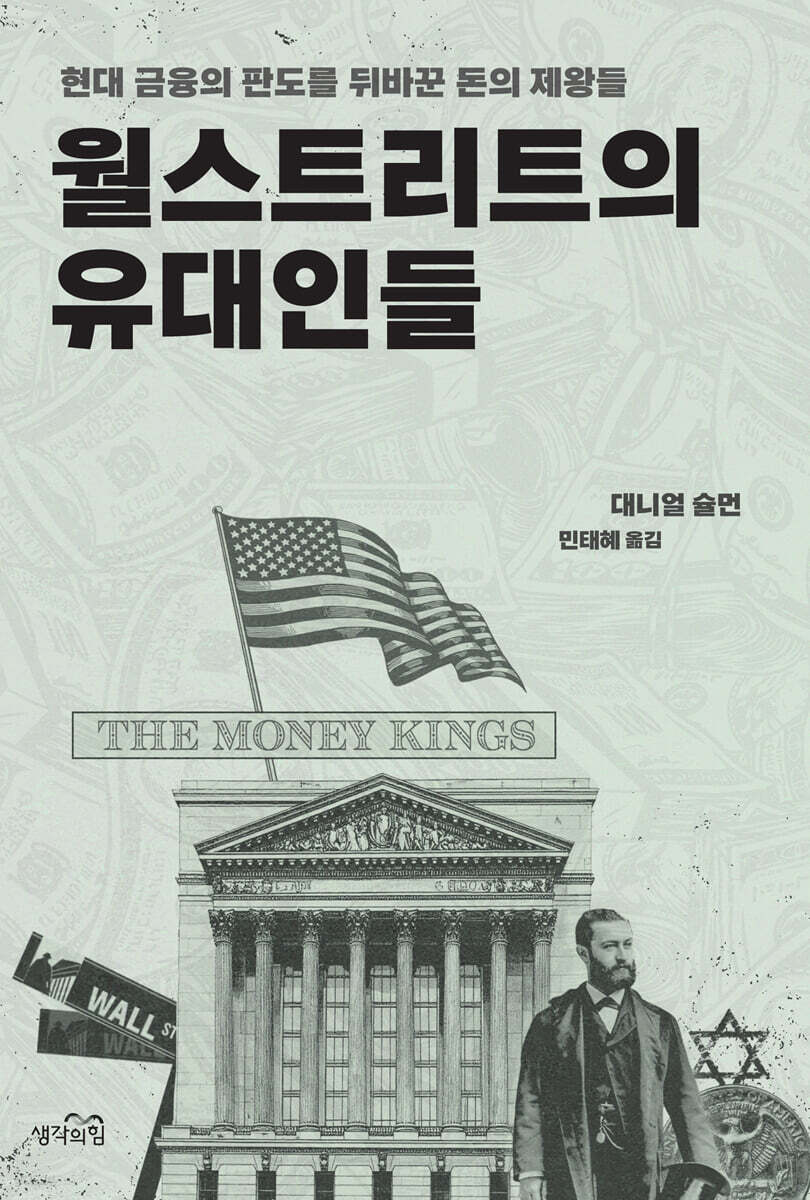
Jews on Wall Street
 |
Description
Book Introduction
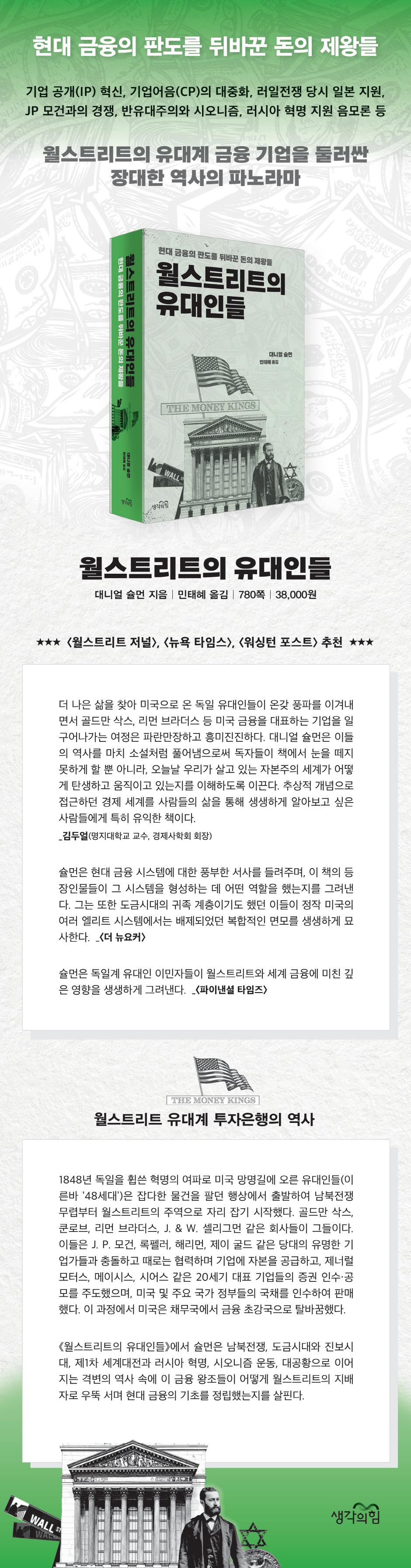
Why did Japan accept thousands of Jewish refugees fleeing Europe during World War II? Japan's stance differed from that of its ally, Germany, because it believed Jewish financial networks held absolute influence in global financial markets.
The background to this thinking is the historical fact that during the Russo-Japanese War, Jewish capital on Wall Street financed a significant portion of Japan's war expenses, and thus, contrary to popular expectations that Russia would win, it provided crucial assistance in Japan's victory.
Jewish immigrants from Germany who fled the revolution and upheaval around 1848 to the United States (the '48ers) started out as peddlers, opened general stores, and soon began to transform into bankers by buying up bills from local merchants and lending them money.
Those who made money by procuring military supplies and selling government bonds during the Civil War were J.
Alongside P. Morgan, he built financial institutions that would grow into the world's largest investment banks, including Kuhnlob, Goldman Sachs, Lehman Brothers, and Seligman.
They transformed the United States into a financial superpower by providing capital to American industrial companies and acquiring and distributing securities of 20th-century corporations such as General Motors, Macy's, and Sears.
The Jewish Empire of Wall Street is a book about these Jewish financial companies and J.
It is an epic story that involves the entire world, including giant corporations such as P. Morgan, Rockefeller, and Henry Ford, the U.S. government, and even World War I and the Russian Revolution.
This book unfolds the rise of German Jewish financiers to financial power on Wall Street in a panoramic manner, covering diverse historical events such as the American Civil War, the failure of the Panama Canal, the Russo-Japanese War, World War I, the Russian Revolution, several financial crises, and the Great Depression.
The background to this thinking is the historical fact that during the Russo-Japanese War, Jewish capital on Wall Street financed a significant portion of Japan's war expenses, and thus, contrary to popular expectations that Russia would win, it provided crucial assistance in Japan's victory.
Jewish immigrants from Germany who fled the revolution and upheaval around 1848 to the United States (the '48ers) started out as peddlers, opened general stores, and soon began to transform into bankers by buying up bills from local merchants and lending them money.
Those who made money by procuring military supplies and selling government bonds during the Civil War were J.
Alongside P. Morgan, he built financial institutions that would grow into the world's largest investment banks, including Kuhnlob, Goldman Sachs, Lehman Brothers, and Seligman.
They transformed the United States into a financial superpower by providing capital to American industrial companies and acquiring and distributing securities of 20th-century corporations such as General Motors, Macy's, and Sears.
The Jewish Empire of Wall Street is a book about these Jewish financial companies and J.
It is an epic story that involves the entire world, including giant corporations such as P. Morgan, Rockefeller, and Henry Ford, the U.S. government, and even World War I and the Russian Revolution.
This book unfolds the rise of German Jewish financiers to financial power on Wall Street in a panoramic manner, covering diverse historical events such as the American Civil War, the failure of the Panama Canal, the Russo-Japanese War, World War I, the Russian Revolution, several financial crises, and the Great Depression.
- You can preview some of the book's contents.
Preview
index
Preface: Debt
Prologue: Salem Fields
Part 1 Origin
1.
And brothers
2.
The advance of peddlers
3.
Manifest Destiny
4.
The wealth brought by war
Part 2 Growth
5.
Imperial City
6.
Panic! 1
7.
little giant
8.
Gilded Ghetto
9.
Montefiore in the United States
10.
The Great Escape
11.
The end of an era
Part 3: The Golden Age
12.
Mergers and Acquisitions
13.
Partners and competitors
14 Jupiter's Shadow
15.
perfect peace
16.
The sinews of war
17.
Harriman Removal Alliance
18.
Goldman Sachs' gold
19.
And still they come
20.
passport issues
21.
Hunters
The Fall of the Fourth Dynasty
22.
The barrier between us
23.
Allied Powers
24.
Land of Heroes
25.
Prelude to Tragedy
26.
Henry Ford
27.
The world to come
Epilogue: Salem Fields Rediscovered
To those who helped
main
References
Photo source
Search
Prologue: Salem Fields
Part 1 Origin
1.
And brothers
2.
The advance of peddlers
3.
Manifest Destiny
4.
The wealth brought by war
Part 2 Growth
5.
Imperial City
6.
Panic! 1
7.
little giant
8.
Gilded Ghetto
9.
Montefiore in the United States
10.
The Great Escape
11.
The end of an era
Part 3: The Golden Age
12.
Mergers and Acquisitions
13.
Partners and competitors
14 Jupiter's Shadow
15.
perfect peace
16.
The sinews of war
17.
Harriman Removal Alliance
18.
Goldman Sachs' gold
19.
And still they come
20.
passport issues
21.
Hunters
The Fall of the Fourth Dynasty
22.
The barrier between us
23.
Allied Powers
24.
Land of Heroes
25.
Prelude to Tragedy
26.
Henry Ford
27.
The world to come
Epilogue: Salem Fields Rediscovered
To those who helped
main
References
Photo source
Search
Detailed image
Into the book
Meyer Lehman's move to the American South was driven not only by the promise of economic opportunity but also by the unrest caused by political unrest.
A series of bloody riots swept Europe starting in 1848, when Karl Marx and Friedrich Engels published The Communist Manifesto.
Like a lit fuse, the flames of resistance spread from Italy to France, the independent German states, and the Habsburg Empire, and the flames of revolution burned throughout most of Western Europe.
--- 「2.
From "The Advance of the Peddler"
The Civil War sowed the seeds of great wealth that would grow even more during the coming Gilded Age.
This hastened the national transition from an agricultural economy to an industrial economy.
Mannheim writes in “Seeds and Trees” that “an unprecedented aristocracy has emerged.
“They are the oil magnates, the railroad barons, the merchant princes, and the financial lords,” he wrote.
They built their fiefdoms on the still-soft clay of the future of American finance, a legacy that would endure for generations.
In New York, which George Washington called the "center of empire," tomorrow's tycoons began building their own empires.
--- 「4.
From "The Wealth of War"
The Panic of 1873 is considered one of the first global financial crises.
And in some ways, from the volatility of the mortgage-backed securities that underpinned the railroad boom to the credit crunch that exacerbated the situation, it bore a striking resemblance to the financial crisis of 2007-08, which drove Lehman Brothers to bankruptcy and imperiled other long-established firms like Goldman Sachs.
The 1873 crisis was a time for Wall Street to sort out the wheat from the chaff, and as a result, Lehman Brothers and Marcus Goldman survived the panic and thrived thereafter.
Goldman steadily built a financial empire by lending money to downtown merchants while his competitors underestimated him.
--- 「6.
From "Panic!"
The largest Jewish exodus since the expulsion of Jews from Spain in 1492 began with an incident on March 13, 1881.
This mass migration fundamentally reshaped Jewish life, and over the next three decades, nearly two million Jews immigrated to the United States.
--- 「10.
From "The Great Escape"
In 1889, when funds ran out, work ceased and the Panama Canal Company went bankrupt.
(Omitted) The shock brought about by the company's bankruptcy soon turned into anger.
This was because it was revealed that the Panama Canal Company had bribed French parliamentarians, and in return, parliament had authorized the company to issue bonds worth 600 million francs in 1888.
The French government launched an investigation, and Ferdinand de Lesseps and his son Charles de Lesseps were brought to trial on corruption charges, both of whom were sentenced to five years in prison.
The repercussions of this scandal went beyond just wasting millions of francs, leaving investors penniless and sending managers and officials to prison.
(Omitted) In this atmosphere, another controversy arose in 1894.
Alfred Dreyfus, a young Jewish artillery officer in the French Army, was convicted of treason for passing military secrets to the German embassy in Paris.
Although Dreyfus was eventually found innocent, the 12-year struggle to free him deeply divided French society, and anti-Semitic sentiment spread rapidly despite his innocence.
--- 「11.
The end of an era
Part of his vast fortune was due to Kuhnroe's recent bold investments in the railroad industry, particularly Schiff's rescue of the bankrupt Union Pacific Railroad.
This incident elevated Schiff to the ranks of John Pierpont Morgan, a figure known as "Jupiter," a god-like figure who ruled the financial world.
--- 「13.
Among “partners and competitors”
During and immediately after the war, Kunloff oversaw five issuances of Japanese government bonds totaling $180 million.
This amounted to more than 20 percent of Japan's total war costs.
Both the Japanese and Russian governments acknowledged Schiff's central role in financing the war.
Even before the war ended, the Emperor of Japan awarded Sif the Second Class Order of Merit, which is given to those who have rendered outstanding service to the Empire.
Meanwhile, Schiff became the object of particular hatred by the Russian government.
Six years after the war, Russian Finance Minister Kokovtsov expressed his anger, saying, “Our government will never forgive or forget what the Jew Schiff did to us.”
--- 「16.
From "The Tendons of War"
As a result of the Portsmouth Conference, Japan obtained from Russia (under a conditional agreement) the southern branch of the Chinese Eastern Railway, which ran from Harbin in northeastern China to Port Arthur at the southern tip of the Liaodong Peninsula.
Harriman saw securing control of this railway, which the Japanese had renamed the South Manchuria Railway, as the first step toward realizing his vision.
(Omitted) “If I can secure the operating rights for the South Manchuria Railway from Japan, I will buy the Eastern Chinese Railway from Russia and build a line that runs along the Trans-Siberian Railway to the Baltic Sea.
And if a steamship line were built to run to the United States, it would connect to the transcontinental railroad and to the Pacific Mail steamships (a leading steamship company on the US-Asia route in the late 19th and early 20th centuries) and the Japanese transpacific steamships on the Pacific coast.
This will be the most amazing transportation system in the world.
We will circle the Earth.”
--- 「17.
From the "Harriman Removal Alliance"
Henry Goldman believed that by capitalizing on this goodwill, he could encourage ordinary investors to invest in a new type of company: one built on its ability to generate future profits.
The timing was perfect.
As President Roosevelt strengthened regulations on railroads and monopolies, investors sought places to invest their capital that were relatively free from the influence of antitrust policies.
(Omitted) Henry Goldman is often mythologized as the godfather of modern IPOs, but this is an exaggerated assessment.
Although he mastered the financial and marketing alchemy required for a successful IPO, he was not a pioneer, but rather an early entrant into the new market for corporate securities underwriting and public offerings.
--- 「18.
From "Goldman Sachs' Gold"
President Wilson signed the Federal Reserve Act shortly after 6:00 p.m. on December 23rd, using four gold-bore fountain pens in turn.
Paul was pleased with the final version, even though he saw some flaws in it.
Although the limit of the number of regional reserve banks to 12 was considered somewhat inefficient, it was considered a success compared to the originally proposed number of 20.
It also included a provision that designated the issuance of currency, which Paul strongly opposed, as the "responsibility of the U.S. government."
--- 「21.
From "The Hunters"
Schiff said there was only one condition for participating in the Allied loan.
If Britain and France had written that they would “not give Russia a single cent of the loan.”
If the remaining partners disagree with him or want to proceed with the deal without these conditions, he said, “then I will leave the company.”
--- 「23.
Among the "United Nations"
Around this time, Woodrow Wilson was briefed on another shocking document.
The document, which emerged from Russia, consisted of 68 circulars and letters allegedly written by German bankers, government officials, and others, and contained claims that Bolshevik leaders, including Trotsky and Lenin, were German agents and had been sent on a mission to instigate a revolution and force Russia out of the war.
A series of bloody riots swept Europe starting in 1848, when Karl Marx and Friedrich Engels published The Communist Manifesto.
Like a lit fuse, the flames of resistance spread from Italy to France, the independent German states, and the Habsburg Empire, and the flames of revolution burned throughout most of Western Europe.
--- 「2.
From "The Advance of the Peddler"
The Civil War sowed the seeds of great wealth that would grow even more during the coming Gilded Age.
This hastened the national transition from an agricultural economy to an industrial economy.
Mannheim writes in “Seeds and Trees” that “an unprecedented aristocracy has emerged.
“They are the oil magnates, the railroad barons, the merchant princes, and the financial lords,” he wrote.
They built their fiefdoms on the still-soft clay of the future of American finance, a legacy that would endure for generations.
In New York, which George Washington called the "center of empire," tomorrow's tycoons began building their own empires.
--- 「4.
From "The Wealth of War"
The Panic of 1873 is considered one of the first global financial crises.
And in some ways, from the volatility of the mortgage-backed securities that underpinned the railroad boom to the credit crunch that exacerbated the situation, it bore a striking resemblance to the financial crisis of 2007-08, which drove Lehman Brothers to bankruptcy and imperiled other long-established firms like Goldman Sachs.
The 1873 crisis was a time for Wall Street to sort out the wheat from the chaff, and as a result, Lehman Brothers and Marcus Goldman survived the panic and thrived thereafter.
Goldman steadily built a financial empire by lending money to downtown merchants while his competitors underestimated him.
--- 「6.
From "Panic!"
The largest Jewish exodus since the expulsion of Jews from Spain in 1492 began with an incident on March 13, 1881.
This mass migration fundamentally reshaped Jewish life, and over the next three decades, nearly two million Jews immigrated to the United States.
--- 「10.
From "The Great Escape"
In 1889, when funds ran out, work ceased and the Panama Canal Company went bankrupt.
(Omitted) The shock brought about by the company's bankruptcy soon turned into anger.
This was because it was revealed that the Panama Canal Company had bribed French parliamentarians, and in return, parliament had authorized the company to issue bonds worth 600 million francs in 1888.
The French government launched an investigation, and Ferdinand de Lesseps and his son Charles de Lesseps were brought to trial on corruption charges, both of whom were sentenced to five years in prison.
The repercussions of this scandal went beyond just wasting millions of francs, leaving investors penniless and sending managers and officials to prison.
(Omitted) In this atmosphere, another controversy arose in 1894.
Alfred Dreyfus, a young Jewish artillery officer in the French Army, was convicted of treason for passing military secrets to the German embassy in Paris.
Although Dreyfus was eventually found innocent, the 12-year struggle to free him deeply divided French society, and anti-Semitic sentiment spread rapidly despite his innocence.
--- 「11.
The end of an era
Part of his vast fortune was due to Kuhnroe's recent bold investments in the railroad industry, particularly Schiff's rescue of the bankrupt Union Pacific Railroad.
This incident elevated Schiff to the ranks of John Pierpont Morgan, a figure known as "Jupiter," a god-like figure who ruled the financial world.
--- 「13.
Among “partners and competitors”
During and immediately after the war, Kunloff oversaw five issuances of Japanese government bonds totaling $180 million.
This amounted to more than 20 percent of Japan's total war costs.
Both the Japanese and Russian governments acknowledged Schiff's central role in financing the war.
Even before the war ended, the Emperor of Japan awarded Sif the Second Class Order of Merit, which is given to those who have rendered outstanding service to the Empire.
Meanwhile, Schiff became the object of particular hatred by the Russian government.
Six years after the war, Russian Finance Minister Kokovtsov expressed his anger, saying, “Our government will never forgive or forget what the Jew Schiff did to us.”
--- 「16.
From "The Tendons of War"
As a result of the Portsmouth Conference, Japan obtained from Russia (under a conditional agreement) the southern branch of the Chinese Eastern Railway, which ran from Harbin in northeastern China to Port Arthur at the southern tip of the Liaodong Peninsula.
Harriman saw securing control of this railway, which the Japanese had renamed the South Manchuria Railway, as the first step toward realizing his vision.
(Omitted) “If I can secure the operating rights for the South Manchuria Railway from Japan, I will buy the Eastern Chinese Railway from Russia and build a line that runs along the Trans-Siberian Railway to the Baltic Sea.
And if a steamship line were built to run to the United States, it would connect to the transcontinental railroad and to the Pacific Mail steamships (a leading steamship company on the US-Asia route in the late 19th and early 20th centuries) and the Japanese transpacific steamships on the Pacific coast.
This will be the most amazing transportation system in the world.
We will circle the Earth.”
--- 「17.
From the "Harriman Removal Alliance"
Henry Goldman believed that by capitalizing on this goodwill, he could encourage ordinary investors to invest in a new type of company: one built on its ability to generate future profits.
The timing was perfect.
As President Roosevelt strengthened regulations on railroads and monopolies, investors sought places to invest their capital that were relatively free from the influence of antitrust policies.
(Omitted) Henry Goldman is often mythologized as the godfather of modern IPOs, but this is an exaggerated assessment.
Although he mastered the financial and marketing alchemy required for a successful IPO, he was not a pioneer, but rather an early entrant into the new market for corporate securities underwriting and public offerings.
--- 「18.
From "Goldman Sachs' Gold"
President Wilson signed the Federal Reserve Act shortly after 6:00 p.m. on December 23rd, using four gold-bore fountain pens in turn.
Paul was pleased with the final version, even though he saw some flaws in it.
Although the limit of the number of regional reserve banks to 12 was considered somewhat inefficient, it was considered a success compared to the originally proposed number of 20.
It also included a provision that designated the issuance of currency, which Paul strongly opposed, as the "responsibility of the U.S. government."
--- 「21.
From "The Hunters"
Schiff said there was only one condition for participating in the Allied loan.
If Britain and France had written that they would “not give Russia a single cent of the loan.”
If the remaining partners disagree with him or want to proceed with the deal without these conditions, he said, “then I will leave the company.”
--- 「23.
Among the "United Nations"
Around this time, Woodrow Wilson was briefed on another shocking document.
The document, which emerged from Russia, consisted of 68 circulars and letters allegedly written by German bankers, government officials, and others, and contained claims that Bolshevik leaders, including Trotsky and Lenin, were German agents and had been sent on a mission to instigate a revolution and force Russia out of the war.
--- 「26.
From "Henry Ford"
From "Henry Ford"
Publisher's Review
German Jewish Immigrants and the History of American Finance
The 1840s in Europe were a time of upheaval and revolution.
In particular, many Jews came to the United States to escape revolution and persecution in Germany in 1848, when the Communist Manifesto was published.
They started out as small peddlers and soon expanded into general stores.
The Civil War was a turning point for them.
The Northern and Confederate governments each had to procure large amounts of military supplies and war funds.
At this time, German Jewish merchants made a lot of money by using their European connections to sell government bonds from the South and the North in Europe.
Marcus Goldman, derided as a "bill clipper," pioneered the market for unsecured short-term paper, later called commercial paper (CP).
They also achieved various financial innovations, such as discovering and listing companies with intangible capital, such as reputation, as opposed to companies with large asset holdings (such as railroad companies).
The Federal Reserve, the central bank of the United States, was also created under the leadership of German Jews.
Paul Warburg, a member of the Hamburg-based Warburg banking family, came to New York for marriage and worked as a partner at Kuhnlob.
When the Panic of 1907 broke out in the United States, he, who was familiar with the European central banking model, found the American financial system completely incomprehensible.
In the United States, where there was no central bank, J.
Financial firms like P. Morgan responded to the panic by stepping in and persuading other banks to prevent the market from collapsing.
Eventually, Paul Warburg drafted the bill, which was passed by both the House and Senate, and the Federal Reserve System was launched in 1914.
Why did Wall Street support Japan in the Russo-Japanese War?
A World History of Hatred and Finance
Korekiyo Takahashi (seven times Minister of Foreign Affairs and Prime Minister), who can be said to be the architect of modern Japanese finance, was traveling around Europe and the United States to raise funds for Japan's war expenses during the Russo-Japanese War.
However, in a situation where most expected Russia to win, no banker was willing to buy and sell Japanese government bonds.
The same was true of the Rothschilds, then the world's largest financial institution, which already had close ties to the Russian Tsarist government.
At this time, the German Warburg Bank, run by Jacob Schiff's Kuhnroe and his relatives, stepped in and acquired and sold Japanese government bonds.
In early March, with Japan's victory at the Battle of Fengtian, the tide of the war turned sharply, and a large crowd of people gathered in front of Kunloff's headquarters in Manhattan to buy the next issue of Japanese government bonds that Kunloff had just put up for sale.
For his decisive contribution to Japan's victory in the war, Schiff was awarded the Order of the Rising Sun, the highest decoration of its kind, by the Emperor of Japan.
Why did Schiff support Japan? Since the Great Exodus from Spain began in 1492, the greatest persecution of Jews occurred in Russia.
In 1881, immediately after Alexander II was killed in a bombing by the socialist group Narodnaya Volya, pogroms were carried out in various places, with the initial anti-Semitism compounded by fake news that Jews were behind the attack.
Since then, more than two million Russian Jews have immigrated to the United States.
Schiff lobbied the U.S. government to pressure Russia to end its persecution of Jews, and while this achieved some success, the Tsarist government's persecution of Jews continued.
Ironically, Schiff's desire to see the Russian Tsarist autocracy fall led to suspicions that he had supported the Bolshevik Revolution.
It was a conspiracy theory that he was a secret supporter of Lenin and Trotsky, that he led the Russian Revolution, and that he executed the Romanov family.
These suspicions gave rise to the forged document "The Protocols of the Elders of Zion," which was actively promoted by Henry Ford and Hitler, who was supported by Ford.
The Gilded Age over 100 years ago,
Are financial excesses and inequalities recurring?
The United States in the late 19th century experienced remarkable industrial growth and financial expansion, which was called the Gilded Age.
But behind the splendid prosperity lay the shadow of extreme inequality, excessive financial power, and speculation.
The infamous Jay Gould gold hoarding scandal of 1869 symbolized how Wall Street could be controlled by a small group of speculators.
Railroad speculation and credit expansion led to the stock market crash of 1873, triggering the first global panic.
The subsequent takeover battle between Harriman and Hill (behind Schiff vs. Morgan) over the Northern Pacific Railroad in 1895 was the highlight of the Gilded Age financial power struggle.
The financial monopolies and railroad cartels of that time overlap with the influence of today's Big Tech companies.
During the Gilded Age, the railroad industry once accounted for 60% of stock market trading volume, and the boards of these railroad companies were monopolized by a small number of financial firms.
Even today, big tech companies that have mastered new technologies like artificial intelligence wield enormous economic power.
By illuminating the roots and consequences of speculation, monopolies, and inequality during the Gilded Age, The Jews of Wall Street offers a chance for reflection for our modern-day selves.
The 1840s in Europe were a time of upheaval and revolution.
In particular, many Jews came to the United States to escape revolution and persecution in Germany in 1848, when the Communist Manifesto was published.
They started out as small peddlers and soon expanded into general stores.
The Civil War was a turning point for them.
The Northern and Confederate governments each had to procure large amounts of military supplies and war funds.
At this time, German Jewish merchants made a lot of money by using their European connections to sell government bonds from the South and the North in Europe.
Marcus Goldman, derided as a "bill clipper," pioneered the market for unsecured short-term paper, later called commercial paper (CP).
They also achieved various financial innovations, such as discovering and listing companies with intangible capital, such as reputation, as opposed to companies with large asset holdings (such as railroad companies).
The Federal Reserve, the central bank of the United States, was also created under the leadership of German Jews.
Paul Warburg, a member of the Hamburg-based Warburg banking family, came to New York for marriage and worked as a partner at Kuhnlob.
When the Panic of 1907 broke out in the United States, he, who was familiar with the European central banking model, found the American financial system completely incomprehensible.
In the United States, where there was no central bank, J.
Financial firms like P. Morgan responded to the panic by stepping in and persuading other banks to prevent the market from collapsing.
Eventually, Paul Warburg drafted the bill, which was passed by both the House and Senate, and the Federal Reserve System was launched in 1914.
Why did Wall Street support Japan in the Russo-Japanese War?
A World History of Hatred and Finance
Korekiyo Takahashi (seven times Minister of Foreign Affairs and Prime Minister), who can be said to be the architect of modern Japanese finance, was traveling around Europe and the United States to raise funds for Japan's war expenses during the Russo-Japanese War.
However, in a situation where most expected Russia to win, no banker was willing to buy and sell Japanese government bonds.
The same was true of the Rothschilds, then the world's largest financial institution, which already had close ties to the Russian Tsarist government.
At this time, the German Warburg Bank, run by Jacob Schiff's Kuhnroe and his relatives, stepped in and acquired and sold Japanese government bonds.
In early March, with Japan's victory at the Battle of Fengtian, the tide of the war turned sharply, and a large crowd of people gathered in front of Kunloff's headquarters in Manhattan to buy the next issue of Japanese government bonds that Kunloff had just put up for sale.
For his decisive contribution to Japan's victory in the war, Schiff was awarded the Order of the Rising Sun, the highest decoration of its kind, by the Emperor of Japan.
Why did Schiff support Japan? Since the Great Exodus from Spain began in 1492, the greatest persecution of Jews occurred in Russia.
In 1881, immediately after Alexander II was killed in a bombing by the socialist group Narodnaya Volya, pogroms were carried out in various places, with the initial anti-Semitism compounded by fake news that Jews were behind the attack.
Since then, more than two million Russian Jews have immigrated to the United States.
Schiff lobbied the U.S. government to pressure Russia to end its persecution of Jews, and while this achieved some success, the Tsarist government's persecution of Jews continued.
Ironically, Schiff's desire to see the Russian Tsarist autocracy fall led to suspicions that he had supported the Bolshevik Revolution.
It was a conspiracy theory that he was a secret supporter of Lenin and Trotsky, that he led the Russian Revolution, and that he executed the Romanov family.
These suspicions gave rise to the forged document "The Protocols of the Elders of Zion," which was actively promoted by Henry Ford and Hitler, who was supported by Ford.
The Gilded Age over 100 years ago,
Are financial excesses and inequalities recurring?
The United States in the late 19th century experienced remarkable industrial growth and financial expansion, which was called the Gilded Age.
But behind the splendid prosperity lay the shadow of extreme inequality, excessive financial power, and speculation.
The infamous Jay Gould gold hoarding scandal of 1869 symbolized how Wall Street could be controlled by a small group of speculators.
Railroad speculation and credit expansion led to the stock market crash of 1873, triggering the first global panic.
The subsequent takeover battle between Harriman and Hill (behind Schiff vs. Morgan) over the Northern Pacific Railroad in 1895 was the highlight of the Gilded Age financial power struggle.
The financial monopolies and railroad cartels of that time overlap with the influence of today's Big Tech companies.
During the Gilded Age, the railroad industry once accounted for 60% of stock market trading volume, and the boards of these railroad companies were monopolized by a small number of financial firms.
Even today, big tech companies that have mastered new technologies like artificial intelligence wield enormous economic power.
By illuminating the roots and consequences of speculation, monopolies, and inequality during the Gilded Age, The Jews of Wall Street offers a chance for reflection for our modern-day selves.
GOODS SPECIFICS
- Date of issue: September 26, 2025
- Page count, weight, size: 780 pages | 988g | 152*225*38mm
- ISBN13: 9791194880196
- ISBN10: 1194880193
You may also like
카테고리
korean


korean

![GQ KOREA Mark (Monthly): December [2025]](http://librairie.coreenne.fr/cdn/shop/files/8ef265dbbfbf186523ed75ba7319009d.jpg?v=1765340328&width=3840)


