

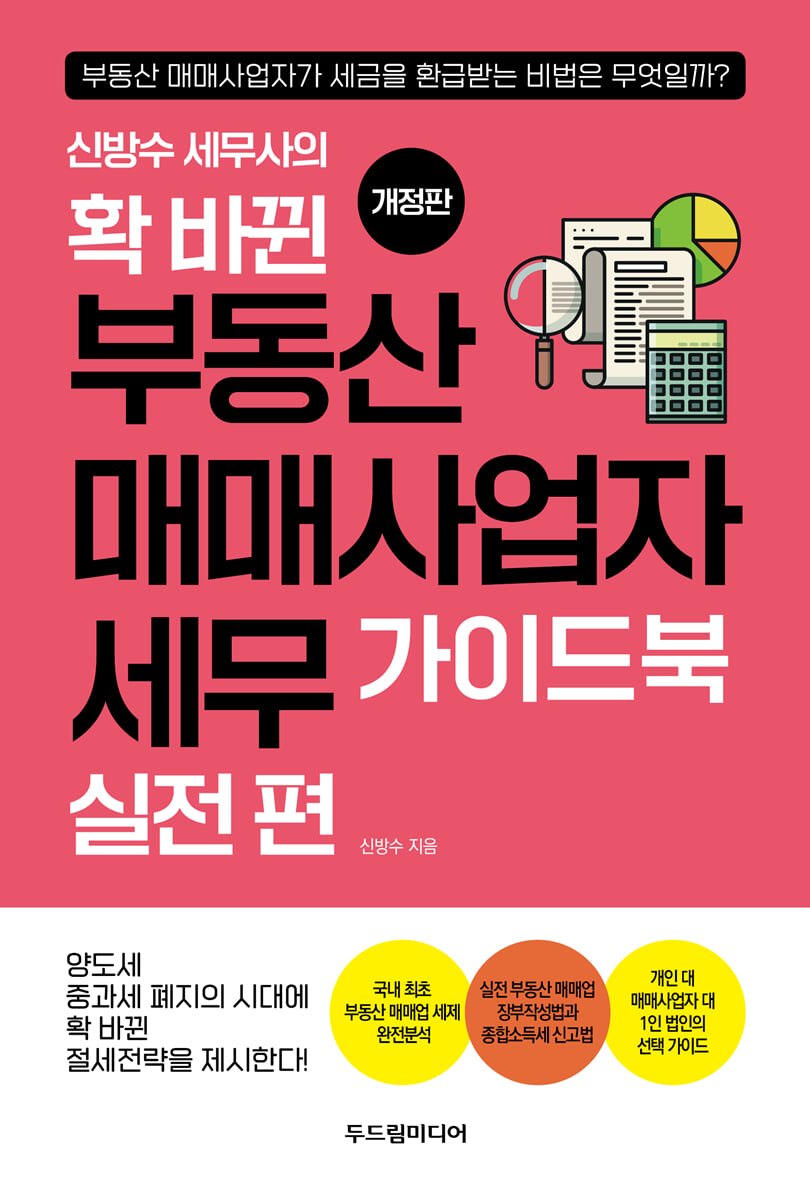
A Practical Guide to Real Estate Sales Business Taxes: A Completely Revamped Guidebook
 |
Description
Book Introduction
Korea's first complete analysis of real estate transaction taxation.
As the real estate market changes, tax regulations for real estate transactions are becoming increasingly complex.
As a result, many business owners are experiencing difficulties in tax processing and are exposed to the risk of additional tax burden or tax audit due to incorrect tax reporting.
Accordingly, we have revised and published a comprehensive, practice-oriented tax guidebook to help individual and corporate business owners engaged in real estate transactions operate their businesses stably through proper tax processing.
This book focuses on tax issues that frequently arise in actual work, rather than complex tax law provisions, and contains practical content that can be applied immediately.
Additionally, it provides practical assistance to business owners by presenting not only simple tax reporting methods but also legal tax-saving measures and risk management strategies.
This book covers all the essential tax issues for real estate investors, examining acquisition tax, holding tax, rental income tax, and capital gains tax from the perspective of an auction investor.
Additionally, we have separately organized methods for saving capital gains tax directly related to the rate of return.
In the second half, the pros and cons of real estate transactions are summarized, as well as reporting methods for transactions related to housing or land.
Lastly, we discussed in depth the tax exemption laws for residential housing for real estate agents.
Let's establish a smart tax-saving strategy through this book that solves problems using various practical examples.
As the real estate market changes, tax regulations for real estate transactions are becoming increasingly complex.
As a result, many business owners are experiencing difficulties in tax processing and are exposed to the risk of additional tax burden or tax audit due to incorrect tax reporting.
Accordingly, we have revised and published a comprehensive, practice-oriented tax guidebook to help individual and corporate business owners engaged in real estate transactions operate their businesses stably through proper tax processing.
This book focuses on tax issues that frequently arise in actual work, rather than complex tax law provisions, and contains practical content that can be applied immediately.
Additionally, it provides practical assistance to business owners by presenting not only simple tax reporting methods but also legal tax-saving measures and risk management strategies.
This book covers all the essential tax issues for real estate investors, examining acquisition tax, holding tax, rental income tax, and capital gains tax from the perspective of an auction investor.
Additionally, we have separately organized methods for saving capital gains tax directly related to the rate of return.
In the second half, the pros and cons of real estate transactions are summarized, as well as reporting methods for transactions related to housing or land.
Lastly, we discussed in depth the tax exemption laws for residential housing for real estate agents.
Let's establish a smart tax-saving strategy through this book that solves problems using various practical examples.
index
Preface 4
Note 12
Chapter 1: Basics of Auction (Sales) Tax
1.
Auction Tax and Profitability 16
2.
Auction and Acquisition Tax Savings 22
3.
Auction and Property Tax Savings Tips 30
4.
Auction and Rental Income Tax Savings Tip 34
5.
Auction and Capital Gains Tax Savings (Tax-Exempt Cases) 38
6.
Auction and Capital Gains Tax Savings (Taxable Cases) 43
In-Depth Analysis of NPL Investment and Taxation Methods 49
Chapter 2: Tax Savings on Transfer Income from Auctioned Real Estate
1.
Check the transfer tax structure that determines the rate of return. 54
2.
Use necessary expenses 58
3.
Conquering the Dangers of Combined Taxation 68
4.
Conquer the Capital Gains Tax 73
5.
Conquer Value Added Tax When Transferring Real Estate 78
6.
Become a master of real estate transactions 83
In-Depth Analysis: The Impact of the Abolition of the Capital Gains Tax 89
Chapter 3: Pros and Cons of Real Estate Sales
1.
What does real estate sales mean? 94
2.
100 Advantages of Real Estate Trading
3.
105 Disadvantages of Real Estate Sales
In-Depth Analysis 1: Distinction between Business Income and Capital Gains 110
In-Depth Analysis 2: How to Manage Real Estate Transaction Taxes? 117
Chapter 4: Basic Knowledge on Taxation in the Real Estate Transaction Industry
1.
Real Estate Transactions and Tax System 122
2.
Issues arising from the transfer of real estate by real estate agents 126
3.
All About the Comparative Taxation System for Real Estate Sales Businesses 131
4.
The Relationship Between the Transfer Tax Rate Application Act and Comparative Taxation 137
5.
The Relationship Between the Determination of Overtaxation of Transfer Tax and the Comparative Taxation System 141
In-Depth Analysis 1: How to Report Real Estate Income Tax 146
In-Depth Analysis 2: Understanding Comprehensive and Classified Taxation 149
Chapter 5 Real Estate Transactions, Business Registration, and Various Tax Reporting Laws
1.
Determination of Value-Added Tax and Exemption in Real Estate Transactions 156
2.
Apply for real estate sales business registration 163
3.
Business Status Report (Tax-Exempt Business) 173
4.
Value-Added Tax Report (General Taxpayers) 177
5.
Comprehensive Income Tax Return (All Businesses) 182
Chapter 6: Practical Real Estate Sales Business Comprehensive Income Tax Reporting Guidelines
1.
Expected and final declaration of capital gains from the sale of a house (if not subject to comparative taxation) 194
2.
Expected and final declaration of capital gains from the sale of a house (when comparative taxation applies) 201
3.
Land Sale Profit Expected Report and Comprehensive Income Tax Report 208
4.
Building (commercial, officetel) new construction sales business and sales profit report 214
In-Depth Analysis: 219 Tax Savings Points for Comprehensive Income Tax in the Housing Transaction Industry
Chapter 7 Business Owner's Bookkeeping Method (including the application of expense ratios due to non-preparation of books)
1.
Types of ledgers and obligations for their preparation 226
2.
232. Method of handling necessary expenses when preparing ledgers
3.
How to Determine Income When Accounts Are Not Prepared (Simple Expense Ratio vs. Standard Expense Ratio) 239
4.
Practical Comprehensive Income Tax Return (Comprehensive) 246
In-depth Analysis: Application of Simple and Standard Expense Ratios Related to the Real Estate Industry 251
Chapter 8: The Importance of Financial Statements in the Real Estate Transaction Industry
1.
Real Estate and Financial Statements 260
2.
Real Estate and Income Statements 266
3.
Inventory Assets (Real Estate Sales, New Home Sales) and Financial Statements 273
4.
Tangible Assets (Real Estate Lease Business) and Financial Statements 280
In-depth Analysis of Real Estate Transactions and Financial Statements of Businesses 287
Chapter 9 Tax Exemption Law for Residential Housing of Real Estate Agents
1.
Number of Housing Units Owned by Real Estate Agents and Tax Issues 292
2.
Under what conditions is a business owner's residential home tax-exempt? 294
3.
Is the final single-home tax-exempt holding period also recalculated for the residential home of a real estate agent? 299
4.
If I report a home over 85 square meters as capital gains, will it be recognized? 303
5.
Taxation method in case of discontinuation of sales business or conversion of business-use housing into residential housing 308
Appendix: Choosing between Individuals, Businesses, and Corporations
1.
Comparing the Pros and Cons of Capital Gains, Comprehensive Income, and Corporate Income 316
2.
Choosing between Individual and Corporation Real Estate Brokerage 320
3.
Choosing between Individuals and Corporations in Land Sales 325
Note 12
Chapter 1: Basics of Auction (Sales) Tax
1.
Auction Tax and Profitability 16
2.
Auction and Acquisition Tax Savings 22
3.
Auction and Property Tax Savings Tips 30
4.
Auction and Rental Income Tax Savings Tip 34
5.
Auction and Capital Gains Tax Savings (Tax-Exempt Cases) 38
6.
Auction and Capital Gains Tax Savings (Taxable Cases) 43
In-Depth Analysis of NPL Investment and Taxation Methods 49
Chapter 2: Tax Savings on Transfer Income from Auctioned Real Estate
1.
Check the transfer tax structure that determines the rate of return. 54
2.
Use necessary expenses 58
3.
Conquering the Dangers of Combined Taxation 68
4.
Conquer the Capital Gains Tax 73
5.
Conquer Value Added Tax When Transferring Real Estate 78
6.
Become a master of real estate transactions 83
In-Depth Analysis: The Impact of the Abolition of the Capital Gains Tax 89
Chapter 3: Pros and Cons of Real Estate Sales
1.
What does real estate sales mean? 94
2.
100 Advantages of Real Estate Trading
3.
105 Disadvantages of Real Estate Sales
In-Depth Analysis 1: Distinction between Business Income and Capital Gains 110
In-Depth Analysis 2: How to Manage Real Estate Transaction Taxes? 117
Chapter 4: Basic Knowledge on Taxation in the Real Estate Transaction Industry
1.
Real Estate Transactions and Tax System 122
2.
Issues arising from the transfer of real estate by real estate agents 126
3.
All About the Comparative Taxation System for Real Estate Sales Businesses 131
4.
The Relationship Between the Transfer Tax Rate Application Act and Comparative Taxation 137
5.
The Relationship Between the Determination of Overtaxation of Transfer Tax and the Comparative Taxation System 141
In-Depth Analysis 1: How to Report Real Estate Income Tax 146
In-Depth Analysis 2: Understanding Comprehensive and Classified Taxation 149
Chapter 5 Real Estate Transactions, Business Registration, and Various Tax Reporting Laws
1.
Determination of Value-Added Tax and Exemption in Real Estate Transactions 156
2.
Apply for real estate sales business registration 163
3.
Business Status Report (Tax-Exempt Business) 173
4.
Value-Added Tax Report (General Taxpayers) 177
5.
Comprehensive Income Tax Return (All Businesses) 182
Chapter 6: Practical Real Estate Sales Business Comprehensive Income Tax Reporting Guidelines
1.
Expected and final declaration of capital gains from the sale of a house (if not subject to comparative taxation) 194
2.
Expected and final declaration of capital gains from the sale of a house (when comparative taxation applies) 201
3.
Land Sale Profit Expected Report and Comprehensive Income Tax Report 208
4.
Building (commercial, officetel) new construction sales business and sales profit report 214
In-Depth Analysis: 219 Tax Savings Points for Comprehensive Income Tax in the Housing Transaction Industry
Chapter 7 Business Owner's Bookkeeping Method (including the application of expense ratios due to non-preparation of books)
1.
Types of ledgers and obligations for their preparation 226
2.
232. Method of handling necessary expenses when preparing ledgers
3.
How to Determine Income When Accounts Are Not Prepared (Simple Expense Ratio vs. Standard Expense Ratio) 239
4.
Practical Comprehensive Income Tax Return (Comprehensive) 246
In-depth Analysis: Application of Simple and Standard Expense Ratios Related to the Real Estate Industry 251
Chapter 8: The Importance of Financial Statements in the Real Estate Transaction Industry
1.
Real Estate and Financial Statements 260
2.
Real Estate and Income Statements 266
3.
Inventory Assets (Real Estate Sales, New Home Sales) and Financial Statements 273
4.
Tangible Assets (Real Estate Lease Business) and Financial Statements 280
In-depth Analysis of Real Estate Transactions and Financial Statements of Businesses 287
Chapter 9 Tax Exemption Law for Residential Housing of Real Estate Agents
1.
Number of Housing Units Owned by Real Estate Agents and Tax Issues 292
2.
Under what conditions is a business owner's residential home tax-exempt? 294
3.
Is the final single-home tax-exempt holding period also recalculated for the residential home of a real estate agent? 299
4.
If I report a home over 85 square meters as capital gains, will it be recognized? 303
5.
Taxation method in case of discontinuation of sales business or conversion of business-use housing into residential housing 308
Appendix: Choosing between Individuals, Businesses, and Corporations
1.
Comparing the Pros and Cons of Capital Gains, Comprehensive Income, and Corporate Income 316
2.
Choosing between Individual and Corporation Real Estate Brokerage 320
3.
Choosing between Individuals and Corporations in Land Sales 325
Into the book
If you dispose of real estate acquired through an auction in a short period of time, a high tax rate may be applied, which may lower your rate of return by 50-70% or more.
Therefore, investors need to analyze various tax-saving strategies according to the holding period.
However, for houses and land subject to heavy taxation, 6-45% + 10-30%p may be applied.
In addition, there is a heavy tax on acquisition tax and property tax, so you must be well-versed in all taxes (please refer to page 21 for information on the temporary abolition of the heavy tax on transfer tax confirmed by the previous government).
For reference, the new government's tax policy, which was launched on June 4, 2025, is expected to continue the previous government's keynote for the time being.
When the tax reform plan comes out, please obtain related information through the author's cafe, etc.)
--- p.18
The distinction between transfer and business depends on whether the sale of real estate is continuous and repetitive.
If the transfer is a one-time transaction, it can be recognized as transfer income, but if the transfer is continuous or repetitive for business purposes, it can be recognized as business income.
Here, 'business' means 'in connection with business', 'for business', and 'in business'.
Therefore, if a business has a substantial business organization that can create added value and is independent enough to be recognized as a business by social norms, and continuous and repetitive activities are carried out, it is considered to have a business purpose.
--- p.111
TIP.
How to handle homes over 85㎡ without paying value-added tax
· Transaction through comprehensive transfer → Refers to a method of comprehensively transferring a trading business.
· Transfer to a rental property → If the property is transferred while it is being rented, it is considered as goods incidental to tax-exempt services and is therefore exempt from value-added tax.
· Transfer for personal use → Refers to the method of transferring for personal use rather than business use.
--- p.181
Sales were confirmed to be 100 million won and the three major expenses were confirmed to be 50 million won.
If this business's simple expense ratio is 90% and its standard expense ratio is 20%, what is its income? However, this business qualifies for simplified bookkeeping.
First, let's substitute the preceding number into the equation we saw earlier.
① Income = Sales - 3 major expenses (labor costs, rent, purchase costs) - Sales × Standard expense ratio = 100 million won - 50 million won - (100 million won × 20%) = 30 million won
② Limit: (Income amount - Income amount × Simple expense ratio) × Multiple = (100 million won - 100 million won × 90%) × 2.8 times = 28 million won
Therefore, in this case, the income amount is 28 million won.
Therefore, investors need to analyze various tax-saving strategies according to the holding period.
However, for houses and land subject to heavy taxation, 6-45% + 10-30%p may be applied.
In addition, there is a heavy tax on acquisition tax and property tax, so you must be well-versed in all taxes (please refer to page 21 for information on the temporary abolition of the heavy tax on transfer tax confirmed by the previous government).
For reference, the new government's tax policy, which was launched on June 4, 2025, is expected to continue the previous government's keynote for the time being.
When the tax reform plan comes out, please obtain related information through the author's cafe, etc.)
--- p.18
The distinction between transfer and business depends on whether the sale of real estate is continuous and repetitive.
If the transfer is a one-time transaction, it can be recognized as transfer income, but if the transfer is continuous or repetitive for business purposes, it can be recognized as business income.
Here, 'business' means 'in connection with business', 'for business', and 'in business'.
Therefore, if a business has a substantial business organization that can create added value and is independent enough to be recognized as a business by social norms, and continuous and repetitive activities are carried out, it is considered to have a business purpose.
--- p.111
TIP.
How to handle homes over 85㎡ without paying value-added tax
· Transaction through comprehensive transfer → Refers to a method of comprehensively transferring a trading business.
· Transfer to a rental property → If the property is transferred while it is being rented, it is considered as goods incidental to tax-exempt services and is therefore exempt from value-added tax.
· Transfer for personal use → Refers to the method of transferring for personal use rather than business use.
--- p.181
Sales were confirmed to be 100 million won and the three major expenses were confirmed to be 50 million won.
If this business's simple expense ratio is 90% and its standard expense ratio is 20%, what is its income? However, this business qualifies for simplified bookkeeping.
First, let's substitute the preceding number into the equation we saw earlier.
① Income = Sales - 3 major expenses (labor costs, rent, purchase costs) - Sales × Standard expense ratio = 100 million won - 50 million won - (100 million won × 20%) = 30 million won
② Limit: (Income amount - Income amount × Simple expense ratio) × Multiple = (100 million won - 100 million won × 90%) × 2.8 times = 28 million won
Therefore, in this case, the income amount is 28 million won.
--- p.253
Publisher's Review
Real estate sales business
The secret to getting a tax refund
This book is designed to be helpful to aspiring real estate sales entrepreneurs, individual business owners and corporations currently operating real estate sales businesses, accounting professionals in charge of real estate-related tax affairs, and tax accountants and accountants seeking to enhance their real estate tax expertise. It covers the tax treatment of real estate sales businesses step-by-step, from the basics to practical application.
This book, consisting of a total of 9 chapters, explains the basics of auction (sale) tax in Chapter 1, and provides methods for saving capital gains tax on real estate auctioned in practice in Chapter 2.
Chapter 3 introduces the pros and cons of the real estate transaction business, and Chapter 4 examines the basics of taxation in the real estate transaction business.
Chapter 5 explains real estate sales, business registration, and various tax reporting laws, and Chapter 6 provides practical comprehensive income tax reporting tips for real estate sales.
Chapter 7 introduces the business's bookkeeping method, including the method of applying expense ratios according to the non-preparation of books, and Chapter 8 examines the importance of real estate transactions and financial statements.
Chapter 9 explains the tax exemption for residential housing owned by real estate agents, and finally, the appendix provides a comparison of the tax systems for individuals and corporations, allowing you to choose the business type that suits you best.
This book, which contains the latest case studies necessary for practical use, will help you prepare for various tax risks and be sure to use it when buying or selling real estate!
The secret to getting a tax refund
This book is designed to be helpful to aspiring real estate sales entrepreneurs, individual business owners and corporations currently operating real estate sales businesses, accounting professionals in charge of real estate-related tax affairs, and tax accountants and accountants seeking to enhance their real estate tax expertise. It covers the tax treatment of real estate sales businesses step-by-step, from the basics to practical application.
This book, consisting of a total of 9 chapters, explains the basics of auction (sale) tax in Chapter 1, and provides methods for saving capital gains tax on real estate auctioned in practice in Chapter 2.
Chapter 3 introduces the pros and cons of the real estate transaction business, and Chapter 4 examines the basics of taxation in the real estate transaction business.
Chapter 5 explains real estate sales, business registration, and various tax reporting laws, and Chapter 6 provides practical comprehensive income tax reporting tips for real estate sales.
Chapter 7 introduces the business's bookkeeping method, including the method of applying expense ratios according to the non-preparation of books, and Chapter 8 examines the importance of real estate transactions and financial statements.
Chapter 9 explains the tax exemption for residential housing owned by real estate agents, and finally, the appendix provides a comparison of the tax systems for individuals and corporations, allowing you to choose the business type that suits you best.
This book, which contains the latest case studies necessary for practical use, will help you prepare for various tax risks and be sure to use it when buying or selling real estate!
GOODS SPECIFICS
- Date of issue: July 10, 2025
- Page count, weight, size: 340 pages | 152*225*30mm
- ISBN13: 9791194223856
- ISBN10: 1194223850
You may also like
카테고리
korean


korean

![GQ KOREA Mark (Monthly): December [2025]](http://librairie.coreenne.fr/cdn/shop/files/8ef265dbbfbf186523ed75ba7319009d.jpg?v=1765340328&width=3840)


