

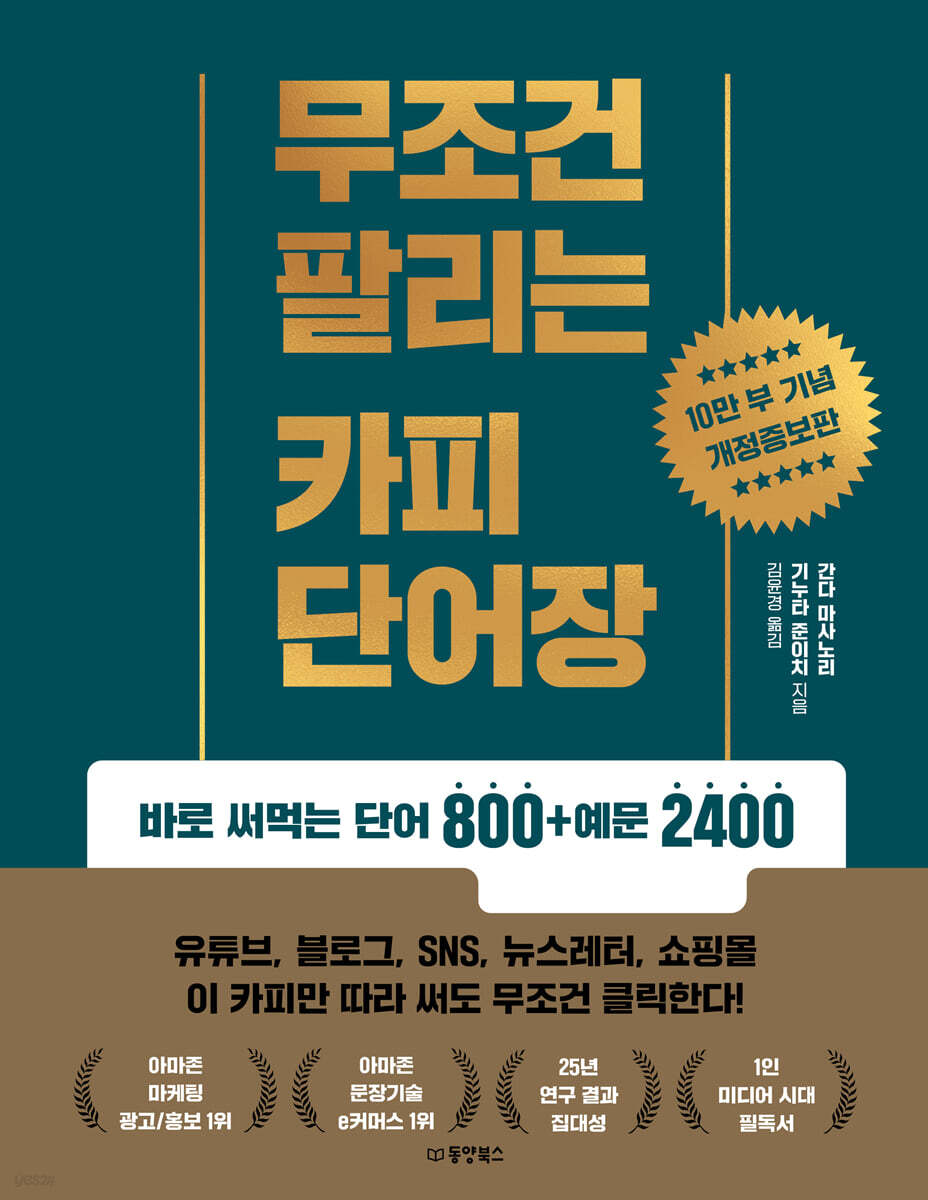
A copybook that sells without fail
 |
Description
Book Introduction
Japan's best marketer,
The Copy Bible Completed by Masanori Kanda
Revised and Expanded Edition of "Copy Word List That Sells Unconditionally" Released
800 words and 2,400 examples extracted from hit ads
If you choose and follow along, it will sell! You will make money!!
Masanori Kanda, a bestselling author of about 100 books and considered one of Japan's top marketers.
One of his representative works, 『Copy Word Book that Sells Unconditionally』, which has been loved as a copy bible in both Korea and Japan, has returned in a revised and expanded edition.
Based on our deepened experience and research, we have significantly added copy words and examples that have proven effective in numerous hit advertisements.
Two appendices, exclusive to this revised and expanded edition, help readers find ideas more easily and quickly in this treasure trove of vocabulary and examples.
Since the publication of "Copy Word List that Sells Unconditionally," several introductory books on copywriting have been published.
But as the saying goes, classics are timeless, and as a bible, this book's power remains strong.
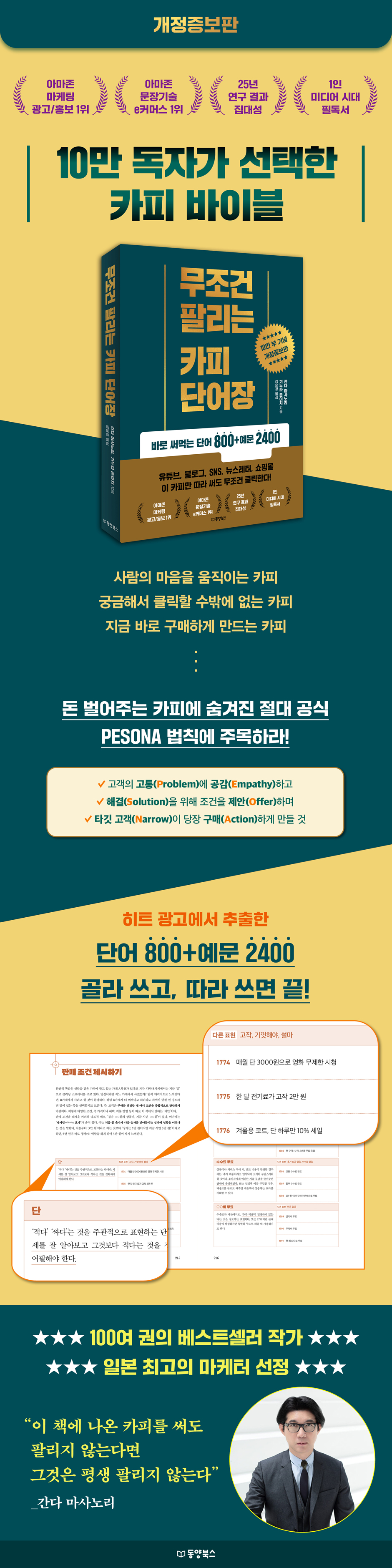
This is because we introduce carefully selected words and examples based on the 'PERSONA law', an absolute formula commonly found in successful copies.
With "Copy Word List That Sells Unconditionally," anyone can instantly write copy that works everywhere: on YouTube, blogs, social media, newsletters, and online shopping malls.
For those of you who are worried about low sales and views that show no signs of increasing, we will give you the joy of ‘selling without fail.’
The Copy Bible Completed by Masanori Kanda
Revised and Expanded Edition of "Copy Word List That Sells Unconditionally" Released
800 words and 2,400 examples extracted from hit ads
If you choose and follow along, it will sell! You will make money!!
Masanori Kanda, a bestselling author of about 100 books and considered one of Japan's top marketers.
One of his representative works, 『Copy Word Book that Sells Unconditionally』, which has been loved as a copy bible in both Korea and Japan, has returned in a revised and expanded edition.
Based on our deepened experience and research, we have significantly added copy words and examples that have proven effective in numerous hit advertisements.
Two appendices, exclusive to this revised and expanded edition, help readers find ideas more easily and quickly in this treasure trove of vocabulary and examples.
Since the publication of "Copy Word List that Sells Unconditionally," several introductory books on copywriting have been published.
But as the saying goes, classics are timeless, and as a bible, this book's power remains strong.
This is because we introduce carefully selected words and examples based on the 'PERSONA law', an absolute formula commonly found in successful copies.
With "Copy Word List That Sells Unconditionally," anyone can instantly write copy that works everywhere: on YouTube, blogs, social media, newsletters, and online shopping malls.
For those of you who are worried about low sales and views that show no signs of increasing, we will give you the joy of ‘selling without fail.’
- You can preview some of the book's contents.
Preview
index
Prologue_ The pen is mightier than the sword
How to get 120% out of this book
[Copy that raises a problem]
Copywriter, the master of problem finding
Point out the problem
Column: The Little-Known History of Copywriting
Show a sense of urgency
Appeal to desire
Asking questions
Arouse curiosity
Creating a gap
Intriguing through comparison
Attract attention
Column: What is Marketing?
[Empathy Copy]
8 Ways to Write Empathically with Just Your Copy
Add a story
Column: Tips for Writing Attention-Grabbing Headlines
Empathize with the reader's emotions
Make recommendations appropriate to the situation
Increase sense of identity
Column: Why I Can't Write
Stimulating the five senses
Expressing sincerity and kindness
Column: Copywriting from Great People ① John Caples
[Copy suggesting a solution]
Think about 'what kind of person will buy this product'
Highlighting important points
Tell me how
Column: The Title of 'Copywriter'
Emphasize simplicity
Column: The Relationship Between Behavioral Economics and Copywriting
Focus on efficiency
Raising expectations
Creating a secretive atmosphere
Column: The "main character" of a copy is the "reader."
Emphasize learning elements
Column: Copywriting from Great People ② David Ogilvy
[Copy presenting the offer terms]
Increase the 'value' of the product you are selling by making a suggestion.
Deliver your proposal
Column: Copywriting from Great People ③ Robert Collier
Emphasize newness
Providing useful information
Providing interesting information
Emphasize originality and superiority
Column: Catch Copy and Headlines
Present sales terms
Column: A Salesman Who Works 24/7
[Narrow copy targeting a specific audience]
You need to have the courage to say no to meet the right customers.
Addressing a specific reader
Column: Misconceptions About Targeting
Limiting the value
Column: A headline that catches the eye at first glance, and a subhead that connects crucially.
Show off your specialness
Column: Can't you sell with just writing skills?!
Level division
Capturing women's hearts
[Action Copy Calling for Action]
The real purpose of copy is to make people take action.
Call for concrete action
Exploiting the psychology of following the trend
Column: Should We Use Terminology or Not?
Instilling trust
Relying on authority
Reassure customers
Column: Emails are all about the subject line.
Liven up the mood
Appendix 1.
List of words in order of publication
Appendix 2.
Examples (Keywords)/Quick Access
Epilogue: When you understand the power of words, a new life unfolds.
How to get 120% out of this book
[Copy that raises a problem]
Copywriter, the master of problem finding
Point out the problem
Column: The Little-Known History of Copywriting
Show a sense of urgency
Appeal to desire
Asking questions
Arouse curiosity
Creating a gap
Intriguing through comparison
Attract attention
Column: What is Marketing?
[Empathy Copy]
8 Ways to Write Empathically with Just Your Copy
Add a story
Column: Tips for Writing Attention-Grabbing Headlines
Empathize with the reader's emotions
Make recommendations appropriate to the situation
Increase sense of identity
Column: Why I Can't Write
Stimulating the five senses
Expressing sincerity and kindness
Column: Copywriting from Great People ① John Caples
[Copy suggesting a solution]
Think about 'what kind of person will buy this product'
Highlighting important points
Tell me how
Column: The Title of 'Copywriter'
Emphasize simplicity
Column: The Relationship Between Behavioral Economics and Copywriting
Focus on efficiency
Raising expectations
Creating a secretive atmosphere
Column: The "main character" of a copy is the "reader."
Emphasize learning elements
Column: Copywriting from Great People ② David Ogilvy
[Copy presenting the offer terms]
Increase the 'value' of the product you are selling by making a suggestion.
Deliver your proposal
Column: Copywriting from Great People ③ Robert Collier
Emphasize newness
Providing useful information
Providing interesting information
Emphasize originality and superiority
Column: Catch Copy and Headlines
Present sales terms
Column: A Salesman Who Works 24/7
[Narrow copy targeting a specific audience]
You need to have the courage to say no to meet the right customers.
Addressing a specific reader
Column: Misconceptions About Targeting
Limiting the value
Column: A headline that catches the eye at first glance, and a subhead that connects crucially.
Show off your specialness
Column: Can't you sell with just writing skills?!
Level division
Capturing women's hearts
[Action Copy Calling for Action]
The real purpose of copy is to make people take action.
Call for concrete action
Exploiting the psychology of following the trend
Column: Should We Use Terminology or Not?
Instilling trust
Relying on authority
Reassure customers
Column: Emails are all about the subject line.
Liven up the mood
Appendix 1.
List of words in order of publication
Appendix 2.
Examples (Keywords)/Quick Access
Epilogue: When you understand the power of words, a new life unfolds.
Detailed image
Publisher's Review
★ Amazon Marketing, #1 in Advertising/PR
★ Amazon's sentence technology, #1 in e-commerce
★ A compilation of 25 years of research results
The Hidden Laws of Money-Making Copy Revealed
“If the copy in this book doesn’t sell,
It never sells”
There are two college classmates who are very similar in grades, appearance, and future aspirations.
Twenty-five years later, the two men meet again by chance, one of whom has already become the president of a large company, while the other remains in a management position at a mid-sized company.
What exactly made the difference between these two? It was a subscription to the Wall Street Journal.
The person who became the president had been consistently subscribing to the Wall Street Journal.
This is the content of a subscription advertising letter that the Wall Street Journal, an influential economic newspaper in the United States and around the world, has maintained for nearly 30 years.
The effect was so amazing that this single advertising letter earned over 2 trillion won in total, and it is still known as the most famous advertising letter in the history of copywriting.
What on earth is the reason?
Because it piqued curiosity by comparing the lives of two people and highlighting the crucial differences.
People read this advertisement and wondered why the fates of these two people had diverged, and after confirming that it was the Wall Street Journal, they felt a sense of anxiety that if they did not subscribe to this economic journal, they would fall behind in information and lose out in the competition.
Behind such enormously successful advertising copy lies a certain formula that appeals to human nature.
Masanori Kanda, a famous Japanese copywriter who served as a judge for the ECHO Award, a world-renowned authority in the marketing industry, systematized this formula, which is the PESONA law that appears in "Copy Wordbook that Will Sell Without a doubt."
[ Empathize with the pain (Problem) that the customer is facing, propose good conditions (Offer) to solve the problem (Solution), and make that very customer (Narrow) make a purchase (Action) right now.
]
This is the absolute formula designed behind the copy, the PESONA law.
Masanori Kanda says that all the successful copies that circulate in the world, the copies that are constantly repeated without losing their vitality and are still being applied and used, all fall into this formula category.
『Copy Word List that Sells Without Requirement』 is a book in which Masanori Kanda, who created this formula, and copywriter Junichi Kinuta painstakingly compiled, like a dictionary, the 800 most copied, repeated, and reproduced copy words and 2,400 examples over the past 25 years.
We generously provide readers with practical copy under sophisticated rules, as if AI had collected big data.
A must-read for the one-person media era
On YouTube, blogs, social media, newsletters, and shopping malls
If you just copy this, it will definitely click!
Regardless of age or gender, one-person media already dominates our lives.
In particular, it is no exaggeration to say that the MZ generation, when they have a question, searches YouTube, follows Instagram accounts that match their tastes and engages in social interaction, and resells used goods through Carrot Market, forming relationships, working, and consuming within a truly one-person media.
What sets this book apart is that it provides practical help to readers living in this era of one-person media.
This book is for a very wide range of readers, including YouTube/blog/social media operators who are struggling with low views despite diligently uploading content, marketers and planners who need to come up with sharp concepts and sentences every day, and self-employed people who are at a loss as to how to attract customers.
When you're stuck wondering, "What kind of copy should I write to promote this?", you'll definitely get some hints by opening up "Copy Word List that Will Sell Without a doubt."
The second differentiating point is that it clearly explains the laws of human nature underlying the copy being introduced.
You can learn knowledge rooted in behavioral economics and psychology, such as the 'status quo bias', which seeks to avoid change if possible; the 'loss aversion bias', which reacts more strongly to losses than gains; the 'priming effect', which means that the first story heard has a great influence on subsequent behavior; and the 'framing effect', which means that answers change 180 degrees depending on what content you focus on when asking a question. You can learn this in a fun way with actual copy examples.
★ Amazon's sentence technology, #1 in e-commerce
★ A compilation of 25 years of research results
The Hidden Laws of Money-Making Copy Revealed
“If the copy in this book doesn’t sell,
It never sells”
There are two college classmates who are very similar in grades, appearance, and future aspirations.
Twenty-five years later, the two men meet again by chance, one of whom has already become the president of a large company, while the other remains in a management position at a mid-sized company.
What exactly made the difference between these two? It was a subscription to the Wall Street Journal.
The person who became the president had been consistently subscribing to the Wall Street Journal.
This is the content of a subscription advertising letter that the Wall Street Journal, an influential economic newspaper in the United States and around the world, has maintained for nearly 30 years.
The effect was so amazing that this single advertising letter earned over 2 trillion won in total, and it is still known as the most famous advertising letter in the history of copywriting.
What on earth is the reason?
Because it piqued curiosity by comparing the lives of two people and highlighting the crucial differences.
People read this advertisement and wondered why the fates of these two people had diverged, and after confirming that it was the Wall Street Journal, they felt a sense of anxiety that if they did not subscribe to this economic journal, they would fall behind in information and lose out in the competition.
Behind such enormously successful advertising copy lies a certain formula that appeals to human nature.
Masanori Kanda, a famous Japanese copywriter who served as a judge for the ECHO Award, a world-renowned authority in the marketing industry, systematized this formula, which is the PESONA law that appears in "Copy Wordbook that Will Sell Without a doubt."
[ Empathize with the pain (Problem) that the customer is facing, propose good conditions (Offer) to solve the problem (Solution), and make that very customer (Narrow) make a purchase (Action) right now.
]
This is the absolute formula designed behind the copy, the PESONA law.
Masanori Kanda says that all the successful copies that circulate in the world, the copies that are constantly repeated without losing their vitality and are still being applied and used, all fall into this formula category.
『Copy Word List that Sells Without Requirement』 is a book in which Masanori Kanda, who created this formula, and copywriter Junichi Kinuta painstakingly compiled, like a dictionary, the 800 most copied, repeated, and reproduced copy words and 2,400 examples over the past 25 years.
We generously provide readers with practical copy under sophisticated rules, as if AI had collected big data.
A must-read for the one-person media era
On YouTube, blogs, social media, newsletters, and shopping malls
If you just copy this, it will definitely click!
Regardless of age or gender, one-person media already dominates our lives.
In particular, it is no exaggeration to say that the MZ generation, when they have a question, searches YouTube, follows Instagram accounts that match their tastes and engages in social interaction, and resells used goods through Carrot Market, forming relationships, working, and consuming within a truly one-person media.
What sets this book apart is that it provides practical help to readers living in this era of one-person media.
This book is for a very wide range of readers, including YouTube/blog/social media operators who are struggling with low views despite diligently uploading content, marketers and planners who need to come up with sharp concepts and sentences every day, and self-employed people who are at a loss as to how to attract customers.
When you're stuck wondering, "What kind of copy should I write to promote this?", you'll definitely get some hints by opening up "Copy Word List that Will Sell Without a doubt."
The second differentiating point is that it clearly explains the laws of human nature underlying the copy being introduced.
You can learn knowledge rooted in behavioral economics and psychology, such as the 'status quo bias', which seeks to avoid change if possible; the 'loss aversion bias', which reacts more strongly to losses than gains; the 'priming effect', which means that the first story heard has a great influence on subsequent behavior; and the 'framing effect', which means that answers change 180 degrees depending on what content you focus on when asking a question. You can learn this in a fun way with actual copy examples.
GOODS SPECIFICS
- Date of issue: June 20, 2025
- Page count, weight, size: 320 pages | 644g | 188*243*16mm
- ISBN13: 9791172101091
- ISBN10: 1172101094
You may also like
카테고리
korean


korean

![GQ KOREA Mark (Monthly): December [2025]](http://librairie.coreenne.fr/cdn/shop/files/8ef265dbbfbf186523ed75ba7319009d.jpg?v=1765340328&width=3840)


