

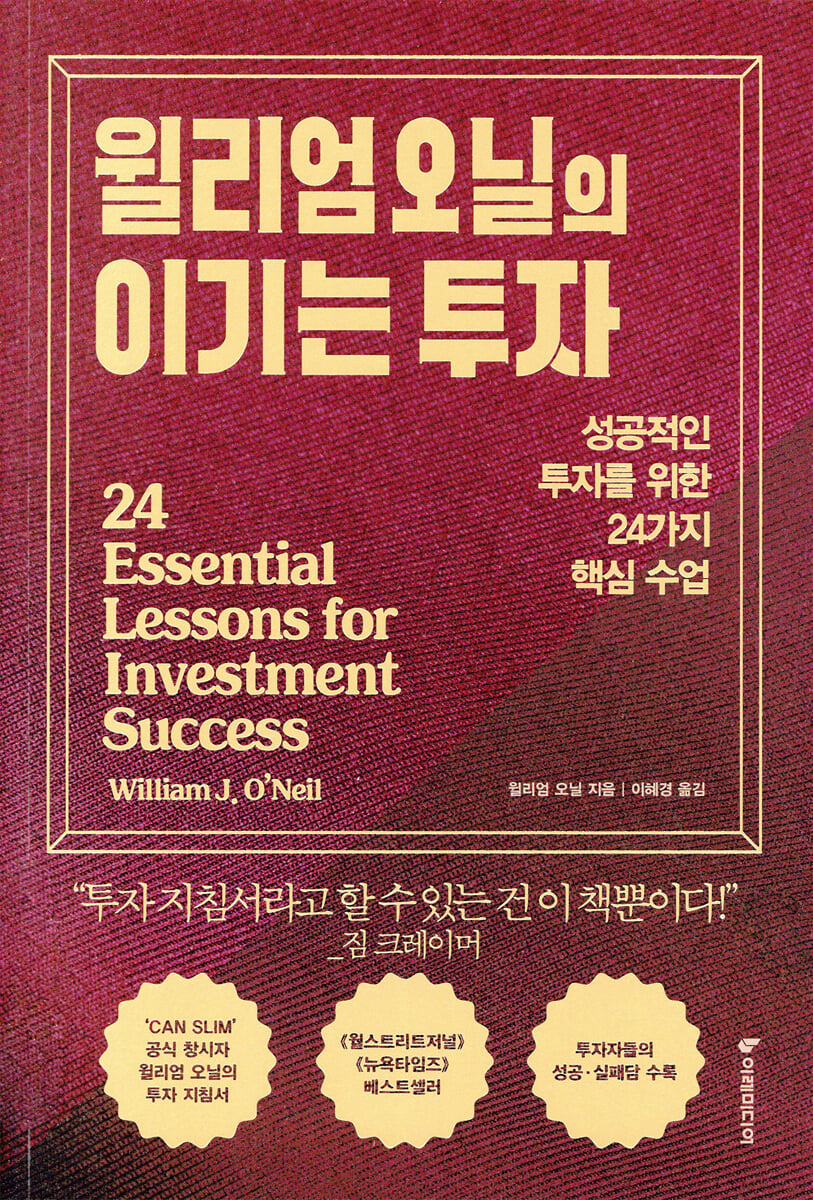
William O'Neil's Winning Investments
 |
Description
Book Introduction
A complete translation of legendary investor William O'Neil!
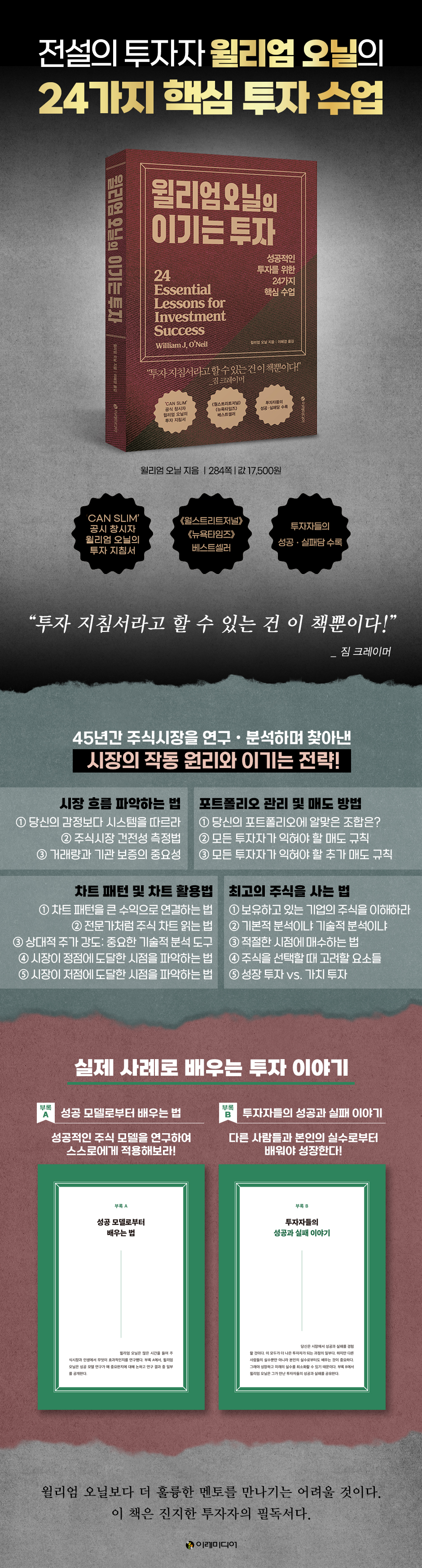
The principles of market operation and winning strategies discovered through 45 years of research and analysis of the stock market!
William O'Neil was a legendary investor who became the youngest member of the New York Stock Exchange at the age of 30.
The CANSLIM rule he devised is still considered the best strategy to beat the stock market.
O'Neill has averaged 40% annual returns over the past 25 years, and these returns weren't just achieved in bull markets.
This book covers the market's operating principles and guidelines, which he discovered through 45 years of comprehensive research and analysis of the stock market.
He outlines it in a series of 24 lectures, offering a method for selecting stocks that beat the market, regardless of whether it's a bull market or a bear market.
The principles of market operation and winning strategies discovered through 45 years of research and analysis of the stock market!
William O'Neil was a legendary investor who became the youngest member of the New York Stock Exchange at the age of 30.
The CANSLIM rule he devised is still considered the best strategy to beat the stock market.
O'Neill has averaged 40% annual returns over the past 25 years, and these returns weren't just achieved in bull markets.
This book covers the market's operating principles and guidelines, which he discovered through 45 years of comprehensive research and analysis of the stock market.
He outlines it in a series of 24 lectures, offering a method for selecting stocks that beat the market, regardless of whether it's a bull market or a bear market.
- You can preview some of the book's contents.
Preview
index
Recommendation
introduction
Lesson 1: What Every Investor Should Know
Lesson 2: Getting Started: There's No Time Like Now!
Lesson 3: Follow the System, Not Your Feelings
Lesson 4: Fundamental Analysis or Technical Analysis?
Lesson 5: Fundamentals, Part 1: Profit and Sales
Lesson 6: Relative Stock Price Strength: A Crucial Technical Analysis Tool
Lesson 7: Understand the stocks of the companies you own.
Lesson 8: The Importance of Trading Volume and Institutional Guarantees
Lesson 9: How to Buy at the Right Time
Lesson 10: How to Connect Chart Patterns to Big Profits
Lesson 11: How to Read Stock Charts Like a Pro
Lecture 12: Measuring Stock Market Health
Lesson 13: How to Identify When the Market Has Peaked
Lesson 14: How to Identify When the Market Has Bottomed
Lesson 15: Factors to Consider When Choosing Stocks
Lesson 16: How to Find New Investment Ideas in Investor's Business Daily
Lesson 17: Growth Investing vs.
value investing
Lesson 18: Don't Try to Become a Jack-of-all-trades Investor
Lesson 19: What's the Right Combination for Your Portfolio?
Lesson 20: Selling Rules Every Investor Should Know
Lesson 21: Additional Selling Rules Every Investor Should Know
Lesson 22: How to Make a Million Dollars with Mutual Funds
Lesson 23: Too Busy? [Investor's Business Daily] How to Use 20 Minutes
Lesson 24: [Investor's Business Daily] How to Use Investors.com
Appendix A: Learning from Success Models
Appendix B: Investor Success and Failure Stories
Recommended Reading List
Glossary
introduction
Lesson 1: What Every Investor Should Know
Lesson 2: Getting Started: There's No Time Like Now!
Lesson 3: Follow the System, Not Your Feelings
Lesson 4: Fundamental Analysis or Technical Analysis?
Lesson 5: Fundamentals, Part 1: Profit and Sales
Lesson 6: Relative Stock Price Strength: A Crucial Technical Analysis Tool
Lesson 7: Understand the stocks of the companies you own.
Lesson 8: The Importance of Trading Volume and Institutional Guarantees
Lesson 9: How to Buy at the Right Time
Lesson 10: How to Connect Chart Patterns to Big Profits
Lesson 11: How to Read Stock Charts Like a Pro
Lecture 12: Measuring Stock Market Health
Lesson 13: How to Identify When the Market Has Peaked
Lesson 14: How to Identify When the Market Has Bottomed
Lesson 15: Factors to Consider When Choosing Stocks
Lesson 16: How to Find New Investment Ideas in Investor's Business Daily
Lesson 17: Growth Investing vs.
value investing
Lesson 18: Don't Try to Become a Jack-of-all-trades Investor
Lesson 19: What's the Right Combination for Your Portfolio?
Lesson 20: Selling Rules Every Investor Should Know
Lesson 21: Additional Selling Rules Every Investor Should Know
Lesson 22: How to Make a Million Dollars with Mutual Funds
Lesson 23: Too Busy? [Investor's Business Daily] How to Use 20 Minutes
Lesson 24: [Investor's Business Daily] How to Use Investors.com
Appendix A: Learning from Success Models
Appendix B: Investor Success and Failure Stories
Recommended Reading List
Glossary
Detailed image
Into the book
If a stock falls 8% from its purchase price and you lose money, you'll want the price to rebound.
But you really should be afraid that you could lose more money.
Therefore, you should respond by selling stocks to reduce losses.
When stock prices rise and you make a profit, you become afraid that you might lose your profits.
So you sell too quickly.
But the fact that the stock price is rising is actually a bullish signal and a sign that you are doing something right.
---From "Lesson 3: Follow the System, Not Your Feelings"
I personally believe that observing the daily movements of major market averages and individual leading stocks is far more reliable than the dozens of technical market analysis tools most technical analysts rely on.
---From "Lecture 12: Measuring Stock Market Soundness"
Markets often under-report news events, and economic conditions move up to six months ahead.
So don't make investment decisions based on what you think about the news.
Determine when and how the overall market index will ultimately reverse course from a downtrend.
The market is rarely wrong.
But people's thoughts and fears are often wrong.
---From "Lesson 14: How to Determine When the Market Has Reached Its Bottom"
What's wrong with selecting a high-performing stock that has ranked first in its sector in terms of sales and profit growth over the past three years, boasts excellent profit margins, and a high ROE? A good selection would be stocks in strong industry groups, with strong institutional investor support, and trading at $15-$150 per share.
A company must also have excellent products or services, and its stock must have a good return.
As long as you don't have gambler's fever and don't try to get rich too quickly, the United States is truly the best place to invest.
The keys to success are prior research, focus, and dedication (before investing).
You can do it too!
---From "Chapter 18: Don't Try to Become a Jack-of-all-trades Investor"
What's the best way to improve your stock selling skills? Get into the habit of analyzing every buy and sell decision annually.
Show on the chart where each stock was bought and sold.
Distinguish between decisions that were profitable and decisions that weren't so profitable.
Study those two groups for a few weeks.
Do you see commonalities among the profitable groups? Do you see persistent problems among the less profitable groups?
If you notice a particular mistake you make often, create a new rule or two to correct it.
Look at the trading situation objectively.
Be willing to admit your mistakes.
But you really should be afraid that you could lose more money.
Therefore, you should respond by selling stocks to reduce losses.
When stock prices rise and you make a profit, you become afraid that you might lose your profits.
So you sell too quickly.
But the fact that the stock price is rising is actually a bullish signal and a sign that you are doing something right.
---From "Lesson 3: Follow the System, Not Your Feelings"
I personally believe that observing the daily movements of major market averages and individual leading stocks is far more reliable than the dozens of technical market analysis tools most technical analysts rely on.
---From "Lecture 12: Measuring Stock Market Soundness"
Markets often under-report news events, and economic conditions move up to six months ahead.
So don't make investment decisions based on what you think about the news.
Determine when and how the overall market index will ultimately reverse course from a downtrend.
The market is rarely wrong.
But people's thoughts and fears are often wrong.
---From "Lesson 14: How to Determine When the Market Has Reached Its Bottom"
What's wrong with selecting a high-performing stock that has ranked first in its sector in terms of sales and profit growth over the past three years, boasts excellent profit margins, and a high ROE? A good selection would be stocks in strong industry groups, with strong institutional investor support, and trading at $15-$150 per share.
A company must also have excellent products or services, and its stock must have a good return.
As long as you don't have gambler's fever and don't try to get rich too quickly, the United States is truly the best place to invest.
The keys to success are prior research, focus, and dedication (before investing).
You can do it too!
---From "Chapter 18: Don't Try to Become a Jack-of-all-trades Investor"
What's the best way to improve your stock selling skills? Get into the habit of analyzing every buy and sell decision annually.
Show on the chart where each stock was bought and sold.
Distinguish between decisions that were profitable and decisions that weren't so profitable.
Study those two groups for a few weeks.
Do you see commonalities among the profitable groups? Do you see persistent problems among the less profitable groups?
If you notice a particular mistake you make often, create a new rule or two to correct it.
Look at the trading situation objectively.
Be willing to admit your mistakes.
---From "Lesson 21: Additional Selling Rules Every Investor Should Learn"
Publisher's Review
A market-beating strategy discovered through 45 years of research and analysis of the stock market!
When you think of William O'Neill, the first words that come to mind are probably the CANSLIM rule and the 'cup with a handle' pattern.
He is the one who invented the cup chart, and it is now a pattern that most investors know.
However, while it is a familiar word and an easily recognizable chart pattern, knowing it and applying it properly is a separate matter.
Moreover, this book focuses on psychology.
“A bear market creates fear, uncertainty, and lowers confidence.
When stocks hit bottom and rebound to start the next bull market, most people don't readily believe it.
People hesitate and are afraid.
Why? Because most new investors, even experts, are still reeling from their losses.
Without a stop-loss system or the ability to interpret overall market movements, most people will lose money and suffer during market corrections.”
William O'Neil studied and analyzed the stock market comprehensively for 45 years, discovering the market's operating principles and guidelines.
He then emphasized clearly:
“The patterns that worked five, ten, or fifteen years ago still work today.
“Because human nature and investor psychology don’t change,” he says, giving his first directive early in the book.
Set your stop loss at 8% and sell if it falls below that level! O'Neill explains his reasoning as follows:
“The only thing you should be afraid of is losing more money.” Conversely, if it is profitable, you should hold on to it.
The reason for this is also explained as follows.
“It’s a signal of strength and a sign that you’re doing it right.”
Conditions and principles of winning stocks!
Refer to both fundamental and technical analysis!
In this book, William O'Neil talks about the conditions for winning stocks.
Don't trade cheap stocks, combine fundamental and technical investments, and look at the company's profits, profit growth rate, sales, profit margin, and return on equity.
At this time, the annual profit growth rate must be at least 30% and the return on equity must be at least 17%.
If you've found a great company through fundamental analysis, it's time for technical analysis.
William O'Neill likens investors to pitchers.
“It’s not enough to just be able to throw a decent fastball.
“You need to be able to throw a curveball and a changeup, and you need excellent control and mental toughness.” To that end, the book frequently introduces [Investor’s Business Daily], which it runs, but we don’t need to look into it all.
As time goes by, there are plenty of sites to refer to.
The key is to analyze stock price and trading volume movements on a weekly basis through various sites and make purchases based on chart patterns.
"Is it a cup with a handle? A double bottom? A flat zone? If it's not one of these patterns, it's likely to go wrong or fail."
If you've never invested before, this book will give you a solid foundation of knowledge and the courage to take the plunge into the stock market.
On the other hand, if you are an experienced investor, this book will help you achieve better results.
When you think of William O'Neill, the first words that come to mind are probably the CANSLIM rule and the 'cup with a handle' pattern.
He is the one who invented the cup chart, and it is now a pattern that most investors know.
However, while it is a familiar word and an easily recognizable chart pattern, knowing it and applying it properly is a separate matter.
Moreover, this book focuses on psychology.
“A bear market creates fear, uncertainty, and lowers confidence.
When stocks hit bottom and rebound to start the next bull market, most people don't readily believe it.
People hesitate and are afraid.
Why? Because most new investors, even experts, are still reeling from their losses.
Without a stop-loss system or the ability to interpret overall market movements, most people will lose money and suffer during market corrections.”
William O'Neil studied and analyzed the stock market comprehensively for 45 years, discovering the market's operating principles and guidelines.
He then emphasized clearly:
“The patterns that worked five, ten, or fifteen years ago still work today.
“Because human nature and investor psychology don’t change,” he says, giving his first directive early in the book.
Set your stop loss at 8% and sell if it falls below that level! O'Neill explains his reasoning as follows:
“The only thing you should be afraid of is losing more money.” Conversely, if it is profitable, you should hold on to it.
The reason for this is also explained as follows.
“It’s a signal of strength and a sign that you’re doing it right.”
Conditions and principles of winning stocks!
Refer to both fundamental and technical analysis!
In this book, William O'Neil talks about the conditions for winning stocks.
Don't trade cheap stocks, combine fundamental and technical investments, and look at the company's profits, profit growth rate, sales, profit margin, and return on equity.
At this time, the annual profit growth rate must be at least 30% and the return on equity must be at least 17%.
If you've found a great company through fundamental analysis, it's time for technical analysis.
William O'Neill likens investors to pitchers.
“It’s not enough to just be able to throw a decent fastball.
“You need to be able to throw a curveball and a changeup, and you need excellent control and mental toughness.” To that end, the book frequently introduces [Investor’s Business Daily], which it runs, but we don’t need to look into it all.
As time goes by, there are plenty of sites to refer to.
The key is to analyze stock price and trading volume movements on a weekly basis through various sites and make purchases based on chart patterns.
"Is it a cup with a handle? A double bottom? A flat zone? If it's not one of these patterns, it's likely to go wrong or fail."
If you've never invested before, this book will give you a solid foundation of knowledge and the courage to take the plunge into the stock market.
On the other hand, if you are an experienced investor, this book will help you achieve better results.
GOODS SPECIFICS
- Publication date: July 29, 2022
- Page count, weight, size: 284 pages | 478g | 148*217*17mm
- ISBN13: 9791191328585
- ISBN10: 1191328589
You may also like
카테고리
korean


korean

![GQ KOREA Mark (Monthly): December [2025]](http://librairie.coreenne.fr/cdn/shop/files/8ef265dbbfbf186523ed75ba7319009d.jpg?v=1765340328&width=3840)


