

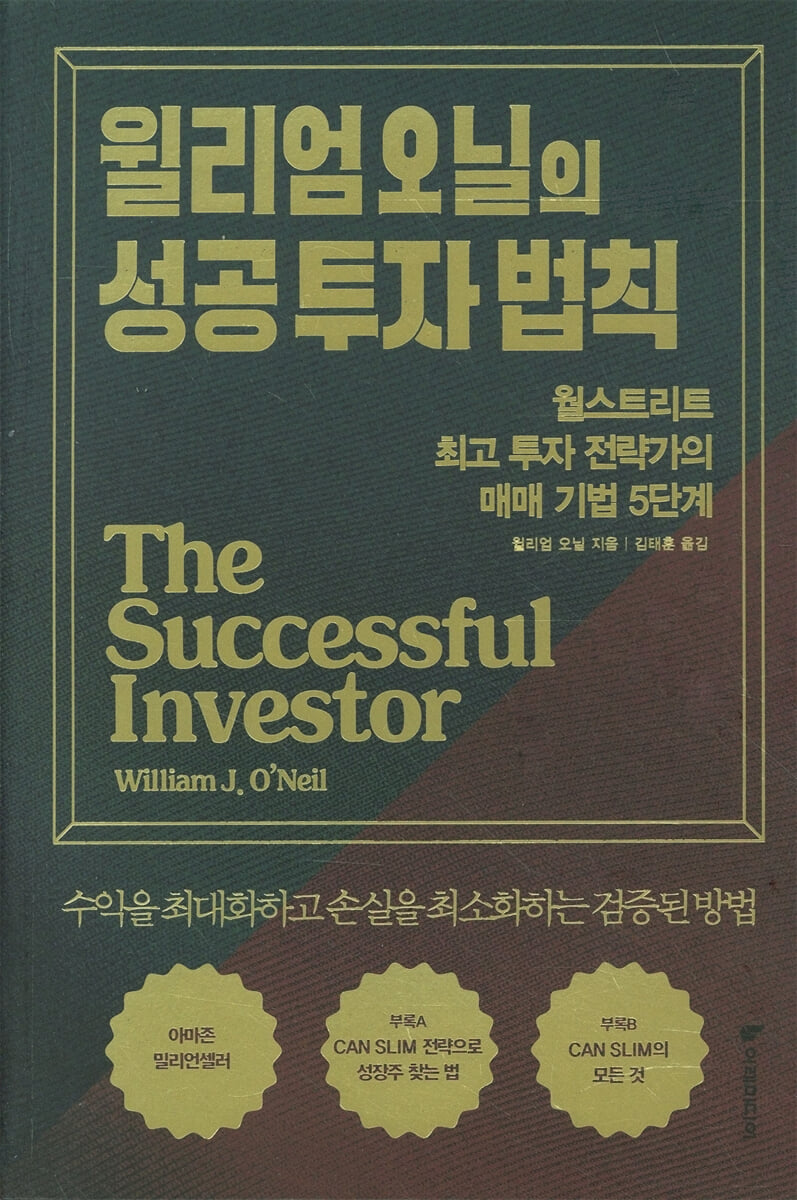
William O'Neil's Laws of Successful Investing
 |
Description
Book Introduction
Amazon Investments' Million-Seller
5 Steps to Proven Trading Techniques from Wall Street's Top Strategists
William O'Neil's masterpiece, "The Successful Investor," a million-seller in the Amazon investment field, has finally been published in full.
William O'Neill was inspired to write this book after witnessing the dot-com boom in the early 2000s, which left 80 million Americans with losses of 50 to 80 percent.
With the current COVID-19 vaccination rollout, we can see that a return to normal life is not too far away.
However, a burdensome period is approaching for the stock market, which has been rising by relying on policies and liquidity.
The stock market continues to move sideways amid continued signs of inflation as the economy recovers.
Trading strategies in bull and bear markets should be different.
In addition to O'Neil's five-step trading strategy, this book also includes 12 rules for picking the best stocks in a bull market and how to respond in a bear market.
In addition, the method of finding rising stocks using the CAN SLIM law developed by O'Neill and everything about CAN SLIM are included in the appendix.
His extensive content is compiled into one book for easy understanding.
Even novice investors will be able to minimize losses and maximize profits by mastering just this one book.
It will serve as a guide for trading for everyone, from beginners just starting out to investors who haven't yet decided on their investment style.
5 Steps to Proven Trading Techniques from Wall Street's Top Strategists
William O'Neil's masterpiece, "The Successful Investor," a million-seller in the Amazon investment field, has finally been published in full.
William O'Neill was inspired to write this book after witnessing the dot-com boom in the early 2000s, which left 80 million Americans with losses of 50 to 80 percent.
With the current COVID-19 vaccination rollout, we can see that a return to normal life is not too far away.
However, a burdensome period is approaching for the stock market, which has been rising by relying on policies and liquidity.
The stock market continues to move sideways amid continued signs of inflation as the economy recovers.
Trading strategies in bull and bear markets should be different.
In addition to O'Neil's five-step trading strategy, this book also includes 12 rules for picking the best stocks in a bull market and how to respond in a bear market.
In addition, the method of finding rising stocks using the CAN SLIM law developed by O'Neill and everything about CAN SLIM are included in the appendix.
His extensive content is compiled into one book for easy understanding.
Even novice investors will be able to minimize losses and maximize profits by mastering just this one book.
It will serve as a guide for trading for everyone, from beginners just starting out to investors who haven't yet decided on their investment style.
- You can preview some of the book's contents.
Preview
index
Introduction_The Road to Successful Investing
Header_ What Successful Investors Should and Shouldn't Do
The market doesn't care who you are | Facts and the market are never wrong | The investment secret that made millionaires: Invest in facts, not emotions | The charts tell it all
Step 1: Where is the market going now?
The market drives the economy, not the economy. | In a bull market, focus on dispersion and volume. | Don't try to persuade the market; completely accept and follow it. | In a bear market, pay attention to dispersion and follow-through, the beginning and end of the market. | React flexibly to market movements. | He who reads the timing dominates the market.
Step 2: Use a 3 to 1 profit/loss ratio.
All stocks are "bad," unless they're going up... | Goodbye, goodbye money | Offset losses with profits using the 3-to-1 formula | Today's blue chips can be tomorrow's dung | Personal opinions are worthless in the market.
Step 3: How to Buy the Best Stocks at the Optimal Time
12 Rules for Picking the Best Stocks in a Bull Market | 5 Chart Patterns That Tell You the Best Buying Points | 3 Weapons of Successful Investing: Supply and Demand Patterns, Fundamentals, and Charts
Step 4: When to Dispose of Stocks and Realize Profits
Making big money requires a heavy butt, not a good head | Blow-off: The bubble bursts when everyone is excited | Spot potential market peaks with rising price-to-earnings ratios | Spot the end of an uptrend with channel lines | First and second bottoms appearing during an uptrend are excellent buy signals | Low relative strength scores: Avoid stocks that are out of sync with the industry's trend | Stock splits: Deal with them based on where they are | The last-minute sell rule: Simplicity is king
Step 5: Portfolio Management: Proven Methods to Maximize Profits and Minimize Losses
Check your holdings weekly, monthly, quarterly, and annually | Diversification is merely a means of avoiding the risks of lack of knowledge | How to wisely diversify your investments: Separate the wheat from the stalks | Additional purchases: Burning stocks, not riding the wave | Short selling: Accurate judgment of timing and stocks is necessary | Invest in the best stocks, not penny stocks | Things not to do when managing a portfolio | For successful investment, honesty, morality, and humility are more important than pride and intelligence | The potential of the stock market, seen through examples, can be achieved by you too | The key to successful investment: Gather as many facts as possible | A sustainable economy is the absolute key to stock market growth
supplement
Appendix A: How to Identify Growth Stocks Using the Can Slim Approach | Appendix B: All About Can Slim | Appendix C: Market Notes | Appendix D: Book Reviews | Appendix E: Bear Market Warning!
Header_ What Successful Investors Should and Shouldn't Do
The market doesn't care who you are | Facts and the market are never wrong | The investment secret that made millionaires: Invest in facts, not emotions | The charts tell it all
Step 1: Where is the market going now?
The market drives the economy, not the economy. | In a bull market, focus on dispersion and volume. | Don't try to persuade the market; completely accept and follow it. | In a bear market, pay attention to dispersion and follow-through, the beginning and end of the market. | React flexibly to market movements. | He who reads the timing dominates the market.
Step 2: Use a 3 to 1 profit/loss ratio.
All stocks are "bad," unless they're going up... | Goodbye, goodbye money | Offset losses with profits using the 3-to-1 formula | Today's blue chips can be tomorrow's dung | Personal opinions are worthless in the market.
Step 3: How to Buy the Best Stocks at the Optimal Time
12 Rules for Picking the Best Stocks in a Bull Market | 5 Chart Patterns That Tell You the Best Buying Points | 3 Weapons of Successful Investing: Supply and Demand Patterns, Fundamentals, and Charts
Step 4: When to Dispose of Stocks and Realize Profits
Making big money requires a heavy butt, not a good head | Blow-off: The bubble bursts when everyone is excited | Spot potential market peaks with rising price-to-earnings ratios | Spot the end of an uptrend with channel lines | First and second bottoms appearing during an uptrend are excellent buy signals | Low relative strength scores: Avoid stocks that are out of sync with the industry's trend | Stock splits: Deal with them based on where they are | The last-minute sell rule: Simplicity is king
Step 5: Portfolio Management: Proven Methods to Maximize Profits and Minimize Losses
Check your holdings weekly, monthly, quarterly, and annually | Diversification is merely a means of avoiding the risks of lack of knowledge | How to wisely diversify your investments: Separate the wheat from the stalks | Additional purchases: Burning stocks, not riding the wave | Short selling: Accurate judgment of timing and stocks is necessary | Invest in the best stocks, not penny stocks | Things not to do when managing a portfolio | For successful investment, honesty, morality, and humility are more important than pride and intelligence | The potential of the stock market, seen through examples, can be achieved by you too | The key to successful investment: Gather as many facts as possible | A sustainable economy is the absolute key to stock market growth
supplement
Appendix A: How to Identify Growth Stocks Using the Can Slim Approach | Appendix B: All About Can Slim | Appendix C: Market Notes | Appendix D: Book Reviews | Appendix E: Bear Market Warning!
Detailed image
Into the book
Third, I collected about 50 charts of stocks that have risen significantly over the past several years.
We analyzed the fundamentals (e.g., earnings growth rate) and technical aspects (stock price and trading volume fluctuations) of these stocks before their prices doubled or tripled.
As a result, we were able to summarize the core characteristics that these stocks have in common.
This gave me an idea of what elements I should look into going forward.
---From the "Header"
The mutual fund strategy of continuing to invest in good stocks works well in most bear markets, where corrections are only about 20 to 25 percent.
However, responding in this way in a bear market that is adjusted by more than 35 to 50 percent can result in fatal damage.
In a bear market, many individual stocks suffer declines much larger than the correction of the market index.
Therefore, individual investors need a proven system that can help them protect the capital they have worked so hard to accumulate.
---From "Step 1_ Where is the market going now?"
Another great investor, Jesse Livermore, once said, “People are hopeful when they should be fearful, and fearful when they should be hopeful.”
In other words, if a stock goes up a little, you should hope that it goes up more rather than selling it before the uptrend ends out of fear that it won't go up any further.
Also, if a stock falls a little and you lose money, don't hope that the stock price will reverse and save you; you should fear that it will fall further.
---From "Step 2_ Use the 3 to 1 profit/loss ratio"
This pattern is similar in appearance to the cup with handle pattern, but is less common.
The saucer pattern has a shallower adjustment range than the cup pattern with handle and lasts at least 6-8 weeks.
In most cases, the handle is visible.
The handles on cups and plates have a purpose.
After a major correction, a stock price usually has to go through a final, temporary setback before it can rally to new highs.
The temporary retreat of the handle can often be 8 to 12 percent of the high to low range.
We analyzed the fundamentals (e.g., earnings growth rate) and technical aspects (stock price and trading volume fluctuations) of these stocks before their prices doubled or tripled.
As a result, we were able to summarize the core characteristics that these stocks have in common.
This gave me an idea of what elements I should look into going forward.
---From the "Header"
The mutual fund strategy of continuing to invest in good stocks works well in most bear markets, where corrections are only about 20 to 25 percent.
However, responding in this way in a bear market that is adjusted by more than 35 to 50 percent can result in fatal damage.
In a bear market, many individual stocks suffer declines much larger than the correction of the market index.
Therefore, individual investors need a proven system that can help them protect the capital they have worked so hard to accumulate.
---From "Step 1_ Where is the market going now?"
Another great investor, Jesse Livermore, once said, “People are hopeful when they should be fearful, and fearful when they should be hopeful.”
In other words, if a stock goes up a little, you should hope that it goes up more rather than selling it before the uptrend ends out of fear that it won't go up any further.
Also, if a stock falls a little and you lose money, don't hope that the stock price will reverse and save you; you should fear that it will fall further.
---From "Step 2_ Use the 3 to 1 profit/loss ratio"
This pattern is similar in appearance to the cup with handle pattern, but is less common.
The saucer pattern has a shallower adjustment range than the cup pattern with handle and lasts at least 6-8 weeks.
In most cases, the handle is visible.
The handles on cups and plates have a purpose.
After a major correction, a stock price usually has to go through a final, temporary setback before it can rally to new highs.
The temporary retreat of the handle can often be 8 to 12 percent of the high to low range.
---From "Step 3_ How to Buy the Best Stocks at the Optimal Time"
Publisher's Review
Amazon Investments' Million-Seller
5 Steps to Proven Trading Techniques from Wall Street's Top Strategists
William O'Neil's masterpiece, "The Successful Investor," which has been an Amazon investment bestseller for 17 years, has finally been published in full.
William O'Neill was inspired to write this book after witnessing the dot-com boom in the early 2000s, which left 80 million Americans with losses of 50 to 80 percent.
After graduating from college, O'Neill studied the secrets of mutual funds that produced the highest investment returns at Hayden Stone & Company, a traditional securities firm at the time.
The secret lies in the 5-step rule and CAN SLIM shown in this book.
He invested $5,000 using a technique he developed and made $200,000 in profit in one year.
This made him the youngest member of the New York Stock Exchange at the age of thirty.
O'Neill founded the William O'Neill Company, an investment firm that today serves more than 500 investment institutions.
As of 2021, O'Neill's assets are estimated at approximately $110 million (approximately 125 billion won).
He became even more famous as he developed and presented investment techniques and tools that have made hundreds of thousands of people millionaires.
In particular, Gil Morales and Chris Kacher, who achieved an astonishing 18,000 percent return on their stocks by following his proven techniques, published "Invest Like O'Neil's Disciples," which contains William O'Neil's investment guidelines and philosophy.
O'Neill is also known for using a trend-following strategy, trading according to market and stock trends.
Expanding on the meaning, it means trading by identifying trends (up or down) and countertrends (sideways).
With the current COVID-19 vaccination rollout, we can expect a return to normal life soon.
However, a burdensome period is approaching for the stock market, which has been rising by relying on policies and liquidity.
The stock market continues to move sideways amid continued signs of inflation as the economy recovers.
How should one trade in such a volatile stock market? The answer can be found in O'Neill's book, which adapts trading strategies according to market trends.
O'Neill says facts and markets are never wrong.
As an investor, it's important to understand where the market is headed and use the 3 to 1 profit/loss ratio to buy the best stocks at the optimal time.
You also need to know exactly when to sell your stocks and realize your profits.
O'Neill's five-step trading strategy provides a complete guide to successful investing, from beginners just starting out to those who have yet to establish their investment style.
Invest like a legend.
O'Neill's strategies encompass fundamental and technical analysis, risk management, and optimal timing.
[Forbes]
O'Neil's strategy combines fundamentals and chart analysis into a single technique.
In the early 2000s, when the market peaked and then bottomed, 98 percent of individual investors lost money.
Even Wall Street experts failed to advise their clients to sell their stocks and secure cash.
Only Investor's Business Daily, founded by O'Neill, accurately reported the market outlook.
When the market peaks and then reverses downward, three-quarters of the stocks you own will decline, regardless of quality or performance.
How can we predict when the market will peak? High-performing investors leverage information gained about strong fundamentals and stock price fluctuations.
In most cases, fundamentals alone cannot tell when a market leader will peak.
To predict where the stock market is headed, O'Neill advises observing and analyzing major market indices daily.
In particular, it is said that you need to know how to read charts to know when to buy and sell.
O'Neill has put all of his know-how, gained through over 50 years of experience in the field, into this book.
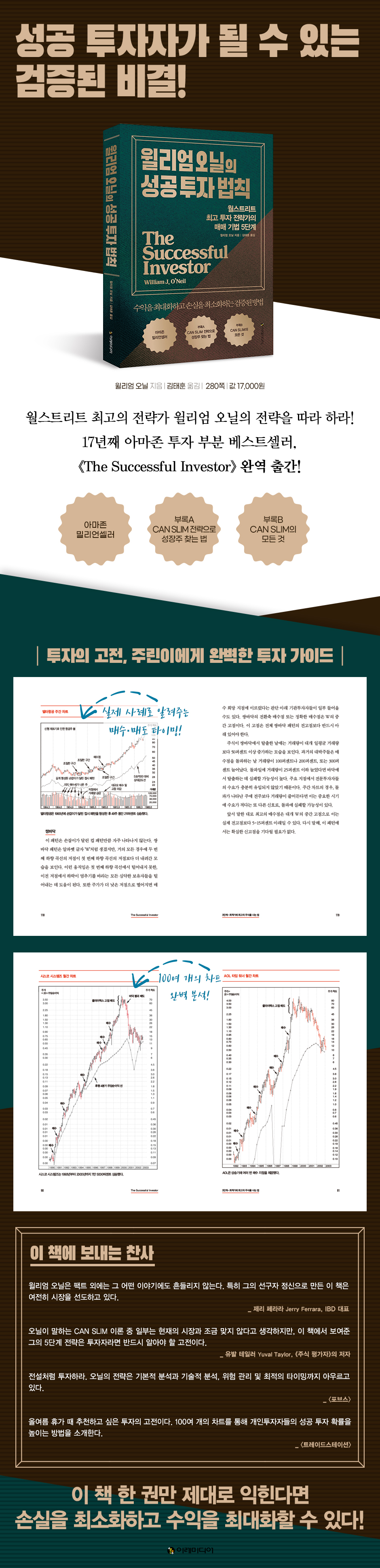
It shows over 100 charts of actual companies and tells you exactly when to buy and sell.
It shows patterns that can help predict the market, such as the 'cup with a handle' shape, the 'saucer', the 'double bottom', the 'flat bottom', and the 'rising bottom', through actual charts.
With a little effort, anyone can read timing, O'Neill advises.
If you can review the charts O'Neill describes several times and read them properly, you are on the road to successful investing.
In addition to O'Neil's five-step trading strategy, this book also includes 12 rules for picking the best stocks in a bull market and how to respond in a bear market.
In addition, the method of finding rising stocks using the CAN SLIM law developed by O'Neill and everything about CAN SLIM are included in the appendix.
His extensive content is compiled into one book for easy understanding.
Even novice investors will be able to minimize losses and maximize profits by mastering just this one book.
5 Steps to Proven Trading Techniques from Wall Street's Top Strategists
William O'Neil's masterpiece, "The Successful Investor," which has been an Amazon investment bestseller for 17 years, has finally been published in full.
William O'Neill was inspired to write this book after witnessing the dot-com boom in the early 2000s, which left 80 million Americans with losses of 50 to 80 percent.
After graduating from college, O'Neill studied the secrets of mutual funds that produced the highest investment returns at Hayden Stone & Company, a traditional securities firm at the time.
The secret lies in the 5-step rule and CAN SLIM shown in this book.
He invested $5,000 using a technique he developed and made $200,000 in profit in one year.
This made him the youngest member of the New York Stock Exchange at the age of thirty.
O'Neill founded the William O'Neill Company, an investment firm that today serves more than 500 investment institutions.
As of 2021, O'Neill's assets are estimated at approximately $110 million (approximately 125 billion won).
He became even more famous as he developed and presented investment techniques and tools that have made hundreds of thousands of people millionaires.
In particular, Gil Morales and Chris Kacher, who achieved an astonishing 18,000 percent return on their stocks by following his proven techniques, published "Invest Like O'Neil's Disciples," which contains William O'Neil's investment guidelines and philosophy.
O'Neill is also known for using a trend-following strategy, trading according to market and stock trends.
Expanding on the meaning, it means trading by identifying trends (up or down) and countertrends (sideways).
With the current COVID-19 vaccination rollout, we can expect a return to normal life soon.
However, a burdensome period is approaching for the stock market, which has been rising by relying on policies and liquidity.
The stock market continues to move sideways amid continued signs of inflation as the economy recovers.
How should one trade in such a volatile stock market? The answer can be found in O'Neill's book, which adapts trading strategies according to market trends.
O'Neill says facts and markets are never wrong.
As an investor, it's important to understand where the market is headed and use the 3 to 1 profit/loss ratio to buy the best stocks at the optimal time.
You also need to know exactly when to sell your stocks and realize your profits.
O'Neill's five-step trading strategy provides a complete guide to successful investing, from beginners just starting out to those who have yet to establish their investment style.
Invest like a legend.
O'Neill's strategies encompass fundamental and technical analysis, risk management, and optimal timing.
[Forbes]
O'Neil's strategy combines fundamentals and chart analysis into a single technique.
In the early 2000s, when the market peaked and then bottomed, 98 percent of individual investors lost money.
Even Wall Street experts failed to advise their clients to sell their stocks and secure cash.
Only Investor's Business Daily, founded by O'Neill, accurately reported the market outlook.
When the market peaks and then reverses downward, three-quarters of the stocks you own will decline, regardless of quality or performance.
How can we predict when the market will peak? High-performing investors leverage information gained about strong fundamentals and stock price fluctuations.
In most cases, fundamentals alone cannot tell when a market leader will peak.
To predict where the stock market is headed, O'Neill advises observing and analyzing major market indices daily.
In particular, it is said that you need to know how to read charts to know when to buy and sell.
O'Neill has put all of his know-how, gained through over 50 years of experience in the field, into this book.
It shows over 100 charts of actual companies and tells you exactly when to buy and sell.
It shows patterns that can help predict the market, such as the 'cup with a handle' shape, the 'saucer', the 'double bottom', the 'flat bottom', and the 'rising bottom', through actual charts.
With a little effort, anyone can read timing, O'Neill advises.
If you can review the charts O'Neill describes several times and read them properly, you are on the road to successful investing.
In addition to O'Neil's five-step trading strategy, this book also includes 12 rules for picking the best stocks in a bull market and how to respond in a bear market.
In addition, the method of finding rising stocks using the CAN SLIM law developed by O'Neill and everything about CAN SLIM are included in the appendix.
His extensive content is compiled into one book for easy understanding.
Even novice investors will be able to minimize losses and maximize profits by mastering just this one book.
GOODS SPECIFICS
- Publication date: July 18, 2021
- Page count, weight, size: 280 pages | 496g | 148*217*18mm
- ISBN13: 9791191328233
- ISBN10: 1191328236
You may also like
카테고리
korean


korean

![GQ KOREA Mark (Monthly): December [2025]](http://librairie.coreenne.fr/cdn/shop/files/8ef265dbbfbf186523ed75ba7319009d.jpg?v=1765340328&width=3840)


