

economic moat
 |
Description
Book Introduction
As long as you have an economic moat, you don't have to fear a market crash!
The game can't always be good.
Because the mechanism of the economy is to go through cycles of boom and recession.
Of course, there are certainly companies that survive even in recessions and market crashes.
However, unfortunately, many of the strong companies that are able to survive fail to generate significant profits.
This is because it only provides stable and low growth, making it completely unattractive to stock investors.
So, is it possible for a company to not easily collapse amidst the ever-changing economic volatility and simultaneously generate consistent, high profits? The world's greatest investors, including Warren Buffett, have unanimously addressed this question.
“It is a company with an economic moat.”
In the Middle Ages, a ditch was dug in front of a castle wall to prevent enemies from infiltrating. This is called a moat. It is said that companies also have moats that can generate sufficient profits while preventing other companies from invading.
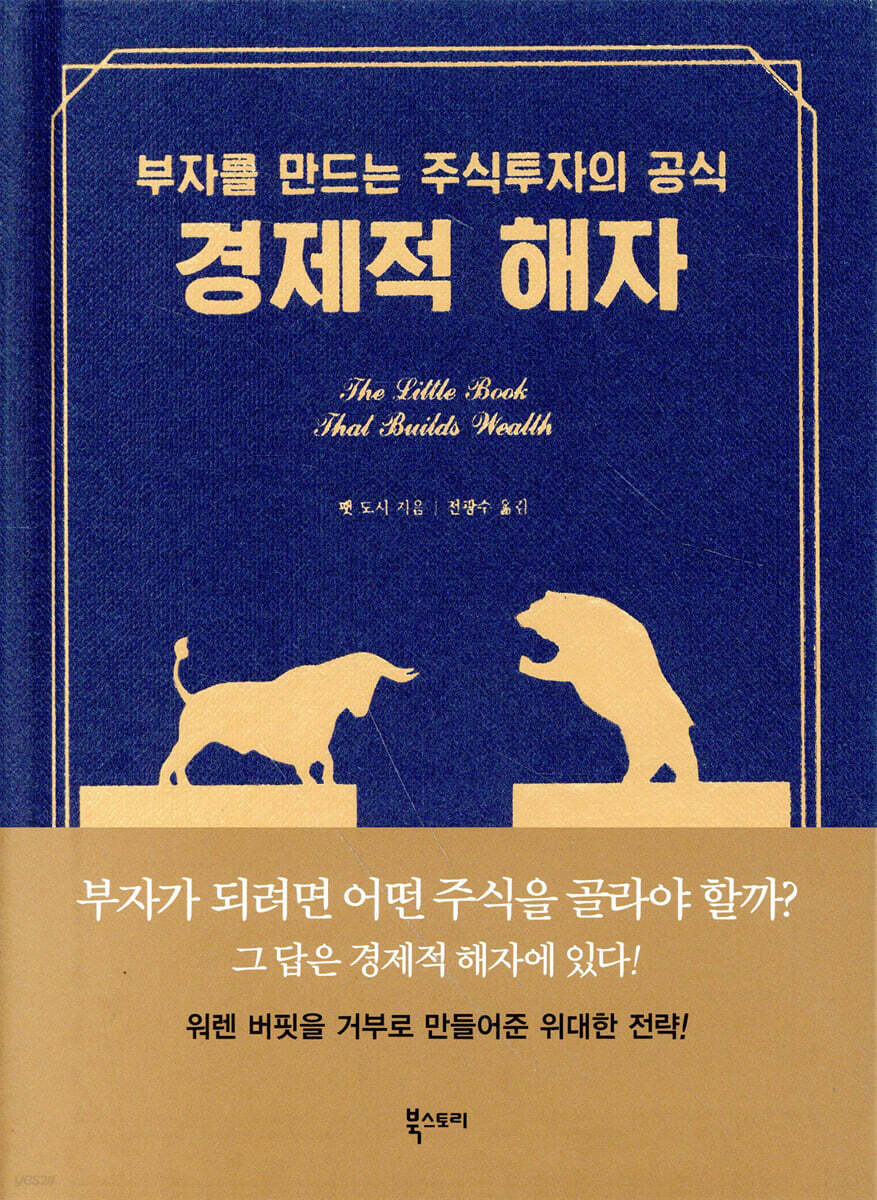
"The Economic Moat: The Formula for Stock Investment That Makes You Rich" is a book about how to find this economic moat.
The game can't always be good.
Because the mechanism of the economy is to go through cycles of boom and recession.
Of course, there are certainly companies that survive even in recessions and market crashes.
However, unfortunately, many of the strong companies that are able to survive fail to generate significant profits.
This is because it only provides stable and low growth, making it completely unattractive to stock investors.
So, is it possible for a company to not easily collapse amidst the ever-changing economic volatility and simultaneously generate consistent, high profits? The world's greatest investors, including Warren Buffett, have unanimously addressed this question.
“It is a company with an economic moat.”
In the Middle Ages, a ditch was dug in front of a castle wall to prevent enemies from infiltrating. This is called a moat. It is said that companies also have moats that can generate sufficient profits while preventing other companies from invading.
"The Economic Moat: The Formula for Stock Investment That Makes You Rich" is a book about how to find this economic moat.
- You can preview some of the book's contents.
Preview
index
Recommendation / Acknowledgement
Prologue: The Game Plans of the World's Top Investors
Chapter 1: Unbreakable Companies Have Moats
Chapter 2: Don't Be Fooled by False Competitiveness
Chapter 3: The First Moat - Intangible Assets
Chapter 4 Second Moat - Transition Costs
Chapter 5: The Third Moat - Network Effects
Chapter 6: The Fourth Moat - Cost Advantage
Chapter 7 Big Fish in a Small Pond
Chapter 8: The Eroding Moat
Chapter 9 How to Find the Moat?
Chapter 10: The Illusion of Being a Great Rider
Chapter 11 Companies That Show Their True Value
Chapter 12: How Much is a Moat Worth?
Chapter 13: Tools for Picking Stocks
Chapter 14: When to Sell
Recommendation
Prologue: The Game Plans of the World's Top Investors
Chapter 1: Unbreakable Companies Have Moats
Chapter 2: Don't Be Fooled by False Competitiveness
Chapter 3: The First Moat - Intangible Assets
Chapter 4 Second Moat - Transition Costs
Chapter 5: The Third Moat - Network Effects
Chapter 6: The Fourth Moat - Cost Advantage
Chapter 7 Big Fish in a Small Pond
Chapter 8: The Eroding Moat
Chapter 9 How to Find the Moat?
Chapter 10: The Illusion of Being a Great Rider
Chapter 11 Companies That Show Their True Value
Chapter 12: How Much is a Moat Worth?
Chapter 13: Tools for Picking Stocks
Chapter 14: When to Sell
Recommendation
Into the book
The final intangible asset that can create a sustainable competitive advantage is a legal license that makes it difficult or impossible for competitors to enter the market.
While a company typically needs legal approval to operate in a market, licensing can be a powerful competitive advantage when there is no oversight over how a product is priced.
Think of the difference between a power company and a pharmaceutical company.
The same thing holds true: no product (electricity or medicine) can be sold to consumers without approval, but while electricity prices are regulated by regulators, the US FDA has no interference with drug prices.
So it's no surprise that pharmaceutical companies are making far more profits than power companies.
Simply put, a company that can set its prices at will like a monopoly, but is not subject to the same regulations as a monopoly, has a very wide economic moat.
While a company typically needs legal approval to operate in a market, licensing can be a powerful competitive advantage when there is no oversight over how a product is priced.
Think of the difference between a power company and a pharmaceutical company.
The same thing holds true: no product (electricity or medicine) can be sold to consumers without approval, but while electricity prices are regulated by regulators, the US FDA has no interference with drug prices.
So it's no surprise that pharmaceutical companies are making far more profits than power companies.
Simply put, a company that can set its prices at will like a monopoly, but is not subject to the same regulations as a monopoly, has a very wide economic moat.
--- From the text
Publisher's Review
Warren Buffett's investment concept, considered a touchstone of investing.
The economic moat concept was not actually first conceived by Morningstar.
Warren Buffett became known to the world when he expressed the concept of an 'economic moat' as a belief he had in his extensive investment experience.
Economic moats have become a holy grail for investors, as it has become known that most outstanding investors have risen to the top with the same beliefs.
However, the specific strategies and methods for finding economic moats and buying and selling stocks through them are not known, so it has been regarded as a legendary magic book and has not been applied as an investment secret for general investors.
Accordingly, Morningstar, America's leading investment information company, has compiled its extensive experience and research into economic moats into investment rules that anyone can access.
Morningstar, America's leading investment information company, has created a masterpiece.
Pat Dorsey, Morningstar's director of equity analysis, explains the well-proven economic moat approach and shows you how to effectively apply it to your own investments.
The city explains step-by-step why economic moats are a strong indicator of good long-term investments and explores four common sources of moats: intangible assets, cost advantages, customer switching costs, and network economics.
After establishing a solid understanding of moats, the book provides case studies of the competitive strengths of several prominent companies, along with a discussion of how industry structure and management can create or destroy moats, which play a crucial role in creating competitive advantage.
Pat Dorsey went on to point out that even the widest moat in a company's history cannot be a good investment if its stock is overpriced, and he even provided detailed guidance on valuation methods and investment timing.
Through this book, the product of Morningstar's long and arduous efforts, ordinary investors will now be able to experience the immense power of the economic moat, once enjoyed by only the world's best investors and a select few, while simultaneously achieving stable and high returns.
The economic moat concept was not actually first conceived by Morningstar.
Warren Buffett became known to the world when he expressed the concept of an 'economic moat' as a belief he had in his extensive investment experience.
Economic moats have become a holy grail for investors, as it has become known that most outstanding investors have risen to the top with the same beliefs.
However, the specific strategies and methods for finding economic moats and buying and selling stocks through them are not known, so it has been regarded as a legendary magic book and has not been applied as an investment secret for general investors.
Accordingly, Morningstar, America's leading investment information company, has compiled its extensive experience and research into economic moats into investment rules that anyone can access.
Morningstar, America's leading investment information company, has created a masterpiece.
Pat Dorsey, Morningstar's director of equity analysis, explains the well-proven economic moat approach and shows you how to effectively apply it to your own investments.
The city explains step-by-step why economic moats are a strong indicator of good long-term investments and explores four common sources of moats: intangible assets, cost advantages, customer switching costs, and network economics.
After establishing a solid understanding of moats, the book provides case studies of the competitive strengths of several prominent companies, along with a discussion of how industry structure and management can create or destroy moats, which play a crucial role in creating competitive advantage.
Pat Dorsey went on to point out that even the widest moat in a company's history cannot be a good investment if its stock is overpriced, and he even provided detailed guidance on valuation methods and investment timing.
Through this book, the product of Morningstar's long and arduous efforts, ordinary investors will now be able to experience the immense power of the economic moat, once enjoyed by only the world's best investors and a select few, while simultaneously achieving stable and high returns.
GOODS SPECIFICS
- Publication date: March 22, 2021
- Format: Hardcover book binding method guide
- Page count, weight, size: 264 pages | 368g | 132*183*18mm
- ISBN13: 9791155642238
- ISBN10: 1155642236
You may also like
카테고리
korean


korean

![GQ KOREA Mark (Monthly): December [2025]](http://librairie.coreenne.fr/cdn/shop/files/8ef265dbbfbf186523ed75ba7319009d.jpg?v=1765340328&width=3840)


