

The End of the Currency War: The Dollar
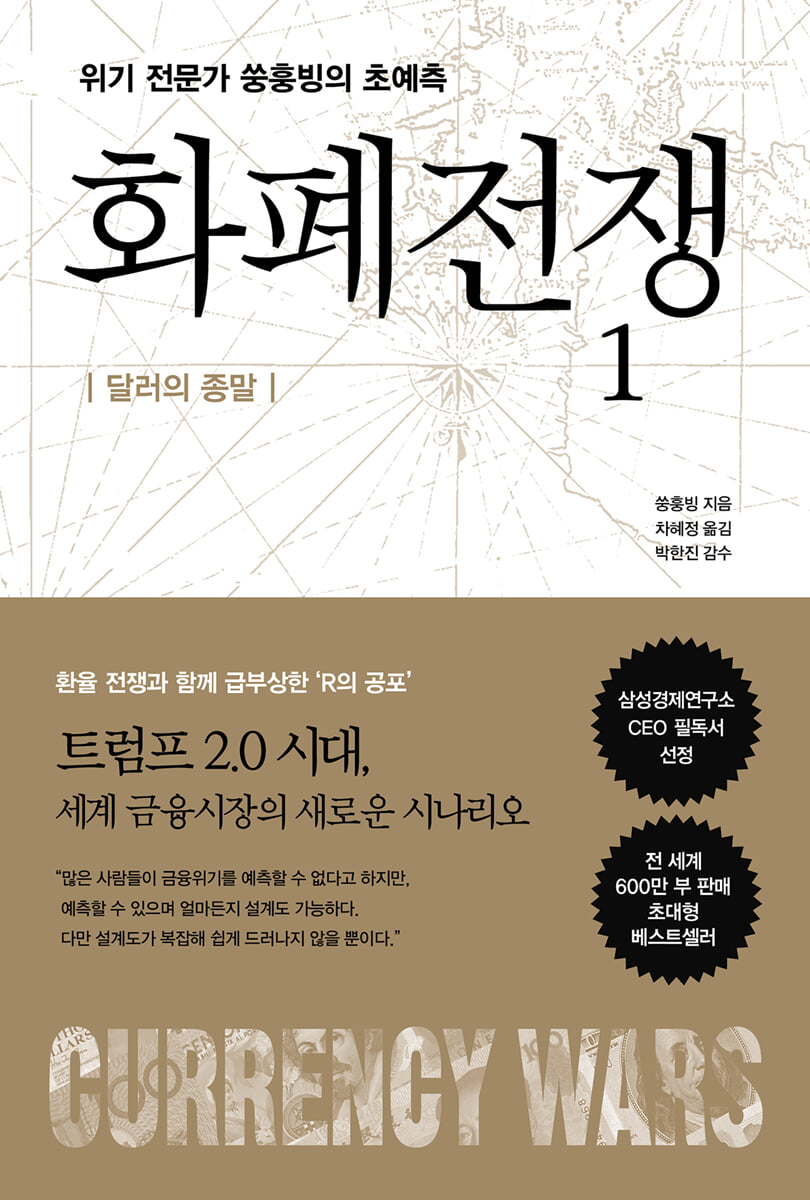 |
Description
Book Introduction
“Where is the global economy headed after COVID-19?”
The Future of Currency: Global Financial Crisis Expert Song Hongbing
A monumental book that heralded the beginning of the financial bombardment of the '21st century nuclear weapon'
The latest revised edition of "Currency Wars 1: The End of the Dollar," which generated significant buzz by predicting currency wars, changes in the gold market, and the US-China conflict, is now available.
This book, which has sold over 6 million copies in Korea and China alone, has become the bible of 'money', receiving overwhelming recommendations from numerous economic organizations and business figures, including the Samsung Economic Research Institute, since its first domestic publication in 2008.
Author Song Hongbing, a Chinese international finance scholar, draws on his experience working in the American financial industry to sharply dissect the inner workings of the US-centric international financial order.
It reveals the deep involvement of financial conglomerates in the center of global finance, including in the United States, and further reveals how the current international order is based on a flawed foundation.
This book, which predicted the 2008 financial crisis in the United States, still holds value as a predictive book.
In recent years, China has been attempting to realize its "Chinese Dream" by establishing the Asian Infrastructure Investment Bank (AIIB) and developing a digital yuan, thereby breaking away from the US dollar's hegemony and establishing the yuan as a reserve currency.
The United States is also keeping China in check and cracking down on Chinese government interference in public trade.
Since the spread of COVID-19, relations between the United States and China have rapidly cooled, heralding the beginning of a full-scale "currency war."
This series will serve as a glimpse into how countries around the world will fight for financial hegemony in the future.
The 21st century is an era where who controls 'currency' is more important than 'nuclear weapons'.
Knowing where money comes from isn't just good for the nation.
Envisioning how future currencies will flow is a skill absolutely essential for anyone who wants to control money in the world.
This is why this book has captured the attention of countless businesspeople and has been a bestseller for over 10 years.
The Future of Currency: Global Financial Crisis Expert Song Hongbing
A monumental book that heralded the beginning of the financial bombardment of the '21st century nuclear weapon'
The latest revised edition of "Currency Wars 1: The End of the Dollar," which generated significant buzz by predicting currency wars, changes in the gold market, and the US-China conflict, is now available.
This book, which has sold over 6 million copies in Korea and China alone, has become the bible of 'money', receiving overwhelming recommendations from numerous economic organizations and business figures, including the Samsung Economic Research Institute, since its first domestic publication in 2008.
Author Song Hongbing, a Chinese international finance scholar, draws on his experience working in the American financial industry to sharply dissect the inner workings of the US-centric international financial order.
It reveals the deep involvement of financial conglomerates in the center of global finance, including in the United States, and further reveals how the current international order is based on a flawed foundation.
This book, which predicted the 2008 financial crisis in the United States, still holds value as a predictive book.
In recent years, China has been attempting to realize its "Chinese Dream" by establishing the Asian Infrastructure Investment Bank (AIIB) and developing a digital yuan, thereby breaking away from the US dollar's hegemony and establishing the yuan as a reserve currency.
The United States is also keeping China in check and cracking down on Chinese government interference in public trade.
Since the spread of COVID-19, relations between the United States and China have rapidly cooled, heralding the beginning of a full-scale "currency war."
This series will serve as a glimpse into how countries around the world will fight for financial hegemony in the future.
The 21st century is an era where who controls 'currency' is more important than 'nuclear weapons'.
Knowing where money comes from isn't just good for the nation.
Envisioning how future currencies will flow is a skill absolutely essential for anyone who wants to control money in the world.
This is why this book has captured the attention of countless businesspeople and has been a bestseller for over 10 years.
- You can preview some of the book's contents.
Preview
index
Reviewer's note
Author's Preface
Chapter 1: The Rothschilds: The Intangible World's Wealth
The Battle of Waterloo and the Rothschilds | The Era of the Rothschilds | The Rothschilds' First Bundle | Nathan Takes Control of the City of London | James Conquers France | Salomon Aims for the Austrian Crown | Germany and Italy Under the Rothschilds | The Rothschild Financial Empire
Chapter 2: The Hundred Years' War between International Bankers and the American President
The assassination of President Lincoln | The right to issue currency and the American Revolution | The first war of international banking: America's first central bank (1791–1811) | The return of international bankers: America's second central bank (1816–1832) | "If banks try to kill us, I will kill them." | A new war: The independent treasury system | International bankers strike again: The Panic of 1857 | The causes of the American Civil War: European international financial powers | Lincoln's new monetary policy | Lincoln's Russian allies | Who was the real culprit behind Lincoln's assassination? | A fatal compromise: The National Bank Act of 1863
Chapter 3 Federal Reserve Bank of the United States
Jekyll Island, shrouded in mystery: The birthplace of the Federal Reserve | The Seven of Wall Street: Behind-the-scenes drivers of the Federal Reserve | Prelude to the establishment of the Federal Reserve: The 1907 financial crisis | From the gold standard to legal tender: A major shift in the banking tycoon's worldview | The 1912 presidential election fever | Project B | The financial tycoons' dreams come true | Who owns the Federal Reserve? | The first board of directors of the Federal Reserve | The secret behind the Federal Advisory Committee | Where is the truth?
Chapter 4: World War I and the Great Depression
Without the Federal Reserve, World War I Wouldn't Have Happened | Benjamin Strong's Wartime Federal Reserve | Going to War 'For Democracy and Morality' | Bankers Who Made a Fortune from War | The Treaty of Versailles: A 20-Year Armistice | 'Shearing the Sheep' and the 1921 American Farm Depression | The Conspiracy of 1927 | The Bubble Bursts in 1929 | The Real Intentions of the Great Depression
Chapter 5: The New Deal Policy of Cheap Money
Keynes's 'Cheap Money' | The 1932 Presidential Election | Who Was Franklin Roosevelt? | The Gold Standard Abolished: Bankers Give Roosevelt a Historic Mission | Risky Bet: Choosing Hitler | Nazi Germany Funded by Wall Street | Expensive Wars and Cheap Money
Chapter 6: The Elite Group That Rules the World
"Spiritual Leader" Colonel House and the Council on Foreign Relations | The International Clearinghouse: The Bank of Central Bankers | The International Monetary Fund and the World Bank | The Elite Group That Rules the World | The Bilderberg Club | The Trilateral Commission
Chapter 7: The Last Struggle for Honest Money
Presidential Order 11110: Kennedy's Death Certificate | The Historical Status of Silver | The End of the Silver Standard | Gold Pool | Special Drawing Rights | The All-Out Attack to Abolish the Gold Standard | Economic Snipers and the Recovery of Petrodollars | Reagan's Assault: The Gold Standard's Last Hope Shattered
Chapter 8: A Currency War Without a Declaration of War
1973 Middle East War: The Dollar's Counterattack | Paul Volcker: 'Controlling and Dismantling' the World Economy | World Environmental Protection Bank: Taking Over 30% of the Earth's Land | Financial Nuclear Bombing: Targeting Tokyo | Soros: The Financial Hacker of Global Bankers | 'Crisis Line' Targeting European Currencies | Asian Currency Strangulation | Future China Fables
Chapter 9: The Dollar's Vulnerable Points and the Gold's Sunlight Martial Arts
Fractional Reserve Banking: The Origin of Monetary Expansion | How Debt Dollars Are Formed | The Debt Torrent Overwhelming the US and the "Waste Paper" Treasury Certificates in Asia's Hands | The "Purchasing" of Financial Derivatives Markets | Government-Guaranteed Institutions: The Second Federal Reserve | Gold: The Penitentiary King of Currency | Red Alert: The Rothschilds Withdraw from the Gold Market | The Vulnerable Spot of the Dollar Bubble
Chapter 10: The Long-Term Visionary
Currency: The Weights and Measures of the Economic World | Gold and Silver: The Mysterious Acupuncture Points That Heal Price Fluctuations | Debt Currency: The Fat and GDP Diet | Finance: The "Strategic Air Force" of China's Economic Development | Future Strategies: Build High Walls, Accumulate Food, and Gradually Rise | The Path to Becoming the World's Reserve Currency
Some Thoughts on China's Later Financial Openness
The biggest risk of China's financial opening is its lack of a "war" mentality | Monetary sovereignty or monetary stability | Currency appreciation and the "endocrine disruption" of the financial system | External operations under equal opening | Appendix: The internal explosion of US debt and the tightening of global liquidity | Reruns of the crisis | Asset securitization and liquidity glut | Subprime and Alt-A mortgage loans: Asset waste | Subprime loan CDOs: Concentrated junk assets | Synthetic CDOs: High-purity concentrated junk | Asset rating agencies: Accomplices in fraud | The internal explosion of debt and the tightening of liquidity | What will the future of the global financial market hold?
Translator's Note
main
Search
Author's Preface
Chapter 1: The Rothschilds: The Intangible World's Wealth
The Battle of Waterloo and the Rothschilds | The Era of the Rothschilds | The Rothschilds' First Bundle | Nathan Takes Control of the City of London | James Conquers France | Salomon Aims for the Austrian Crown | Germany and Italy Under the Rothschilds | The Rothschild Financial Empire
Chapter 2: The Hundred Years' War between International Bankers and the American President
The assassination of President Lincoln | The right to issue currency and the American Revolution | The first war of international banking: America's first central bank (1791–1811) | The return of international bankers: America's second central bank (1816–1832) | "If banks try to kill us, I will kill them." | A new war: The independent treasury system | International bankers strike again: The Panic of 1857 | The causes of the American Civil War: European international financial powers | Lincoln's new monetary policy | Lincoln's Russian allies | Who was the real culprit behind Lincoln's assassination? | A fatal compromise: The National Bank Act of 1863
Chapter 3 Federal Reserve Bank of the United States
Jekyll Island, shrouded in mystery: The birthplace of the Federal Reserve | The Seven of Wall Street: Behind-the-scenes drivers of the Federal Reserve | Prelude to the establishment of the Federal Reserve: The 1907 financial crisis | From the gold standard to legal tender: A major shift in the banking tycoon's worldview | The 1912 presidential election fever | Project B | The financial tycoons' dreams come true | Who owns the Federal Reserve? | The first board of directors of the Federal Reserve | The secret behind the Federal Advisory Committee | Where is the truth?
Chapter 4: World War I and the Great Depression
Without the Federal Reserve, World War I Wouldn't Have Happened | Benjamin Strong's Wartime Federal Reserve | Going to War 'For Democracy and Morality' | Bankers Who Made a Fortune from War | The Treaty of Versailles: A 20-Year Armistice | 'Shearing the Sheep' and the 1921 American Farm Depression | The Conspiracy of 1927 | The Bubble Bursts in 1929 | The Real Intentions of the Great Depression
Chapter 5: The New Deal Policy of Cheap Money
Keynes's 'Cheap Money' | The 1932 Presidential Election | Who Was Franklin Roosevelt? | The Gold Standard Abolished: Bankers Give Roosevelt a Historic Mission | Risky Bet: Choosing Hitler | Nazi Germany Funded by Wall Street | Expensive Wars and Cheap Money
Chapter 6: The Elite Group That Rules the World
"Spiritual Leader" Colonel House and the Council on Foreign Relations | The International Clearinghouse: The Bank of Central Bankers | The International Monetary Fund and the World Bank | The Elite Group That Rules the World | The Bilderberg Club | The Trilateral Commission
Chapter 7: The Last Struggle for Honest Money
Presidential Order 11110: Kennedy's Death Certificate | The Historical Status of Silver | The End of the Silver Standard | Gold Pool | Special Drawing Rights | The All-Out Attack to Abolish the Gold Standard | Economic Snipers and the Recovery of Petrodollars | Reagan's Assault: The Gold Standard's Last Hope Shattered
Chapter 8: A Currency War Without a Declaration of War
1973 Middle East War: The Dollar's Counterattack | Paul Volcker: 'Controlling and Dismantling' the World Economy | World Environmental Protection Bank: Taking Over 30% of the Earth's Land | Financial Nuclear Bombing: Targeting Tokyo | Soros: The Financial Hacker of Global Bankers | 'Crisis Line' Targeting European Currencies | Asian Currency Strangulation | Future China Fables
Chapter 9: The Dollar's Vulnerable Points and the Gold's Sunlight Martial Arts
Fractional Reserve Banking: The Origin of Monetary Expansion | How Debt Dollars Are Formed | The Debt Torrent Overwhelming the US and the "Waste Paper" Treasury Certificates in Asia's Hands | The "Purchasing" of Financial Derivatives Markets | Government-Guaranteed Institutions: The Second Federal Reserve | Gold: The Penitentiary King of Currency | Red Alert: The Rothschilds Withdraw from the Gold Market | The Vulnerable Spot of the Dollar Bubble
Chapter 10: The Long-Term Visionary
Currency: The Weights and Measures of the Economic World | Gold and Silver: The Mysterious Acupuncture Points That Heal Price Fluctuations | Debt Currency: The Fat and GDP Diet | Finance: The "Strategic Air Force" of China's Economic Development | Future Strategies: Build High Walls, Accumulate Food, and Gradually Rise | The Path to Becoming the World's Reserve Currency
Some Thoughts on China's Later Financial Openness
The biggest risk of China's financial opening is its lack of a "war" mentality | Monetary sovereignty or monetary stability | Currency appreciation and the "endocrine disruption" of the financial system | External operations under equal opening | Appendix: The internal explosion of US debt and the tightening of global liquidity | Reruns of the crisis | Asset securitization and liquidity glut | Subprime and Alt-A mortgage loans: Asset waste | Subprime loan CDOs: Concentrated junk assets | Synthetic CDOs: High-purity concentrated junk | Asset rating agencies: Accomplices in fraud | The internal explosion of debt and the tightening of liquidity | What will the future of the global financial market hold?
Translator's Note
main
Search
Detailed image
.jpg)
Into the book
History and reality are equally harsh.
The dissolution of the Soviet Union led to the devaluation of the ruble, and the Asian financial crisis halted the rise of the "Four Little Dragons."
The Japanese economy was struggling as if it had taken a soul-destroying drug.
Do you believe these events are just coincidences? If not, what powers are behind the scenes? Which country will be the next target? In recent months, former Soviet spies, energy magnates, and European bankers have been targeted in succession.
Could this be related to the collapse of the former Soviet Union? Was political reform the key factor in its dissolution? Or was it the financial crisis?
--- p.11~12
Even today, few people realize that the Federal Reserve is actually a privately owned central bank.
The so-called 'Federal Reserve Bank (FRB)' has no 'federal', no 'reserves', and cannot be called a 'bank'.
Most people assume that the U.S. government issues dollars.
However, the U.S. government has no authority to issue currency.
After President Kennedy was assassinated in 1963, the U.S. government lost even the authority to issue what little it had left of silver dollars.
When the U.S. government needs dollars, it issues "Federal Reserve Notes" by pledging future tax revenue (national bonds) to be paid by the people to the Federal Reserve, a private bank.
This is the 'dollar'.
--- p.100
International financial conglomerates have underestimated Korea's strong national spirit.
A country with a strong national spirit does not easily yield to pressure from foreign powers.
Koreans, who were isolated and helpless, joined in the gold collection campaign to help the government with the sole purpose of saving their country.
With foreign exchange reserves completely depleted, gold and silver were used as a means of payment of last resort, and foreign creditors readily accepted them as a means of repaying debts.
What surprised the international financial tycoons even more was that Korea did not experience the wave of large-scale corporate and bank failures they had expected.
Western companies have barely been able to buy any of the major Korean companies.
The Korean economy quickly recovered from the nightmare of the summer of 1998, the most difficult year of its existence, and exports recovered quickly.
The Korean government, which had already figured out Wall Street's intentions, steadfastly rejected the poison pill offered by the IMF and froze all the projects of large corporations that were preparing to file for bankruptcy.
And the government boldly took on the banks' bad loans worth between $700 billion and $150 billion.
When the government took over these bad loans, control of the banks returned to the government.
This left the IMF out of the bank's restructuring.
The dissolution of the Soviet Union led to the devaluation of the ruble, and the Asian financial crisis halted the rise of the "Four Little Dragons."
The Japanese economy was struggling as if it had taken a soul-destroying drug.
Do you believe these events are just coincidences? If not, what powers are behind the scenes? Which country will be the next target? In recent months, former Soviet spies, energy magnates, and European bankers have been targeted in succession.
Could this be related to the collapse of the former Soviet Union? Was political reform the key factor in its dissolution? Or was it the financial crisis?
--- p.11~12
Even today, few people realize that the Federal Reserve is actually a privately owned central bank.
The so-called 'Federal Reserve Bank (FRB)' has no 'federal', no 'reserves', and cannot be called a 'bank'.
Most people assume that the U.S. government issues dollars.
However, the U.S. government has no authority to issue currency.
After President Kennedy was assassinated in 1963, the U.S. government lost even the authority to issue what little it had left of silver dollars.
When the U.S. government needs dollars, it issues "Federal Reserve Notes" by pledging future tax revenue (national bonds) to be paid by the people to the Federal Reserve, a private bank.
This is the 'dollar'.
--- p.100
International financial conglomerates have underestimated Korea's strong national spirit.
A country with a strong national spirit does not easily yield to pressure from foreign powers.
Koreans, who were isolated and helpless, joined in the gold collection campaign to help the government with the sole purpose of saving their country.
With foreign exchange reserves completely depleted, gold and silver were used as a means of payment of last resort, and foreign creditors readily accepted them as a means of repaying debts.
What surprised the international financial tycoons even more was that Korea did not experience the wave of large-scale corporate and bank failures they had expected.
Western companies have barely been able to buy any of the major Korean companies.
The Korean economy quickly recovered from the nightmare of the summer of 1998, the most difficult year of its existence, and exports recovered quickly.
The Korean government, which had already figured out Wall Street's intentions, steadfastly rejected the poison pill offered by the IMF and froze all the projects of large corporations that were preparing to file for bankruptcy.
And the government boldly took on the banks' bad loans worth between $700 billion and $150 billion.
When the government took over these bad loans, control of the banks returned to the government.
This left the IMF out of the bank's restructuring.
--- p.347
Publisher's Review
He who controls the money, controls everything!
The Rules of the Game You Need to Know to Prepare for the New Financial Order
Who is the richest person in the world? Amazon CEO Jeff Bezos likely comes to mind.
His fortune is estimated at approximately $100 billion.
However, this book introduces a family with a fortune exceeding 50 trillion dollars (about 50 trillion won).
The Rothschild family is the world's first international banking tycoon, creating a stir in the financial sector.
If a person in finance has never heard of the name Rothschild, it is like a soldier not knowing about Napoleon.
However, if you ask the general public, many people know about Citibank in the United States but not Rothschild Bank.
What if the international financial tycoons that began with the Rothschilds continue to dominate the global economy from behind the scenes? The author argues that they were behind the major events that occurred in the world after the Battle of Waterloo.
It also shows the events behind the scenes, claiming that they control the economic and political destiny of a country and control the flow and distribution of world wealth.
Their ultimate goal is to 'control and dismantle' the world economy, laying the foundation for a 'world government', 'world currency', and 'world tax' system dominated by the City of London and Wall Street.
American presidents Lincoln, James Garfield, and John F.
Kennedy was murdered by a 'lunatic' sent by an international financier.
Additionally, the Federal Reserve is a privately owned bank, and the United States has no authority to issue currency.
In addition, the author suggests a path forward for the global economy by revealing the reasons why the Great Depression occurred in the United States in 1929, why gold cannot be an international reserve currency, the impact of Middle Eastern oil on the US dollar, why the Japanese economy fell into a long-term recession in the 1990s, why Korea was able to escape the IMF crisis, and the mastermind behind the Asian financial crisis.
From this perspective, China, which has been suffering from pressure to appreciate the yuan, should be seen as already in the midst of a silent currency war, he said, sounding an alarm in Chinese society.
Furthermore, this book explores how the struggle over money has driven the development of Western history and the distribution of national wealth through the activities of international financial tycoons and their spokespeople in global financial history, reproducing the means and consequences of the constant financial wars waged by the elite groups that rule the world in the political and economic spheres.
The reason we should read this book remains clear.
This is to understand the flow of global financial history and prepare for the coming "war without gunfire" by properly understanding currency, which is more important than nuclear weapons.
The Rules of the Game You Need to Know to Prepare for the New Financial Order
Who is the richest person in the world? Amazon CEO Jeff Bezos likely comes to mind.
His fortune is estimated at approximately $100 billion.
However, this book introduces a family with a fortune exceeding 50 trillion dollars (about 50 trillion won).
The Rothschild family is the world's first international banking tycoon, creating a stir in the financial sector.
If a person in finance has never heard of the name Rothschild, it is like a soldier not knowing about Napoleon.
However, if you ask the general public, many people know about Citibank in the United States but not Rothschild Bank.
What if the international financial tycoons that began with the Rothschilds continue to dominate the global economy from behind the scenes? The author argues that they were behind the major events that occurred in the world after the Battle of Waterloo.
It also shows the events behind the scenes, claiming that they control the economic and political destiny of a country and control the flow and distribution of world wealth.
Their ultimate goal is to 'control and dismantle' the world economy, laying the foundation for a 'world government', 'world currency', and 'world tax' system dominated by the City of London and Wall Street.
American presidents Lincoln, James Garfield, and John F.
Kennedy was murdered by a 'lunatic' sent by an international financier.
Additionally, the Federal Reserve is a privately owned bank, and the United States has no authority to issue currency.
In addition, the author suggests a path forward for the global economy by revealing the reasons why the Great Depression occurred in the United States in 1929, why gold cannot be an international reserve currency, the impact of Middle Eastern oil on the US dollar, why the Japanese economy fell into a long-term recession in the 1990s, why Korea was able to escape the IMF crisis, and the mastermind behind the Asian financial crisis.
From this perspective, China, which has been suffering from pressure to appreciate the yuan, should be seen as already in the midst of a silent currency war, he said, sounding an alarm in Chinese society.
Furthermore, this book explores how the struggle over money has driven the development of Western history and the distribution of national wealth through the activities of international financial tycoons and their spokespeople in global financial history, reproducing the means and consequences of the constant financial wars waged by the elite groups that rule the world in the political and economic spheres.
The reason we should read this book remains clear.
This is to understand the flow of global financial history and prepare for the coming "war without gunfire" by properly understanding currency, which is more important than nuclear weapons.
GOODS SPECIFICS
- Date of publication: September 14, 2020
- Page count, weight, size: 512 pages | 734g | 152*225*35mm
- ISBN13: 9788925589909
- ISBN10: 8925589907
You may also like
카테고리
korean


korean

![ELLE 엘르 스페셜 에디션 A형 : 12월 [2025]](http://librairie.coreenne.fr/cdn/shop/files/b8e27a3de6c9538896439686c6b0e8fb.jpg?v=1766436872&width=3840)


