

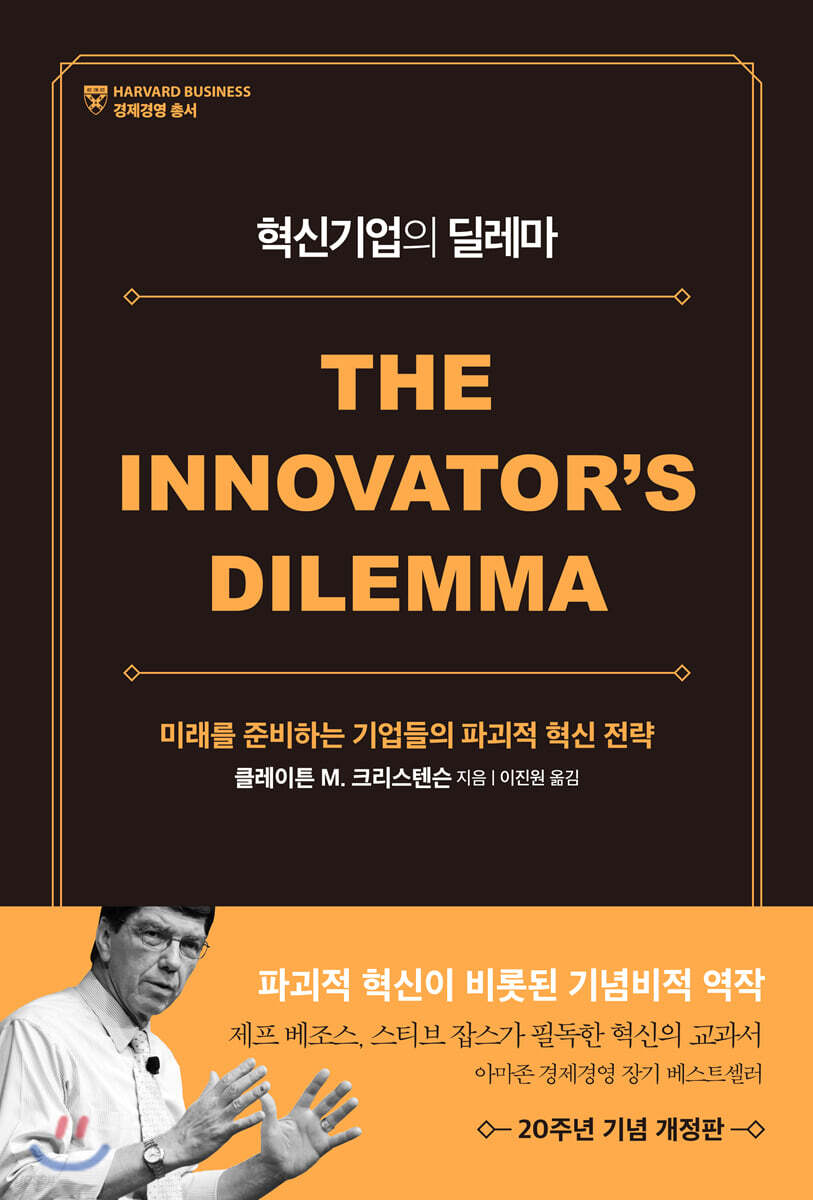
The Innovator's Dilemma
 |
Description
Book Introduction
The book that inspired Jeff Bezos to develop Amazon's strategy!
Professor Christensen captures the essence of "disruptive innovation."
Clayton Christensen, a world-renowned management guru, passed away on January 23, 2020, at the age of 67.
The concept of 'disruptive innovation' he advocated has inspired many Silicon Valley entrepreneurs such as Steve Jobs, Jeff Bezos, and Reed Hastings, and has been strongly recommended by renowned Korean scholars and journalists such as Hong Chun-wook, Professor Cho Shin of Yonsei University, Jeong Ji-hoon, Son Jae-kwon, and Shin Hyeon-gyu.
This book attracted a lot of attention as a must-read in Silicon Valley when Andy Grove, then the CEO of Intel, introduced it at the Comdex event as “the most important book for every company.” In today’s era of accelerated change, it has become an even more urgent idea.
This time, to mark the 20th anniversary of its publication, we have published a revised edition with supplementary translations to make it easier for current readers to understand.
"The Innovator's Dilemma" explores the dilemma faced by successful companies: while they believe innovation and technological advancement are essential for their survival, this may not always be the case. It also provides insights into how to cope with rapid technological change.
There are several common characteristics found in the super-excellent companies that have lost market dominance.
In other words, the company lost its leading position by listening to the voices of existing customers, actively investing in developing new technologies that customers wanted, and investing capital only in innovations that promised better returns.
The author presents an unusual view that the failure of excellent companies is due to managers' disregard for the principles of disruptive technologies.
We analyze why sound decision-making by excellent managers can lead companies to failure and propose a disruptive innovation strategy to resolve this dilemma.
Professor Christensen captures the essence of "disruptive innovation."
Clayton Christensen, a world-renowned management guru, passed away on January 23, 2020, at the age of 67.
The concept of 'disruptive innovation' he advocated has inspired many Silicon Valley entrepreneurs such as Steve Jobs, Jeff Bezos, and Reed Hastings, and has been strongly recommended by renowned Korean scholars and journalists such as Hong Chun-wook, Professor Cho Shin of Yonsei University, Jeong Ji-hoon, Son Jae-kwon, and Shin Hyeon-gyu.
This book attracted a lot of attention as a must-read in Silicon Valley when Andy Grove, then the CEO of Intel, introduced it at the Comdex event as “the most important book for every company.” In today’s era of accelerated change, it has become an even more urgent idea.
This time, to mark the 20th anniversary of its publication, we have published a revised edition with supplementary translations to make it easier for current readers to understand.
"The Innovator's Dilemma" explores the dilemma faced by successful companies: while they believe innovation and technological advancement are essential for their survival, this may not always be the case. It also provides insights into how to cope with rapid technological change.
There are several common characteristics found in the super-excellent companies that have lost market dominance.
In other words, the company lost its leading position by listening to the voices of existing customers, actively investing in developing new technologies that customers wanted, and investing capital only in innovations that promised better returns.
The author presents an unusual view that the failure of excellent companies is due to managers' disregard for the principles of disruptive technologies.
We analyze why sound decision-making by excellent managers can lead companies to failure and propose a disruptive innovation strategy to resolve this dilemma.
- You can preview some of the book's contents.
Preview
index
preface
Part 1: Why Even Great Companies Fail
Chapter 1.
How Great Companies Fail
Insights from the Drive Industry
Chapter 2: Value Networks and the Power of Innovation
How to understand the needs of stakeholders within your value network
Chapter 3: Disruptive Technological Changes in the Excavator Industry
Disruptive technologies occurring in industries that do not change rapidly
Chapter 4: Once You Go Up, You Can't Come Down
Problems that cannot be solved even with good management
Part 2: Managing Disruptive Technological Change
Chapter 5: Hold Organizations Responsible for Requirements for Disruptive Technologies
Coexistence of sustainable and destructive technologies
Chapter 6: Match the size of your organization to the size of your market.
The Correlation Between Firm Size and Disruptive Technology Leadership
Chapter 7: Discovering New Markets
Unpredictability and the impossibility of downward mobility in established companies
Chapter 8: How to Evaluate Organizational Capabilities
Building an Organization That Adapts Well to Change
Chapter 9 Performance, Market Demand, and Product Life Cycle
Key Features of Disruptive Technologies
Chapter 10: Managing Disruptive Technological Change: Case Studies
Building an Organization that Achieves Disruptive Innovation
Chapter 11 Full Summary
The Innovator's Dilemma Guide
annotation
Part 1: Why Even Great Companies Fail
Chapter 1.
How Great Companies Fail
Insights from the Drive Industry
Chapter 2: Value Networks and the Power of Innovation
How to understand the needs of stakeholders within your value network
Chapter 3: Disruptive Technological Changes in the Excavator Industry
Disruptive technologies occurring in industries that do not change rapidly
Chapter 4: Once You Go Up, You Can't Come Down
Problems that cannot be solved even with good management
Part 2: Managing Disruptive Technological Change
Chapter 5: Hold Organizations Responsible for Requirements for Disruptive Technologies
Coexistence of sustainable and destructive technologies
Chapter 6: Match the size of your organization to the size of your market.
The Correlation Between Firm Size and Disruptive Technology Leadership
Chapter 7: Discovering New Markets
Unpredictability and the impossibility of downward mobility in established companies
Chapter 8: How to Evaluate Organizational Capabilities
Building an Organization That Adapts Well to Change
Chapter 9 Performance, Market Demand, and Product Life Cycle
Key Features of Disruptive Technologies
Chapter 10: Managing Disruptive Technological Change: Case Studies
Building an Organization that Achieves Disruptive Innovation
Chapter 11 Full Summary
The Innovator's Dilemma Guide
annotation
Into the book
This book tells the stories of companies that fail to maintain their position at the top of their industries when faced with technological and market changes.
Among them, it deals with the stories of excellent companies that many managers have admired, strived to surpass, and been highly recognized for their innovation and execution capabilities.
Of course, many businesses fail due to bureaucracy, arrogance, stale hereditary management, poor planning, short-sighted investment, inadequate technology and resource investment, and simply bad luck.
But this book is not about companies with the weaknesses mentioned above.
This book tells the story of super-efficient companies that lost market dominance despite striving to maintain competitiveness, responding quickly to customer demands, and aggressively investing in new technologies.
--- From the "Preface"
The book begins with the difficult question, "Why do even great companies fail?"
Why do companies that are considered aggressive, innovative, and customer-focused ignore or delay responding to strategically significant technological innovations? Given the analysis of the disk drive industry discussed so far, this may seem like a rather pointed question.
In fact, established companies have been aggressive and innovative in their approach to all types of sustaining innovation, and have been sensitive to customers.
However, the problem that existing companies were unable to successfully solve was narrow vision and slow movement.
Once these companies demonstrated the ability to find new applications and markets for them when entering a market, they seem to have completely lost that ability.
Leading companies now seem to be hamstrung by their customers, and with each new disruptive technology, established leaders seem to be pushed out by aggressive entrants.
--- From Chapter 1, “How Great Companies Fail”
Creating a new market is less risky and far more rewarding than entering an existing market against established competitors.
However, as a company grows larger and more successful, it becomes much more difficult to enter new markets quickly.
As growing companies increasingly need to generate large amounts of new revenue each year to maintain their desired growth rates, smaller markets are increasingly seen as vehicles for generating these large profits.
As we will see, the best way to address these challenges head-on is to embed projects aimed at commercializing disruptive technologies in small organizations.
--- From Chapter 6, “Match the Size of Your Organization to the Size of the Market”
Most managers learn about innovation in the context of sustaining technologies.
This is because most of the technologies developed by existing companies are inherently sustainable.
In theory, such innovations target existing markets where customer needs are understood.
In this environment, planning and researching ways to evaluate, develop, and market innovative products is not only feasible but also critical to success.
But this means that what top executives at successful companies have learned about innovation management has nothing to do with disruptive technologies.
For example, most marketers have spent years learning the crucial skill of listening to customers in college or on the job, but they have rarely received any theoretical or practical training on how to discover markets that don't yet exist.
This one-sided experience-based approach can have disastrous consequences for companies when applying the analytical and decision-making processes learned through sustaining innovation to enabling or disruptive technologies.
--- From Chapter 7, Discovery of New Markets
In this book, we learned that even truly talented managers working at some exceptionally successful companies used their best management techniques to pursue profits and growth, only to lead their companies into the abyss of failure.
However, companies should not abandon the capabilities, organizational structures, and decision-making processes that made them successful in mainstream markets simply because they are ineffective in the face of disruptive technological change.
The innovation challenges they faced were of a persistent nature, and they were the kind of innovations that could be solved solely by their existing capabilities.
Managers of these companies simply need to recognize that their capabilities, culture, and practices are valuable only under certain circumstances.
Among them, it deals with the stories of excellent companies that many managers have admired, strived to surpass, and been highly recognized for their innovation and execution capabilities.
Of course, many businesses fail due to bureaucracy, arrogance, stale hereditary management, poor planning, short-sighted investment, inadequate technology and resource investment, and simply bad luck.
But this book is not about companies with the weaknesses mentioned above.
This book tells the story of super-efficient companies that lost market dominance despite striving to maintain competitiveness, responding quickly to customer demands, and aggressively investing in new technologies.
--- From the "Preface"
The book begins with the difficult question, "Why do even great companies fail?"
Why do companies that are considered aggressive, innovative, and customer-focused ignore or delay responding to strategically significant technological innovations? Given the analysis of the disk drive industry discussed so far, this may seem like a rather pointed question.
In fact, established companies have been aggressive and innovative in their approach to all types of sustaining innovation, and have been sensitive to customers.
However, the problem that existing companies were unable to successfully solve was narrow vision and slow movement.
Once these companies demonstrated the ability to find new applications and markets for them when entering a market, they seem to have completely lost that ability.
Leading companies now seem to be hamstrung by their customers, and with each new disruptive technology, established leaders seem to be pushed out by aggressive entrants.
--- From Chapter 1, “How Great Companies Fail”
Creating a new market is less risky and far more rewarding than entering an existing market against established competitors.
However, as a company grows larger and more successful, it becomes much more difficult to enter new markets quickly.
As growing companies increasingly need to generate large amounts of new revenue each year to maintain their desired growth rates, smaller markets are increasingly seen as vehicles for generating these large profits.
As we will see, the best way to address these challenges head-on is to embed projects aimed at commercializing disruptive technologies in small organizations.
--- From Chapter 6, “Match the Size of Your Organization to the Size of the Market”
Most managers learn about innovation in the context of sustaining technologies.
This is because most of the technologies developed by existing companies are inherently sustainable.
In theory, such innovations target existing markets where customer needs are understood.
In this environment, planning and researching ways to evaluate, develop, and market innovative products is not only feasible but also critical to success.
But this means that what top executives at successful companies have learned about innovation management has nothing to do with disruptive technologies.
For example, most marketers have spent years learning the crucial skill of listening to customers in college or on the job, but they have rarely received any theoretical or practical training on how to discover markets that don't yet exist.
This one-sided experience-based approach can have disastrous consequences for companies when applying the analytical and decision-making processes learned through sustaining innovation to enabling or disruptive technologies.
--- From Chapter 7, Discovery of New Markets
In this book, we learned that even truly talented managers working at some exceptionally successful companies used their best management techniques to pursue profits and growth, only to lead their companies into the abyss of failure.
However, companies should not abandon the capabilities, organizational structures, and decision-making processes that made them successful in mainstream markets simply because they are ineffective in the face of disruptive technological change.
The innovation challenges they faced were of a persistent nature, and they were the kind of innovations that could be solved solely by their existing capabilities.
Managers of these companies simply need to recognize that their capabilities, culture, and practices are valuable only under certain circumstances.
--- From "Chapter 11 Full Summary"
Publisher's Review
Why did even the world's best companies lose their market dominance?
The waves and influence this book created
In 1997, when the first edition of "The Innovator's Dilemma" was published, the idea of "disruptive innovation," which managers had never considered at the time, caused a huge stir in the business world.
The idea that only disruptive innovation, which destroys the past and seeks new opportunities for innovation, would provide a breakthrough for future growth was valid then, and has become even more urgent 20 years later.
The uncertainty in the real economy stemming from the financial market shows no sign of resolution, and no one can predict what innovative strategies will be needed to overcome the current crisis.
This book explores the dilemma faced by successful companies: while they believe innovation and technological advancement are essential for their survival, this may not necessarily be the case. It provides a guide to coping with rapidly evolving technological changes.
History does not repeat itself.
Only those who fail to learn from past experiences will continue to fail.
We must be able to properly utilize what we have learned from the failures and successes of existing companies' disruptive technologies.
Innovation should not be something that is done only when a crisis arises or when a sense of crisis arises, but should become a normal part of a company's activities.
The Birth of Disruptive Innovation: The Most Widely Known, Yet Mostly Misunderstood Concept
All previous innovations were sustaining innovations.
It was a strategy to thoroughly satisfy and impress existing customers by tailoring them to their needs.
However, the disruptive innovation discussed in this book is a strategy that attracts a new class of customers by shining in a completely different field while possessing technology that is much lower than the performance required by existing customers.
Disruptive innovation occurs in both the rapidly changing disk drive industry and the relatively slow-moving excavator industry.
The reason disk drives are used as a specific example is because, like fruit flies in a laboratory, rapid generational change occurs, making 'scientific' hypothesis verification possible.
When disruptive innovations first emerge, they almost always offer inferior performance on features that mainstream consumers care about.
However, companies with disruptive technologies ultimately discover 'hidden' customers and dominate existing markets.
This book explores the process by which disruptive technologies replace outdated technologies and the companies that struggle to develop them. It also delves into the dilemma of innovative companies that aggressively invest in products and services that loyal customers want, only to ultimately fail.
Customers don't know what they want.
Disruptive Innovation Strategies for Companies Preparing for the Future
There are several common characteristics found in the super-excellent companies that have lost market dominance.
They lost their leadership position because they listened to the voices of existing customers, actively invested in developing new technologies that customers wanted, and invested capital only in innovations that promised better returns.
The underlying meaning of this statement is that good management principles that are widely accepted today may not actually be appropriate in some situations.
In other words, there are times when it's right to ignore the voice of the customer, invest in developing low-performance products, and target a narrow market.
This book shows that the reason for the failure of excellent companies is that managers ignored the principles of disruptive technology.
Additionally, the theory is developed in two parts to ensure comprehensive usefulness for the past, present, and future.
Part 1, consisting of chapters 1 through 4, presents an analysis of 'why sound decision-making by excellent managers can lead companies to failure.'
In Part 2, we propose a disruptive innovation strategy to address this dilemma: focusing appropriate resources on disruptive technologies that strengthen companies in the short term but ultimately lead to their downfall.
The core of the strategy is as follows:
1.
Don't rely on customers and investors.
To survive, companies listen to the opinions of customers and investors and provide the products and services they want.
However, the speed of a company's technological development is qualitatively different from the speed of market demand.
That is, the rate of development that the market demands or can absorb may differ from the rate of development that technology provides.
A product created using a disruptive technology that doesn't seem useful to customers today may well meet their needs tomorrow.
Therefore, companies must recognize that customers cannot lead innovation.
But in a corporate culture that prioritizes customers and investors, it's difficult to invest adequate resources in ideas that are abandoned until customers want them.
And by the time you actually invest, it may be too late.
A company's success may depend on the ideas that end up in its trash can.
Therefore, a separate organization should be established to manage technologies that are considered disruptive.
Managers should also remember that the biggest barrier to innovation is not technology or management skills, but rather management techniques.
2.
Focus on small markets
As a company grows in size, it becomes increasingly difficult to maintain the same growth rate as before.
To maintain that growth rate, they need to increase their sales volume further.
Therefore, they have a hard time entering the small markets that are currently in the process of becoming large markets in the future.
Because to maintain growth rates, we need to focus on large markets.
It's too late to wait for a new market to grow.
A separate organization created for disruptive technologies should focus on smaller markets where even small deals can generate big excitement, rather than large markets that require large profits.
In small, independent organizations, the chances of failure are also high.
But we need the flexibility to fail on a small scale so that we can try again.
Having less capital also reduces the pressure on an organization to generate significant returns for mainstream markets.
Instead, they will focus more on finding core customers who can sustain their profitability.
3.
Don't plan too much
Thorough market research, good planning, and appropriate execution are hallmarks of good management.
However, companies that must quantify market size and profits during the investment process are bound to hesitate when faced with disruptive technologies.
Because market data related to disruptive technologies does not exist.
So, rather than focusing from the outset on who will want the product, we need to explore different options and adopt a flexible approach when it comes to investing in product design and manufacturing capabilities.
Ideas surrounding disruptive technologies often die, but the business of creating new markets for those technologies isn't always risky.
Managers who can quickly learn from failures and try again will succeed based on their understanding of the customers, markets, and technologies needed to commercialize disruptive innovations.
Disruptive technologies don't inherently pose a huge challenge and put the company at risk because there's no market for them.
That's why marketing challenges that assume failure are absolutely necessary.
If the initial direction you took wasn't the right one, you can carefully move into the market based on what you learned along the way, leaving resources to correct.
4.
Individual capabilities and organizational capabilities are different.
Most managers try to leave innovation to their "capable" employees.
Because we believe they will be able to successfully drive innovation.
However, organizations have capabilities separate from the people who work within them.
An organization's capabilities exist in two places:
One of them is the organizational process, which refers to how labor, energy, and technology are used to produce high value-added products.
The other one is the value of the organization.
This refers to the criteria used when determining priorities.
Organizations cannot think more flexibly than individuals.
Therefore, to create organizational capabilities, it is necessary to acquire other organizations or other organizations, draw team boundaries, and create new teams.
5.
Technology supply may not match market demand.
Disruptive technologies often start in small markets but ultimately enter the mainstream market.
Moreover, product performance is no longer a critical factor once it has been improved beyond what customers want.
Now, the criteria for product selection are moving from reliability and convenience to ultimately price.
Therefore, only companies that closely monitor the product usage trends of mainstream customers will be able to accurately identify shifts in the competitive landscape in their markets.
Only disruptive innovation, which destroys the past and seeks new opportunities for innovation, will provide a breakthrough for future growth.
Professor Christensen points out five key points: “Don’t rely on customers and investors; focus on small markets; don’t plan too much; individual capabilities and organizational capabilities are different; and technology supply may not match market demand.” He shows disruptive technologies that move in a completely different way from the past, from the technology acquisition process to distribution, but that cooperate harmoniously with each other.
This book will help you understand the laws that govern disruptive technologies that lead to success, and uncover insights you can leverage to create new markets and products.
Innovate 'Innovation'
How to Respond to Disruptive Technologies
Many companies still struggle to identify disruptive technologies, even with strong technological capabilities, brands, distribution networks, and ample cash.
Because disruptive technologies rarely seem feasible in the early years when investment is most critical.
Therefore, management is forced to work towards sustaining technologies while creating barriers to disruptive technologies.
However, these barriers can be overcome.
The dilemma faced by innovative companies due to the conflicting demands of sustaining and disruptive technologies is solvable.
Managers must first understand the inherent conflicts between different technologies.
They then need to ensure that each organization's market position, economic scale, and value are sufficiently aligned with the power of its customers.
Disruptive innovation is a technology that usually requires a restructuring of not only the product itself but also the organizational structure.
Now, when dealing with disruptive technologies, we need technologies that operate in a completely different way from the past, from the technology acquisition process to distribution, but that work together harmoniously.
Only managers who understand the laws governing disruptive technologies that lead to success and who know how to use them to create new markets and products will be able to effectively respond to the opportunities they present.
The waves and influence this book created
In 1997, when the first edition of "The Innovator's Dilemma" was published, the idea of "disruptive innovation," which managers had never considered at the time, caused a huge stir in the business world.
The idea that only disruptive innovation, which destroys the past and seeks new opportunities for innovation, would provide a breakthrough for future growth was valid then, and has become even more urgent 20 years later.
The uncertainty in the real economy stemming from the financial market shows no sign of resolution, and no one can predict what innovative strategies will be needed to overcome the current crisis.
This book explores the dilemma faced by successful companies: while they believe innovation and technological advancement are essential for their survival, this may not necessarily be the case. It provides a guide to coping with rapidly evolving technological changes.
History does not repeat itself.
Only those who fail to learn from past experiences will continue to fail.
We must be able to properly utilize what we have learned from the failures and successes of existing companies' disruptive technologies.
Innovation should not be something that is done only when a crisis arises or when a sense of crisis arises, but should become a normal part of a company's activities.
The Birth of Disruptive Innovation: The Most Widely Known, Yet Mostly Misunderstood Concept
All previous innovations were sustaining innovations.
It was a strategy to thoroughly satisfy and impress existing customers by tailoring them to their needs.
However, the disruptive innovation discussed in this book is a strategy that attracts a new class of customers by shining in a completely different field while possessing technology that is much lower than the performance required by existing customers.
Disruptive innovation occurs in both the rapidly changing disk drive industry and the relatively slow-moving excavator industry.
The reason disk drives are used as a specific example is because, like fruit flies in a laboratory, rapid generational change occurs, making 'scientific' hypothesis verification possible.
When disruptive innovations first emerge, they almost always offer inferior performance on features that mainstream consumers care about.
However, companies with disruptive technologies ultimately discover 'hidden' customers and dominate existing markets.
This book explores the process by which disruptive technologies replace outdated technologies and the companies that struggle to develop them. It also delves into the dilemma of innovative companies that aggressively invest in products and services that loyal customers want, only to ultimately fail.
Customers don't know what they want.
Disruptive Innovation Strategies for Companies Preparing for the Future
There are several common characteristics found in the super-excellent companies that have lost market dominance.
They lost their leadership position because they listened to the voices of existing customers, actively invested in developing new technologies that customers wanted, and invested capital only in innovations that promised better returns.
The underlying meaning of this statement is that good management principles that are widely accepted today may not actually be appropriate in some situations.
In other words, there are times when it's right to ignore the voice of the customer, invest in developing low-performance products, and target a narrow market.
This book shows that the reason for the failure of excellent companies is that managers ignored the principles of disruptive technology.
Additionally, the theory is developed in two parts to ensure comprehensive usefulness for the past, present, and future.
Part 1, consisting of chapters 1 through 4, presents an analysis of 'why sound decision-making by excellent managers can lead companies to failure.'
In Part 2, we propose a disruptive innovation strategy to address this dilemma: focusing appropriate resources on disruptive technologies that strengthen companies in the short term but ultimately lead to their downfall.
The core of the strategy is as follows:
1.
Don't rely on customers and investors.
To survive, companies listen to the opinions of customers and investors and provide the products and services they want.
However, the speed of a company's technological development is qualitatively different from the speed of market demand.
That is, the rate of development that the market demands or can absorb may differ from the rate of development that technology provides.
A product created using a disruptive technology that doesn't seem useful to customers today may well meet their needs tomorrow.
Therefore, companies must recognize that customers cannot lead innovation.
But in a corporate culture that prioritizes customers and investors, it's difficult to invest adequate resources in ideas that are abandoned until customers want them.
And by the time you actually invest, it may be too late.
A company's success may depend on the ideas that end up in its trash can.
Therefore, a separate organization should be established to manage technologies that are considered disruptive.
Managers should also remember that the biggest barrier to innovation is not technology or management skills, but rather management techniques.
2.
Focus on small markets
As a company grows in size, it becomes increasingly difficult to maintain the same growth rate as before.
To maintain that growth rate, they need to increase their sales volume further.
Therefore, they have a hard time entering the small markets that are currently in the process of becoming large markets in the future.
Because to maintain growth rates, we need to focus on large markets.
It's too late to wait for a new market to grow.
A separate organization created for disruptive technologies should focus on smaller markets where even small deals can generate big excitement, rather than large markets that require large profits.
In small, independent organizations, the chances of failure are also high.
But we need the flexibility to fail on a small scale so that we can try again.
Having less capital also reduces the pressure on an organization to generate significant returns for mainstream markets.
Instead, they will focus more on finding core customers who can sustain their profitability.
3.
Don't plan too much
Thorough market research, good planning, and appropriate execution are hallmarks of good management.
However, companies that must quantify market size and profits during the investment process are bound to hesitate when faced with disruptive technologies.
Because market data related to disruptive technologies does not exist.
So, rather than focusing from the outset on who will want the product, we need to explore different options and adopt a flexible approach when it comes to investing in product design and manufacturing capabilities.
Ideas surrounding disruptive technologies often die, but the business of creating new markets for those technologies isn't always risky.
Managers who can quickly learn from failures and try again will succeed based on their understanding of the customers, markets, and technologies needed to commercialize disruptive innovations.
Disruptive technologies don't inherently pose a huge challenge and put the company at risk because there's no market for them.
That's why marketing challenges that assume failure are absolutely necessary.
If the initial direction you took wasn't the right one, you can carefully move into the market based on what you learned along the way, leaving resources to correct.
4.
Individual capabilities and organizational capabilities are different.
Most managers try to leave innovation to their "capable" employees.
Because we believe they will be able to successfully drive innovation.
However, organizations have capabilities separate from the people who work within them.
An organization's capabilities exist in two places:
One of them is the organizational process, which refers to how labor, energy, and technology are used to produce high value-added products.
The other one is the value of the organization.
This refers to the criteria used when determining priorities.
Organizations cannot think more flexibly than individuals.
Therefore, to create organizational capabilities, it is necessary to acquire other organizations or other organizations, draw team boundaries, and create new teams.
5.
Technology supply may not match market demand.
Disruptive technologies often start in small markets but ultimately enter the mainstream market.
Moreover, product performance is no longer a critical factor once it has been improved beyond what customers want.
Now, the criteria for product selection are moving from reliability and convenience to ultimately price.
Therefore, only companies that closely monitor the product usage trends of mainstream customers will be able to accurately identify shifts in the competitive landscape in their markets.
Only disruptive innovation, which destroys the past and seeks new opportunities for innovation, will provide a breakthrough for future growth.
Professor Christensen points out five key points: “Don’t rely on customers and investors; focus on small markets; don’t plan too much; individual capabilities and organizational capabilities are different; and technology supply may not match market demand.” He shows disruptive technologies that move in a completely different way from the past, from the technology acquisition process to distribution, but that cooperate harmoniously with each other.
This book will help you understand the laws that govern disruptive technologies that lead to success, and uncover insights you can leverage to create new markets and products.
Innovate 'Innovation'
How to Respond to Disruptive Technologies
Many companies still struggle to identify disruptive technologies, even with strong technological capabilities, brands, distribution networks, and ample cash.
Because disruptive technologies rarely seem feasible in the early years when investment is most critical.
Therefore, management is forced to work towards sustaining technologies while creating barriers to disruptive technologies.
However, these barriers can be overcome.
The dilemma faced by innovative companies due to the conflicting demands of sustaining and disruptive technologies is solvable.
Managers must first understand the inherent conflicts between different technologies.
They then need to ensure that each organization's market position, economic scale, and value are sufficiently aligned with the power of its customers.
Disruptive innovation is a technology that usually requires a restructuring of not only the product itself but also the organizational structure.
Now, when dealing with disruptive technologies, we need technologies that operate in a completely different way from the past, from the technology acquisition process to distribution, but that work together harmoniously.
Only managers who understand the laws governing disruptive technologies that lead to success and who know how to use them to create new markets and products will be able to effectively respond to the opportunities they present.
GOODS SPECIFICS
- Date of issue: March 30, 2020
- Page count, weight, size: 360 pages | 548g | 152*224*30mm
- ISBN13: 9788984077850
- ISBN10: 8984077852
You may also like
카테고리
korean


korean

![GQ KOREA Mark (Monthly): December [2025]](http://librairie.coreenne.fr/cdn/shop/files/8ef265dbbfbf186523ed75ba7319009d.jpg?v=1765340328&width=3840)


