

Fearless Organization
 |
Description
Book Introduction
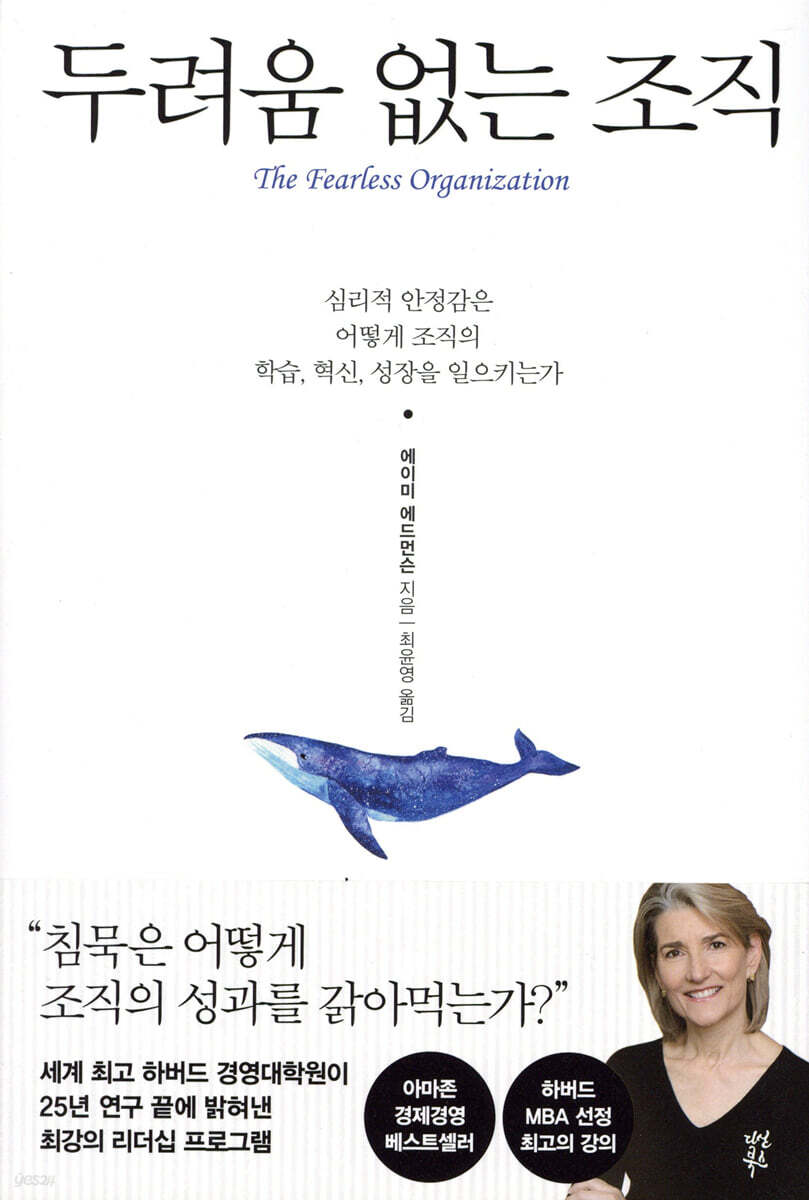
“How Silence Eats Away Organizational Performance” The most powerful leadership program discovered by Harvard Business School after 25 years of research. Amy Edmondson, a Harvard Business School professor and world-renowned management guru, has compiled 25 years of research into her book, "The Fearless Organization." This book is the most practical management guide for leaders and teams, and teaches how to incorporate "psychological safety," which fosters knowledge and innovation, into an organization's culture. Psychological safety is defined as an organizational environment in which employees believe they will not be punished or retaliated against for expressing any opinions related to their work. In this book, the author scientifically proves how fear undermines organizational performance. An organization can only continue to innovate and grow when its members feel comfortable expressing their ideas, opinions, and even mistakes without the fear of being awkward with someone or getting fired (i.e., when a culture of psychological comfort is established). |
- You can preview some of the book's contents.
Preview
index
· Praise for this book
· Preface to the Korean edition
· A note from the editor - For all leaders who dream of a dynamic organizational culture
· Introduction - A special power that exists only in the strongest team.
Survival Strategies for Businesses in Uncertain Times│Why Do Harmonious Teams Make More Mistakes?│The Final Piece of the Puzzle for Building a Strong Team
Chapter 1 - Is Your Organization Safe Now?
· Rescue the organization from the shackles of silence.
The unconscious calculator silences all results. Make people believe that their relationships are safe. Dishonest organizations create attention soldiers. Why fear cannot be a driving force for growth.
· Psychological stability is not a welfare benefit.
Why Silence Is Inevitable in Organizations│Psychological Safety and Employee Engagement Are Proportional│Good Leaders Use Conflict as a Driving Force
[CASE STUDY] A Tragedy Caused by Silence: The Tenerife Airport Disaster
[CASE STUDY] The Power of Open Communication - The Miracle on the Hudson
Chapter 2 - What Makes a Fearless Organization Different?
· Three ways to build psychological safety
Step 1: Build the Foundation | Step 2: Engage | Step 3: Respond Productively
· [Step 1] Change your 'failure framework' right now.
Why Google Gives Bonuses to Failing Teams? │The Three Types of Failure │The Ideal Leader in a Turbulent Society │How Did Volkswagen Cross the River of No Return? │Why Did the Tsunami Spare the Daini Nuclear Power Plant? Motivate with a Higher Goal
· [Step 2] Be humble but dig in actively.
Show situational humility│Ask questions proactively.
· [Step 3] Are you prepared to celebrate failure?
Be grateful first, and the results will come later. │ Remove the stigma attached to failure. │ Take firm action against violations.
Some misconceptions about psychological stability
Psychological safety is not the same as kindness. Psychological safety transcends individual tendencies. Psychological safety is not the same as trust. Psychological safety does not lower the bar for performance. You can never be safe without motivation.
[CASE STUDY] A Predictable Disaster - The Fukushima Nuclear Accident
[CASE STUDY] The Consequences of Fearing Reality - Wells Fargo and the Federal Reserve Bank of New York
[CASE STUDY] Treating Employees Like Family - Berry Wehmiller
[SELF-CHECK] Leadership Self-Assessment
Chapter 3 - How Do the Best Organizations Innovate?
There is no "final" in psychological stability.
Do you have the courage to change consistently? │Like a sailor sailing against the wind
· Be honest, as if you've never been hurt!
Pixar's Every Employee Becomes a Critic│The "Freedom to Fail" to Prevent Box Office Flops│The Tragedy of Nokia's Fear of Reality│Fear Can Always Become Courage
· Open your ears and listen to the 'sound of silence'
The Columbia explosion that some predicted│The silence doesn't break on its own.
· Jokes that can't be taken as jokes
Silence in the Age of Social Media? │Susan Fowler's Little Ball │Peace Comes to Uber
· Leaders' Questions About Psychological Safety
[CASE STUDY] One for All, All for One - DaVita Kidney Dialysis Center
[CASE STUDY] Extreme Honesty - Bridgewater Associates
[CASE STUDY] The Magic of "I Don't Know" - Eileen Fisher
[SELF-CHECK] Self-Assessment of Psychological Stability
· Acknowledgements
About the author
· References
· Preface to the Korean edition
· A note from the editor - For all leaders who dream of a dynamic organizational culture
· Introduction - A special power that exists only in the strongest team.
Survival Strategies for Businesses in Uncertain Times│Why Do Harmonious Teams Make More Mistakes?│The Final Piece of the Puzzle for Building a Strong Team
Chapter 1 - Is Your Organization Safe Now?
· Rescue the organization from the shackles of silence.
The unconscious calculator silences all results. Make people believe that their relationships are safe. Dishonest organizations create attention soldiers. Why fear cannot be a driving force for growth.
· Psychological stability is not a welfare benefit.
Why Silence Is Inevitable in Organizations│Psychological Safety and Employee Engagement Are Proportional│Good Leaders Use Conflict as a Driving Force
[CASE STUDY] A Tragedy Caused by Silence: The Tenerife Airport Disaster
[CASE STUDY] The Power of Open Communication - The Miracle on the Hudson
Chapter 2 - What Makes a Fearless Organization Different?
· Three ways to build psychological safety
Step 1: Build the Foundation | Step 2: Engage | Step 3: Respond Productively
· [Step 1] Change your 'failure framework' right now.
Why Google Gives Bonuses to Failing Teams? │The Three Types of Failure │The Ideal Leader in a Turbulent Society │How Did Volkswagen Cross the River of No Return? │Why Did the Tsunami Spare the Daini Nuclear Power Plant? Motivate with a Higher Goal
· [Step 2] Be humble but dig in actively.
Show situational humility│Ask questions proactively.
· [Step 3] Are you prepared to celebrate failure?
Be grateful first, and the results will come later. │ Remove the stigma attached to failure. │ Take firm action against violations.
Some misconceptions about psychological stability
Psychological safety is not the same as kindness. Psychological safety transcends individual tendencies. Psychological safety is not the same as trust. Psychological safety does not lower the bar for performance. You can never be safe without motivation.
[CASE STUDY] A Predictable Disaster - The Fukushima Nuclear Accident
[CASE STUDY] The Consequences of Fearing Reality - Wells Fargo and the Federal Reserve Bank of New York
[CASE STUDY] Treating Employees Like Family - Berry Wehmiller
[SELF-CHECK] Leadership Self-Assessment
Chapter 3 - How Do the Best Organizations Innovate?
There is no "final" in psychological stability.
Do you have the courage to change consistently? │Like a sailor sailing against the wind
· Be honest, as if you've never been hurt!
Pixar's Every Employee Becomes a Critic│The "Freedom to Fail" to Prevent Box Office Flops│The Tragedy of Nokia's Fear of Reality│Fear Can Always Become Courage
· Open your ears and listen to the 'sound of silence'
The Columbia explosion that some predicted│The silence doesn't break on its own.
· Jokes that can't be taken as jokes
Silence in the Age of Social Media? │Susan Fowler's Little Ball │Peace Comes to Uber
· Leaders' Questions About Psychological Safety
[CASE STUDY] One for All, All for One - DaVita Kidney Dialysis Center
[CASE STUDY] Extreme Honesty - Bridgewater Associates
[CASE STUDY] The Magic of "I Don't Know" - Eileen Fisher
[SELF-CHECK] Self-Assessment of Psychological Stability
· Acknowledgements
About the author
· References
Detailed image
Into the book
In this context, I defined 'psychological safety' as 'the belief that the work environment is safe from the risks of interpersonal relationships.'
If everyone feels psychologically safe—if they can express their opinions without being ignored, reprimanded, or disciplined—then they can freely express their thoughts, questions, and concerns without worrying about what their colleagues think.
Psychological safety only occurs when members trust and respect each other and share their thoughts honestly.
In organizations where psychological safety prevails, the “very brief but crucial moments of silence” that Christina experienced do not occur.
Instead, everyone speaks their mind without hesitation, listens to others' opinions, and easily deals with various problems and mistakes.
This process is also used as an opportunity for internal development.
--- p.41, from “Chapter 1, Is Your Organization Safe Now?”
Astro Teller, CEO of Google X and head of the Moonshot project, spoke about the ‘safe failure strategy’ in a 2016 TED Talk:
'That doesn't mean you should just rush and shout at them to fail quickly.
The employees are protesting.
I'm worried again.
"What will happen to me if I fail? Will people laugh at me? Will I get fired?" The only way to engage employees in bold, ambitious, and risky projects while encouraging them to tackle the most critical issues first is to run the project in a way they won't resist.
It is in this context that Google X ensures what is called safe failure.
Ideas that seem unlikely are nixed as soon as the evidence becomes clear.
That's how you get a bonus.
Of course, I got compliments from my colleagues.
Moreover, the superiors give high fives and hugs to say that they did a good job.
Even failures can lead to promotions.
“In cases like this where a project is disbanded midway, bonuses are given to everyone, whether there are two or thirty team members.”
--- p.95, from “Chapter 2, What Makes a Fearless Organization Different?”
The Wells Fargo incident cannot be simply attributed to one person's fault.
The crux of the problem was that the goal could not be achieved without committing illegal acts.
Wells Fargo employees worked in an environment where dissent was not tolerated, and management drilled only one message into them:
'Sell it, or you'll be fired!'
--- p.158, from “Chapter 2, What Makes a Fearless Organization Different?”
The best way to experience psychological security is to act as if it already exists.
Just watch what happens next.
The environment around you will have become much safer and more energetic than before.
Leadership is not a virtue that should only be possessed by those at the top of an organization.
It is an essential element that all members of any position who wish to work actively must possess.
The essence of leadership is to achieve goals together through mutual effort that cannot be achieved alone.
It is about helping each member to devote themselves to their work to the fullest based on their own abilities and skills.
Instead of remaining silent, speak honestly; instead of being fearful, engage actively. The message of this book will be a powerful weapon for members of every organization today.
--- p.179, from “Chapter 3, How Do the Best Organizations Innovate?”
Finally, here are some simple yet powerful expressions that can help create a psychologically safe working environment.
“I don’t know.”
“I need help.”
“I made a mistake.”
"sorry."
All of the above expressions reveal one's own vulnerabilities.
By acknowledging that you are a vulnerable being who can make mistakes, you can give your colleagues room to think and act in a similar way.
It's a way to take off your mask and help others do the same.
This expression means acting as if you feel psychologically stable, even if it is not perfect.
Sometimes, it's like taking some risks to reduce the risk in interpersonal relationships.
If everyone feels psychologically safe—if they can express their opinions without being ignored, reprimanded, or disciplined—then they can freely express their thoughts, questions, and concerns without worrying about what their colleagues think.
Psychological safety only occurs when members trust and respect each other and share their thoughts honestly.
In organizations where psychological safety prevails, the “very brief but crucial moments of silence” that Christina experienced do not occur.
Instead, everyone speaks their mind without hesitation, listens to others' opinions, and easily deals with various problems and mistakes.
This process is also used as an opportunity for internal development.
--- p.41, from “Chapter 1, Is Your Organization Safe Now?”
Astro Teller, CEO of Google X and head of the Moonshot project, spoke about the ‘safe failure strategy’ in a 2016 TED Talk:
'That doesn't mean you should just rush and shout at them to fail quickly.
The employees are protesting.
I'm worried again.
"What will happen to me if I fail? Will people laugh at me? Will I get fired?" The only way to engage employees in bold, ambitious, and risky projects while encouraging them to tackle the most critical issues first is to run the project in a way they won't resist.
It is in this context that Google X ensures what is called safe failure.
Ideas that seem unlikely are nixed as soon as the evidence becomes clear.
That's how you get a bonus.
Of course, I got compliments from my colleagues.
Moreover, the superiors give high fives and hugs to say that they did a good job.
Even failures can lead to promotions.
“In cases like this where a project is disbanded midway, bonuses are given to everyone, whether there are two or thirty team members.”
--- p.95, from “Chapter 2, What Makes a Fearless Organization Different?”
The Wells Fargo incident cannot be simply attributed to one person's fault.
The crux of the problem was that the goal could not be achieved without committing illegal acts.
Wells Fargo employees worked in an environment where dissent was not tolerated, and management drilled only one message into them:
'Sell it, or you'll be fired!'
--- p.158, from “Chapter 2, What Makes a Fearless Organization Different?”
The best way to experience psychological security is to act as if it already exists.
Just watch what happens next.
The environment around you will have become much safer and more energetic than before.
Leadership is not a virtue that should only be possessed by those at the top of an organization.
It is an essential element that all members of any position who wish to work actively must possess.
The essence of leadership is to achieve goals together through mutual effort that cannot be achieved alone.
It is about helping each member to devote themselves to their work to the fullest based on their own abilities and skills.
Instead of remaining silent, speak honestly; instead of being fearful, engage actively. The message of this book will be a powerful weapon for members of every organization today.
--- p.179, from “Chapter 3, How Do the Best Organizations Innovate?”
Finally, here are some simple yet powerful expressions that can help create a psychologically safe working environment.
“I don’t know.”
“I need help.”
“I made a mistake.”
"sorry."
All of the above expressions reveal one's own vulnerabilities.
By acknowledging that you are a vulnerable being who can make mistakes, you can give your colleagues room to think and act in a similar way.
It's a way to take off your mask and help others do the same.
This expression means acting as if you feel psychologically stable, even if it is not perfect.
Sometimes, it's like taking some risks to reduce the risk in interpersonal relationships.
--- p.216, from “Chapter 3, How Do the Best Organizations Innovate?”
Publisher's Review
Why does Google give bonuses to failing teams?
Psychological Stability: A Special Power Existing Only in the Strongest Teams
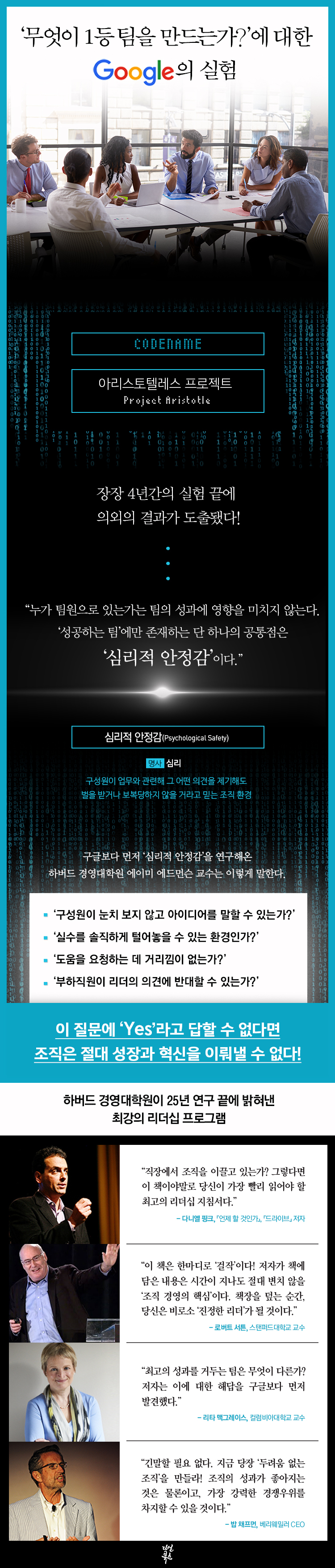
Google, a company that brings together the world's best minds, conducted a survey on 'teamwork,' a key factor in its growth.
Codenamed "Project Aristotle," the project brought together sociologists, organizational psychologists, engineers, and statisticians to explore the question, "What makes teams more effective?"
Researchers conducted their research based on various hypotheses, such as the members' educational background and gender balance, but the results were surprising.
Who was on the team didn't matter much to the organization's performance.
More importantly, it was the way team members communicated and the belief that their opinions were valued.
The first of the 'Characteristics of Successful Teams' announced by Google was 'Psychological Safety'.
Most companies today put a lot of effort into recruiting talented people.
However, unless members are guaranteed the freedom to raise issues in a psychologically stable manner, their outstanding capabilities will be wasted.
When employees feel recognized, shamed, and accepted for speaking up about work-related issues, they are more likely to actively suggest ideas and quickly address mistakes or issues, preventing further damage.
In fact, Google is taking the unusual step of giving bonuses to failing teams to boost psychological well-being.
Astro Teller, CEO of Google X, says, “It’s better to reward the people who figure out what’s wrong and stop it, rather than pouring money into a project that has no potential for years.”
Google's growth is driven by leaders stepping up and creating an environment where failure is safe, and by employees having the opportunity to freely raise issues and make improvements.
A leader's greatest fear is
No one tells the truth
The common thread among all organizations that make mistakes, fail, and fall is silence.
“I'll show you how to build the best car.
Summon all employees, including engineers, to the conference room.
Then declare it like this:
"I'm sick of these crappy, outdated models! I'll give you six weeks to come up with a world-class design! If you don't come up with something decent in six weeks, you'll all be fired!"
It was CEO Martin Winterkorn's 'reign of fear' that instantly brought Volkswagen, which had been on a winning streak, to the brink of ruin.
He forced his employees to achieve absolutely impossible goals and ended up becoming the main culprit in the 'Dieselgate' (exhaust gas manipulation scandal).
The growth strategy of the industrial age, typified by 'bureaucracy', can no longer function effectively.
In today's knowledge economy, only 'agility' and 'innovation' can put a company on the path to success.
And this productive organizational environment depends on how the leader manages the hierarchy within the organization based on psychological stability.
In this book, Dr. Edmondson presents three specific guidelines for building psychological safety in organizations.
* Step 1 [Building a Foundation] refers to creating a new framework for looking at work.
More directly, it is a task of redefining the framework of ‘failure.’
In companies that must develop groundbreaking technologies through innovation, failure should be viewed not as something that "should never happen," but as something that "must be experienced to succeed."
* Step 2 [Inducing Participation] is a method in which a leader approaches members using ‘humility’ and ‘active questions’ as weapons.
As has been the case in the past, an organization cannot grow if the leader acts as if he or she knows all the answers.
Leaders must realize that humility is not a 'benefit' bestowed upon members, but rather an essential mindset for the 'survival' of the company.
Additionally, we must actively encourage members to offer different opinions with the attitude that 'opposing ideas always exist.'
* Step 3 [Reacting Productively] is having the courage to genuinely celebrate failure.
The final task of a leader who creates a safe organizational environment is to 'provide a productive response to members who are willing to take risks and speak up.'
Even if a member's thoughts don't influence the outcome, they should express gratitude and change the perception of failure to a "natural process" so that they don't hide failure and make the problem worse.
However, we also need the courage to firmly punish violations.
If you want to create an organization where everyone can have a voice, you need to systematize psychological safety into the organization through the three steps above.
A silent organization is dangerous.
A leader who believes his or her opinion is always right and that fear motivates is managing with his or her eyes closed and hands tied.
This will undoubtedly lead to a tragic downfall like the Volkswagen case.
What Makes 'Koreans Born in the 90s' Quit Their Jobs?
The only way to solve chronic organizational problems such as 'MeToo', 'Gapjil', and 'Taeum'
Dr. Edmondson, who has actively discussed Korean organizational culture through interviews with numerous domestic media outlets, emphasizes in this book that “even in companies with strong vertical hierarchies like Korea, ‘psychological stability’ can take root.”
In particular, it makes us realize that various problems that commonly occur in Korean organizations, such as 'MeToo', 'Gapjil', and the 'taeum' culture of nurses, are the result of the absence of 'psychological stability'.
Above all, this book will be of great help in understanding the 90s generation, who like to speak their minds honestly and mercilessly ignore the older generation or superiors who nag them, and in creating the organizational culture they desire.
Although it is said that we live in an era of 'war for talent,' the role of a leader does not end with recruiting good talent.
We must focus more on securing excellent talent and creating an environment that fully brings out their hidden abilities and passion.
Peter Drucker said, “Culture eats strategy for breakfast.”
Building a fearless, dynamic organization should not be a fancy phrase to decorate the last page of a company's strategy report, but a leader's top strategic priority.
Do you want to build a team that becomes more powerful the more it works together, a team where ideas are constantly flowing and discussions are vibrant, a team where the entire organization and each member grow together and achieve results? If so, this is the ultimate leadership guide you need to read immediately.
Dr. Edmondson's research, derived from analyzing thousands of organizations, from global corporations like Google to small factories, will serve as an excellent guide for leaders of any organization seeking innovation and growth.
Psychological Stability: A Special Power Existing Only in the Strongest Teams
Google, a company that brings together the world's best minds, conducted a survey on 'teamwork,' a key factor in its growth.
Codenamed "Project Aristotle," the project brought together sociologists, organizational psychologists, engineers, and statisticians to explore the question, "What makes teams more effective?"
Researchers conducted their research based on various hypotheses, such as the members' educational background and gender balance, but the results were surprising.
Who was on the team didn't matter much to the organization's performance.
More importantly, it was the way team members communicated and the belief that their opinions were valued.
The first of the 'Characteristics of Successful Teams' announced by Google was 'Psychological Safety'.
Most companies today put a lot of effort into recruiting talented people.
However, unless members are guaranteed the freedom to raise issues in a psychologically stable manner, their outstanding capabilities will be wasted.
When employees feel recognized, shamed, and accepted for speaking up about work-related issues, they are more likely to actively suggest ideas and quickly address mistakes or issues, preventing further damage.
In fact, Google is taking the unusual step of giving bonuses to failing teams to boost psychological well-being.
Astro Teller, CEO of Google X, says, “It’s better to reward the people who figure out what’s wrong and stop it, rather than pouring money into a project that has no potential for years.”
Google's growth is driven by leaders stepping up and creating an environment where failure is safe, and by employees having the opportunity to freely raise issues and make improvements.
A leader's greatest fear is
No one tells the truth
The common thread among all organizations that make mistakes, fail, and fall is silence.
“I'll show you how to build the best car.
Summon all employees, including engineers, to the conference room.
Then declare it like this:
"I'm sick of these crappy, outdated models! I'll give you six weeks to come up with a world-class design! If you don't come up with something decent in six weeks, you'll all be fired!"
It was CEO Martin Winterkorn's 'reign of fear' that instantly brought Volkswagen, which had been on a winning streak, to the brink of ruin.
He forced his employees to achieve absolutely impossible goals and ended up becoming the main culprit in the 'Dieselgate' (exhaust gas manipulation scandal).
The growth strategy of the industrial age, typified by 'bureaucracy', can no longer function effectively.
In today's knowledge economy, only 'agility' and 'innovation' can put a company on the path to success.
And this productive organizational environment depends on how the leader manages the hierarchy within the organization based on psychological stability.
In this book, Dr. Edmondson presents three specific guidelines for building psychological safety in organizations.
* Step 1 [Building a Foundation] refers to creating a new framework for looking at work.
More directly, it is a task of redefining the framework of ‘failure.’
In companies that must develop groundbreaking technologies through innovation, failure should be viewed not as something that "should never happen," but as something that "must be experienced to succeed."
* Step 2 [Inducing Participation] is a method in which a leader approaches members using ‘humility’ and ‘active questions’ as weapons.
As has been the case in the past, an organization cannot grow if the leader acts as if he or she knows all the answers.
Leaders must realize that humility is not a 'benefit' bestowed upon members, but rather an essential mindset for the 'survival' of the company.
Additionally, we must actively encourage members to offer different opinions with the attitude that 'opposing ideas always exist.'
* Step 3 [Reacting Productively] is having the courage to genuinely celebrate failure.
The final task of a leader who creates a safe organizational environment is to 'provide a productive response to members who are willing to take risks and speak up.'
Even if a member's thoughts don't influence the outcome, they should express gratitude and change the perception of failure to a "natural process" so that they don't hide failure and make the problem worse.
However, we also need the courage to firmly punish violations.
If you want to create an organization where everyone can have a voice, you need to systematize psychological safety into the organization through the three steps above.
A silent organization is dangerous.
A leader who believes his or her opinion is always right and that fear motivates is managing with his or her eyes closed and hands tied.
This will undoubtedly lead to a tragic downfall like the Volkswagen case.
What Makes 'Koreans Born in the 90s' Quit Their Jobs?
The only way to solve chronic organizational problems such as 'MeToo', 'Gapjil', and 'Taeum'
Dr. Edmondson, who has actively discussed Korean organizational culture through interviews with numerous domestic media outlets, emphasizes in this book that “even in companies with strong vertical hierarchies like Korea, ‘psychological stability’ can take root.”
In particular, it makes us realize that various problems that commonly occur in Korean organizations, such as 'MeToo', 'Gapjil', and the 'taeum' culture of nurses, are the result of the absence of 'psychological stability'.
Above all, this book will be of great help in understanding the 90s generation, who like to speak their minds honestly and mercilessly ignore the older generation or superiors who nag them, and in creating the organizational culture they desire.
Although it is said that we live in an era of 'war for talent,' the role of a leader does not end with recruiting good talent.
We must focus more on securing excellent talent and creating an environment that fully brings out their hidden abilities and passion.
Peter Drucker said, “Culture eats strategy for breakfast.”
Building a fearless, dynamic organization should not be a fancy phrase to decorate the last page of a company's strategy report, but a leader's top strategic priority.
Do you want to build a team that becomes more powerful the more it works together, a team where ideas are constantly flowing and discussions are vibrant, a team where the entire organization and each member grow together and achieve results? If so, this is the ultimate leadership guide you need to read immediately.
Dr. Edmondson's research, derived from analyzing thousands of organizations, from global corporations like Google to small factories, will serve as an excellent guide for leaders of any organization seeking innovation and growth.
GOODS SPECIFICS
- Date of issue: October 1, 2019
- Format: Hardcover book binding method guide
- Page count, weight, size: 288 pages | 530g | 147*212*23mm
- ISBN13: 9791130625867
- ISBN10: 1130625869
You may also like
카테고리
korean


korean

![GQ KOREA Mark (Monthly): December [2025]](http://librairie.coreenne.fr/cdn/shop/files/8ef265dbbfbf186523ed75ba7319009d.jpg?v=1765340328&width=3840)


