

THE GOAL The Goal 2
 |
Description
Book Introduction
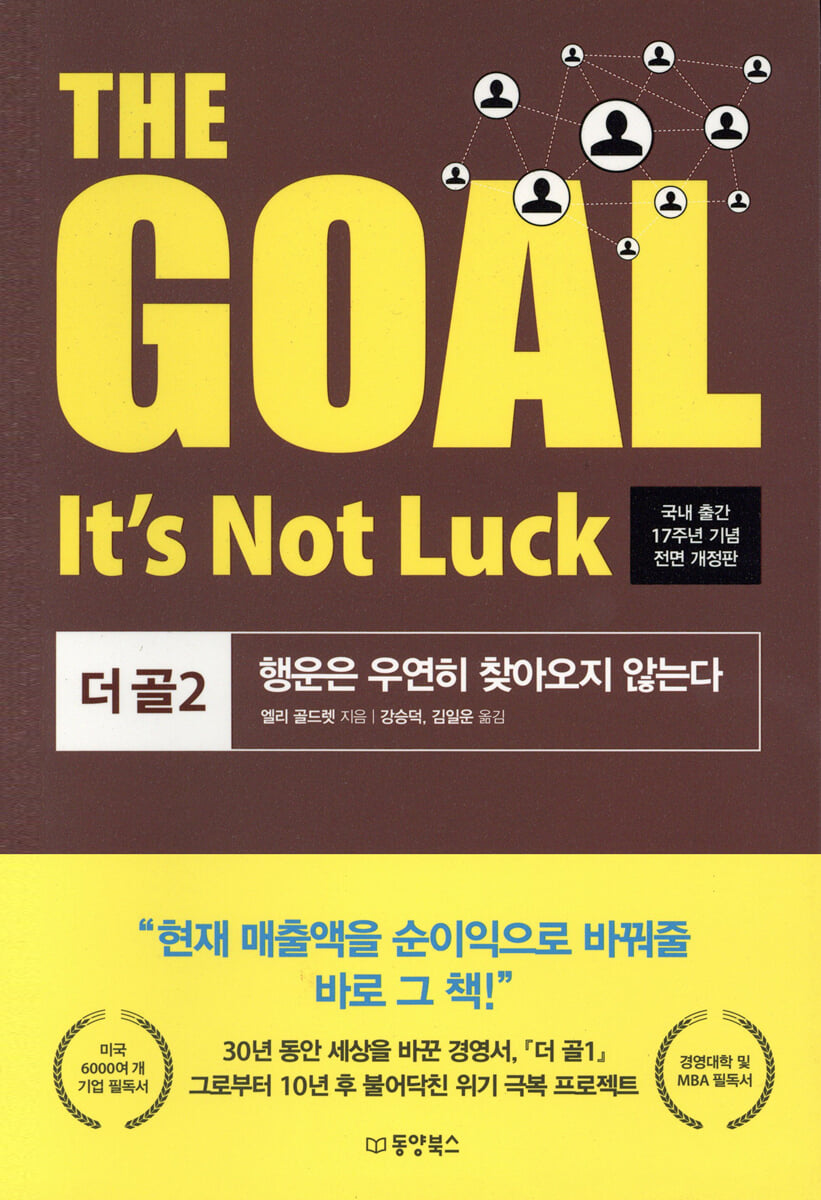
The Goal 1: A Management Book That Changed the World for 30 Years A project to overcome the crisis that struck 10 years later So here's a company in crisis. The company's financial situation deteriorated rapidly when market conditions suddenly worsened and products could not be sold. A company's first goal is, of course, to 'make money'. According to this goal, the company would have to lay off its employees immediately. But another goal of a company is to 'satisfy its employees'. To achieve this goal, we must not lay off employees. So what should we do? There's another goal for companies. It is about satisfying the market, that is, the customers. Businesses, customers, and employees. A strategy that wins for all three groups. This is the core message of the TOC theory that appears in 『The Goal 2』. Just like The Goal 1, which completely changed the paradigm of American business and the global economy, "The Goal 2" is a must-read for thousands of businesses in the United States, a must-read for business schools and MBAs, and a book that has changed the fate of countless businesses. This 2019 revised edition, commemorating the 17th anniversary of its domestic publication, has been completely revised and supplemented, featuring smoother sentences, a lively conversational tone, and maximizing the use of economic terms and modern language in our daily lives. Furthermore, foreign word notation and proofreading have been neatly organized based on the latest spelling conventions. As with 『The Goal 1』, quotes relevant to the content of each chapter have been rearranged and arranged, and an explanation by Professor Jo Mina, an expert well-versed in TOC theory, has been added. Professor Cho Mina, a research professor at the Korea Institute for Industrial Policy Studies, director of the HSG Human Solutions Group, and former administrative officer at the Blue House, helped readers understand the theory better by providing examples of how TOC theory was applied to solve problems in various industrial sites in Korea. |
- You can preview some of the book's contents.
Preview
index
There is no problem that cannot be solved if you want to release the revised version _ Jo Mina
Act 1: In danger
“What happens to us if the company is sold?”
Find the one problem that is the core of Act 2.
“Most problems are simply undesirable outcomes.”
The Key to Solving Act 3 Problems: The Thought Process
"Marketing breakthroughs lie in the market, not in the company."
Act 4: Luck doesn't come by chance.
"The only way to save your company: a groundbreaking marketing solution."
Act 5: The True Goal of a Company
“What is the social responsibility of a company beyond the pursuit of profit?”
Glossary of Key Terms
Act 1: In danger
“What happens to us if the company is sold?”
Find the one problem that is the core of Act 2.
“Most problems are simply undesirable outcomes.”
The Key to Solving Act 3 Problems: The Thought Process
"Marketing breakthroughs lie in the market, not in the company."
Act 4: Luck doesn't come by chance.
"The only way to save your company: a groundbreaking marketing solution."
Act 5: The True Goal of a Company
“What is the social responsibility of a company beyond the pursuit of profit?”
Glossary of Key Terms
Detailed image
Into the book
When I consider someone to be stubborn, unreasonable, and illogical, they tend to think the same of me.
--- p.28
There are only one or two core causes of any problem.
So the rest of the things we don't call 'problems', we call them 'undesirable effects' (UDEs).
They are merely inevitable consequences of core issues.”
--- p.157
To outsiders like us, whenever a company's performance is poor, it appears that each department is blaming each other.
Because they always say it's because of other departments' mistakes.
But that's a problem that arises because company managers pursue partial optimization."
--- p.161
To find a marketing breakthrough that will save your company, you need to analyze your market, not your company.
The marketing breakthrough is in the market.
It's a simple and obvious story."
--- p.284
You might think that setting ambitious goals and then listing obstacles first might actually be counterproductive.
But Professor Jonah said, 'Start with what people do best.'
Everyone is an expert at nitpicking and making excuses.
So, first, write down the obstacles and organize the reasons why you cannot achieve your goal.
--- p.358
"Vice Chairman! What has Unico done for us since they acquired us four years ago? How much have they invested in modernizing the company? Absolutely nothing.
I didn't invest a single penny.
And now they're trying to sell it off.
“The fun is in Unico and the employees are kicked out into the street.”
--- p.373
“First, we agreed on ‘making money now and in the future,’ and ‘providing a stable and satisfying environment for employees now and in the future,’ and ‘satisfying customers now and in the future.’
The first represents the traditional thinking of the company's owners, and the second traditionally represents the views of unions or employee representatives.
The third is the view that all new management methods emphasize.
As senior executives at a company, we have a responsibility to ensure that our companies achieve all three.”
--- p.414
“Until we achieve complete competitive advantage in multiple segments of the market, we should still consider ourselves unsafe.”
“Why is that?”
“Because competitors keep catching up.
There is no such thing as perfect competitive advantage.
“That window of opportunity can close at any time.”
“So what you’re saying is that we have to keep moving so that our competitors can’t catch up.”
--- p.419
“I am really fed up with people in high places who refuse to take full responsibility for their actions.
If you avoid the responsibilities you should take, it will only be the people around you who will suffer in the end.
Their creed was to gather all the power they had and to take no responsibility at all.
--- p.422
“Even if we have a leading position in a part of the market, we should not dominate that entire segment.
Do you know what I mean?
--- p.28
There are only one or two core causes of any problem.
So the rest of the things we don't call 'problems', we call them 'undesirable effects' (UDEs).
They are merely inevitable consequences of core issues.”
--- p.157
To outsiders like us, whenever a company's performance is poor, it appears that each department is blaming each other.
Because they always say it's because of other departments' mistakes.
But that's a problem that arises because company managers pursue partial optimization."
--- p.161
To find a marketing breakthrough that will save your company, you need to analyze your market, not your company.
The marketing breakthrough is in the market.
It's a simple and obvious story."
--- p.284
You might think that setting ambitious goals and then listing obstacles first might actually be counterproductive.
But Professor Jonah said, 'Start with what people do best.'
Everyone is an expert at nitpicking and making excuses.
So, first, write down the obstacles and organize the reasons why you cannot achieve your goal.
--- p.358
"Vice Chairman! What has Unico done for us since they acquired us four years ago? How much have they invested in modernizing the company? Absolutely nothing.
I didn't invest a single penny.
And now they're trying to sell it off.
“The fun is in Unico and the employees are kicked out into the street.”
--- p.373
“First, we agreed on ‘making money now and in the future,’ and ‘providing a stable and satisfying environment for employees now and in the future,’ and ‘satisfying customers now and in the future.’
The first represents the traditional thinking of the company's owners, and the second traditionally represents the views of unions or employee representatives.
The third is the view that all new management methods emphasize.
As senior executives at a company, we have a responsibility to ensure that our companies achieve all three.”
--- p.414
“Until we achieve complete competitive advantage in multiple segments of the market, we should still consider ourselves unsafe.”
“Why is that?”
“Because competitors keep catching up.
There is no such thing as perfect competitive advantage.
“That window of opportunity can close at any time.”
“So what you’re saying is that we have to keep moving so that our competitors can’t catch up.”
--- p.419
“I am really fed up with people in high places who refuse to take full responsibility for their actions.
If you avoid the responsibilities you should take, it will only be the people around you who will suffer in the end.
Their creed was to gather all the power they had and to take no responsibility at all.
--- p.422
“Even if we have a leading position in a part of the market, we should not dominate that entire segment.
Do you know what I mean?
--- p.427
Publisher's Review
The book that will turn your current sales into net profit!
The Goal 1: A Management Book That Changed the World for 30 Years
A project to overcome the crisis that struck 10 years later
★A must-read for over 6,000 U.S. companies.
★Must-read for business schools and MBAs
Hidden behind 100 problems
Find just one key problem!
So here's a company in crisis.
The company's financial situation deteriorated rapidly when market conditions suddenly worsened and products could not be sold.
A company's first goal is, of course, to 'make money'.
According to this goal, the company would have to lay off its employees immediately.
But another goal of a company is to 'satisfy its employees'.
To achieve this goal, we must not lay off employees.
So what should we do? There's another goal for companies.
It is about satisfying the market, that is, the customers.
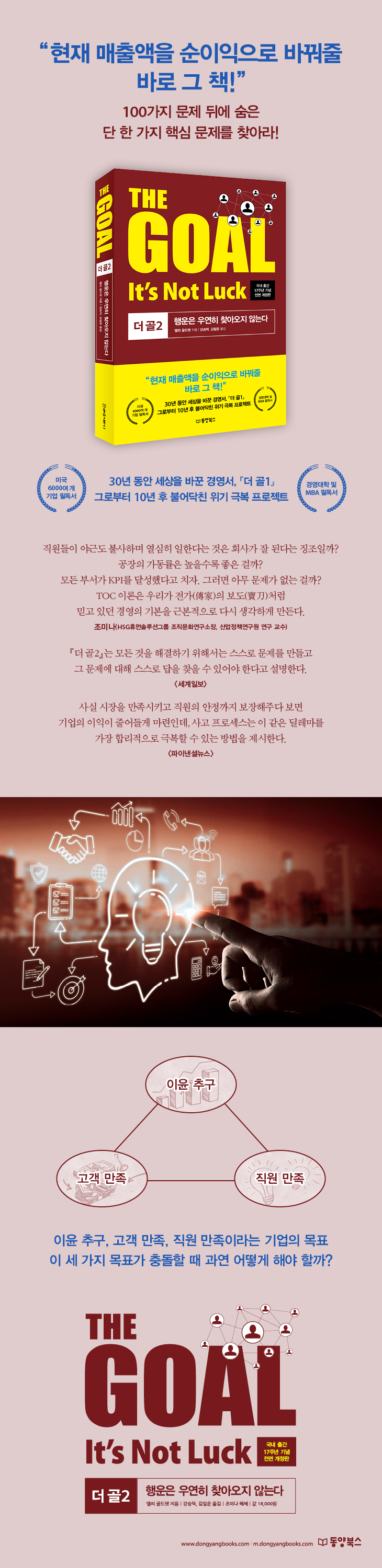
Businesses, customers, and employees.
A strategy that wins for all three groups.
This is the core message of the TOC theory that appears in 『The Goal 2』.
The classic book on economics and management, "The Goal 1," has an astonishing record of selling over 10 million copies in 35 countries over the past 30 years.
While this book focuses on identifying and solving problems in terms of production management, "The Goal 2" identifies and solves hidden problems in broader aspects such as marketing, management, organizational management, and education.
Ellie Goldratt, in her previous work, said that you should clearly define your goal before finding a solution to a problem, and she delivers the same message in The Goal 2.
In other words, all the problems we see are merely undesirable effects (UDEs) derived from some core problem.
Therefore, rather than rushing to treat the superficial, fragmented symptoms, we should focus our energy on identifying the single core problem that is producing all these various problems and solving it.
So how can we identify the core problem? The solution the author proposes is the Thinking Process, a concept within the TOC theory.
The unfamiliar economic terms that appear in the thought process, such as the Current Reality Tree, Cloud, Future Reality Tree, Prerequisite Tree, and Transition Tree, may seem difficult at first glance, but they are very simple when explained in simple terms.
First, let's list all the problems that are phenomenologically apparent.
And then we draw a picture by examining the correlation between the problems.
After connecting all the problems, try to value them one by one.
After going through this process, the root cause will finally be revealed and a solution can be found through this process.
Just like The Goal 1, which completely changed the paradigm of American companies and the global economy, 『The Goal 2』 is a must-read for thousands of companies in the United States, and has been selected as a must-read for business schools and MBAs, and has changed the fate of countless companies.
This 2019 revised edition, commemorating the 17th anniversary of its domestic publication, has been comprehensively revised and supplemented. It features smoother sentences, a lively conversational tone, and the most realistic economic terms and modern language used in our daily lives. Foreign word notation, proofreading, and other elements have been neatly organized based on the latest spelling conventions.
As with 『The Goal 1』, quotes relevant to the content of each chapter have been rearranged and arranged, and an explanation by Professor Jo Mina, an expert well-versed in TOC theory, has been added.
Professor Cho Mina, a research professor at the Korea Institute for Industrial Policy Studies, director of the HSG Human Solutions Group, and former administrative officer at the Blue House, helped readers understand the theory better by providing examples of how TOC theory was applied to solve problems in various industrial sites in Korea.
First, break free from stereotypes.
From then on, the clue to solving the problem is revealed!
“Please tell me how you would rate me.
Then I will tell you how I will act.
If you judge me in a wrong way, then please don't take issue with my actions.”
This is one of Eli Goldratt's famous quotes.
The reason he said this is because every organization has rules, and most of the time, people's bad behavior is due to these rules.
Therefore, I am warning you that a big mistake can occur when you evaluate people only by what they see.
This is a famous quote that clearly shows his philosophy that questions are better than commands, and that people who ask questions and think can achieve greater results than people who listen well.
His way of thinking is well revealed in 『The Goal 2』.
For example, during a negotiation, will it really solve the problem if I assume I'm right and the other party is stubborn and illogical? The company has been running at a loss for years, and every department is just blaming each other.
At this point, will simply looking at the balance sheet and reducing the workforce in loss-making departments solve everything? Will installing state-of-the-art equipment boost productivity and sales? Will a company's future be bright if employees work hard, even overtime and weekends? Just as questions often lead to answers, the questions posed by Eli Goldratt reveal that what we've previously called common sense, practices, or customs may simply be stereotypes.
In other words, a balance sheet full of numbers does not include the company's real assets, such as its professional workforce, the company's market share, and the company's brand value and reputation, so the company's value cannot be evaluated based on that alone. In addition, building the latest facilities or having employees work tirelessly can actually lead to overproduction, which only leads to inventory accumulation and ultimately, a decline in sales.
In this way, TOC theory raises the question of how important reverse thinking is in generating new ideas.
The power of a story that makes you want to read it all the way through once you pick it up
『The Goal 2』, like its predecessor, is written in a novel format, making you curious about the backstory and keep reading.
This is the power of story.
In the rapidly changing era of the Fourth Industrial Revolution, where past winners become today's losers and new businesses suddenly become trends only to reverse course, we have entered an era of global, limitless competition. This book introduces us to a story that is still ongoing.
This universal story, which can happen in any business setting in any country, begins with the tragic situation of having to sell a company that is just emerging from hardship and trying to take a leap forward (for no other reason than because it is currently running a loss).
Readers can't put the book down, wondering how the protagonist will overcome this crisis.
When the protagonist finds a solution, we rejoice together, and when a force appears that hinders the protagonist, we become angry together.
Although it is a business book, it borrows the format of a novel, making it feel like it is my story.
This is the great appeal of this book.
The book that will turn your current sales into net profit!
Eli Goldratt said at the 2004 Korea TOC Conference, “TOC is what can make current sales equal to net income in four years,” and introduced the case of how he saved GM’s Cadillac division from a crisis situation on the verge of closure to a profitable company.
In addition, numerous American companies, including GE, Ford, Boeing, Philips, the US Navy and Air Force, P&G, Delta Air Lines, HP, and BHP, achieved an average net profit growth of 73 percent within one year of implementing TOC.
In particular, through the thought process introduced in 『The Goal 2』 among TOCs, GM was able to reduce lead time from 70 days to 20 days, and Delta Airlines was able to perfectly handle the increased workload without building new facilities.
In addition, the effectiveness of the thought process has been proven in various industrial settings, including P&G, Ford Motor Company, and various banks and hospitals.
Among them, the case of an American bank is noteworthy.
This bank, which was on the verge of bankruptcy due to its notorious poor customer service and slow service, discovered through a Current Reality Tree that the root cause of the problem was its employee evaluation system.
It is of course important to provide kindness training, change processes to expedite work, reorganize the organization, and increase the number of counter staff, but we have found that if there is no objective 'evaluation system' in place, it lowers employee motivation, which ultimately leads to tens of thousands of problems.
In this way, TOC theory, and especially the thinking process, has changed the fate of companies by identifying real problems and improving them, and it continues to play that role today.
The Goal 1: A Management Book That Changed the World for 30 Years
A project to overcome the crisis that struck 10 years later
★A must-read for over 6,000 U.S. companies.
★Must-read for business schools and MBAs
Hidden behind 100 problems
Find just one key problem!
So here's a company in crisis.
The company's financial situation deteriorated rapidly when market conditions suddenly worsened and products could not be sold.
A company's first goal is, of course, to 'make money'.
According to this goal, the company would have to lay off its employees immediately.
But another goal of a company is to 'satisfy its employees'.
To achieve this goal, we must not lay off employees.
So what should we do? There's another goal for companies.
It is about satisfying the market, that is, the customers.
Businesses, customers, and employees.
A strategy that wins for all three groups.
This is the core message of the TOC theory that appears in 『The Goal 2』.
The classic book on economics and management, "The Goal 1," has an astonishing record of selling over 10 million copies in 35 countries over the past 30 years.
While this book focuses on identifying and solving problems in terms of production management, "The Goal 2" identifies and solves hidden problems in broader aspects such as marketing, management, organizational management, and education.
Ellie Goldratt, in her previous work, said that you should clearly define your goal before finding a solution to a problem, and she delivers the same message in The Goal 2.
In other words, all the problems we see are merely undesirable effects (UDEs) derived from some core problem.
Therefore, rather than rushing to treat the superficial, fragmented symptoms, we should focus our energy on identifying the single core problem that is producing all these various problems and solving it.
So how can we identify the core problem? The solution the author proposes is the Thinking Process, a concept within the TOC theory.
The unfamiliar economic terms that appear in the thought process, such as the Current Reality Tree, Cloud, Future Reality Tree, Prerequisite Tree, and Transition Tree, may seem difficult at first glance, but they are very simple when explained in simple terms.
First, let's list all the problems that are phenomenologically apparent.
And then we draw a picture by examining the correlation between the problems.
After connecting all the problems, try to value them one by one.
After going through this process, the root cause will finally be revealed and a solution can be found through this process.
Just like The Goal 1, which completely changed the paradigm of American companies and the global economy, 『The Goal 2』 is a must-read for thousands of companies in the United States, and has been selected as a must-read for business schools and MBAs, and has changed the fate of countless companies.
This 2019 revised edition, commemorating the 17th anniversary of its domestic publication, has been comprehensively revised and supplemented. It features smoother sentences, a lively conversational tone, and the most realistic economic terms and modern language used in our daily lives. Foreign word notation, proofreading, and other elements have been neatly organized based on the latest spelling conventions.
As with 『The Goal 1』, quotes relevant to the content of each chapter have been rearranged and arranged, and an explanation by Professor Jo Mina, an expert well-versed in TOC theory, has been added.
Professor Cho Mina, a research professor at the Korea Institute for Industrial Policy Studies, director of the HSG Human Solutions Group, and former administrative officer at the Blue House, helped readers understand the theory better by providing examples of how TOC theory was applied to solve problems in various industrial sites in Korea.
First, break free from stereotypes.
From then on, the clue to solving the problem is revealed!
“Please tell me how you would rate me.
Then I will tell you how I will act.
If you judge me in a wrong way, then please don't take issue with my actions.”
This is one of Eli Goldratt's famous quotes.
The reason he said this is because every organization has rules, and most of the time, people's bad behavior is due to these rules.
Therefore, I am warning you that a big mistake can occur when you evaluate people only by what they see.
This is a famous quote that clearly shows his philosophy that questions are better than commands, and that people who ask questions and think can achieve greater results than people who listen well.
His way of thinking is well revealed in 『The Goal 2』.
For example, during a negotiation, will it really solve the problem if I assume I'm right and the other party is stubborn and illogical? The company has been running at a loss for years, and every department is just blaming each other.
At this point, will simply looking at the balance sheet and reducing the workforce in loss-making departments solve everything? Will installing state-of-the-art equipment boost productivity and sales? Will a company's future be bright if employees work hard, even overtime and weekends? Just as questions often lead to answers, the questions posed by Eli Goldratt reveal that what we've previously called common sense, practices, or customs may simply be stereotypes.
In other words, a balance sheet full of numbers does not include the company's real assets, such as its professional workforce, the company's market share, and the company's brand value and reputation, so the company's value cannot be evaluated based on that alone. In addition, building the latest facilities or having employees work tirelessly can actually lead to overproduction, which only leads to inventory accumulation and ultimately, a decline in sales.
In this way, TOC theory raises the question of how important reverse thinking is in generating new ideas.
The power of a story that makes you want to read it all the way through once you pick it up
『The Goal 2』, like its predecessor, is written in a novel format, making you curious about the backstory and keep reading.
This is the power of story.
In the rapidly changing era of the Fourth Industrial Revolution, where past winners become today's losers and new businesses suddenly become trends only to reverse course, we have entered an era of global, limitless competition. This book introduces us to a story that is still ongoing.
This universal story, which can happen in any business setting in any country, begins with the tragic situation of having to sell a company that is just emerging from hardship and trying to take a leap forward (for no other reason than because it is currently running a loss).
Readers can't put the book down, wondering how the protagonist will overcome this crisis.
When the protagonist finds a solution, we rejoice together, and when a force appears that hinders the protagonist, we become angry together.
Although it is a business book, it borrows the format of a novel, making it feel like it is my story.
This is the great appeal of this book.
The book that will turn your current sales into net profit!
Eli Goldratt said at the 2004 Korea TOC Conference, “TOC is what can make current sales equal to net income in four years,” and introduced the case of how he saved GM’s Cadillac division from a crisis situation on the verge of closure to a profitable company.
In addition, numerous American companies, including GE, Ford, Boeing, Philips, the US Navy and Air Force, P&G, Delta Air Lines, HP, and BHP, achieved an average net profit growth of 73 percent within one year of implementing TOC.
In particular, through the thought process introduced in 『The Goal 2』 among TOCs, GM was able to reduce lead time from 70 days to 20 days, and Delta Airlines was able to perfectly handle the increased workload without building new facilities.
In addition, the effectiveness of the thought process has been proven in various industrial settings, including P&G, Ford Motor Company, and various banks and hospitals.
Among them, the case of an American bank is noteworthy.
This bank, which was on the verge of bankruptcy due to its notorious poor customer service and slow service, discovered through a Current Reality Tree that the root cause of the problem was its employee evaluation system.
It is of course important to provide kindness training, change processes to expedite work, reorganize the organization, and increase the number of counter staff, but we have found that if there is no objective 'evaluation system' in place, it lowers employee motivation, which ultimately leads to tens of thousands of problems.
In this way, TOC theory, and especially the thinking process, has changed the fate of companies by identifying real problems and improving them, and it continues to play that role today.
GOODS SPECIFICS
- Date of issue: September 10, 2019
- Page count, weight, size: 440 pages | 642g | 153*224*25mm
- ISBN13: 9791157685417
- ISBN10: 1157685412
You may also like
카테고리
korean


korean

![ELLE 엘르 스페셜 에디션 A형 : 12월 [2025]](http://librairie.coreenne.fr/cdn/shop/files/b8e27a3de6c9538896439686c6b0e8fb.jpg?v=1766436872&width=3840)


