

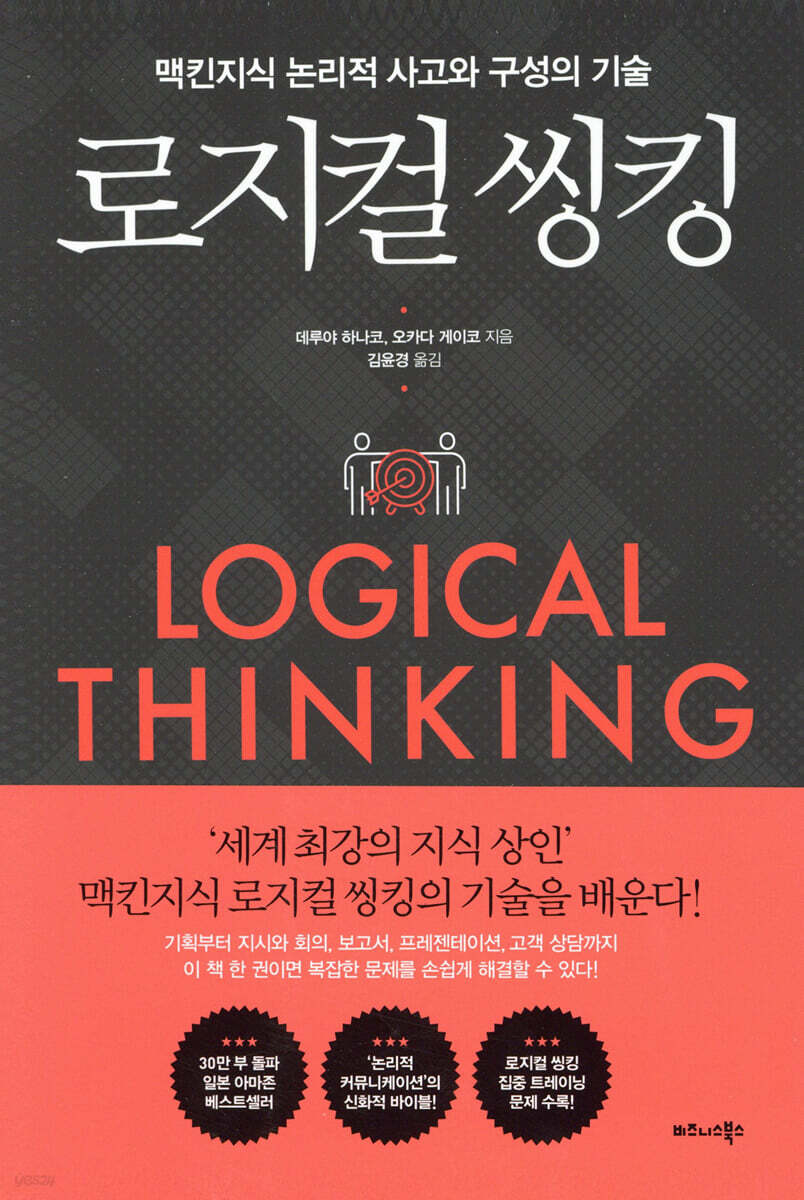
Logical Thinking
 |
Description
Book Introduction
A book that caused a sensation in academia and the public immediately after its publication!
Logical thinking skills taught by top communication experts!
Tom Peters, known as the 'founder of modern management,' called the management consulting firm McKinsey & Company 'the world's greatest knowledge merchant.'
McKinsey is known as a place where top talent possesses outstanding business knowledge, while also being able to appropriately convey that knowledge and achieve desired results.
Hanako Teruya and Keiko Okada, who wrote “Logical Thinking,” are communication experts from McKinsey.
Logical and understandable messages have certain rules and points, regardless of the field or topic.
The 'Logical Thinking' introduced in this book is a systematization of the logical laws of messages and employee training techniques accumulated by McKinsey.
In particular, 『Logical Thinking』 was designed to help us personally check and improve the expression and logic of the documents we write or speak.
These abilities are essential for not only businesspeople but also students and the general public to succeed in social life and interpersonal relationships in an environment that is constantly changing.
Logical thinking is a 'skill', so anyone can acquire it with enough training.
"Logical Thinking" immediately created a sensation among both academics and the general public upon its publication, reaching number one in the business and management book category on Amazon Japan and selling 300,000 copies.
It also became a bestseller in Korea in 2002, and has been republished this time after rectifying the shortcomings of the original and undergoing expert review.
Logical thinking skills taught by top communication experts!
Tom Peters, known as the 'founder of modern management,' called the management consulting firm McKinsey & Company 'the world's greatest knowledge merchant.'
McKinsey is known as a place where top talent possesses outstanding business knowledge, while also being able to appropriately convey that knowledge and achieve desired results.
Hanako Teruya and Keiko Okada, who wrote “Logical Thinking,” are communication experts from McKinsey.
Logical and understandable messages have certain rules and points, regardless of the field or topic.
The 'Logical Thinking' introduced in this book is a systematization of the logical laws of messages and employee training techniques accumulated by McKinsey.
In particular, 『Logical Thinking』 was designed to help us personally check and improve the expression and logic of the documents we write or speak.
These abilities are essential for not only businesspeople but also students and the general public to succeed in social life and interpersonal relationships in an environment that is constantly changing.
Logical thinking is a 'skill', so anyone can acquire it with enough training.
"Logical Thinking" immediately created a sensation among both academics and the general public upon its publication, reaching number one in the business and management book category on Amazon Japan and selling 300,000 copies.
It also became a bestseller in Korea in 2002, and has been republished this time after rectifying the shortcomings of the original and undergoing expert review.
- You can preview some of the book's contents.
Preview
index
Reviewer's Note: A book that makes it easy to learn the basics of logical thinking.
Getting Started_You, Too, Can Become a Logical Communicator!
Part 1: Skills You Need to Know Before Writing or Speaking
Chapter 1: Communicating to the Other Party
1.
Aren't you suffering from the foolish mind reader syndrome?
2.
What message do you want to convey to the other person?
Check 1.
Check the assignment
Check 2.
Check the expected reaction from the other person
3.
What should I say to get an answer?
4.
Why doesn't your answer resonate with the other person?
Two Pitfalls When Conclusions Are Not Delivered
Three Pitfalls When Evidence Isn't Communicated
Two Pitfalls When Methods Are Not Communicated
Check sensitivity
Chapter 2: Common Flaws in Unconvincing Answers
1.
Obvious duplication, omission, and confusion in the story
Repeated stories are a sign that your mind is in disarray.
A missed opportunity in the story leads to a "one-point breakthrough, total collapse."
The confusion in the story diverts from the original purpose or theme.
2.
A leap in the story
Part 2: The Art of Organizing Thoughts Logically
Chapter 3: Preventing Duplication, Omission, and Confusion
1. MECE is a technique for eliminating duplication, omission, and confusion in stories.
What is MECE?
Let's have diverse MECE perspectives
A handy MECE framework to know
2.
Grouping is an information organization process that utilizes MECE.
Create a subset without duplicates, omissions, or confusion.
Intensive Training 1
1. Become strong in MECE
2.
Become strong at grouping
Chapter 4: Eliminating Leaps in Storytelling
1.
So What?/Why So? is a technique for eliminating leaps in storytelling.
Get into the habit of asking "So What?/Why So?"
2.
Two types of So What?/Why So?
Observation of So What?/Why So?
Insight's So What?/Why So?
The "So What?" of insight must presuppose the "So What?" of observation.
Intensive Training 2
1.
Become strong in the So What?/Why So? observation.
2.
You must be able to recognize the So What?/Why So? of a faulty observation.
3.
Become strong in the So What?/Why So? insight
Part 3: Logical Composition Techniques
Chapter 5: Build Logic with So What?/Why So? and MECE
1.
What is logic?
The Law of Verticality, So What?/Why So?
The Law of Transverse, MECE
Basic structure of logic
2.
The simpler the logic, the better.
How many layers should be created vertically?
How to divide it into several parts in the horizontal direction
Chapter 6: Learning Logic Types
1.
Parallel
Parallel structure
Precautions for use
Application Cases
2.
Commentary type
explanatory structure
Precautions for use
Application Cases
Intensive Training 3
1.
Let's fully master the basics of logical types.
2.
Let's develop the ability to detect illogical developments.
Chapter 7: Using Logical Types
1.
This is how to use logical types
When answering a task
When answering two tasks simultaneously
2.
Logic FAQ
Intensive Training 4
1.
Let's organize information into logical types so that it's easy to understand.
2.
Let's explain logically using a diagram.
3.
Let's develop the ability to construct logical arguments that convince others.
Concluding Thoughts: Logical Thinking Becomes a Weapon in Life
Getting Started_You, Too, Can Become a Logical Communicator!
Part 1: Skills You Need to Know Before Writing or Speaking
Chapter 1: Communicating to the Other Party
1.
Aren't you suffering from the foolish mind reader syndrome?
2.
What message do you want to convey to the other person?
Check 1.
Check the assignment
Check 2.
Check the expected reaction from the other person
3.
What should I say to get an answer?
4.
Why doesn't your answer resonate with the other person?
Two Pitfalls When Conclusions Are Not Delivered
Three Pitfalls When Evidence Isn't Communicated
Two Pitfalls When Methods Are Not Communicated
Check sensitivity
Chapter 2: Common Flaws in Unconvincing Answers
1.
Obvious duplication, omission, and confusion in the story
Repeated stories are a sign that your mind is in disarray.
A missed opportunity in the story leads to a "one-point breakthrough, total collapse."
The confusion in the story diverts from the original purpose or theme.
2.
A leap in the story
Part 2: The Art of Organizing Thoughts Logically
Chapter 3: Preventing Duplication, Omission, and Confusion
1. MECE is a technique for eliminating duplication, omission, and confusion in stories.
What is MECE?
Let's have diverse MECE perspectives
A handy MECE framework to know
2.
Grouping is an information organization process that utilizes MECE.
Create a subset without duplicates, omissions, or confusion.
Intensive Training 1
1. Become strong in MECE
2.
Become strong at grouping
Chapter 4: Eliminating Leaps in Storytelling
1.
So What?/Why So? is a technique for eliminating leaps in storytelling.
Get into the habit of asking "So What?/Why So?"
2.
Two types of So What?/Why So?
Observation of So What?/Why So?
Insight's So What?/Why So?
The "So What?" of insight must presuppose the "So What?" of observation.
Intensive Training 2
1.
Become strong in the So What?/Why So? observation.
2.
You must be able to recognize the So What?/Why So? of a faulty observation.
3.
Become strong in the So What?/Why So? insight
Part 3: Logical Composition Techniques
Chapter 5: Build Logic with So What?/Why So? and MECE
1.
What is logic?
The Law of Verticality, So What?/Why So?
The Law of Transverse, MECE
Basic structure of logic
2.
The simpler the logic, the better.
How many layers should be created vertically?
How to divide it into several parts in the horizontal direction
Chapter 6: Learning Logic Types
1.
Parallel
Parallel structure
Precautions for use
Application Cases
2.
Commentary type
explanatory structure
Precautions for use
Application Cases
Intensive Training 3
1.
Let's fully master the basics of logical types.
2.
Let's develop the ability to detect illogical developments.
Chapter 7: Using Logical Types
1.
This is how to use logical types
When answering a task
When answering two tasks simultaneously
2.
Logic FAQ
Intensive Training 4
1.
Let's organize information into logical types so that it's easy to understand.
2.
Let's explain logically using a diagram.
3.
Let's develop the ability to construct logical arguments that convince others.
Concluding Thoughts: Logical Thinking Becomes a Weapon in Life
Detailed image
Into the book
Mr. A, the branch manager of a certain travel agency, gave instructions in front of all managers at every inquiry.
However, while some departments immediately carried out their work as instructed, there were also departments that did not do anything even after a day or two had passed.
Moreover, both departments reacted to everything in the same way.
Mr. A was curious and worried about why this difference occurred.
To resolve the request, I personally participated in the agency's inquiry.
But, surprisingly, Mr. A always makes comments that can cause the other person to respond differently depending on the situation.
“This week is the busiest time due to the Golden Week holiday, but confirming customer reservations depends on the situation…”
--- From "Chapter 1: Conveying to the Other Party"
When discussing new customer acquisition, it is clearly unreasonable to bring up a company with which C has previously done business, even though it has no current business with the company.
However, meeting attendees who hear this may be deeply convinced by the attractive language of investment efficiency and effectiveness.
So, the direction of the discussion may even change to whether to prioritize new customer acquisition or revitalization of dormant customers.
If you were the boss, it would be right to firmly reject this suggestion.
“You know, we concluded at the last meeting that we needed to develop new customers for these and other reasons.
“You are saying that we cannot discuss existing business partners in the same market as Systema and Satellite,” and you should reject it.
--- From "Chapter 2 Common Flaws in Unconvincing Answers"
Even if you're not a master of the topic or field itself, there are techniques to ensure that your story is free of serious duplication or omissions so that the other person can naturally understand the conclusion you want to convey.
This is a technique called MECE, used by the management consulting firm McKinsey & Company. MECE stands for Mutually Exclusive and Collectively Exhaustive.
This means 'recognizing a thing or concept as a complete, non-overlapping, and complete set of parts.'
It is easy to understand if you think of the concept of a set as dividing the entire set into subsets with no duplicates or omissions.
--- From “Chapter 3: Preventing Duplication, Omission, and Confusion”
Among middle managers, there are many who lament, “My subordinates don’t understand what I’m saying,” or “My subordinates lack comprehension.”
However, the more these people are, the more likely they are to simply relay the instructions given by their superiors to their subordinates, and are unable to say "So What?" in their own words, or to give instructions without a "Why So?"
In contrast, most people in organizations who are evaluated as having quick comprehension skills excel at "So What?", such as quickly and accurately extracting conclusions and important key points from reading materials or listening to others.
Middle managers play a significant role in determining an organization's communication capabilities because they serve as a link between information within the organization.
Therefore, it is essential for middle managers to develop the So What?/Why So? ability.
--- From "Chapter 4: Eliminating Leaps in the Story"
Why do we construct a logical structure? It's obvious: to convey the answer to the task set between you and the other person, ensuring they understand your conclusion and respond as expected.
To achieve the purpose of communication, it is assumed that the conclusion, which is the core of the answer, must be a summary of the answer to the question.
When constructing a logical structure, you must first check whether the conclusion, which is the culmination of the logical structure, is appropriate for the task.
Even when organizing reports or preparing presentations, the task may be 'What is the current status of Business X?', but it is unimaginable how many people later conclude that 'There is a problem with the partnership between the sales and development departments led by Business X, so we need to come up with a strengthening measure.'
Of course, this conclusion deviates from the answer to the question.
--- From "Chapter 5: Creating Logic with So What?/Why So? and MECE"
I once told this experience to a loan officer at a financial institution.
But I heard that person say, “How much easier would it be if you could honestly state the criteria for a loan when rejecting a customer’s loan application?”
But is that really true? From a customer's perspective, wouldn't it be better to hear the criteria honestly, as it might be more convincing and allow them to respond more realistically, such as by exploring alternative options beyond bank loans.
Moreover, the overwhelming information gap that once existed between buyers and sellers, or between beneficiaries and providers of medical services, such as customers and businesses, is rapidly narrowing thanks to innovations in information and communication technologies, symbolized by the Internet.
In the future, customers and service recipients will have access to significant amounts of information, both quantitative and qualitative, and will be able to organize that information themselves.
Then, even the other party who reluctantly accepted something despite feeling unsure will no longer accept it unless a clear standard is presented.
--- From "Chapter 6: Learning Logical Types"
In the case of an explanatory logic type that supports the conclusion in the flow of 'facts → judgment criteria → judgment content', it is persuasive only when the judgment criteria are valid from the other party's perspective.
However, the conversation between the child and the grandmother does not provide any basis for why children must be in the fourth grade to play games.
If the grandmother clearly explains the criteria for judgment, the child will understand.
The essence is the same in business.
If you don't provide a rationale for why you set these criteria when deciding which strategy to choose from among several options or whether to invest in a business, the other party won't accept your conclusion.
One time, I was conducting a logical communication training session for executives at a certain company. At the time, someone said, “How do we set the criteria for judgment? That logic is the very basis of management decision-making.”
That's absolutely true.
However, while some departments immediately carried out their work as instructed, there were also departments that did not do anything even after a day or two had passed.
Moreover, both departments reacted to everything in the same way.
Mr. A was curious and worried about why this difference occurred.
To resolve the request, I personally participated in the agency's inquiry.
But, surprisingly, Mr. A always makes comments that can cause the other person to respond differently depending on the situation.
“This week is the busiest time due to the Golden Week holiday, but confirming customer reservations depends on the situation…”
--- From "Chapter 1: Conveying to the Other Party"
When discussing new customer acquisition, it is clearly unreasonable to bring up a company with which C has previously done business, even though it has no current business with the company.
However, meeting attendees who hear this may be deeply convinced by the attractive language of investment efficiency and effectiveness.
So, the direction of the discussion may even change to whether to prioritize new customer acquisition or revitalization of dormant customers.
If you were the boss, it would be right to firmly reject this suggestion.
“You know, we concluded at the last meeting that we needed to develop new customers for these and other reasons.
“You are saying that we cannot discuss existing business partners in the same market as Systema and Satellite,” and you should reject it.
--- From "Chapter 2 Common Flaws in Unconvincing Answers"
Even if you're not a master of the topic or field itself, there are techniques to ensure that your story is free of serious duplication or omissions so that the other person can naturally understand the conclusion you want to convey.
This is a technique called MECE, used by the management consulting firm McKinsey & Company. MECE stands for Mutually Exclusive and Collectively Exhaustive.
This means 'recognizing a thing or concept as a complete, non-overlapping, and complete set of parts.'
It is easy to understand if you think of the concept of a set as dividing the entire set into subsets with no duplicates or omissions.
--- From “Chapter 3: Preventing Duplication, Omission, and Confusion”
Among middle managers, there are many who lament, “My subordinates don’t understand what I’m saying,” or “My subordinates lack comprehension.”
However, the more these people are, the more likely they are to simply relay the instructions given by their superiors to their subordinates, and are unable to say "So What?" in their own words, or to give instructions without a "Why So?"
In contrast, most people in organizations who are evaluated as having quick comprehension skills excel at "So What?", such as quickly and accurately extracting conclusions and important key points from reading materials or listening to others.
Middle managers play a significant role in determining an organization's communication capabilities because they serve as a link between information within the organization.
Therefore, it is essential for middle managers to develop the So What?/Why So? ability.
--- From "Chapter 4: Eliminating Leaps in the Story"
Why do we construct a logical structure? It's obvious: to convey the answer to the task set between you and the other person, ensuring they understand your conclusion and respond as expected.
To achieve the purpose of communication, it is assumed that the conclusion, which is the core of the answer, must be a summary of the answer to the question.
When constructing a logical structure, you must first check whether the conclusion, which is the culmination of the logical structure, is appropriate for the task.
Even when organizing reports or preparing presentations, the task may be 'What is the current status of Business X?', but it is unimaginable how many people later conclude that 'There is a problem with the partnership between the sales and development departments led by Business X, so we need to come up with a strengthening measure.'
Of course, this conclusion deviates from the answer to the question.
--- From "Chapter 5: Creating Logic with So What?/Why So? and MECE"
I once told this experience to a loan officer at a financial institution.
But I heard that person say, “How much easier would it be if you could honestly state the criteria for a loan when rejecting a customer’s loan application?”
But is that really true? From a customer's perspective, wouldn't it be better to hear the criteria honestly, as it might be more convincing and allow them to respond more realistically, such as by exploring alternative options beyond bank loans.
Moreover, the overwhelming information gap that once existed between buyers and sellers, or between beneficiaries and providers of medical services, such as customers and businesses, is rapidly narrowing thanks to innovations in information and communication technologies, symbolized by the Internet.
In the future, customers and service recipients will have access to significant amounts of information, both quantitative and qualitative, and will be able to organize that information themselves.
Then, even the other party who reluctantly accepted something despite feeling unsure will no longer accept it unless a clear standard is presented.
--- From "Chapter 6: Learning Logical Types"
In the case of an explanatory logic type that supports the conclusion in the flow of 'facts → judgment criteria → judgment content', it is persuasive only when the judgment criteria are valid from the other party's perspective.
However, the conversation between the child and the grandmother does not provide any basis for why children must be in the fourth grade to play games.
If the grandmother clearly explains the criteria for judgment, the child will understand.
The essence is the same in business.
If you don't provide a rationale for why you set these criteria when deciding which strategy to choose from among several options or whether to invest in a business, the other party won't accept your conclusion.
One time, I was conducting a logical communication training session for executives at a certain company. At the time, someone said, “How do we set the criteria for judgment? That logic is the very basis of management decision-making.”
That's absolutely true.
--- From "Chapter 7: Using Logical Types"
Publisher's Review
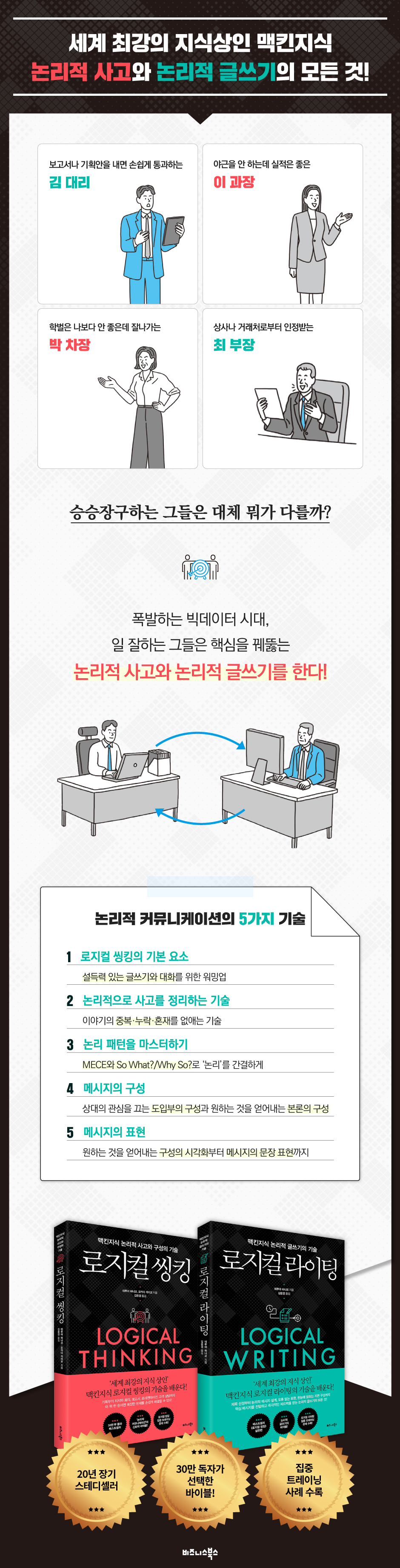
In the exploding era of big data, logical thinkers will survive!
Logical thinking starts with Park, the deputy manager of the public relations team, Lee, the manager of the marketing team, and Kim, the team leader of the planning team.
A skill that everyone, from consultants to CEOs, must possess!
Logical thinking is receiving more attention as the era of big data dawns.
Compared to data created in the analog environment of the past, big data is much larger in scale, has a shorter generation cycle, and comes in various forms, such as video.
In this era of exploding big data, both quantitatively and qualitatively, we must transform into logical communicators—or "logical thinkers"—to select meaningful information and effectively utilize it in communication.
"Logical Thinking" is divided into three parts and is structured step by step to systematically learn the theory of logical thinking.
Part 1 is the first step toward becoming a logical communicator, presenting key points to consider when preparing communication, based on examples such as drafting a report.
Part 2 focuses on organizing only the information relevant to solving the problem from among various sources, using it as "components that create logic." It introduces two "logical thinking techniques": MECE (a technique for eliminating duplication, omission, and confusion in a story) and So What?/Why So? (a technique for eliminating leaps in a story).
Communication is two-way, so there is a sender of the message and a receiver.
The recipient of a message has less information than the sender.
Therefore, the recipient is bound to ask “Why So?” about the message, and after the sender explains, he or she is bound to ask “So What?”
However, errors such as duplication, omission, confusion, and leaps of faith often occur at this time.
Have you ever repeated the same thing over and over again when reporting to your boss at work? It's because you haven't quite gathered your thoughts yet.
Have you ever experienced, during a presentation of a carefully prepared plan, a brilliant idea suddenly turned into a flawed one because you omitted a crucial point? Or have you ever thought you explained things correctly, only to have the other person misinterpret your intentions, resulting in a completely different outcome? Perhaps you've even been embarrassed by a hasty conclusion, skipping over a story that should have been presented step-by-step, with supporting evidence.
In fact, such things happen often at work, at school, and in everyday life, and the core skills of logical thinking, such as 'MECE, So What?/Why So?, Parallel, and Explanatory', help us overcome such communication errors.
Part 3 is the stage that deals with the 'logical construction technique' of assembling each 'part' with 'logic'.
We define the structure of logic and introduce two types of logic useful for business practice: parallel and explanatory.
Another feature of this book is its outstanding practicality.
First, there are many practical examples that can be easily applied to work.
There are various situations, such as when reporting verbally to a superior, when a superior gives verbal instructions to subordinates, when a project team is giving a presentation, or when writing an email to a colleague within the company.
Second, we present intensive training problems that can be practiced as if in a real situation.
After learning the theory, you will master it through practice.
In this way, 『Logical Thinking』 helps even beginners who are new to communication technology to learn logical thinking easily and simply.
You can be a logical communicator in any field!
Logical thinking becomes a weapon in life!
Recently, the problem of declining communication skills has been raised worldwide.
The ability to elicit what the other person wants to say or thinks has declined, and the number of people who have difficulty conveying what they want to say has increased.
The cause of this phenomenon is the lack of logical thinking and logical expression skills.
If we acquire logical thinking skills, upgrade our communication skills, and become logical communicators, we can achieve high performance in our fields like McKinsey.
As we go through life, we face many situations where we find ourselves in deep thought and are faced with crossroads where we must choose one side or the other.
In moments like these, why not gather scattered information, organize your thoughts, and organize them in a MECE (Mean-Equal-Order-Executive) format to overcome the frustrating situation? Or, perhaps, recall the uncompromising standards of your life and life, prioritize the options before you, and find the answer? Now, let's use logical thinking, which brings out the best results through logical reasoning, as a self-editing tool and a powerful life weapon!
Logical thinking starts with Park, the deputy manager of the public relations team, Lee, the manager of the marketing team, and Kim, the team leader of the planning team.
A skill that everyone, from consultants to CEOs, must possess!
Logical thinking is receiving more attention as the era of big data dawns.
Compared to data created in the analog environment of the past, big data is much larger in scale, has a shorter generation cycle, and comes in various forms, such as video.
In this era of exploding big data, both quantitatively and qualitatively, we must transform into logical communicators—or "logical thinkers"—to select meaningful information and effectively utilize it in communication.
"Logical Thinking" is divided into three parts and is structured step by step to systematically learn the theory of logical thinking.
Part 1 is the first step toward becoming a logical communicator, presenting key points to consider when preparing communication, based on examples such as drafting a report.
Part 2 focuses on organizing only the information relevant to solving the problem from among various sources, using it as "components that create logic." It introduces two "logical thinking techniques": MECE (a technique for eliminating duplication, omission, and confusion in a story) and So What?/Why So? (a technique for eliminating leaps in a story).
Communication is two-way, so there is a sender of the message and a receiver.
The recipient of a message has less information than the sender.
Therefore, the recipient is bound to ask “Why So?” about the message, and after the sender explains, he or she is bound to ask “So What?”
However, errors such as duplication, omission, confusion, and leaps of faith often occur at this time.
Have you ever repeated the same thing over and over again when reporting to your boss at work? It's because you haven't quite gathered your thoughts yet.
Have you ever experienced, during a presentation of a carefully prepared plan, a brilliant idea suddenly turned into a flawed one because you omitted a crucial point? Or have you ever thought you explained things correctly, only to have the other person misinterpret your intentions, resulting in a completely different outcome? Perhaps you've even been embarrassed by a hasty conclusion, skipping over a story that should have been presented step-by-step, with supporting evidence.
In fact, such things happen often at work, at school, and in everyday life, and the core skills of logical thinking, such as 'MECE, So What?/Why So?, Parallel, and Explanatory', help us overcome such communication errors.
Part 3 is the stage that deals with the 'logical construction technique' of assembling each 'part' with 'logic'.
We define the structure of logic and introduce two types of logic useful for business practice: parallel and explanatory.
Another feature of this book is its outstanding practicality.
First, there are many practical examples that can be easily applied to work.
There are various situations, such as when reporting verbally to a superior, when a superior gives verbal instructions to subordinates, when a project team is giving a presentation, or when writing an email to a colleague within the company.
Second, we present intensive training problems that can be practiced as if in a real situation.
After learning the theory, you will master it through practice.
In this way, 『Logical Thinking』 helps even beginners who are new to communication technology to learn logical thinking easily and simply.
You can be a logical communicator in any field!
Logical thinking becomes a weapon in life!
Recently, the problem of declining communication skills has been raised worldwide.
The ability to elicit what the other person wants to say or thinks has declined, and the number of people who have difficulty conveying what they want to say has increased.
The cause of this phenomenon is the lack of logical thinking and logical expression skills.
If we acquire logical thinking skills, upgrade our communication skills, and become logical communicators, we can achieve high performance in our fields like McKinsey.
As we go through life, we face many situations where we find ourselves in deep thought and are faced with crossroads where we must choose one side or the other.
In moments like these, why not gather scattered information, organize your thoughts, and organize them in a MECE (Mean-Equal-Order-Executive) format to overcome the frustrating situation? Or, perhaps, recall the uncompromising standards of your life and life, prioritize the options before you, and find the answer? Now, let's use logical thinking, which brings out the best results through logical reasoning, as a self-editing tool and a powerful life weapon!
GOODS SPECIFICS
- Date of issue: July 29, 2019
- Page count, weight, size: 280 pages | 514g | 153*224*17mm
- ISBN13: 9791162540947
- ISBN10: 116254094X
You may also like
카테고리
korean


korean

![GQ KOREA Mark (Monthly): December [2025]](http://librairie.coreenne.fr/cdn/shop/files/8ef265dbbfbf186523ed75ba7319009d.jpg?v=1765340328&width=3840)


