

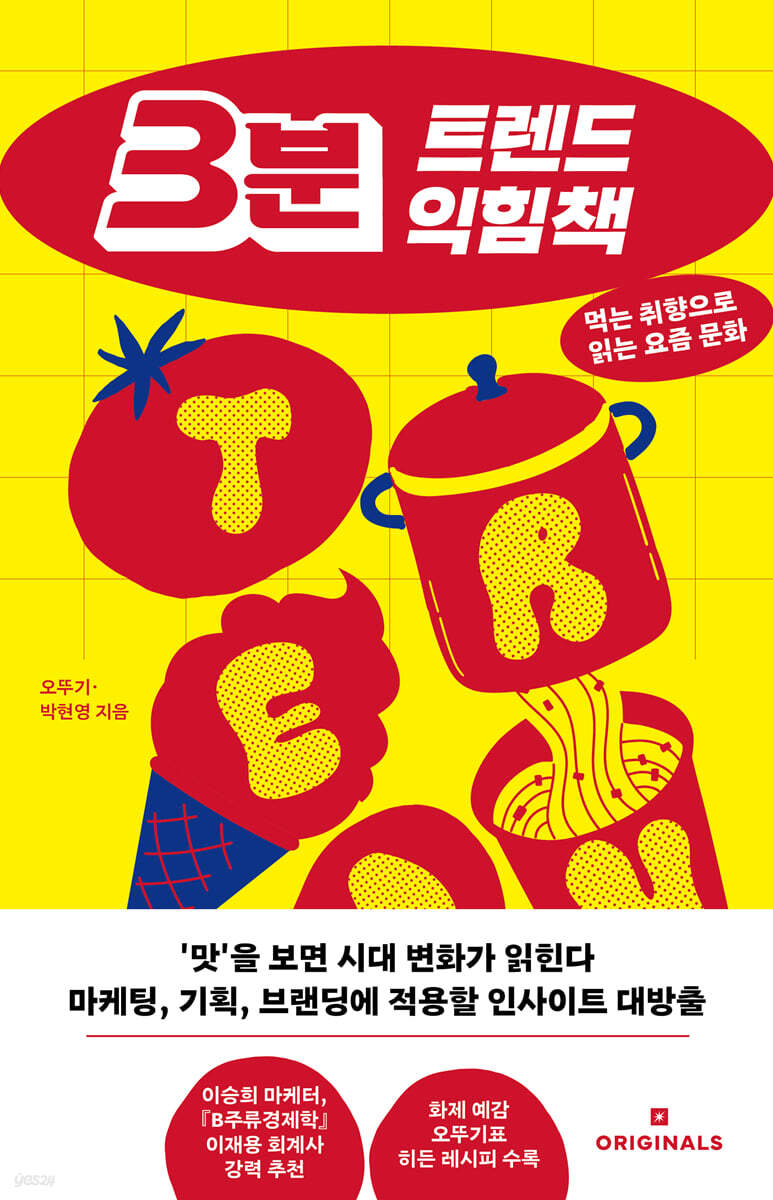
3-Minute Trend Mastery Guide
 |
Description
Book Introduction
★Highly recommended by CPA Lee Jae-yong, author of "B Mainstream Economics," and marketer Lee Seung-hee★
★A box office hit, a simple, new combination revealed! This book includes Ottogi's hidden recipes, exclusive to this book.★
In our daily lives, eating is one of the most basic and important necessities of life.
"3-Minute Trend Mastery" examines food culture, which is inseparable from our society, and delivers insights drawn from the food scene.
This book begins with the question, "How does the meal I eat reflect the current times?"
And through scenes surrounding eating culture and behavior, including advertising copy broadcast through TV, YouTube, and SNS, collaborations between brands, pop-up stores, and even character worlds created independently by brands, it shows how to read today's trends most closely.
As the fact that food is the fastest-spreading content on social media suggests, eating is both content and the language of marketing.
The trend of eating alone created the HMR market, and the anxiety of the MZ generation made ESG a must-have for companies.
This is why properly reading a consumer's every meal is the power that defines the future market.
This book will provide marketers, planners, and brand leaders with vivid insights that can be applied immediately to their work, and for those interested in global change, it will offer the most delicious clues to understanding today's lifestyles.
★A box office hit, a simple, new combination revealed! This book includes Ottogi's hidden recipes, exclusive to this book.★
In our daily lives, eating is one of the most basic and important necessities of life.
"3-Minute Trend Mastery" examines food culture, which is inseparable from our society, and delivers insights drawn from the food scene.
This book begins with the question, "How does the meal I eat reflect the current times?"
And through scenes surrounding eating culture and behavior, including advertising copy broadcast through TV, YouTube, and SNS, collaborations between brands, pop-up stores, and even character worlds created independently by brands, it shows how to read today's trends most closely.
As the fact that food is the fastest-spreading content on social media suggests, eating is both content and the language of marketing.
The trend of eating alone created the HMR market, and the anxiety of the MZ generation made ESG a must-have for companies.
This is why properly reading a consumer's every meal is the power that defines the future market.
This book will provide marketers, planners, and brand leaders with vivid insights that can be applied immediately to their work, and for those interested in global change, it will offer the most delicious clues to understanding today's lifestyles.
- You can preview some of the book's contents.
Preview
index
Recommendation
Entering
The dining table always reflects the times - Ottogi
Eating is content - Park Hyun-young, Director of the Lifestyle Observation Research Institute
Part 1 Our Eating Culture: A Serious Approach to Eating
~1970s: Eating culture is changing rapidly and deliciously.
The 1980s: A Perfect Harmony of Korean and Global
The 1990s: Wisdom and Diversity in a Meal That Blossomed in Crisis
2000s: Stay healthy, and enjoy your food too!
2010s: The Value of Coexistence, Alone and Together
2020s: We are the world
Part 2: Trends Found in Eating Culture
Taste #Personalization #Consumption_Taste #Sustainability
Collaboration fever: Who approved the collaboration between Ottogi and Nongshim?
Taste and Sensibility Tool: Do you know CJ E&M Odense?
Living Alone and Socially: The Changing Drinking Scene in South Korea
Morning Change: Those who eat breakfast are protected throughout the day.
Environmental and Social Contribution: Why Cereal Cocoball Cups Were Created
Experience #Spatial_Experience #Local #Experience
Brand Space: Seongsu-dong LCDC, Ottogi Pop-up Store without Ottogi
The Changing Face of Restaurants: A Name That Will Never Be Repeated in Korea: Seongsimdang
Distribution Changes: Single-Person Households Go to Costco?
Baseball Stadium Food: Why Brands Should Be Running to the Stadium
Communication #Content #Media_Communication #Lifestyle
Changing the way we communicate: Crazy Kellogg's makes it real after 16 years
Broadcasting Transformation: Cucumber Kimbap, a Story of Her Life
Aging Society: A Healthy Diet That Responds to Younger People, Not Older People
Brand and Character: Binggeureus, what is its worldview?
supplement.
Five keywords that have become a trend
#Brand_Storytelling: Those who tell stories authentically will survive - Marketer Seunghee Lee
#Contemporaneity_Universality_Embraces_a_Good_Brand_Experience - Ottogi BX Room
#AI: Things That Will Never Change, Even in the Face of Great Change - Kim Byeong-gi, CEO of Fritz Coffee Company
Now is the time to focus on yourself #value_consumption - Kim Kyung-hee, editor-in-chief of Conceptjin
The feeling of taking good care of yourself #wellness - Yoo Ji-hyun, CEO of Sosomungu
Entering
The dining table always reflects the times - Ottogi
Eating is content - Park Hyun-young, Director of the Lifestyle Observation Research Institute
Part 1 Our Eating Culture: A Serious Approach to Eating
~1970s: Eating culture is changing rapidly and deliciously.
The 1980s: A Perfect Harmony of Korean and Global
The 1990s: Wisdom and Diversity in a Meal That Blossomed in Crisis
2000s: Stay healthy, and enjoy your food too!
2010s: The Value of Coexistence, Alone and Together
2020s: We are the world
Part 2: Trends Found in Eating Culture
Taste #Personalization #Consumption_Taste #Sustainability
Collaboration fever: Who approved the collaboration between Ottogi and Nongshim?
Taste and Sensibility Tool: Do you know CJ E&M Odense?
Living Alone and Socially: The Changing Drinking Scene in South Korea
Morning Change: Those who eat breakfast are protected throughout the day.
Environmental and Social Contribution: Why Cereal Cocoball Cups Were Created
Experience #Spatial_Experience #Local #Experience
Brand Space: Seongsu-dong LCDC, Ottogi Pop-up Store without Ottogi
The Changing Face of Restaurants: A Name That Will Never Be Repeated in Korea: Seongsimdang
Distribution Changes: Single-Person Households Go to Costco?
Baseball Stadium Food: Why Brands Should Be Running to the Stadium
Communication #Content #Media_Communication #Lifestyle
Changing the way we communicate: Crazy Kellogg's makes it real after 16 years
Broadcasting Transformation: Cucumber Kimbap, a Story of Her Life
Aging Society: A Healthy Diet That Responds to Younger People, Not Older People
Brand and Character: Binggeureus, what is its worldview?
supplement.
Five keywords that have become a trend
#Brand_Storytelling: Those who tell stories authentically will survive - Marketer Seunghee Lee
#Contemporaneity_Universality_Embraces_a_Good_Brand_Experience - Ottogi BX Room
#AI: Things That Will Never Change, Even in the Face of Great Change - Kim Byeong-gi, CEO of Fritz Coffee Company
Now is the time to focus on yourself #value_consumption - Kim Kyung-hee, editor-in-chief of Conceptjin
The feeling of taking good care of yourself #wellness - Yoo Ji-hyun, CEO of Sosomungu
Detailed image

Into the book
Eating is a vessel that holds people's culture and reflects current trends. It is an essential element of survival that no one can avoid, and at the same time, it is also the greatest source of pleasure.
--- p.20
In July 1999, a strange ramen appeared.
The ramen packet had a friendly warning written on it: “Do not boil before eating.”
Consumers, faced with this confusing problem, became curious and began to actively purchase this ramen.
The ramen that you should not boil and eat is 'Ppusseo Ppusseo'.
--- p.43
The animated film "K-Pop Demon Hunters," which took the world by storm, sparked a fervent interest in Korean food, including ramen, kimbap, and gukbap, as well as aspects of Korean food culture, such as putting tissues under spoons and reaching for a hot bowl of soup when feeling down.
Along with this, as Buldak Bokkeum Myeon, Shin Ramyun, and Jin Ramyun gain popularity worldwide, a huge amount of K-ramen is spreading around the world.
--- p.74~75
Since he is a busy office worker, I assume he will easily open the bag and slurp it down on the road.
But busy office workers don't eat breakfast.
If you eat breakfast, your identity is not that of a busy office worker, but rather of a health-seeker, a newbie, or someone who sticks to a morning routine.
--- p.124~125
Being friendly and kind is the most important human skill in the 21st century.
--- p.154
The reason why Seongsimdang, which was a local bakery, became successful nationwide is because a genuine business met a trend.
Two trends and two minds combined to create the uniqueness of Seongsimdang.
The desire to coexist with the local community developed into a distinctive idea, and consumers recognized this authenticity and uniqueness.
--- p.164~165
Ambiguity doesn't work.
The era of 'introduction', where people were excited about something new they didn't know about, has ended, and the era of depth has arrived.
--- p.183
Who will be the influencers of the future? If today's influencers showcase food as a lifestyle, the next influencer is likely to be a nutritionist, a food expert.
A nutritionist is not someone who eats well and lives well just for himself, but someone who feeds everyone.
--- p.203
The 2010s ushered in an era of lifestyle, with food becoming the greatest source of pleasure and mood change.
And now, as we head toward 2026, food is now a tool of reassurance that soothes anxiety and fear.
--- p.20
In July 1999, a strange ramen appeared.
The ramen packet had a friendly warning written on it: “Do not boil before eating.”
Consumers, faced with this confusing problem, became curious and began to actively purchase this ramen.
The ramen that you should not boil and eat is 'Ppusseo Ppusseo'.
--- p.43
The animated film "K-Pop Demon Hunters," which took the world by storm, sparked a fervent interest in Korean food, including ramen, kimbap, and gukbap, as well as aspects of Korean food culture, such as putting tissues under spoons and reaching for a hot bowl of soup when feeling down.
Along with this, as Buldak Bokkeum Myeon, Shin Ramyun, and Jin Ramyun gain popularity worldwide, a huge amount of K-ramen is spreading around the world.
--- p.74~75
Since he is a busy office worker, I assume he will easily open the bag and slurp it down on the road.
But busy office workers don't eat breakfast.
If you eat breakfast, your identity is not that of a busy office worker, but rather of a health-seeker, a newbie, or someone who sticks to a morning routine.
--- p.124~125
Being friendly and kind is the most important human skill in the 21st century.
--- p.154
The reason why Seongsimdang, which was a local bakery, became successful nationwide is because a genuine business met a trend.
Two trends and two minds combined to create the uniqueness of Seongsimdang.
The desire to coexist with the local community developed into a distinctive idea, and consumers recognized this authenticity and uniqueness.
--- p.164~165
Ambiguity doesn't work.
The era of 'introduction', where people were excited about something new they didn't know about, has ended, and the era of depth has arrived.
--- p.183
Who will be the influencers of the future? If today's influencers showcase food as a lifestyle, the next influencer is likely to be a nutritionist, a food expert.
A nutritionist is not someone who eats well and lives well just for himself, but someone who feeds everyone.
--- p.203
The 2010s ushered in an era of lifestyle, with food becoming the greatest source of pleasure and mood change.
And now, as we head toward 2026, food is now a tool of reassurance that soothes anxiety and fear.
--- p.220
Publisher's Review
★『B Mainstream Economics』 Highly Recommended by CPA Lee Jae-yong and Marketer Lee Seung-hee★
★A box office hit, a simple, new combination revealed! This book includes Ottogi's hidden recipes, exclusive to this book.★
* Recommendation
We eat it every day.
How we eat often reflects the times.
() Why should marketers know this? The answer is simple.
Because 'how people eat' is directly related to 'how we define our next consumption.'
Eating alone created the HMR market, and tasteful consumption gave rise to a boom in pop-up stores and collaborations.
An aging population has fostered a demand for healthy eating, and the anxieties of the MZ generation have made ESG messaging a brand imperative.
‘Eating’ has always been the fastest harbinger of change.
(Omitted) Marketers are always people who ask about the future.
The answer is not far away.
Just look at what people are eating and how they are eating today.
This book provides the answer in the most delicious and realistic way.
_Lee Seung-hee, Marketer
It's a fresh yet universal perspective on food.
The human body is made up of what we eat.
Therefore, understanding the changes in food is understanding the changes in humans, and that is not much different from understanding society and the times.
(Omitted) The process of reading society and the times through the mirror of food is not simply a matter of interest.
It is an exercise in insight that interprets today and prepares for tomorrow.
As an accountant, I look at the world through numbers, but reading this book gave me another powerful framework.
I hope that readers will have the same experience as I did through this book.
_Lee Jae-yong, CPA, author of "B Mainstream Economics"
Powdered curry, instant rice, ramen, meal kits… …
Insights Hidden in Stories of Eating to Your Own Taste
Sunday curry eaten with the whole family, a family restaurant where you can enjoy a birthday party, or tteokbokki delivered to enjoy alone time after work…
The dining table has always been a mirror of our lives.
Even a single bowl of food eaten every day as a habit contains the memories and values of that era.
For example, the powdered curry of the 1970s represented efficiency, the family restaurant of the 1990s represented specialness, and the delivery app of the 2020s represented the zeitgeist of pursuing freedom.
In our daily lives, eating is one of the most basic and important necessities of life.
"3-Minute Trend Mastery" examines food culture, which is inseparable from our society, and delivers insights drawn from the food scene.
This book begins with the question, "How does the meal I eat reflect the current times?"
And through advertising copy broadcasted through TV, YouTube, and SNS, collaborations between brands, pop-up stores, and even character worlds created independently by brands, it shows how to read today's trends most closely through scenes surrounding food culture and eating behavior.
In Part 1, we follow the representative products and advertisements that dominated each era and examine the trajectory of the Korean dining table over the past half century.
From powdered curry, soup, 3-minute meals, ramen, and instant rice, a single meal has always reflected society's desires and lifestyle.
By examining this, we can learn what values our society pursued at that time and how food companies responded to consumer demands.
Part 2 shifts its focus to today's trends, exploring how K-food and food culture are expanding at the forefront of marketing through collaborations, characters, pop-up stores, and mukbangs.
In the appendix, "Five Keywords Embedded in Trends," interviews with leading figures in marketing, branding, the coffee industry, editing, and planning identify keywords that deserve special attention among trends.
All change begins with what you eat.
How to properly interpret current and future trends
Because we've always lived by eating, changes on the table have directly led to changes in society, culture, and consumption, and have also become the very essence of change itself. As the fact that food is the fastest-spreading content on social media demonstrates, eating is both content and a marketing language.
The trend of eating alone created the HMR market, and the anxiety of the MZ generation made ESG a must-have for companies.
This is why properly reading a consumer's every meal will be the power to define the future market.
So this book is not just a book about food.
We analyze the tastes and cultures of today's people through the changes in food, which is at the forefront of all changes.
And it shows the scene where brand and content meet.
As food has become a stage for content, we can see vivid examples of how food culture is expanding at the forefront of marketing through advertisements, YouTube, pop-up stores, characters, and collaborations.
It also provides the most realistic evidence to capture signs of consumption changes in food culture.
It's time to learn about the culture and trends you need to know today in an easy and fun way, like the "food guide" you used to get in school, through food stories.
This book will provide marketers, planners, and brand leaders with vivid insights that can be applied immediately to their work, and for those interested in global change, it will offer the most delicious clues to understanding today's lifestyles.
★A box office hit, a simple, new combination revealed! This book includes Ottogi's hidden recipes, exclusive to this book.★
* Recommendation
We eat it every day.
How we eat often reflects the times.
() Why should marketers know this? The answer is simple.
Because 'how people eat' is directly related to 'how we define our next consumption.'
Eating alone created the HMR market, and tasteful consumption gave rise to a boom in pop-up stores and collaborations.
An aging population has fostered a demand for healthy eating, and the anxieties of the MZ generation have made ESG messaging a brand imperative.
‘Eating’ has always been the fastest harbinger of change.
(Omitted) Marketers are always people who ask about the future.
The answer is not far away.
Just look at what people are eating and how they are eating today.
This book provides the answer in the most delicious and realistic way.
_Lee Seung-hee, Marketer
It's a fresh yet universal perspective on food.
The human body is made up of what we eat.
Therefore, understanding the changes in food is understanding the changes in humans, and that is not much different from understanding society and the times.
(Omitted) The process of reading society and the times through the mirror of food is not simply a matter of interest.
It is an exercise in insight that interprets today and prepares for tomorrow.
As an accountant, I look at the world through numbers, but reading this book gave me another powerful framework.
I hope that readers will have the same experience as I did through this book.
_Lee Jae-yong, CPA, author of "B Mainstream Economics"
Powdered curry, instant rice, ramen, meal kits… …
Insights Hidden in Stories of Eating to Your Own Taste
Sunday curry eaten with the whole family, a family restaurant where you can enjoy a birthday party, or tteokbokki delivered to enjoy alone time after work…
The dining table has always been a mirror of our lives.
Even a single bowl of food eaten every day as a habit contains the memories and values of that era.
For example, the powdered curry of the 1970s represented efficiency, the family restaurant of the 1990s represented specialness, and the delivery app of the 2020s represented the zeitgeist of pursuing freedom.
In our daily lives, eating is one of the most basic and important necessities of life.
"3-Minute Trend Mastery" examines food culture, which is inseparable from our society, and delivers insights drawn from the food scene.
This book begins with the question, "How does the meal I eat reflect the current times?"
And through advertising copy broadcasted through TV, YouTube, and SNS, collaborations between brands, pop-up stores, and even character worlds created independently by brands, it shows how to read today's trends most closely through scenes surrounding food culture and eating behavior.
In Part 1, we follow the representative products and advertisements that dominated each era and examine the trajectory of the Korean dining table over the past half century.
From powdered curry, soup, 3-minute meals, ramen, and instant rice, a single meal has always reflected society's desires and lifestyle.
By examining this, we can learn what values our society pursued at that time and how food companies responded to consumer demands.
Part 2 shifts its focus to today's trends, exploring how K-food and food culture are expanding at the forefront of marketing through collaborations, characters, pop-up stores, and mukbangs.
In the appendix, "Five Keywords Embedded in Trends," interviews with leading figures in marketing, branding, the coffee industry, editing, and planning identify keywords that deserve special attention among trends.
All change begins with what you eat.
How to properly interpret current and future trends
Because we've always lived by eating, changes on the table have directly led to changes in society, culture, and consumption, and have also become the very essence of change itself. As the fact that food is the fastest-spreading content on social media demonstrates, eating is both content and a marketing language.
The trend of eating alone created the HMR market, and the anxiety of the MZ generation made ESG a must-have for companies.
This is why properly reading a consumer's every meal will be the power to define the future market.
So this book is not just a book about food.
We analyze the tastes and cultures of today's people through the changes in food, which is at the forefront of all changes.
And it shows the scene where brand and content meet.
As food has become a stage for content, we can see vivid examples of how food culture is expanding at the forefront of marketing through advertisements, YouTube, pop-up stores, characters, and collaborations.
It also provides the most realistic evidence to capture signs of consumption changes in food culture.
It's time to learn about the culture and trends you need to know today in an easy and fun way, like the "food guide" you used to get in school, through food stories.
This book will provide marketers, planners, and brand leaders with vivid insights that can be applied immediately to their work, and for those interested in global change, it will offer the most delicious clues to understanding today's lifestyles.
GOODS SPECIFICS
- Date of issue: October 22, 2025
- Page count, weight, size: 248 pages | 526g | 145*225*20mm
- ISBN13: 9791169085373
- ISBN10: 1169085377
You may also like
카테고리
korean


korean

![GQ KOREA Mark (Monthly): December [2025]](http://librairie.coreenne.fr/cdn/shop/files/8ef265dbbfbf186523ed75ba7319009d.jpg?v=1765340328&width=3840)


