

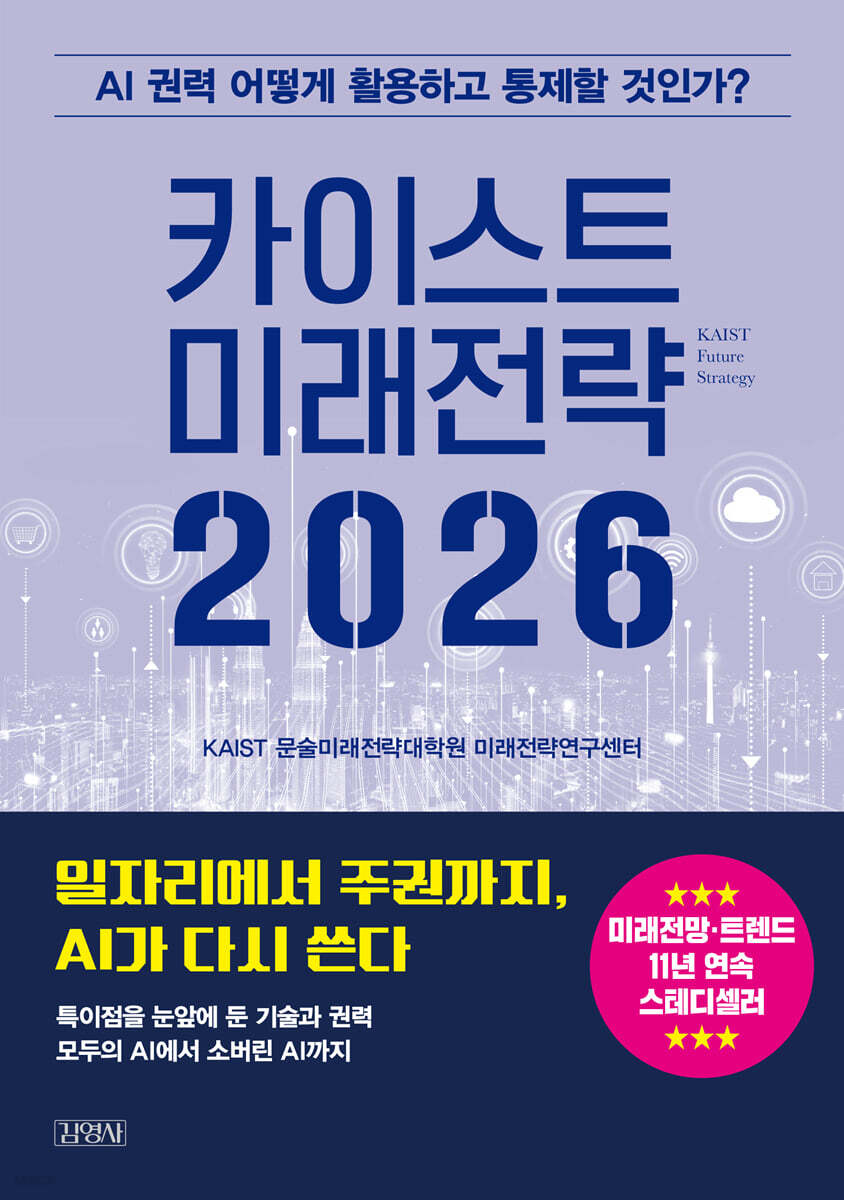
KAIST Future Strategy 2026
 |
Description
Book Introduction
From jobs to sovereignty, AI is rewriting the rules!
KAIST's Focus on Science and Technology Megatrends in 2026
From DeepSec Shock to AI Elite: A Report on the Future of AI Power
★ Steady Seller in Future Outlook and Trends for 11 Consecutive Years ★
★ Korea's top future research institute & largest number of experts participating ★
The 'DeepSec shock' from China changed the US policy direction, and the South Korean government announced a plan to invest 100 trillion won in the AI field by 2030, with the goal of becoming one of the 'three major AI powers' as a key pledge.
Who will lead the domestic AI ecosystem? How is global power being reorganized by AI? Can Korea truly become an AI powerhouse this time?
The "KAIST Future Strategy" series, where experts from Korea's leading future research institute deliver high-level analysis and insights unseen anywhere else.
In 2026, we will compile a single volume on the changing state of our economy, society, and culture amidst the competition for hegemony, under the theme of "AI Power."
KAIST's Focus on Science and Technology Megatrends in 2026
From DeepSec Shock to AI Elite: A Report on the Future of AI Power
★ Steady Seller in Future Outlook and Trends for 11 Consecutive Years ★
★ Korea's top future research institute & largest number of experts participating ★
The 'DeepSec shock' from China changed the US policy direction, and the South Korean government announced a plan to invest 100 trillion won in the AI field by 2030, with the goal of becoming one of the 'three major AI powers' as a key pledge.
Who will lead the domestic AI ecosystem? How is global power being reorganized by AI? Can Korea truly become an AI powerhouse this time?
The "KAIST Future Strategy" series, where experts from Korea's leading future research institute deliver high-level analysis and insights unseen anywhere else.
In 2026, we will compile a single volume on the changing state of our economy, society, and culture amidst the competition for hegemony, under the theme of "AI Power."
- You can preview some of the book's contents.
Preview
index
Recommendation: The Rise of AI Power: Where Will South Korea Stand?
Prologue: Challenges and Strategies for AI Sovereignty
Part 1: AI Power: Rewriting the Rules of the World
Chapter 1: Evolving AI Technology Changes the World
The Emerging Digital Population and "Nadam"
The Future of Work: Physical AI and Superworkers
The Advance of Intelligent AI Agents
Politics in the AI Age and the Potential of AI Politicians
A more sophisticated manipulation society with the advent of superintelligent AI.
Chapter 2 Who will seize new power and how?
A New Paradigm of Power: The Rise of AI Power
The era of innovation led by big tech companies
The Core of Power: Sovereign AI and AI Governance
Oil in the AI Era: The War for Data
AI Elite? AI Mafia? The Empowerment of Technology
Chapter 3: Designing Coexistence between AI and Humans
AI Literacy: Preventing Technological Dystopia
Ethical and Legal Issues of AI as Seen Through Autonomous Weapons
Education for Coexistence of Humans and AI
Green AI that Respects Climate Limits
In a rapidly changing society driven by AI, what values will we choose?
Part 2: The STEPPER Strategy for Coping with Change
Chapter 1: Future Strategies in the Social Sector
Digital Social Conflict: AI Amplifies Conflict and Reconciliation
Hybrid Forces: National Security Policies to Address Population Decline
Innovation in Mobility: Values and Issues in the New Era of Mobility
Chapter 2: Future Strategies in Technology
AI-Native Communications Networks: Core Infrastructure for an Intelligent, Connected Society
Gene Therapy: The Limits and Promise of a 'Dream Technology'
Quantum Computing: The Future Technology with the Biggest Impact
Chapter 3: Future Strategies in the Environmental Field
Carbon Neutrality: The Path to Green Industry
Future Transportation: Transportation Infrastructure and Urban Space in the Autonomous Driving Era
X-Event: Future Disasters and Response Systems as Suggested by AI
Chapter 4: Future Strategies in Population
Anti-aging research: Strategic technologies in the age of Homo Hundred
Reconstructing the Family: Changing Families and Tailored Support
Immigration Policy: Policies and Responses Suitable for a Multiethnic and Multicultural Society
Chapter 5: Future Strategies in Politics
Smart Government: A Plan for Building a Korean-Style Smart Government
Science Diplomacy: Strategies for Securing Technological Sovereignty in the AI Era
AI Cognitive Warfare: How AI is Changing the Battlefield
Chapter 6: Future Strategy in the Economic Sector
Financial Innovation: A New Approach to Lost Trust in Finance
Small Business Technology: A Critical Technology Driving Global Supply Chains
Deep Tech: Fostering Startups that Tackle High-Tech Challenges
Chapter 7 Future Strategy in the Resource Sector
New Materials: Developing cutting-edge new materials that will serve as the foundation for digital transformation and environmental friendliness.
Intellectual Property Rights: A National Wealth That's Becoming More Important in the Age of Technological Hegemony
AI Science Capital: The Key to National Competitiveness
Epilogue _ Looking to the Future with a Long Breath
People who participated in the publication of KAIST Future Strategy 2026
History of the Munsul Report
References
main
Search
Prologue: Challenges and Strategies for AI Sovereignty
Part 1: AI Power: Rewriting the Rules of the World
Chapter 1: Evolving AI Technology Changes the World
The Emerging Digital Population and "Nadam"
The Future of Work: Physical AI and Superworkers
The Advance of Intelligent AI Agents
Politics in the AI Age and the Potential of AI Politicians
A more sophisticated manipulation society with the advent of superintelligent AI.
Chapter 2 Who will seize new power and how?
A New Paradigm of Power: The Rise of AI Power
The era of innovation led by big tech companies
The Core of Power: Sovereign AI and AI Governance
Oil in the AI Era: The War for Data
AI Elite? AI Mafia? The Empowerment of Technology
Chapter 3: Designing Coexistence between AI and Humans
AI Literacy: Preventing Technological Dystopia
Ethical and Legal Issues of AI as Seen Through Autonomous Weapons
Education for Coexistence of Humans and AI
Green AI that Respects Climate Limits
In a rapidly changing society driven by AI, what values will we choose?
Part 2: The STEPPER Strategy for Coping with Change
Chapter 1: Future Strategies in the Social Sector
Digital Social Conflict: AI Amplifies Conflict and Reconciliation
Hybrid Forces: National Security Policies to Address Population Decline
Innovation in Mobility: Values and Issues in the New Era of Mobility
Chapter 2: Future Strategies in Technology
AI-Native Communications Networks: Core Infrastructure for an Intelligent, Connected Society
Gene Therapy: The Limits and Promise of a 'Dream Technology'
Quantum Computing: The Future Technology with the Biggest Impact
Chapter 3: Future Strategies in the Environmental Field
Carbon Neutrality: The Path to Green Industry
Future Transportation: Transportation Infrastructure and Urban Space in the Autonomous Driving Era
X-Event: Future Disasters and Response Systems as Suggested by AI
Chapter 4: Future Strategies in Population
Anti-aging research: Strategic technologies in the age of Homo Hundred
Reconstructing the Family: Changing Families and Tailored Support
Immigration Policy: Policies and Responses Suitable for a Multiethnic and Multicultural Society
Chapter 5: Future Strategies in Politics
Smart Government: A Plan for Building a Korean-Style Smart Government
Science Diplomacy: Strategies for Securing Technological Sovereignty in the AI Era
AI Cognitive Warfare: How AI is Changing the Battlefield
Chapter 6: Future Strategy in the Economic Sector
Financial Innovation: A New Approach to Lost Trust in Finance
Small Business Technology: A Critical Technology Driving Global Supply Chains
Deep Tech: Fostering Startups that Tackle High-Tech Challenges
Chapter 7 Future Strategy in the Resource Sector
New Materials: Developing cutting-edge new materials that will serve as the foundation for digital transformation and environmental friendliness.
Intellectual Property Rights: A National Wealth That's Becoming More Important in the Age of Technological Hegemony
AI Science Capital: The Key to National Competitiveness
Epilogue _ Looking to the Future with a Long Breath
People who participated in the publication of KAIST Future Strategy 2026
History of the Munsul Report
References
main
Search
Detailed image

Into the book
AI has emerged as a key force reshaping power structures and international order, going beyond mere technological advancement.
While the sources of power in the past were territory, resources, and population, now data, algorithms, and computational power determine national security, economics, and even social and cultural autonomy. The AI revolution is not a future possibility, but a present reality.
--- From the "Prologue"
The evolution toward general-purpose AI signifies the emergence of another intelligent being. AI will reach a level where it can run businesses and organizations without humans, from strategic planning to human resource management and overall organizational operations.
At this time, the demand for human labor will decrease rapidly, and even positions such as senior managers and executives will likely be replaced by AI.
--- From "The Emerging Digital Population and I Am"
More realistic and interesting are the fusion super walkers.
For example, a web novel writer could work with an AI assistant, conveying their ideas to the AI, and then the AI would generate a story, which would then be used to make the final decision.
(...) If this type of fusion super worker model is introduced into the creative field, the nature of creation will fundamentally change.
--- From "The Future of Work Changed by Physical AI and Superworkers"
“We think digital is limitless, light as air, and practically free,” says IT developer and author Gary McGovern.
But that's not true.
Digital is heavy.
And by producing so much data, we are increasingly putting a strain on our planet,” he points out.
All digital actions consume significant energy, and it is safe to say that there is no AI without energy input.
--- From "Green AI that Respects Climate Limits"
The spread of AI services is also a factor that deepens the marginalization of digitally vulnerable groups, such as low-income families.
An algorithm at a US healthcare company has been found to exhibit racial bias, excluding Black people from treatment priorities due to lower medical costs, even though Black and white people have similar rates of chronic disease.
While the sources of power in the past were territory, resources, and population, now data, algorithms, and computational power determine national security, economics, and even social and cultural autonomy. The AI revolution is not a future possibility, but a present reality.
--- From the "Prologue"
The evolution toward general-purpose AI signifies the emergence of another intelligent being. AI will reach a level where it can run businesses and organizations without humans, from strategic planning to human resource management and overall organizational operations.
At this time, the demand for human labor will decrease rapidly, and even positions such as senior managers and executives will likely be replaced by AI.
--- From "The Emerging Digital Population and I Am"
More realistic and interesting are the fusion super walkers.
For example, a web novel writer could work with an AI assistant, conveying their ideas to the AI, and then the AI would generate a story, which would then be used to make the final decision.
(...) If this type of fusion super worker model is introduced into the creative field, the nature of creation will fundamentally change.
--- From "The Future of Work Changed by Physical AI and Superworkers"
“We think digital is limitless, light as air, and practically free,” says IT developer and author Gary McGovern.
But that's not true.
Digital is heavy.
And by producing so much data, we are increasingly putting a strain on our planet,” he points out.
All digital actions consume significant energy, and it is safe to say that there is no AI without energy input.
--- From "Green AI that Respects Climate Limits"
The spread of AI services is also a factor that deepens the marginalization of digitally vulnerable groups, such as low-income families.
An algorithm at a US healthcare company has been found to exhibit racial bias, excluding Black people from treatment priorities due to lower medical costs, even though Black and white people have similar rates of chronic disease.
--- From "AI Literacy to Prevent Technological Dystopia"
Publisher's Review
The world's wealth and power will be reorganized by AI.
Technology and power on the verge of a singularity!
From DeepSec Shock to AI Elite: A Report on the Future of AI Power
“The era of AI power has already begun.
The question now is how we will control and leverage this power, and ultimately, what kind of world will AI contribute to creating?
Our answers to these questions will determine the world future generations will live in.”
As AI evolves into a useful tool and practical weapon, the world is watching the future direction of AI power.
The 'DeepSec shock' from China changed the US policy direction, and OpenAI, the developer of ChatGPT, suffered from the pain of rushing development without sufficient safety measures to secure technological superiority.
The South Korean government has announced plans to invest 100 trillion won in the AI field by 2030, with the goal of becoming one of the top three AI powerhouses.
Who will lead the domestic AI ecosystem? How is global power being reorganized by AI? Can Korea truly become an AI powerhouse this time?
The "KAIST Future Strategy" series, where experts from Korea's leading future research institute deliver high-level analysis and insights unseen anywhere else.
《KAIST Future Strategy 2026》 summarizes in one volume our economy, society, and culture, which are changing amidst the competition for hegemony, under the theme of "AI power."
Part 1 examines the new paradigm of power created by AI from various angles.
In Part 2, future strategies are presented by experts in the seven STEPPER areas: society, technology, environment, population, politics, economy, and resources.
Through "KAIST Future Strategy 2026," we will find ways to prepare for the new era ushered in by AI, from technological innovation to power innovation.
What is happening in the world right now?
KAIST's Focus on Science and Technology Megatrends in 2026
AI politicians run for election
New Zealand's AI politician, SAM, and Japan's local election AI candidates design policies based on data, respond to voters' questions, and collect and reflect feedback through social media.
Will they be able to further develop empathy and make ethical judgments? Even if they are, it will be difficult for AI, lacking rights and responsibilities, to replace human politicians.
The politics of the future will not be a competition between people and AI, but rather a competition between those who understand AI and those who do not.
The 'OpenAI Mafia' Emerges, Following the 'PayPal Mafia'
Elon Musk served as head of the Office of Government Efficiency in Donald Trump's second term.
In this way, the number of technical elites participating in politics directly or indirectly is increasing.
Following the "PayPal Mafia" of 20 years ago, Silicon Valley innovators, now known as the "OpenAI Mafia," are swaying economic policy and even wielding political influence, raising both hopes and concerns. Given the potential for AI technology to have a tangible impact on media shaping and military security, continued monitoring and control of these individuals is essential.
Big tech companies are waging a war to secure data.
Data is a valuable resource, so much so that it is called the oil of the 21st century.
The fierce competition in AI development is rapidly depleting high-quality training data.
Google signed a $60 million annual deal with Reddit, the largest community site in the U.S., in early 2024, and Meta is pushing to acquire Simon & Schuster, a publishing company, to secure data.
Meanwhile, the competition to secure data is entering a new phase as synthetic data is developed to address the problem of data depletion.
- AI with a body is revolutionizing labor.
Physical AI is the 'materialization of AI', where AI agents are installed in physical devices such as humanoid robots or self-driving cars.
Physical AI can make decisions and act on its own, demonstrating tireless endurance and accuracy.
They can perform tasks that humans cannot do in industrial settings, and can also play an active role in everyday life, such as delivering, moving, and providing care.
In the future, AI-powered "silicon collar" workers will replace traditional blue-collar and white-collar workers, and "new collar" workers will emerge, a fusion of humans and AI.
From quantum computing to biotechnology, deep tech is on the rise.
Deep tech startups leverage cutting-edge science and technology to solve global problems like the climate crisis, food shortages, and pandemics, and connect them to new businesses.
Deep tech unicorns are emerging one after another in fields such as space development, biotechnology, and quantum technology, with SpaceX in the US and the developer of mRNA vaccines that helped alleviate the pandemic being cited as typical success stories.
In Korea, startups such as Furiosa AI (designing AI-specific semiconductors), SM Lab (producing battery materials), and Graphene Square (developing the world's first mass synthesis technology for the new material graphene) are also active.
-Is AI the culprit behind environmental destruction or the key to solving the climate crisis?
AI can help us use energy and resources more efficiently and reduce damage by more accurately predicting climate disasters.
For example, integrating AI into a building's lighting or heating and cooling equipment can optimize power usage and reduce energy waste.
But the massive power demands of data centers ultimately result in more carbon emissions.
It should be noted that even 'AI for the climate' must operate within the acceptable range of the Earth's ecosystem.
-STEPPER, Outlook and Insights in Seven Areas
What financial innovations will follow fintech? How should cities change in the era of autonomous driving? What anti-aging technologies should we focus on in the age of Homo Hundred? KAIST's STEPPER strategy concisely addresses pressing issues across seven areas: Society, Technology, Environment, Population, Politics, Economy, and Resources.
From technology and science to social and political issues, you can discover the most objective and scientific perspectives and insights from experts in seven fields.
Technology and power on the verge of a singularity!
From DeepSec Shock to AI Elite: A Report on the Future of AI Power
“The era of AI power has already begun.
The question now is how we will control and leverage this power, and ultimately, what kind of world will AI contribute to creating?
Our answers to these questions will determine the world future generations will live in.”
As AI evolves into a useful tool and practical weapon, the world is watching the future direction of AI power.
The 'DeepSec shock' from China changed the US policy direction, and OpenAI, the developer of ChatGPT, suffered from the pain of rushing development without sufficient safety measures to secure technological superiority.
The South Korean government has announced plans to invest 100 trillion won in the AI field by 2030, with the goal of becoming one of the top three AI powerhouses.
Who will lead the domestic AI ecosystem? How is global power being reorganized by AI? Can Korea truly become an AI powerhouse this time?
The "KAIST Future Strategy" series, where experts from Korea's leading future research institute deliver high-level analysis and insights unseen anywhere else.
《KAIST Future Strategy 2026》 summarizes in one volume our economy, society, and culture, which are changing amidst the competition for hegemony, under the theme of "AI power."
Part 1 examines the new paradigm of power created by AI from various angles.
In Part 2, future strategies are presented by experts in the seven STEPPER areas: society, technology, environment, population, politics, economy, and resources.
Through "KAIST Future Strategy 2026," we will find ways to prepare for the new era ushered in by AI, from technological innovation to power innovation.
What is happening in the world right now?
KAIST's Focus on Science and Technology Megatrends in 2026
AI politicians run for election
New Zealand's AI politician, SAM, and Japan's local election AI candidates design policies based on data, respond to voters' questions, and collect and reflect feedback through social media.
Will they be able to further develop empathy and make ethical judgments? Even if they are, it will be difficult for AI, lacking rights and responsibilities, to replace human politicians.
The politics of the future will not be a competition between people and AI, but rather a competition between those who understand AI and those who do not.
The 'OpenAI Mafia' Emerges, Following the 'PayPal Mafia'
Elon Musk served as head of the Office of Government Efficiency in Donald Trump's second term.
In this way, the number of technical elites participating in politics directly or indirectly is increasing.
Following the "PayPal Mafia" of 20 years ago, Silicon Valley innovators, now known as the "OpenAI Mafia," are swaying economic policy and even wielding political influence, raising both hopes and concerns. Given the potential for AI technology to have a tangible impact on media shaping and military security, continued monitoring and control of these individuals is essential.
Big tech companies are waging a war to secure data.
Data is a valuable resource, so much so that it is called the oil of the 21st century.
The fierce competition in AI development is rapidly depleting high-quality training data.
Google signed a $60 million annual deal with Reddit, the largest community site in the U.S., in early 2024, and Meta is pushing to acquire Simon & Schuster, a publishing company, to secure data.
Meanwhile, the competition to secure data is entering a new phase as synthetic data is developed to address the problem of data depletion.
- AI with a body is revolutionizing labor.
Physical AI is the 'materialization of AI', where AI agents are installed in physical devices such as humanoid robots or self-driving cars.
Physical AI can make decisions and act on its own, demonstrating tireless endurance and accuracy.
They can perform tasks that humans cannot do in industrial settings, and can also play an active role in everyday life, such as delivering, moving, and providing care.
In the future, AI-powered "silicon collar" workers will replace traditional blue-collar and white-collar workers, and "new collar" workers will emerge, a fusion of humans and AI.
From quantum computing to biotechnology, deep tech is on the rise.
Deep tech startups leverage cutting-edge science and technology to solve global problems like the climate crisis, food shortages, and pandemics, and connect them to new businesses.
Deep tech unicorns are emerging one after another in fields such as space development, biotechnology, and quantum technology, with SpaceX in the US and the developer of mRNA vaccines that helped alleviate the pandemic being cited as typical success stories.
In Korea, startups such as Furiosa AI (designing AI-specific semiconductors), SM Lab (producing battery materials), and Graphene Square (developing the world's first mass synthesis technology for the new material graphene) are also active.
-Is AI the culprit behind environmental destruction or the key to solving the climate crisis?
AI can help us use energy and resources more efficiently and reduce damage by more accurately predicting climate disasters.
For example, integrating AI into a building's lighting or heating and cooling equipment can optimize power usage and reduce energy waste.
But the massive power demands of data centers ultimately result in more carbon emissions.
It should be noted that even 'AI for the climate' must operate within the acceptable range of the Earth's ecosystem.
-STEPPER, Outlook and Insights in Seven Areas
What financial innovations will follow fintech? How should cities change in the era of autonomous driving? What anti-aging technologies should we focus on in the age of Homo Hundred? KAIST's STEPPER strategy concisely addresses pressing issues across seven areas: Society, Technology, Environment, Population, Politics, Economy, and Resources.
From technology and science to social and political issues, you can discover the most objective and scientific perspectives and insights from experts in seven fields.
GOODS SPECIFICS
- Date of issue: September 30, 2025
- Page count, weight, size: 492 pages | 678g | 152*216*24mm
- ISBN13: 9791173323201
- ISBN10: 1173323201
You may also like
카테고리
korean


korean

![GQ KOREA Mark (Monthly): December [2025]](http://librairie.coreenne.fr/cdn/shop/files/8ef265dbbfbf186523ed75ba7319009d.jpg?v=1765340328&width=3840)


