

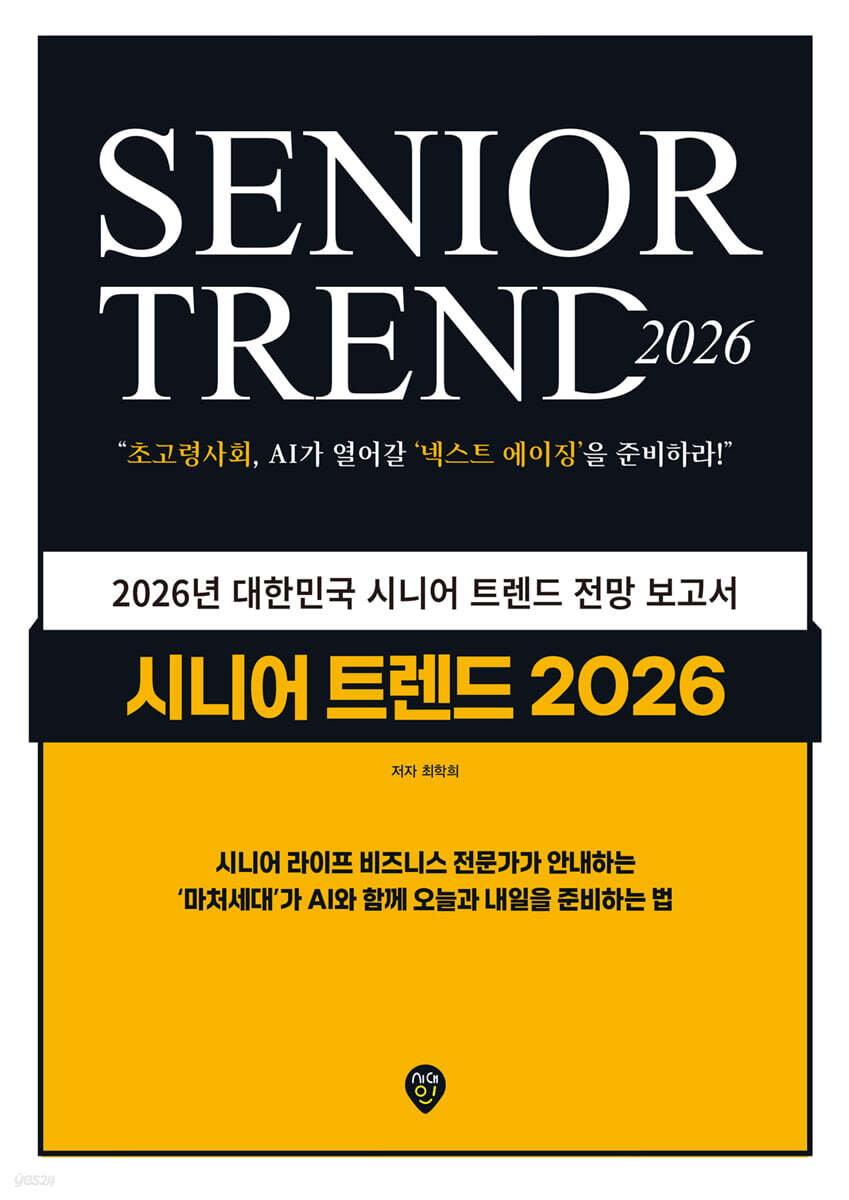
Senior Trends 2026
 |
Description
Book Introduction
"Prepare for the 'next aging' ushered in by AI in a super-aging society!"
Guided by Senior Life Business Experts
How the "March Generation" Prepares for Today and Tomorrow with AI
In 2026, South Korea will reach a turning point where its population structure will accelerate after entering a super-aged society.
In 1961, approximately 940,000 people will reach the age of 65, making a super-aged society no longer the future but the present.
"Senior Trends 2026" is a practical book that turns anxiety into action.
This is not a book to be read once and finished, but a workbook to be opened and looked at continuously, with highlighters to underline and take notes.
Chapter 2 designs the future of the baby boomer generation through retirement risk management, lifetime cash flow strategies, strategic asset consumption, and generational customized policies.
Chapter 3 analyzes international trends and industry prospects for physical AI, including care robots and AI tutors, and introduces practical AI applications in everyday life, such as chatbots and schedule management.
Chapter 4 presents models for a sustainable super-aging society, including environmental gerontology, basic income and welfare transition, multigenerational community housing, and community care.
The action box in the appendix presents nine actionable guidelines, including how to use AI as a second brain, how to create a small but steady N-job cash flow, how to prevent asset depletion after age 75, and how to redesign 1,440 minutes a day.
This book does not provide a complete solution.
Instead, it offers good questions and practical methods.
As small actions continue, anxiety becomes a plan, plans become habits, and habits become the direction of life.
This book focuses on practice, not theory, data, not hope, and strategy, not emotion.
Time management is divided into daily routines, space is divided into living routes, and money management is divided into income, expenditure, and risk, helping to bring about practical changes.
Guided by Senior Life Business Experts
How the "March Generation" Prepares for Today and Tomorrow with AI
In 2026, South Korea will reach a turning point where its population structure will accelerate after entering a super-aged society.
In 1961, approximately 940,000 people will reach the age of 65, making a super-aged society no longer the future but the present.
"Senior Trends 2026" is a practical book that turns anxiety into action.
This is not a book to be read once and finished, but a workbook to be opened and looked at continuously, with highlighters to underline and take notes.
Chapter 2 designs the future of the baby boomer generation through retirement risk management, lifetime cash flow strategies, strategic asset consumption, and generational customized policies.
Chapter 3 analyzes international trends and industry prospects for physical AI, including care robots and AI tutors, and introduces practical AI applications in everyday life, such as chatbots and schedule management.
Chapter 4 presents models for a sustainable super-aging society, including environmental gerontology, basic income and welfare transition, multigenerational community housing, and community care.
The action box in the appendix presents nine actionable guidelines, including how to use AI as a second brain, how to create a small but steady N-job cash flow, how to prevent asset depletion after age 75, and how to redesign 1,440 minutes a day.
This book does not provide a complete solution.
Instead, it offers good questions and practical methods.
As small actions continue, anxiety becomes a plan, plans become habits, and habits become the direction of life.
This book focuses on practice, not theory, data, not hope, and strategy, not emotion.
Time management is divided into daily routines, space is divided into living routes, and money management is divided into income, expenditure, and risk, helping to bring about practical changes.
- You can preview some of the book's contents.
Preview
index
1.
In a super-aging society, lead the next era of aging with AI.
1-1 Changes in the population structure of Korean society
1-2 The Critical Point Where Artificial Intelligence and Super-Aging Meet
1-3 Why is 'preparation' necessary now?
2.
Reset Generation: Baby Boomers' Future Strategies
"Retirement is not the End, but the Beginning: A Baby Boomer's Guide to 'Reset Life'"
2-1 Understanding Global Trends and Generations
The Last Support and the First Loneliness: The Paradox of Korea's Baby Boomer Generation
Those Who Refuse Retirement: America's Baby Boomers and the New Paradigm
Life Goes On After Retirement: Lessons from Japan's Silver Talent Center
The 100-Year-Old Era: The Birth of the "New Senior"
Trend Keywords
2-2 Transformation of the Economy and Business
Retirement Risk Management Strategies: Wisdom Beyond the Retirement Red Zone
Baby Boomers' Cash Flow Strategies and Multi-Income Structures
Strategic Asset Consumption and Longevity Risk
Senior Consumption Trends: Health, Leisure, Finance, and Housing
Trend Keywords
2-3 Life Strategies and Policy Proposals
Generation-specific policies: entrepreneurship, reemployment, and care differentiation
Asset monetization strategy
Guardianships, Trusts, and Insurance Claims: The Future of Legal Systems
Entering the Empty Room: Life After Retirement
Trend Keywords
3.
The Age of Physical AI: A New Coexistence Between Humans and Machines
AI Becomes a 'Supportive Companion' for Seniors!
3-1 Global Insights
Befriending Machines: AI and Old Age
Care Robots and Care Tech: New Companions in the Aging Society
Senior-Friendly UX Design and Barrier-Free AI
AI and Humans, at the Boundary of Empathy
Trend Keywords
3-2 Industry and Business
The AI Care Revolution: How Smart Homes, Wearables, and Care Robots Are Changing Senior Life
Personalized Senior Health AI: A New Horizon in Medication and Diet Management
A Collaborative Model for Senior Employment and AI Automation
AI tutors and digital mates emerge for senior education.
Trend Keywords
3-3 Strategies and Practice in Life
Senior Digital Transformation Training: Practical Case Studies
Seniors Meet AI: A Practical Perspective on Digital Transformation
Machines that Share Loneliness: AI Care Services and the Changing Daily Lives of Seniors
Between machines and people
Trend Keywords
4.
Designing a Sustainable Super-Aging Society
“Deeper than speed: What kind of society will it be where baby boomers and AI coexist?”
4-1 Expanding Global Policies and Concepts
Growing old in nature and community
Sustainable Economic Models: Basic Income, Welfare Transition, and Climate Justice
Multigenerational Community Housing and Community Care
Trend Keywords
4-2 Business Transformation and Response Strategy
Redesigning Your Routine: Pace Yourself and Deepen Your Life
The intersection of senior-friendly industries and ESG
A new world created by seniors
Where old people and capital meet
Trend Keywords
4-3 Personal Life Change Strategies
A Journey of Spirituality, Sharing, and Heritage Design
Beyond Loneliness to Connection: The Social Footprints of Seniors
In Search of Lost Seasons: Seniors and the Climate Crisis
Trend Keywords
5.
supplement
5-1 A 9-Step Guide to Resetting Your Future in the Age of Aging and AI
5-2 AI Senior Persona Marketing System Guide
6.
Special Contribution
6-1 In the age of 100, a new perspective and wise mind to protect my health_Kimina
6-2 Fibonacci's Senior Investment Manual_Lee Yoon-young
6-3 How to Use Personal IRPs to Prepare Smartly by Age Group_Hyungri Kim
6-4 Dementia Mother_Hong Jong-seok
6-5 Living a life filled with what you love_Lee Ji-yeon
6-6 Romantic Senior_Kim Min-ji
6-7 Seniors: A New Community Model for Living as Cultural Creators_Eunju Kang
6-8 People-Centered Senior-Friendly Design_Lee Han-gyeol
6-9 Shorts Commerce: A New Era of Sales Created by Short Videos_Kwon Soon-gil
6-10 AI and 'Creator Senior': A Blooming Spring Day Again_Jo Yeon-mi
In a super-aging society, lead the next era of aging with AI.
1-1 Changes in the population structure of Korean society
1-2 The Critical Point Where Artificial Intelligence and Super-Aging Meet
1-3 Why is 'preparation' necessary now?
2.
Reset Generation: Baby Boomers' Future Strategies
"Retirement is not the End, but the Beginning: A Baby Boomer's Guide to 'Reset Life'"
2-1 Understanding Global Trends and Generations
The Last Support and the First Loneliness: The Paradox of Korea's Baby Boomer Generation
Those Who Refuse Retirement: America's Baby Boomers and the New Paradigm
Life Goes On After Retirement: Lessons from Japan's Silver Talent Center
The 100-Year-Old Era: The Birth of the "New Senior"
Trend Keywords
2-2 Transformation of the Economy and Business
Retirement Risk Management Strategies: Wisdom Beyond the Retirement Red Zone
Baby Boomers' Cash Flow Strategies and Multi-Income Structures
Strategic Asset Consumption and Longevity Risk
Senior Consumption Trends: Health, Leisure, Finance, and Housing
Trend Keywords
2-3 Life Strategies and Policy Proposals
Generation-specific policies: entrepreneurship, reemployment, and care differentiation
Asset monetization strategy
Guardianships, Trusts, and Insurance Claims: The Future of Legal Systems
Entering the Empty Room: Life After Retirement
Trend Keywords
3.
The Age of Physical AI: A New Coexistence Between Humans and Machines
AI Becomes a 'Supportive Companion' for Seniors!
3-1 Global Insights
Befriending Machines: AI and Old Age
Care Robots and Care Tech: New Companions in the Aging Society
Senior-Friendly UX Design and Barrier-Free AI
AI and Humans, at the Boundary of Empathy
Trend Keywords
3-2 Industry and Business
The AI Care Revolution: How Smart Homes, Wearables, and Care Robots Are Changing Senior Life
Personalized Senior Health AI: A New Horizon in Medication and Diet Management
A Collaborative Model for Senior Employment and AI Automation
AI tutors and digital mates emerge for senior education.
Trend Keywords
3-3 Strategies and Practice in Life
Senior Digital Transformation Training: Practical Case Studies
Seniors Meet AI: A Practical Perspective on Digital Transformation
Machines that Share Loneliness: AI Care Services and the Changing Daily Lives of Seniors
Between machines and people
Trend Keywords
4.
Designing a Sustainable Super-Aging Society
“Deeper than speed: What kind of society will it be where baby boomers and AI coexist?”
4-1 Expanding Global Policies and Concepts
Growing old in nature and community
Sustainable Economic Models: Basic Income, Welfare Transition, and Climate Justice
Multigenerational Community Housing and Community Care
Trend Keywords
4-2 Business Transformation and Response Strategy
Redesigning Your Routine: Pace Yourself and Deepen Your Life
The intersection of senior-friendly industries and ESG
A new world created by seniors
Where old people and capital meet
Trend Keywords
4-3 Personal Life Change Strategies
A Journey of Spirituality, Sharing, and Heritage Design
Beyond Loneliness to Connection: The Social Footprints of Seniors
In Search of Lost Seasons: Seniors and the Climate Crisis
Trend Keywords
5.
supplement
5-1 A 9-Step Guide to Resetting Your Future in the Age of Aging and AI
5-2 AI Senior Persona Marketing System Guide
6.
Special Contribution
6-1 In the age of 100, a new perspective and wise mind to protect my health_Kimina
6-2 Fibonacci's Senior Investment Manual_Lee Yoon-young
6-3 How to Use Personal IRPs to Prepare Smartly by Age Group_Hyungri Kim
6-4 Dementia Mother_Hong Jong-seok
6-5 Living a life filled with what you love_Lee Ji-yeon
6-6 Romantic Senior_Kim Min-ji
6-7 Seniors: A New Community Model for Living as Cultural Creators_Eunju Kang
6-8 People-Centered Senior-Friendly Design_Lee Han-gyeol
6-9 Shorts Commerce: A New Era of Sales Created by Short Videos_Kwon Soon-gil
6-10 AI and 'Creator Senior': A Blooming Spring Day Again_Jo Yeon-mi
Detailed image

Into the book
Our baby boomers are 8 to 9 years younger than those in the US or Japan.
This is because of the unique birth pattern during the reconstruction and industrialization period following the Korean War.
It was a population expansion with a 'heretical structure' that is rare even worldwide.
Their true specialness lies in their paradoxical position as the 'March Generation'.
It is an abbreviation for 'the generation of the last to support parents and the first to become independent.'
In particular, the second baby boomer generation is 'the last generation to support their parents and the first generation to not be supported by their children.'
Above, we have parents who live long lives, but below, we have children with strong individualistic tendencies.
--- p.20
The aging patterns of Korea and Japan are similar, but Korea's rate is much faster.
Japan entered a super-aged society (21% of the population is 65 years or older) in 2007, and will be in its 17th year as of 2025.
The proportion of the population aged 65 or older reaches 29.3%.
Meanwhile, Korea officially entered a super-aged society in December 2024.
While it took Japan 11 years to transition from an aging society to a super-aged society, Korea accomplished this transformation in just 7 years.
Experts predict that the proportion of the population aged 65 and over in Korea will reach Japan's current level of 30% within just 10 to 12 years.
--- p.42
Active seniors show a prominent consumption tendency in the leisure, culture, and tourism sectors.
If in the past, the leisure activities of the elderly were limited to playing cards at senior centers or watching TV, today's 50-60 year-olds are a generation that actively enjoys self-development and hobbies.
The activities of seniors are particularly notable in the travel and tourism sector.
Retired baby boomers are actively using their free time to travel domestically and internationally, and they prefer independent travel over package tours.
According to a global survey, 50% of Korean respondents said, “Instead of leaving my children my money, I plan to use that money to travel with them.”
This figure is higher than the overseas average of 46%.
89% of Korean baby boomers said they would be willing to pay for their children's travel expenses in the future.
The so-called 'SKI (Spending Kids' Inheritance) travel' trend demonstrates a shift in values that prioritizes memories over heritage.
--- p.59
Household debt among those in their 50s poses a risk of a cliff.
The average total debt of people in their 50s is 80 million won, the highest among all age groups.
Monthly interest payments amount to 300,000 won, accounting for 6% of monthly income.
The situation is especially dire for small business owners.
In the midst of the shocking reality of one million business closures annually, self-employed people in their 50s are facing an interest burden of 15-18% of their monthly income.
With real estate assets accounting for over 70% of total assets, the phenomenon of 'asset rich, cash poor', where people have assets but lack cash flow, is spreading.
--- p.77
Retirement from work is more than just losing a job.
It is a loss of social status, role, and even identity.
As we no longer wear the tie, suit, or uniform we used to wear to work every morning, we also return the name tag that used to identify us.
A person who has been someone's boss, colleague, and subordinate for decades suddenly returns to being just 'someone.'
Many retirees, especially men, complain of a decline in self-acceptance and a sense of accomplishment after leaving work.
Are you experiencing confusion about your own worth, wondering if you are a useless being to society?
--- p.93
The use of AI to prevent dementia and maintain cognitive function is also drawing attention.
Robots or tablet AI coaches equipped with cognitive training programs provide interactive feedback to seniors by giving them games and quizzes that stimulate their brain activity.
In Japan, a study reported that talking to or singing with a companion robot helps improve emotional stability and cognitive stimulation in elderly people with dementia.
Especially in the mid-2020s, when the second baby boomer generation is entering its senior years, the new generation of seniors with relatively high digital affinity tend to actively embrace AI as a new friend and helper.
--- p.115
New specialized jobs, such as robot maintenance, software tuning, and sensor calibration, are on the rise.
A logistics veteran in his 60s takes on the role of a "field teacher," correcting and supplementing robots when they make mistakes or encounter unpredictable situations, and rearranging logistics that the robots have knocked over.
Checks for sensor errors and provides suggestions for process optimization.
A generational survey found that only 10% of baby boomer workers perceived the introduction of robots as a threat to their jobs.
On the other hand, 57% saw it as an opportunity for collaboration.
This demonstrates the practical approach of seniors who have adapted to technological changes through long-term field experience.
--- p.143
It's a world where you can scan a QR code on the subway to get a discount, transfer money through an app instead of going to a bank teller, and order at a kiosk.
How will seniors who can't use digital devices survive in this world? Just a few years ago, bank tellers would greet you warmly.
But now, I hear, “Sir, you need to install the app and register your certificate.”
But then an interesting change began.
Elderly people are starting to talk to AI.
This is not simply curiosity, but a new attempt to adapt to the digital world.
--- p.162
Retirees don't just go to the farm to harvest crops.
Because of the people you meet there.
Conversations with people who share the same interests are always energizing.
If the natural environment nourishes the body and mind, connection with the community is the support that supports social health in old age.
Social bonds with family, neighbors, and fellow citizens reduce feelings of isolation and give life a sense of purpose.
Especially for seniors living alone, community is a matter of survival.
--- p.239
Today, with the advancement of medical technology and the extension of lifespan, interest in 'how to die well (well-dying)' is increasing.
One of the most notable is 'die with dignity through fasting', or 'death with dignity through voluntary fasting (VSED; Voluntary Stopping of Eating and Drinking).
Fasting euthanasia is a method of death that emphasizes the patient's right to self-determination and dignity, allowing the patient to end their life naturally by voluntarily stopping their intake of food and water.
This is not simply 'starving to death', but is described as a process in which a patient nearing death accepts a natural death.
In the West, it is recognized as a choice based on the patient's right to self-determination.
In some countries, medical professionals provide discussion and support regarding VSED out of respect for the patient's right to self-determination.
On the other hand, in East Asia, including Korea, it is still an unfamiliar and controversial topic.
This is because of the unique birth pattern during the reconstruction and industrialization period following the Korean War.
It was a population expansion with a 'heretical structure' that is rare even worldwide.
Their true specialness lies in their paradoxical position as the 'March Generation'.
It is an abbreviation for 'the generation of the last to support parents and the first to become independent.'
In particular, the second baby boomer generation is 'the last generation to support their parents and the first generation to not be supported by their children.'
Above, we have parents who live long lives, but below, we have children with strong individualistic tendencies.
--- p.20
The aging patterns of Korea and Japan are similar, but Korea's rate is much faster.
Japan entered a super-aged society (21% of the population is 65 years or older) in 2007, and will be in its 17th year as of 2025.
The proportion of the population aged 65 or older reaches 29.3%.
Meanwhile, Korea officially entered a super-aged society in December 2024.
While it took Japan 11 years to transition from an aging society to a super-aged society, Korea accomplished this transformation in just 7 years.
Experts predict that the proportion of the population aged 65 and over in Korea will reach Japan's current level of 30% within just 10 to 12 years.
--- p.42
Active seniors show a prominent consumption tendency in the leisure, culture, and tourism sectors.
If in the past, the leisure activities of the elderly were limited to playing cards at senior centers or watching TV, today's 50-60 year-olds are a generation that actively enjoys self-development and hobbies.
The activities of seniors are particularly notable in the travel and tourism sector.
Retired baby boomers are actively using their free time to travel domestically and internationally, and they prefer independent travel over package tours.
According to a global survey, 50% of Korean respondents said, “Instead of leaving my children my money, I plan to use that money to travel with them.”
This figure is higher than the overseas average of 46%.
89% of Korean baby boomers said they would be willing to pay for their children's travel expenses in the future.
The so-called 'SKI (Spending Kids' Inheritance) travel' trend demonstrates a shift in values that prioritizes memories over heritage.
--- p.59
Household debt among those in their 50s poses a risk of a cliff.
The average total debt of people in their 50s is 80 million won, the highest among all age groups.
Monthly interest payments amount to 300,000 won, accounting for 6% of monthly income.
The situation is especially dire for small business owners.
In the midst of the shocking reality of one million business closures annually, self-employed people in their 50s are facing an interest burden of 15-18% of their monthly income.
With real estate assets accounting for over 70% of total assets, the phenomenon of 'asset rich, cash poor', where people have assets but lack cash flow, is spreading.
--- p.77
Retirement from work is more than just losing a job.
It is a loss of social status, role, and even identity.
As we no longer wear the tie, suit, or uniform we used to wear to work every morning, we also return the name tag that used to identify us.
A person who has been someone's boss, colleague, and subordinate for decades suddenly returns to being just 'someone.'
Many retirees, especially men, complain of a decline in self-acceptance and a sense of accomplishment after leaving work.
Are you experiencing confusion about your own worth, wondering if you are a useless being to society?
--- p.93
The use of AI to prevent dementia and maintain cognitive function is also drawing attention.
Robots or tablet AI coaches equipped with cognitive training programs provide interactive feedback to seniors by giving them games and quizzes that stimulate their brain activity.
In Japan, a study reported that talking to or singing with a companion robot helps improve emotional stability and cognitive stimulation in elderly people with dementia.
Especially in the mid-2020s, when the second baby boomer generation is entering its senior years, the new generation of seniors with relatively high digital affinity tend to actively embrace AI as a new friend and helper.
--- p.115
New specialized jobs, such as robot maintenance, software tuning, and sensor calibration, are on the rise.
A logistics veteran in his 60s takes on the role of a "field teacher," correcting and supplementing robots when they make mistakes or encounter unpredictable situations, and rearranging logistics that the robots have knocked over.
Checks for sensor errors and provides suggestions for process optimization.
A generational survey found that only 10% of baby boomer workers perceived the introduction of robots as a threat to their jobs.
On the other hand, 57% saw it as an opportunity for collaboration.
This demonstrates the practical approach of seniors who have adapted to technological changes through long-term field experience.
--- p.143
It's a world where you can scan a QR code on the subway to get a discount, transfer money through an app instead of going to a bank teller, and order at a kiosk.
How will seniors who can't use digital devices survive in this world? Just a few years ago, bank tellers would greet you warmly.
But now, I hear, “Sir, you need to install the app and register your certificate.”
But then an interesting change began.
Elderly people are starting to talk to AI.
This is not simply curiosity, but a new attempt to adapt to the digital world.
--- p.162
Retirees don't just go to the farm to harvest crops.
Because of the people you meet there.
Conversations with people who share the same interests are always energizing.
If the natural environment nourishes the body and mind, connection with the community is the support that supports social health in old age.
Social bonds with family, neighbors, and fellow citizens reduce feelings of isolation and give life a sense of purpose.
Especially for seniors living alone, community is a matter of survival.
--- p.239
Today, with the advancement of medical technology and the extension of lifespan, interest in 'how to die well (well-dying)' is increasing.
One of the most notable is 'die with dignity through fasting', or 'death with dignity through voluntary fasting (VSED; Voluntary Stopping of Eating and Drinking).
Fasting euthanasia is a method of death that emphasizes the patient's right to self-determination and dignity, allowing the patient to end their life naturally by voluntarily stopping their intake of food and water.
This is not simply 'starving to death', but is described as a process in which a patient nearing death accepts a natural death.
In the West, it is recognized as a choice based on the patient's right to self-determination.
In some countries, medical professionals provide discussion and support regarding VSED out of respect for the patient's right to self-determination.
On the other hand, in East Asia, including Korea, it is still an unfamiliar and controversial topic.
--- p.299
Publisher's Review
"Senior Trends 2026" suggests ways for Korean society, rapidly entering a super-aged society, to navigate the waves of change it will face without being swept away.
The most notable feature of this book is that it presents implications for each field, including a total of 79 senior trend keywords for 2026, with a broad focus on designing the future of the baby boomer generation, implementing AI in daily life, and presenting a model for a sustainable super-aged society.
While previous works were comprehensive white papers that provided insight into changes across society, centered on the insights of various experts, "Senior Trends 2026" has evolved into an "actionable trend book" that combines both analytical precision and practical concreteness.
In terms of content, it covers a wide range of topics, including the lifestyles of the senior generation, welfare and policy changes, the integration of new technologies, and global senior industry trends, and presents each topic in realistic language.
This will serve as a practical guide for not only seniors in the baby boomer generation, but also senior business professionals, policymakers concerned about creating a senior-friendly environment, and individual readers preparing for the future.
The most notable feature of this book is that it presents implications for each field, including a total of 79 senior trend keywords for 2026, with a broad focus on designing the future of the baby boomer generation, implementing AI in daily life, and presenting a model for a sustainable super-aged society.
While previous works were comprehensive white papers that provided insight into changes across society, centered on the insights of various experts, "Senior Trends 2026" has evolved into an "actionable trend book" that combines both analytical precision and practical concreteness.
In terms of content, it covers a wide range of topics, including the lifestyles of the senior generation, welfare and policy changes, the integration of new technologies, and global senior industry trends, and presents each topic in realistic language.
This will serve as a practical guide for not only seniors in the baby boomer generation, but also senior business professionals, policymakers concerned about creating a senior-friendly environment, and individual readers preparing for the future.
GOODS SPECIFICS
- Date of issue: October 15, 2025
- Page count, weight, size: 380 pages | 170*240*30mm
- ISBN13: 9791138399692
You may also like
카테고리
korean


korean

![GQ KOREA Mark (Monthly): December [2025]](http://librairie.coreenne.fr/cdn/shop/files/8ef265dbbfbf186523ed75ba7319009d.jpg?v=1765340328&width=3840)


