

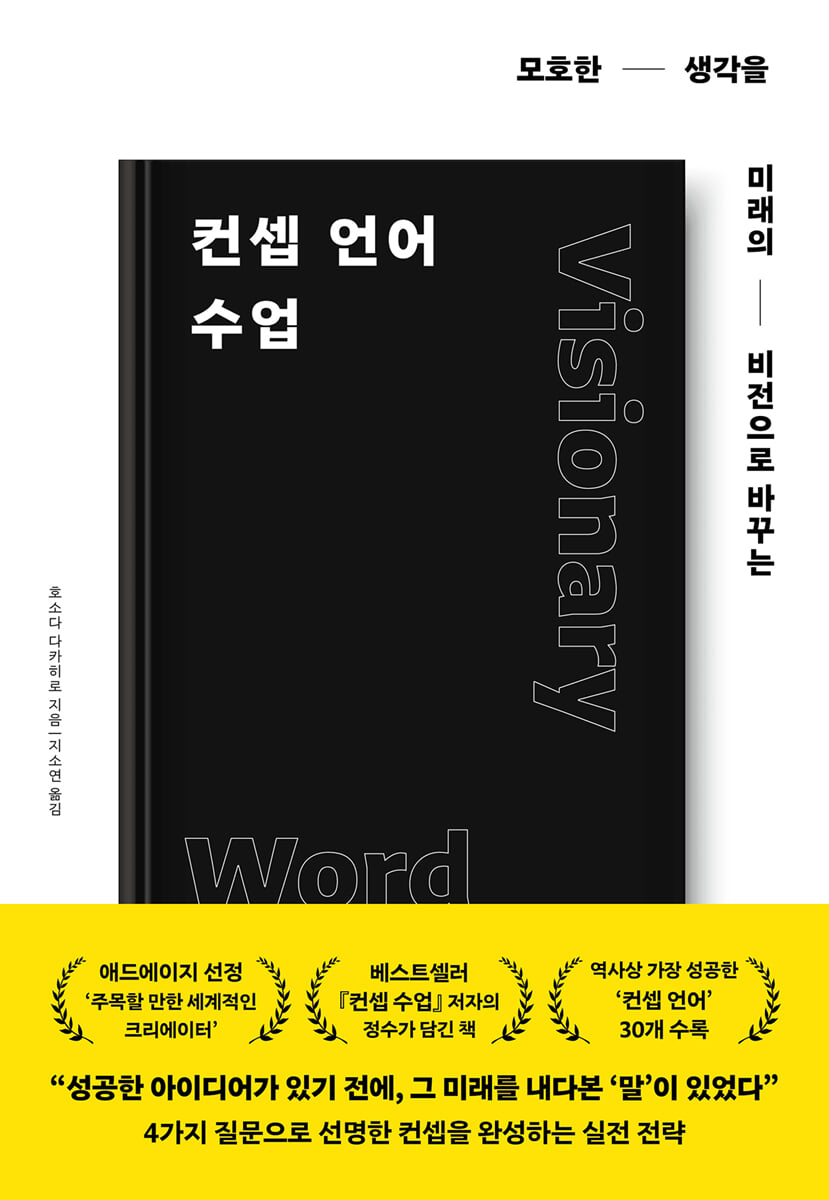
Concept Language Class
 |
Description
Book Introduction
The book that executives at large corporations seek out first: the publication of the "Concept Class" series, a textbook for planners.
Before there was a successful idea, there was a 'word' that foresaw the future.
How to create more engaging concepts using the tool called 'language'
The author of "Concept Class," which became a bestseller in economics and management in 2024 through word-of-mouth on social media and among planners and marketers, and recommended by executives of large corporations such as SK, has returned with "Concept Language Class."
Following the previous work, which received praise such as “better than a lecture worth millions of won” and “a masterpiece with nothing to throw away,” and became a textbook for planners and everyone who needs a concept, “Concept Language Class” focuses specifically on the tool called “language.”
The most compelling concepts start with just a word.
Takahiro Hosoda, a “notable global creator” selected by AdAge, one of the world’s most influential advertising and marketing media outlets, emphasizes in this book that “the first thing that touches a new landscape is words.”
To express something new—an organization's vision that hasn't yet been formalized into words, a product that doesn't exist in the world, a service that no one has ever experienced—a new language is essential.
Just like “an artist, not an engineer (Steve Jobs)” and “a computer on every desk and in every home (Bill Gates),” a single vision establishes itself as the brand’s purpose and promise to customers.
That is, at the starting point of every innovation, there is always a sentence that suggests the future.
If the previous work, "Concept Class," laid the groundwork for the basic concepts of concepts, "Concept Language Class" guides readers through the process of creating even more attractive and persuasive concepts.
It introduces 30 concept languages (visionary words) that have created successful organizations and products, and helps readers derive their own concepts through a four-step process based on these.
Even readers who know the importance of concepts but feel overwhelmed by the practical aspects will naturally acquire a sense of the subject by following the book's rich examples and methods.
※ According to the National Institute of the Korean Language's foreign language notation rules, the correct expression for 'concept' is 'concept.'
We have standardized the notation to ‘concept’ based on the expression used in the book.
Before there was a successful idea, there was a 'word' that foresaw the future.
How to create more engaging concepts using the tool called 'language'
The author of "Concept Class," which became a bestseller in economics and management in 2024 through word-of-mouth on social media and among planners and marketers, and recommended by executives of large corporations such as SK, has returned with "Concept Language Class."
Following the previous work, which received praise such as “better than a lecture worth millions of won” and “a masterpiece with nothing to throw away,” and became a textbook for planners and everyone who needs a concept, “Concept Language Class” focuses specifically on the tool called “language.”
The most compelling concepts start with just a word.
Takahiro Hosoda, a “notable global creator” selected by AdAge, one of the world’s most influential advertising and marketing media outlets, emphasizes in this book that “the first thing that touches a new landscape is words.”
To express something new—an organization's vision that hasn't yet been formalized into words, a product that doesn't exist in the world, a service that no one has ever experienced—a new language is essential.
Just like “an artist, not an engineer (Steve Jobs)” and “a computer on every desk and in every home (Bill Gates),” a single vision establishes itself as the brand’s purpose and promise to customers.
That is, at the starting point of every innovation, there is always a sentence that suggests the future.
If the previous work, "Concept Class," laid the groundwork for the basic concepts of concepts, "Concept Language Class" guides readers through the process of creating even more attractive and persuasive concepts.
It introduces 30 concept languages (visionary words) that have created successful organizations and products, and helps readers derive their own concepts through a four-step process based on these.
Even readers who know the importance of concepts but feel overwhelmed by the practical aspects will naturally acquire a sense of the subject by following the book's rich examples and methods.
※ According to the National Institute of the Korean Language's foreign language notation rules, the correct expression for 'concept' is 'concept.'
We have standardized the notation to ‘concept’ based on the expression used in the book.
- You can preview some of the book's contents.
Preview
index
To our Korean readers,
preface
Everyone had a 'word that drew the future' in their hearts.
Whose job is it to tell the future?
You haven't said anything yet
PART 1.
Words are tools for inventing the future
The limits of speech are the limits of thought.
Seven-Colored Rainbow and Mottainai
'Amazing' service spirit
The word that created Disneyland
The word that gave birth to the digital age
A sure way to predict the future
The Relationship Between Words and Innovation
Visionary Words that Invent the Future
“I have a dream” was just a phrase.
PART 2.
The word that invented 'era'
1.
Sending humans to the moon within 10 years John F.
Kennedy
2.
Muhammad Yunus: Turning Poverty into a Museum
3.
Coco Chanel restores freedom to women's bodies
4.
The world becomes a classroom Salman Khan
5.
Bill Gates put a computer on every desk and in every home
6.
Jimmy Wales, the encyclopedia anyone can edit
7.
Vidal Sassoon: Beauty as a New Art
8.
Skyscrapers are too small, Le Corbusier
9.
Akio Morita: A company that overturns the image of "Made in Japan" as being crude.
10.
Google organizes all the world's information and makes it easily accessible and usable for everyone around the world.
PART 3.
The word that invented 'brand and organization'
11.
Masaru Ibuka, the free-spirited and cheerful dream factory
12.
Create a product that others want to copy. Tokuji Hayakawa
13.
Raising the World's Temperature: Masamichi Toyama
14. GIVE A GOOD IMAGE FC Barcelona
15.
Make it one less Enzo Ferrari
16.
The Happiest Place on Earth: Walt Disney
17.
21st Century Museum of Contemporary Art, Kanazawa: An Art Museum That Grows with Children
18.
We are artists, not engineers - Steve Jobs
19.
Shareholders are the Earth Yvonne Chouinard
20.
Muji Yangpum Plan
PART 4.
The word that invented 'goods and services'
21.
Let's make a radio that fits in your pocket: the transistor radio. Masaru Ibuka and Akio Morita.
22.
A wind-up radio that doesn't need electricity, Trevor Bayliss
23.
Ecute, JR East, a meeting point at a passing station
24.
From morphological exhibitions to behavioral exhibitions at Asahiyama Zoo
25.
Zipcar and Robin Chase are ushering in a world where cars are as easy to use as ATMs.
26.
1,000-song iPod in your pocket, Apple
27.
Kindle, Amazon, so you can get all the books in 60 seconds
28.
Games for the whole family: Wii, Nintendo
29 Third Place Starbucks, Howard Schultz
30.
Travel the world via space with Virgin Galactic
PART 5.
4 Steps to Creating a Visionary Word
What Words Become Visionary Words?
Conditions for a great visionary word
The Birth of Visionary Words
The Birth of the Personal Computer in Four Stages
PART 6.
Finding the entrance to the future
Step 1: Question the Current Situation
Let's ask the question, "Is that really true?"
Doubt List
Remove the label from the horse
Step 2: Explore the future
Expand your thinking with “What if?”
'Different answer' rather than 'right answer'
The more professional you are, the more you think from an amateur's perspective.
PART 7.
5 Skills for Making Words
Step 3: Create a horse
·First skill: Renaming
If you change your name, the times will change too.
From 'student' to 'little scholar'
Training to change titles
·Second skill: Flipping
When you turn your discontent around, hope appears.
When you overturn common sense, you create originality.
Turn it over and revolutionize it
·Third skill: analogy
Creation as a metaphor
Capital, Amoeba, and Poker
Let's express the future with a metaphor
·Fourth skill: Running
The future begins where it's shunned
Designing a game console with different elements
· Fifth skill: Pairing opposites
Innovation begins with contradiction.
Let's pair opposites
PART 8.
Backcasting to create a schedule
Step 4: Make a plan
Planning with backcasting
Postcards as travel itineraries
Conclusion
References
preface
Everyone had a 'word that drew the future' in their hearts.
Whose job is it to tell the future?
You haven't said anything yet
PART 1.
Words are tools for inventing the future
The limits of speech are the limits of thought.
Seven-Colored Rainbow and Mottainai
'Amazing' service spirit
The word that created Disneyland
The word that gave birth to the digital age
A sure way to predict the future
The Relationship Between Words and Innovation
Visionary Words that Invent the Future
“I have a dream” was just a phrase.
PART 2.
The word that invented 'era'
1.
Sending humans to the moon within 10 years John F.
Kennedy
2.
Muhammad Yunus: Turning Poverty into a Museum
3.
Coco Chanel restores freedom to women's bodies
4.
The world becomes a classroom Salman Khan
5.
Bill Gates put a computer on every desk and in every home
6.
Jimmy Wales, the encyclopedia anyone can edit
7.
Vidal Sassoon: Beauty as a New Art
8.
Skyscrapers are too small, Le Corbusier
9.
Akio Morita: A company that overturns the image of "Made in Japan" as being crude.
10.
Google organizes all the world's information and makes it easily accessible and usable for everyone around the world.
PART 3.
The word that invented 'brand and organization'
11.
Masaru Ibuka, the free-spirited and cheerful dream factory
12.
Create a product that others want to copy. Tokuji Hayakawa
13.
Raising the World's Temperature: Masamichi Toyama
14. GIVE A GOOD IMAGE FC Barcelona
15.
Make it one less Enzo Ferrari
16.
The Happiest Place on Earth: Walt Disney
17.
21st Century Museum of Contemporary Art, Kanazawa: An Art Museum That Grows with Children
18.
We are artists, not engineers - Steve Jobs
19.
Shareholders are the Earth Yvonne Chouinard
20.
Muji Yangpum Plan
PART 4.
The word that invented 'goods and services'
21.
Let's make a radio that fits in your pocket: the transistor radio. Masaru Ibuka and Akio Morita.
22.
A wind-up radio that doesn't need electricity, Trevor Bayliss
23.
Ecute, JR East, a meeting point at a passing station
24.
From morphological exhibitions to behavioral exhibitions at Asahiyama Zoo
25.
Zipcar and Robin Chase are ushering in a world where cars are as easy to use as ATMs.
26.
1,000-song iPod in your pocket, Apple
27.
Kindle, Amazon, so you can get all the books in 60 seconds
28.
Games for the whole family: Wii, Nintendo
29 Third Place Starbucks, Howard Schultz
30.
Travel the world via space with Virgin Galactic
PART 5.
4 Steps to Creating a Visionary Word
What Words Become Visionary Words?
Conditions for a great visionary word
The Birth of Visionary Words
The Birth of the Personal Computer in Four Stages
PART 6.
Finding the entrance to the future
Step 1: Question the Current Situation
Let's ask the question, "Is that really true?"
Doubt List
Remove the label from the horse
Step 2: Explore the future
Expand your thinking with “What if?”
'Different answer' rather than 'right answer'
The more professional you are, the more you think from an amateur's perspective.
PART 7.
5 Skills for Making Words
Step 3: Create a horse
·First skill: Renaming
If you change your name, the times will change too.
From 'student' to 'little scholar'
Training to change titles
·Second skill: Flipping
When you turn your discontent around, hope appears.
When you overturn common sense, you create originality.
Turn it over and revolutionize it
·Third skill: analogy
Creation as a metaphor
Capital, Amoeba, and Poker
Let's express the future with a metaphor
·Fourth skill: Running
The future begins where it's shunned
Designing a game console with different elements
· Fifth skill: Pairing opposites
Innovation begins with contradiction.
Let's pair opposites
PART 8.
Backcasting to create a schedule
Step 4: Make a plan
Planning with backcasting
Postcards as travel itineraries
Conclusion
References
Detailed image

Into the book
Everyone has a future they want to realize.
This book is a precious book that I wrote to realize my own vision.
I am honored that this book has reached Korea, a country I love and where I have many friends.
I hope this book will be of some help to readers in turning 'imagination' into 'conception.'
--- p.8
Not long after we settled in on Shayat Day, this happened.
To the senior executives in the advertising department, “In Japan, the main job of a copywriter is to convey a company’s message or newly developed products to customers.
That's why he's called the last runner in corporate activity," he said.
“I can’t agree with that.
The copywriter is rather the first runner.
“Because the first thing to reach a new landscape is ‘words’.”
--- p.13
In business, we tend to think that the only time we need to talk is when we need to 'communicate' and 'show' a finished product or organization in a way that makes it look appealing.
However, what this book deals with is not words that 'make up' the image of a product or a company, but words that form the so-called 'skeleton' that designs the essence of a product or a company.
--- p.17
Talking about the future can be expressed in one word as creating a 'destination'.
Unlike a marathon, there is no predetermined finish line in business or life.
You have to design, build, and maintain a compelling destination that will make your heart race and get you there.
I think the true role of this book is to guide you through that process.
--- p.18
Vision is not 'what you see' but 'what you want to see', not 'the future you predict' but 'the future you hope for'.
To borrow Alan Kay's words, a visionary is someone who "doesn't predict the future, he creates it."
So, this book focuses on the words of those who invented the future.
--- p.46
When people think of the future, they often expect something new and visible, like a 'flying car'.
But something new that does not yet exist in the world may actually be hidden within something that cannot be seen.
--- p.108
A great visionary word can be likened to a 'postcard from the future'.
A phrase that shows a vivid and attractive landscape, as if you had traveled back in time several decades by yourself and sent a photo from there to the present.
That's a great visionary word.
--- p.185~186
If you think about it, creating something new is like destroying something from the past.
If so, isn't the very thing that professionals want to protect the very thing that needs to be broken? Shouldn't professionals sometimes be like amateurs and think like amateurs? Words like "a little more" or "more than now" are now forbidden.
Rather than competing within the rules, let's think about the 'what if' that changes the rules themselves.
--- p.215
Words are the skeleton of the future.
Only by gaining flesh can one gain life.
Therefore, the words we create should not be placed in the framed images of the president's office or in advertisements.
There should be one clear plan that everyone is always aware of, a daily guide that guides the actions of the team or organization.
--- p.265
Japanese businesspeople seem overly reticent to talk about the future.
Magazines with special features on future predictions sell well at the end of the year, so it's not like you're not interested in the future.
But he refuses to open his mouth about what he wants to do in the future.
I wrote this book with the thought of throwing a small stone toward such a world.
Of course, having a great visionary word doesn't guarantee success.
There are many cases where words just end up as words.
But it is even more clear that nothing begins without words.
This book is a precious book that I wrote to realize my own vision.
I am honored that this book has reached Korea, a country I love and where I have many friends.
I hope this book will be of some help to readers in turning 'imagination' into 'conception.'
--- p.8
Not long after we settled in on Shayat Day, this happened.
To the senior executives in the advertising department, “In Japan, the main job of a copywriter is to convey a company’s message or newly developed products to customers.
That's why he's called the last runner in corporate activity," he said.
“I can’t agree with that.
The copywriter is rather the first runner.
“Because the first thing to reach a new landscape is ‘words’.”
--- p.13
In business, we tend to think that the only time we need to talk is when we need to 'communicate' and 'show' a finished product or organization in a way that makes it look appealing.
However, what this book deals with is not words that 'make up' the image of a product or a company, but words that form the so-called 'skeleton' that designs the essence of a product or a company.
--- p.17
Talking about the future can be expressed in one word as creating a 'destination'.
Unlike a marathon, there is no predetermined finish line in business or life.
You have to design, build, and maintain a compelling destination that will make your heart race and get you there.
I think the true role of this book is to guide you through that process.
--- p.18
Vision is not 'what you see' but 'what you want to see', not 'the future you predict' but 'the future you hope for'.
To borrow Alan Kay's words, a visionary is someone who "doesn't predict the future, he creates it."
So, this book focuses on the words of those who invented the future.
--- p.46
When people think of the future, they often expect something new and visible, like a 'flying car'.
But something new that does not yet exist in the world may actually be hidden within something that cannot be seen.
--- p.108
A great visionary word can be likened to a 'postcard from the future'.
A phrase that shows a vivid and attractive landscape, as if you had traveled back in time several decades by yourself and sent a photo from there to the present.
That's a great visionary word.
--- p.185~186
If you think about it, creating something new is like destroying something from the past.
If so, isn't the very thing that professionals want to protect the very thing that needs to be broken? Shouldn't professionals sometimes be like amateurs and think like amateurs? Words like "a little more" or "more than now" are now forbidden.
Rather than competing within the rules, let's think about the 'what if' that changes the rules themselves.
--- p.215
Words are the skeleton of the future.
Only by gaining flesh can one gain life.
Therefore, the words we create should not be placed in the framed images of the president's office or in advertisements.
There should be one clear plan that everyone is always aware of, a daily guide that guides the actions of the team or organization.
--- p.265
Japanese businesspeople seem overly reticent to talk about the future.
Magazines with special features on future predictions sell well at the end of the year, so it's not like you're not interested in the future.
But he refuses to open his mouth about what he wants to do in the future.
I wrote this book with the thought of throwing a small stone toward such a world.
Of course, having a great visionary word doesn't guarantee success.
There are many cases where words just end up as words.
But it is even more clear that nothing begins without words.
--- p.282
Publisher's Review
The second installment of the planner's textbook, following "Concept Class."
How to Create a One-Word Weapon That Will Imprint Your Customers' Minds
"It's hard to come up with fresh and creative plans." "I often hear feedback that the concepts I come up with myself are somehow vague." These are concerns that every planner has faced at least once.
How can we create compelling concepts that capture customers' hearts, rather than just plain old copy or meaningless one-liners?
Takahiro Hosoda, Chief Creative Director of TBWAHAKUHODO and author of this book, points to a very familiar tool: language as the answer.
He emphasizes that what is needed when creating a concept is the 'words' that create the future.
There is no need for fancy words.
Any word that clearly expresses the destination of the product or brand is sufficient.
He calls this one-word strategy the 'Visionary Word.'
Just like the case of Alan Kay, who called for a “personal computer” for individuals in a world where only large corporate computers existed, the visionary word is not an empty landscape, but a language that shows the future of planning.
Even great copy ultimately comes from visionary words that form the skeleton of the concept.
"Concept Language Class" is a systematic guide on how to discover, refine, and utilize those "visionary words."
Anyone can come up with an idea, but creating a compelling concept is not easy.
This book will provide practical tools and creative inspiration not only for planners but also for anyone who wants to build a brand, communicate ideas, and inspire people.
Contains 30 of the most successful 'visionary words' in history.
A practical strategy for creating a clear concept in four steps.
The text introduces the concept of visionary words and then provides a wealth of practical examples.
Divided into three parts: Words that Invented 'Era' (Part 2), Words that Invented 'Brands and Organizations' (Part 3), and Words that Invented 'Products and Services' (Part 4), we will encounter successful cases that brought to light a new landscape that had previously existed only in the mind of one person through a single concept, thereby eliciting sympathy from numerous people.
After encountering various visionary words, the reader is guided through practical exercises.
From Part 5 to Part 8, we explain a four-step technique to help readers create their own visionary words.
By systematically organizing the seemingly daunting process of concept generation, we help anyone create a concept that captivates customers step by step.
Step 1: "Is that really true?" - Unlabeling the Words
Step 1 is the process of questioning facts taken for granted.
Is it really true that "computers are just convenient and useful"? Let's strip away the linguistic "labels" attached to existing products like "computers."
It can be helpful to create a 'doubt list' of facts that you suspect.
Step 2: "What if?" - Exploring the Future
If you've ever questioned what seems obvious, here's a look at a new future.
Let's imagine freely on the removed label.
For example, “What if you could make a beautiful computer?” In addition to “beautiful computer,” there are many other adjectives that can be used.
Create an 'If List' of questions with the word 'if' attached.
Step 3: "In Summary?" - Creating Language
It is a process of refining free imagination into language.
Here, the author introduces five unique techniques.
What if we applied the "renaming" technique to the computer example above? "We're artists, not engineers," Steve Jobs said, defying conventional wisdom and creating Apple's unique concept.
Step 4: "What if?" - Making a Plan
The important thing is to put the concept into practice.
It teaches you how to make plans for action by 'backcasting', which involves calculating your current plans from an ideal future.
As you turn the pages, you realize that the various planning skills introduced on the market must be built on the foundation of a solid concept.
Because one word that captures the essence of a product or brand becomes the center of all strategies.
As strongly recommended by leading concept experts such as Jeon Woo-seong (Branding Director), Jang Moon-jeong (Author of "Don't Sell, Make Them Buy"), and Kim Kyung-hee (Editor-in-Chief of "Concept Jin"), this book will transform the ideas in the planner's head into clear concept language.
How to Create a One-Word Weapon That Will Imprint Your Customers' Minds
"It's hard to come up with fresh and creative plans." "I often hear feedback that the concepts I come up with myself are somehow vague." These are concerns that every planner has faced at least once.
How can we create compelling concepts that capture customers' hearts, rather than just plain old copy or meaningless one-liners?
Takahiro Hosoda, Chief Creative Director of TBWAHAKUHODO and author of this book, points to a very familiar tool: language as the answer.
He emphasizes that what is needed when creating a concept is the 'words' that create the future.
There is no need for fancy words.
Any word that clearly expresses the destination of the product or brand is sufficient.
He calls this one-word strategy the 'Visionary Word.'
Just like the case of Alan Kay, who called for a “personal computer” for individuals in a world where only large corporate computers existed, the visionary word is not an empty landscape, but a language that shows the future of planning.
Even great copy ultimately comes from visionary words that form the skeleton of the concept.
"Concept Language Class" is a systematic guide on how to discover, refine, and utilize those "visionary words."
Anyone can come up with an idea, but creating a compelling concept is not easy.
This book will provide practical tools and creative inspiration not only for planners but also for anyone who wants to build a brand, communicate ideas, and inspire people.
Contains 30 of the most successful 'visionary words' in history.
A practical strategy for creating a clear concept in four steps.
The text introduces the concept of visionary words and then provides a wealth of practical examples.
Divided into three parts: Words that Invented 'Era' (Part 2), Words that Invented 'Brands and Organizations' (Part 3), and Words that Invented 'Products and Services' (Part 4), we will encounter successful cases that brought to light a new landscape that had previously existed only in the mind of one person through a single concept, thereby eliciting sympathy from numerous people.
After encountering various visionary words, the reader is guided through practical exercises.
From Part 5 to Part 8, we explain a four-step technique to help readers create their own visionary words.
By systematically organizing the seemingly daunting process of concept generation, we help anyone create a concept that captivates customers step by step.
Step 1: "Is that really true?" - Unlabeling the Words
Step 1 is the process of questioning facts taken for granted.
Is it really true that "computers are just convenient and useful"? Let's strip away the linguistic "labels" attached to existing products like "computers."
It can be helpful to create a 'doubt list' of facts that you suspect.
Step 2: "What if?" - Exploring the Future
If you've ever questioned what seems obvious, here's a look at a new future.
Let's imagine freely on the removed label.
For example, “What if you could make a beautiful computer?” In addition to “beautiful computer,” there are many other adjectives that can be used.
Create an 'If List' of questions with the word 'if' attached.
Step 3: "In Summary?" - Creating Language
It is a process of refining free imagination into language.
Here, the author introduces five unique techniques.
What if we applied the "renaming" technique to the computer example above? "We're artists, not engineers," Steve Jobs said, defying conventional wisdom and creating Apple's unique concept.
Step 4: "What if?" - Making a Plan
The important thing is to put the concept into practice.
It teaches you how to make plans for action by 'backcasting', which involves calculating your current plans from an ideal future.
As you turn the pages, you realize that the various planning skills introduced on the market must be built on the foundation of a solid concept.
Because one word that captures the essence of a product or brand becomes the center of all strategies.
As strongly recommended by leading concept experts such as Jeon Woo-seong (Branding Director), Jang Moon-jeong (Author of "Don't Sell, Make Them Buy"), and Kim Kyung-hee (Editor-in-Chief of "Concept Jin"), this book will transform the ideas in the planner's head into clear concept language.
GOODS SPECIFICS
- Date of issue: July 9, 2025
- Page count, weight, size: 288 pages | 406g | 145*210*20mm
- ISBN13: 9788925573502
- ISBN10: 8925573504
You may also like
카테고리
korean


korean

![ELLE 엘르 스페셜 에디션 A형 : 12월 [2025]](http://librairie.coreenne.fr/cdn/shop/files/b8e27a3de6c9538896439686c6b0e8fb.jpg?v=1766436872&width=3840)


