

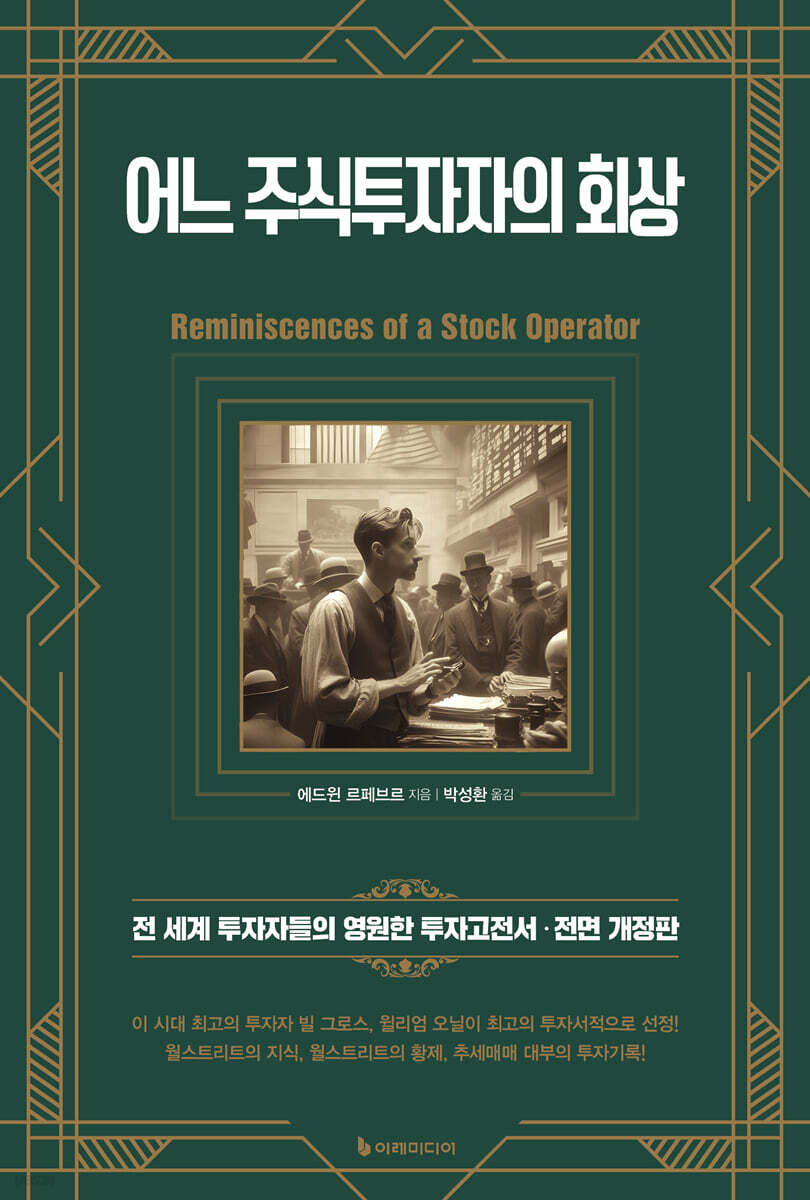
A stock investor's recollections
 |
Description
Book Introduction
This book contains the story of how Jesse Livermore, known as the "Father of Trend Trading" for establishing trend trading, which forms a major axis of today's stock trading techniques along with value investing, developed and applied his own trading techniques in real-life situations that he had to face on a daily basis.
Since the first edition was published in 2005, Jesse Livermore has been receiving a lot of love.
To repay this, we are back with a completely revised edition in 2024.
It has been edited to be more clear and smooth sentences, making it easier to read.
Since the first edition was published in 2005, Jesse Livermore has been receiving a lot of love.
To repay this, we are back with a completely revised edition in 2024.
It has been edited to be more clear and smooth sentences, making it easier to read.
- You can preview some of the book's contents.
Preview
index
Recommendation
Translator's Preface to the Revised Edition
Translator's Preface to the First Edition
01 Started trading stocks at the age of fifteen
02 There is nothing more foolish than trading every day.
03 Win with short-term trading
04 Scammers
05 Chart Fighters
06 San Francisco Earthquake and Premonition
07 Discovery of the pyramiding technique
08 How to scoop up a huge pile of money with a shovel
Become the Emperor of Wall Street for a Day
10. If you are anxious, reduce your holdings.
11 Investor sentiment
12 Never be persuaded
13 You never know until you bet
14 There are times when money pours down like rain when you walk through a storm without an umbrella.
15 Different Ways to Confidential Information
16 Renowned Cartoonist, Rogers' Hat
17 The birth process of the leading state
18. Scolding Insider Traders
19 Stock Manipulators
20 Flexible Thinking
Psychology of the 21st Force
22 Tarantula
23 Investor's Enemy
24. The extent of stock investment
Translator's Preface to the Revised Edition
Translator's Preface to the First Edition
01 Started trading stocks at the age of fifteen
02 There is nothing more foolish than trading every day.
03 Win with short-term trading
04 Scammers
05 Chart Fighters
06 San Francisco Earthquake and Premonition
07 Discovery of the pyramiding technique
08 How to scoop up a huge pile of money with a shovel
Become the Emperor of Wall Street for a Day
10. If you are anxious, reduce your holdings.
11 Investor sentiment
12 Never be persuaded
13 You never know until you bet
14 There are times when money pours down like rain when you walk through a storm without an umbrella.
15 Different Ways to Confidential Information
16 Renowned Cartoonist, Rogers' Hat
17 The birth process of the leading state
18. Scolding Insider Traders
19 Stock Manipulators
20 Flexible Thinking
Psychology of the 21st Force
22 Tarantula
23 Investor's Enemy
24. The extent of stock investment
Detailed image
Into the book
I had to put money on the line to prove whether my judgment was right or wrong.
I learned by losing money.
What I'm saying is that you shouldn't move forward until you're sure there's no need to back down.
When I couldn't move forward, I didn't budge.
That doesn't mean you shouldn't cut your losses even if your predictions are off.
Losses must be managed, but they must not cloud your judgment.
I have made mistakes over and over again throughout my life.
I gained experience by losing money and steadily learned what not to do.
--- p.62
Even when I read stock quotes, I look at factors beyond simple arithmetic.
I call this the stock's behavioral pattern. By consistently observing how the stock price has moved in the past, you can determine whether it will continue to move in that direction or not.
If a stock price deviates from its previous behavior, it is impossible to predict how it will move in the future.
So if the movement is not correct, you should not touch it.
If you can't diagnose, you can't predict, and if you can't predict, you can't make money.
--- p.96
I learned all this very slowly.
Because I learned from making mistakes over and over again.
It usually takes time to realize that you made a mistake, and even after you realize it, it takes more time to analyze it accurately.
But at the time, I was living quite comfortably and was still young, so I made up for my mistakes in other ways.
He made most of his profits by reading stock market charts, a method that worked well in the market conditions of the time.
--- p.110
The moment I heard the news of the unprecedented 10 percent dividend, I realized the painful price I paid for ignoring the voice of experience and listening to the voice of my informant.
It was the price I paid for betraying my own beliefs simply because I was a friend who was selfless and did his job properly, after listening to my skeptical friend.
--- p.128
Since I was a child, I have always found my own meaning in the facts I observed.
The only way to reach meaning was observation.
Since I did not obtain these facts directly through my own observations, I could not discover anything from what others told me.
Don't you? If I believe in something, it's simply because I have to.
If I bought stocks, it was because I judged the market situation to be bullish.
--- p.142
So I said to my friend:
“Go and tell Mr. Blank.
I agree with him, he was fully aware of the gravity of the situation before he sent you away.
“I plan to buy as much stock as possible today without shorting any more.” I kept my promise.
I bought 100,000 shares that day and didn't short sell them for 9 months.
I learned by losing money.
What I'm saying is that you shouldn't move forward until you're sure there's no need to back down.
When I couldn't move forward, I didn't budge.
That doesn't mean you shouldn't cut your losses even if your predictions are off.
Losses must be managed, but they must not cloud your judgment.
I have made mistakes over and over again throughout my life.
I gained experience by losing money and steadily learned what not to do.
--- p.62
Even when I read stock quotes, I look at factors beyond simple arithmetic.
I call this the stock's behavioral pattern. By consistently observing how the stock price has moved in the past, you can determine whether it will continue to move in that direction or not.
If a stock price deviates from its previous behavior, it is impossible to predict how it will move in the future.
So if the movement is not correct, you should not touch it.
If you can't diagnose, you can't predict, and if you can't predict, you can't make money.
--- p.96
I learned all this very slowly.
Because I learned from making mistakes over and over again.
It usually takes time to realize that you made a mistake, and even after you realize it, it takes more time to analyze it accurately.
But at the time, I was living quite comfortably and was still young, so I made up for my mistakes in other ways.
He made most of his profits by reading stock market charts, a method that worked well in the market conditions of the time.
--- p.110
The moment I heard the news of the unprecedented 10 percent dividend, I realized the painful price I paid for ignoring the voice of experience and listening to the voice of my informant.
It was the price I paid for betraying my own beliefs simply because I was a friend who was selfless and did his job properly, after listening to my skeptical friend.
--- p.128
Since I was a child, I have always found my own meaning in the facts I observed.
The only way to reach meaning was observation.
Since I did not obtain these facts directly through my own observations, I could not discover anything from what others told me.
Don't you? If I believe in something, it's simply because I have to.
If I bought stocks, it was because I judged the market situation to be bullish.
--- p.142
So I said to my friend:
“Go and tell Mr. Blank.
I agree with him, he was fully aware of the gravity of the situation before he sent you away.
“I plan to buy as much stock as possible today without shorting any more.” I kept my promise.
I bought 100,000 shares that day and didn't short sell them for 9 months.
--- p.182
Publisher's Review
Larry Livingston, who appears in this book, is a fictional character created by author Edwin Lefevre after interviewing Jesse Livermore, the "King of Wall Street" who dominated the stock market in the first half of the 20th century.
He can be said to be the key code for understanding the modern financial market, because the solution that can easily cut through the seemingly incomprehensible stock market is contained in his investment adversity.
Meet Jesse Livermore, the "Father of Trend Trading"
Jesse Livermore is called the 'father of trend trading' for establishing trend trading, which, along with value investing, forms a major axis of today's stock trading techniques.
The first known trend trader was a man named Dickson Watts.
Jesse Livermore reveals in this book that he was influenced by him.
Even after Jesse Livermore, the trend trading method was used by Gerald M.
Gerld M. Loeb
Loeb), William J.
O'Neill (William J.
O'neil), Ed Seykota, Richard Dennis, etc.
They have maintained a complementary and opposing relationship with so-called value investors, represented by Warren Buffett, and have led one axis of the market.
Revealing the pyramiding technique that functions as an efficient fund management principle and psychological control system.
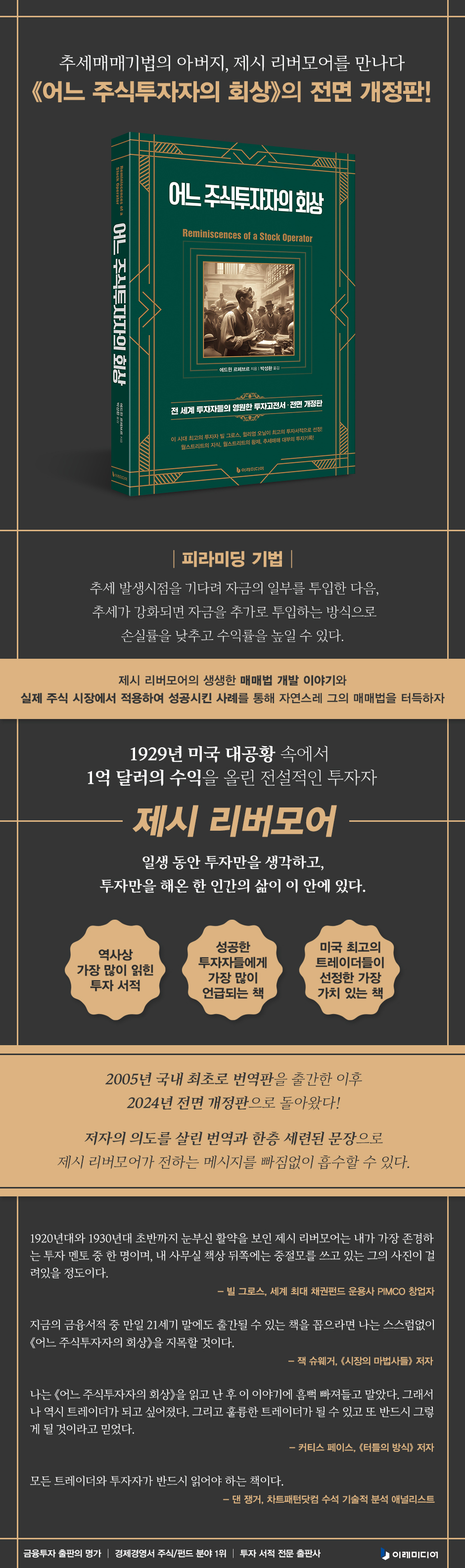
The trend trading method he used was to wait for the start of a trend, invest some of the funds, and then invest more funds when the trend strengthens.
That is, a method of increasing investment funds according to the trend was used, which is called the pyramiding technique.
However, when the trend does not strengthen or a sudden counter-trend movement is observed, a defensive probing strategy is used, in which only a portion of the funds are entered following the trend and then a stop loss is cut.
This trend trading investment technique not only serves as a fund management principle for appropriately allocating investment funds, but also serves as a psychological control system to prevent psychological disturbances such as greed, fear, and anxiety that accompany investment.
It is also an effective way to reduce loss rates and increase returns.
The investment management method, trend trading method, and emotion control method he developed are trading techniques that are still used as powerful weapons today.
Moreover, by directly observing how he developed and applied his trading techniques in the real-life situations he encountered, today's investors will naturally acquire his trading methods by reading the book.
Achieve phenomenal returns regardless of market conditions through trend trading.
The defining event that made him a legendary investor was his massive $100 million profit by building up a wide short position across the market during the Great Depression of 1929.
Even if you calculate his returns since he made about $50,000, his win rate is a whopping 220,000%.
Over the next 15 years, it achieved an average annual return of 66%, which is an incredible achievement considering that even the best investment experts like Warren Buffett achieved annual returns in the 30% range.
Meanwhile, Jesse Livermore was known to the world as a representative bearish figure, nicknamed the "Great Bear of Wall Street," for making a huge amount of money during the Great Deposit Crash of 1907.
However, as you read this book, you will see that he is not a bearish person, but a trend trader who makes profits by trading when a trend is formed, whether it is a bull or bear market.
However, the rumor spread because he made a lot of money in a bear market.
Unlike many investment gurus who were or became institutional investors, he remained a solitary, full-time individual investor his entire life, becoming an idol for individual investors.
This is the best investment book, highly praised by world-class professional traders.
Bill Gross, William O'Neill, Ken Fisher, Jack Schwager, Curtis Pace, Alexander Elder… … .
Besides being widely remembered as legends and heroes of the investment world, they share another important common denominator.
What's more, these professional traders consistently recommend "Memoirs of a Stock Investor" as the best investment book.
Bill Gross, chairman of Pimco, the world's largest bond fund manager, says in his book:
“Jesse Livermore, who was active in the 1920s and early 1930s, is one of my investment mentors and I respect him so much that I even have a picture of him wearing a fedora hanging behind my desk in my office.
He has been a millionaire eight times and has gone bankrupt just as many times.
His book, “Memoirs of a Stock Investor,” is filled with such exquisite writing that it deserves to be called a classic in the investment world.” Indeed, this book has been praised as the bible of stock investment books by investors around the world, and has maintained that reputation to this day.
A vivid portrayal of the stock market, a condensed history of life's ups and downs.
This book depicts the fierce mind games of stock manipulators for profit, and vividly reveals the history of all the incidents and accidents encountered in the jungle-like stock market, such as the bank run, the San Francisco earthquake, the Great Depression, and war.
Through the investment record of one investor who wisely and successfully navigated the arduous path of investing, where he is inevitably swayed by extreme emotions such as fear and joy, anxiety and relief, readers can experience in advance all that can happen in today's stock market or find more practical answers to various problems they are already struggling with.
It is also said that many operational forces used this book as a textbook to learn valuable techniques, as it introduces surprising operational methods based on the protagonist's actual experiences.
By mastering these various techniques, investors will be able to understand and exploit the psychology of the powerful forces, achieving remarkable winning rates.
It's full of gems of trading advice.
"Memoirs of a Stock Investor" is filled with gem-like aphorisms gleaned from the experiences and observations of real investors who dominated the market during their time.
Some of these have become essential elements of "Wall Street lore," such as "The secret to stock investing is to make big profits when your judgment is right," "Never smooth out losses," "The price is never too high to buy or too low to sell short," "It's easier to make millions of dollars knowing how to trade than to make hundreds of dollars without knowing how," and "No one alive can beat the stock market." These are just a few of the many gems readers discover along the way.
Jesse Livermore became known in Korea thanks to the first edition of this book!
The real reason this book has transcended time and been considered a stock investment bible by traders around the world is that it goes beyond the countless proverbs and incredibly influential trading techniques to take investment to a philosophical level.
Iremedia, which recognized the value of this book faster and more accurately than anyone else, published the first translated version in Korea in 2005 and introduced it to readers.
Since its publication, it has received an overwhelming amount of love from readers, and to repay this love, it has returned with a completely revised edition in 2024.
You will be able to absorb Jesse Livermore's message without missing a beat, thanks to a perfect translation that accurately captures the author's intent and a more refined prose.
He can be said to be the key code for understanding the modern financial market, because the solution that can easily cut through the seemingly incomprehensible stock market is contained in his investment adversity.
Meet Jesse Livermore, the "Father of Trend Trading"
Jesse Livermore is called the 'father of trend trading' for establishing trend trading, which, along with value investing, forms a major axis of today's stock trading techniques.
The first known trend trader was a man named Dickson Watts.
Jesse Livermore reveals in this book that he was influenced by him.
Even after Jesse Livermore, the trend trading method was used by Gerald M.
Gerld M. Loeb
Loeb), William J.
O'Neill (William J.
O'neil), Ed Seykota, Richard Dennis, etc.
They have maintained a complementary and opposing relationship with so-called value investors, represented by Warren Buffett, and have led one axis of the market.
Revealing the pyramiding technique that functions as an efficient fund management principle and psychological control system.
The trend trading method he used was to wait for the start of a trend, invest some of the funds, and then invest more funds when the trend strengthens.
That is, a method of increasing investment funds according to the trend was used, which is called the pyramiding technique.
However, when the trend does not strengthen or a sudden counter-trend movement is observed, a defensive probing strategy is used, in which only a portion of the funds are entered following the trend and then a stop loss is cut.
This trend trading investment technique not only serves as a fund management principle for appropriately allocating investment funds, but also serves as a psychological control system to prevent psychological disturbances such as greed, fear, and anxiety that accompany investment.
It is also an effective way to reduce loss rates and increase returns.
The investment management method, trend trading method, and emotion control method he developed are trading techniques that are still used as powerful weapons today.
Moreover, by directly observing how he developed and applied his trading techniques in the real-life situations he encountered, today's investors will naturally acquire his trading methods by reading the book.
Achieve phenomenal returns regardless of market conditions through trend trading.
The defining event that made him a legendary investor was his massive $100 million profit by building up a wide short position across the market during the Great Depression of 1929.
Even if you calculate his returns since he made about $50,000, his win rate is a whopping 220,000%.
Over the next 15 years, it achieved an average annual return of 66%, which is an incredible achievement considering that even the best investment experts like Warren Buffett achieved annual returns in the 30% range.
Meanwhile, Jesse Livermore was known to the world as a representative bearish figure, nicknamed the "Great Bear of Wall Street," for making a huge amount of money during the Great Deposit Crash of 1907.
However, as you read this book, you will see that he is not a bearish person, but a trend trader who makes profits by trading when a trend is formed, whether it is a bull or bear market.
However, the rumor spread because he made a lot of money in a bear market.
Unlike many investment gurus who were or became institutional investors, he remained a solitary, full-time individual investor his entire life, becoming an idol for individual investors.
This is the best investment book, highly praised by world-class professional traders.
Bill Gross, William O'Neill, Ken Fisher, Jack Schwager, Curtis Pace, Alexander Elder… … .
Besides being widely remembered as legends and heroes of the investment world, they share another important common denominator.
What's more, these professional traders consistently recommend "Memoirs of a Stock Investor" as the best investment book.
Bill Gross, chairman of Pimco, the world's largest bond fund manager, says in his book:
“Jesse Livermore, who was active in the 1920s and early 1930s, is one of my investment mentors and I respect him so much that I even have a picture of him wearing a fedora hanging behind my desk in my office.
He has been a millionaire eight times and has gone bankrupt just as many times.
His book, “Memoirs of a Stock Investor,” is filled with such exquisite writing that it deserves to be called a classic in the investment world.” Indeed, this book has been praised as the bible of stock investment books by investors around the world, and has maintained that reputation to this day.
A vivid portrayal of the stock market, a condensed history of life's ups and downs.
This book depicts the fierce mind games of stock manipulators for profit, and vividly reveals the history of all the incidents and accidents encountered in the jungle-like stock market, such as the bank run, the San Francisco earthquake, the Great Depression, and war.
Through the investment record of one investor who wisely and successfully navigated the arduous path of investing, where he is inevitably swayed by extreme emotions such as fear and joy, anxiety and relief, readers can experience in advance all that can happen in today's stock market or find more practical answers to various problems they are already struggling with.
It is also said that many operational forces used this book as a textbook to learn valuable techniques, as it introduces surprising operational methods based on the protagonist's actual experiences.
By mastering these various techniques, investors will be able to understand and exploit the psychology of the powerful forces, achieving remarkable winning rates.
It's full of gems of trading advice.
"Memoirs of a Stock Investor" is filled with gem-like aphorisms gleaned from the experiences and observations of real investors who dominated the market during their time.
Some of these have become essential elements of "Wall Street lore," such as "The secret to stock investing is to make big profits when your judgment is right," "Never smooth out losses," "The price is never too high to buy or too low to sell short," "It's easier to make millions of dollars knowing how to trade than to make hundreds of dollars without knowing how," and "No one alive can beat the stock market." These are just a few of the many gems readers discover along the way.
Jesse Livermore became known in Korea thanks to the first edition of this book!
The real reason this book has transcended time and been considered a stock investment bible by traders around the world is that it goes beyond the countless proverbs and incredibly influential trading techniques to take investment to a philosophical level.
Iremedia, which recognized the value of this book faster and more accurately than anyone else, published the first translated version in Korea in 2005 and introduced it to readers.
Since its publication, it has received an overwhelming amount of love from readers, and to repay this love, it has returned with a completely revised edition in 2024.
You will be able to absorb Jesse Livermore's message without missing a beat, thanks to a perfect translation that accurately captures the author's intent and a more refined prose.
GOODS SPECIFICS
- Date of issue: March 1, 2024
- Page count, weight, size: 448 pages | 662g | 152*225*21mm
- ISBN13: 9791193394229
- ISBN10: 1193394228
You may also like
카테고리
korean


korean

![GQ KOREA Mark (Monthly): December [2025]](http://librairie.coreenne.fr/cdn/shop/files/8ef265dbbfbf186523ed75ba7319009d.jpg?v=1765340328&width=3840)


