

AI 2041
 |
Description
Book Introduction
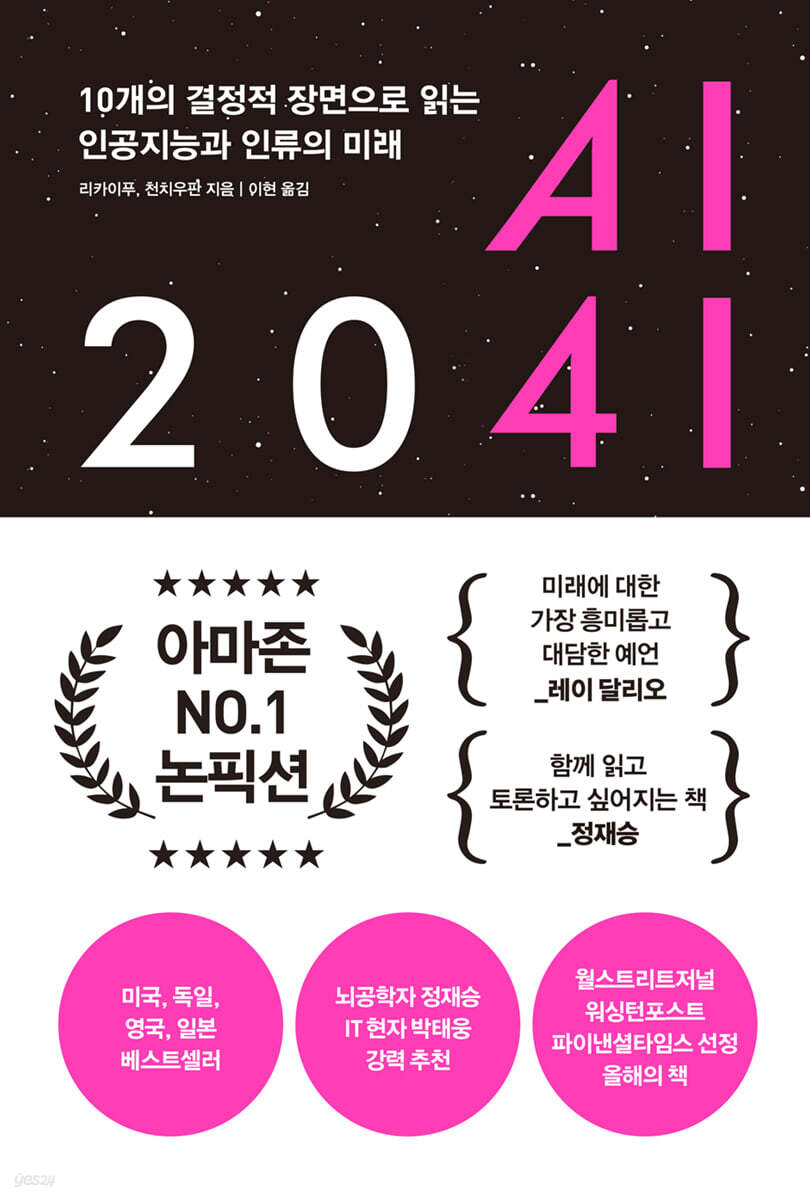
Brain engineer Jeong Jae-seung, IT sage Park Tae-woong, Investment guru Ray Dalio… Highly recommended by leaders in each field! "AI is already a predetermined future." Immediately after AlphaGo's victory over Lee Sedol, the public was shocked, saying that the era in which artificial intelligence dominates humanity had arrived. Professor Kim Dae-sik of KAIST warned that we must prepare for a future where half of today's jobs will disappear in 20 years, saying, "I saw what we will be like 20 years from now in the bewildered face of 9-dan Lee Se-dol." On the other hand, the late Lee Eo-ryeong warned against excessive AI phobia, saying, “It was just a fight between a database, that is, 1,000 professional players, and a trained opponent, and they lost.” And now, how much has AI truly transformed our present and future? As AI continues to develop and be applied in even greater ways, what kind of future will unfold? The two authors of "AI 2041," which drew attention from leaders and readers worldwide even before its publication for its fresh approach and bold analysis, offer a precise vision for AI, addressing both our curiosity and fears about the future. ***** Amazon's No. 1 Nonfiction ***** Bestseller in the US, Germany, UK, and Japan ***** Book of the Year by the Wall Street Journal, Washington Post, and Financial Times |
- You can preview some of the book's contents.
Preview
index
introduction
The Real Story of Artificial Intelligence_Kai-Fu Lee
Imagination creates the real world_Cheon Chi-woo-pan
Chapter 1: The Golden Elephant
Negative Externalities of Deep Learning in Technical Analysis and Solutions
Chapter 2 The God Behind the Mask
Technical Analysis: Another Technique to Combat Malicious Deepfakes
Chapter 3: Twin Sparrows
The Present and Future of Natural Language-Based Artificial Intelligence in Technical Analysis
Chapter 4: Love Without Contact
Technology Analysis: Artificial Intelligence in Healthcare
Chapter 5: The Idol Star Who Became a Ghost
Ethical and Social Issues of Extended Reality in Technology Analysis
Chapter 6 The Holy Driver
Technology Analysis: Will the era of fully autonomous vehicles arrive?
Chapter 7: Quantum Massacre
Technology Analysis: The Dangerous Future of Quantum Computing and Autonomous Weapons
Chapter 8: The Story of the Savior
Technology Analysis: A Solution to Job Loss Caused by AI
Chapter 9: The Island of Happiness
Questions about happiness posed by AI in technical analysis
Chapter 10: Dreaming of Abundance
Technical Analysis: New Economic Models and the Future of Abundance
Acknowledgements
The Real Story of Artificial Intelligence_Kai-Fu Lee
Imagination creates the real world_Cheon Chi-woo-pan
Chapter 1: The Golden Elephant
Negative Externalities of Deep Learning in Technical Analysis and Solutions
Chapter 2 The God Behind the Mask
Technical Analysis: Another Technique to Combat Malicious Deepfakes
Chapter 3: Twin Sparrows
The Present and Future of Natural Language-Based Artificial Intelligence in Technical Analysis
Chapter 4: Love Without Contact
Technology Analysis: Artificial Intelligence in Healthcare
Chapter 5: The Idol Star Who Became a Ghost
Ethical and Social Issues of Extended Reality in Technology Analysis
Chapter 6 The Holy Driver
Technology Analysis: Will the era of fully autonomous vehicles arrive?
Chapter 7: Quantum Massacre
Technology Analysis: The Dangerous Future of Quantum Computing and Autonomous Weapons
Chapter 8: The Story of the Savior
Technology Analysis: A Solution to Job Loss Caused by AI
Chapter 9: The Island of Happiness
Questions about happiness posed by AI in technical analysis
Chapter 10: Dreaming of Abundance
Technical Analysis: New Economic Models and the Future of Abundance
Acknowledgements
Detailed image

Into the book
Now we must think about the future that artificial intelligence will pioneer.
I lecture on artificial intelligence around the world, and I constantly hear the question, “What’s next?”
What will happen in the next five, ten, twenty years? What kind of future will humanity face? These are crucial questions for all of us living in this era.
Most experts in the technology field will have an opinion on that.
Some people believe that artificial intelligence is a 'bubble' that will eventually collapse or lose its enthusiasm.
Those with more extreme, dystopian views accept as fact all sorts of dark scenarios, from predictions that AI giants will eventually take over the human mind and create a utopian new species of "human cyborgs" to predictions that AI will ultimately lead to the destruction of humanity.
Most of these predictions, which may have originated from pure curiosity or fear, are merely conjecture and exaggerated.
Crucially, we are missing the big picture that AI will accomplish.
--- p.7~8
I believe that the greatest utility of science fiction lies not in providing answers, but in raising questions.
I hope that after reading this book, many new questions will arise.
In the future, will AI be able to eradicate infectious diseases and prevent the recurrence of global pandemics? How will we address future job challenges? How will we maintain cultural diversity in a machine-driven world? How will we teach children how to live in a society where humans and machines coexist? Many other questions will arise.
I hope that readers' questions will help us visualize a happier and brighter future and get us one step closer to that future.
--- p.19
Despite its tremendous benefits, deep learning faces serious public distrust due to the various side effects it produces.
But in fact, all new technologies have drawbacks.
Looking at past history, the errors in new technologies at the time of their introduction have been improved or supplemented over time.
Think of circuit breakers to prevent electrocution and antivirus software to prevent computer viruses.
I am confident that there are technological and policy solutions to address the powerful influence of AI, the problems posed by bias, unfairness, and incomprehensible algorithms.
--- p.58
Until we have a long-term solution based on blockchain or a comparable technology, we can only expect that the technologies and tools to monitor deepfakes will continue to evolve.
Additionally, laws should be enacted to severely punish malicious deepfakes to deter potential criminals.
In 2019, the US state of California passed a law banning the use of deepfakes in pornography and the manipulation of videos of political candidates ahead of elections.
Finally, we may have to learn to live in a new world where we must always verify the authenticity of online content, no matter how authentic it may seem (until blockchain solutions are implemented).
--- p.93
One of the most exciting aspects of GPT-3's potential is that it could serve as a new platform for rapidly developing NLP applications.
In fact, in the months since GPT-3 was released, people have developed many applications for it.
For example, there are chatbots that can converse with historical figures, composition tools that can finish a guitar score you've started, and applications that can create a complete image from half an image.
There is also an application called DALL.E that can draw people based on natural language descriptions (e.g., a baby in a ballet outfit walking a dog).
While these applications are currently merely a curiosity, once the aforementioned flaws are addressed, platforms like GPT-3 could create a virtuous cycle where tens of thousands of developers create compelling applications that attract more users.
Just like Windows and Android.
--- p.152
Even complex surgeries that rely on sophisticated judgment and dexterity will become increasingly automated over time.
Robot-assisted surgeries accounted for 1.8% of all surgeries in 2012, but increased to 15.1% in 2018.
At the same time, robots can now perform semi-autonomous surgeries such as colonoscopy, suturing, intestinal anastomosis, and dental implants under the supervision of a doctor.
Based on these trends, it is estimated that in 20 years, robots will be involved in all surgeries and will play an increasing role in autonomous surgery.
Finally, medical nanobots will emerge, giving us countless capabilities that surpass those of doctors.
Miniature robots measuring 1 to 10 nanometers could repair damaged cells, fight cancer, correct genetic defects, and replace DNA molecules to combat disease.
I lecture on artificial intelligence around the world, and I constantly hear the question, “What’s next?”
What will happen in the next five, ten, twenty years? What kind of future will humanity face? These are crucial questions for all of us living in this era.
Most experts in the technology field will have an opinion on that.
Some people believe that artificial intelligence is a 'bubble' that will eventually collapse or lose its enthusiasm.
Those with more extreme, dystopian views accept as fact all sorts of dark scenarios, from predictions that AI giants will eventually take over the human mind and create a utopian new species of "human cyborgs" to predictions that AI will ultimately lead to the destruction of humanity.
Most of these predictions, which may have originated from pure curiosity or fear, are merely conjecture and exaggerated.
Crucially, we are missing the big picture that AI will accomplish.
--- p.7~8
I believe that the greatest utility of science fiction lies not in providing answers, but in raising questions.
I hope that after reading this book, many new questions will arise.
In the future, will AI be able to eradicate infectious diseases and prevent the recurrence of global pandemics? How will we address future job challenges? How will we maintain cultural diversity in a machine-driven world? How will we teach children how to live in a society where humans and machines coexist? Many other questions will arise.
I hope that readers' questions will help us visualize a happier and brighter future and get us one step closer to that future.
--- p.19
Despite its tremendous benefits, deep learning faces serious public distrust due to the various side effects it produces.
But in fact, all new technologies have drawbacks.
Looking at past history, the errors in new technologies at the time of their introduction have been improved or supplemented over time.
Think of circuit breakers to prevent electrocution and antivirus software to prevent computer viruses.
I am confident that there are technological and policy solutions to address the powerful influence of AI, the problems posed by bias, unfairness, and incomprehensible algorithms.
--- p.58
Until we have a long-term solution based on blockchain or a comparable technology, we can only expect that the technologies and tools to monitor deepfakes will continue to evolve.
Additionally, laws should be enacted to severely punish malicious deepfakes to deter potential criminals.
In 2019, the US state of California passed a law banning the use of deepfakes in pornography and the manipulation of videos of political candidates ahead of elections.
Finally, we may have to learn to live in a new world where we must always verify the authenticity of online content, no matter how authentic it may seem (until blockchain solutions are implemented).
--- p.93
One of the most exciting aspects of GPT-3's potential is that it could serve as a new platform for rapidly developing NLP applications.
In fact, in the months since GPT-3 was released, people have developed many applications for it.
For example, there are chatbots that can converse with historical figures, composition tools that can finish a guitar score you've started, and applications that can create a complete image from half an image.
There is also an application called DALL.E that can draw people based on natural language descriptions (e.g., a baby in a ballet outfit walking a dog).
While these applications are currently merely a curiosity, once the aforementioned flaws are addressed, platforms like GPT-3 could create a virtuous cycle where tens of thousands of developers create compelling applications that attract more users.
Just like Windows and Android.
--- p.152
Even complex surgeries that rely on sophisticated judgment and dexterity will become increasingly automated over time.
Robot-assisted surgeries accounted for 1.8% of all surgeries in 2012, but increased to 15.1% in 2018.
At the same time, robots can now perform semi-autonomous surgeries such as colonoscopy, suturing, intestinal anastomosis, and dental implants under the supervision of a doctor.
Based on these trends, it is estimated that in 20 years, robots will be involved in all surgeries and will play an increasing role in autonomous surgery.
Finally, medical nanobots will emerge, giving us countless capabilities that surpass those of doctors.
Miniature robots measuring 1 to 10 nanometers could repair damaged cells, fight cancer, correct genetic defects, and replace DNA molecules to combat disease.
--- p.206
Publisher's Review
Humanity and AI at a Critical Turning Point
How is AI changing the future of humanity?
Artificial intelligence has already reached a tipping point.
It has reached a level where it can predict up to 90% of the 'protein folding structure', which was a long-standing mystery in the field of biology, and artificial intelligence has surpassed human capabilities in speech recognition and object recognition, giving rise to digital humans that are eerily human-like in appearance and speech.
He has demonstrated exceptional intellectual ability by passing the college entrance exam and the specialist licensing exam, has shown that he can make decisions much more fair and objective than a judge, and has demonstrated skills that are superior to those of a radiologist in diagnosing lung cancer.
Self-driving cars driving on highways are also part of our future, made possible by artificial intelligence.
But those with more extreme views accept as fact all sorts of dark scenarios: self-driving cars killing pedestrians, tech companies and politicians using AI to influence elections, or spreading fake news and deepfakes.
And when such things actually happen, it makes us anxious.
Kaifu Lee, author of "AI 2041," who has worked on AI research and product development at Microsoft, Google, and Apple, and Qiufan Chen, a science fiction writer whose debut work has created a sensation, say it's important to closely examine and pay attention to various aspects of AI development, but at the same time, see the technology's potential and the big picture.
This is because only then can we strike a balance between all the worries and concerns about artificial intelligence and the future of humanity.
This book, which combines ten exciting science fiction novels set in various parts of the world, including Korea, Japan, and India, with sharp technological analysis from an AI expert, serves as the most accurate prediction and scenario for the near future we will soon face.
The perfect fusion of science and fiction!
Reading through 10 decisive scenes
Artificial Intelligence and the Future of Humanity
This book, which shows how artificial intelligence could transform human society in the near future in fields such as medicine, education, entertainment, employment, and finance, raises new questions.
Can AI eradicate infectious diseases and prevent another global pandemic? How can cultural diversity be maintained in a machine-driven world? What will become of those whose jobs are taken away by AI? And ultimately, we will reach the following questions:
“Can artificial intelligence coexist with humans?”
This question, which has inspired countless works of popular culture, including science fiction novels and movies, is answered by ChatGPT, a conversational AI that was used by 1 million people in just 5 days since its launch.
“Artificial intelligence can coexist with humans, but it is difficult to predict what kind of relationship will emerge when artificial intelligence and humans coexist.
…what kind of relationship will emerge when AI and humans coexist will depend on how we utilize AI and how humans and AI live together.”
The two authors answer the same question through the voices of characters in the short story "The Golden Elephant," which explores the negative externalities of deep learning and how to find solutions.
“Some risks are worth taking.” We must first learn to imagine all the futures we want to create.
This book will be the beginning of that imagination.
How is AI changing the future of humanity?
Artificial intelligence has already reached a tipping point.
It has reached a level where it can predict up to 90% of the 'protein folding structure', which was a long-standing mystery in the field of biology, and artificial intelligence has surpassed human capabilities in speech recognition and object recognition, giving rise to digital humans that are eerily human-like in appearance and speech.
He has demonstrated exceptional intellectual ability by passing the college entrance exam and the specialist licensing exam, has shown that he can make decisions much more fair and objective than a judge, and has demonstrated skills that are superior to those of a radiologist in diagnosing lung cancer.
Self-driving cars driving on highways are also part of our future, made possible by artificial intelligence.
But those with more extreme views accept as fact all sorts of dark scenarios: self-driving cars killing pedestrians, tech companies and politicians using AI to influence elections, or spreading fake news and deepfakes.
And when such things actually happen, it makes us anxious.
Kaifu Lee, author of "AI 2041," who has worked on AI research and product development at Microsoft, Google, and Apple, and Qiufan Chen, a science fiction writer whose debut work has created a sensation, say it's important to closely examine and pay attention to various aspects of AI development, but at the same time, see the technology's potential and the big picture.
This is because only then can we strike a balance between all the worries and concerns about artificial intelligence and the future of humanity.
This book, which combines ten exciting science fiction novels set in various parts of the world, including Korea, Japan, and India, with sharp technological analysis from an AI expert, serves as the most accurate prediction and scenario for the near future we will soon face.
The perfect fusion of science and fiction!
Reading through 10 decisive scenes
Artificial Intelligence and the Future of Humanity
This book, which shows how artificial intelligence could transform human society in the near future in fields such as medicine, education, entertainment, employment, and finance, raises new questions.
Can AI eradicate infectious diseases and prevent another global pandemic? How can cultural diversity be maintained in a machine-driven world? What will become of those whose jobs are taken away by AI? And ultimately, we will reach the following questions:
“Can artificial intelligence coexist with humans?”
This question, which has inspired countless works of popular culture, including science fiction novels and movies, is answered by ChatGPT, a conversational AI that was used by 1 million people in just 5 days since its launch.
“Artificial intelligence can coexist with humans, but it is difficult to predict what kind of relationship will emerge when artificial intelligence and humans coexist.
…what kind of relationship will emerge when AI and humans coexist will depend on how we utilize AI and how humans and AI live together.”
The two authors answer the same question through the voices of characters in the short story "The Golden Elephant," which explores the negative externalities of deep learning and how to find solutions.
“Some risks are worth taking.” We must first learn to imagine all the futures we want to create.
This book will be the beginning of that imagination.
GOODS SPECIFICS
- Date of issue: January 9, 2023
- Page count, weight, size: 528 pages | 832g | 152*225*32mm
- ISBN13: 9791157846405
- ISBN10: 1157846408
You may also like
카테고리
korean


korean

![GQ KOREA Mark (Monthly): December [2025]](http://librairie.coreenne.fr/cdn/shop/files/8ef265dbbfbf186523ed75ba7319009d.jpg?v=1765340328&width=3840)


