

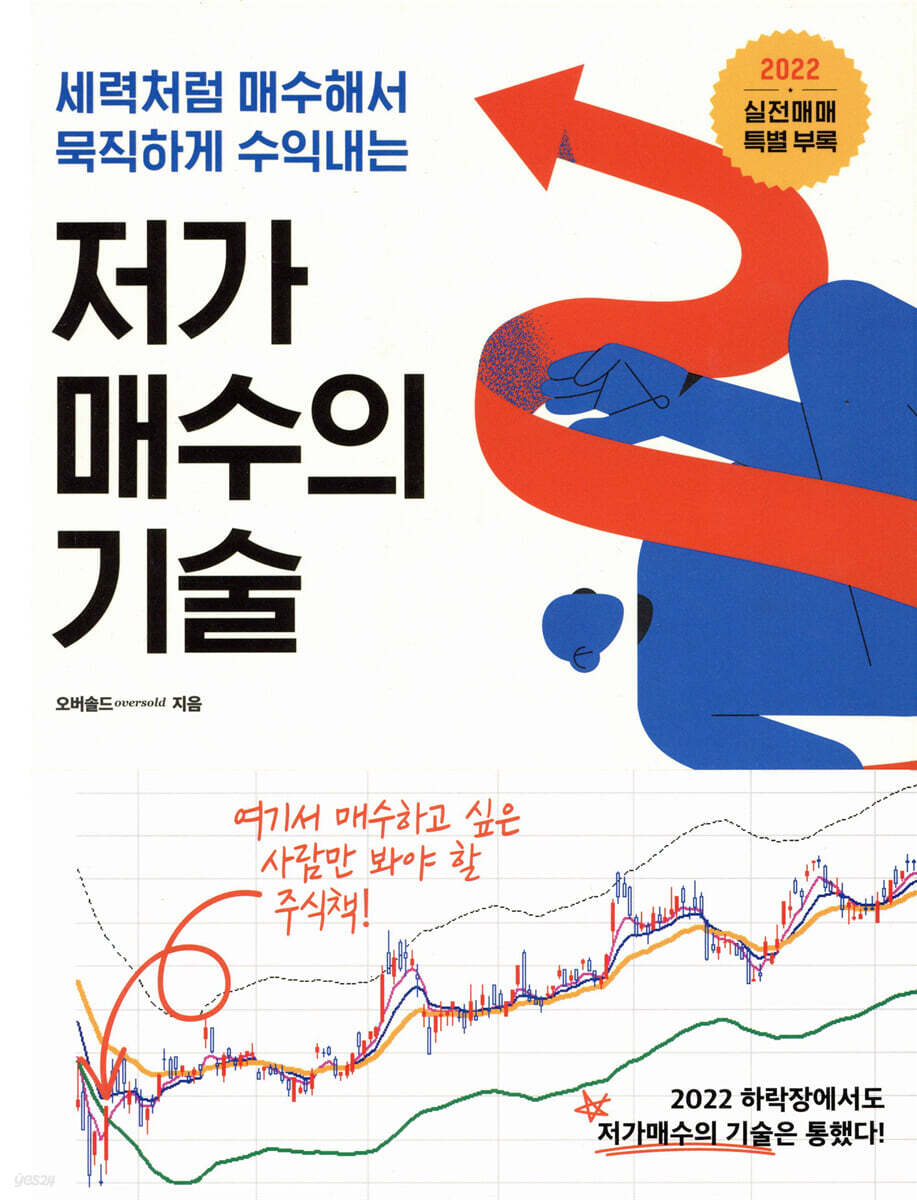
The art of buying low
 |
Description
Book Introduction
The revised edition of "The Art of Buying Low Prices and Earning Steady Profits by Buying Like a Powerhouse," which was published in 2021 and has been consistently loved by readers, has been released.
This revised edition includes a special appendix, "2022 Practical Appendix - The Technique of Buying Low Prices Worked Even in a Bear Market," which explains how the book's "Budget Buying Technique" performed well even in the challenging 2022 bear market.
"The Art of Buying Low and Earning Steady Profits Like a Powerhouse" introduces the "buying low" investment technique, which allows beginners to generate steady and substantial profits simply by looking at the stock market once a day.
This book provides a detailed, practical method for determining optimal buy and sell timing by reading the psychology of stock traders, especially the intentions of the "forces" that shape and manage stock prices, based on technical analysis of four auxiliary indicators: the exponential moving average, envelope, RSI, and MACD.
This is a very stable investment technique that aims to minimize losses by purchasing at the low price point everyone fears, manage risk through weight adjustments and split purchases, actively utilize auxiliary indicators as a means to maximize profits, and achieve compounding effects by generating steady profits rather than one-time profits.
This book will help you correct the bad trading habits of retail investors who buy out of desire and sell out of fear without clear principles or standards of their own, only to end up losing money every time. It will also teach you a reliable method for investing in stocks that will allow you to enjoy it for a lifetime without major failures.
This revised edition includes a special appendix, "2022 Practical Appendix - The Technique of Buying Low Prices Worked Even in a Bear Market," which explains how the book's "Budget Buying Technique" performed well even in the challenging 2022 bear market.
"The Art of Buying Low and Earning Steady Profits Like a Powerhouse" introduces the "buying low" investment technique, which allows beginners to generate steady and substantial profits simply by looking at the stock market once a day.
This book provides a detailed, practical method for determining optimal buy and sell timing by reading the psychology of stock traders, especially the intentions of the "forces" that shape and manage stock prices, based on technical analysis of four auxiliary indicators: the exponential moving average, envelope, RSI, and MACD.
This is a very stable investment technique that aims to minimize losses by purchasing at the low price point everyone fears, manage risk through weight adjustments and split purchases, actively utilize auxiliary indicators as a means to maximize profits, and achieve compounding effects by generating steady profits rather than one-time profits.
This book will help you correct the bad trading habits of retail investors who buy out of desire and sell out of fear without clear principles or standards of their own, only to end up losing money every time. It will also teach you a reliable method for investing in stocks that will allow you to enjoy it for a lifetime without major failures.
- You can preview some of the book's contents.
Preview
index
preface
1 Why Stocks Are Biting: Mental Health Checkups Before Investing
Being impatient with small gains and losses: the habit of evaluating trades by monetary value.
Lack of control over time: a trading addiction that requires constant buying and selling.
Buying unmanaged stocks: Investing in a variety of stores, not diversifying.
Constantly changing trading techniques: trading habits without principles
No selling principles: no habit of taking profits
No buying principles 1: Investment habits that don't know how to adjust weighting
No Principle of Buying 2: Investment Habits That Don't Know How to Buy in Splits
2 How the Stock Market Works: Basic Stock Investing Prerequisites for Buying at Dip Points
Time solves many problems.
Every stock has an owner who manages it.
Stocks rise
Stock prices rise and fall
Stock prices rise and fall around the baseline.
Stock prices rise and fall at regular intervals.
Stock prices rise and fall in trends.
When the direction changes, a reference bar appears.
There are other places where you can make money.
Buy in fear, sell in hope
You don't live on your knees, you make your knees.
A specific point must be passed to move higher: a breakout of the previous high.
If the previous low is broken, it is a decline.
You win by standing on the side of the powerful.
3 Technical Analysis of Stock Investments for Buying at the Bottom
What the completion of a candle means
What a bee candle means
Buying intervention point after low-price candlestick
Don't buy while it's coming down, buy when it's all over
Profit taking through technical analysis: Sell points
Understanding beekeeping reveals the turning point.
4 What Moving Averages Really Mean
Trading based on beekeeping is trading based on absolute standards.
What is a moving average?
The Psychology of Candlesticks and Moving Averages: The Meaning of Moving Averages I
The Psychology of Moving Averages: The Meaning of Moving Averages II
The True Meaning of the Moving Average Golden Cross
Dead Cross: The Period When You Should Never Buy: The Meaning of Moving Averages III
Setting the TIP BOX moving average line
Practical Moving Average Buying Timing: Patterns Implying a Golden Cross
Creating a TIP BOX conditional search expression
Reliability increases over longer timescales.
Trading timing on a lower time axis for short-term traders
5 10% profit capture: envelope
Moving average and envelope indicators
TIP BOX Envelope Indicator Settings: Based on Daily Chart
Real-world envelope buy/sell timing
Creating a TIP BOX conditional search expression
Reliability increases over longer timescales.
6. Catch the 3-week low: RSI
Using the RSI indicator
TIP BOX RSI indicator settings: Daily chart basis
Real-world RSI buy and sell timing
Creating a TIP BOX conditional search expression
Reliability increases over longer timescales.
7 Maximize Profits, Eat the Trend to the End: MACD
Using MACD
TIP BOX MACD indicator settings: Based on daily chart
Real-world MACD buy and sell timing
Creating a TIP BOX conditional search expression
Reliability increases over longer timescales.
2022 Practical Trading Techniques Case Study
- The technique of buying at low prices worked even in a bear market.
Conclusion
1 Why Stocks Are Biting: Mental Health Checkups Before Investing
Being impatient with small gains and losses: the habit of evaluating trades by monetary value.
Lack of control over time: a trading addiction that requires constant buying and selling.
Buying unmanaged stocks: Investing in a variety of stores, not diversifying.
Constantly changing trading techniques: trading habits without principles
No selling principles: no habit of taking profits
No buying principles 1: Investment habits that don't know how to adjust weighting
No Principle of Buying 2: Investment Habits That Don't Know How to Buy in Splits
2 How the Stock Market Works: Basic Stock Investing Prerequisites for Buying at Dip Points
Time solves many problems.
Every stock has an owner who manages it.
Stocks rise
Stock prices rise and fall
Stock prices rise and fall around the baseline.
Stock prices rise and fall at regular intervals.
Stock prices rise and fall in trends.
When the direction changes, a reference bar appears.
There are other places where you can make money.
Buy in fear, sell in hope
You don't live on your knees, you make your knees.
A specific point must be passed to move higher: a breakout of the previous high.
If the previous low is broken, it is a decline.
You win by standing on the side of the powerful.
3 Technical Analysis of Stock Investments for Buying at the Bottom
What the completion of a candle means
What a bee candle means
Buying intervention point after low-price candlestick
Don't buy while it's coming down, buy when it's all over
Profit taking through technical analysis: Sell points
Understanding beekeeping reveals the turning point.
4 What Moving Averages Really Mean
Trading based on beekeeping is trading based on absolute standards.
What is a moving average?
The Psychology of Candlesticks and Moving Averages: The Meaning of Moving Averages I
The Psychology of Moving Averages: The Meaning of Moving Averages II
The True Meaning of the Moving Average Golden Cross
Dead Cross: The Period When You Should Never Buy: The Meaning of Moving Averages III
Setting the TIP BOX moving average line
Practical Moving Average Buying Timing: Patterns Implying a Golden Cross
Creating a TIP BOX conditional search expression
Reliability increases over longer timescales.
Trading timing on a lower time axis for short-term traders
5 10% profit capture: envelope
Moving average and envelope indicators
TIP BOX Envelope Indicator Settings: Based on Daily Chart
Real-world envelope buy/sell timing
Creating a TIP BOX conditional search expression
Reliability increases over longer timescales.
6. Catch the 3-week low: RSI
Using the RSI indicator
TIP BOX RSI indicator settings: Daily chart basis
Real-world RSI buy and sell timing
Creating a TIP BOX conditional search expression
Reliability increases over longer timescales.
7 Maximize Profits, Eat the Trend to the End: MACD
Using MACD
TIP BOX MACD indicator settings: Based on daily chart
Real-world MACD buy and sell timing
Creating a TIP BOX conditional search expression
Reliability increases over longer timescales.
2022 Practical Trading Techniques Case Study
- The technique of buying at low prices worked even in a bear market.
Conclusion
Detailed image

Publisher's Review
#'Why Are Ants Biting into Stocks?' A Thorough Analysis
Most stock investors are always in a 'bite' state, with their funds tied up in a particular stock and unable to buy or sell.
Why do retail investors always get bitten?
First, the profit and loss are evaluated based on the amount.
If you evaluate your profits and losses in monetary terms, you will lose your composure and rush to cut your losses even if the stock price falls slightly, and even if the stock price rises by luck, you will not be able to hold on to your profits until the end.
When investing in stocks, you must develop the habit of evaluating it in percentages, not in monetary terms.
Second, if you stay still, it feels like you're not doing anything, so you keep buying and selling.
However, waiting without buying is also an active investment, and the core of stock investment is to make profits by taking advantage of an upward trend in return for 'investing time' while waiting for the timing for the decline to end and the price to turn upward.
“Investing isn’t about buying, it’s about waiting for the right moment to buy.” Third, there’s no limit to the number of stocks you can trade.
Beginner investors chase and buy rising stocks and accumulate stocks recommended by experts, but the number of stocks they own quickly exceeds the limit of what they can focus on.
They try to console themselves by saying that they are diversifying their investments by looking at the numerous stocks they hold, but in reality, they are investing in a general store without any principles, and if the market is shocked, there is a high risk that all of their holdings will decline.
Untrained and novice investors should never arbitrarily increase their holdings in unmanaged stocks.
Fourth, keep changing your trading techniques.
If you blindly follow the various investment techniques taught by stock experts on various stock broadcasts and YouTube, but fail, you will soon switch to another method, and as you experiment with this and that, your account will be wiped out.
This is particularly dangerous because it can be easy to blame others for your losses rather than taking responsibility for them.
Just think of how many failures many experts have had to experience before they arrived at their own unique investment techniques.
The author of this book advises, “Put one method through to the end until you master it without wavering.”
Trading habits without principles are a surefire way to ruin. This book aims to help readers establish their own trading principles. That principle is "buying at low prices."
#Read the intentions of the powers that be and buy at a low price.
In order for a stock price to rise, there must be a movement to continuously receive selling orders from individuals over a certain period of time and then buy them back at a higher price.
It is impossible for individual investors to use such large financial power to move stock prices in the direction they want; only 'powers' such as foreigners and institutional investors can do so.
We, the retail investors, can make profits by buying and selling in step with the forces that change the direction of the stock price.
In other words, we are not making a profit, but rather taking a small portion of the profits made by the powerful.
Stock prices are ultimately determined by forces, and you should carefully observe the flow of these forces to determine the timing of your purchases.
Those who control stock prices must secure as much stock as possible to maximize profits, so they sometimes try to seize the stocks held by retail investors by coaxing and cajoling them, and sometimes even scaring them.
By creating a situation where the price temporarily rises sharply and attracts buying power, a situation where the price falls sharply is created to induce a stop loss and secure volume.
The low price zone is the period in which the powerful buy stocks while planning to raise the stock price in the future.
If we can anticipate the movements of these forces in a particular stock before others and purchase them at low prices like a powerful force, we can comfortably watch the stock price move while riding high prices where the powerful force realizes profits.
Low-price zones are usually places where ordinary investors find it difficult to enter rashly for fear of further decline.
The low price zone is also called the 'oversold zone', which means that many people have sold the stock and left because they believe that the stock has no future.
But this means that, conversely, 'someone' has been receiving and accumulating those stocks over time, and most profits are generated at this point.
The stock market adage, "Don't catch a falling knife," is true, but even falling knives eventually hit the ground.
The low price this book is talking about is not the sword in the middle of falling, but the point at which the sword touches the ground.
#4 auxiliary indicators to identify low-price buying opportunities.
How do we know when the sword hits the bottom? This is like asking where the stock price begins to rise (at the end of a decline = at the beginning of an uptrend) and where it begins to fall (at the end of an uptrend = at the beginning of a downtrend).
This book uses technical analysis of four auxiliary indicators—the exponential moving average, envelope, RSI, and MACD—as criteria for determining whether stock prices are rising or falling.
A moving average is a line that connects the average closing prices over a specific period of time. If a bullish candle breaks through the falling 5- and 10-moving averages, or a bullish candle occurs along with a golden cross of the 5- and 10-moving averages, it can be interpreted that a force is now intervening to move the stock price upward.
The envelope is a representative indicator of channel trading that uses the property of stock prices to oscillate above and below a specific moving average line to set arbitrary upper and lower lines and use them as a reference.
If a bearish or bullish candlestick breaks below the -10% level of the 20-day moving average, it indicates a low has formed in the stock price movement over the past month, and you can buy in anticipation of a short-term rebound. The RSI is an indicator that indicates the strength of a stock's ups and downs over a 14-day period, and an RSI oversold zone is the most reliable indicator of a low.
For blue-chip stocks, RSI oversold territory presents a rare golden buying opportunity. By examining the trends indicated by the MACD in addition to the RSI, you can achieve even greater profits. The MACD, when the exponential moving averages form golden and death crosses, allows you to anticipate the continuation of an uptrend or downtrend. It is primarily used as a supplementary tool to maximize profits by fully exploiting an uptrend.
This book explains these four indicators in more detail and in a more friendly way than anywhere else before.
Auxiliary indicators are often undervalued as 'lagging indicators' that are created after the stock price has moved.
However, the rising and falling signals these auxiliary indicators show can also be seen as confirmation that 'someone' has already successfully completed the work to make such signals possible.
In other words, auxiliary indicators are useful tools that allow us to objectively examine the psychology of stock traders (especially powerful people) involved in a given stock by visualizing it.
By understanding the precise meaning of these indicators through the explanations in this book, you will no longer repeat the mistakes of trading based on mood and incurring losses from ambiguous positions. Instead, you will be able to firmly establish your mind, which swings between fear and hope, and trade without being swayed by any temptation, relying on technical analysis of auxiliary indicators.
Even beginner investors can achieve stable profits by intervening in the closing price once a day.
There are three main timings for making money with stocks.
Buying while the price is rising rapidly is the domain of experts, buying during a brief pause after a steady rise is the domain of intermediate investors, and buying when the stock price has almost finished falling is the domain of our retail investors and the 'buy at a low price' strategy recommended in this book.
As short-term trading and high-priced stocks become more complex, numerous variables arise, making it difficult for untrained novice investors to respond appropriately.
For mid- to long-term traders who trade only at the closing price once a day, rather than full-time traders who watch the stock market all day, the low price range is a relatively safe zone where they do not have to worry too much about fluctuations and where various risks related to declines are eliminated.
Additionally, by combining four auxiliary indicators, we can capture the optimal timing for buying at low prices with a high probability.
In fact, the four auxiliary indicators can be used much more meaningfully in medium- to long-term trading on a timeframe longer than daily trading.
This book doesn't introduce specialized investment techniques like day trading or short-term trading, but rather introduces effective methods for novice investors, such as office workers, housewives, and students, to generate stable profits through medium- to long-term trading by intervening in the stock market once a day.
The basic principle is to buy at the low price created by the powerful, and the specific method of capturing that timing is technical analysis using four objective auxiliary indicators that exclude personal desires and emotions.
This book not only explains in detail the true meaning of four auxiliary indicators that most stock investors think they already know well but in fact only know superficially, but also explains in an easy-to-understand way even for novice investors how to read the psychology of traders in various situations revealed in each chart and candlestick through auxiliary indicators, how to identify the point when a powerful force is accumulating and digesting volume by the appearance of a bullish candlestick on a continuous line of a chart, how to create knees and determine shoulders, and how to manage risk through weight adjustment and split purchase.
In particular, each auxiliary indicator is explained conceptually, and by using over 180 extensive real-world case charts, it helps with concrete understanding and can be used as a model for future reference in actual trading.
Additionally, it provides step-by-step instructions for individual investors on how to set up four auxiliary indicators and create conditional search formulas in HTS and MTS, helping anyone easily customize auxiliary indicators and perform real-time searches.
Most stock investors are always in a 'bite' state, with their funds tied up in a particular stock and unable to buy or sell.
Why do retail investors always get bitten?
First, the profit and loss are evaluated based on the amount.
If you evaluate your profits and losses in monetary terms, you will lose your composure and rush to cut your losses even if the stock price falls slightly, and even if the stock price rises by luck, you will not be able to hold on to your profits until the end.
When investing in stocks, you must develop the habit of evaluating it in percentages, not in monetary terms.
Second, if you stay still, it feels like you're not doing anything, so you keep buying and selling.
However, waiting without buying is also an active investment, and the core of stock investment is to make profits by taking advantage of an upward trend in return for 'investing time' while waiting for the timing for the decline to end and the price to turn upward.
“Investing isn’t about buying, it’s about waiting for the right moment to buy.” Third, there’s no limit to the number of stocks you can trade.
Beginner investors chase and buy rising stocks and accumulate stocks recommended by experts, but the number of stocks they own quickly exceeds the limit of what they can focus on.
They try to console themselves by saying that they are diversifying their investments by looking at the numerous stocks they hold, but in reality, they are investing in a general store without any principles, and if the market is shocked, there is a high risk that all of their holdings will decline.
Untrained and novice investors should never arbitrarily increase their holdings in unmanaged stocks.
Fourth, keep changing your trading techniques.
If you blindly follow the various investment techniques taught by stock experts on various stock broadcasts and YouTube, but fail, you will soon switch to another method, and as you experiment with this and that, your account will be wiped out.
This is particularly dangerous because it can be easy to blame others for your losses rather than taking responsibility for them.
Just think of how many failures many experts have had to experience before they arrived at their own unique investment techniques.
The author of this book advises, “Put one method through to the end until you master it without wavering.”
Trading habits without principles are a surefire way to ruin. This book aims to help readers establish their own trading principles. That principle is "buying at low prices."
#Read the intentions of the powers that be and buy at a low price.
In order for a stock price to rise, there must be a movement to continuously receive selling orders from individuals over a certain period of time and then buy them back at a higher price.
It is impossible for individual investors to use such large financial power to move stock prices in the direction they want; only 'powers' such as foreigners and institutional investors can do so.
We, the retail investors, can make profits by buying and selling in step with the forces that change the direction of the stock price.
In other words, we are not making a profit, but rather taking a small portion of the profits made by the powerful.
Stock prices are ultimately determined by forces, and you should carefully observe the flow of these forces to determine the timing of your purchases.
Those who control stock prices must secure as much stock as possible to maximize profits, so they sometimes try to seize the stocks held by retail investors by coaxing and cajoling them, and sometimes even scaring them.
By creating a situation where the price temporarily rises sharply and attracts buying power, a situation where the price falls sharply is created to induce a stop loss and secure volume.
The low price zone is the period in which the powerful buy stocks while planning to raise the stock price in the future.
If we can anticipate the movements of these forces in a particular stock before others and purchase them at low prices like a powerful force, we can comfortably watch the stock price move while riding high prices where the powerful force realizes profits.
Low-price zones are usually places where ordinary investors find it difficult to enter rashly for fear of further decline.
The low price zone is also called the 'oversold zone', which means that many people have sold the stock and left because they believe that the stock has no future.
But this means that, conversely, 'someone' has been receiving and accumulating those stocks over time, and most profits are generated at this point.
The stock market adage, "Don't catch a falling knife," is true, but even falling knives eventually hit the ground.
The low price this book is talking about is not the sword in the middle of falling, but the point at which the sword touches the ground.
#4 auxiliary indicators to identify low-price buying opportunities.
How do we know when the sword hits the bottom? This is like asking where the stock price begins to rise (at the end of a decline = at the beginning of an uptrend) and where it begins to fall (at the end of an uptrend = at the beginning of a downtrend).
This book uses technical analysis of four auxiliary indicators—the exponential moving average, envelope, RSI, and MACD—as criteria for determining whether stock prices are rising or falling.
A moving average is a line that connects the average closing prices over a specific period of time. If a bullish candle breaks through the falling 5- and 10-moving averages, or a bullish candle occurs along with a golden cross of the 5- and 10-moving averages, it can be interpreted that a force is now intervening to move the stock price upward.
The envelope is a representative indicator of channel trading that uses the property of stock prices to oscillate above and below a specific moving average line to set arbitrary upper and lower lines and use them as a reference.
If a bearish or bullish candlestick breaks below the -10% level of the 20-day moving average, it indicates a low has formed in the stock price movement over the past month, and you can buy in anticipation of a short-term rebound. The RSI is an indicator that indicates the strength of a stock's ups and downs over a 14-day period, and an RSI oversold zone is the most reliable indicator of a low.
For blue-chip stocks, RSI oversold territory presents a rare golden buying opportunity. By examining the trends indicated by the MACD in addition to the RSI, you can achieve even greater profits. The MACD, when the exponential moving averages form golden and death crosses, allows you to anticipate the continuation of an uptrend or downtrend. It is primarily used as a supplementary tool to maximize profits by fully exploiting an uptrend.
This book explains these four indicators in more detail and in a more friendly way than anywhere else before.
Auxiliary indicators are often undervalued as 'lagging indicators' that are created after the stock price has moved.
However, the rising and falling signals these auxiliary indicators show can also be seen as confirmation that 'someone' has already successfully completed the work to make such signals possible.
In other words, auxiliary indicators are useful tools that allow us to objectively examine the psychology of stock traders (especially powerful people) involved in a given stock by visualizing it.
By understanding the precise meaning of these indicators through the explanations in this book, you will no longer repeat the mistakes of trading based on mood and incurring losses from ambiguous positions. Instead, you will be able to firmly establish your mind, which swings between fear and hope, and trade without being swayed by any temptation, relying on technical analysis of auxiliary indicators.
Even beginner investors can achieve stable profits by intervening in the closing price once a day.
There are three main timings for making money with stocks.
Buying while the price is rising rapidly is the domain of experts, buying during a brief pause after a steady rise is the domain of intermediate investors, and buying when the stock price has almost finished falling is the domain of our retail investors and the 'buy at a low price' strategy recommended in this book.
As short-term trading and high-priced stocks become more complex, numerous variables arise, making it difficult for untrained novice investors to respond appropriately.
For mid- to long-term traders who trade only at the closing price once a day, rather than full-time traders who watch the stock market all day, the low price range is a relatively safe zone where they do not have to worry too much about fluctuations and where various risks related to declines are eliminated.
Additionally, by combining four auxiliary indicators, we can capture the optimal timing for buying at low prices with a high probability.
In fact, the four auxiliary indicators can be used much more meaningfully in medium- to long-term trading on a timeframe longer than daily trading.
This book doesn't introduce specialized investment techniques like day trading or short-term trading, but rather introduces effective methods for novice investors, such as office workers, housewives, and students, to generate stable profits through medium- to long-term trading by intervening in the stock market once a day.
The basic principle is to buy at the low price created by the powerful, and the specific method of capturing that timing is technical analysis using four objective auxiliary indicators that exclude personal desires and emotions.
This book not only explains in detail the true meaning of four auxiliary indicators that most stock investors think they already know well but in fact only know superficially, but also explains in an easy-to-understand way even for novice investors how to read the psychology of traders in various situations revealed in each chart and candlestick through auxiliary indicators, how to identify the point when a powerful force is accumulating and digesting volume by the appearance of a bullish candlestick on a continuous line of a chart, how to create knees and determine shoulders, and how to manage risk through weight adjustment and split purchase.
In particular, each auxiliary indicator is explained conceptually, and by using over 180 extensive real-world case charts, it helps with concrete understanding and can be used as a model for future reference in actual trading.
Additionally, it provides step-by-step instructions for individual investors on how to set up four auxiliary indicators and create conditional search formulas in HTS and MTS, helping anyone easily customize auxiliary indicators and perform real-time searches.
GOODS SPECIFICS
- Publication date: October 31, 2022
- Page count, weight, size: 472 pages | 1,090g | 170*225*31mm
- ISBN13: 9791166891144
- ISBN10: 1166891143
You may also like
카테고리
korean


korean

![GQ KOREA Mark (Monthly): December [2025]](http://librairie.coreenne.fr/cdn/shop/files/8ef265dbbfbf186523ed75ba7319009d.jpg?v=1765340328&width=3840)


