

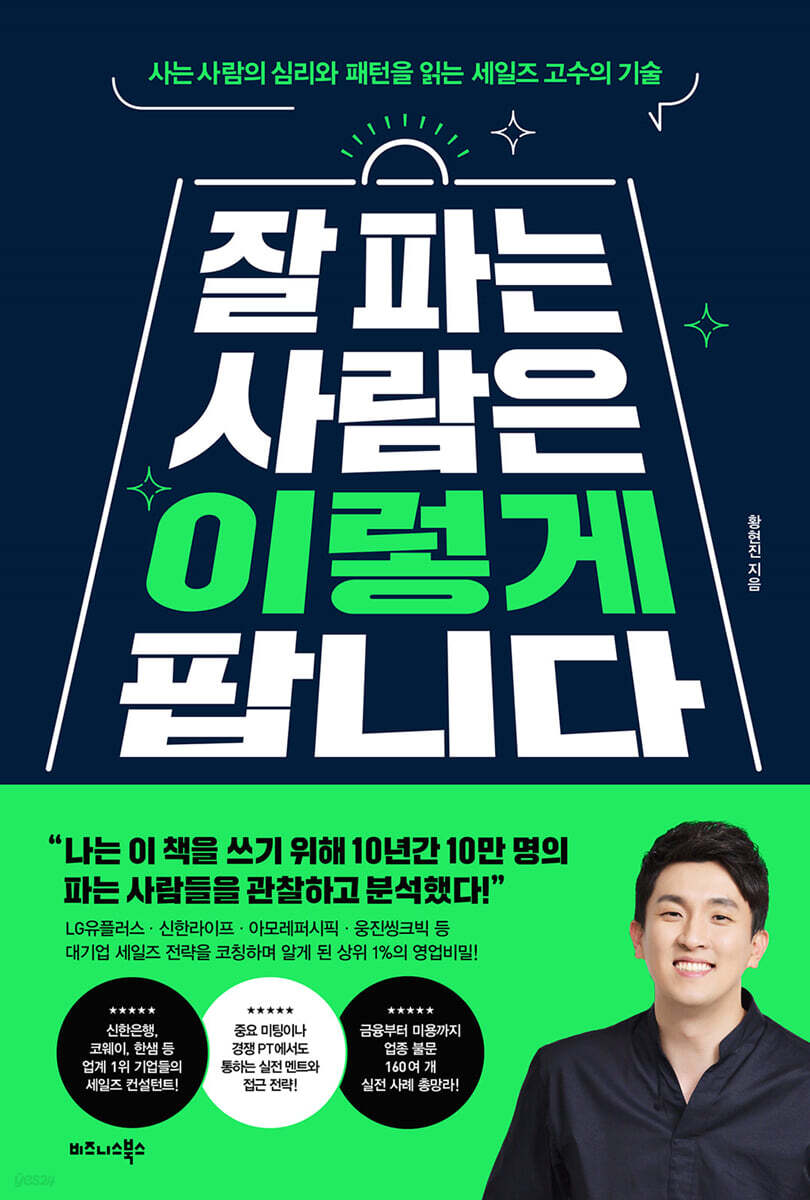
This is how good sellers sell
 |
Description
Book Introduction
Making even the most stubborn customers, whom everyone avoids, my ally. Praise the customer's actions rather than their appearance, and give the customer small but detailed impressions. Top sales consultant Hwang Hyun-jin reveals the sales secrets of the top 1%! Salespeople, small business owners, live commerce workers, and even businessmen “All good sellers sell like this!” Many people say that the consumer market landscape has changed since the coronavirus pandemic. The non-face-to-face online market is rising, while the face-to-face offline market is declining. Many sellers were confused as they tried to adapt to the new order. But in fact, the essence of selling has not changed at all. Author Hwang Hyeon-jin, Korea's top sales consultant, says that customers, past and present, buy "what looks good and is recommended by good people." The customer's decision to purchase is not whether it is face-to-face or not, but whether or not they want to buy. Author Hwang Hyun-jin has been consulting on sales practices and sales language for leading domestic companies such as Samsung Electronics, Shinsegae Department Store, LG U+, Shinhan Bank, Amore Pacific, Woongjin Think Big, Coway, and Hanssem. He helps to make products and services that are not selling well sell well, and helps to make new products sell well from the beginning. He prides himself on having met more and more top-performing salespeople up close than anyone else during the past ten years he has worked as a sales consultant. In this book, which summarizes their successful selling know-how, the author emphasizes two abilities. These are the ‘ability to instill trust in customers’ and the ‘ability to express the product or service you are selling in a way that makes it look good.’ This book reveals all the exceptional sales secrets that only great salespeople possess: how to capture customers' unaware needs and ultimately close a satisfactory transaction, how to effectively demonstrate your expertise and gain their trust, and how to use speaking skills to capture customers' attention and offer persuasive proposals. Additionally, the 160+ diverse real-world examples and comments will serve as valuable resources that can be immediately utilized by salespeople, small business owners, live commerce workers, and entrepreneurs. |
- You can preview some of the book's contents.
Preview
index
Prologue: Two Unchanging Essentials of What Sells Well
Part 1: This is what good sellers say
「Intro」 Good sellers make their products look good.
First, we need to resolve the 'un-bombing' issue.
You have to change the frame to change the language.
Only the right questions will open the customer's mouth.
Just organizing the order of the proposals makes them look more attractive.
Create a space so they listen
Making language unfamiliar attracts attention
Expressing it metaphorically creates impact
The more specific you are about your customers, the more powerful they become.
Just adding numbers catches the eye
Breaking the mold brings freshness
It's advantageous to set standards.
If you give it common sense, it will sell easily.
If you scare them and give them medicine, they will thank you.
Customers only make decisions when their heads nod.
Only easy words remain in the heart
It becomes easier if you use a metaphor.
If you tell the customer to make an inference, you are an expert.
If you tell me to draw a picture, I will respond immediately.
Just changing the order of your proposals can change your sales.
You stand out when you play a villain.
If lime lives, so does persuasion.
Part 2: This is how good sellers sell
"Intro" People who sell well make themselves look like good people.
Attack your emotions in three stages
I laugh once and laugh again
Listen well and respond well
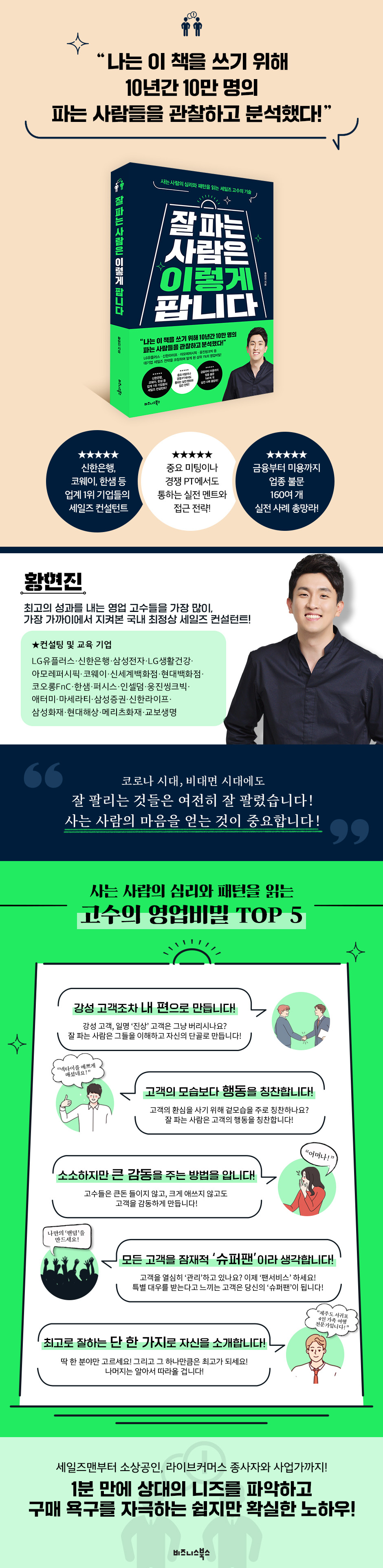
Praise with a verb
I see it often and become attached to it.
It makes you go 'oh my' with a 'thwack'
The masters are small but powerful and give a great impression.
We share values while eating together.
I share my small stories rather than others' grand stories.
Know how to segment your customers and markets
Create your own #1 field
We start by finding the customer's problem.
Reassure customers who refuse
I request firmly with the magic keyword
Encourage but do not force
We design and present a framework for selection.
Approach without feeling burdened
I confidently request an introduction.
Create superfans
I have a unique belief in karma.
Even the most stubborn customers are on my side.
Masters' Secret Moves: Six Situational Magic Phrases
Epilogue: Why the World Needs Salesmen
annotation
Part 1: This is what good sellers say
「Intro」 Good sellers make their products look good.
First, we need to resolve the 'un-bombing' issue.
You have to change the frame to change the language.
Only the right questions will open the customer's mouth.
Just organizing the order of the proposals makes them look more attractive.
Create a space so they listen
Making language unfamiliar attracts attention
Expressing it metaphorically creates impact
The more specific you are about your customers, the more powerful they become.
Just adding numbers catches the eye
Breaking the mold brings freshness
It's advantageous to set standards.
If you give it common sense, it will sell easily.
If you scare them and give them medicine, they will thank you.
Customers only make decisions when their heads nod.
Only easy words remain in the heart
It becomes easier if you use a metaphor.
If you tell the customer to make an inference, you are an expert.
If you tell me to draw a picture, I will respond immediately.
Just changing the order of your proposals can change your sales.
You stand out when you play a villain.
If lime lives, so does persuasion.
Part 2: This is how good sellers sell
"Intro" People who sell well make themselves look like good people.
Attack your emotions in three stages
I laugh once and laugh again
Listen well and respond well
Praise with a verb
I see it often and become attached to it.
It makes you go 'oh my' with a 'thwack'
The masters are small but powerful and give a great impression.
We share values while eating together.
I share my small stories rather than others' grand stories.
Know how to segment your customers and markets
Create your own #1 field
We start by finding the customer's problem.
Reassure customers who refuse
I request firmly with the magic keyword
Encourage but do not force
We design and present a framework for selection.
Approach without feeling burdened
I confidently request an introduction.
Create superfans
I have a unique belief in karma.
Even the most stubborn customers are on my side.
Masters' Secret Moves: Six Situational Magic Phrases
Epilogue: Why the World Needs Salesmen
annotation
Detailed image
Into the book
I started by thinking, "What solutions should I add to sell better?" but ultimately, I came to the conclusion, "If you want to sell well, you have to start by removing this."
The number one target for removal was ‘unbok’.
These are comments that I wrote down in red pen in my notebook while watching and listening to the actual phone consultation process right next to me.
“Customer, I know you may feel burdened….”
“Oh, it’s definitely not a product you’ll lose money on.
“You don’t have to doubt it.”
“When I introduce it like this, many people say that the payment period is too long.”
“Of course, even if you have a lot of cancer insurance, it’s useless if you don’t get cancer….”
“As you saw on the news, this is a product that you don’t have to worry about at all about potential disputes.”
Have you noticed this verbal bomb? The client is listening to the counselor without any pressure, and the counselor uses the word "burden" first.
Then, from then on, a burden that was not there before will arise.
I never suspected that I might suffer a loss, but they said, 'Don't doubt it, you won't suffer a loss.'
From then on, the thought, "Could this be a loss? I should be very suspicious," crosses the customer's mind.
---From "First, we need to resolve the 'unclear language' issue"
What if someone suddenly asked you, "What kind of parent do you want your children to remember you as in 10 years?" It sounds like a good question, and you'd be ready to give a compelling answer, but the words just wouldn't come out.
Because the questions are too difficult. Good sellers never harass their prospects with difficult questions right from the start. They start with easy questions.
“I guess your child is still young?”
“Can I ask how old you are this year?”
“How many hours a week do you usually spend playing with your children?”
“Then, do you feel better that you are growing differently each day?”
Okay, so let's start with some easy questions, and then we'll ask the ones you really want to ask, like, "What kind of parent do you want your children to remember you as in 10 years?"
It will be much easier for the other person to answer than if you ask a difficult question right away.
Naturally, more stories will come out of the other person's mouth.
---From "Only the right question opens the customer's mouth"
The language of strange combinations appears to be full of contradictions on the surface.
But the more you ponder it, the more it holds a special meaning, and it has the power to make the other person slap their knee and say, "Ah!"
“Try combining things in an unfamiliar way.” The messiness created by unfamiliar combinations is surprising.
'Huh? What is it?'
Then, you deliver a powerful counterpunch (Ah!) to your opponent's mind.
Take a look at some examples and get inspired to apply them to your own language right away.
· In the case of cool shampoo
“Have you heard of the phenomenon of scalp warming?” (Huh? Scalp warming?) “If the temperature of the Earth rises even a little, all sorts of problems will arise.
Trees disappear and deserts appear.
The scalp is the same.
If your scalp is hot, problems like hair loss can occur more quickly.
So, at least when you shampoo, it is good for the health of your scalp and hair to cool down the scalp.”
---From "If you make the language unfamiliar, it attracts attention"
For example, imagine you meet a client with really nice skin.
First, let's praise with adjectives.
“Wow, your skin is really nice.” Compliments like this don’t really resonate with the other person.
It feels like just a casual greeting.
This time, let's praise with a verb.
"You always take care of your skin, don't you? I bet you drink plenty of water and only use high-quality products." Compliments like this will definitely resonate with the person you're complimenting.
Because you know the series of actions the customer has taken to care for their skin.
The moment you hear a compliment delivered through a verb, all the efforts you have made flash through your mind.
And I can't help but feel even more grateful to you for recognizing and acknowledging that.
Praise is clearly the lubricant of sales.
However, only when you acknowledge the other person's actions will your compliment be conveyed with sincerity.
I hope you don't think too hard about it.
Even a simple word of appreciation for a small movement is the best compliment.
---From "Praise with Verbs"
What makes my proposal 'look good' has to be small.
It should be something literally trivial and insignificant.
Whether it's a thing or a favor, if it's given in excess, it can become poisonous.
Simply put, if the 'brain' reacts, it is a 'bribe'.
When you think, "Huh? Why are you doing this to me? Is there something you want from me?" your reasoning takes precedence over your emotions.
A small favor given unexpectedly on a random day is the key to eliciting an emotional response.
However, trivial is a relative standard.
It may be a small thing to me, but it may be a burden to the other person.
Conversely, what I thought was big may feel like a trivial thing to the other person.
Still, the answer lies with the other person.
If I do a small favor and the other person responds by waving their hands from side to side and saying, “Hey, no, no, that won’t do!”, then it’s excessive.
On the other hand, if the other person responds by covering their mouth with both hands and saying, “Oh, thank you!” then you did well.
In other words, it doesn't mean that you have to convey something great.
If it's something you can just hand over, it's a success.
---From "It makes you go 'Oh my' with a 'thud'"
My seven-year-old son is racing with his forty-two-year-old father.
You can never beat me by running in an empty lot.
But if they both race their cars in the living room, the son wins.
My son and I are also going to compete in a character quiz.
My son will never be able to beat me in 'Guessing Korean History Figures'.
But when it comes to 'Guess the Pokemon Character', my son always wins.
You need to win against your competitors? Never go to your competitor's home stadium.
You have to bring your opponent to your home stadium.
So how do you create your own home stadium? As mentioned earlier, the best way to achieve this is to segment your products and customers to create your own market.
“You have to keep breaking it down until you can say, ‘I am number one here.’” If you keep breaking it down, you will eventually create a situation where you can be number one.
Of course, it's okay if that category seems very narrow and insignificant.
---From "Create your own number one field"
The biggest obstacle for sellers is the fear of rejection.
On the other hand, the biggest wall for those who live is the fear of ‘failure.’
The fears customers feel stem from the question, "Is my choice truly rational? Is it the best option? What if it fails?"
Yet, sellers often interpret the other person's fear of failure as mere rejection.
And then you just try to overcome the person who rejects you.
But we must look at the nature of rejection.
“An opponent who rejects you is not an object to be overcome.
Rather, you should approach it with the mindset that you need to reassure the other person.” This is because rejection is truly rooted in ‘anxiety’ about one’s own choice.
Maybe the other person is asking you a question and asking for your help.
'I want to understand your proposal.'
'Please help me decide.'
'It's not easy right now.'
'Is my choice the best?'
People who sell well have a different attitude toward rejection.
Don't try to overcome someone who rejects you.
Just accept it as it is.
And it reassures the other person.
The number one target for removal was ‘unbok’.
These are comments that I wrote down in red pen in my notebook while watching and listening to the actual phone consultation process right next to me.
“Customer, I know you may feel burdened….”
“Oh, it’s definitely not a product you’ll lose money on.
“You don’t have to doubt it.”
“When I introduce it like this, many people say that the payment period is too long.”
“Of course, even if you have a lot of cancer insurance, it’s useless if you don’t get cancer….”
“As you saw on the news, this is a product that you don’t have to worry about at all about potential disputes.”
Have you noticed this verbal bomb? The client is listening to the counselor without any pressure, and the counselor uses the word "burden" first.
Then, from then on, a burden that was not there before will arise.
I never suspected that I might suffer a loss, but they said, 'Don't doubt it, you won't suffer a loss.'
From then on, the thought, "Could this be a loss? I should be very suspicious," crosses the customer's mind.
---From "First, we need to resolve the 'unclear language' issue"
What if someone suddenly asked you, "What kind of parent do you want your children to remember you as in 10 years?" It sounds like a good question, and you'd be ready to give a compelling answer, but the words just wouldn't come out.
Because the questions are too difficult. Good sellers never harass their prospects with difficult questions right from the start. They start with easy questions.
“I guess your child is still young?”
“Can I ask how old you are this year?”
“How many hours a week do you usually spend playing with your children?”
“Then, do you feel better that you are growing differently each day?”
Okay, so let's start with some easy questions, and then we'll ask the ones you really want to ask, like, "What kind of parent do you want your children to remember you as in 10 years?"
It will be much easier for the other person to answer than if you ask a difficult question right away.
Naturally, more stories will come out of the other person's mouth.
---From "Only the right question opens the customer's mouth"
The language of strange combinations appears to be full of contradictions on the surface.
But the more you ponder it, the more it holds a special meaning, and it has the power to make the other person slap their knee and say, "Ah!"
“Try combining things in an unfamiliar way.” The messiness created by unfamiliar combinations is surprising.
'Huh? What is it?'
Then, you deliver a powerful counterpunch (Ah!) to your opponent's mind.
Take a look at some examples and get inspired to apply them to your own language right away.
· In the case of cool shampoo
“Have you heard of the phenomenon of scalp warming?” (Huh? Scalp warming?) “If the temperature of the Earth rises even a little, all sorts of problems will arise.
Trees disappear and deserts appear.
The scalp is the same.
If your scalp is hot, problems like hair loss can occur more quickly.
So, at least when you shampoo, it is good for the health of your scalp and hair to cool down the scalp.”
---From "If you make the language unfamiliar, it attracts attention"
For example, imagine you meet a client with really nice skin.
First, let's praise with adjectives.
“Wow, your skin is really nice.” Compliments like this don’t really resonate with the other person.
It feels like just a casual greeting.
This time, let's praise with a verb.
"You always take care of your skin, don't you? I bet you drink plenty of water and only use high-quality products." Compliments like this will definitely resonate with the person you're complimenting.
Because you know the series of actions the customer has taken to care for their skin.
The moment you hear a compliment delivered through a verb, all the efforts you have made flash through your mind.
And I can't help but feel even more grateful to you for recognizing and acknowledging that.
Praise is clearly the lubricant of sales.
However, only when you acknowledge the other person's actions will your compliment be conveyed with sincerity.
I hope you don't think too hard about it.
Even a simple word of appreciation for a small movement is the best compliment.
---From "Praise with Verbs"
What makes my proposal 'look good' has to be small.
It should be something literally trivial and insignificant.
Whether it's a thing or a favor, if it's given in excess, it can become poisonous.
Simply put, if the 'brain' reacts, it is a 'bribe'.
When you think, "Huh? Why are you doing this to me? Is there something you want from me?" your reasoning takes precedence over your emotions.
A small favor given unexpectedly on a random day is the key to eliciting an emotional response.
However, trivial is a relative standard.
It may be a small thing to me, but it may be a burden to the other person.
Conversely, what I thought was big may feel like a trivial thing to the other person.
Still, the answer lies with the other person.
If I do a small favor and the other person responds by waving their hands from side to side and saying, “Hey, no, no, that won’t do!”, then it’s excessive.
On the other hand, if the other person responds by covering their mouth with both hands and saying, “Oh, thank you!” then you did well.
In other words, it doesn't mean that you have to convey something great.
If it's something you can just hand over, it's a success.
---From "It makes you go 'Oh my' with a 'thud'"
My seven-year-old son is racing with his forty-two-year-old father.
You can never beat me by running in an empty lot.
But if they both race their cars in the living room, the son wins.
My son and I are also going to compete in a character quiz.
My son will never be able to beat me in 'Guessing Korean History Figures'.
But when it comes to 'Guess the Pokemon Character', my son always wins.
You need to win against your competitors? Never go to your competitor's home stadium.
You have to bring your opponent to your home stadium.
So how do you create your own home stadium? As mentioned earlier, the best way to achieve this is to segment your products and customers to create your own market.
“You have to keep breaking it down until you can say, ‘I am number one here.’” If you keep breaking it down, you will eventually create a situation where you can be number one.
Of course, it's okay if that category seems very narrow and insignificant.
---From "Create your own number one field"
The biggest obstacle for sellers is the fear of rejection.
On the other hand, the biggest wall for those who live is the fear of ‘failure.’
The fears customers feel stem from the question, "Is my choice truly rational? Is it the best option? What if it fails?"
Yet, sellers often interpret the other person's fear of failure as mere rejection.
And then you just try to overcome the person who rejects you.
But we must look at the nature of rejection.
“An opponent who rejects you is not an object to be overcome.
Rather, you should approach it with the mindset that you need to reassure the other person.” This is because rejection is truly rooted in ‘anxiety’ about one’s own choice.
Maybe the other person is asking you a question and asking for your help.
'I want to understand your proposal.'
'Please help me decide.'
'It's not easy right now.'
'Is my choice the best?'
People who sell well have a different attitude toward rejection.
Don't try to overcome someone who rejects you.
Just accept it as it is.
And it reassures the other person.
---From "Reassuring Customers Who Refuse"
Publisher's Review
Now is the era of 'face-to-face' rather than 'non-face-to-face'!
To sell well, you have to be someone people want to meet!
Two essential things to remember about selling to become a good seller!
The rapid transition to a contactless era due to COVID-19 has also brought about significant changes in consumer trends.
The sales share of the non-face-to-face online market has increased significantly compared to the face-to-face offline market.
But if you think about it, even when social distancing was strictly enforced, people continued to flock to 'hot places'.
Sales consultant Hwang Hyeon-jin analyzes this phenomenon as the 'era of face-to-face choice.'
In other words, to sell well, a product or service must be something customers want to experience or own, and the seller must also be someone customers want to meet.
The ability of sellers to sell products and provide services is more important than ever.
Author Hwang Hyeon-jin is a top sales consultant who has worked with leading domestic companies for the past 10 years and met with approximately 100,000 salespeople.
In this book, written after observing and analyzing the differences between ordinary salespeople and high-performing experts, the author emphasizes two things.
'How to gain customer trust' and 'How to present your product or service in a positive light.'
This is because customers choose what they see as 'something that looks good and is recommended by a trustworthy and good person.'
This is the essence of selling well.
This is precisely why a recommendation from a close acquaintance is more persuasive than an advertisement featuring a top star.
If you keep this in mind and practice the 43 sales techniques in the book, you too can become a top-performing "seller."
How do good sellers speak and act?
The top-performing sales experts' secrets revealed!
43 sales techniques that will help you grow as a seller and satisfy your buyers!
Part 1, “This is what good sellers say,” contains the sensible sales techniques of good sellers.
From the buyer's perspective, we provide detailed and specific information on points that can stimulate the desire to purchase.
In particular, the book's highlight is the 160+ real-world examples and comments from sales of educational products, insurance, and health foods, as well as rental service sales.
You'll learn how to speak in a way that grabs your customers' attention, demonstrates your expertise, and strongly convinces them why they should buy your product.
I'm sure you'll also find some great ideas and inspiration that you can apply to your own sales situations.
In Part 2, "How Successful Sellers Sell," the top-performing sellers vividly share their know-how on how to approach customers.
The author says that above all else, we must appeal to the customer's emotions.
It shows that gaining customer favor and trust is not a difficult task, but something that anyone can do with just a little bit of careful attention.
We also reveal the outstanding 'psychological skills' that only those who sell well possess.
It contains the sales secrets of sales experts who read people's psychology and patterns, such as how to turn stubborn customers, so-called 'true customers', into regulars, and how to reassure customers who refuse.
Don't just read the book; be sure to think about how you can apply it to your own work.
You will be able to personally experience the difference in customer reactions starting the very next day.
I hope you won't put this book down until the day when the numbers prove it with skyrocketing performance and sales.
To sell well, you have to be someone people want to meet!
Two essential things to remember about selling to become a good seller!
The rapid transition to a contactless era due to COVID-19 has also brought about significant changes in consumer trends.
The sales share of the non-face-to-face online market has increased significantly compared to the face-to-face offline market.
But if you think about it, even when social distancing was strictly enforced, people continued to flock to 'hot places'.
Sales consultant Hwang Hyeon-jin analyzes this phenomenon as the 'era of face-to-face choice.'
In other words, to sell well, a product or service must be something customers want to experience or own, and the seller must also be someone customers want to meet.
The ability of sellers to sell products and provide services is more important than ever.
Author Hwang Hyeon-jin is a top sales consultant who has worked with leading domestic companies for the past 10 years and met with approximately 100,000 salespeople.
In this book, written after observing and analyzing the differences between ordinary salespeople and high-performing experts, the author emphasizes two things.
'How to gain customer trust' and 'How to present your product or service in a positive light.'
This is because customers choose what they see as 'something that looks good and is recommended by a trustworthy and good person.'
This is the essence of selling well.
This is precisely why a recommendation from a close acquaintance is more persuasive than an advertisement featuring a top star.
If you keep this in mind and practice the 43 sales techniques in the book, you too can become a top-performing "seller."
How do good sellers speak and act?
The top-performing sales experts' secrets revealed!
43 sales techniques that will help you grow as a seller and satisfy your buyers!
Part 1, “This is what good sellers say,” contains the sensible sales techniques of good sellers.
From the buyer's perspective, we provide detailed and specific information on points that can stimulate the desire to purchase.
In particular, the book's highlight is the 160+ real-world examples and comments from sales of educational products, insurance, and health foods, as well as rental service sales.
You'll learn how to speak in a way that grabs your customers' attention, demonstrates your expertise, and strongly convinces them why they should buy your product.
I'm sure you'll also find some great ideas and inspiration that you can apply to your own sales situations.
In Part 2, "How Successful Sellers Sell," the top-performing sellers vividly share their know-how on how to approach customers.
The author says that above all else, we must appeal to the customer's emotions.
It shows that gaining customer favor and trust is not a difficult task, but something that anyone can do with just a little bit of careful attention.
We also reveal the outstanding 'psychological skills' that only those who sell well possess.
It contains the sales secrets of sales experts who read people's psychology and patterns, such as how to turn stubborn customers, so-called 'true customers', into regulars, and how to reassure customers who refuse.
Don't just read the book; be sure to think about how you can apply it to your own work.
You will be able to personally experience the difference in customer reactions starting the very next day.
I hope you won't put this book down until the day when the numbers prove it with skyrocketing performance and sales.
GOODS SPECIFICS
- Publication date: October 18, 2022
- Page count, weight, size: 332 pages | 582g | 152*225*18mm
- ISBN13: 9791162543061
- ISBN10: 116254306X
You may also like
카테고리
korean


korean

![GQ KOREA Mark (Monthly): December [2025]](http://librairie.coreenne.fr/cdn/shop/files/8ef265dbbfbf186523ed75ba7319009d.jpg?v=1765340328&width=3840)


