

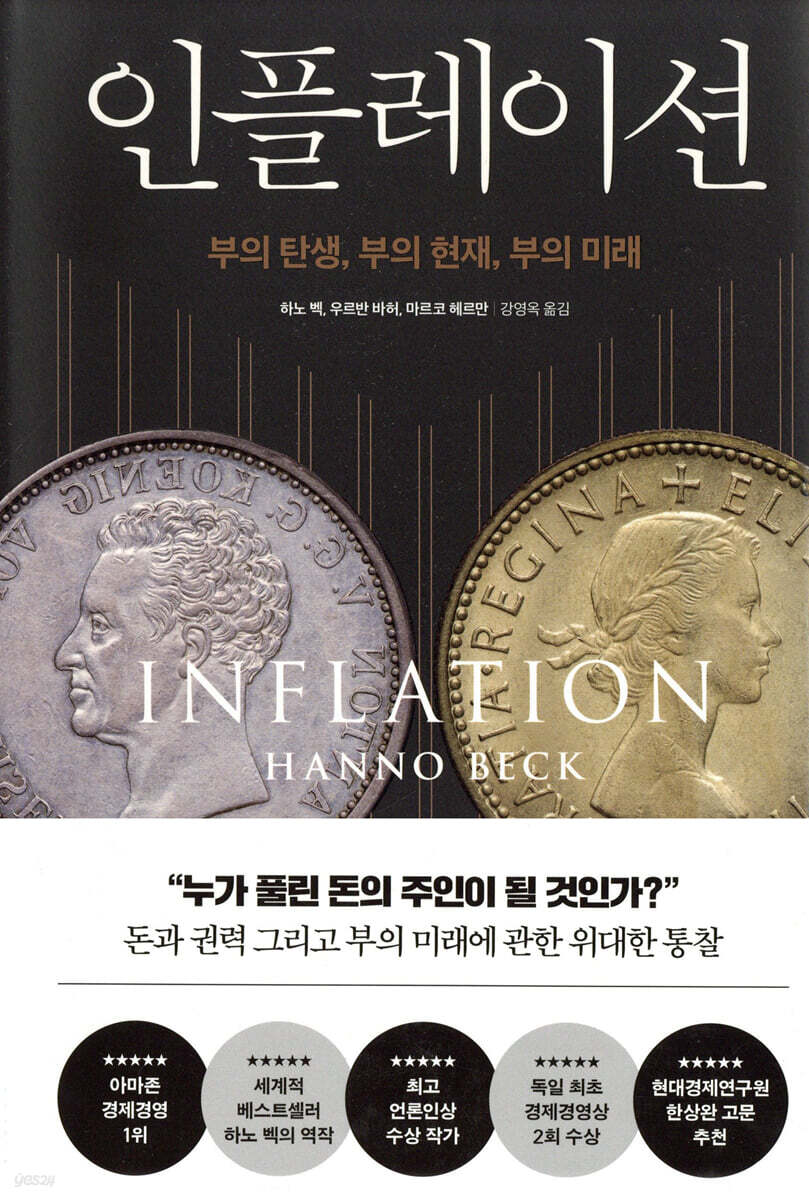
inflation
 |
Description
Book Introduction
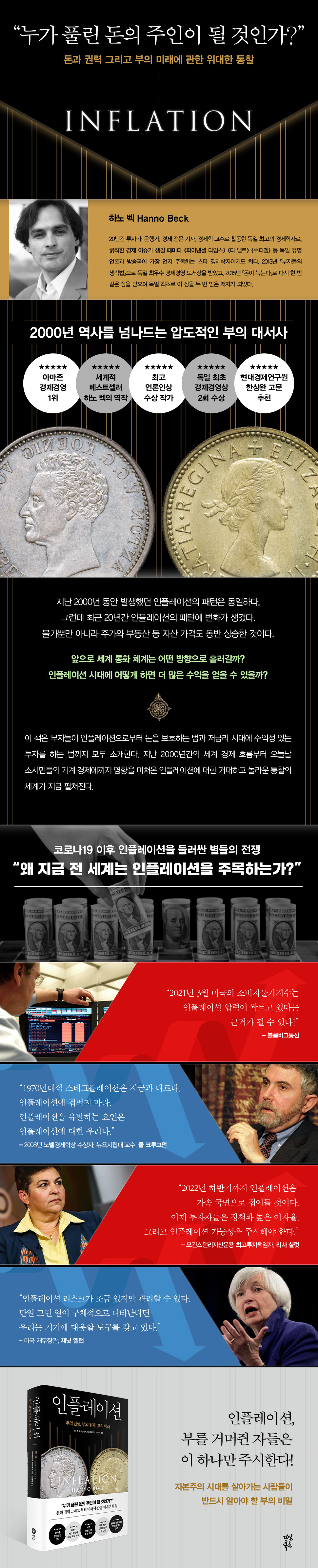
“Who will be the owner of the freed money?”
Great insights into the future of money, power, and wealth.
What direction will the global monetary system take in the future?
How can you earn more in an age of inflation?
The pattern of inflation over the past 2,000 years has been the same.
However, there has been a change in the inflation pattern over the past 20 years.
Not only prices, but also asset prices such as stock prices and real estate prices rose.
This book covers everything from how the wealthy protect their money from inflation, how to make profitable investments in a low-interest-rate era, and how to wisely plan for retirement in times of crisis.
A world of vast and surprising insights into inflation, from its impact on the global economy over the past 2,000 years to the household finances of even the average citizen today, unfolds before you.
Great insights into the future of money, power, and wealth.
What direction will the global monetary system take in the future?
How can you earn more in an age of inflation?
The pattern of inflation over the past 2,000 years has been the same.
However, there has been a change in the inflation pattern over the past 20 years.
Not only prices, but also asset prices such as stock prices and real estate prices rose.
This book covers everything from how the wealthy protect their money from inflation, how to make profitable investments in a low-interest-rate era, and how to wisely plan for retirement in times of crisis.
A world of vast and surprising insights into inflation, from its impact on the global economy over the past 2,000 years to the household finances of even the average citizen today, unfolds before you.
- You can preview some of the book's contents.
Preview
index
Preface to the Korean edition
To Korean readers
Recommendation
In the Age of Wealth, Reading Inflation Can Provide a Look into the Future
The history of black numbers that have governed the fate of humanity
Part 1
The invention of money, the beginning of inflation
: The rise and fall of wealth driven by inflation
Chapter 1: Inflation: The Beginning of a 2,000-Year History
01 The Beginning of Currency Destruction
Money Melts | 10 Propositions from the History of Inflation
02 A piece of paper that moved history
Money Becomes an Incinerator | The Destructive Power of Moderate Inflation | The Birth of Paper Money
03 The history of inflation is a history of political failure.
The Destruction of Money's Value | Money as a Political Servant
INFLATION STORY 01 How is inflation measured?
Chapter 2: The Destruction of Money: A New Era Begins
01 Wriggling inflation
A regime that distributes counterfeit money | The first currency devaluation in history
02 Black Death and Europe's First Inflation
"Schunderinge": More Dreadful Than War | "Take All the Silver Out of My Coins!" | War's Mass Production of Low-Quality Coins
INFLATION STORY 02 Who is the creator of the legendary counterfeit money?
Part 2
Who creates and exploits inflation and why?
: The black hand that has been manipulating the value of currency
Chapter 3: The Devil's Currency System
01 Pandora's Box
The Man Who Made Money Without a Penny | The Founding of the First Bank of Korea, the Prelude to a Great Collapse | The Maids Who Get Rich Quickly, the Ponzi Game of the 1700s
02 Irresistible temptations and traps
Sweden's Paper Money Experiment | The American Civil War Caused 209 Percent Inflation | The Misguided Idea That More Is Better: "Ahsinya" Revolutionary Currency
03 The endlessly repetitive inflation game
Familiar events transcend time and space | The star of this five-act play is the nation, created by inflation.
INFLATION STORY 03 Who made the most money from inflation?
Chapter 4: The 20th Century: The Madness of Hyperinflation Begins
01 The era of hyperinflation begins
Venezuela's Tragedy: 720 Percent Annual Inflation | The First Hyperinflation of the 20th Century
02 Numbers that run wild
Daily inflation rate of 207 percent, monthly inflation rate of 313 million percent | Anatomy of hyperinflation
03 How to calm the confusion
The Principle of Inflation | How to Calm the Beast
INFLATION STORY 04 How did literature portray inflation?
Chapter 5: A Disaster Foretold: Massive Inflation
01 The fate of the world changed overnight.
"Cherries ripened overnight!" | The golden age of the German economy
Economic Thinkers of the 2nd Century
A Refutation of Classical Economics | How to Surge the Economy | The Awkward Mechanism of the Phillips Curve
03 Oil Shock and Stagflation
The Ghost of Inflation Haunting the 1970s | The Critic Who Destroyed the Phillips Curve
04 A period of global economic stability led by financial policy
Two Men Who Rebeled Against the Phillips Curve | The Cause of Economic Stability
INFLATION STORY 05 What principles should central banks follow?
Part 3
What drives the landscape of capitalism?
: Wealth Opportunities Determined by Inflation in the Age of Financial Crisis
Chapter 6: The Return of the Financial Crisis
01 Trailer of the Financial Crisis
The Decade of Crisis | The Balance of Money and Fisher's Equation | The Equation of Exchange's Mysteries
02 Massive cash burn
The unexpected stock market crash at the end of the century | The magic spell that triggered the financial crisis | The Spanish financial crisis triggered by the real estate bubble
03 A new powerhouse in financial policy
Politicians Who Passed the Burden on Central Banks | Quantitative Easing: A Missing Bullet
04 National Debt Waste Recycling
Central Bank Operations | Financial Policy Summary of the Past Decade
INFLATION STORY 06 What is the quantity of money?
Chapter 7: The Victim is Always a Commoner
01 Why do the poorer ones suffer more?
In the Wolves' Hole | The Curse of Cash | The Correlation Between Inflation and Poverty
02 Who will win the inflation game?
Debt-fueling math | The unexpected variables that determine success or failure
03 One person is playing the wrong game
Question the Forecast | Is the Government a Winner in the Inflation Game? | Can the Government Directly Determine the Inflation Rate?
INFLATION STORY 07 Why doesn't inflation occur even when the money supply increases?
Part 4
How to ride the wave of inflation?
: Investment methods that increase returns through inflation
Chapter 8: Zero Interest Rates, Zero Profits
01 The advent of the zero interest rate era
The Shadow of Interest and Ethics | Why Have Interest Rates Falln So Precipitously Over the Past Decade?
02 Creaking Pension System
Low Interest Rates, High Risk | Life Insurance Suffering from Low Interest Rates
03 The End of Workplace Pensions
The Age of Retirement Crisis | The 3-6-3 Rule That Has Sustained Banks | The Impact of Interest Rate Hike
INFLATION STORY 08 How is risk calculated?
Chapter 9: Investing in the Age of Financial Crisis
01 Increasing Returns in a Financial Crisis
5 Million Books | Four Scenarios Surrounding Inflation
02 Structural Risk of Inflation
Price Inflation and Asset Inflation | The Magic Triangle
03 Gold and Real Estate in Cement
Real Estate as an Investment | The Correlation Between Real Estate and Securities
04 Stocks and gold as investment targets
A means of enjoying corporate profits | Three criteria for stock investment | Gold
05 Interest Products
Bonds | If you're looking for higher returns
INFLATION STORY 09 The Correlation Between Stocks and Inflation
Chapter 10: Portfolio Construction Strategies in an Age of Inflation
01 How to Create a Portfolio
Know your enemy to win | Build the best team
02 Diversifying your portfolio
The Principle of Diversification | Cockroach Portfolio
03 Psychological Traps of Investment
Overcoming psychological vulnerabilities
INFLATION STORY 10 What are the timeless investment principles?
Chapter 11: The Future of Money
01 A future you couldn't dream of
The Maturity of Humanity | The End of Money as We Know It | Fierce Competition Between Currencies | The Indestructibility of Money
Translator's Note
If you don't want to fall victim to the blind spot of inflation
annotation
Search
To Korean readers
Recommendation
In the Age of Wealth, Reading Inflation Can Provide a Look into the Future
The history of black numbers that have governed the fate of humanity
Part 1
The invention of money, the beginning of inflation
: The rise and fall of wealth driven by inflation
Chapter 1: Inflation: The Beginning of a 2,000-Year History
01 The Beginning of Currency Destruction
Money Melts | 10 Propositions from the History of Inflation
02 A piece of paper that moved history
Money Becomes an Incinerator | The Destructive Power of Moderate Inflation | The Birth of Paper Money
03 The history of inflation is a history of political failure.
The Destruction of Money's Value | Money as a Political Servant
INFLATION STORY 01 How is inflation measured?
Chapter 2: The Destruction of Money: A New Era Begins
01 Wriggling inflation
A regime that distributes counterfeit money | The first currency devaluation in history
02 Black Death and Europe's First Inflation
"Schunderinge": More Dreadful Than War | "Take All the Silver Out of My Coins!" | War's Mass Production of Low-Quality Coins
INFLATION STORY 02 Who is the creator of the legendary counterfeit money?
Part 2
Who creates and exploits inflation and why?
: The black hand that has been manipulating the value of currency
Chapter 3: The Devil's Currency System
01 Pandora's Box
The Man Who Made Money Without a Penny | The Founding of the First Bank of Korea, the Prelude to a Great Collapse | The Maids Who Get Rich Quickly, the Ponzi Game of the 1700s
02 Irresistible temptations and traps
Sweden's Paper Money Experiment | The American Civil War Caused 209 Percent Inflation | The Misguided Idea That More Is Better: "Ahsinya" Revolutionary Currency
03 The endlessly repetitive inflation game
Familiar events transcend time and space | The star of this five-act play is the nation, created by inflation.
INFLATION STORY 03 Who made the most money from inflation?
Chapter 4: The 20th Century: The Madness of Hyperinflation Begins
01 The era of hyperinflation begins
Venezuela's Tragedy: 720 Percent Annual Inflation | The First Hyperinflation of the 20th Century
02 Numbers that run wild
Daily inflation rate of 207 percent, monthly inflation rate of 313 million percent | Anatomy of hyperinflation
03 How to calm the confusion
The Principle of Inflation | How to Calm the Beast
INFLATION STORY 04 How did literature portray inflation?
Chapter 5: A Disaster Foretold: Massive Inflation
01 The fate of the world changed overnight.
"Cherries ripened overnight!" | The golden age of the German economy
Economic Thinkers of the 2nd Century
A Refutation of Classical Economics | How to Surge the Economy | The Awkward Mechanism of the Phillips Curve
03 Oil Shock and Stagflation
The Ghost of Inflation Haunting the 1970s | The Critic Who Destroyed the Phillips Curve
04 A period of global economic stability led by financial policy
Two Men Who Rebeled Against the Phillips Curve | The Cause of Economic Stability
INFLATION STORY 05 What principles should central banks follow?
Part 3
What drives the landscape of capitalism?
: Wealth Opportunities Determined by Inflation in the Age of Financial Crisis
Chapter 6: The Return of the Financial Crisis
01 Trailer of the Financial Crisis
The Decade of Crisis | The Balance of Money and Fisher's Equation | The Equation of Exchange's Mysteries
02 Massive cash burn
The unexpected stock market crash at the end of the century | The magic spell that triggered the financial crisis | The Spanish financial crisis triggered by the real estate bubble
03 A new powerhouse in financial policy
Politicians Who Passed the Burden on Central Banks | Quantitative Easing: A Missing Bullet
04 National Debt Waste Recycling
Central Bank Operations | Financial Policy Summary of the Past Decade
INFLATION STORY 06 What is the quantity of money?
Chapter 7: The Victim is Always a Commoner
01 Why do the poorer ones suffer more?
In the Wolves' Hole | The Curse of Cash | The Correlation Between Inflation and Poverty
02 Who will win the inflation game?
Debt-fueling math | The unexpected variables that determine success or failure
03 One person is playing the wrong game
Question the Forecast | Is the Government a Winner in the Inflation Game? | Can the Government Directly Determine the Inflation Rate?
INFLATION STORY 07 Why doesn't inflation occur even when the money supply increases?
Part 4
How to ride the wave of inflation?
: Investment methods that increase returns through inflation
Chapter 8: Zero Interest Rates, Zero Profits
01 The advent of the zero interest rate era
The Shadow of Interest and Ethics | Why Have Interest Rates Falln So Precipitously Over the Past Decade?
02 Creaking Pension System
Low Interest Rates, High Risk | Life Insurance Suffering from Low Interest Rates
03 The End of Workplace Pensions
The Age of Retirement Crisis | The 3-6-3 Rule That Has Sustained Banks | The Impact of Interest Rate Hike
INFLATION STORY 08 How is risk calculated?
Chapter 9: Investing in the Age of Financial Crisis
01 Increasing Returns in a Financial Crisis
5 Million Books | Four Scenarios Surrounding Inflation
02 Structural Risk of Inflation
Price Inflation and Asset Inflation | The Magic Triangle
03 Gold and Real Estate in Cement
Real Estate as an Investment | The Correlation Between Real Estate and Securities
04 Stocks and gold as investment targets
A means of enjoying corporate profits | Three criteria for stock investment | Gold
05 Interest Products
Bonds | If you're looking for higher returns
INFLATION STORY 09 The Correlation Between Stocks and Inflation
Chapter 10: Portfolio Construction Strategies in an Age of Inflation
01 How to Create a Portfolio
Know your enemy to win | Build the best team
02 Diversifying your portfolio
The Principle of Diversification | Cockroach Portfolio
03 Psychological Traps of Investment
Overcoming psychological vulnerabilities
INFLATION STORY 10 What are the timeless investment principles?
Chapter 11: The Future of Money
01 A future you couldn't dream of
The Maturity of Humanity | The End of Money as We Know It | Fierce Competition Between Currencies | The Indestructibility of Money
Translator's Note
If you don't want to fall victim to the blind spot of inflation
annotation
Search
Detailed image
Into the book
The history of money is the history of inflation.
For this reason, we should not easily believe the statement that 'inflation is over'.
While signs of deflation, with falling prices, were evident in 2016, a closer look reveals that we can never afford to let our guard down against inflation.
Because we see the movements of forces that could collapse the currency.
At first glance, the script for a currency collapse operation may seem a little different, but there has been a consistent pattern to the destruction of currencies throughout the ages.
--- p.31, from “01 The Beginning of Currency Destruction”
How do prices rise? From a purchasing power perspective, the smaller the amount of currency in circulation, the more frequently currency ownership changes hands.
The workers' wives would park their carts and wait until their husbands received their daily wages, and then run to the stores to buy goods as soon as they received their wages.
In these situations, the ownership of money changes more frequently.
Among the technical terms that describe this situation, there is an expression called 'velocity of money'.
The more frequently a currency changes hands, the more troublesome it becomes to deal with it quickly.
It is better to get rid of it quickly, as holding on to it will only cause harm.
It's not particularly surprising.
Even when looking at indicators related to the national economy, in cases of high inflation, GNP, consumption, and investment decrease.
High inflation is detrimental to economic growth.
This is a fact confirmed throughout the history of inflation.
Countries whose monetary systems do not function properly sacrifice the happiness of their citizens.
--- p.129, from “03 How to Calm the Confusion”
Stagflation is something politicians and economists around the world have brought upon themselves.
In a situation where things were going very differently than the Phillips curve suggested, politicians were forced to choose between unemployment and inflation.
The pain began when unemployment and inflation rose simultaneously.
Politicians no longer had a choice.
Eventually, the Phillips curve was banished from the drawer of economic historians.
What on earth happened? The key factor that shook the economy in the 1970s was the price of crude oil.
The Yom Kippur War (also known as the Ramadan War, the October War, or the Fourth Middle East War) took place between Israel and Arab countries (mainly Egypt and Syria) from October 6 to October 25, 1973, and OPEC member countries halted oil exports to Western developed countries.
The price of crude oil, which was $3 per barrel (159 liters) in 1973, skyrocketed to $38 per barrel in 1979.
The new word that emerged at this time is ‘supply wave.’
--- p.160, from “03 Oil Shock and Stagflation”
However, quantitative easing policy is an act of turning a blind eye.
In fact, bonds are no different from the country's debt.
The government lends money to the capital market and issues securities for the money lent.
The repayment date and loan interest rate are specified in the securities.
When a central bank buys a large amount of bonds, it ends up taking over and managing the country's debt.
This can only be seen as a trick to exchange the country's debt for cash.
Experts call this situation "monetary alimentation" to address the country's debt.
Simply put, it is a trick to increase the amount of currency issued and operate the national debt.
Having experienced hyperinflation, can you imagine what might happen next?
--- p.199, from “04 National Debt Waste Recycling”
When it comes to dealing with debt, there is no method more effective than inflation.
Ultimately, there is no more attractive way to solve a nation's debt than inflation.
In the previous chapter, we examined in detail the history of how states have perceived these mechanisms and taken the lead in promoting inflation.
Politicians cannot possibly forget such an old lesson.
There is a point here that could be objected to.
So, can the government directly determine the inflation rate? To prevent such abuses, arguments have emerged that the independence of the central bank must be guaranteed.
Didn't we already taste the bitterness of hyperinflation in 1923? Yet, the temptation to manipulate inflation is once again beckoning.
For this reason, we should not easily believe the statement that 'inflation is over'.
While signs of deflation, with falling prices, were evident in 2016, a closer look reveals that we can never afford to let our guard down against inflation.
Because we see the movements of forces that could collapse the currency.
At first glance, the script for a currency collapse operation may seem a little different, but there has been a consistent pattern to the destruction of currencies throughout the ages.
--- p.31, from “01 The Beginning of Currency Destruction”
How do prices rise? From a purchasing power perspective, the smaller the amount of currency in circulation, the more frequently currency ownership changes hands.
The workers' wives would park their carts and wait until their husbands received their daily wages, and then run to the stores to buy goods as soon as they received their wages.
In these situations, the ownership of money changes more frequently.
Among the technical terms that describe this situation, there is an expression called 'velocity of money'.
The more frequently a currency changes hands, the more troublesome it becomes to deal with it quickly.
It is better to get rid of it quickly, as holding on to it will only cause harm.
It's not particularly surprising.
Even when looking at indicators related to the national economy, in cases of high inflation, GNP, consumption, and investment decrease.
High inflation is detrimental to economic growth.
This is a fact confirmed throughout the history of inflation.
Countries whose monetary systems do not function properly sacrifice the happiness of their citizens.
--- p.129, from “03 How to Calm the Confusion”
Stagflation is something politicians and economists around the world have brought upon themselves.
In a situation where things were going very differently than the Phillips curve suggested, politicians were forced to choose between unemployment and inflation.
The pain began when unemployment and inflation rose simultaneously.
Politicians no longer had a choice.
Eventually, the Phillips curve was banished from the drawer of economic historians.
What on earth happened? The key factor that shook the economy in the 1970s was the price of crude oil.
The Yom Kippur War (also known as the Ramadan War, the October War, or the Fourth Middle East War) took place between Israel and Arab countries (mainly Egypt and Syria) from October 6 to October 25, 1973, and OPEC member countries halted oil exports to Western developed countries.
The price of crude oil, which was $3 per barrel (159 liters) in 1973, skyrocketed to $38 per barrel in 1979.
The new word that emerged at this time is ‘supply wave.’
--- p.160, from “03 Oil Shock and Stagflation”
However, quantitative easing policy is an act of turning a blind eye.
In fact, bonds are no different from the country's debt.
The government lends money to the capital market and issues securities for the money lent.
The repayment date and loan interest rate are specified in the securities.
When a central bank buys a large amount of bonds, it ends up taking over and managing the country's debt.
This can only be seen as a trick to exchange the country's debt for cash.
Experts call this situation "monetary alimentation" to address the country's debt.
Simply put, it is a trick to increase the amount of currency issued and operate the national debt.
Having experienced hyperinflation, can you imagine what might happen next?
--- p.199, from “04 National Debt Waste Recycling”
When it comes to dealing with debt, there is no method more effective than inflation.
Ultimately, there is no more attractive way to solve a nation's debt than inflation.
In the previous chapter, we examined in detail the history of how states have perceived these mechanisms and taken the lead in promoting inflation.
Politicians cannot possibly forget such an old lesson.
There is a point here that could be objected to.
So, can the government directly determine the inflation rate? To prevent such abuses, arguments have emerged that the independence of the central bank must be guaranteed.
Didn't we already taste the bitterness of hyperinflation in 1923? Yet, the temptation to manipulate inflation is once again beckoning.
--- p.230, from “03 One Person is Playing the Wrong Game”
Publisher's Review
★★★ Amazon's #1 Business Management Course ★★★
★★★ Hanno Beck's world-renowned bestseller ★★★
★★★ Best Journalist Award-Winning Author ★★★
★★★ Germany's first two-time winner of the Economics and Management Award ★★★
★★★ Recommended by Han Sang-wan, Advisor at the Hyundai Research Institute ★★★
inflation,
Those who have amassed wealth only look at this one thing!
× How has inflation ruled wealth?
× How did those in power bring down the financial system?
× How did capitalism grow alongside inflation?
× How should we prepare for the coming era of inflation?
× How should we develop investment strategies in the era of financial crisis?
Inflation is coming.
The global economy has been thrown into extreme turmoil since COVID-19.
Central banks around the world are implementing massive fiscal spending and liquidity expansion strategies, and the global economy is entering a recovery phase as herd immunity is achieved, starting with vaccinations.
As the value of currency declines, asset prices such as real estate and stocks are skyrocketing, and the whole world is now on edge over the topic of 'inflation'.
Where does inflation, which drives the global economy, originate? Who creates and exploits it, and why? Inflation is not a recent invention.
It began with the birth of currency 2,000 years ago and continues to this day, occurring in every era and country, influencing the global economy and the movement of wealth.
The ruling class, including emperors, politicians, dictators, and rulers, constantly manipulated the value of money for their own benefit and pushed the poor into further poverty.
How did inflation destroy the value of currency, disrupt the financial system, and ultimately lead to a financial crisis? This book, "Inflation," is a profound and astonishing insight and epic record of inflation, a phenomenon that has impacted human life without fail, from the global economic landscape to the household finances of today's average citizen.
Hanno Beck, the first German economist to win the Best Economics and Management Award twice and known in Korea for his bestselling books, “How Economists Think” and “How the Rich Think,” has uncovered the secrets of inflation hidden throughout 2,000 years of human history through this book.
He realizes that ordinary citizens must properly understand inflation, the foundation of capitalism, to avoid suffering during the financial crisis. He goes back and forth between the birth, present, and future of inflation, clearly introducing the operating principles of capitalism hidden within it and investment methods for the low-interest-rate era.
Inflation has been the driving force
The Birth of Wealth, The Present of Wealth, The Future of Wealth
The history of mankind is the history of money, and the history of money is the history of inflation.
Although the occurrence and course of inflation may vary depending on the era and circumstances, there has been a certain pattern to the destruction of currency regardless of the era.
From the poor quality coins produced by wars in ancient Rome to the financial investment frauds of the Middle Ages to the hyperinflation of the 20th century, the early stages of a currency's collapse have always been marked by the burden of excessive debt on the part of the nation or ruler.
When excessive debt arises, nations and rulers have tried to evade their obligations by using inflation, a dark temptation that has existed in every era.
However, the method has changed slightly over time.
Even though 2,000 years have passed and circumstances have changed, inflation will never go away as long as money and rulers exist.
Inflation has the potential to destroy entire nations and even overturn major trends in the global economy.
From the tragedy of Venezuela, which recorded an annual inflation rate of 720 percent, to Hungary, which recorded a daily inflation rate of 207 percent and prices doubling every 15 hours, to the currency reform that turned Germany's economy into a golden age during the worst inflation, inflation has influenced the rise and fall of a nation, not to mention the daily lives of ordinary citizens.
A look into the vivid history of the impact and destructive power of inflation offers important insights for us living in an age of inflation.
It's important to understand what inflation can do to our daily lives and what steps we need to take when it happens.
This book reveals why ordinary people are disproportionately affected by inflation driven by rulers and the powerful, and clearly shows how to prepare for inflation to avoid being left behind in this massive trend.
In the coming inflation
How to prepare?
The author points out that the reason people only realize the existence of inflation after they become penniless is because they "underestimate the power of numbers."
This is because they are unaware of the enormous potential ripple effects of the 'exponential growth' that inflation causes.
If inflation rises by just 2 percent per year, our wallets will immediately take a hit, and if it rises by 4 percent per year, it will become difficult to even prepare for retirement.
The author warns readers by citing historical examples of how inflation, which stimulates the economy in the short term, can devastate the lives of ordinary people, saying, “Inflation is like running on a giant razor blade.”
At the same time, it is a sharp signal to watch out for policies, politicians, and those in power that encourage inflation under the pretext of stimulating the economy.
So, what should we as individuals do to avoid becoming losers in the inflation game? This book explains how economic theory explains the risks of inflation and even offers advice on strategies to protect our precious assets from a major crisis.
The author, who worked for eight years at the Frankfurter Allgemeine Zeitung, Germany's top daily newspaper and one of the world's top three newspapers, and won the Best Journalist Award, provides practical and useful information on how to protect your assets and earn more in the coming era of inflation, including how to create a portfolio that increases returns, investment methods, and the psychological traps of investing.
The author says that the prescription of temporarily loosening the monetary policy to stimulate the economy is "like a drug."
Can global financial markets function without disruption when we stop this drug? How should we prepare for the massive power and influence that drives inflation? The historical events triggered by inflation throughout 2,000 years of human history, and the vast secrets and ambitions hidden behind them, pose crucial questions for us.
"Inflation" will be a meaningful journey for us, living in an age of inflation, to gain insight into and predict the fate and future of the economy.
★★★ Hanno Beck's world-renowned bestseller ★★★
★★★ Best Journalist Award-Winning Author ★★★
★★★ Germany's first two-time winner of the Economics and Management Award ★★★
★★★ Recommended by Han Sang-wan, Advisor at the Hyundai Research Institute ★★★
inflation,
Those who have amassed wealth only look at this one thing!
× How has inflation ruled wealth?
× How did those in power bring down the financial system?
× How did capitalism grow alongside inflation?
× How should we prepare for the coming era of inflation?
× How should we develop investment strategies in the era of financial crisis?
Inflation is coming.
The global economy has been thrown into extreme turmoil since COVID-19.
Central banks around the world are implementing massive fiscal spending and liquidity expansion strategies, and the global economy is entering a recovery phase as herd immunity is achieved, starting with vaccinations.
As the value of currency declines, asset prices such as real estate and stocks are skyrocketing, and the whole world is now on edge over the topic of 'inflation'.
Where does inflation, which drives the global economy, originate? Who creates and exploits it, and why? Inflation is not a recent invention.
It began with the birth of currency 2,000 years ago and continues to this day, occurring in every era and country, influencing the global economy and the movement of wealth.
The ruling class, including emperors, politicians, dictators, and rulers, constantly manipulated the value of money for their own benefit and pushed the poor into further poverty.
How did inflation destroy the value of currency, disrupt the financial system, and ultimately lead to a financial crisis? This book, "Inflation," is a profound and astonishing insight and epic record of inflation, a phenomenon that has impacted human life without fail, from the global economic landscape to the household finances of today's average citizen.
Hanno Beck, the first German economist to win the Best Economics and Management Award twice and known in Korea for his bestselling books, “How Economists Think” and “How the Rich Think,” has uncovered the secrets of inflation hidden throughout 2,000 years of human history through this book.
He realizes that ordinary citizens must properly understand inflation, the foundation of capitalism, to avoid suffering during the financial crisis. He goes back and forth between the birth, present, and future of inflation, clearly introducing the operating principles of capitalism hidden within it and investment methods for the low-interest-rate era.
Inflation has been the driving force
The Birth of Wealth, The Present of Wealth, The Future of Wealth
The history of mankind is the history of money, and the history of money is the history of inflation.
Although the occurrence and course of inflation may vary depending on the era and circumstances, there has been a certain pattern to the destruction of currency regardless of the era.
From the poor quality coins produced by wars in ancient Rome to the financial investment frauds of the Middle Ages to the hyperinflation of the 20th century, the early stages of a currency's collapse have always been marked by the burden of excessive debt on the part of the nation or ruler.
When excessive debt arises, nations and rulers have tried to evade their obligations by using inflation, a dark temptation that has existed in every era.
However, the method has changed slightly over time.
Even though 2,000 years have passed and circumstances have changed, inflation will never go away as long as money and rulers exist.
Inflation has the potential to destroy entire nations and even overturn major trends in the global economy.
From the tragedy of Venezuela, which recorded an annual inflation rate of 720 percent, to Hungary, which recorded a daily inflation rate of 207 percent and prices doubling every 15 hours, to the currency reform that turned Germany's economy into a golden age during the worst inflation, inflation has influenced the rise and fall of a nation, not to mention the daily lives of ordinary citizens.
A look into the vivid history of the impact and destructive power of inflation offers important insights for us living in an age of inflation.
It's important to understand what inflation can do to our daily lives and what steps we need to take when it happens.
This book reveals why ordinary people are disproportionately affected by inflation driven by rulers and the powerful, and clearly shows how to prepare for inflation to avoid being left behind in this massive trend.
In the coming inflation
How to prepare?
The author points out that the reason people only realize the existence of inflation after they become penniless is because they "underestimate the power of numbers."
This is because they are unaware of the enormous potential ripple effects of the 'exponential growth' that inflation causes.
If inflation rises by just 2 percent per year, our wallets will immediately take a hit, and if it rises by 4 percent per year, it will become difficult to even prepare for retirement.
The author warns readers by citing historical examples of how inflation, which stimulates the economy in the short term, can devastate the lives of ordinary people, saying, “Inflation is like running on a giant razor blade.”
At the same time, it is a sharp signal to watch out for policies, politicians, and those in power that encourage inflation under the pretext of stimulating the economy.
So, what should we as individuals do to avoid becoming losers in the inflation game? This book explains how economic theory explains the risks of inflation and even offers advice on strategies to protect our precious assets from a major crisis.
The author, who worked for eight years at the Frankfurter Allgemeine Zeitung, Germany's top daily newspaper and one of the world's top three newspapers, and won the Best Journalist Award, provides practical and useful information on how to protect your assets and earn more in the coming era of inflation, including how to create a portfolio that increases returns, investment methods, and the psychological traps of investing.
The author says that the prescription of temporarily loosening the monetary policy to stimulate the economy is "like a drug."
Can global financial markets function without disruption when we stop this drug? How should we prepare for the massive power and influence that drives inflation? The historical events triggered by inflation throughout 2,000 years of human history, and the vast secrets and ambitions hidden behind them, pose crucial questions for us.
"Inflation" will be a meaningful journey for us, living in an age of inflation, to gain insight into and predict the fate and future of the economy.
GOODS SPECIFICS
- Publication date: April 20, 2021
- Format: Hardcover book binding method guide
- Page count, weight, size: 356 pages | 646g | 142*219*30mm
- ISBN13: 9791130637136
- ISBN10: 1130637131
You may also like
카테고리
korean


korean

![GQ KOREA Mark (Monthly): December [2025]](http://librairie.coreenne.fr/cdn/shop/files/8ef265dbbfbf186523ed75ba7319009d.jpg?v=1765340328&width=3840)


