

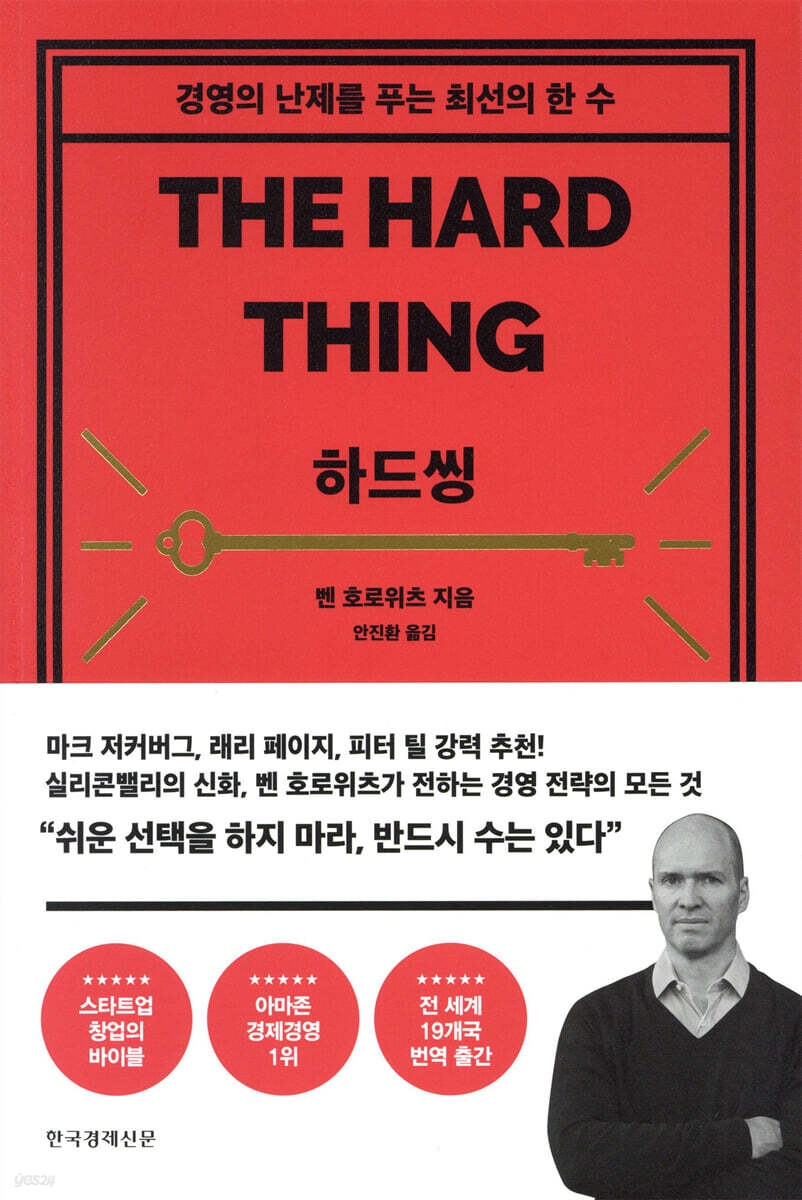
Hard Thing
 |
Description
Book Introduction
“That’s not the real problem!”
Ben Horowitz, co-founder of a16z and Silicon Valley guru, explains everything you need to know about business strategy.
There is a CEO who is the co-founder of Andreessen Horowitz (a16z), the company that led the investment in 'Clubhouse', a hot topic in 2021, and sold the company to Hewlett-Packard for an astronomical sum of $1.6 billion.
That's Ben Horowitz.
The glamorous image of a successful entrepreneur and famous investor is highlighted, but behind it are unimaginable 'blood, sweat, and tears' and roller coaster-like twists and turns.
In "Hard Thing," he vividly describes the struggles he overcame, from starting a business, to the brink of bankruptcy, to a brilliant comeback, to a successful sale, and finally to starting a new business.
“There are no formulas in this book,” he says firmly.
You may wonder what he's talking about, but if you follow what he's saying, you'll soon find yourself nodding along.
When you need to lay off a long-time employee, when office politics become serious, when you desperately need investment to prevent bankruptcy, when you're wondering whether to sell the company...
There is no way there is a right answer here.
There is nothing that can be solved with the success formulas commonly mentioned in economics and management books.
The author argues that these are truly difficult "management challenges," and that any leader will inevitably face such challenges at some point.
And based on his own experience, he suggests the 'best move' to solve a problem without an answer.
First published in Korea in 2014, it received an explosive response in the US and other English-speaking countries, but it failed to gain traction in Korea and went out of print. However, it has been consistently referred to as a hidden masterpiece, considered a textbook for both entrepreneurs and managers of organizations.
It has received rave reviews from numerous executives, including Peter Thiel, Mark Zuckerberg, and Larry Page, and in Korea, Publy CEO Park So-ryeong has recommended it several times, and former National Assembly member Hong Jeong-wook recently recommended it on his social media.
Ben Horowitz, co-founder of a16z and Silicon Valley guru, explains everything you need to know about business strategy.
There is a CEO who is the co-founder of Andreessen Horowitz (a16z), the company that led the investment in 'Clubhouse', a hot topic in 2021, and sold the company to Hewlett-Packard for an astronomical sum of $1.6 billion.
That's Ben Horowitz.
The glamorous image of a successful entrepreneur and famous investor is highlighted, but behind it are unimaginable 'blood, sweat, and tears' and roller coaster-like twists and turns.
In "Hard Thing," he vividly describes the struggles he overcame, from starting a business, to the brink of bankruptcy, to a brilliant comeback, to a successful sale, and finally to starting a new business.
“There are no formulas in this book,” he says firmly.
You may wonder what he's talking about, but if you follow what he's saying, you'll soon find yourself nodding along.
When you need to lay off a long-time employee, when office politics become serious, when you desperately need investment to prevent bankruptcy, when you're wondering whether to sell the company...
There is no way there is a right answer here.
There is nothing that can be solved with the success formulas commonly mentioned in economics and management books.
The author argues that these are truly difficult "management challenges," and that any leader will inevitably face such challenges at some point.
And based on his own experience, he suggests the 'best move' to solve a problem without an answer.
First published in Korea in 2014, it received an explosive response in the US and other English-speaking countries, but it failed to gain traction in Korea and went out of print. However, it has been consistently referred to as a hidden masterpiece, considered a textbook for both entrepreneurs and managers of organizations.
It has received rave reviews from numerous executives, including Peter Thiel, Mark Zuckerberg, and Larry Page, and in Korea, Publy CEO Park So-ryeong has recommended it several times, and former National Assembly member Hong Jeong-wook recently recommended it on his social media.
- You can preview some of the book's contents.
Preview
index
Prologue: There's no such thing as a formula in the business world.
Chapter 1: From Shy Little Crybaby to Brave Venture Capitalist
Chapter 2: Somehow, I'll Survive
Chapter 3: No More Failure
Chapter 4: The CEO's Fate and the Hardships of Struggle
A Hard Struggle │ CEOs Must Tell It Like It Is │ The Right Way to Fire an Employee │ Things to Know When Firing an Executive │ If You Have to Demote a Loyal Friend │ Common Lies Losers Tell │ When to Load Lead Bullets │ Nobody Cares
Chapter 5: People First, Product Second, Profit Last
A great place to work │ Why do we need to train our employees │ Is it okay to take employees from a friend's company │ Why is it difficult to bring executives from large corporations to small companies │ How do I find the right person for a job I've never done before │ A leader's attitude toward dealing with employee misunderstandings │ Management debt: expensive interest paid for immediate convenience │ Quality assurance is also important in personnel management
Chapter 6: Conditions for a Long-Lasting Company
How to minimize office politics │ Encourage the right ambitions │ Systematize the title and promotion process │ Weed out the smart troublemakers │ Understand the risks involved in hiring senior executives │ Build a good communication structure with one-on-one meetings │ Program the culture │ Growing a company also requires savvy │ Don't presume an executive's ability to scale
Chapter 7: When You Lose Your Sense of Direction
The Hardest CEO Skills │ Fear and Courage Are Only a Few Steps Apart │ 'One Type' and 'Two Types' │ Follow the Leader │ Peacetime CEO vs. Wartime CEO │ CEOs Are Made │ What Score of CEO Am I?
Chapter 8: The Business World: No Rules Are the Rule
The Paradox of Responsibility and Creativity │ The 'Freaky Friday' Management Technique │ The Secret to Making the Jackpot Fantasy a Reality │ The Crossroads of Selling Your Company or Not
Chapter 9: The End of the Beginning
supplement
tribute
credit
Chapter 1: From Shy Little Crybaby to Brave Venture Capitalist
Chapter 2: Somehow, I'll Survive
Chapter 3: No More Failure
Chapter 4: The CEO's Fate and the Hardships of Struggle
A Hard Struggle │ CEOs Must Tell It Like It Is │ The Right Way to Fire an Employee │ Things to Know When Firing an Executive │ If You Have to Demote a Loyal Friend │ Common Lies Losers Tell │ When to Load Lead Bullets │ Nobody Cares
Chapter 5: People First, Product Second, Profit Last
A great place to work │ Why do we need to train our employees │ Is it okay to take employees from a friend's company │ Why is it difficult to bring executives from large corporations to small companies │ How do I find the right person for a job I've never done before │ A leader's attitude toward dealing with employee misunderstandings │ Management debt: expensive interest paid for immediate convenience │ Quality assurance is also important in personnel management
Chapter 6: Conditions for a Long-Lasting Company
How to minimize office politics │ Encourage the right ambitions │ Systematize the title and promotion process │ Weed out the smart troublemakers │ Understand the risks involved in hiring senior executives │ Build a good communication structure with one-on-one meetings │ Program the culture │ Growing a company also requires savvy │ Don't presume an executive's ability to scale
Chapter 7: When You Lose Your Sense of Direction
The Hardest CEO Skills │ Fear and Courage Are Only a Few Steps Apart │ 'One Type' and 'Two Types' │ Follow the Leader │ Peacetime CEO vs. Wartime CEO │ CEOs Are Made │ What Score of CEO Am I?
Chapter 8: The Business World: No Rules Are the Rule
The Paradox of Responsibility and Creativity │ The 'Freaky Friday' Management Technique │ The Secret to Making the Jackpot Fantasy a Reality │ The Crossroads of Selling Your Company or Not
Chapter 9: The End of the Beginning
supplement
tribute
credit
Detailed image
Into the book
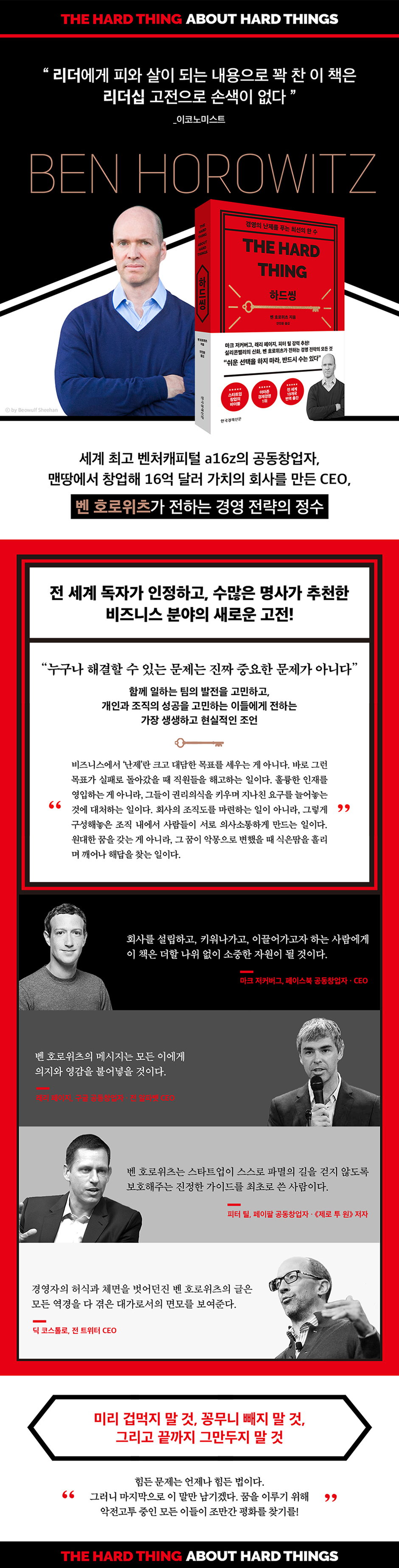
In business, the 'challenge' isn't setting big, bold goals.
It is precisely when such goals fail that employees are fired.
It's not about recruiting great talent, it's about dealing with their excessive demands and developing a sense of entitlement.
It's not about creating an organizational chart for a company, it's about making sure people within that structure communicate with each other.
It's not about having grand dreams, it's about waking up in a cold sweat when those dreams turn into nightmares and searching for answers.
--- From the "Prologue"
So there are no formulas in this book.
Instead, I would like to introduce various difficulties I personally experienced in the business field and how I overcame them.
I've worked in a corporate setting, been a businessman, and even been a CEO.
He is currently working as a venture capitalist.
The lessons learned through firsthand experience throughout this entire process are invaluable and useful assets that cannot be replaced by anything else.
I believe these lessons will be especially useful to the new generation of founders and CEOs.
Establishing and growing a company inevitably involves difficult times.
I too have been involved in that process and have gone through difficult and harsh times.
The circumstances may be different, but the fundamental challenges and the lessons learned will be the same.
--- From the "Prologue"
I also learned the lesson of not judging something by its appearance.
Whether it's a person, a situation, or a thing, you don't know anything about it until you first make an effort to know it.
There are no shortcuts to this knowledge.
This is especially true of knowledge gained through direct experience.
Following conventions and relying on shortcuts can be worse than not knowing anything at all.
--- From "Chapter 1"
Then one day, I asked myself another question.
“What should I do if the company goes bankrupt?” Then, an answer that surprised even me came out of my mouth.
“I want to buy our software Opsware, which runs on LoudCloud, and start a software company.”
--- From Chapter 2
I called Bill Campbell and told him the good news.
He said the deal has been signed and that it will be announced in New York on Monday.
But he gave some unexpected advice.
“It’s a shame, but you absolutely must not go to New York and be the main character of that announcement.
“Send Mark instead,” I asked, puzzled.
“What do you mean?” he explained.
“You are saying that you should stay at the company and inform all employees of the current situation.
You can't delay even a day.
No, this is something that cannot be delayed even for a minute.
We need to allow our employees to clarify their positions as quickly as possible.
“Should I work for you, move to EDS, or look for another job?”
--- From Chapter 2
Developers seeking innovation can consider every possible factor, but often have to go against what is perceived as 'customer-friendly'.
Ultimately, innovation requires both knowledge, skill, and courage.
And sometimes, only the founders of a company have the courage to ignore the data.
We didn't have much time, so I had to step up.
I said this.
“There is no need to worry about the needs of existing customers.
“It is more important to innovate and reinvent our products so that we can win the competition.”
--- From Chapter 3
Remember, at some point you will have to ask yourself this question.
“What are we not doing now?”
--- From Chapter 3
When building a business, you should always believe that there is a solution, not worry about the probability of finding it.
The point is, you just have to find it.
Whether it's 90 percent or 0.1 percent, the probability doesn't matter. The CEO's job remains the same.
--- From Chapter 4
Most management books focus on how to do things right so as not to make mistakes.
But I want to talk about the steps you should take after a situation goes wrong.
The good news is that I have a lot of experience in that area, and so do most other CEOs.
--- From Chapter 4
Struggle is not failure, but it causes failure.
Especially when you are weak.
It's always like that when you're weak.
Most people are not strong enough.
Even great entrepreneurs like Steve Jobs and Mark Zuckerberg have struggled, and they truly struggled in those situations.
So don't worry.
You're not alone.
Of course, that doesn't guarantee you'll win.
I might not be able to overcome it.
If it were that easy, would it be considered a struggle?
Ultimately, a fierce struggle is a situation in which greatness is revealed.
--- From Chapter 4
Bill Campbell, former CEO of Intuit, once said to me:
I hope you too will keep this in mind.
“The CEO’s message about layoffs is for the remaining employees.”
--- From Chapter 4
Bill Campbell once gave me some very important advice when I was preparing to fire an executive.
“Ben, you can’t save his job, but you can save his face.”
--- From Chapter 4
Every CEO says his company will be great.
You won't know if that's truly true until you see how the company or its CEO handles something truly difficult.
Firing executives is a great way to gauge that.
--- From Chapter 4
There comes a time when any company must fight for its very existence.
If you feel like running away when you have to fight, ask yourself this:
“If our company is so bad that it can’t win this fight, is it even worth existing?”
--- From Chapter 4
If you have the mental energy to scrutinize your misfortune, pour it all into finding a way out of your current predicament.
Even if it seems impossible on the surface.
Don't waste a single second on unproductive regrets like, "If only I had done this or that, how would things have turned out differently?"
Spend all your time wondering, 'What should I do now?'
In the end, no one cares, so just run the company.
--- From Chapter 4
If you're not sure where to focus, focus on building a great company to work for, like Bill did.
--- From Chapter 5
The experienced and great CEOs I know all have one important thing in common.
When faced with management-related problems, we often choose the difficult path that others would not readily choose.
--- From Chapter 5
Organizations sometimes need clarity, not solutions.
--- From Chapter 6
As a CEO, you must always consider the impact your words and actions have on the entire organization.
Acting as an open leader, a responsive leader, or an action-oriented leader may make you feel good in the short term.
But we must always keep in mind that doing so may have the unintended consequence of encouraging all sorts of bad things.
--- From Chapter 6
You might think that pouring so much time and effort into promotions and titles is an overemphasis on foolish formalism.
It's the exact opposite.
Without a carefully planned, rigorous process for promotions and promotions, employees will become fixated on the resulting inequities.
--- From Chapter 6
A company is a place where people work together as a team.
No matter how great an employee's potential is, it is impossible to bring out their true potential unless they perform their work in a trustworthy manner.
--- From Chapter 6
But if you want to create something out of nothing, you have to take risks and win the race against time.
This means that you must acquire the best talent, knowledge, and experience.
--- From Chapter 6
The most important lesson I've learned as an entrepreneur is to focus on what needs to be fixed and stop worrying about what you did or might do wrong.
--- From Chapter 7
The secret to getting the right outcome is not to be biased towards either the positive or the negative scenario.
--- From Chapter 7
Whenever I meet a successful CEO, I ask them how they got to where they are today.
Average CEOs often tout their brilliant strategic moves, their intuitive business sense, or any number of other self-satisfying explanations.
But great CEOs are surprisingly consistent in their answers.
They all say this.
“I just didn’t quit.”
--- From Chapter 7
Every time we make a difficult, right decision, we become a little braver, and every time we make an easy, wrong decision, we become a little cowardly.
--- From Chapter 7
When setting standards, you shouldn't look too far ahead.
It is neither unnecessary nor a good idea to judge executives based on what tasks they will be assigned in two years.
That's something to think about when the time comes.
Evaluate executives based on their current performance in their current position.
--- From Chapter 8
The answer is, “Your loyalty should be directed towards your employees.”
That is, employees working under executives, employees in charge of engineering, marketing, sales, finance, human resources, etc.
You have a duty to ensure that they work under top-notch management.
That comes first.
--- From Chapter 8
Also I realized.
Acknowledging and embracing the unique aspects of my background is the key to overcoming them and achieving my goals.
It ultimately gives me a unique perspective and approach to business.
A perspective and approach that no one else but me can have.
--- From Chapter 9
Of course, even if you take all the advice in the world and the wisdom of those who have experienced it as your guide, difficult problems will always be difficult.
So, I will leave you with just this last word.
May all those struggling to achieve their dreams find peace soon!
It is precisely when such goals fail that employees are fired.
It's not about recruiting great talent, it's about dealing with their excessive demands and developing a sense of entitlement.
It's not about creating an organizational chart for a company, it's about making sure people within that structure communicate with each other.
It's not about having grand dreams, it's about waking up in a cold sweat when those dreams turn into nightmares and searching for answers.
--- From the "Prologue"
So there are no formulas in this book.
Instead, I would like to introduce various difficulties I personally experienced in the business field and how I overcame them.
I've worked in a corporate setting, been a businessman, and even been a CEO.
He is currently working as a venture capitalist.
The lessons learned through firsthand experience throughout this entire process are invaluable and useful assets that cannot be replaced by anything else.
I believe these lessons will be especially useful to the new generation of founders and CEOs.
Establishing and growing a company inevitably involves difficult times.
I too have been involved in that process and have gone through difficult and harsh times.
The circumstances may be different, but the fundamental challenges and the lessons learned will be the same.
--- From the "Prologue"
I also learned the lesson of not judging something by its appearance.
Whether it's a person, a situation, or a thing, you don't know anything about it until you first make an effort to know it.
There are no shortcuts to this knowledge.
This is especially true of knowledge gained through direct experience.
Following conventions and relying on shortcuts can be worse than not knowing anything at all.
--- From "Chapter 1"
Then one day, I asked myself another question.
“What should I do if the company goes bankrupt?” Then, an answer that surprised even me came out of my mouth.
“I want to buy our software Opsware, which runs on LoudCloud, and start a software company.”
--- From Chapter 2
I called Bill Campbell and told him the good news.
He said the deal has been signed and that it will be announced in New York on Monday.
But he gave some unexpected advice.
“It’s a shame, but you absolutely must not go to New York and be the main character of that announcement.
“Send Mark instead,” I asked, puzzled.
“What do you mean?” he explained.
“You are saying that you should stay at the company and inform all employees of the current situation.
You can't delay even a day.
No, this is something that cannot be delayed even for a minute.
We need to allow our employees to clarify their positions as quickly as possible.
“Should I work for you, move to EDS, or look for another job?”
--- From Chapter 2
Developers seeking innovation can consider every possible factor, but often have to go against what is perceived as 'customer-friendly'.
Ultimately, innovation requires both knowledge, skill, and courage.
And sometimes, only the founders of a company have the courage to ignore the data.
We didn't have much time, so I had to step up.
I said this.
“There is no need to worry about the needs of existing customers.
“It is more important to innovate and reinvent our products so that we can win the competition.”
--- From Chapter 3
Remember, at some point you will have to ask yourself this question.
“What are we not doing now?”
--- From Chapter 3
When building a business, you should always believe that there is a solution, not worry about the probability of finding it.
The point is, you just have to find it.
Whether it's 90 percent or 0.1 percent, the probability doesn't matter. The CEO's job remains the same.
--- From Chapter 4
Most management books focus on how to do things right so as not to make mistakes.
But I want to talk about the steps you should take after a situation goes wrong.
The good news is that I have a lot of experience in that area, and so do most other CEOs.
--- From Chapter 4
Struggle is not failure, but it causes failure.
Especially when you are weak.
It's always like that when you're weak.
Most people are not strong enough.
Even great entrepreneurs like Steve Jobs and Mark Zuckerberg have struggled, and they truly struggled in those situations.
So don't worry.
You're not alone.
Of course, that doesn't guarantee you'll win.
I might not be able to overcome it.
If it were that easy, would it be considered a struggle?
Ultimately, a fierce struggle is a situation in which greatness is revealed.
--- From Chapter 4
Bill Campbell, former CEO of Intuit, once said to me:
I hope you too will keep this in mind.
“The CEO’s message about layoffs is for the remaining employees.”
--- From Chapter 4
Bill Campbell once gave me some very important advice when I was preparing to fire an executive.
“Ben, you can’t save his job, but you can save his face.”
--- From Chapter 4
Every CEO says his company will be great.
You won't know if that's truly true until you see how the company or its CEO handles something truly difficult.
Firing executives is a great way to gauge that.
--- From Chapter 4
There comes a time when any company must fight for its very existence.
If you feel like running away when you have to fight, ask yourself this:
“If our company is so bad that it can’t win this fight, is it even worth existing?”
--- From Chapter 4
If you have the mental energy to scrutinize your misfortune, pour it all into finding a way out of your current predicament.
Even if it seems impossible on the surface.
Don't waste a single second on unproductive regrets like, "If only I had done this or that, how would things have turned out differently?"
Spend all your time wondering, 'What should I do now?'
In the end, no one cares, so just run the company.
--- From Chapter 4
If you're not sure where to focus, focus on building a great company to work for, like Bill did.
--- From Chapter 5
The experienced and great CEOs I know all have one important thing in common.
When faced with management-related problems, we often choose the difficult path that others would not readily choose.
--- From Chapter 5
Organizations sometimes need clarity, not solutions.
--- From Chapter 6
As a CEO, you must always consider the impact your words and actions have on the entire organization.
Acting as an open leader, a responsive leader, or an action-oriented leader may make you feel good in the short term.
But we must always keep in mind that doing so may have the unintended consequence of encouraging all sorts of bad things.
--- From Chapter 6
You might think that pouring so much time and effort into promotions and titles is an overemphasis on foolish formalism.
It's the exact opposite.
Without a carefully planned, rigorous process for promotions and promotions, employees will become fixated on the resulting inequities.
--- From Chapter 6
A company is a place where people work together as a team.
No matter how great an employee's potential is, it is impossible to bring out their true potential unless they perform their work in a trustworthy manner.
--- From Chapter 6
But if you want to create something out of nothing, you have to take risks and win the race against time.
This means that you must acquire the best talent, knowledge, and experience.
--- From Chapter 6
The most important lesson I've learned as an entrepreneur is to focus on what needs to be fixed and stop worrying about what you did or might do wrong.
--- From Chapter 7
The secret to getting the right outcome is not to be biased towards either the positive or the negative scenario.
--- From Chapter 7
Whenever I meet a successful CEO, I ask them how they got to where they are today.
Average CEOs often tout their brilliant strategic moves, their intuitive business sense, or any number of other self-satisfying explanations.
But great CEOs are surprisingly consistent in their answers.
They all say this.
“I just didn’t quit.”
--- From Chapter 7
Every time we make a difficult, right decision, we become a little braver, and every time we make an easy, wrong decision, we become a little cowardly.
--- From Chapter 7
When setting standards, you shouldn't look too far ahead.
It is neither unnecessary nor a good idea to judge executives based on what tasks they will be assigned in two years.
That's something to think about when the time comes.
Evaluate executives based on their current performance in their current position.
--- From Chapter 8
The answer is, “Your loyalty should be directed towards your employees.”
That is, employees working under executives, employees in charge of engineering, marketing, sales, finance, human resources, etc.
You have a duty to ensure that they work under top-notch management.
That comes first.
--- From Chapter 8
Also I realized.
Acknowledging and embracing the unique aspects of my background is the key to overcoming them and achieving my goals.
It ultimately gives me a unique perspective and approach to business.
A perspective and approach that no one else but me can have.
--- From Chapter 9
Of course, even if you take all the advice in the world and the wisdom of those who have experienced it as your guide, difficult problems will always be difficult.
So, I will leave you with just this last word.
May all those struggling to achieve their dreams find peace soon!
--- From Chapter 9
Publisher's Review
“In business, the ‘challenge’ isn’t setting big, bold goals.
It is precisely when such goals fail that employees are fired.
It's not about recruiting great talent, it's about dealing with their excessive demands and developing a sense of entitlement.
It's not about creating an organizational chart for a company, it's about making sure people within that structure communicate with each other.
“It’s not about having grand dreams, it’s about waking up in a cold sweat when those dreams turn into nightmares and searching for answers.”
《Hard Thing》 begins with the above words.
I can already hear people complaining about the exhausting story they heard as soon as they opened the book.
How about talking about it like this?
What do you do when you're faced with the need to lay off employees? What if a talented employee you brought in on exceptional terms fails to deliver the expected results and becomes a source of frustration? How do you handle an epidemic of office politics? And that's not all.
The truly difficult problems in business are endless.
When we emphasized responsibility to our employees, we saw a situation where they were only concerned with avoiding disciplinary action and not spending time on solving important problems. A situation where a key talent who had been scouted by another company was demanding a raise, and a situation where the company's future had to be decided between maintaining it and selling it...
There is no perfect formula to answer the series of situations just listed.
The author says we must accept this point and start from there.
So what we need to look for are rules of thumb and advice that can help make the situation a little easier.
So, “there is no formula in this book”.
Keep both feet on the ground.
Above all, the formulas that assume perfect situations, which are often mentioned in economics and management books, do not work in reality.
The business world is not a laboratory.
This is why Ben Horowitz offers the "best move" to solve problems without a right answer, drawing on his diverse experiences as an entrepreneur, CEO, investor, and software engineer.
Ben Horowitz, a self-proclaimed Silicon Valley superstar, started his own company in 1999, sold it to HP for $1.6 billion in 2007, and is currently a venture capitalist at a16z, which he co-founded with Marc Andreessen in 2009.
His glamorous image as a successful entrepreneur and renowned investor is highlighted, but behind it lies unimaginable 'blood, sweat, and tears' and a roller coaster-like twists and turns.
In this book, he vividly describes the struggles he endured, from starting a business, to the brink of bankruptcy, to a brilliant comeback, a successful sale, and finally, to starting a new business.
Don't be afraid, don't back down, and don't quit until the very end.
There are no right answers in the business world.
Yet, there are people who find the answer!
The book is divided into three main areas.
Chapters 1 through 3 are about Ben Horowitz's struggles.
It quickly unfolds the process of starting a company from scratch and growing it into an astronomical company.
In chapters 4 through 8, which are the most extensive, he reveals his know-how in detail.
It covers all aspects of management, from organizational management to attracting investment.
It's okay to read them in order, but you can start from any part you like.
For example, if you need to fill a position you're unfamiliar with, look at Chapter 5, "How to Find the Right Person for a Job You've Never Done Before."
Additionally, the appendix, "Things to Consider When Hiring Employees" and "Questions CEOs Should Ask Themselves," is full of valuable information for managers in organizations.
The final chapter, Chapter 9, concludes the story and describes the process of founding a16z, currently considered one of the world's leading venture capital firms.
Ben Horowitz never digresses or evades, even in the smallest details.
The story is told in a refreshing and bold manner.
There are times when I honestly confess the burden of responsibility and the loneliness of being a leader.
Let's look at the section that deals with the issue of rank within the company.
These days, setting strict rules for titles and ranks is often criticized as anachronistic and formalistic.
However, the author draws the line, saying, 'Position is ultimately necessary.'
It is essential to consider the circumstances that employees will face when they change jobs, and to improve the efficiency of communication between employees.
The author then asks the following question:
Is it better to set the position high or is it better to do the opposite?
The argument is developed by comparing Marc Andreessen and Mark Zuckerberg.
The former is to set the position as high as possible, as the position has a low cost compared to bonus, salary, and authority.
The latter, Facebook, maintains a lower-than-industry-average job title policy.
This prevents new employees from being promoted to higher positions than existing, more capable employees, and increases fairness in the promotion process within the organization.
So which method is better? There's no perfect answer.
It depends on the status of your company.
Facebook doesn't lose out on recruiting talent by setting job titles low.
Because it is the best company.
On the other hand, if other advantages are minimal, assigning a high position can be a good strategy for recruiting talent.
However, whichever scenario is adopted, it must have a highly disciplined and fair process.
This is how Ben Horowitz solves problems that have no right answer.
Rather than naively expecting everyone to work hard, we need to think about how to create conditions that encourage hard work.
And it doesn't end with 'I did this', it doesn't leave out 'why'.
Just as you persuade your organization members through sufficient discussion and rational reasons, you persuade your readers.
What this means is that if you focus on the reasons for his choices, rather than the methods he adopted, you can do it too.
And “that’s the CEO’s job.”
As you listen to his story of success, built daily through going back and forth between hurt and pain, you will understand why he repeatedly emphasizes, "Don't avoid it, and don't quit until the very end."
He concludes his book with words of encouragement to all the world's leaders who, like him, are struggling under adverse conditions today.
“Of course, even if you take all the advice in the world and the wisdom of those who have experienced it as your guide, difficult problems will always be difficult.
So, I will leave you with just this last word.
“May all those struggling to achieve their dreams find peace soon!”
It is precisely when such goals fail that employees are fired.
It's not about recruiting great talent, it's about dealing with their excessive demands and developing a sense of entitlement.
It's not about creating an organizational chart for a company, it's about making sure people within that structure communicate with each other.
“It’s not about having grand dreams, it’s about waking up in a cold sweat when those dreams turn into nightmares and searching for answers.”
《Hard Thing》 begins with the above words.
I can already hear people complaining about the exhausting story they heard as soon as they opened the book.
How about talking about it like this?
What do you do when you're faced with the need to lay off employees? What if a talented employee you brought in on exceptional terms fails to deliver the expected results and becomes a source of frustration? How do you handle an epidemic of office politics? And that's not all.
The truly difficult problems in business are endless.
When we emphasized responsibility to our employees, we saw a situation where they were only concerned with avoiding disciplinary action and not spending time on solving important problems. A situation where a key talent who had been scouted by another company was demanding a raise, and a situation where the company's future had to be decided between maintaining it and selling it...
There is no perfect formula to answer the series of situations just listed.
The author says we must accept this point and start from there.
So what we need to look for are rules of thumb and advice that can help make the situation a little easier.
So, “there is no formula in this book”.
Keep both feet on the ground.
Above all, the formulas that assume perfect situations, which are often mentioned in economics and management books, do not work in reality.
The business world is not a laboratory.
This is why Ben Horowitz offers the "best move" to solve problems without a right answer, drawing on his diverse experiences as an entrepreneur, CEO, investor, and software engineer.
Ben Horowitz, a self-proclaimed Silicon Valley superstar, started his own company in 1999, sold it to HP for $1.6 billion in 2007, and is currently a venture capitalist at a16z, which he co-founded with Marc Andreessen in 2009.
His glamorous image as a successful entrepreneur and renowned investor is highlighted, but behind it lies unimaginable 'blood, sweat, and tears' and a roller coaster-like twists and turns.
In this book, he vividly describes the struggles he endured, from starting a business, to the brink of bankruptcy, to a brilliant comeback, a successful sale, and finally, to starting a new business.
Don't be afraid, don't back down, and don't quit until the very end.
There are no right answers in the business world.
Yet, there are people who find the answer!
The book is divided into three main areas.
Chapters 1 through 3 are about Ben Horowitz's struggles.
It quickly unfolds the process of starting a company from scratch and growing it into an astronomical company.
In chapters 4 through 8, which are the most extensive, he reveals his know-how in detail.
It covers all aspects of management, from organizational management to attracting investment.
It's okay to read them in order, but you can start from any part you like.
For example, if you need to fill a position you're unfamiliar with, look at Chapter 5, "How to Find the Right Person for a Job You've Never Done Before."
Additionally, the appendix, "Things to Consider When Hiring Employees" and "Questions CEOs Should Ask Themselves," is full of valuable information for managers in organizations.
The final chapter, Chapter 9, concludes the story and describes the process of founding a16z, currently considered one of the world's leading venture capital firms.
Ben Horowitz never digresses or evades, even in the smallest details.
The story is told in a refreshing and bold manner.
There are times when I honestly confess the burden of responsibility and the loneliness of being a leader.
Let's look at the section that deals with the issue of rank within the company.
These days, setting strict rules for titles and ranks is often criticized as anachronistic and formalistic.
However, the author draws the line, saying, 'Position is ultimately necessary.'
It is essential to consider the circumstances that employees will face when they change jobs, and to improve the efficiency of communication between employees.
The author then asks the following question:
Is it better to set the position high or is it better to do the opposite?
The argument is developed by comparing Marc Andreessen and Mark Zuckerberg.
The former is to set the position as high as possible, as the position has a low cost compared to bonus, salary, and authority.
The latter, Facebook, maintains a lower-than-industry-average job title policy.
This prevents new employees from being promoted to higher positions than existing, more capable employees, and increases fairness in the promotion process within the organization.
So which method is better? There's no perfect answer.
It depends on the status of your company.
Facebook doesn't lose out on recruiting talent by setting job titles low.
Because it is the best company.
On the other hand, if other advantages are minimal, assigning a high position can be a good strategy for recruiting talent.
However, whichever scenario is adopted, it must have a highly disciplined and fair process.
This is how Ben Horowitz solves problems that have no right answer.
Rather than naively expecting everyone to work hard, we need to think about how to create conditions that encourage hard work.
And it doesn't end with 'I did this', it doesn't leave out 'why'.
Just as you persuade your organization members through sufficient discussion and rational reasons, you persuade your readers.
What this means is that if you focus on the reasons for his choices, rather than the methods he adopted, you can do it too.
And “that’s the CEO’s job.”
As you listen to his story of success, built daily through going back and forth between hurt and pain, you will understand why he repeatedly emphasizes, "Don't avoid it, and don't quit until the very end."
He concludes his book with words of encouragement to all the world's leaders who, like him, are struggling under adverse conditions today.
“Of course, even if you take all the advice in the world and the wisdom of those who have experienced it as your guide, difficult problems will always be difficult.
So, I will leave you with just this last word.
“May all those struggling to achieve their dreams find peace soon!”
GOODS SPECIFICS
- Publication date: March 15, 2021
- Page count, weight, size: 412 pages | 730g | 152*224*24mm
- ISBN13: 9788947547031
- ISBN10: 8947547034
You may also like
카테고리
korean


korean

![GQ KOREA Mark (Monthly): December [2025]](http://librairie.coreenne.fr/cdn/shop/files/8ef265dbbfbf186523ed75ba7319009d.jpg?v=1765340328&width=3840)


