

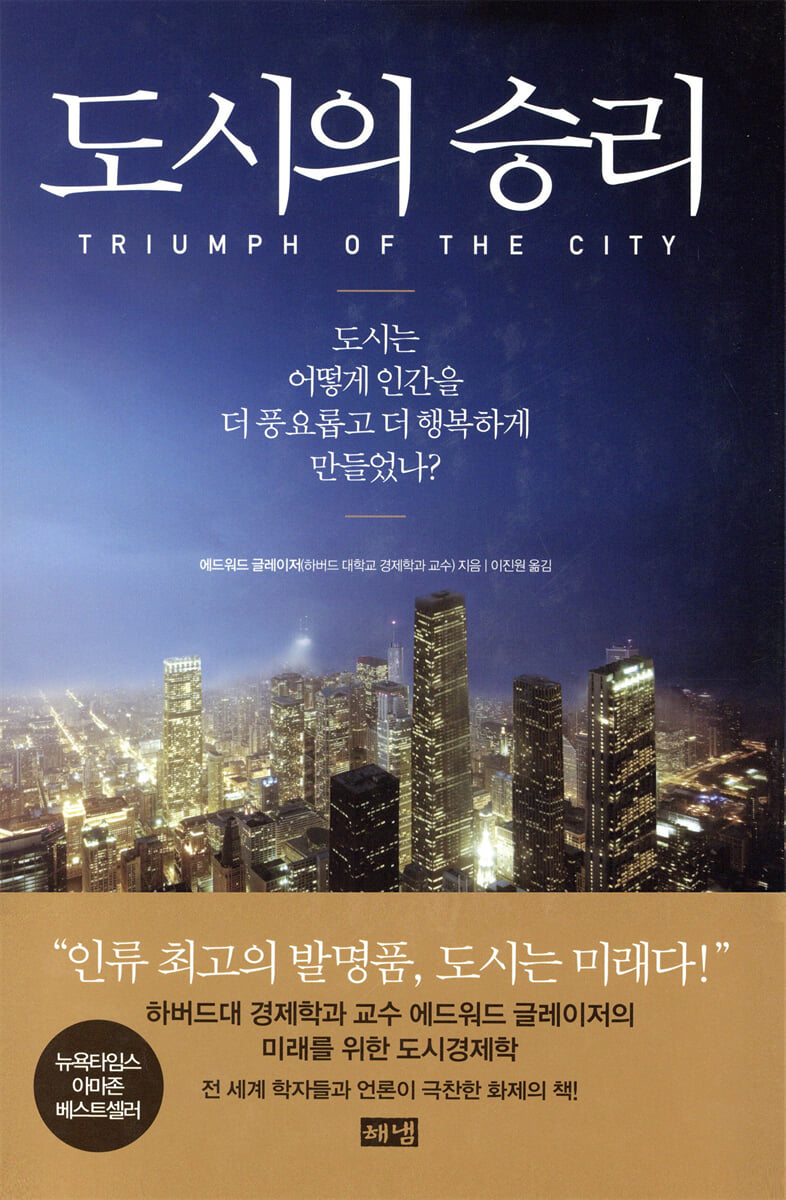
Victory of the City
 |
Description
Book Introduction
“Why should we live in the city?”
A brilliant insight into the mechanisms of cities and the future of urban humanity!
The DNA of a winning city analyzed by genius urban economist Edward Glaser!
Today, more than half of the world's population lives in cities, and in our country, 70% of the population lives in large cities.
As a result, issues such as urban overcrowding, confusion in urban housing policy, and problems with the construction of large-scale administrative cities are being discussed, the importance of a correct vision and policy for cities is emerging more than ever.
Accordingly, the new book, "TRIUMPH OF THE CITY," by Professor Edward Glaeser of Harvard University, a world authority in the field of urban economics, provides keen analysis and insight into the rise and fall of cities around the world and their key issues, thereby helping us gauge the direction in which Korean cities should move forward.
This book was published in the United States in February 2011 and immediately became a bestseller on Amazon and the New York Times, and was called “a book that offers surprising insights and policy proposals about cities” (The New York Times) and “a masterpiece that seamlessly connects economics and history, explaining why cities are ‘our greatest invention’” (Stephen D.
He received praise from the author of Freakonomics (Levitt).
Given our current situation, where rapid economic growth and a small national land area are leading to serious urban problems, and where there are virtually no popular books on urban economics, the publication of this book holds special significance.
In particular, the author, Professor Edward Glaser, is currently receiving attention as one of the most controversial and outstanding young scholars in the United States, and is emerging as a key opinion leader not only in academia but also among urban policy and economic policymakers around the world.
Are cities truly still dirty, impoverished, dens of crime, and environmentally unfriendly? The author, who asserts that "the city is humanity's greatest invention," shatters long-held prejudices and re-examines the value and future of cities through extensive research and provocative writing spanning economics, society, history, policy, and culture.
The book consists of 10 chapters, presenting fascinating cases from around the world, from New York to Mumbai, India. It addresses issues surrounding cities, such as the connection between urban success and human capital; new solutions to chronic urban problems such as disease, traffic, housing policy, and environmental issues; the endless conflict between development and conservation; the pros and cons of urban sprawl; and urban poverty and the rise of the consumer city.
Through this, we derive a successful formula for cities in today's age of globalization and information technology, proving that cities are the most humane, healthy, environmentally friendly, and culturally and economically viable places to live.
Cities are powerhouses of innovation.
The proximity, intimacy, and congestion of cities attract human resources such as talent, technology, and ideas, making them centers of innovation.
This is the key factor in a successful city.
21st century
Bangalore, India, a gateway to cutting-edge ideas, and Silicon Valley, USA, show how education and new technologies bring people together to drive urban success.
It also vividly illustrates the principles of urban success by comparing Detroit, once a manufacturing mecca but now a declining automobile empire, with New York, which has transformed into a financial, publishing, and cultural center and has since risen to become a global hub.
Cities are the key to health, prosperity, and happiness.
Our success as a nation and as individuals depends on the health and wealth of our cities.
For example, New Yorkers have lower rates of heart disease and cancer than Americans in other parts of the country, and more than half of all American income comes from just 22 metropolitan areas.
It is often thought that cities make people poor, but the author counters that this is because cities attract the poor as lands of opportunity.
The urban poor are wealthier, have better hygiene, and have more opportunities than the rural poor.
He also argues that cities, as seen in the rise of consumer cities like London in the 1960s, must now transform into playgrounds for humans indulging in taste and style, as well as creative spaces where ideas and capital circulate.
The world is flat, but cities must rise.
Various regulations and preservation policies warn that they can hinder urban development and exacerbate urban sprawl.
While India's hub Mumbai has suffered from high housing prices, sprawl, slums, and corruption due to its land-use restrictions, Shanghai, China, has a booming economy but attracts numerous foreign entrepreneurs due to its flexible housing policies.
It also explains the city's eco-friendliness by proving with various statistics that migration to the suburbs actually causes more serious environmental destruction.
While emphasizing flexible urban development and housing supply policies, he criticizes large-scale political construction projects carried out under the pretext of urban regeneration, emphasizing once again that the true power of a city comes from its people, not its buildings.
Invest in people!
In this book, Professor Edward Glaser argues that the power to attract human capital such as education, technology, ideas, talent, and entrepreneurship and to enable them to collaborate has a significant impact on the prosperity of cities and nations, as well as human happiness, and he presents criticisms of flawed urban policies and alternatives.
Although based on American realities, this will offer sober and realistic advice to our urban policies, which are facing numerous issues such as the construction of new towns and new cities, and the many conflicts that arise in the process.
"Victory of the City" will help make cities more humane and livable by presenting the true value of cities and the right direction for development to those who study cities and make policies in this land, as well as to all who live in cities.
A brilliant insight into the mechanisms of cities and the future of urban humanity!
The DNA of a winning city analyzed by genius urban economist Edward Glaser!
Today, more than half of the world's population lives in cities, and in our country, 70% of the population lives in large cities.
As a result, issues such as urban overcrowding, confusion in urban housing policy, and problems with the construction of large-scale administrative cities are being discussed, the importance of a correct vision and policy for cities is emerging more than ever.
Accordingly, the new book, "TRIUMPH OF THE CITY," by Professor Edward Glaeser of Harvard University, a world authority in the field of urban economics, provides keen analysis and insight into the rise and fall of cities around the world and their key issues, thereby helping us gauge the direction in which Korean cities should move forward.
This book was published in the United States in February 2011 and immediately became a bestseller on Amazon and the New York Times, and was called “a book that offers surprising insights and policy proposals about cities” (The New York Times) and “a masterpiece that seamlessly connects economics and history, explaining why cities are ‘our greatest invention’” (Stephen D.
He received praise from the author of Freakonomics (Levitt).
Given our current situation, where rapid economic growth and a small national land area are leading to serious urban problems, and where there are virtually no popular books on urban economics, the publication of this book holds special significance.
In particular, the author, Professor Edward Glaser, is currently receiving attention as one of the most controversial and outstanding young scholars in the United States, and is emerging as a key opinion leader not only in academia but also among urban policy and economic policymakers around the world.
Are cities truly still dirty, impoverished, dens of crime, and environmentally unfriendly? The author, who asserts that "the city is humanity's greatest invention," shatters long-held prejudices and re-examines the value and future of cities through extensive research and provocative writing spanning economics, society, history, policy, and culture.
The book consists of 10 chapters, presenting fascinating cases from around the world, from New York to Mumbai, India. It addresses issues surrounding cities, such as the connection between urban success and human capital; new solutions to chronic urban problems such as disease, traffic, housing policy, and environmental issues; the endless conflict between development and conservation; the pros and cons of urban sprawl; and urban poverty and the rise of the consumer city.
Through this, we derive a successful formula for cities in today's age of globalization and information technology, proving that cities are the most humane, healthy, environmentally friendly, and culturally and economically viable places to live.
Cities are powerhouses of innovation.
The proximity, intimacy, and congestion of cities attract human resources such as talent, technology, and ideas, making them centers of innovation.
This is the key factor in a successful city.
21st century
Bangalore, India, a gateway to cutting-edge ideas, and Silicon Valley, USA, show how education and new technologies bring people together to drive urban success.
It also vividly illustrates the principles of urban success by comparing Detroit, once a manufacturing mecca but now a declining automobile empire, with New York, which has transformed into a financial, publishing, and cultural center and has since risen to become a global hub.
Cities are the key to health, prosperity, and happiness.
Our success as a nation and as individuals depends on the health and wealth of our cities.
For example, New Yorkers have lower rates of heart disease and cancer than Americans in other parts of the country, and more than half of all American income comes from just 22 metropolitan areas.
It is often thought that cities make people poor, but the author counters that this is because cities attract the poor as lands of opportunity.
The urban poor are wealthier, have better hygiene, and have more opportunities than the rural poor.
He also argues that cities, as seen in the rise of consumer cities like London in the 1960s, must now transform into playgrounds for humans indulging in taste and style, as well as creative spaces where ideas and capital circulate.
The world is flat, but cities must rise.
Various regulations and preservation policies warn that they can hinder urban development and exacerbate urban sprawl.
While India's hub Mumbai has suffered from high housing prices, sprawl, slums, and corruption due to its land-use restrictions, Shanghai, China, has a booming economy but attracts numerous foreign entrepreneurs due to its flexible housing policies.
It also explains the city's eco-friendliness by proving with various statistics that migration to the suburbs actually causes more serious environmental destruction.
While emphasizing flexible urban development and housing supply policies, he criticizes large-scale political construction projects carried out under the pretext of urban regeneration, emphasizing once again that the true power of a city comes from its people, not its buildings.
Invest in people!
In this book, Professor Edward Glaser argues that the power to attract human capital such as education, technology, ideas, talent, and entrepreneurship and to enable them to collaborate has a significant impact on the prosperity of cities and nations, as well as human happiness, and he presents criticisms of flawed urban policies and alternatives.
Although based on American realities, this will offer sober and realistic advice to our urban policies, which are facing numerous issues such as the construction of new towns and new cities, and the many conflicts that arise in the process.
"Victory of the City" will help make cities more humane and livable by presenting the true value of cities and the right direction for development to those who study cities and make policies in this land, as well as to all who live in cities.
- You can preview some of the book's contents.
Preview
index
Recommendation
Preface to the Korean Edition | Seoul: A Hub of Innovation
Introduction | The true power of a city comes from its people.
Chapter 1 - What Do They Make in Bangalore?
Athens, the entry port of knowledge | Baghdad, the 'House of Wisdom' | Lessons from Nagasaki, the entry port of goods and knowledge | How Bangalore, India, became a boomtown | Human capital is the key to successful cities | The rise of Silicon Valley, a hub for technology and ideas | What drives cities in the information technology age? | Books, the Internet, and technological advancements that accelerated urbanization.
Chapter 2 - Why Do Cities Decline?
The Rust Belt: Origins at the Center of Transportation Networks | Henry Ford and Detroit's Auto Industry | The Decline of Manufacturing Cities | Why Detroit Rioted | The Rise of New York and the Fall of Detroit | Detroit Mayor Coleman Young's Justified Fury | Urban Policy and the 'Curley Effect' | The Orientation for Massive Buildings | Why Cities Still Remain in Decline | The 'Great Destruction' and Urban Regeneration
Chapter 3: There is hope even in poor cities.
Cities as a New Land of Opportunity | Urban Poverty and Rural Poverty | Cities That Enabled Poor Immigrants to Elevate Their Status | Richard Wright's Urban Escape | The Rise and Fall of America's Slums | Poverty and Urban Transportation | Government Policies That Deepen Poverty
Chapter 4 - How to treat a sick and crowded city?
Incompetent policies that lead urban dwellers to disaster | The plight of Kinshasa, the 'world's scariest city' | Can the private sector provide clean water? | Street cleaning and corruption in power | Will more roads lead to less congestion? | Building safe cities | The complex phenomenology of urban crime | A new approach to urban security | Cities are no longer 'gardens of death'
Chapter 5: A Happy City Succeeds
Economies of scale and the Globe Theatre | Restaurant boom, the city's obsession with taste | Fashion and the city | London as a marriage market | The rapidly growing consumer city
Chapter 6: Why Skyscrapers, Icons of Urban Development, Are So Great
The History of Skyscrapers: Icons of Urban Development | A.
E. Lefcott's overflowing ambition | New York's 'height' regulations | Jane Jacobs' opposition to high-rise construction | The perils of preservation and regulation | Rethinking Paris | Mumbai's mismanagement | Three rules for good urban architecture
Chapter 7: Why is urban sprawl worsening?
Why I Left the City | Sprawl Before the Automobile | The Rise of the Automobile and the Intensification of Sprawl | Arthur Levitt and Mass-Produced Housing | Remaking America Around the Car | Welcome to the Woodlands | Why Did a Million People Move to Houston? | Why Are Houses So Cheap in the Sunbelt? | What's the Problem with Sprawl?
Chapter 8 - Is there anything more environmentally friendly than asphalt?
The Unforgettable Dream of Garden Life | Comparing the Carbon Footprint of Urban Housing | The Unintended Consequences of the Environmental Movement | Two Green Visions: Prince Charles vs. Mayor Livingstone | The Toughest Fight: Greening India and China | Pursuing 'Smart' Environmentalism
Chapter 9: The Equation for Urban Success
Imperial Cities: Tokyo | Well-Managed Cities: Singapore and Gaborone | Smart Cities: Boston, Minneapolis, Milan | Rational Immigration Policies and Urban Planning: Vancouver | Growth Cities: Chicago and Atlanta | Dubai's Over-Aggression
Chapter 10: A Flat World, Rising Cities
Level the playing field for cities | Urbanization through globalization | Invest aggressively in quality education | Help the poor, not the poor places | Challenge urban poverty | The growth of consumer cities | Break the curse of NIMBYism that hinders urban development | The bias against sprawl | Green cities | The gift of cities
Preface to the Korean Edition | Seoul: A Hub of Innovation
Introduction | The true power of a city comes from its people.
Chapter 1 - What Do They Make in Bangalore?
Athens, the entry port of knowledge | Baghdad, the 'House of Wisdom' | Lessons from Nagasaki, the entry port of goods and knowledge | How Bangalore, India, became a boomtown | Human capital is the key to successful cities | The rise of Silicon Valley, a hub for technology and ideas | What drives cities in the information technology age? | Books, the Internet, and technological advancements that accelerated urbanization.
Chapter 2 - Why Do Cities Decline?
The Rust Belt: Origins at the Center of Transportation Networks | Henry Ford and Detroit's Auto Industry | The Decline of Manufacturing Cities | Why Detroit Rioted | The Rise of New York and the Fall of Detroit | Detroit Mayor Coleman Young's Justified Fury | Urban Policy and the 'Curley Effect' | The Orientation for Massive Buildings | Why Cities Still Remain in Decline | The 'Great Destruction' and Urban Regeneration
Chapter 3: There is hope even in poor cities.
Cities as a New Land of Opportunity | Urban Poverty and Rural Poverty | Cities That Enabled Poor Immigrants to Elevate Their Status | Richard Wright's Urban Escape | The Rise and Fall of America's Slums | Poverty and Urban Transportation | Government Policies That Deepen Poverty
Chapter 4 - How to treat a sick and crowded city?
Incompetent policies that lead urban dwellers to disaster | The plight of Kinshasa, the 'world's scariest city' | Can the private sector provide clean water? | Street cleaning and corruption in power | Will more roads lead to less congestion? | Building safe cities | The complex phenomenology of urban crime | A new approach to urban security | Cities are no longer 'gardens of death'
Chapter 5: A Happy City Succeeds
Economies of scale and the Globe Theatre | Restaurant boom, the city's obsession with taste | Fashion and the city | London as a marriage market | The rapidly growing consumer city
Chapter 6: Why Skyscrapers, Icons of Urban Development, Are So Great
The History of Skyscrapers: Icons of Urban Development | A.
E. Lefcott's overflowing ambition | New York's 'height' regulations | Jane Jacobs' opposition to high-rise construction | The perils of preservation and regulation | Rethinking Paris | Mumbai's mismanagement | Three rules for good urban architecture
Chapter 7: Why is urban sprawl worsening?
Why I Left the City | Sprawl Before the Automobile | The Rise of the Automobile and the Intensification of Sprawl | Arthur Levitt and Mass-Produced Housing | Remaking America Around the Car | Welcome to the Woodlands | Why Did a Million People Move to Houston? | Why Are Houses So Cheap in the Sunbelt? | What's the Problem with Sprawl?
Chapter 8 - Is there anything more environmentally friendly than asphalt?
The Unforgettable Dream of Garden Life | Comparing the Carbon Footprint of Urban Housing | The Unintended Consequences of the Environmental Movement | Two Green Visions: Prince Charles vs. Mayor Livingstone | The Toughest Fight: Greening India and China | Pursuing 'Smart' Environmentalism
Chapter 9: The Equation for Urban Success
Imperial Cities: Tokyo | Well-Managed Cities: Singapore and Gaborone | Smart Cities: Boston, Minneapolis, Milan | Rational Immigration Policies and Urban Planning: Vancouver | Growth Cities: Chicago and Atlanta | Dubai's Over-Aggression
Chapter 10: A Flat World, Rising Cities
Level the playing field for cities | Urbanization through globalization | Invest aggressively in quality education | Help the poor, not the poor places | Challenge urban poverty | The growth of consumer cities | Break the curse of NIMBYism that hinders urban development | The bias against sprawl | Green cities | The gift of cities
Detailed image

Into the book
The success of places like Bangalore wasn't solely a result of international intellectual exchange.
In these cities, employers are attracted to a large pool of potential workers, and workers find jobs in a virtuous cycle where they are attracted to a rich pool of potential employers.
So companies come to Bangalore looking for engineers, and engineers come to companies looking for engineers.
The size of the city also makes it much easier for workers to move between jobs.
In highly entrepreneurial industries, workers move from company to company to advance their careers.
Young people change employers, learn new skills, increase production, and earn better wages.
Having a large number of employees working together has the effect of providing implicit insurance against the bankruptcy of a particular startup.
There will always be another software company in Bangalore.
Additionally, as talented entrepreneurs flock to the area, it will encourage the growth of related industries, much like the venture capital firms operating near Silicon Valley.
--- Chapter 1 What Do They Make in Bangalore?
By making humans cogs in a vast industrial machine, Ford made it possible for people to be highly productive without having to know much about everything.
But if people knew just a little, there would be less need for cities that spread knowledge.
If a city has the powerful idea of destroying knowledge, it is preparing for its own destruction.
The irony, and ultimately the tragedy, of Detroit's situation is that its small, dynamic companies and independent component manufacturers have grown into fully integrated, massive automakers.
They subsequently became synonymous with 'stagnation'.
Ford realized that while massive scale allowed him to build cars more cheaply, self-contained, megafactories were hostile to the city's virtues of competition and connectivity.
Ford figured out how to create an assembly line that could harness the talents of poorly educated Americans, but he hurt the economy in the long run by making Detroit a less skilled city.
--- From Chapter 2, Why Do Cities Decline?
What forces attract the poor to cities? Above all, they seek jobs.
The city's high population density facilitates trade.
That is, it allows us to create a market.
The most important market in the world is the labor market.
Here, people lend their human capital to those with financial capital.
But cities do not simply provide a space for workers and capitalists to interact.
Cities often offer a wide range of jobs, often numbering in the thousands.
The big cities are a diversified portfolio of employers.
In a city, if one employer goes bankrupt, there are other employers (maybe two, maybe ten) to replace him.
While this mix of employers may not provide insurance against a global economic collapse due to a severe slowdown, it certainly helps mitigate the day-to-day volatility of the market.
--- From Chapter 3: There is hope even in poor cities
Cities in developing countries must do what Western cities did in the 19th and early 20th centuries.
In other words, we must safely remove human waste while providing clean water.
City governments must make slums safe.
We must do what too many American cities have failed to do: eliminate the isolation that can rob poor children of the benefits most people get from living in big cities.
The West's battle against disease, corruption, crime, and isolation in its cities over the past two centuries holds many lessons for developing countries today, but unfortunately, one of those lessons is that this fight is far from easy.
--- Chapter 4: How to Treat a Sick and Crowded City?
What publicly provided amenities are most important to attracting skilled talent? People, especially those with higher education, will pay a lot for safe roads and good schools for their children.
As the importance of consumer cities grows, city leaders will focus on performing basic local government functions such as maintaining street safety and improving the quality of public schools.
Restaurants and theaters also play a role in attracting skilled workers, but they are not as important as safety and schools, and they do not require government intervention.
These amenities are a natural outgrowth of urban prosperity, at least as long as the city does not overly regulate the pleasures they provide.
--- From Chapter 5, "A Happy City Succeeds"
While it is worth protecting the most beautiful vestiges of our city's past, we must not allow our cities to become like preserved amber fossils.
Excessive preservation prevents cities from providing newer, bigger, and better buildings for their residents.
Height limits in Paris, New York and Mumbai may seem like vague puzzles that concern only urban planners.
There could be nothing more wrong than that.
These rules are shaping the future of our cities and the world.
If a city's history binds it, it loses its greatest asset: its ability to develop.
--- Chapter 6: Why Skyscrapers Are Great, the Icon of Urban Development
Transportation technology is reshaping the societies we live in, and modern sprawl is a byproduct of car culture.
The 'connectivity' that defines cities has always benefited from transportation technology in some form.
Sprawl is not the opposite of high urban population density.
Even isolated rural areas are densely populated.
People living in expanding quasi-suburban areas may come into contact with neighbors, stores, employees, restaurants, and more.
However, they have to drive to make such contact.
Sprawl began long ago when people began using other modes of transportation besides foot traffic, and later boats, horses, buses, elevators, subways, and automobiles all influenced the layout and growth of cities.
Many older areas, such as New York's Washington Square and Barcelona's Eixample, which are now beloved by city dwellers, are examples of early sprawl.
--- From Chapter 7: Why is urban sprawl worsening?
As with Soro's case, my personal story suggests one important point.
That is, cities are far more beneficial to the environment than forested living spaces.
Living in the forest might be a great way to show your love for nature, but living in a concrete jungle is actually much more eco-friendly.
We humans have destructive tendencies.
Even when we don't do it on purpose, like Soro does.
We burn forests and oil, which ultimately harms the surrounding environment.
If you love nature, you must live away from nature.
In the 1970s, Jane Jacobs argued that we could minimize our environmental impact by living together in tall buildings and walking to work.
David Owen makes a compelling case for this in his book Green Metropolis.
When we insist on living surrounded by green space, we are maximizing the damage we do to the environment.
Low-density areas ultimately require more movement, which requires more energy.
While spacious living spaces certainly have their advantages, suburban homes consume significantly more energy.
--- Chapter 8 Is there anything more environmentally friendly than asphalt?
Jean-Jacques Rousseau, the 18th-century French Enlightenment thinker, famously said, “The city is a deep abyss where the human species lives together,” but he completely misunderstood the city.
Cities enable the collaborative work that makes humanity shine brightest.
Because humans learn so much from other humans, we learn more when we are with more people.
The chaos of cities creates a constant flow of new information gained by observing the successes and failures of others.
Just as Monet and Cézanne found each other in 19th-century Paris, and Belushi and Ackroyd found each other in 20th-century Chicago, so in big cities people can choose companions who share their tastes.
Cities make it easier to observe, listen, and learn.
A fundamental characteristic of humanity is that we can learn from others, and so cities make us more human.
In these cities, employers are attracted to a large pool of potential workers, and workers find jobs in a virtuous cycle where they are attracted to a rich pool of potential employers.
So companies come to Bangalore looking for engineers, and engineers come to companies looking for engineers.
The size of the city also makes it much easier for workers to move between jobs.
In highly entrepreneurial industries, workers move from company to company to advance their careers.
Young people change employers, learn new skills, increase production, and earn better wages.
Having a large number of employees working together has the effect of providing implicit insurance against the bankruptcy of a particular startup.
There will always be another software company in Bangalore.
Additionally, as talented entrepreneurs flock to the area, it will encourage the growth of related industries, much like the venture capital firms operating near Silicon Valley.
--- Chapter 1 What Do They Make in Bangalore?
By making humans cogs in a vast industrial machine, Ford made it possible for people to be highly productive without having to know much about everything.
But if people knew just a little, there would be less need for cities that spread knowledge.
If a city has the powerful idea of destroying knowledge, it is preparing for its own destruction.
The irony, and ultimately the tragedy, of Detroit's situation is that its small, dynamic companies and independent component manufacturers have grown into fully integrated, massive automakers.
They subsequently became synonymous with 'stagnation'.
Ford realized that while massive scale allowed him to build cars more cheaply, self-contained, megafactories were hostile to the city's virtues of competition and connectivity.
Ford figured out how to create an assembly line that could harness the talents of poorly educated Americans, but he hurt the economy in the long run by making Detroit a less skilled city.
--- From Chapter 2, Why Do Cities Decline?
What forces attract the poor to cities? Above all, they seek jobs.
The city's high population density facilitates trade.
That is, it allows us to create a market.
The most important market in the world is the labor market.
Here, people lend their human capital to those with financial capital.
But cities do not simply provide a space for workers and capitalists to interact.
Cities often offer a wide range of jobs, often numbering in the thousands.
The big cities are a diversified portfolio of employers.
In a city, if one employer goes bankrupt, there are other employers (maybe two, maybe ten) to replace him.
While this mix of employers may not provide insurance against a global economic collapse due to a severe slowdown, it certainly helps mitigate the day-to-day volatility of the market.
--- From Chapter 3: There is hope even in poor cities
Cities in developing countries must do what Western cities did in the 19th and early 20th centuries.
In other words, we must safely remove human waste while providing clean water.
City governments must make slums safe.
We must do what too many American cities have failed to do: eliminate the isolation that can rob poor children of the benefits most people get from living in big cities.
The West's battle against disease, corruption, crime, and isolation in its cities over the past two centuries holds many lessons for developing countries today, but unfortunately, one of those lessons is that this fight is far from easy.
--- Chapter 4: How to Treat a Sick and Crowded City?
What publicly provided amenities are most important to attracting skilled talent? People, especially those with higher education, will pay a lot for safe roads and good schools for their children.
As the importance of consumer cities grows, city leaders will focus on performing basic local government functions such as maintaining street safety and improving the quality of public schools.
Restaurants and theaters also play a role in attracting skilled workers, but they are not as important as safety and schools, and they do not require government intervention.
These amenities are a natural outgrowth of urban prosperity, at least as long as the city does not overly regulate the pleasures they provide.
--- From Chapter 5, "A Happy City Succeeds"
While it is worth protecting the most beautiful vestiges of our city's past, we must not allow our cities to become like preserved amber fossils.
Excessive preservation prevents cities from providing newer, bigger, and better buildings for their residents.
Height limits in Paris, New York and Mumbai may seem like vague puzzles that concern only urban planners.
There could be nothing more wrong than that.
These rules are shaping the future of our cities and the world.
If a city's history binds it, it loses its greatest asset: its ability to develop.
--- Chapter 6: Why Skyscrapers Are Great, the Icon of Urban Development
Transportation technology is reshaping the societies we live in, and modern sprawl is a byproduct of car culture.
The 'connectivity' that defines cities has always benefited from transportation technology in some form.
Sprawl is not the opposite of high urban population density.
Even isolated rural areas are densely populated.
People living in expanding quasi-suburban areas may come into contact with neighbors, stores, employees, restaurants, and more.
However, they have to drive to make such contact.
Sprawl began long ago when people began using other modes of transportation besides foot traffic, and later boats, horses, buses, elevators, subways, and automobiles all influenced the layout and growth of cities.
Many older areas, such as New York's Washington Square and Barcelona's Eixample, which are now beloved by city dwellers, are examples of early sprawl.
--- From Chapter 7: Why is urban sprawl worsening?
As with Soro's case, my personal story suggests one important point.
That is, cities are far more beneficial to the environment than forested living spaces.
Living in the forest might be a great way to show your love for nature, but living in a concrete jungle is actually much more eco-friendly.
We humans have destructive tendencies.
Even when we don't do it on purpose, like Soro does.
We burn forests and oil, which ultimately harms the surrounding environment.
If you love nature, you must live away from nature.
In the 1970s, Jane Jacobs argued that we could minimize our environmental impact by living together in tall buildings and walking to work.
David Owen makes a compelling case for this in his book Green Metropolis.
When we insist on living surrounded by green space, we are maximizing the damage we do to the environment.
Low-density areas ultimately require more movement, which requires more energy.
While spacious living spaces certainly have their advantages, suburban homes consume significantly more energy.
--- Chapter 8 Is there anything more environmentally friendly than asphalt?
Jean-Jacques Rousseau, the 18th-century French Enlightenment thinker, famously said, “The city is a deep abyss where the human species lives together,” but he completely misunderstood the city.
Cities enable the collaborative work that makes humanity shine brightest.
Because humans learn so much from other humans, we learn more when we are with more people.
The chaos of cities creates a constant flow of new information gained by observing the successes and failures of others.
Just as Monet and Cézanne found each other in 19th-century Paris, and Belushi and Ackroyd found each other in 20th-century Chicago, so in big cities people can choose companions who share their tastes.
Cities make it easier to observe, listen, and learn.
A fundamental characteristic of humanity is that we can learn from others, and so cities make us more human.
--- Chapter 10: A Flat World, a Rising City
Publisher's Review
[From the preface to the Korean edition]
Connecting Korea and the world, Seoul is a hub of innovation.
South Korea has written one of the world's greatest success stories since World War II.
Korea, once scarred by foreign occupation and torn apart by war, has now emerged as a global economic powerhouse.
Why has Korea been able to achieve such dazzling economic success?
Even in the 19th century, a nation's success depended on its rich agricultural land and the raw materials it produced from coal mines.
There was.
But today's economic success depends on whether a nation is 'smart'.
Human capital, or in other words, the skills and knowledge we possess, has been the cornerstone of success not only in Korea but also in most countries that have achieved rapid growth in recent decades.
Human capital is built on schools and universities, and Korea has benefited greatly from its excellent education system.
But knowledge is not only acquired in the classroom.
As we work, we learn from our friends, coworkers, and people from other companies.
Cities facilitate this learning process, bringing people together to engage in collaborative productive activities that contribute to economic growth.
Over the past several decades, Seoul has established itself as a thriving city, attracting talented individuals from all over the country.
Seoul's size and scope have made it a hub of great innovation.
Seoul doesn't just connect Koreans.
Seoul has served as a gateway connecting Korea and Asian countries, as well as Europe and the United States.
Seoul's transportation infrastructure allows not only people but also the ideas in their heads to flow within and outside of Korea.
Korea faces many challenges ahead, and its cities will help overcome them.
[From the introduction]
Cities are made of human flesh, not concrete!
243 million Americans live in cities that cover just 3 percent of the country's land area.
Tokyo, the world's most productive metropolis, is home to 36 million people in and around the city.
Mumbai, India, has a population of 12 million, and Shanghai is just as large.
On this vast planet, we choose cities.
Although it is now cheaper to travel long distances or make long-distance calls than before, more and more people are living in denser areas closer to major cities.
More than 5 million people flock to cities in developing countries every month, and as of 2011, more than half of the world's population lived in cities.
Cities have been engines of innovation since the days when Plato and Socrates debated in the marketplace of Athens in ancient Greece.
The streets of Florence, Italy gave us the Renaissance, and the streets of Birmingham, England gave us the Industrial Revolution.
The great prosperity of modern London, Bangalore, and Tokyo stemmed from their ability to generate new ideas.
Whether walking the cobblestone streets of India, traversing grid-cut intersections, driving around roundabouts or under freeways, exploring these cities is a study in human evolution.
So far the city has won.
But as many of us know from personal experience, city roads can sometimes be paved to hell.
Cities may triumph, but their citizens seem to fail far too often.
In fact, for many people, the second half of the 20th century was a time when they learned not about the splendor of cities, but about their squalor.
But how well we learn from the lessons our cities teach us will determine whether urban humanity thrives in what might be called a new golden age for cities.
Connecting Korea and the world, Seoul is a hub of innovation.
South Korea has written one of the world's greatest success stories since World War II.
Korea, once scarred by foreign occupation and torn apart by war, has now emerged as a global economic powerhouse.
Why has Korea been able to achieve such dazzling economic success?
Even in the 19th century, a nation's success depended on its rich agricultural land and the raw materials it produced from coal mines.
There was.
But today's economic success depends on whether a nation is 'smart'.
Human capital, or in other words, the skills and knowledge we possess, has been the cornerstone of success not only in Korea but also in most countries that have achieved rapid growth in recent decades.
Human capital is built on schools and universities, and Korea has benefited greatly from its excellent education system.
But knowledge is not only acquired in the classroom.
As we work, we learn from our friends, coworkers, and people from other companies.
Cities facilitate this learning process, bringing people together to engage in collaborative productive activities that contribute to economic growth.
Over the past several decades, Seoul has established itself as a thriving city, attracting talented individuals from all over the country.
Seoul's size and scope have made it a hub of great innovation.
Seoul doesn't just connect Koreans.
Seoul has served as a gateway connecting Korea and Asian countries, as well as Europe and the United States.
Seoul's transportation infrastructure allows not only people but also the ideas in their heads to flow within and outside of Korea.
Korea faces many challenges ahead, and its cities will help overcome them.
[From the introduction]
Cities are made of human flesh, not concrete!
243 million Americans live in cities that cover just 3 percent of the country's land area.
Tokyo, the world's most productive metropolis, is home to 36 million people in and around the city.
Mumbai, India, has a population of 12 million, and Shanghai is just as large.
On this vast planet, we choose cities.
Although it is now cheaper to travel long distances or make long-distance calls than before, more and more people are living in denser areas closer to major cities.
More than 5 million people flock to cities in developing countries every month, and as of 2011, more than half of the world's population lived in cities.
Cities have been engines of innovation since the days when Plato and Socrates debated in the marketplace of Athens in ancient Greece.
The streets of Florence, Italy gave us the Renaissance, and the streets of Birmingham, England gave us the Industrial Revolution.
The great prosperity of modern London, Bangalore, and Tokyo stemmed from their ability to generate new ideas.
Whether walking the cobblestone streets of India, traversing grid-cut intersections, driving around roundabouts or under freeways, exploring these cities is a study in human evolution.
So far the city has won.
But as many of us know from personal experience, city roads can sometimes be paved to hell.
Cities may triumph, but their citizens seem to fail far too often.
In fact, for many people, the second half of the 20th century was a time when they learned not about the splendor of cities, but about their squalor.
But how well we learn from the lessons our cities teach us will determine whether urban humanity thrives in what might be called a new golden age for cities.
GOODS SPECIFICS
- Date of issue: January 30, 2021
- Format: Hardcover book binding method guide
- Page count, weight, size: 544 pages | 884g | 152*225*35mm
- ISBN13: 9788965743293
- ISBN10: 896574329X
You may also like
카테고리
korean


korean

![GQ KOREA Mark (Monthly): December [2025]](http://librairie.coreenne.fr/cdn/shop/files/8ef265dbbfbf186523ed75ba7319009d.jpg?v=1765340328&width=3840)


