

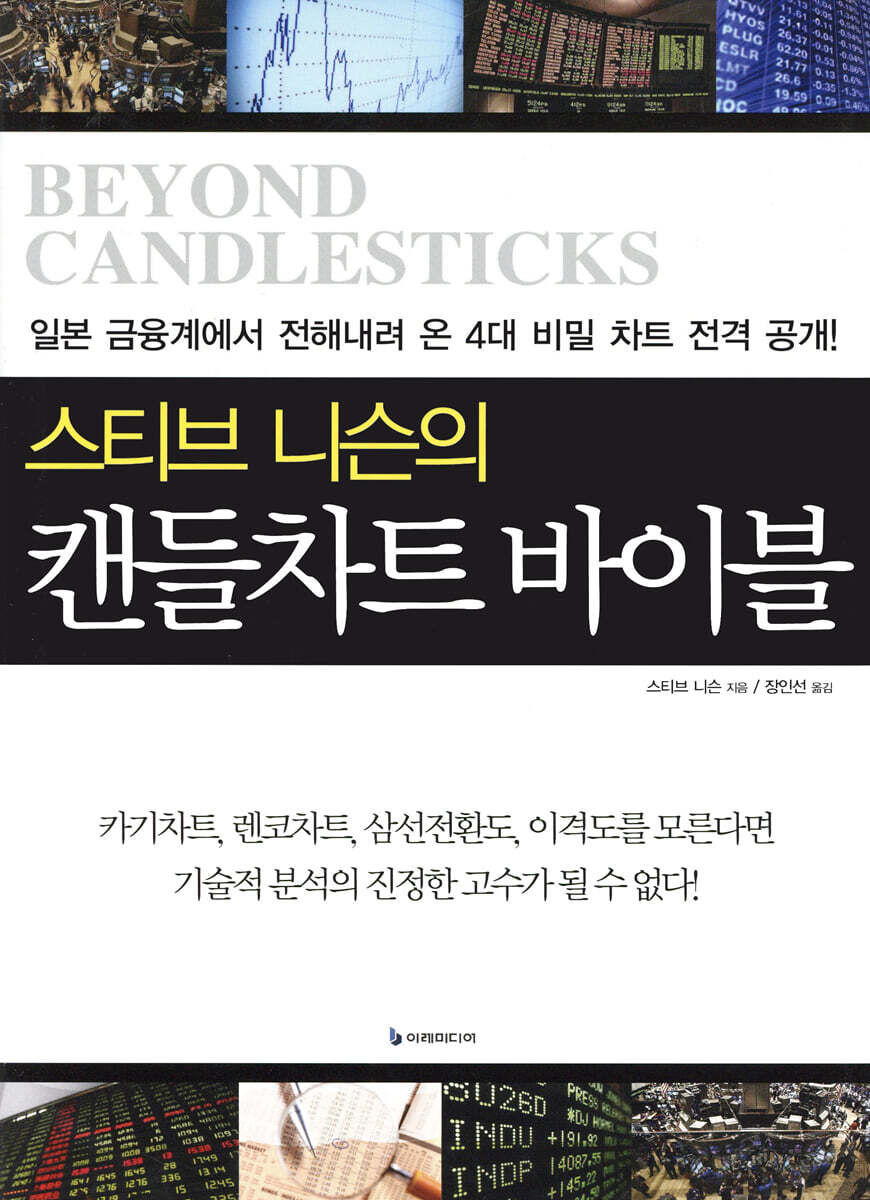
Steve Neeson's Candlestick Chart Bible
 |
Description
Book Introduction
Steve Neeson, the father of candlestick charts, presents a more powerful charting technique.
Although the first person to devise the candlestick chart was the famous Japanese investor Munehisa Homma, the person who brought the tool out of the limited region of Japan was none other than the author of this book, Steve Neeson.
It is thanks to his hard work that we can now use candlestick charts as a technical analysis tool to predict market movements.
This time, he introduced another secret weapon that will further confirm the trading signals of candlestick charts.
These include the three-line reversal chart, Kagi chart, and Renko chart, which exclude the concept of time from the chart and only track new prices to clearly capture reversal points.
Here, the probability of chart signals being hit can be increased by adding a divergence that measures the strength of the market's buying and selling forces using a double moving average.
Although the first person to devise the candlestick chart was the famous Japanese investor Munehisa Homma, the person who brought the tool out of the limited region of Japan was none other than the author of this book, Steve Neeson.
It is thanks to his hard work that we can now use candlestick charts as a technical analysis tool to predict market movements.
This time, he introduced another secret weapon that will further confirm the trading signals of candlestick charts.
These include the three-line reversal chart, Kagi chart, and Renko chart, which exclude the concept of time from the chart and only track new prices to clearly capture reversal points.
Here, the probability of chart signals being hit can be increased by adding a divergence that measures the strength of the market's buying and selling forces using a double moving average.
- You can preview some of the book's contents.
Preview
index
PART 1 Candlestick Chart
introduction
Chapter 1 Overview
Chapter 2 Laying the Foundation
The Origin of Candlestick Charts
- Evolution of candlestick charts
Candle structure
Body and shadow
body
- Long-term beekeeping
- Long bullish candlestick at the low point
- A long candlestick is the basis for a clear support line.
- A long bullish candlestick that breaks through the resistance line and rises
- Long candlestick acting as a support line
- Long candlestick at high point
- A long candlestick that becomes a resistance line
- A long candlestick that breaks through the support line and falls
- Jangdaebong and target
- Length and period of the trunk
- Compare the previous day's candle body and opening price
- Top type
- Acquisition and distribution
- Doji
shadow
- High wave candle
Chapter 3 Patterns
Single candle
- Hammer type
- Hanging
- Meteoroid
Composite candlestick pattern
- Black cloud type
- Penetrating
- Dominant type
- Final control type
- Harami
window
- Three consecutive windows
- 2nd candle after gap
- Gapping Doji
A pattern consisting of three or more candles
- Seokbyeolhyung
- Morning Star
- Consecutive record breaking type
Chapter 4: The Big Picture of Candlesticks and Technical Analysis
loss limitation measures
Risk vs. Return
Trend
Chameleon strategy
Computer and candlestick charts
- The importance of the timing of candlestick patterns
- Specific criteria for judging patterns
- Make a real deal
- When to liquidate a transaction
PART 2: Disparity and New Price Charts
introduction
Chapter 5 How the Japanese Use Moving Averages
Golden Cross and Dead Cross
Separation
- Trade using the gap chart
Divergence Index
Chapter 6 Three-Line Transition Diagram
Create a three-line conversion diagram
Trading technique using the three-line conversion chart
- White and black lines as buy and sell signals
- Three-line conversion chart and candlestick chart
- Three-line conversion chart and trend
- Different types of conversion charts
- Additional confirmation of trend reversal
- Black shoes, black and white suit and neck
- Consecutive record renewal type and three-line conversion type
- Western patterns and three-line transition diagrams
Practice drawing a three-line transition diagram
Chapter 7 Renko Chart
Creating a Renko chart
Trading techniques using Renko charts
Practice creating a Renko chart
Chapter 8 Kagichart
Creating a Kagi Chart
- Using the percentage chart
Trading techniques using Kagi charts
- Buy with the positive, sell with the negative.
- Shoulders and waist
- Multi-level break
- Positive and negative length
- If the adjustment stops within the previous Kagi line
- Double-paned windows
- Trend line
- Clamp type
- Sambul-type and reverse Sambul-type
- Consecutive record breaking type
Practice creating a Kagi chart
conclusion
Glossary
introduction
Chapter 1 Overview
Chapter 2 Laying the Foundation
The Origin of Candlestick Charts
- Evolution of candlestick charts
Candle structure
Body and shadow
body
- Long-term beekeeping
- Long bullish candlestick at the low point
- A long candlestick is the basis for a clear support line.
- A long bullish candlestick that breaks through the resistance line and rises
- Long candlestick acting as a support line
- Long candlestick at high point
- A long candlestick that becomes a resistance line
- A long candlestick that breaks through the support line and falls
- Jangdaebong and target
- Length and period of the trunk
- Compare the previous day's candle body and opening price
- Top type
- Acquisition and distribution
- Doji
shadow
- High wave candle
Chapter 3 Patterns
Single candle
- Hammer type
- Hanging
- Meteoroid
Composite candlestick pattern
- Black cloud type
- Penetrating
- Dominant type
- Final control type
- Harami
window
- Three consecutive windows
- 2nd candle after gap
- Gapping Doji
A pattern consisting of three or more candles
- Seokbyeolhyung
- Morning Star
- Consecutive record breaking type
Chapter 4: The Big Picture of Candlesticks and Technical Analysis
loss limitation measures
Risk vs. Return
Trend
Chameleon strategy
Computer and candlestick charts
- The importance of the timing of candlestick patterns
- Specific criteria for judging patterns
- Make a real deal
- When to liquidate a transaction
PART 2: Disparity and New Price Charts
introduction
Chapter 5 How the Japanese Use Moving Averages
Golden Cross and Dead Cross
Separation
- Trade using the gap chart
Divergence Index
Chapter 6 Three-Line Transition Diagram
Create a three-line conversion diagram
Trading technique using the three-line conversion chart
- White and black lines as buy and sell signals
- Three-line conversion chart and candlestick chart
- Three-line conversion chart and trend
- Different types of conversion charts
- Additional confirmation of trend reversal
- Black shoes, black and white suit and neck
- Consecutive record renewal type and three-line conversion type
- Western patterns and three-line transition diagrams
Practice drawing a three-line transition diagram
Chapter 7 Renko Chart
Creating a Renko chart
Trading techniques using Renko charts
Practice creating a Renko chart
Chapter 8 Kagichart
Creating a Kagi Chart
- Using the percentage chart
Trading techniques using Kagi charts
- Buy with the positive, sell with the negative.
- Shoulders and waist
- Multi-level break
- Positive and negative length
- If the adjustment stops within the previous Kagi line
- Double-paned windows
- Trend line
- Clamp type
- Sambul-type and reverse Sambul-type
- Consecutive record breaking type
Practice creating a Kagi chart
conclusion
Glossary
Into the book
One of the greatest advantages of candlestick charts is that they can be easily integrated with other technical analysis methods.
...
Two key concepts that link volume and price movement are accumulation and distribution.
When there is a lot of trading volume at a low price range and the price moves sideways, this is called buying.
High volume at the low point means that sellers are waging an all-out war, mobilizing all available resources and weapons.
However, the fact that the price is moving sideways is evidence that the selling forces are unable to push the price down.
This is because the buying force is digesting all the selling volume put out by the selling force.
Eventually, the selling forces may run out of bullets or just give up.
Then the rally begins.
Diversification is the opposite of accumulation.
Dispersion means that there is a lot of trading volume at a high price point, but the price is essentially stagnant.
In this case, so-called smart money can be seen as meeting the demand of all buyers entering the market by supplying quantity.
As the distribution phase progresses, sellers release sufficient supply to satisfy all buyers' demand, thus maintaining the price.
Dispersion should be viewed as a downward reversal scenario. --- From PART 1 Candlestick Chart 'Acquisition and Dispersion'
While the three-line chart, Renko chart, and Kagi chart are different, they are powerful tools that should be in any trader's technical analysis arsenal.
The advantages of these charts can be summarized as follows:
1.
Support lines, resistance lines, and concentrated areas become more clearly visible.
2.
It captures important movements by filtering out abnormal price fluctuations.
3.
It shows the overall trend of the market more clearly.
4.
It provides a broader view of the market by compressing price movements and providing a longer-term outlook.
5.
It helps you decide when to liquidate your position.
Since candlestick charts typically don't provide target prices, the reversal signals these new techniques provide can be used to close out positions.
6.
It provides technical analysis tools that can be applied even to markets that only provide closing prices.
This is because these techniques can be utilized as long as you have the stock.
Therefore, it is possible to analyze the returns on financial products such as mutual funds and U.S. Treasury bonds. --- From the 'Introduction' of PART 2: Disparity and New Price Charts
In Chapter 4, we looked at the importance of trend monitoring when using candlestick charts.
Since the three-line conversion chart can be used to determine whether an upward or downward trend is occurring, it can be used as a supplementary tool along with candlestick charts.
The three-line chart is used as a compass to determine trends, and specific trading strategies are established based on the trading signals that appear on the candlestick chart.
For example, if there are three consecutive white lines, it is an uptrend.
In this case, a bullish candle signal can be seen as a buy signal, and a bearish candle signal that appears during an uptrend can be seen as a warning to cover short positions, i.e., to buy back short-sold stocks.
Since candlestick charts rarely provide target prices, rising or falling reversal lines can be used as signals to liquidate trades made based on candlestick chart signals. --- PART 2 Divergence and New Price Charts From 'Three-Line Reversal Chart and Candlestick Chart'
There are many ways to use the Kagi chart, but the most basic way is to buy when the Kagi line changes from a thin line to a thick line, and sell when the line changes from a thick line to a thin line.
Remember that the Kagi line thickens when the price breaks through the previous high.
When the price breaks through the previous low, the Kagi line changes into a thin line, or negative line.
...
When a positive line appears, a buy signal is generated, and when it changes to a negative line, a sell signal is generated.
In a sideways movement, you may incur losses due to unnecessary frequent trading signals.
The reason is that, like the three-line conversion chart or the Renko chart, the Kagi chart is also a tool that indicates trends, and therefore, in a market without a trend, it can cause frequent market entries and exits.
There are a few ways to avoid this problem, one of which is adjusting the sensitivity.
However, the purpose of the Kagi chart is to identify long-term trends.
...
Two key concepts that link volume and price movement are accumulation and distribution.
When there is a lot of trading volume at a low price range and the price moves sideways, this is called buying.
High volume at the low point means that sellers are waging an all-out war, mobilizing all available resources and weapons.
However, the fact that the price is moving sideways is evidence that the selling forces are unable to push the price down.
This is because the buying force is digesting all the selling volume put out by the selling force.
Eventually, the selling forces may run out of bullets or just give up.
Then the rally begins.
Diversification is the opposite of accumulation.
Dispersion means that there is a lot of trading volume at a high price point, but the price is essentially stagnant.
In this case, so-called smart money can be seen as meeting the demand of all buyers entering the market by supplying quantity.
As the distribution phase progresses, sellers release sufficient supply to satisfy all buyers' demand, thus maintaining the price.
Dispersion should be viewed as a downward reversal scenario. --- From PART 1 Candlestick Chart 'Acquisition and Dispersion'
While the three-line chart, Renko chart, and Kagi chart are different, they are powerful tools that should be in any trader's technical analysis arsenal.
The advantages of these charts can be summarized as follows:
1.
Support lines, resistance lines, and concentrated areas become more clearly visible.
2.
It captures important movements by filtering out abnormal price fluctuations.
3.
It shows the overall trend of the market more clearly.
4.
It provides a broader view of the market by compressing price movements and providing a longer-term outlook.
5.
It helps you decide when to liquidate your position.
Since candlestick charts typically don't provide target prices, the reversal signals these new techniques provide can be used to close out positions.
6.
It provides technical analysis tools that can be applied even to markets that only provide closing prices.
This is because these techniques can be utilized as long as you have the stock.
Therefore, it is possible to analyze the returns on financial products such as mutual funds and U.S. Treasury bonds. --- From the 'Introduction' of PART 2: Disparity and New Price Charts
In Chapter 4, we looked at the importance of trend monitoring when using candlestick charts.
Since the three-line conversion chart can be used to determine whether an upward or downward trend is occurring, it can be used as a supplementary tool along with candlestick charts.
The three-line chart is used as a compass to determine trends, and specific trading strategies are established based on the trading signals that appear on the candlestick chart.
For example, if there are three consecutive white lines, it is an uptrend.
In this case, a bullish candle signal can be seen as a buy signal, and a bearish candle signal that appears during an uptrend can be seen as a warning to cover short positions, i.e., to buy back short-sold stocks.
Since candlestick charts rarely provide target prices, rising or falling reversal lines can be used as signals to liquidate trades made based on candlestick chart signals. --- PART 2 Divergence and New Price Charts From 'Three-Line Reversal Chart and Candlestick Chart'
There are many ways to use the Kagi chart, but the most basic way is to buy when the Kagi line changes from a thin line to a thick line, and sell when the line changes from a thick line to a thin line.
Remember that the Kagi line thickens when the price breaks through the previous high.
When the price breaks through the previous low, the Kagi line changes into a thin line, or negative line.
...
When a positive line appears, a buy signal is generated, and when it changes to a negative line, a sell signal is generated.
In a sideways movement, you may incur losses due to unnecessary frequent trading signals.
The reason is that, like the three-line conversion chart or the Renko chart, the Kagi chart is also a tool that indicates trends, and therefore, in a market without a trend, it can cause frequent market entries and exits.
There are a few ways to avoid this problem, one of which is adjusting the sensitivity.
However, the purpose of the Kagi chart is to identify long-term trends.
--- PART 2: Separation and New Price Charts 'Trading Techniques Using Kagi Charts'
Publisher's Review
The essence of Japanese technical analysis techniques that have evolved over generations: "The Candlestick Chart Bible."
The Candlestick Chart Bible is largely divided into two parts.
First, Part 1 contains the results of his more advanced research on candlestick charts, obtained through lectures and actual investments since his first book, "Candlestick Chart Investment Technique."
Beyond the first book, this book summarizes the core knowledge of candlestick charts and presents numerous charts and examples, proving that candlestick charts not only enhance trading and investment efficiency, but are also very effective in determining the right trading timing.
We also examine candlestick patterns within the overall technical analysis framework and focus on several factors that must be considered together to understand their interrelationships.
And in Part 2, we introduce the four secret weapons - Kagi Chart, Renko Chart, Samseon Conversion Chart, and Igap Chart.
In Japan, where rice futures trading was already taking place in the 1600s, various techniques were developed to analyze rice price movement patterns and read the psychology of traders.
The Kagi chart, Renko chart, and Sanhao chart, which Japan kept hidden for centuries for fear of being known to the West, are new concepts of charts that do not use time data and accurately capture the timing of trend reversals.
Additionally, the divergence is similar to the Western double moving average, but it provides better market timing and is an important yardstick for determining whether the market is overbought or oversold.
These charting techniques can be used on their own, but they are even more effective when combined with traditional trading, investment, and hedging strategies.
If you don't know the Kagi chart, Renko chart, three-line conversion chart, and separation chart
You can never be a true expert in technical analysis!
These analytical techniques are particularly useful for forecasting the market, tracking trends, and determining trading timing. They can be combined with traditional candlestick charting techniques to create powerful hybrid techniques, demonstrating their remarkable effectiveness in practice.
The media, including Amazon, are sending out praise:
"By learning how to combine candlestick charts and traditional Western technical analysis methods presented in this book, you will gain the ability to create a diverse and complete trading system."
“To achieve a high winning rate in the markets, learn how to use candlestick charts in your trading.
You will be amazed at how well this tool can predict market sentiment.”
“A sharp analytical tool for tracking market price movements and predicting timing.”
Attractive Indicators to Guide Your Investments
“If you want to fully understand charts, read this book.”
“The candle chart is a visual representation of the psychology of the crowd running through the market.
If you're an investor looking for a way to gain an edge in the market, this book has the answers."
Currently, most securities companies in Korea have HTS equipped with not only candlestick charts but also three-line conversion charts, Kagi charts, and Renko charts.
However, there are not many investors who can actually use these tools for investment.
By mastering candlestick charts and learning how to utilize new price charts through this book, you will not only greatly improve your investment strategy, but also significantly improve your actual investment performance.
The Candlestick Chart Bible is largely divided into two parts.
First, Part 1 contains the results of his more advanced research on candlestick charts, obtained through lectures and actual investments since his first book, "Candlestick Chart Investment Technique."
Beyond the first book, this book summarizes the core knowledge of candlestick charts and presents numerous charts and examples, proving that candlestick charts not only enhance trading and investment efficiency, but are also very effective in determining the right trading timing.
We also examine candlestick patterns within the overall technical analysis framework and focus on several factors that must be considered together to understand their interrelationships.
And in Part 2, we introduce the four secret weapons - Kagi Chart, Renko Chart, Samseon Conversion Chart, and Igap Chart.
In Japan, where rice futures trading was already taking place in the 1600s, various techniques were developed to analyze rice price movement patterns and read the psychology of traders.
The Kagi chart, Renko chart, and Sanhao chart, which Japan kept hidden for centuries for fear of being known to the West, are new concepts of charts that do not use time data and accurately capture the timing of trend reversals.
Additionally, the divergence is similar to the Western double moving average, but it provides better market timing and is an important yardstick for determining whether the market is overbought or oversold.
These charting techniques can be used on their own, but they are even more effective when combined with traditional trading, investment, and hedging strategies.
If you don't know the Kagi chart, Renko chart, three-line conversion chart, and separation chart
You can never be a true expert in technical analysis!
These analytical techniques are particularly useful for forecasting the market, tracking trends, and determining trading timing. They can be combined with traditional candlestick charting techniques to create powerful hybrid techniques, demonstrating their remarkable effectiveness in practice.
The media, including Amazon, are sending out praise:
"By learning how to combine candlestick charts and traditional Western technical analysis methods presented in this book, you will gain the ability to create a diverse and complete trading system."
“To achieve a high winning rate in the markets, learn how to use candlestick charts in your trading.
You will be amazed at how well this tool can predict market sentiment.”
“A sharp analytical tool for tracking market price movements and predicting timing.”
Attractive Indicators to Guide Your Investments
“If you want to fully understand charts, read this book.”
“The candle chart is a visual representation of the psychology of the crowd running through the market.
If you're an investor looking for a way to gain an edge in the market, this book has the answers."
Currently, most securities companies in Korea have HTS equipped with not only candlestick charts but also three-line conversion charts, Kagi charts, and Renko charts.
However, there are not many investors who can actually use these tools for investment.
By mastering candlestick charts and learning how to utilize new price charts through this book, you will not only greatly improve your investment strategy, but also significantly improve your actual investment performance.
GOODS SPECIFICS
- Date of issue: March 15, 2010
- Format: Hardcover book binding method guide
- Page count, weight, size: 336 pages | 844g | 176*248*30mm
- ISBN13: 9788991998360
- ISBN10: 8991998364
You may also like
카테고리
korean


korean

![GQ KOREA Mark (Monthly): December [2025]](http://librairie.coreenne.fr/cdn/shop/files/8ef265dbbfbf186523ed75ba7319009d.jpg?v=1765340328&width=3840)


