

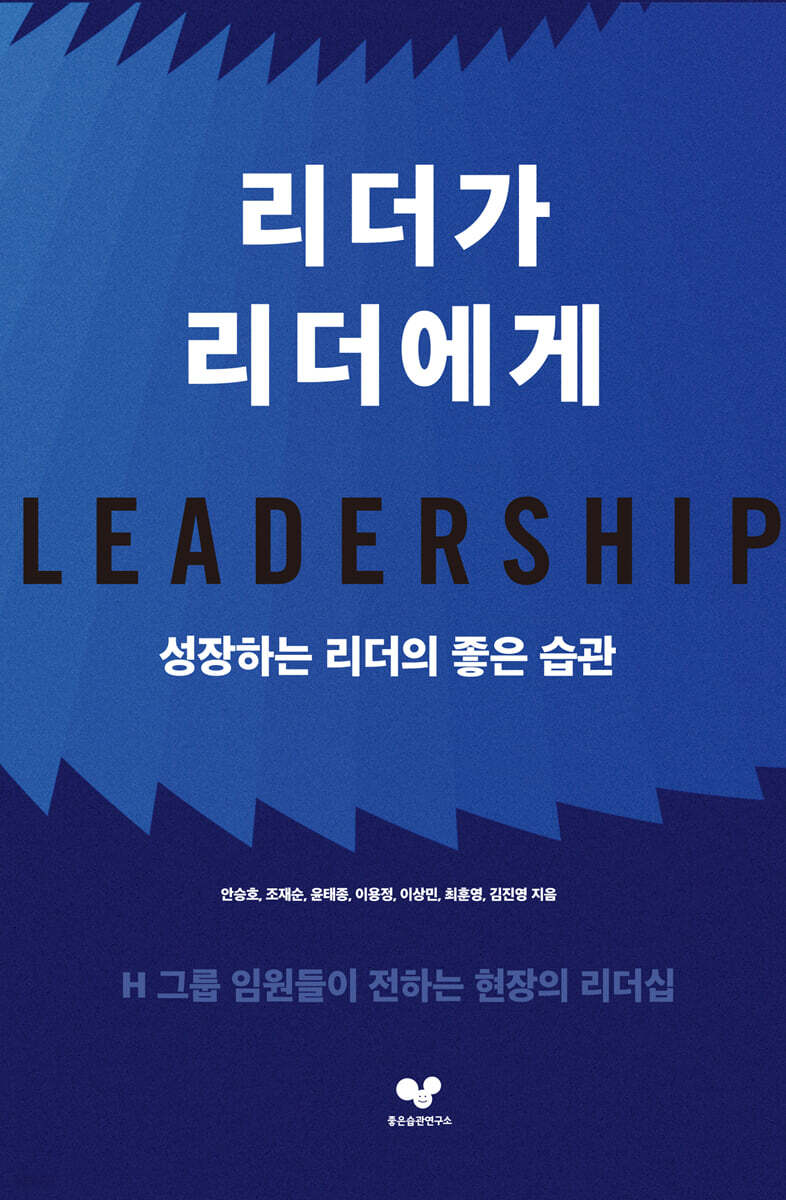
Leader to leader
 |
Description
Book Introduction
This book contains honest advice and experiences from Hyundai Motor Group executives who have led organizations in the field, sharing them with junior leaders.
Rather than a leadership textbook, we talk about “leadership that works in the field.”
It is vivid and persuasive because it is the result of actual executives within the Hyundai Motor Group gathering to learn, discuss, and write.
Learning and mental management, essential virtues and core competencies, crisis management tips, and even the growth essential for leaders.
All the necessary habits are gathered in one book.
Rather than a leadership textbook, we talk about “leadership that works in the field.”
It is vivid and persuasive because it is the result of actual executives within the Hyundai Motor Group gathering to learn, discuss, and write.
Learning and mental management, essential virtues and core competencies, crisis management tips, and even the growth essential for leaders.
All the necessary habits are gathered in one book.
- You can preview some of the book's contents.
Preview
index
Leader's Learning and Mental Management
Acquire knowledge | Never stop learning
Learning Attitude | Learn from Everyone
Reading | Becoming a Deeper Human
Loneliness | A Leader's Natural Fate
Humility | Always remember that you may make mistakes
Stress | You need at least one sport
Positive Energy | Meeting People Outside of Work
Reflection | Acknowledging and filling deficiencies
Reading and Meditation | Cultivating a Leader's Heart
Beginner | 1993 Ulsan Express Bus
Virtues Required for a Leader
Shadow | Is it a cool shade or an obstacle blocking the light?
Honesty | Sharing the Inconvenient Truth
Humility | Is there such a thing as a 'correct answer'?
Reading | Understanding Humanity, Insight into Society
Authenticity | "Team Leader, you've become much warmer than before."
Warmth | “It is truly a tremendous thing that people come.”
Love | From Team to Family
Care | What I Learned While Living in the Residence
Team-leading skills, a leader's core competencies
Reason for Being | Don't Miss the Essence
Questions | How to Ask Thought-Provoking Questions
Internalizing Strategy | Breathing and Drinking Every Day Like Air
Presenting a Vision | Going Out to Do Something Meaningful Today
Establishing Relationships | You Can't Be Perfect for Everyone
Humility | Willingness to make corrections
A Leader's Perspective | Global Optimization, Not Partial Optimization
Working Space | Creating an Energizing Environment
Personalized Leadership | Helping You Discover Your Unique Color and Shine
Execution | A special ability that only leaders can possess
Connector | A meeting of different perspectives and capabilities
Coaching | The Risk of Degenerating into Gaslighting
Leader's Crisis Management
Crisis Management | A Test That Reveals a Leader's True Character
Exposing Failure | Opportunities for Learning and Growth
Leadership Variations | Flexible Leadership Turns into Solid Skills
Leading by example | The first to step forward and take responsibility
Community of Destiny | Don't be obsessed with evaluation scores
Sustainable growth of leaders
Life Mentor | My Shooter 31 Years Ago
Learning and Sharing | Helping Each Person Grow
A New Path | A Choice I Never Want to Make Again
A Leader's Concerns | Some Thoughts on Leadership
The Inside Story of a Leader | Honest Concerns About Running an Organization
Ethics | Technology Needs Ethics Too
Practitioner | What kind of practitioner am I?
Role | Rethinking the Role of a Senior
Global Leadership | I'm a Human Engineer
Autonomy | If you want to go far, go together
Good habits that leaders pass on to other leaders
Acquire knowledge | Never stop learning
Learning Attitude | Learn from Everyone
Reading | Becoming a Deeper Human
Loneliness | A Leader's Natural Fate
Humility | Always remember that you may make mistakes
Stress | You need at least one sport
Positive Energy | Meeting People Outside of Work
Reflection | Acknowledging and filling deficiencies
Reading and Meditation | Cultivating a Leader's Heart
Beginner | 1993 Ulsan Express Bus
Virtues Required for a Leader
Shadow | Is it a cool shade or an obstacle blocking the light?
Honesty | Sharing the Inconvenient Truth
Humility | Is there such a thing as a 'correct answer'?
Reading | Understanding Humanity, Insight into Society
Authenticity | "Team Leader, you've become much warmer than before."
Warmth | “It is truly a tremendous thing that people come.”
Love | From Team to Family
Care | What I Learned While Living in the Residence
Team-leading skills, a leader's core competencies
Reason for Being | Don't Miss the Essence
Questions | How to Ask Thought-Provoking Questions
Internalizing Strategy | Breathing and Drinking Every Day Like Air
Presenting a Vision | Going Out to Do Something Meaningful Today
Establishing Relationships | You Can't Be Perfect for Everyone
Humility | Willingness to make corrections
A Leader's Perspective | Global Optimization, Not Partial Optimization
Working Space | Creating an Energizing Environment
Personalized Leadership | Helping You Discover Your Unique Color and Shine
Execution | A special ability that only leaders can possess
Connector | A meeting of different perspectives and capabilities
Coaching | The Risk of Degenerating into Gaslighting
Leader's Crisis Management
Crisis Management | A Test That Reveals a Leader's True Character
Exposing Failure | Opportunities for Learning and Growth
Leadership Variations | Flexible Leadership Turns into Solid Skills
Leading by example | The first to step forward and take responsibility
Community of Destiny | Don't be obsessed with evaluation scores
Sustainable growth of leaders
Life Mentor | My Shooter 31 Years Ago
Learning and Sharing | Helping Each Person Grow
A New Path | A Choice I Never Want to Make Again
A Leader's Concerns | Some Thoughts on Leadership
The Inside Story of a Leader | Honest Concerns About Running an Organization
Ethics | Technology Needs Ethics Too
Practitioner | What kind of practitioner am I?
Role | Rethinking the Role of a Senior
Global Leadership | I'm a Human Engineer
Autonomy | If you want to go far, go together
Good habits that leaders pass on to other leaders
Detailed image

Into the book
The pace of technological change is truly rapid.
Past knowledge alone will not solve present problems.
Especially in the field of crash safety that I work in, regulations and crash product specifications are constantly changing, and an understanding of physical phenomena is increasingly necessary.
Analysis of test results and simulation techniques for new vehicles are also rapidly developing.
I believe that automotive safety technology is not simply a competition of equipment specifications.
I think it's the sum total of understanding how the human body reacts to injury and what patterns actual traffic accidents follow.
In short, it is a field that combines not only mechanical engineering but also ergonomics and biomechanics.
There is something I always emphasize to my juniors.
When acquiring a skill, don't just look at data or figures; understand the background and context.
Problem solving begins with a good question, and knowing the background and context is essential to asking the right question.
In other words, rather than asking questions about fragmentary results, we need to ask questions about the root cause.
--- p.25
I also remember the image of an executive I met while working in the United States.
When he dined with his colleagues, he paid for the food with his corporate card, but he always paid the service tip with his own money.
I think they decided that since tipping involves a somewhat subjective judgment, it is not suitable for use with a corporate card.
As such, a leader must set clear standards for his or her words and actions.
But sometimes I feel like I want to get distracted and close my eyes for a moment.
The moment the tension eases, we find excuses to do something else and rationalize ourselves.
To avoid this, leaders engage in a constant battle to keep their promises to themselves.
--- p.68
Although organizational culture has changed significantly and become more personalized, our organization still retains a family-like culture and sentiment.
From managers to managers, we occasionally travel together or go on family camping trips together, creating precious memories.
Because our society today has a strong individualistic culture and a tendency to separate work and personal life, many people have negative opinions about forming personal relationships with coworkers.
However, the results of various psychological experiments show that the “psychological safety” created by a family-like atmosphere increases learning speed and innovation in problem solving (see the book “Fearless Organization”).
And there are reports that when employees feel like they belong to an organization like a family, their sense of responsibility, engagement, and performance are all enhanced (Achievers Workforce Institute 2021 report).
--- p.93
How you ask questions will determine how the conversation works.
Rather than asking questions that suggest the answer is in your head and that you should try to guess it, you should ask questions that seek and elicit the other person's opinion.
It should be a question that asks what is causing the problem, not a question of reproach.
That way, you can make an effort to find the answer without breaking your will.
By doing so, the willpower of the executor is utilized, and the organization runs smoothly.
--- p.109
We must acknowledge that it is impossible to be perfectly in harmony with everyone.
Sometimes we need the wisdom to give up what needs to be given up.
This goes beyond simply cutting ties; it means setting appropriate boundaries around relationships that are unproductive or negatively impacting you.
Instead of trying to be nice to everyone and genuinely trying to help them, if the relationship isn't right for you or you feel it's not worth it after a few tries, it's wise to focus your energy and time elsewhere.
That means you don't have to be perfect for everyone.
A leader must have a broad understanding of people and a cool-headed judgment.
This is essential for maximizing the potential of each team member and fostering a healthy culture throughout the organization.
Some relationships need to be nurtured and strengthened, while others require a safe distance to protect yourself and your team.
--- p.120
Even coaching that starts with good intentions can become "gaslighting" if it is distorted or misleading.
Especially in organizations, the line between coaching and gaslighting is subtle, and can easily become a source of conflict.
At first it's just concern and advice, but as the intensity and frequency increases, it becomes more and more like gaslighting.
Coaching and gaslighting may seem similar at first glance in that they both promote behavioral change and are results-oriented, but they are actually very different.
--- p.144
Even leaders who empathize with their employees' difficulties may have no choice but to say unpleasant things when the surrounding circumstances or situations are difficult.
A single word at this time cannot help but be a burden to the members.
On the other hand, as on-site conditions improve and become more stable, the organizational culture perceived on-site becomes more positive, and as nagging toward employees decreases, leadership competency evaluations also improve.
Even leadership can be interpreted differently depending on working conditions and environment. Therefore, rather than focusing on evaluation scores, it's important to calmly reflect on whether your leadership is absolutely focused on shared values and whether your own ego is mixed in.
It's certainly a difficult statement and difficult to put into practice, but leaders must strive toward ideal shared values.
Even if you don't get the sympathy of your members in the short term, I hope you don't feel too disappointed or discouraged.
This is also the ability of the leader to manage the crisis that comes to him.
Past knowledge alone will not solve present problems.
Especially in the field of crash safety that I work in, regulations and crash product specifications are constantly changing, and an understanding of physical phenomena is increasingly necessary.
Analysis of test results and simulation techniques for new vehicles are also rapidly developing.
I believe that automotive safety technology is not simply a competition of equipment specifications.
I think it's the sum total of understanding how the human body reacts to injury and what patterns actual traffic accidents follow.
In short, it is a field that combines not only mechanical engineering but also ergonomics and biomechanics.
There is something I always emphasize to my juniors.
When acquiring a skill, don't just look at data or figures; understand the background and context.
Problem solving begins with a good question, and knowing the background and context is essential to asking the right question.
In other words, rather than asking questions about fragmentary results, we need to ask questions about the root cause.
--- p.25
I also remember the image of an executive I met while working in the United States.
When he dined with his colleagues, he paid for the food with his corporate card, but he always paid the service tip with his own money.
I think they decided that since tipping involves a somewhat subjective judgment, it is not suitable for use with a corporate card.
As such, a leader must set clear standards for his or her words and actions.
But sometimes I feel like I want to get distracted and close my eyes for a moment.
The moment the tension eases, we find excuses to do something else and rationalize ourselves.
To avoid this, leaders engage in a constant battle to keep their promises to themselves.
--- p.68
Although organizational culture has changed significantly and become more personalized, our organization still retains a family-like culture and sentiment.
From managers to managers, we occasionally travel together or go on family camping trips together, creating precious memories.
Because our society today has a strong individualistic culture and a tendency to separate work and personal life, many people have negative opinions about forming personal relationships with coworkers.
However, the results of various psychological experiments show that the “psychological safety” created by a family-like atmosphere increases learning speed and innovation in problem solving (see the book “Fearless Organization”).
And there are reports that when employees feel like they belong to an organization like a family, their sense of responsibility, engagement, and performance are all enhanced (Achievers Workforce Institute 2021 report).
--- p.93
How you ask questions will determine how the conversation works.
Rather than asking questions that suggest the answer is in your head and that you should try to guess it, you should ask questions that seek and elicit the other person's opinion.
It should be a question that asks what is causing the problem, not a question of reproach.
That way, you can make an effort to find the answer without breaking your will.
By doing so, the willpower of the executor is utilized, and the organization runs smoothly.
--- p.109
We must acknowledge that it is impossible to be perfectly in harmony with everyone.
Sometimes we need the wisdom to give up what needs to be given up.
This goes beyond simply cutting ties; it means setting appropriate boundaries around relationships that are unproductive or negatively impacting you.
Instead of trying to be nice to everyone and genuinely trying to help them, if the relationship isn't right for you or you feel it's not worth it after a few tries, it's wise to focus your energy and time elsewhere.
That means you don't have to be perfect for everyone.
A leader must have a broad understanding of people and a cool-headed judgment.
This is essential for maximizing the potential of each team member and fostering a healthy culture throughout the organization.
Some relationships need to be nurtured and strengthened, while others require a safe distance to protect yourself and your team.
--- p.120
Even coaching that starts with good intentions can become "gaslighting" if it is distorted or misleading.
Especially in organizations, the line between coaching and gaslighting is subtle, and can easily become a source of conflict.
At first it's just concern and advice, but as the intensity and frequency increases, it becomes more and more like gaslighting.
Coaching and gaslighting may seem similar at first glance in that they both promote behavioral change and are results-oriented, but they are actually very different.
--- p.144
Even leaders who empathize with their employees' difficulties may have no choice but to say unpleasant things when the surrounding circumstances or situations are difficult.
A single word at this time cannot help but be a burden to the members.
On the other hand, as on-site conditions improve and become more stable, the organizational culture perceived on-site becomes more positive, and as nagging toward employees decreases, leadership competency evaluations also improve.
Even leadership can be interpreted differently depending on working conditions and environment. Therefore, rather than focusing on evaluation scores, it's important to calmly reflect on whether your leadership is absolutely focused on shared values and whether your own ego is mixed in.
It's certainly a difficult statement and difficult to put into practice, but leaders must strive toward ideal shared values.
Even if you don't get the sympathy of your members in the short term, I hope you don't feel too disappointed or discouraged.
This is also the ability of the leader to manage the crisis that comes to him.
--- p.170
Publisher's Review
On-site leadership delivered directly by Hyundai Motor Group executives
A vivid collection of leadership advice, "From Leader to Leader," has been published.
A book titled "Leader to Leader" has been published, containing honest advice and experiences from Hyundai Motor Group executives who have led organizations in the field to junior leaders.
This book is not simply a theoretical book, but a record of leadership wisdom gained through direct experience in the ever-changing business world.
"Leader to Leader" is a message from senior leaders to junior leaders who have just been promoted to executive positions and are now leading their teams.
It is vivid and persuasive because it is the result of actual executives within the Hyundai Motor Group gathering to learn, discuss, and write.
In that sense, it is not a leadership textbook, but a book that talks about “leadership that works in the field.”
The book contains the various concerns, choices, failures, and reflections experienced by executives.
It answers practical questions that any young leader will face, such as how to build trust with team members, what attitude to adopt in a crisis, and how to manage performance without losing people.
For example, while in the past, the problem of car safety management could be solved with only a knowledge of technological development, now it requires a wide range of knowledge, including traffic laws and an understanding of the human body, and he emphasizes the importance of continuous learning.
He also explains the importance of questions, saying that asking questions that are like interrogating someone who already has the answer in mind is never a good question, and that even in a world where individualism is rampant, the importance of a family-like culture is still emphasized.
He also shares an episode where, in the process of imparting various knowledge to a junior he cared about, it was misunderstood as gaslighting rather than coaching, and the junior ended up deciding to resign, showing once again how difficult leadership is.
In addition, he shares his experience that being overly obsessed with evaluations is not the attitude of a good leader, as leadership evaluations can vary depending on the work environment.
In this way, the book covers a variety of episodes, including leadership learning and mental management, necessary virtues and core competencies, crisis management tips, and even the growth that leaders need.
Leadership is covered in five chapters.
“Leader to Leader” is not a book that teaches leadership, but a book that conveys living leadership.
The experiences of Hyundai Motor Group leaders will serve as a solid compass for junior leaders just starting out.
It will serve as a practical guide for everyone, from young people preparing for leadership, to mid-level managers leading teams in the field, to leaders just emerging from the executive ranks.
A vivid collection of leadership advice, "From Leader to Leader," has been published.
A book titled "Leader to Leader" has been published, containing honest advice and experiences from Hyundai Motor Group executives who have led organizations in the field to junior leaders.
This book is not simply a theoretical book, but a record of leadership wisdom gained through direct experience in the ever-changing business world.
"Leader to Leader" is a message from senior leaders to junior leaders who have just been promoted to executive positions and are now leading their teams.
It is vivid and persuasive because it is the result of actual executives within the Hyundai Motor Group gathering to learn, discuss, and write.
In that sense, it is not a leadership textbook, but a book that talks about “leadership that works in the field.”
The book contains the various concerns, choices, failures, and reflections experienced by executives.
It answers practical questions that any young leader will face, such as how to build trust with team members, what attitude to adopt in a crisis, and how to manage performance without losing people.
For example, while in the past, the problem of car safety management could be solved with only a knowledge of technological development, now it requires a wide range of knowledge, including traffic laws and an understanding of the human body, and he emphasizes the importance of continuous learning.
He also explains the importance of questions, saying that asking questions that are like interrogating someone who already has the answer in mind is never a good question, and that even in a world where individualism is rampant, the importance of a family-like culture is still emphasized.
He also shares an episode where, in the process of imparting various knowledge to a junior he cared about, it was misunderstood as gaslighting rather than coaching, and the junior ended up deciding to resign, showing once again how difficult leadership is.
In addition, he shares his experience that being overly obsessed with evaluations is not the attitude of a good leader, as leadership evaluations can vary depending on the work environment.
In this way, the book covers a variety of episodes, including leadership learning and mental management, necessary virtues and core competencies, crisis management tips, and even the growth that leaders need.
Leadership is covered in five chapters.
“Leader to Leader” is not a book that teaches leadership, but a book that conveys living leadership.
The experiences of Hyundai Motor Group leaders will serve as a solid compass for junior leaders just starting out.
It will serve as a practical guide for everyone, from young people preparing for leadership, to mid-level managers leading teams in the field, to leaders just emerging from the executive ranks.
GOODS SPECIFICS
- Date of issue: November 1, 2025
- Page count, weight, size: 226 pages | 306g | 138*210*15mm
- ISBN13: 9791193639580
- ISBN10: 1193639581
You may also like
카테고리
korean


korean

![GQ KOREA Mark (Monthly): December [2025]](http://librairie.coreenne.fr/cdn/shop/files/8ef265dbbfbf186523ed75ba7319009d.jpg?v=1765340328&width=3840)


