

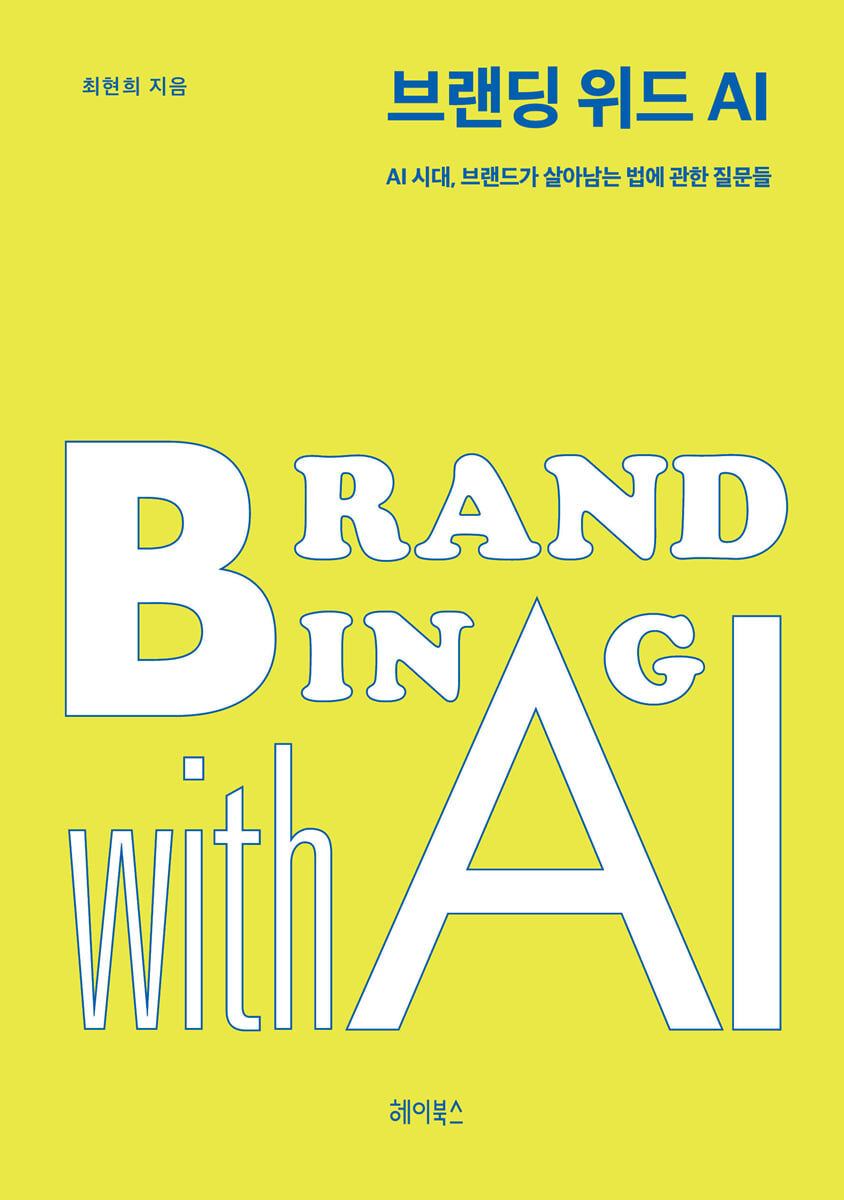
Branding with AI
 |
Description
Book Introduction
How will brands design emotions in the AI era?
A brand is no longer a language defined by a company.
It's a memory that lingers in the human mind, a resonance of shared experiences. AI reads these memories and emotions in real time, combines them with data, and continuously circulates them.
Brands now face an opportunity to become more human than ever before, pivoting from technology to emotion, from control to relationships, and from calculation to trust.
This book is the result of reflection and exploration on the changes that brands will face in the AI era and how to survive.
A brand is no longer a language defined by a company.
It's a memory that lingers in the human mind, a resonance of shared experiences. AI reads these memories and emotions in real time, combines them with data, and continuously circulates them.
Brands now face an opportunity to become more human than ever before, pivoting from technology to emotion, from control to relationships, and from calculation to trust.
This book is the result of reflection and exploration on the changes that brands will face in the AI era and how to survive.
- You can preview some of the book's contents.
Preview
index
Prologue - How will brands design emotions in the AI era?
1. The Relationship Between Brands and Consumers in the Pre-AI Era
Brand, what is its essence?
Brand strategy, the traditional way?
How have consumers changed?
Why did the old way reach its limits?
Brands, why do we need to talk about them again?
2. Fundamental Changes in Brands in the AI Era
How AI is Redefining Brand Identity
Can memories and emotions be measured with data?
How far can AI transform the brand experience?
Emotion-Driven Marketing: Can AI Do It Better?
Brands, can they no longer be what we want?
How would relationships and emotions be different if designed by AI?
Will technology swallow the essence of the brand?
Can affective computing breathe emotion into brands?
Real-time interpretation: How quickly can brands understand their customers?
How far can brand ethics go in the AI era?
3 Designing an AI-Based Brand Strategy
What if AI became a brand strategist?
How does AI interpret a brand's raison d'être?
AI-Aware Brand Cycle: What if This Structure Worked?
Can AI Protect Brand Identity?
Will programmable interfaces become the new face of brands?
Emotional Design: How Far Can We Go with Data?
Brand strategy: What are the new principles for the AI era?
What would change if brand philosophy were implemented as an API?
AI and Ethics: How Much Responsibility Can Brands Take?
Can our brand survive in the AI era?
4 AI and the Future of Brands
How do customers feel about AI-generated interactions?
What if a brand's tone was determined by an algorithm?
How will customer experience change when designed by AI?
How will offline, online, and AI connect?
How will marketing change when AI predicts customer behavior?
Is it okay to leave brand interpretation to AI?
Real-time feedback: How should brands respond?
Could AI agents and brand OS be the future of brands?
How can AI solve the brand strategy dilemma?
How will the relationship between brands and customers evolve in the AI era?
References
annotation
1. The Relationship Between Brands and Consumers in the Pre-AI Era
Brand, what is its essence?
Brand strategy, the traditional way?
How have consumers changed?
Why did the old way reach its limits?
Brands, why do we need to talk about them again?
2. Fundamental Changes in Brands in the AI Era
How AI is Redefining Brand Identity
Can memories and emotions be measured with data?
How far can AI transform the brand experience?
Emotion-Driven Marketing: Can AI Do It Better?
Brands, can they no longer be what we want?
How would relationships and emotions be different if designed by AI?
Will technology swallow the essence of the brand?
Can affective computing breathe emotion into brands?
Real-time interpretation: How quickly can brands understand their customers?
How far can brand ethics go in the AI era?
3 Designing an AI-Based Brand Strategy
What if AI became a brand strategist?
How does AI interpret a brand's raison d'être?
AI-Aware Brand Cycle: What if This Structure Worked?
Can AI Protect Brand Identity?
Will programmable interfaces become the new face of brands?
Emotional Design: How Far Can We Go with Data?
Brand strategy: What are the new principles for the AI era?
What would change if brand philosophy were implemented as an API?
AI and Ethics: How Much Responsibility Can Brands Take?
Can our brand survive in the AI era?
4 AI and the Future of Brands
How do customers feel about AI-generated interactions?
What if a brand's tone was determined by an algorithm?
How will customer experience change when designed by AI?
How will offline, online, and AI connect?
How will marketing change when AI predicts customer behavior?
Is it okay to leave brand interpretation to AI?
Real-time feedback: How should brands respond?
Could AI agents and brand OS be the future of brands?
How can AI solve the brand strategy dilemma?
How will the relationship between brands and customers evolve in the AI era?
References
annotation
Detailed image

Into the book
A brand is no longer a language defined by a company.
It's a memory that lingers in the human mind, a resonance of shared experiences. AI now reads these memories and emotions in real time, combines them with data, and continuously circulates them.
--- p.7, from "Prologue"
Now is the time for us to think about 'how to talk' rather than 'how to talk'.
Understanding that journey is also the first step to redesigning brand strategy in the AI era.
--- p.24, from Chapter 1, “Brand Strategy, What is the Traditional Way?”
Brands must no longer be one-sided teachers, but rather empathetic partners who exchange emotions and grow together with consumers.
This is the end of the pre-AI era and the new direction brand strategy must take going forward.
--- p.35, from Chapter 1, “Why did the past methods reach their limits?”
AI is breaking down the boundaries of brand identity and infinitely expanding touchpoints with customers.
But the vitality of a brand depends not on the precision of technology, but on the temperature of emotion.
Ultimately, as AI evolves, brands must become more and more human.
This is how brands will build authentic memories and relationships in the AI era.
--- p.65, from Chapter 2, “How does AI redefine brand identity?”
Technology can either swallow the essence of a brand or revive its emotions.
Ultimately, the choice is up to the brand, and emotions are the deepest footprints a brand leaves behind.
--- p.101, from Chapter 2, “Will Technology Swallow the Essence of Brands?”
AI offers incredible scalability to brands.
However, this expansion should not shake the brand's answer to the fundamental question: "Why does the brand exist?"
As brands leverage AI to achieve emotional personalization, maintaining the emotional consistency and intent behind it will be key to future brand strategy.
--- p.164, from Chapter 3, “Can Brand Identity Be Protected with AI?”
Brand ethics are no longer policies written in product descriptions, but the sum total of small language adjustments, small acts of consideration, and small but sincere responses revealed in everyday interactions.
That's where we feel the ethical brand.
In an age where technology and emotion collide, brands must be remembered as "empathetic beings" in the midst of it all.
That's the way to become a beloved brand even in the AI era.
--- p.200, from Chapter 3, “AI and Ethics: How Much Responsibility Can Brands Take?”
The fact that AI is designing the language of brands is not a cause for fear.
Rather, it opens the door to new possibilities for brands to better understand and engage with their customers in a more nuanced way.
However, the key to opening that door is not technology, but a strategy that comes from sincerity.
--- p.217, from Chapter 4, “What if the brand’s tone is determined by an algorithm?”
Brands can automate the cycle of 'interpretation → response → memory → evolution' through AI-recognition loop.
But the key isn't the technology, it's the brand's philosophy and intention to sense and empathize with emotions.
It's a memory that lingers in the human mind, a resonance of shared experiences. AI now reads these memories and emotions in real time, combines them with data, and continuously circulates them.
--- p.7, from "Prologue"
Now is the time for us to think about 'how to talk' rather than 'how to talk'.
Understanding that journey is also the first step to redesigning brand strategy in the AI era.
--- p.24, from Chapter 1, “Brand Strategy, What is the Traditional Way?”
Brands must no longer be one-sided teachers, but rather empathetic partners who exchange emotions and grow together with consumers.
This is the end of the pre-AI era and the new direction brand strategy must take going forward.
--- p.35, from Chapter 1, “Why did the past methods reach their limits?”
AI is breaking down the boundaries of brand identity and infinitely expanding touchpoints with customers.
But the vitality of a brand depends not on the precision of technology, but on the temperature of emotion.
Ultimately, as AI evolves, brands must become more and more human.
This is how brands will build authentic memories and relationships in the AI era.
--- p.65, from Chapter 2, “How does AI redefine brand identity?”
Technology can either swallow the essence of a brand or revive its emotions.
Ultimately, the choice is up to the brand, and emotions are the deepest footprints a brand leaves behind.
--- p.101, from Chapter 2, “Will Technology Swallow the Essence of Brands?”
AI offers incredible scalability to brands.
However, this expansion should not shake the brand's answer to the fundamental question: "Why does the brand exist?"
As brands leverage AI to achieve emotional personalization, maintaining the emotional consistency and intent behind it will be key to future brand strategy.
--- p.164, from Chapter 3, “Can Brand Identity Be Protected with AI?”
Brand ethics are no longer policies written in product descriptions, but the sum total of small language adjustments, small acts of consideration, and small but sincere responses revealed in everyday interactions.
That's where we feel the ethical brand.
In an age where technology and emotion collide, brands must be remembered as "empathetic beings" in the midst of it all.
That's the way to become a beloved brand even in the AI era.
--- p.200, from Chapter 3, “AI and Ethics: How Much Responsibility Can Brands Take?”
The fact that AI is designing the language of brands is not a cause for fear.
Rather, it opens the door to new possibilities for brands to better understand and engage with their customers in a more nuanced way.
However, the key to opening that door is not technology, but a strategy that comes from sincerity.
--- p.217, from Chapter 4, “What if the brand’s tone is determined by an algorithm?”
Brands can automate the cycle of 'interpretation → response → memory → evolution' through AI-recognition loop.
But the key isn't the technology, it's the brand's philosophy and intention to sense and empathize with emotions.
--- p.238, from Chapter 4, “Is it okay to leave brand interpretation to AI?”
Publisher's Review
Questions about how brands can survive in the AI era.
The days when companies controlled messages and consumers passively received them are over. AI detects customer emotions, orchestrates experiences in real time, and circulates data and emotions. What changes will brands face in the AI era, and how will they survive? This book is not a simple AI technology manual or a list of marketing tools.
This is a strategy book that aims to redefine the essence of a brand and discover opportunities for a new paradigm centered on emotions and experiences.
We are now at a crossroads in a long journey where the language of branding is expanding beyond function and control to encompass emotions, trust, memories, and relationships.
A brand is no longer a symbol created solely by a company's will.
Brands, like living organisms, breathe, connect, and evolve with consumers.
This book is a record of that change.
The author, having observed the strategies of countless companies and the changes in cities and spaces, has written in this book that a brand is not simply a marketing tool, but a language of emotions that connects people.
This is an attempt to redefine the essence of a brand as a ‘collection of emotions and memories.’
It also explores the cyclical principle of how a brand's intentions evoke emotions, which are then recorded as data, and then returned as experiences to reconstruct the brand.
Additionally, we introduce the perspective of viewing a brand as an operating system.
It is a new paradigm that implements a program-operable order in which the brand's tone, emotional consistency, and crisis response methods are all implemented.
The author wrote about this entire process in the language of a researcher and at the same time through the eyes of a traveler.
How will brands design emotions in the AI era?
A brand is no longer a language defined by a company.
It's a memory that lingers in the human mind, a resonance of shared experiences. AI now reads these memories and emotions in real time, combines them with data, and continuously circulates them.
There is no need to be afraid though.
Rather, brands now face an opportunity to become more human than ever before, pivoting from technology to emotion, from control to relationships, and from calculation to trust.
This book is a record of that journey and a question about the path ahead.
This book is divided into four chapters.
Chapter 1 is 'The Relationship Between Brands and Consumers in the Pre-AI Era.'
It reveals that brands are a collection of memories and emotions, and traces the trajectory of consumers' transformation from recipients of information to creators of emotions.
It is a description of the process by which corporate-centered control strategies are collapsing and an era centered on relationships and experiences is dawning.
Chapter 2 is "The Fundamental Transformation of Brands in the AI Era." It explores the moment when AI transforms brands from static images into organic living beings.
We explore how emerging technologies such as real-time emotion detection, affective computing, and experience orchestration can read and reflect the human mind.
Chapter 3 is "Designing AI-Based Brand Strategy." This chapter explores the era in which AI emerges as a brand strategist. Through two innovative structures—the AI-Aware Brand Loop and Brand OS—it explains how brands can circulate data and emotions, transforming into living entities.
It also addresses "ethics and trust." The ultimate challenge for brands in the AI era is trust.
Chapter 4 is "AI and the Future of Brands." In AI-designed interactions, brands no longer appear as advertisements but as emotional experiences.
It depicts the future of intimate relationships created by hyperpersonalization and conversational AI.
It also introduces ‘emotional design expanded to space, city, and art.’
Brand strategy extends beyond the corporate walls to cities, spaces, and art.
We explore a new paradigm where cities speak of emotions like a brand, and art leaves memories like a brand.
The days when companies controlled messages and consumers passively received them are over. AI detects customer emotions, orchestrates experiences in real time, and circulates data and emotions. What changes will brands face in the AI era, and how will they survive? This book is not a simple AI technology manual or a list of marketing tools.
This is a strategy book that aims to redefine the essence of a brand and discover opportunities for a new paradigm centered on emotions and experiences.
We are now at a crossroads in a long journey where the language of branding is expanding beyond function and control to encompass emotions, trust, memories, and relationships.
A brand is no longer a symbol created solely by a company's will.
Brands, like living organisms, breathe, connect, and evolve with consumers.
This book is a record of that change.
The author, having observed the strategies of countless companies and the changes in cities and spaces, has written in this book that a brand is not simply a marketing tool, but a language of emotions that connects people.
This is an attempt to redefine the essence of a brand as a ‘collection of emotions and memories.’
It also explores the cyclical principle of how a brand's intentions evoke emotions, which are then recorded as data, and then returned as experiences to reconstruct the brand.
Additionally, we introduce the perspective of viewing a brand as an operating system.
It is a new paradigm that implements a program-operable order in which the brand's tone, emotional consistency, and crisis response methods are all implemented.
The author wrote about this entire process in the language of a researcher and at the same time through the eyes of a traveler.
How will brands design emotions in the AI era?
A brand is no longer a language defined by a company.
It's a memory that lingers in the human mind, a resonance of shared experiences. AI now reads these memories and emotions in real time, combines them with data, and continuously circulates them.
There is no need to be afraid though.
Rather, brands now face an opportunity to become more human than ever before, pivoting from technology to emotion, from control to relationships, and from calculation to trust.
This book is a record of that journey and a question about the path ahead.
This book is divided into four chapters.
Chapter 1 is 'The Relationship Between Brands and Consumers in the Pre-AI Era.'
It reveals that brands are a collection of memories and emotions, and traces the trajectory of consumers' transformation from recipients of information to creators of emotions.
It is a description of the process by which corporate-centered control strategies are collapsing and an era centered on relationships and experiences is dawning.
Chapter 2 is "The Fundamental Transformation of Brands in the AI Era." It explores the moment when AI transforms brands from static images into organic living beings.
We explore how emerging technologies such as real-time emotion detection, affective computing, and experience orchestration can read and reflect the human mind.
Chapter 3 is "Designing AI-Based Brand Strategy." This chapter explores the era in which AI emerges as a brand strategist. Through two innovative structures—the AI-Aware Brand Loop and Brand OS—it explains how brands can circulate data and emotions, transforming into living entities.
It also addresses "ethics and trust." The ultimate challenge for brands in the AI era is trust.
Chapter 4 is "AI and the Future of Brands." In AI-designed interactions, brands no longer appear as advertisements but as emotional experiences.
It depicts the future of intimate relationships created by hyperpersonalization and conversational AI.
It also introduces ‘emotional design expanded to space, city, and art.’
Brand strategy extends beyond the corporate walls to cities, spaces, and art.
We explore a new paradigm where cities speak of emotions like a brand, and art leaves memories like a brand.
GOODS SPECIFICS
- Date of issue: September 30, 2025
- Page count, weight, size: 272 pages | 500g | 152*215*19mm
- ISBN13: 9791188366941
- ISBN10: 1188366947
You may also like
카테고리
korean


korean

![GQ KOREA Mark (Monthly): December [2025]](http://librairie.coreenne.fr/cdn/shop/files/8ef265dbbfbf186523ed75ba7319009d.jpg?v=1765340328&width=3840)


