

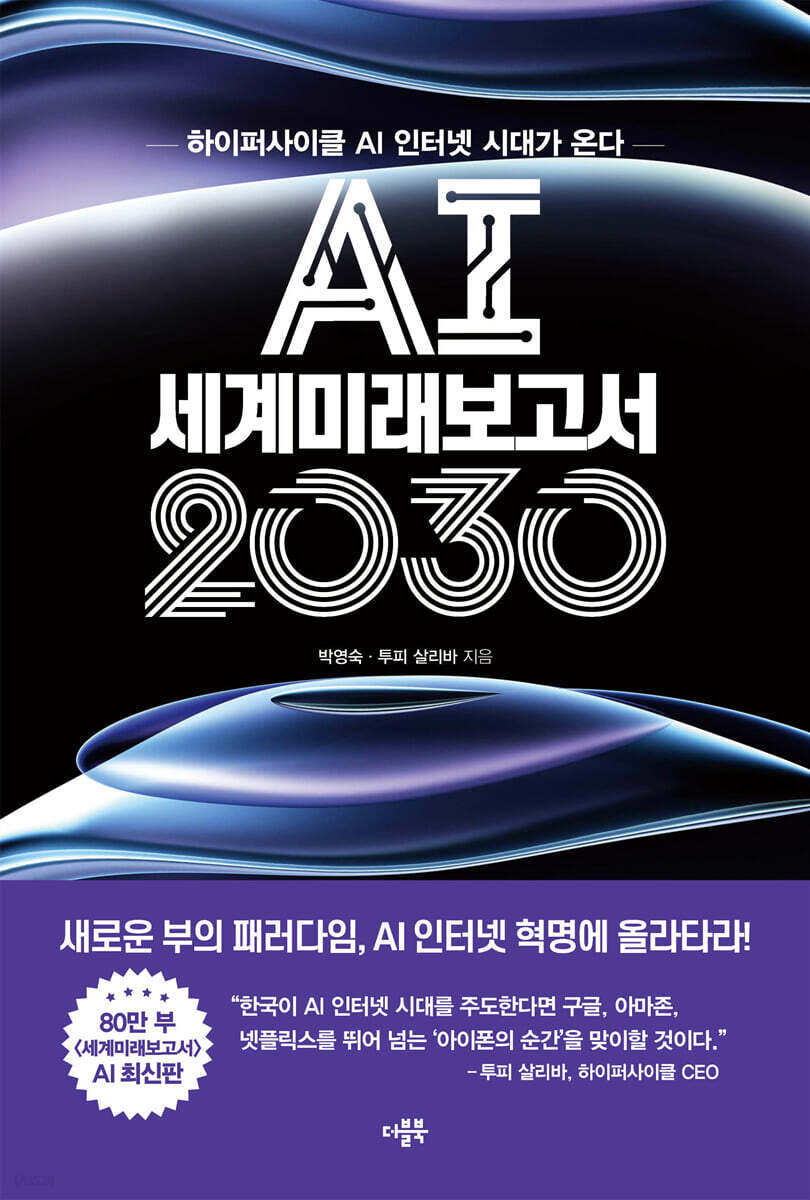
AI World Future Report 2030
 |
Description
Book Introduction
A new wealth paradigm, ride the AI Internet revolution!
If Korea leads the AI Internet era
Surpassing Google, Amazon, and Netflix
We're about to have our 'iPhone moment'!
This book, co-authored by Park Young-sook, the representative of the United Nations Future Forum and the Korean representative of international future research organizations and emerging technology companies such as the Artificial General Intelligence (AGI) Society and SingularityNet, and Tufi Saliba, the global chair of the IEEE AI Security International Protocol, is a report that provides important insights into the coming 'AI Internet Era.'
The Lee Jae-myung administration, which will be launched in 2025, has set an ambitious goal of making South Korea one of the world's top three AI powerhouses.
However, despite its outstanding IT infrastructure and semiconductor capabilities, Korea still shows weaknesses in AI software and talent development.
Accordingly, this book emphasizes the urgent need for a comprehensive national AI strategy, including a significant increase in the AI R&D budget and attracting private investment through deregulation.
In particular, AI internet networks, AI semiconductors, and AI expert training are presented as key investment areas.
The authors also emphasize that AI internet technologies such as 'Hypercycle' will emerge as core to the future digital ecosystem, and that Korea has a strategic opportunity to proactively adopt them and lead the global AI ecosystem.
Hypercycles are expected to account for the majority of machine-to-machine communication by 2026, fundamentally changing the landscape of the AI market.
AI also heralds revolutionary changes in the education and real estate sectors. Personalized learning through AI education systems will become widespread, accelerating the shift to an era where practical skills are valued over academic degrees.
Furthermore, it is predicted that by 2030, the AI industry will form a massive economic sphere worth 160 trillion won, reorganizing the industrial landscape and creating new occupations along with changes in working methods.
However, the development of AI brings with it both opportunities and risks.
The authors emphasize the importance of international cooperation and AI governance to address ethical issues and security threats, and emphasize the need for policies and regulations to ensure the safe and ethical development and use of AI.
This book clearly demonstrates that AI has the potential to add enormous economic value to the global economy by 2030, and proposes specific strategic directions to help Korea wisely respond to the opportunities and challenges of the coming AI era.
If Korea leads the AI Internet era
Surpassing Google, Amazon, and Netflix
We're about to have our 'iPhone moment'!
This book, co-authored by Park Young-sook, the representative of the United Nations Future Forum and the Korean representative of international future research organizations and emerging technology companies such as the Artificial General Intelligence (AGI) Society and SingularityNet, and Tufi Saliba, the global chair of the IEEE AI Security International Protocol, is a report that provides important insights into the coming 'AI Internet Era.'
The Lee Jae-myung administration, which will be launched in 2025, has set an ambitious goal of making South Korea one of the world's top three AI powerhouses.
However, despite its outstanding IT infrastructure and semiconductor capabilities, Korea still shows weaknesses in AI software and talent development.
Accordingly, this book emphasizes the urgent need for a comprehensive national AI strategy, including a significant increase in the AI R&D budget and attracting private investment through deregulation.
In particular, AI internet networks, AI semiconductors, and AI expert training are presented as key investment areas.
The authors also emphasize that AI internet technologies such as 'Hypercycle' will emerge as core to the future digital ecosystem, and that Korea has a strategic opportunity to proactively adopt them and lead the global AI ecosystem.
Hypercycles are expected to account for the majority of machine-to-machine communication by 2026, fundamentally changing the landscape of the AI market.
AI also heralds revolutionary changes in the education and real estate sectors. Personalized learning through AI education systems will become widespread, accelerating the shift to an era where practical skills are valued over academic degrees.
Furthermore, it is predicted that by 2030, the AI industry will form a massive economic sphere worth 160 trillion won, reorganizing the industrial landscape and creating new occupations along with changes in working methods.
However, the development of AI brings with it both opportunities and risks.
The authors emphasize the importance of international cooperation and AI governance to address ethical issues and security threats, and emphasize the need for policies and regulations to ensure the safe and ethical development and use of AI.
This book clearly demonstrates that AI has the potential to add enormous economic value to the global economy by 2030, and proposes specific strategic directions to help Korea wisely respond to the opportunities and challenges of the coming AI era.
- You can preview some of the book's contents.
Preview
index
prolog
South Korea's Strategy for Becoming a Global AI Hegemon
PART 1
The Hypercycle AI Internet Era is Coming
1.
The era of the "Internet of AI" has arrived.
2. The "iPhone moment" for AI is coming.
3.
Hypercycle, a decentralized network of nodes, is driving the AI revolution.
4.
Hypercycle's AI Internet Brings Its Power to Korea
5.
Addip's augmented AI service automatically generates content.
PART 2
The End of Education and Real Estate in the AI Internet Age
1. In the AI era, a solution to Korea's low birth rate emerges.
2.
The end of college has begun
3.
The era of the disappearance of the "educational background" section from resumes worldwide.
4. The Future of Education Through AI Agents
5. AGI Edu Opens the Future of Training 1 Million AI Experts
6.
The End of the Real Estate Republic
7.
Korea is expected to enter the era of free housing by 2078.
8. Solutions to Korea's Real Estate Crisis in the AI Era
PART 3
Future Industries Emerging in the AI Era of 2030
1. The future transformed by AI will completely reshape the industrial landscape.
2.
The AI industry will reach a value of 16 quadrillion won by 2030.
3. The Rise of the AI EdTech Revolution
4.
The Golden Age of Service Robots and Collaborative Robots
5. The era of smart healthcare powered by AI and data
6.
The Age of Superintelligence is Fast Approaching... AI Giants Declare War on Superintelligence
7. AI is now evolving into 'emotional intelligence.'
8.
Opportunities and Prospects for the Next Decade in the AI Era 2030
PART 4
The AI Era of 2030: The Way We Work Will Change
1. In the AGI era, half of the workforce will disappear.
2. AI Accelerates Workplace Restructuring
3. The AI Era Predicts Turbulent Job Markets
4. AI Usheres in the Era of the "Solopreneur"
5. AI is changing the way we work.
6. Statistics on AI replacing jobs
7. AI Agents: The Shadow Cast on Our Jobs
8. Why AI Won't Take Your Job Anytime Soon
PART 5
AGI Global Governance Establishment Scenario
1.
Millennium Project: Discussion on Phase 1 of Establishing AGI Global Governance
2.
Millennium Project: Discussion on Phase 2 of the AGI Global Governance Framework
3.
Millennium Project: Discussion on the 3rd Step of Establishing AGI Global Governance
4.
The Millennium Project: Discussing the Four Steps to Establishing AGI Global Governance
PART 6
The 2030 AI Governance Revolution is Coming
1. The UN begins serious discussions on global AI governance.
2. The UN Security Council will begin a full-scale discussion on the military use of AI and international peace and security.
3.
Why UN IAIA?
4.
Analysis of the economic impact of the UN IAIA when Korea hosts it
5.
Possibility of South Korea Hosting the UN Artificial Intelligence Agency (IAIA)
South Korea's Strategy for Becoming a Global AI Hegemon
PART 1
The Hypercycle AI Internet Era is Coming
1.
The era of the "Internet of AI" has arrived.
2. The "iPhone moment" for AI is coming.
3.
Hypercycle, a decentralized network of nodes, is driving the AI revolution.
4.
Hypercycle's AI Internet Brings Its Power to Korea
5.
Addip's augmented AI service automatically generates content.
PART 2
The End of Education and Real Estate in the AI Internet Age
1. In the AI era, a solution to Korea's low birth rate emerges.
2.
The end of college has begun
3.
The era of the disappearance of the "educational background" section from resumes worldwide.
4. The Future of Education Through AI Agents
5. AGI Edu Opens the Future of Training 1 Million AI Experts
6.
The End of the Real Estate Republic
7.
Korea is expected to enter the era of free housing by 2078.
8. Solutions to Korea's Real Estate Crisis in the AI Era
PART 3
Future Industries Emerging in the AI Era of 2030
1. The future transformed by AI will completely reshape the industrial landscape.
2.
The AI industry will reach a value of 16 quadrillion won by 2030.
3. The Rise of the AI EdTech Revolution
4.
The Golden Age of Service Robots and Collaborative Robots
5. The era of smart healthcare powered by AI and data
6.
The Age of Superintelligence is Fast Approaching... AI Giants Declare War on Superintelligence
7. AI is now evolving into 'emotional intelligence.'
8.
Opportunities and Prospects for the Next Decade in the AI Era 2030
PART 4
The AI Era of 2030: The Way We Work Will Change
1. In the AGI era, half of the workforce will disappear.
2. AI Accelerates Workplace Restructuring
3. The AI Era Predicts Turbulent Job Markets
4. AI Usheres in the Era of the "Solopreneur"
5. AI is changing the way we work.
6. Statistics on AI replacing jobs
7. AI Agents: The Shadow Cast on Our Jobs
8. Why AI Won't Take Your Job Anytime Soon
PART 5
AGI Global Governance Establishment Scenario
1.
Millennium Project: Discussion on Phase 1 of Establishing AGI Global Governance
2.
Millennium Project: Discussion on Phase 2 of the AGI Global Governance Framework
3.
Millennium Project: Discussion on the 3rd Step of Establishing AGI Global Governance
4.
The Millennium Project: Discussing the Four Steps to Establishing AGI Global Governance
PART 6
The 2030 AI Governance Revolution is Coming
1. The UN begins serious discussions on global AI governance.
2. The UN Security Council will begin a full-scale discussion on the military use of AI and international peace and security.
3.
Why UN IAIA?
4.
Analysis of the economic impact of the UN IAIA when Korea hosts it
5.
Possibility of South Korea Hosting the UN Artificial Intelligence Agency (IAIA)
Detailed image

Into the book
Just as Uber revolutionized the taxi industry, Amazon revolutionized retail, and Airbnb revolutionized the hotel industry, ushering in an "iPhone moment," Hypercycle's node factory network is now heralding a major turning point that will reshape the entire artificial intelligence (AI) landscape.
--- p.25
The activation of Hypercycle's node network represents more than just another technological advancement.
This signals the beginning of a new era in AI development, one where network effects and distributed collaboration are replacing centralized infrastructure and proprietary platforms as the primary drivers of competitive advantage.
--- p.35
It is perhaps the greatest existential threat to our existence today, and while many people want to prevent AI from destroying humanity, we also want to protect AI from humans using it to attack other humans.
The worst enemy could develop and license the same AI in other domains today.
Visionaries like Elon Musk seem to have grasped the core of the problem we face, but they don't seem to know what can be done technologically to prevent it.
--- p.37
“When students access the cloud and receive personalized, one-on-one learning from AI tutors, children from wealthy families will no longer have an advantage.” The era of educational equality is coming.
--- p.47
Korea has poured an astronomical 280 trillion won into encouraging childbirth over the past 18 years, but has failed.
But now, with the advent of the AI era and a shift in the real estate paradigm, real solutions are beginning to emerge.
An era where AI takes charge of education and the government takes charge of housing.
The future of Korea, where young people dream again and the laughter of children is heard, is not far away.
--- p.49
Universities are facing an existential crisis as the global school-age population declines and rapidly changing technological cycles converge.
In particular, as Elon Musk declared in 2014 that a college degree was unnecessary for Tesla hiring, a fundamental change in the four-year university system is needed as companies increasingly value practical skills over degrees.
The phenomenon of universities disappearing or consolidating around the world is due to a number of complex factors.
--- p.51
The emergence of AI like Chat GPT is fundamentally shaking the very foundations of traditional university education.
Memorizing information and taking tests has become meaningless.
In a 2024 survey, 60% of companies responded that they require AI skills from job applicants.
But most universities are still stuck in a 20th-century curriculum.
Here's why coding bootcamps and online courses are so popular.
Platforms like Coursera, Udacity, and edX offer hands-on, real-time training.
You can master in six months what it takes a traditional university four years to teach.
--- p.57
The world has moved from the 'degree syndrome' to the 'skills revolution'.
The regional balance and alleviation of private education that the '10 Seoul National University' dreams of are difficult to achieve simply by increasing the number of signboards.
By building AI universities, skill centers, and national certification systems with the same budget, more young people could acquire job skills and enter high-paying jobs in a shorter period of time.
What the global market needs is not people with diplomas, but people who can do the job.
It is time to shift the direction of policy from ‘degree-first’ to ‘skill-first.’
--- p.63
Crucially, AI can make this high-quality education accessible to everyone, not just students in elite schools or wealthy areas.
Students in rural areas can now receive the same expert-level education as students in top-tier urban schools. AI agents adapt to local circumstances, learning styles, and even special needs, making education more inclusive, engaging, and empowering for everyone.
--- p.72
Japan's AIREC project aims to commercialize a 150kg humanoid robot that can help with diaper changing, bedsore prevention, and patient transport by 2030.
Singapore ranks first (75.8 points) on the Global Cities AI Readiness Index and is building AI leadership in healthcare through 100 experimental programs.
A Korean-style senior-friendly city must have the following elements:
--- p.82
South Korea should increase its housing allocation quota for families from the current 10-20% to 40%, implement a tiered subsidy that increases with each child, create a housing voucher program modeled after the French system, mandate childcare in new developments, regulate jeonse deposits to improve rental accessibility, and create 15-minute neighborhoods with integrated family services.
Only by making family housing affordable and accessible can South Korea reverse its population collapse.
--- p.93
AI and robots are also actively being applied in the fields of elderly welfare and nursing.
Looking at the case of Japan, the introduction of robots to nursing facilities has been promoted with government support since the mid-2010s, and cognitive play robots, toilet assistance robots, and mobility assistance robots (electric carts) are being used.
According to the Reuters report introduced above, a research team at Waseda University in Japan is developing a 150kg humanoid care robot called AIREC that can gently lift people and change their posture. This is part of Japan's efforts to make care provided by AI robots instead of people a reality in a super-aging society.
--- p.121
Microsoft claims it is moving towards “medical superintelligence.”
Meta established the “Meta Superintelligence Research Institute” with the goal of “personal superintelligence for everyone.”
Sam Altman, CEO of openAI, has said that we have already reached a “gentle singularity” (referring to superintelligence), while Dario Amodei, CEO of Anthroic, predicts that “a nation of geniuses living in data centers” will arrive between 2026 and 2027.
This analysis also suggests that this is another name for superintelligence.
--- p.127
The latest AI platforms, including Retool, are differentiated from existing simple automation in that they directly integrate with internal databases, APIs, and existing business tools, allowing AI to actually "perform" tasks.
For example, complex tasks such as refund processing, lead management, and inventory updates are all handled by agents through their own judgment and execution.
From a business standpoint, there are various benefits, including reduced labor costs, increased work speed, and complete record management.
--- p.168
Bidding strategies will need to be further refined through ongoing analysis of competitor analysis and the evolving global AI governance landscape.
Through this strategic hosting process, Korea has a very high possibility of successfully hosting the UN IAIA.
--- p.25
The activation of Hypercycle's node network represents more than just another technological advancement.
This signals the beginning of a new era in AI development, one where network effects and distributed collaboration are replacing centralized infrastructure and proprietary platforms as the primary drivers of competitive advantage.
--- p.35
It is perhaps the greatest existential threat to our existence today, and while many people want to prevent AI from destroying humanity, we also want to protect AI from humans using it to attack other humans.
The worst enemy could develop and license the same AI in other domains today.
Visionaries like Elon Musk seem to have grasped the core of the problem we face, but they don't seem to know what can be done technologically to prevent it.
--- p.37
“When students access the cloud and receive personalized, one-on-one learning from AI tutors, children from wealthy families will no longer have an advantage.” The era of educational equality is coming.
--- p.47
Korea has poured an astronomical 280 trillion won into encouraging childbirth over the past 18 years, but has failed.
But now, with the advent of the AI era and a shift in the real estate paradigm, real solutions are beginning to emerge.
An era where AI takes charge of education and the government takes charge of housing.
The future of Korea, where young people dream again and the laughter of children is heard, is not far away.
--- p.49
Universities are facing an existential crisis as the global school-age population declines and rapidly changing technological cycles converge.
In particular, as Elon Musk declared in 2014 that a college degree was unnecessary for Tesla hiring, a fundamental change in the four-year university system is needed as companies increasingly value practical skills over degrees.
The phenomenon of universities disappearing or consolidating around the world is due to a number of complex factors.
--- p.51
The emergence of AI like Chat GPT is fundamentally shaking the very foundations of traditional university education.
Memorizing information and taking tests has become meaningless.
In a 2024 survey, 60% of companies responded that they require AI skills from job applicants.
But most universities are still stuck in a 20th-century curriculum.
Here's why coding bootcamps and online courses are so popular.
Platforms like Coursera, Udacity, and edX offer hands-on, real-time training.
You can master in six months what it takes a traditional university four years to teach.
--- p.57
The world has moved from the 'degree syndrome' to the 'skills revolution'.
The regional balance and alleviation of private education that the '10 Seoul National University' dreams of are difficult to achieve simply by increasing the number of signboards.
By building AI universities, skill centers, and national certification systems with the same budget, more young people could acquire job skills and enter high-paying jobs in a shorter period of time.
What the global market needs is not people with diplomas, but people who can do the job.
It is time to shift the direction of policy from ‘degree-first’ to ‘skill-first.’
--- p.63
Crucially, AI can make this high-quality education accessible to everyone, not just students in elite schools or wealthy areas.
Students in rural areas can now receive the same expert-level education as students in top-tier urban schools. AI agents adapt to local circumstances, learning styles, and even special needs, making education more inclusive, engaging, and empowering for everyone.
--- p.72
Japan's AIREC project aims to commercialize a 150kg humanoid robot that can help with diaper changing, bedsore prevention, and patient transport by 2030.
Singapore ranks first (75.8 points) on the Global Cities AI Readiness Index and is building AI leadership in healthcare through 100 experimental programs.
A Korean-style senior-friendly city must have the following elements:
--- p.82
South Korea should increase its housing allocation quota for families from the current 10-20% to 40%, implement a tiered subsidy that increases with each child, create a housing voucher program modeled after the French system, mandate childcare in new developments, regulate jeonse deposits to improve rental accessibility, and create 15-minute neighborhoods with integrated family services.
Only by making family housing affordable and accessible can South Korea reverse its population collapse.
--- p.93
AI and robots are also actively being applied in the fields of elderly welfare and nursing.
Looking at the case of Japan, the introduction of robots to nursing facilities has been promoted with government support since the mid-2010s, and cognitive play robots, toilet assistance robots, and mobility assistance robots (electric carts) are being used.
According to the Reuters report introduced above, a research team at Waseda University in Japan is developing a 150kg humanoid care robot called AIREC that can gently lift people and change their posture. This is part of Japan's efforts to make care provided by AI robots instead of people a reality in a super-aging society.
--- p.121
Microsoft claims it is moving towards “medical superintelligence.”
Meta established the “Meta Superintelligence Research Institute” with the goal of “personal superintelligence for everyone.”
Sam Altman, CEO of openAI, has said that we have already reached a “gentle singularity” (referring to superintelligence), while Dario Amodei, CEO of Anthroic, predicts that “a nation of geniuses living in data centers” will arrive between 2026 and 2027.
This analysis also suggests that this is another name for superintelligence.
--- p.127
The latest AI platforms, including Retool, are differentiated from existing simple automation in that they directly integrate with internal databases, APIs, and existing business tools, allowing AI to actually "perform" tasks.
For example, complex tasks such as refund processing, lead management, and inventory updates are all handled by agents through their own judgment and execution.
From a business standpoint, there are various benefits, including reduced labor costs, increased work speed, and complete record management.
--- p.168
Bidding strategies will need to be further refined through ongoing analysis of competitor analysis and the evolving global AI governance landscape.
Through this strategic hosting process, Korea has a very high possibility of successfully hosting the UN IAIA.
--- p.302
Publisher's Review
A turning point from Web 2 and Web 3 to the 'Web AI era'
The AI Internet is where AI exists independently of each other.
A growing new digital civilization infrastructure!
A new economic paradigm that offers opportunities for wealth creation
The 21st Lee Jae-myung administration, which took office in 2025, has set an ambitious goal of making South Korea one of the world's top three AI powerhouses.
The new government views artificial intelligence (AI) as a game-changer that will shift the global economic paradigm and has declared its commitment to achieving technology-led growth through it. The AI industry is becoming a key indicator of national competitiveness in the 21st century.
The government emphasizes that the development of AI technology will bring innovation to the economy and society as a whole.
The current global competition for AI hegemony is characterized by a two-party system between the United States and China, with South Korea possessing strengths in IT infrastructure and the semiconductor industry.
However, Korea is considered to be lagging behind the United States and China in terms of AI software and talent.
Accordingly, voices are growing louder that South Korea should pursue a comprehensive national AI strategy.
A recent survey ranked Korea 6th in the world in AI competitiveness, but it ranked 18th out of 62 countries in terms of private investment.
To improve this, the government argues that it should provide deregulation, tax credits, and incentives for foreign investment to encourage private companies to actively invest in AI. Expanding investment in AI R&D is essential, and the government plans to significantly increase its AI R&D budget over the next five years.
Key areas include AI internet networks, AI semiconductors, and AI expert training.
Additionally, a national AI data center and cloud infrastructure are needed to support large-scale AI development.
This book is an AI future report co-written by Park Young-sook, the representative of future research international organizations such as the Artificial General Intelligence (AGI) Society, OpenCog, and SingularityNet, as well as future emerging technology companies, and Tufi Saliba, the global chair of the IEEE AI Security International Protocol.
This book, consisting of six parts, diagnoses the current state of the AI Internet as it evolves into a hyper-intelligent digital ecosystem and presents specific strategies and global scenarios that Korea should explore to secure strategic opportunities to attract and manage this AI Internet and leap forward as a central country in the global AI ecosystem.
The Hypercycle AI Internet Era is Coming
Hypercycle's decentralized AI network is expected to challenge the centralized structure of the AI market and present a new economic paradigm.
“By 2026, 90% of all machine-to-machine communication will be done through this network,” said CEO Saliba.
Now, Hypercycle's node factory network is heralding a major turning point that will reshape the entire artificial intelligence (AI) landscape.
This is evaluated as a key technology infrastructure that will open the era of the Internet of AI, and there are growing voices calling for Korea to attract this technology and lead the global AI Internet ecosystem.
The End of Education and Real Estate in the AI Internet Age
The AI era provides customized education through AI education systems.
There is no longer a need to wander around Gangnam's academy district or receive tutoring until dawn.
In particular, with the change in the hiring system of big tech companies that eliminates the diploma and degree section in the West, we are moving towards an era where the section for writing about university graduation is eliminated.
Now, we are entering an era where we need to demonstrate our skills, portfolio, and experience, rather than just our degrees.
This is explained through in-depth analysis by five experts, using the cases of Walmart and Google.
It also calls for a shift in perception toward governance reform and regional regeneration ideas for balanced regional development, and proposes solutions to Korea's real estate crisis.
Future Industries Emerging in the 2030 AI Era
The landscape of future industries is being completely reorganized.
The analysis is that the paradigm of existing industries is fundamentally changing with the emergence of various AI technologies, from generative AI to agent AI and multimodal AI.
We explore the megatrends of three future industries and 12 emerging key AI convergence industries.
The AI industry in 2030 will be worth 16 quadrillion won.
Morgan Stanley predicts that by 2050, AI will have deeply permeated our daily lives and industries, and the humanoid robot market alone will reach $5 trillion.
The overall AI industry size is expected to exceed 10 to 20 trillion dollars, and the economic ripple effect will easily exceed 20 trillion dollars.
The AI Era of 2030: The Way We Work Will Change
Recent studies predict that AGI will surpass human intellectual capabilities by the late 2020s.
With shocking projections that 4.8 billion jobs worldwide could disappear, humanity stands on the precipice of the greatest economic and social transformation in history.
McKinsey predicts that between 400 million and 800 million people will have to leave their current jobs by 2030.
However, areas where human interaction and creativity are important, such as medical staff, educators, and artists, remain relatively safe.
Meanwhile, AI trainers, ethics supervisors, and human-AI collaborative designers are expected to emerge as new, emerging "future" jobs.
Thanks to the rapid advancements in AI technology in recent years, a single entrepreneur can now leverage AI agents and cutting-edge platforms to handle all core business functions. AI is ushering in the era of the "solopreneur."
Scenarios for Building AI Global Governance
Chapter 5 introduces the contents of the ‘Report of the Presidency of the United Nations General Assembly (UNCPGA)’ and the appendix [Terms of Reference: High-Level Panel on Artificial General Intelligence (AGI) of the Presidency of the United Nations General Assembly (UNCPGA)].
Moreover, the rapid development of AI, including AGI, presents both enormous opportunities and significant risks.
Unregulated development can lead to ethical dilemmas, security threats, and social unrest. The global nature of AI necessitates international cooperation to address challenges that transcend national borders.
Therefore, we aim to create a global, integrated international organization called IAIA to provide a platform for countries to share knowledge, best practices, and resources.
Here, IAIA explains its core role.
The 2030 AI Governance Revolution is Coming
As the UN Security Council begins discussions on the military use of artificial intelligence (AI) and international peace and security, international interest in AI governance is growing. While advancements in AI technology could bring significant benefits to humanity, concerns are also being raised about the potential for new security threats, such as the development of autonomous weapons systems, cyberattacks, and the spread of disinformation.
Accordingly, the UN Security Council is working to address the challenges posed by the advancement of AI technology and establish norms for international peace and security. Policies and regulations are needed to ensure that AI is developed and used safely and ethically.
This should increase transparency in AI's decision-making process and outcomes, and strengthen privacy protection.
The government is pursuing AI transformation as a national project, aiming to achieve productivity innovation across all industries.
We plan to pursue innovation in the manufacturing and healthcare sectors by introducing smart factories and AI-based precision medicine.
Advances in AI technology will create a new economic paradigm, and experts predict that AI will add $15.7 trillion to the global economy by 2030.
In this way, the advent of the AI era will present both new opportunities and challenges to humanity. With the dawn of the AI era, we will be able to move toward a better future.
The AI Internet is where AI exists independently of each other.
A growing new digital civilization infrastructure!
A new economic paradigm that offers opportunities for wealth creation
The 21st Lee Jae-myung administration, which took office in 2025, has set an ambitious goal of making South Korea one of the world's top three AI powerhouses.
The new government views artificial intelligence (AI) as a game-changer that will shift the global economic paradigm and has declared its commitment to achieving technology-led growth through it. The AI industry is becoming a key indicator of national competitiveness in the 21st century.
The government emphasizes that the development of AI technology will bring innovation to the economy and society as a whole.
The current global competition for AI hegemony is characterized by a two-party system between the United States and China, with South Korea possessing strengths in IT infrastructure and the semiconductor industry.
However, Korea is considered to be lagging behind the United States and China in terms of AI software and talent.
Accordingly, voices are growing louder that South Korea should pursue a comprehensive national AI strategy.
A recent survey ranked Korea 6th in the world in AI competitiveness, but it ranked 18th out of 62 countries in terms of private investment.
To improve this, the government argues that it should provide deregulation, tax credits, and incentives for foreign investment to encourage private companies to actively invest in AI. Expanding investment in AI R&D is essential, and the government plans to significantly increase its AI R&D budget over the next five years.
Key areas include AI internet networks, AI semiconductors, and AI expert training.
Additionally, a national AI data center and cloud infrastructure are needed to support large-scale AI development.
This book is an AI future report co-written by Park Young-sook, the representative of future research international organizations such as the Artificial General Intelligence (AGI) Society, OpenCog, and SingularityNet, as well as future emerging technology companies, and Tufi Saliba, the global chair of the IEEE AI Security International Protocol.
This book, consisting of six parts, diagnoses the current state of the AI Internet as it evolves into a hyper-intelligent digital ecosystem and presents specific strategies and global scenarios that Korea should explore to secure strategic opportunities to attract and manage this AI Internet and leap forward as a central country in the global AI ecosystem.
The Hypercycle AI Internet Era is Coming
Hypercycle's decentralized AI network is expected to challenge the centralized structure of the AI market and present a new economic paradigm.
“By 2026, 90% of all machine-to-machine communication will be done through this network,” said CEO Saliba.
Now, Hypercycle's node factory network is heralding a major turning point that will reshape the entire artificial intelligence (AI) landscape.
This is evaluated as a key technology infrastructure that will open the era of the Internet of AI, and there are growing voices calling for Korea to attract this technology and lead the global AI Internet ecosystem.
The End of Education and Real Estate in the AI Internet Age
The AI era provides customized education through AI education systems.
There is no longer a need to wander around Gangnam's academy district or receive tutoring until dawn.
In particular, with the change in the hiring system of big tech companies that eliminates the diploma and degree section in the West, we are moving towards an era where the section for writing about university graduation is eliminated.
Now, we are entering an era where we need to demonstrate our skills, portfolio, and experience, rather than just our degrees.
This is explained through in-depth analysis by five experts, using the cases of Walmart and Google.
It also calls for a shift in perception toward governance reform and regional regeneration ideas for balanced regional development, and proposes solutions to Korea's real estate crisis.
Future Industries Emerging in the 2030 AI Era
The landscape of future industries is being completely reorganized.
The analysis is that the paradigm of existing industries is fundamentally changing with the emergence of various AI technologies, from generative AI to agent AI and multimodal AI.
We explore the megatrends of three future industries and 12 emerging key AI convergence industries.
The AI industry in 2030 will be worth 16 quadrillion won.
Morgan Stanley predicts that by 2050, AI will have deeply permeated our daily lives and industries, and the humanoid robot market alone will reach $5 trillion.
The overall AI industry size is expected to exceed 10 to 20 trillion dollars, and the economic ripple effect will easily exceed 20 trillion dollars.
The AI Era of 2030: The Way We Work Will Change
Recent studies predict that AGI will surpass human intellectual capabilities by the late 2020s.
With shocking projections that 4.8 billion jobs worldwide could disappear, humanity stands on the precipice of the greatest economic and social transformation in history.
McKinsey predicts that between 400 million and 800 million people will have to leave their current jobs by 2030.
However, areas where human interaction and creativity are important, such as medical staff, educators, and artists, remain relatively safe.
Meanwhile, AI trainers, ethics supervisors, and human-AI collaborative designers are expected to emerge as new, emerging "future" jobs.
Thanks to the rapid advancements in AI technology in recent years, a single entrepreneur can now leverage AI agents and cutting-edge platforms to handle all core business functions. AI is ushering in the era of the "solopreneur."
Scenarios for Building AI Global Governance
Chapter 5 introduces the contents of the ‘Report of the Presidency of the United Nations General Assembly (UNCPGA)’ and the appendix [Terms of Reference: High-Level Panel on Artificial General Intelligence (AGI) of the Presidency of the United Nations General Assembly (UNCPGA)].
Moreover, the rapid development of AI, including AGI, presents both enormous opportunities and significant risks.
Unregulated development can lead to ethical dilemmas, security threats, and social unrest. The global nature of AI necessitates international cooperation to address challenges that transcend national borders.
Therefore, we aim to create a global, integrated international organization called IAIA to provide a platform for countries to share knowledge, best practices, and resources.
Here, IAIA explains its core role.
The 2030 AI Governance Revolution is Coming
As the UN Security Council begins discussions on the military use of artificial intelligence (AI) and international peace and security, international interest in AI governance is growing. While advancements in AI technology could bring significant benefits to humanity, concerns are also being raised about the potential for new security threats, such as the development of autonomous weapons systems, cyberattacks, and the spread of disinformation.
Accordingly, the UN Security Council is working to address the challenges posed by the advancement of AI technology and establish norms for international peace and security. Policies and regulations are needed to ensure that AI is developed and used safely and ethically.
This should increase transparency in AI's decision-making process and outcomes, and strengthen privacy protection.
The government is pursuing AI transformation as a national project, aiming to achieve productivity innovation across all industries.
We plan to pursue innovation in the manufacturing and healthcare sectors by introducing smart factories and AI-based precision medicine.
Advances in AI technology will create a new economic paradigm, and experts predict that AI will add $15.7 trillion to the global economy by 2030.
In this way, the advent of the AI era will present both new opportunities and challenges to humanity. With the dawn of the AI era, we will be able to move toward a better future.
GOODS SPECIFICS
- Date of issue: August 11, 2025
- Page count, weight, size: 304 pages | 548g | 152*225*18mm
- ISBN13: 9791193153819
You may also like
카테고리
korean


korean

![GQ KOREA Mark (Monthly): December [2025]](http://librairie.coreenne.fr/cdn/shop/files/8ef265dbbfbf186523ed75ba7319009d.jpg?v=1765340328&width=3840)


