

Smart Investor Release
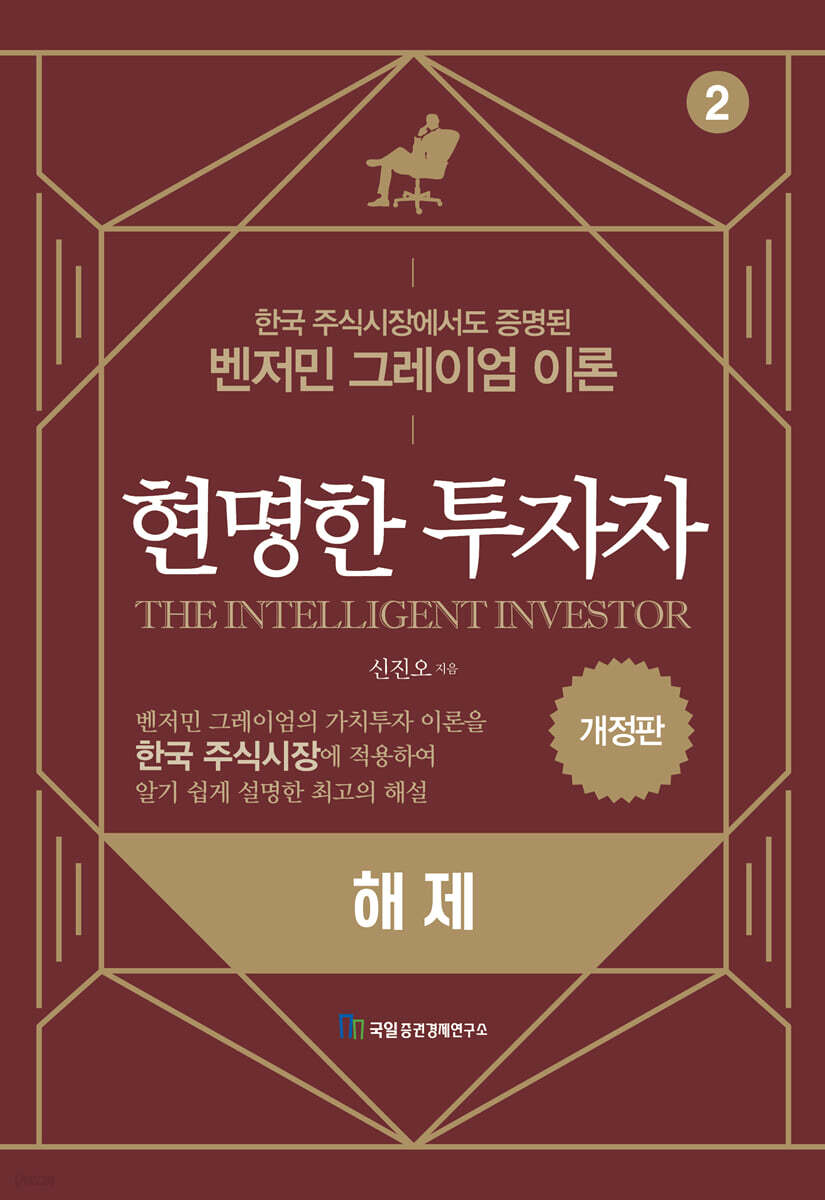 |
Description
Book Introduction
Benjamin Graham, the father of value investing, published his book "The Intelligent Investor" in 1949, and went through two revised editions, three revised editions, and a fourth revised edition in 1973.
And in 2016, a revised edition was published with additional commentary by Jason Zweig.
However, many people said that Jason Zweig's commentary was too difficult to understand and did not fit the Korean stock market because it used the US stock market as an example.
So, we published "The Intelligent Investor," which explains the theories emphasized by Benjamin Graham by applying them to the Korean stock market, along with "The Intelligent Investor, Revised 4th Edition," the last revised edition written by Benjamin Graham himself during his lifetime.
"The Intelligent Investor" is the best book that explains Benjamin Graham's theories in an easy-to-understand manner and proves the success of Graham's theories by conducting simulations to see if they can be applied to the Korean stock market.
This time, the revised 4th edition of “The Intelligent Investor” has been revised with Lee Seong-min’s easy-to-understand and clear translation, so the quotations have been changed to Lee Seong-min’s text and the revised edition of “The Intelligent Investor Commentary” has been published.
As Warren Buffett emphasized, “The principles of value investing transcend national borders and apply to all markets. I follow the principles written in Benjamin Graham’s book, “The Intelligent Investor,” not only in the United States but also in other countries,” Graham’s theory has once again proven to be an investment book that delivers the best value beyond time and space.
And in 2016, a revised edition was published with additional commentary by Jason Zweig.
However, many people said that Jason Zweig's commentary was too difficult to understand and did not fit the Korean stock market because it used the US stock market as an example.
So, we published "The Intelligent Investor," which explains the theories emphasized by Benjamin Graham by applying them to the Korean stock market, along with "The Intelligent Investor, Revised 4th Edition," the last revised edition written by Benjamin Graham himself during his lifetime.
"The Intelligent Investor" is the best book that explains Benjamin Graham's theories in an easy-to-understand manner and proves the success of Graham's theories by conducting simulations to see if they can be applied to the Korean stock market.
This time, the revised 4th edition of “The Intelligent Investor” has been revised with Lee Seong-min’s easy-to-understand and clear translation, so the quotations have been changed to Lee Seong-min’s text and the revised edition of “The Intelligent Investor Commentary” has been published.
As Warren Buffett emphasized, “The principles of value investing transcend national borders and apply to all markets. I follow the principles written in Benjamin Graham’s book, “The Intelligent Investor,” not only in the United States but also in other countries,” Graham’s theory has once again proven to be an investment book that delivers the best value beyond time and space.
- You can preview some of the book's contents.
Preview
index
Entering
Wise / Purpose of writing
Chapter 1: Investment Principles
The Temptation of Speculation / Youthful Investment Studies / Ownership Mindset / Investment Advice / Investment Philosophy
Chapter 2 PER and Fair Price
Current PER / Average PER / Normal PER / Fair Price / Fair PER
Chapter 3 Safety Margin and RIM
Yield gap / Price spread / Investor mistakes / RIM / Appropriate PBR
Chapter 4: Stock Selection
Bonds Recommended for Defensive Investors / Bonds Recommended for Defensive Investors in Korea /
Stocks Recommended for Defensive Investors / Stocks Recommended for Defensive Investors in Korea /
Bonds Recommended for Active Investors / Bonds Recommended for Active Investors in Korea /
Stocks Recommended for Active Investors / Stocks Recommended for Active Investors in Korea
Chapter 5 Quant
NCAV Strategy / Graham's Last Gift
Chapter 6 Portfolio
Benchmark / Market-Cap-Weighted Portfolio [1] / Equal-Weighted Portfolio [1] / Value-Weighted Portfolio [1] / Market-Cap-Weighted Portfolio [2] / Equal-Weighted Portfolio [2] / Value-Weighted Portfolio [2]
Chapter 7 Asset Allocation
Buy-and-hold method / Fixed-rate investment method / Variable-rate investment method / Fixed-rate purchase accumulation method / Benchmark (international) /
Constant-Rate Investment Method (International) / FED (Domestic) Model / FED (International) Model / Strategic Value Investment [1] /
Strategic Value Investing [2] / Strategic Value Investing [3]
In conclusion
A Summary of Benjamin Graham's Life
Reference books
index
Wise / Purpose of writing
Chapter 1: Investment Principles
The Temptation of Speculation / Youthful Investment Studies / Ownership Mindset / Investment Advice / Investment Philosophy
Chapter 2 PER and Fair Price
Current PER / Average PER / Normal PER / Fair Price / Fair PER
Chapter 3 Safety Margin and RIM
Yield gap / Price spread / Investor mistakes / RIM / Appropriate PBR
Chapter 4: Stock Selection
Bonds Recommended for Defensive Investors / Bonds Recommended for Defensive Investors in Korea /
Stocks Recommended for Defensive Investors / Stocks Recommended for Defensive Investors in Korea /
Bonds Recommended for Active Investors / Bonds Recommended for Active Investors in Korea /
Stocks Recommended for Active Investors / Stocks Recommended for Active Investors in Korea
Chapter 5 Quant
NCAV Strategy / Graham's Last Gift
Chapter 6 Portfolio
Benchmark / Market-Cap-Weighted Portfolio [1] / Equal-Weighted Portfolio [1] / Value-Weighted Portfolio [1] / Market-Cap-Weighted Portfolio [2] / Equal-Weighted Portfolio [2] / Value-Weighted Portfolio [2]
Chapter 7 Asset Allocation
Buy-and-hold method / Fixed-rate investment method / Variable-rate investment method / Fixed-rate purchase accumulation method / Benchmark (international) /
Constant-Rate Investment Method (International) / FED (Domestic) Model / FED (International) Model / Strategic Value Investment [1] /
Strategic Value Investing [2] / Strategic Value Investing [3]
In conclusion
A Summary of Benjamin Graham's Life
Reference books
index
Detailed image
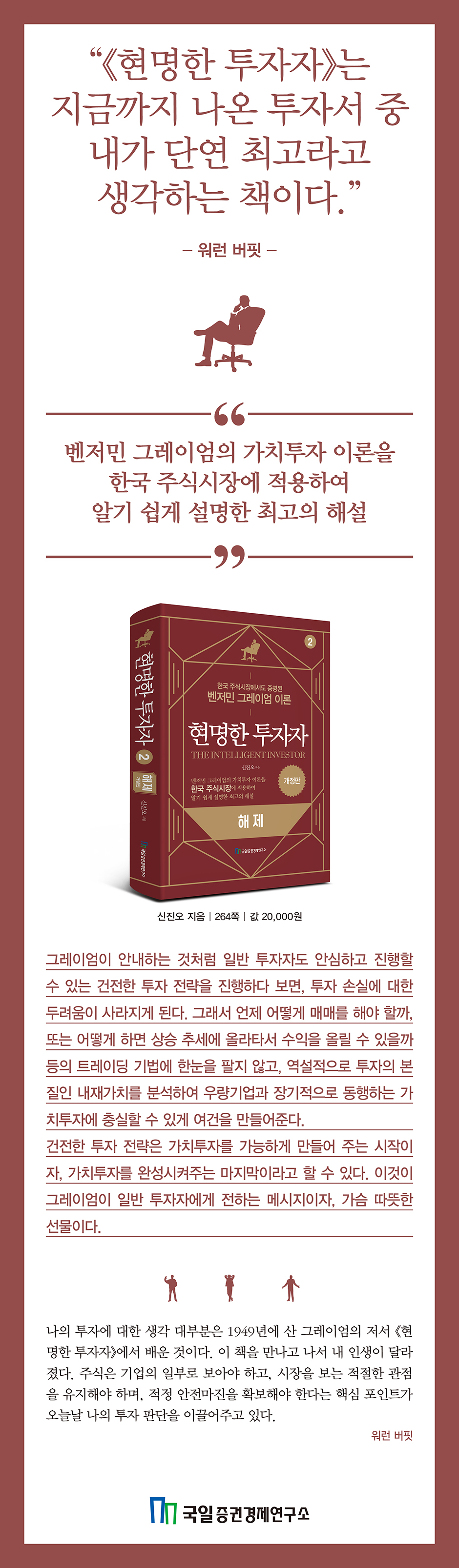
Into the book
When asked during an interview with Graham for advice for young people starting out in investing, Graham replied:
“I think The Intelligent Investor is a more useful book than Security Analysis.
“The Intelligent Investor recommends choosing a technique that seems advantageous and sticking to it consistently.” It is interesting to note that Graham himself recommended The Intelligent Investor more than Security Analysis.
---From "Entering"
Investors should invest in companies that make money.
Therefore, Graham considers profitability to be the first criterion for investment.
Companies with stock returns exceeding bond yields are investment targets that provide a margin of safety.
However, there may be companies that are grossly undervalued but not sufficiently profitable.
In other words, it is clear that it is not a sound investment in principle, but it is so undervalued that it is worth investing in exceptionally or temporarily.
At this point, the difference between intrinsic value and stock price can be considered a kind of safety margin.
---From "Chapter 3 Safety Margin and RIM"
Quantitative investment expert Kang Hwan-guk named this strategy "Graham's Last Gift" because Graham proposed it just before he passed away.
What if the "Graham's Last Gift" strategy had been used in Korea? A backtest conducted from July 2002 to June 2016 yielded a compound annual return of 14.0%.
This super-simple strategy worked in Korea, too! Historically, Korea has had a lower PER than the US.
Therefore, we backtested a strategy of lowering the PER to 5x and investing in companies with a debt ratio of 50% or less, and the annual compound interest rate improved to 16.3%.
Including dividends, it is estimated to be close to the US figure of 17.8%.
This strategy has achieved high returns in the United States as well as in Korea.
Forty years after its introduction, the strategy remains relevant.
---From "Chapter 5 Quant"
As Graham guides, if you follow a sound investment strategy that even ordinary investors can safely proceed with, the fear of investment losses will disappear.
So, instead of focusing on trading techniques like how and when to trade or how to ride an upward trend to generate profits, paradoxically, it creates an environment where you can faithfully focus on value investing, which involves analyzing intrinsic value, the essence of investing, and partnering with quality companies over the long term.
A sound investment strategy is both the beginning that makes value investing possible and the end that completes it.
This is Graham's message to the average investor, and it's a heartwarming gift.
“I think The Intelligent Investor is a more useful book than Security Analysis.
“The Intelligent Investor recommends choosing a technique that seems advantageous and sticking to it consistently.” It is interesting to note that Graham himself recommended The Intelligent Investor more than Security Analysis.
---From "Entering"
Investors should invest in companies that make money.
Therefore, Graham considers profitability to be the first criterion for investment.
Companies with stock returns exceeding bond yields are investment targets that provide a margin of safety.
However, there may be companies that are grossly undervalued but not sufficiently profitable.
In other words, it is clear that it is not a sound investment in principle, but it is so undervalued that it is worth investing in exceptionally or temporarily.
At this point, the difference between intrinsic value and stock price can be considered a kind of safety margin.
---From "Chapter 3 Safety Margin and RIM"
Quantitative investment expert Kang Hwan-guk named this strategy "Graham's Last Gift" because Graham proposed it just before he passed away.
What if the "Graham's Last Gift" strategy had been used in Korea? A backtest conducted from July 2002 to June 2016 yielded a compound annual return of 14.0%.
This super-simple strategy worked in Korea, too! Historically, Korea has had a lower PER than the US.
Therefore, we backtested a strategy of lowering the PER to 5x and investing in companies with a debt ratio of 50% or less, and the annual compound interest rate improved to 16.3%.
Including dividends, it is estimated to be close to the US figure of 17.8%.
This strategy has achieved high returns in the United States as well as in Korea.
Forty years after its introduction, the strategy remains relevant.
---From "Chapter 5 Quant"
As Graham guides, if you follow a sound investment strategy that even ordinary investors can safely proceed with, the fear of investment losses will disappear.
So, instead of focusing on trading techniques like how and when to trade or how to ride an upward trend to generate profits, paradoxically, it creates an environment where you can faithfully focus on value investing, which involves analyzing intrinsic value, the essence of investing, and partnering with quality companies over the long term.
A sound investment strategy is both the beginning that makes value investing possible and the end that completes it.
This is Graham's message to the average investor, and it's a heartwarming gift.
---From "In Conclusion"
Publisher's Review
Benjamin Graham wrote The Intelligent Investor for ordinary investors, not investment experts.
So, although it covers a very basic level of securities analysis, it avoids explaining in-depth content and divides investors into defensive and active investors, explaining investment principles that suit each investor's tendencies and temperament.
《The Intelligent Investor》 explains Benjamin Graham's theories by applying them to the Korean stock market, so that Korean stock investors can more easily understand 《The Intelligent Investor》.
This section presents the simulation results of 10 large, blue-chip stocks, including Samsung Electronics, SKT, POSCO, KEPCO, Hyundai Motor Company, Samsung Fire & Marine Insurance, Shinsegae, Hyundai Mobis, S-Oil, and GS Engineering & Construction, and constructs a market capitalization-weighted portfolio (1), an equal-weighted portfolio (1), and a value-weighted portfolio (1).
And, by selecting 10 value-added stocks, including Samsung Fire & Marine Insurance, Shinsegae, S-Oil, GS Engineering & Construction, KCC, Yuhan Corporation, Lotte Holdings, Nongshim, Orion Holdings, and Korea Zinc, the results of simulations for a market capitalization-weighted portfolio (2), an equal-weighted portfolio (2), and a value-weighted portfolio (2) are presented.
Looking at the simulation results starting from 878.82 at the end of January 1996 and running until the end of January 2020, 24 years later, we can see that the returns were astonishing: 890.23%, 1419.63%, 3911.96%, 647.83%, 2551.47%, and 8519.66%.
It also focuses on how to construct a portfolio with high-quality stocks and high-quality bonds.
We are discussing asset allocation between stocks and bonds, which has recently attracted a lot of attention.
It introduces the fixed-rate investment method, variable-rate investment method, and fixed-rate purchase accumulation method, which are types of official investment methods, and also introduces the FED model, which determines the weight by comparing stock and bond returns.
Through this, it was proven that the fixed-rate investment method can generate large returns of 254.87%, the variable-rate investment method 416.21%, the fixed-rate purchase accumulation method 297.28%, the FED (domestic) model 525.57%, and the FED (international) model 664.12%.
Benjamin Graham's strategy has achieved high returns in the United States and Korea, and has proven that even after 70 years, it is still a method that can yield large returns.
I hope you become a wise investor who invests according to Graham's teachings and become an investment genius who achieves high returns.
So, although it covers a very basic level of securities analysis, it avoids explaining in-depth content and divides investors into defensive and active investors, explaining investment principles that suit each investor's tendencies and temperament.
《The Intelligent Investor》 explains Benjamin Graham's theories by applying them to the Korean stock market, so that Korean stock investors can more easily understand 《The Intelligent Investor》.
This section presents the simulation results of 10 large, blue-chip stocks, including Samsung Electronics, SKT, POSCO, KEPCO, Hyundai Motor Company, Samsung Fire & Marine Insurance, Shinsegae, Hyundai Mobis, S-Oil, and GS Engineering & Construction, and constructs a market capitalization-weighted portfolio (1), an equal-weighted portfolio (1), and a value-weighted portfolio (1).
And, by selecting 10 value-added stocks, including Samsung Fire & Marine Insurance, Shinsegae, S-Oil, GS Engineering & Construction, KCC, Yuhan Corporation, Lotte Holdings, Nongshim, Orion Holdings, and Korea Zinc, the results of simulations for a market capitalization-weighted portfolio (2), an equal-weighted portfolio (2), and a value-weighted portfolio (2) are presented.
Looking at the simulation results starting from 878.82 at the end of January 1996 and running until the end of January 2020, 24 years later, we can see that the returns were astonishing: 890.23%, 1419.63%, 3911.96%, 647.83%, 2551.47%, and 8519.66%.
It also focuses on how to construct a portfolio with high-quality stocks and high-quality bonds.
We are discussing asset allocation between stocks and bonds, which has recently attracted a lot of attention.
It introduces the fixed-rate investment method, variable-rate investment method, and fixed-rate purchase accumulation method, which are types of official investment methods, and also introduces the FED model, which determines the weight by comparing stock and bond returns.
Through this, it was proven that the fixed-rate investment method can generate large returns of 254.87%, the variable-rate investment method 416.21%, the fixed-rate purchase accumulation method 297.28%, the FED (domestic) model 525.57%, and the FED (international) model 664.12%.
Benjamin Graham's strategy has achieved high returns in the United States and Korea, and has proven that even after 70 years, it is still a method that can yield large returns.
I hope you become a wise investor who invests according to Graham's teachings and become an investment genius who achieves high returns.
GOODS SPECIFICS
- Date of issue: July 1, 2025
- Page count, weight, size: 264 pages | 153*225*20mm
- ISBN13: 9788957822432
- ISBN10: 8957822437
You may also like
카테고리
korean


korean

![GQ KOREA Mark (Monthly): December [2025]](http://librairie.coreenne.fr/cdn/shop/files/8ef265dbbfbf186523ed75ba7319009d.jpg?v=1765340328&width=3840)


