

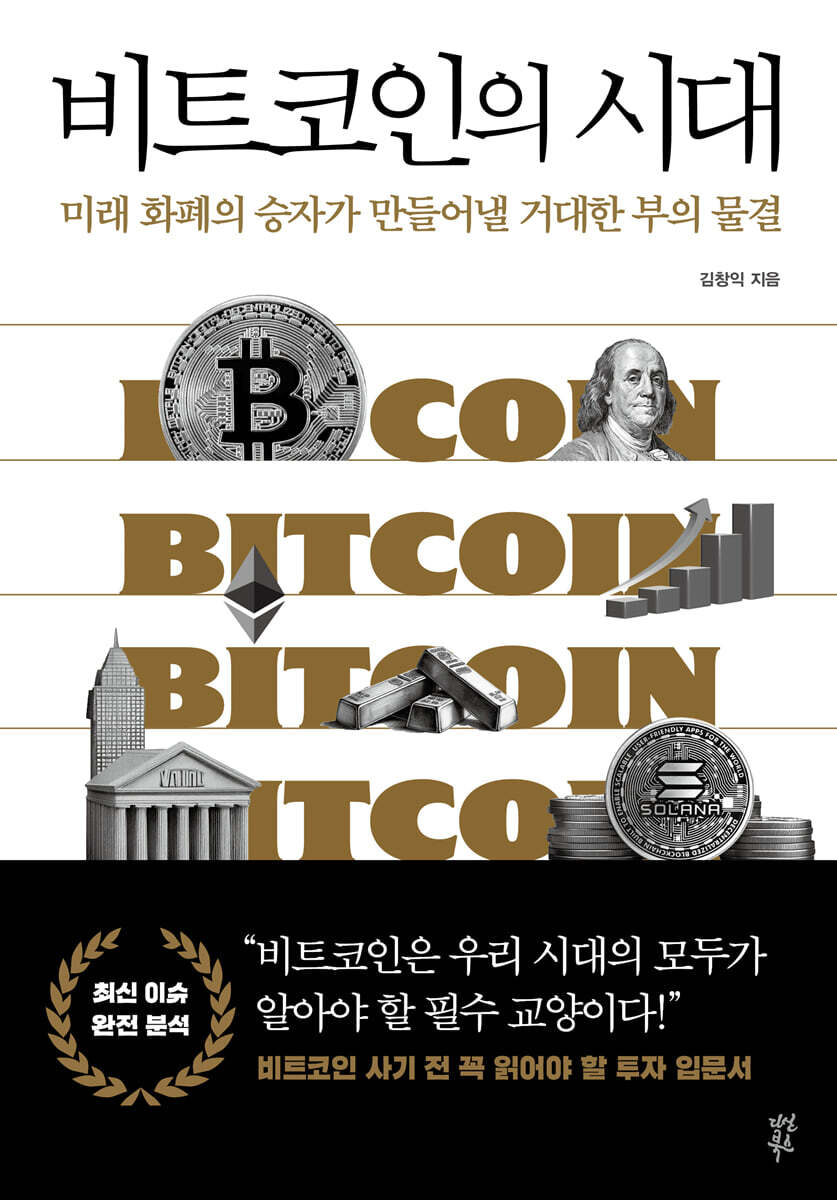
The Age of Bitcoin
 |
Description
Book Introduction
“Bitcoin is the future of our time.
“It is essential knowledge that you must know!”
A Must-Read Investing Guide Before Buying Bitcoin
Following President Trump's re-election in December 2024, Bitcoin surpassed $100,000, its all-time high.
However, his unconventional actions, including tariff wars, the end of war, and the DEI debate, have shocked the world and are even causing financial markets, including the Nasdaq and Bitcoin, to falter.
This book details Trump's inner thoughts, the picture he paints of Bitcoin, and how it will elevate Bitcoin's status.
It clearly reveals not only the future value of Bitcoin as an investment asset, but also the wealth flows that Bitcoin will transform, and the political, economic, industrial, and technological interrelationships between them.
This is essential economic knowledge for modern people living in the literal 'age of Bitcoin.'
In addition, for those interested in investing in Bitcoin or investors, it helps them understand the future direction of Bitcoin by analyzing current Bitcoin news issues.
This will help readers who are confused by the abundance of information about Bitcoin make investment decisions.
“It is essential knowledge that you must know!”
A Must-Read Investing Guide Before Buying Bitcoin
Following President Trump's re-election in December 2024, Bitcoin surpassed $100,000, its all-time high.
However, his unconventional actions, including tariff wars, the end of war, and the DEI debate, have shocked the world and are even causing financial markets, including the Nasdaq and Bitcoin, to falter.
This book details Trump's inner thoughts, the picture he paints of Bitcoin, and how it will elevate Bitcoin's status.
It clearly reveals not only the future value of Bitcoin as an investment asset, but also the wealth flows that Bitcoin will transform, and the political, economic, industrial, and technological interrelationships between them.
This is essential economic knowledge for modern people living in the literal 'age of Bitcoin.'
In addition, for those interested in investing in Bitcoin or investors, it helps them understand the future direction of Bitcoin by analyzing current Bitcoin news issues.
This will help readers who are confused by the abundance of information about Bitcoin make investment decisions.
- You can preview some of the book's contents.
Preview
index
Prologue | A currency that has risen 24.4 million times in 15 years: This is enough reason to know about Bitcoin.
Chapter 1: Bitcoin: An Investment, Not a Speculation
Why is money flowing into Bitcoin?
The dollar's contradictions will fuel Bitcoin.
The US and China's race to secure Bitcoin
Is indirect investment in Bitcoin safer?
Why a Poor Country Became a Rich Country
The cryptocurrency ecosystem expands with altcoins.
Bitcoin Price Support Lines Based on Halving Events
Chapter 2: Bitcoin Can't Help But Rise
The currency that showed the biggest rise in history
How Bitcoin Became "Digital Gold"
Elon Musk and Dogecoin, the creators of meme coins
Why Michael Saylor Is 'All In' on Bitcoin
The power that owns more Bitcoin than Satoshi
The Middle Eastern princes who will determine Bitcoin's price
Chapter 3: Why Trump Became the Bitcoin President
The collapse of the petrodollar system
The rich get richer and the poor get poorer due to inflation
One book changed the course of the US presidential election.
What does Trump hope to gain from the tariff war?
21st Century Imperialism and the US-China Bitcoin Battle
Energy hegemony will shift from oil to electricity.
Differences in Perspectives on Bitcoin Between Korea and Japan
Chapter 4: How Bitcoin Will Change the Global Economy
Pay attention to the kingmaker who made the dollar the world's reserve currency.
Could Bitcoin Become a Reserve Currency?
Bitcoin as an inflation-protecting asset
Is Bitcoin Digital Gold?
Can I pay with Bitcoin?
Combining Bitcoin and NFTs
The Bitcoin Industry's Expansion and its Connection to AI
Chapter 5: What You Need to Know Before Investing in Bitcoin
Bitcoin Price Cycle Through Halvings
Bitcoin Price Prediction Indicators
You need to know Bitcoin to see the real altcoins.
Check out Bitcoin trends
How to Incorporate Volatile Assets into Your Portfolio
Chapter 6: How Will Bitcoin Evolve?
Will Bitcoin Surpass $1 Million?
Corporate Response to the Bitcoin Era
The US's Path as a Bitcoin Hegemon and the World Order
Things Individual Investors Should Prepare for
Epilogue | "Holding" is the Key to Success in Bitcoin Investment
References
Chapter 1: Bitcoin: An Investment, Not a Speculation
Why is money flowing into Bitcoin?
The dollar's contradictions will fuel Bitcoin.
The US and China's race to secure Bitcoin
Is indirect investment in Bitcoin safer?
Why a Poor Country Became a Rich Country
The cryptocurrency ecosystem expands with altcoins.
Bitcoin Price Support Lines Based on Halving Events
Chapter 2: Bitcoin Can't Help But Rise
The currency that showed the biggest rise in history
How Bitcoin Became "Digital Gold"
Elon Musk and Dogecoin, the creators of meme coins
Why Michael Saylor Is 'All In' on Bitcoin
The power that owns more Bitcoin than Satoshi
The Middle Eastern princes who will determine Bitcoin's price
Chapter 3: Why Trump Became the Bitcoin President
The collapse of the petrodollar system
The rich get richer and the poor get poorer due to inflation
One book changed the course of the US presidential election.
What does Trump hope to gain from the tariff war?
21st Century Imperialism and the US-China Bitcoin Battle
Energy hegemony will shift from oil to electricity.
Differences in Perspectives on Bitcoin Between Korea and Japan
Chapter 4: How Bitcoin Will Change the Global Economy
Pay attention to the kingmaker who made the dollar the world's reserve currency.
Could Bitcoin Become a Reserve Currency?
Bitcoin as an inflation-protecting asset
Is Bitcoin Digital Gold?
Can I pay with Bitcoin?
Combining Bitcoin and NFTs
The Bitcoin Industry's Expansion and its Connection to AI
Chapter 5: What You Need to Know Before Investing in Bitcoin
Bitcoin Price Cycle Through Halvings
Bitcoin Price Prediction Indicators
You need to know Bitcoin to see the real altcoins.
Check out Bitcoin trends
How to Incorporate Volatile Assets into Your Portfolio
Chapter 6: How Will Bitcoin Evolve?
Will Bitcoin Surpass $1 Million?
Corporate Response to the Bitcoin Era
The US's Path as a Bitcoin Hegemon and the World Order
Things Individual Investors Should Prepare for
Epilogue | "Holding" is the Key to Success in Bitcoin Investment
References
Detailed image

Into the book
Bitcoin is similar to gold in that it has a high cost of production.
To mine Bitcoin, businesses must build mining farms and purchase mining machines.
Factors of production such as land, capital, and labor are input.
Miners use enormous amounts of electricity to crack passwords.
Depending on the electricity rate, mining costs vary greatly from region to region.
In the United States, it is known that it costs more than $50,000 to mine 1 BTC.
Considering the concept of production cost, it is difficult for the price of Bitcoin to fall below $50,000.
As explained in the gold price, production costs act as a support line to prevent prices from falling below a certain level.
In this situation, excess demand plays a role in pushing up prices.
After the US SEC approved the listing of Bitcoin spot ETFs in 2024, the amount of Bitcoin purchased by asset management companies such as BlackRock to run ETF products exceeded 1 million BTC.
Taking the halving into account, only about 150,000 new Bitcoins were mined during this period.
Considering supply and demand factors, it's actually strange that Bitcoin prices aren't rising.
--- pp.76-77, from “Chapter 1 Bitcoin, Becoming an Investment, Not Speculation”
Cryptocurrency is a crucial variable in Elon Musk's challenge for global power hegemony.
Judging by his actions so far, it seems that Elon Musk himself knows this fact better than anyone else.
Elon Musk's Tesla Energy Grid, TED, is simply a decentralized power grid that combines 'eco-friendly (solar) power generation + batteries + AI trading system' to allow each household or factory to trade surplus electricity with each other.
While lowering the production cost of solar roofs (power generation) and Powerwalls (batteries) is important, lowering payment costs through AI transaction systems is also key.
It's almost a foregone conclusion whether Elon Musk will choose the dollar or cryptocurrency.
(…)
The reason Elon Musk acquired Twitter (now X) is also connected to this.
Elon Musk said, “If you combine a social network with a payments platform, you can achieve what I set out to do with X.com.”
X.com is an internet payment service company founded by Elon Musk in 1999.
It became PayPal in 2000 through a merger with Confinity, founded by Peter Thiel and Max Levchin.
Elon Musk had a vision of making X.com the “center of all finance.”
In short, it was a provocative dream to eliminate existing banks and securities firms.
The fact that they changed their name to 'X' after acquiring Twitter is evidence that they are dreaming again the dream they had set out to achieve with X.com.
--- pp.112-113, from “Chapter 2: Bitcoin Can Only Rise”
It is worth noting the report titled “A Guide to Restructuring the International Trade System,” published in November 2024 by Steve Miran, Chairman of the White House Council of Economic Advisers (CEA).
Looking at Donald Trump's actions since taking office, it is safe to say that he is implementing the contents of this report.
According to this, Donald Trump's tariff policy can be analyzed as a negotiation stepping stone for exchange rate adjustment.
This is interpreted as a strategy to induce a weaker dollar through negotiations after imposing a high tariff of 60% on China.
It is also possible to interpret that Trump is considering a second Plaza Accord, also known as the Mar-a-Lago Accord, targeting China and the EU.
(…)
The report proposes forcing 100-year Treasury bonds on countries seeking access to U.S. economic and security packages as a way to increase demand for Treasury bonds.
The idea is to use the security umbrella to sell government bonds.
The conclusion is that this can prevent a long-term rise in US Treasury yields due to a weak dollar (decrease in confidence in US Treasury bonds).
--- pp.177-178, from “Chapter 3: Why Trump Became the Bitcoin President”
Most arguments against using Bitcoin as a currency cite its "heavy weight."
Because it usually takes 10 minutes to pay with Bitcoin.
On the other hand, banknotes are weight-reduced currency, or lightning currency, which solves the weight problem of gold.
Lightning Network technology, designed to shorten Bitcoin transaction times, has already emerged.
The Lightning Network is a fast-processing technology that processes payments in a separate channel and then stores only the final result on the blockchain when the channel is closed.
(…)
The fact that Bitcoin's issuance is limited is also often used as evidence against Bitcoin becoming a reserve currency.
The argument is that while limited editions are advantageous for storing value, they are actually disadvantages for fulfilling the important function of currency as a medium of exchange.
Global gold reserves total approximately 200,000 tonnes as of 2024.
Unmined gold reserves are estimated at around 54,000 tons.
This is equivalent to only about 155 units if packed into a 12-meter container box.
Gold is not easily divided physically.
The Port of Busan handles an average of 33,000 container boxes per day, while the Port of Shanghai handles more than double that number.
Under the gold standard, this means that hundreds of thousands of boxes of gold were traded daily using 155 boxes of gold.
Bitcoin's issuance amount is 21 million BTC, but 1 BTC can be divided into 100 million Satoshis (Sats).
The actual circulating supply is 2100 trillion Sats, so concerns about the circulating supply are unfounded.
--- pp.243-244, from “Chapter 4: How Bitcoin Will Change the Global Economy”
Looking at the peaks of each halving over the past four halvings, the Bitcoin price has consistently trended upward over the long term.
If you make a long-term investment of more than four years, which is one cycle of the half-life, then 'now is the cheapest price' no matter when you buy.
--- p.313, from “Chapter 5 Things to Know Before Investing in Bitcoin”
Bitcoin is not just one asset among many.
It is an inevitable result of the conflict between globalization and anti-globalization.
It is a historical product that will grow as free trade turns into protectionism and the fiat currency system returns to the commodity currency system.
So, to look into the future of Bitcoin, we must first look back at the history of money.
This is much more important than studying the technical aspects of the Bitcoin blockchain.
Now that I think about it, there definitely is a secret to success in Bitcoin investing.
It sees through the essence of Bitcoin.
To mine Bitcoin, businesses must build mining farms and purchase mining machines.
Factors of production such as land, capital, and labor are input.
Miners use enormous amounts of electricity to crack passwords.
Depending on the electricity rate, mining costs vary greatly from region to region.
In the United States, it is known that it costs more than $50,000 to mine 1 BTC.
Considering the concept of production cost, it is difficult for the price of Bitcoin to fall below $50,000.
As explained in the gold price, production costs act as a support line to prevent prices from falling below a certain level.
In this situation, excess demand plays a role in pushing up prices.
After the US SEC approved the listing of Bitcoin spot ETFs in 2024, the amount of Bitcoin purchased by asset management companies such as BlackRock to run ETF products exceeded 1 million BTC.
Taking the halving into account, only about 150,000 new Bitcoins were mined during this period.
Considering supply and demand factors, it's actually strange that Bitcoin prices aren't rising.
--- pp.76-77, from “Chapter 1 Bitcoin, Becoming an Investment, Not Speculation”
Cryptocurrency is a crucial variable in Elon Musk's challenge for global power hegemony.
Judging by his actions so far, it seems that Elon Musk himself knows this fact better than anyone else.
Elon Musk's Tesla Energy Grid, TED, is simply a decentralized power grid that combines 'eco-friendly (solar) power generation + batteries + AI trading system' to allow each household or factory to trade surplus electricity with each other.
While lowering the production cost of solar roofs (power generation) and Powerwalls (batteries) is important, lowering payment costs through AI transaction systems is also key.
It's almost a foregone conclusion whether Elon Musk will choose the dollar or cryptocurrency.
(…)
The reason Elon Musk acquired Twitter (now X) is also connected to this.
Elon Musk said, “If you combine a social network with a payments platform, you can achieve what I set out to do with X.com.”
X.com is an internet payment service company founded by Elon Musk in 1999.
It became PayPal in 2000 through a merger with Confinity, founded by Peter Thiel and Max Levchin.
Elon Musk had a vision of making X.com the “center of all finance.”
In short, it was a provocative dream to eliminate existing banks and securities firms.
The fact that they changed their name to 'X' after acquiring Twitter is evidence that they are dreaming again the dream they had set out to achieve with X.com.
--- pp.112-113, from “Chapter 2: Bitcoin Can Only Rise”
It is worth noting the report titled “A Guide to Restructuring the International Trade System,” published in November 2024 by Steve Miran, Chairman of the White House Council of Economic Advisers (CEA).
Looking at Donald Trump's actions since taking office, it is safe to say that he is implementing the contents of this report.
According to this, Donald Trump's tariff policy can be analyzed as a negotiation stepping stone for exchange rate adjustment.
This is interpreted as a strategy to induce a weaker dollar through negotiations after imposing a high tariff of 60% on China.
It is also possible to interpret that Trump is considering a second Plaza Accord, also known as the Mar-a-Lago Accord, targeting China and the EU.
(…)
The report proposes forcing 100-year Treasury bonds on countries seeking access to U.S. economic and security packages as a way to increase demand for Treasury bonds.
The idea is to use the security umbrella to sell government bonds.
The conclusion is that this can prevent a long-term rise in US Treasury yields due to a weak dollar (decrease in confidence in US Treasury bonds).
--- pp.177-178, from “Chapter 3: Why Trump Became the Bitcoin President”
Most arguments against using Bitcoin as a currency cite its "heavy weight."
Because it usually takes 10 minutes to pay with Bitcoin.
On the other hand, banknotes are weight-reduced currency, or lightning currency, which solves the weight problem of gold.
Lightning Network technology, designed to shorten Bitcoin transaction times, has already emerged.
The Lightning Network is a fast-processing technology that processes payments in a separate channel and then stores only the final result on the blockchain when the channel is closed.
(…)
The fact that Bitcoin's issuance is limited is also often used as evidence against Bitcoin becoming a reserve currency.
The argument is that while limited editions are advantageous for storing value, they are actually disadvantages for fulfilling the important function of currency as a medium of exchange.
Global gold reserves total approximately 200,000 tonnes as of 2024.
Unmined gold reserves are estimated at around 54,000 tons.
This is equivalent to only about 155 units if packed into a 12-meter container box.
Gold is not easily divided physically.
The Port of Busan handles an average of 33,000 container boxes per day, while the Port of Shanghai handles more than double that number.
Under the gold standard, this means that hundreds of thousands of boxes of gold were traded daily using 155 boxes of gold.
Bitcoin's issuance amount is 21 million BTC, but 1 BTC can be divided into 100 million Satoshis (Sats).
The actual circulating supply is 2100 trillion Sats, so concerns about the circulating supply are unfounded.
--- pp.243-244, from “Chapter 4: How Bitcoin Will Change the Global Economy”
Looking at the peaks of each halving over the past four halvings, the Bitcoin price has consistently trended upward over the long term.
If you make a long-term investment of more than four years, which is one cycle of the half-life, then 'now is the cheapest price' no matter when you buy.
--- p.313, from “Chapter 5 Things to Know Before Investing in Bitcoin”
Bitcoin is not just one asset among many.
It is an inevitable result of the conflict between globalization and anti-globalization.
It is a historical product that will grow as free trade turns into protectionism and the fiat currency system returns to the commodity currency system.
So, to look into the future of Bitcoin, we must first look back at the history of money.
This is much more important than studying the technical aspects of the Bitcoin blockchain.
Now that I think about it, there definitely is a secret to success in Bitcoin investing.
It sees through the essence of Bitcoin.
--- p.393, from “Chapter 6: How will the Bitcoin era evolve?”
Publisher's Review
An economic storyteller who has been studying currency wars as an economic journalist and investor for over 30 years.
Author Kim Chang-ik's must-know Bitcoin textbook for this era!
Kim Chang-ik, author of "The Age of Bitcoin," has been working as a journalist for 25 years, researching the real economy and monetary systems.
As a result, we examined the correlation between gold, oil, and the dollar, and realized that the prices of gold and oil were determined by the war for hegemony over currency.
After understanding the correlation between oil prices and the dollar and the international situation, he was able to predict oil price patterns and make a tenfold profit.
This book examines the conflicting interests of the various individuals, organizations, and countries surrounding Bitcoin, rather than Bitcoin itself, and explains why Bitcoin is bound to become the central currency of the future.
The author, a long-time journalist, possesses a knack for storytelling that makes complex topics accessible. He also possesses a broad perspective that allows him to weave together events unfolding around the world to understand the larger picture, neatly organizing the complex world of Bitcoin.
“If the dollar has maintained its position as a reserve currency based on oil,
Bitcoin will take its place as the world's reserve currency, fueled by electricity!”
A book that is confident that Bitcoin will be the currency of the future!
The reason money is pouring into Bitcoin is because its returns are overwhelmingly higher than those of other assets.
While Bitcoin has emerged as a new investment, its future remains a matter of debate, partly because it remains unclear whether the current price represents a bubble.
The author is confident that Bitcoin will continue to rise in the future.
Unlike the dollar, which is an inflationary currency whose value cannot help but decline, Bitcoin is a deflationary currency that requires a lot of resources for mining and has a limited number of coins issued, 21 million.
The reason the dollar was able to function as a reserve currency was because it was linked to deflationary currencies such as 'gold' and 'oil', and the next energy source after oil will be electricity, and the deflationary currency linked to it will be 'Bitcoin'.
Indeed, as major powers in the global economy have begun competing to hoard Bitcoin, it is predictable that this will be a key event that will shake up the global economy in the future.
The book explains how the Bitcoin era opened through history, the flow of the global economy, and the dynamics of each country.
The new book in the "Minimum Economic Literacy Series for Intellectuals of This Era," which follows "The Age of Enterprise," "The Age of Metaverse," and "The Age of NFT," allows you to learn about Bitcoin's history, prospects, and investment methods all at once with "The Age of Bitcoin"!
This book explains the phenomena of the Bitcoin era.
Based on this, the outlook for the monetary system that Bitcoin will bring about and the resulting changes in the macroeconomy is also included.
A prospect is a phenomenon of the future.
Ultimately, this book is a book that explains present and future phenomena.
So, Chapter 1 of this book diagnoses the current situation in which Bitcoin has emerged as the center of the global economy.
Because if you don't look at the phenomenon straight, you can miss important moments.
On a small scale, it could be an investment opportunity, or on a large scale, it could be a turning point for the economy.
To explain the Bitcoin phenomenon, we delve into the nature of money.
Money is a system of trust.
For the past 50 years, American hegemony has been the guarantor of that trust.
Bitcoin is based on a cutting-edge technology called blockchain, which is the foundation of trust.
To illustrate this, Chapter 2 covers the history of Bitcoin over the past 15 years, during which a network of trust has been built around Bitcoin.
This book shows how Bitcoin transformed from an object of speculation to an investment, focusing on the figures who influenced the birth and popularization of Bitcoin, including Satoshi Nakamoto, Hal Finney, Adam Beck, Gavin Andreessen, Donald Trump, Elon Musk, and Michael Saylor.
Chapter 3 analyzes Trump's attitude toward Bitcoin, which contributed to Bitcoin's rise to prominence.
This article explains why Bitcoin has become a counterweight to the dollar's hegemony, why major countries are jumping into the race to hoard Bitcoin, and what moves major U.S. companies are making as a result of Bitcoin's rapid rise.
Can Bitcoin truly replace the dollar? Chapter 4 provides the answer.
We analyze the value of Bitcoin not only as a currency, but also as an asset and a technology-intensive future industry, and predict how Bitcoin will transform the global economy.
Chapter 5 introduces the basic investment principles and concepts you need to know when actually investing in Bitcoin.
Ultimately, this book looks at Bitcoin from an investor's perspective.
The reason I focused on the phenomenon of Bitcoin rather than the concept itself was to understand what individuals, institutions, and countries interested in Bitcoin are looking at.
Finally, Chapter 6 discusses the future phenomena of the Bitcoin era, or prospects, divided into individuals, companies, nations, and financial markets.
The author emphasizes that to succeed in Bitcoin investment, you must be able to read the massive changes surrounding Bitcoin.
The only secret to success in Bitcoin investment is to understand the essence of Bitcoin.
I hope this book will serve as a guide to successful Bitcoin investment and a guide to the future economy.
Author Kim Chang-ik's must-know Bitcoin textbook for this era!
Kim Chang-ik, author of "The Age of Bitcoin," has been working as a journalist for 25 years, researching the real economy and monetary systems.
As a result, we examined the correlation between gold, oil, and the dollar, and realized that the prices of gold and oil were determined by the war for hegemony over currency.
After understanding the correlation between oil prices and the dollar and the international situation, he was able to predict oil price patterns and make a tenfold profit.
This book examines the conflicting interests of the various individuals, organizations, and countries surrounding Bitcoin, rather than Bitcoin itself, and explains why Bitcoin is bound to become the central currency of the future.
The author, a long-time journalist, possesses a knack for storytelling that makes complex topics accessible. He also possesses a broad perspective that allows him to weave together events unfolding around the world to understand the larger picture, neatly organizing the complex world of Bitcoin.
“If the dollar has maintained its position as a reserve currency based on oil,
Bitcoin will take its place as the world's reserve currency, fueled by electricity!”
A book that is confident that Bitcoin will be the currency of the future!
The reason money is pouring into Bitcoin is because its returns are overwhelmingly higher than those of other assets.
While Bitcoin has emerged as a new investment, its future remains a matter of debate, partly because it remains unclear whether the current price represents a bubble.
The author is confident that Bitcoin will continue to rise in the future.
Unlike the dollar, which is an inflationary currency whose value cannot help but decline, Bitcoin is a deflationary currency that requires a lot of resources for mining and has a limited number of coins issued, 21 million.
The reason the dollar was able to function as a reserve currency was because it was linked to deflationary currencies such as 'gold' and 'oil', and the next energy source after oil will be electricity, and the deflationary currency linked to it will be 'Bitcoin'.
Indeed, as major powers in the global economy have begun competing to hoard Bitcoin, it is predictable that this will be a key event that will shake up the global economy in the future.
The book explains how the Bitcoin era opened through history, the flow of the global economy, and the dynamics of each country.
The new book in the "Minimum Economic Literacy Series for Intellectuals of This Era," which follows "The Age of Enterprise," "The Age of Metaverse," and "The Age of NFT," allows you to learn about Bitcoin's history, prospects, and investment methods all at once with "The Age of Bitcoin"!
This book explains the phenomena of the Bitcoin era.
Based on this, the outlook for the monetary system that Bitcoin will bring about and the resulting changes in the macroeconomy is also included.
A prospect is a phenomenon of the future.
Ultimately, this book is a book that explains present and future phenomena.
So, Chapter 1 of this book diagnoses the current situation in which Bitcoin has emerged as the center of the global economy.
Because if you don't look at the phenomenon straight, you can miss important moments.
On a small scale, it could be an investment opportunity, or on a large scale, it could be a turning point for the economy.
To explain the Bitcoin phenomenon, we delve into the nature of money.
Money is a system of trust.
For the past 50 years, American hegemony has been the guarantor of that trust.
Bitcoin is based on a cutting-edge technology called blockchain, which is the foundation of trust.
To illustrate this, Chapter 2 covers the history of Bitcoin over the past 15 years, during which a network of trust has been built around Bitcoin.
This book shows how Bitcoin transformed from an object of speculation to an investment, focusing on the figures who influenced the birth and popularization of Bitcoin, including Satoshi Nakamoto, Hal Finney, Adam Beck, Gavin Andreessen, Donald Trump, Elon Musk, and Michael Saylor.
Chapter 3 analyzes Trump's attitude toward Bitcoin, which contributed to Bitcoin's rise to prominence.
This article explains why Bitcoin has become a counterweight to the dollar's hegemony, why major countries are jumping into the race to hoard Bitcoin, and what moves major U.S. companies are making as a result of Bitcoin's rapid rise.
Can Bitcoin truly replace the dollar? Chapter 4 provides the answer.
We analyze the value of Bitcoin not only as a currency, but also as an asset and a technology-intensive future industry, and predict how Bitcoin will transform the global economy.
Chapter 5 introduces the basic investment principles and concepts you need to know when actually investing in Bitcoin.
Ultimately, this book looks at Bitcoin from an investor's perspective.
The reason I focused on the phenomenon of Bitcoin rather than the concept itself was to understand what individuals, institutions, and countries interested in Bitcoin are looking at.
Finally, Chapter 6 discusses the future phenomena of the Bitcoin era, or prospects, divided into individuals, companies, nations, and financial markets.
The author emphasizes that to succeed in Bitcoin investment, you must be able to read the massive changes surrounding Bitcoin.
The only secret to success in Bitcoin investment is to understand the essence of Bitcoin.
I hope this book will serve as a guide to successful Bitcoin investment and a guide to the future economy.
GOODS SPECIFICS
- Date of issue: April 16, 2025
- Page count, weight, size: 400 pages | 658g | 150*215*25mm
- ISBN13: 9791130665757
- ISBN10: 1130665755
You may also like
카테고리
korean


korean

![ELLE 엘르 스페셜 에디션 A형 : 12월 [2025]](http://librairie.coreenne.fr/cdn/shop/files/b8e27a3de6c9538896439686c6b0e8fb.jpg?v=1766436872&width=3840)


