

Writing Thinking
 |
Description
Book Introduction
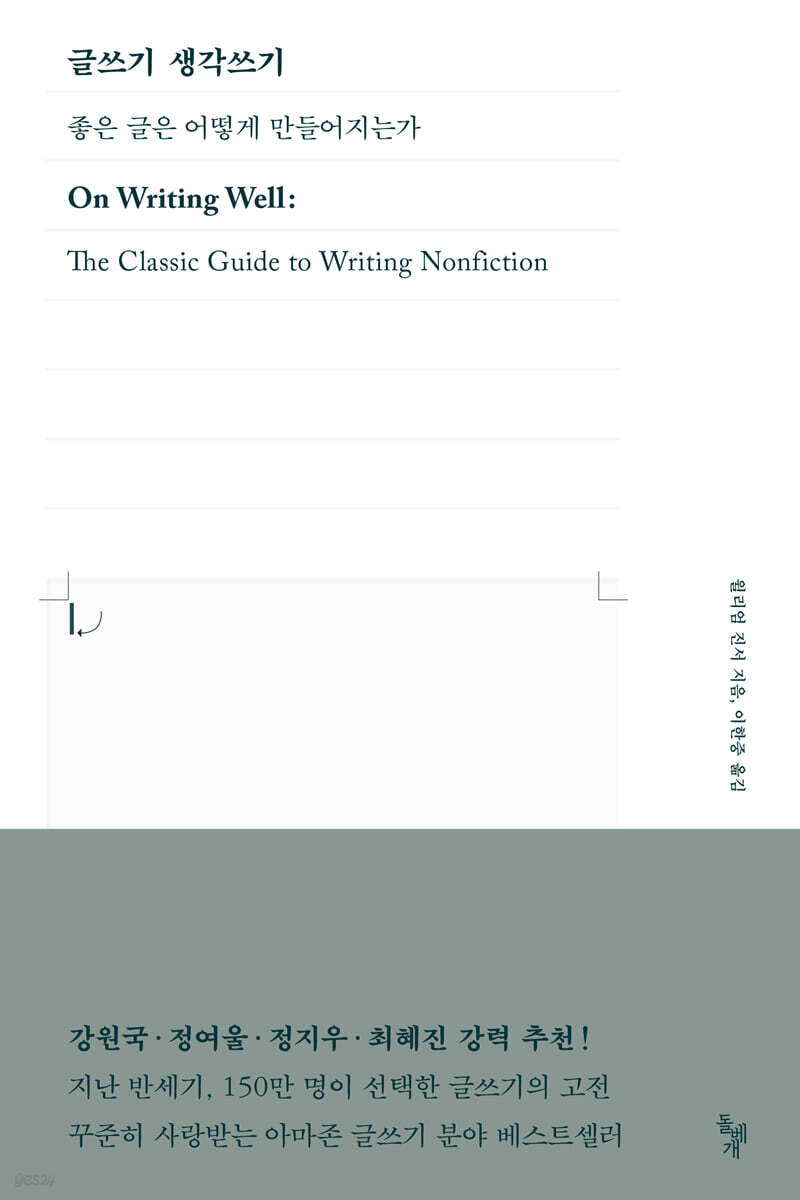
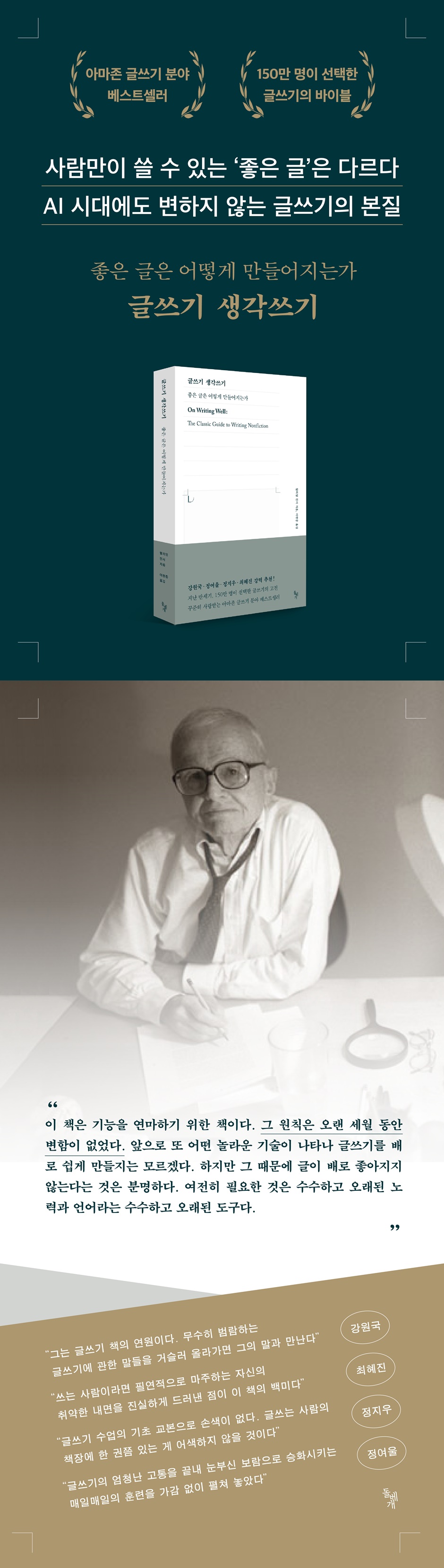
A classic in writing, 『Writing, Thinking』, chosen by over 1.5 million readers since its first publication in 1976.
Half a century after its publication, it remains a bestseller in the Amazon writing category, enjoying timeless popularity. Why is this book still so beloved by readers today, even when AI generates thousands of characters in seconds? It's because the essence of good writing remains constant, no matter the times.
Author William Zinsser says that the best writing is 'writing that reveals oneself.'
To demonstrate this, the author analyzes a variety of writing styles with rich examples, offering deep insights and practical advice.
Furthermore, it details the process of constantly refining and rewriting to find and express one's own voice.
The second edition, being published this time, features a newly designed cover and a more organized format with the text reorganized for greater readability.
Additionally, to make the book more meaningful to modern readers, we included recommendations from active writers today: Kang Won-guk, Jeong Yeo-ul, Jeong Ji-woo, and Choi Hye-jin.
"How is good writing created?" This book will provide a warm and clear answer to that question.
Half a century after its publication, it remains a bestseller in the Amazon writing category, enjoying timeless popularity. Why is this book still so beloved by readers today, even when AI generates thousands of characters in seconds? It's because the essence of good writing remains constant, no matter the times.
Author William Zinsser says that the best writing is 'writing that reveals oneself.'
To demonstrate this, the author analyzes a variety of writing styles with rich examples, offering deep insights and practical advice.
Furthermore, it details the process of constantly refining and rewriting to find and express one's own voice.
The second edition, being published this time, features a newly designed cover and a more organized format with the text reorganized for greater readability.
Additionally, to make the book more meaningful to modern readers, we included recommendations from active writers today: Kang Won-guk, Jeong Yeo-ul, Jeong Ji-woo, and Choi Hye-jin.
"How is good writing created?" This book will provide a warm and clear answer to that question.
- You can preview some of the book's contents.
Preview
index
introduction
Part 1: Principles of Good Writing
1.
Writing that discovers me
2.
Simple writing is good writing.
3.
Let's throw away as much as we can
4.
My own style is my own writing style
5.
Who are you writing for?
Part 2: Things to Know
6.
How to maintain unity
7.
How to start and end
Part 3 Various formats
8.
Nonfiction as Literature
9.
Interview: Writing About People
10.
Travelogue: Writing about Places
11.
Memoir: Writing About Myself
12.
Science and Technology: Descriptive Writing
13.
Business: Writing about work-related matters
14.
Criticism: Writing about Art
15.
Humor: Writing for Pleasure
Part 4: Writing Posture
16.
Let's listen to the voice of the text
17.
Joy, fear, confidence
18.
The tyranny of the final result
19.
Writing is a series of decisions
20.
Writing that preserves memories
21.
Let's do our best
Advice for Writing in English
22.
word
23.
usage
24.
etc.
Entry
Major authors featured in this book
Translator's Note
Search
Part 1: Principles of Good Writing
1.
Writing that discovers me
2.
Simple writing is good writing.
3.
Let's throw away as much as we can
4.
My own style is my own writing style
5.
Who are you writing for?
Part 2: Things to Know
6.
How to maintain unity
7.
How to start and end
Part 3 Various formats
8.
Nonfiction as Literature
9.
Interview: Writing About People
10.
Travelogue: Writing about Places
11.
Memoir: Writing About Myself
12.
Science and Technology: Descriptive Writing
13.
Business: Writing about work-related matters
14.
Criticism: Writing about Art
15.
Humor: Writing for Pleasure
Part 4: Writing Posture
16.
Let's listen to the voice of the text
17.
Joy, fear, confidence
18.
The tyranny of the final result
19.
Writing is a series of decisions
20.
Writing that preserves memories
21.
Let's do our best
Advice for Writing in English
22.
word
23.
usage
24.
etc.
Entry
Major authors featured in this book
Translator's Note
Search
Detailed image
Into the book
People tend to exaggerate things to make it seem like something is going on.
The pilot of the plane, who says that a significant amount of rain is expected in a short time, does not think to say that it looks like rain.
If a sentence is too simple, I think something is wrong.
The secret of good writing is to strip away the clutter and leave only the most obvious elements in every sentence.
Words that don't do anything, long words that could be expressed with shorter ones, adverbs that have the same meaning as existing verbs, passive constructions that make it hard for the reader to know who is doing what—these are all just impurities that weaken the power of the sentence.
And these impurities usually appear in proportion to education and status.
--- From "Simple writing is good writing"
You'd be amazed at how often editors will blow through the first three or four paragraphs or even pages of a piece and grab the first paragraph where the writer's voice begins to emerge.
Such an opening paragraph is not only impersonal and decorative, but it actually says nothing.
It's just a self-conscious attempt at a cool introduction.
The sentence I'm always looking for as an editor is something like, "I will never forget that day."
When I come across such a sentence, the words “Hey, it’s a person!” come out naturally.
--- From "What is mine is my writing style"
The introduction should quickly grab the reader and make them want to keep reading.
You must entice your readers with novelty, novelty, paradox, humor, surprise, unusual ideas, interesting facts, and questions.
Anything that pokes the reader in the ribs and tugs at their sleeves is good.
Also, the introduction should play a somewhat practical role.
You must specifically inform the reader why you wrote this article and why they should read it.
But let's not try to appeal too rationally.
All you have to do is entice the reader a little more and keep them curious.
--- From "How to Start and End"
If you want to write a memoir, narrow your thoughts.
A memoir is not a summary of a life, but a window into it.
It's very similar to photography in that it's optional.
It may seem like I'm just recalling things that have happened, randomly or at will.
But that's not the case.
A memoir is a well-calculated composition.
Thoreau rewrote the manuscript of Walden seven times over eight years.
There is no memoir in America more elaborate than this.
To write a good memoir, you must become the editor of your own life.
We must give form and structure to the story by giving it to scattered memories and vague events.
Memoir is a technique for creating truth.
--- From "Memoir: Writing About Myself"
Recently, I received a letter from a computer supply company titled 'Dear Customers.'
The article began like this:
"Effective March 30th, we will be transferring end-user order entry and supply consignment processing to a new telemarketing center." It was only later that I learned that they had set up an 800 number (the toll-free equivalent of 080 in Korea) and that the end-user was me.
Organizations that don't make an effort to write clearly and humanely are bound to lose customers and money.
To put it another way for corporate executives, they are bound to miss their targeted revenue targets.
--- From "Business: Writing About Work"
Humor is not an independent organism that survives through its own fragile metabolism.
It is a special perspective on things that is given only to writers who are good at using language.
They are not writing about lives that are inherently ridiculous.
They write about essentially serious lives, but they also cast their eyes on areas where serious hopes are mocked by the tricks of fate.
The pilot of the plane, who says that a significant amount of rain is expected in a short time, does not think to say that it looks like rain.
If a sentence is too simple, I think something is wrong.
The secret of good writing is to strip away the clutter and leave only the most obvious elements in every sentence.
Words that don't do anything, long words that could be expressed with shorter ones, adverbs that have the same meaning as existing verbs, passive constructions that make it hard for the reader to know who is doing what—these are all just impurities that weaken the power of the sentence.
And these impurities usually appear in proportion to education and status.
--- From "Simple writing is good writing"
You'd be amazed at how often editors will blow through the first three or four paragraphs or even pages of a piece and grab the first paragraph where the writer's voice begins to emerge.
Such an opening paragraph is not only impersonal and decorative, but it actually says nothing.
It's just a self-conscious attempt at a cool introduction.
The sentence I'm always looking for as an editor is something like, "I will never forget that day."
When I come across such a sentence, the words “Hey, it’s a person!” come out naturally.
--- From "What is mine is my writing style"
The introduction should quickly grab the reader and make them want to keep reading.
You must entice your readers with novelty, novelty, paradox, humor, surprise, unusual ideas, interesting facts, and questions.
Anything that pokes the reader in the ribs and tugs at their sleeves is good.
Also, the introduction should play a somewhat practical role.
You must specifically inform the reader why you wrote this article and why they should read it.
But let's not try to appeal too rationally.
All you have to do is entice the reader a little more and keep them curious.
--- From "How to Start and End"
If you want to write a memoir, narrow your thoughts.
A memoir is not a summary of a life, but a window into it.
It's very similar to photography in that it's optional.
It may seem like I'm just recalling things that have happened, randomly or at will.
But that's not the case.
A memoir is a well-calculated composition.
Thoreau rewrote the manuscript of Walden seven times over eight years.
There is no memoir in America more elaborate than this.
To write a good memoir, you must become the editor of your own life.
We must give form and structure to the story by giving it to scattered memories and vague events.
Memoir is a technique for creating truth.
--- From "Memoir: Writing About Myself"
Recently, I received a letter from a computer supply company titled 'Dear Customers.'
The article began like this:
"Effective March 30th, we will be transferring end-user order entry and supply consignment processing to a new telemarketing center." It was only later that I learned that they had set up an 800 number (the toll-free equivalent of 080 in Korea) and that the end-user was me.
Organizations that don't make an effort to write clearly and humanely are bound to lose customers and money.
To put it another way for corporate executives, they are bound to miss their targeted revenue targets.
--- From "Business: Writing About Work"
Humor is not an independent organism that survives through its own fragile metabolism.
It is a special perspective on things that is given only to writers who are good at using language.
They are not writing about lives that are inherently ridiculous.
They write about essentially serious lives, but they also cast their eyes on areas where serious hopes are mocked by the tricks of fate.
--- From "Humor: Writing for Pleasure"
Publisher's Review
The essence of writing is 'rewriting'
With the advent of AI-powered chatbots and automated writing tools, anyone can easily write.
Bookstores are flooded with books on writing using AI.
But just because something is written without any hesitation, does that mean it is good writing?
“Inventions that reduce the fear of writing are as convenient as air conditioning or light bulbs.
But as with all things, there are pitfalls.
Those who write on computers do not realize that the essence of writing is rewriting.
“Just because you can write fluently without hesitation doesn’t mean you’re a good writer.” _19p
Jinseo recalls the early days of word processors and points out that technological advancements don't necessarily mean everyone becomes a better writer.
People who rely solely on convenience without going through the process of polishing their writing end up writing even more lengthy texts because they are so absorbed in their sentences that they look neat.
However, technological advancements have clearly benefited those who are good at writing.
Because it has become easier to rewrite sentences.
He emphasizes that the essence of writing lies in ‘rewriting.’
Good writing is not completed in one go, but is created through a process of refinement and organization.
Ultimately, it is not artificial intelligence but you, yourself, that decides what to discard and what to keep in your writing.
This book presents the principles of writing good articles and how to polish them.
That principle has remained unchanged over the years.
The same will apply to any innovative technologies that emerge in the future.
The Core of Good Writing: Humanity and Warmth
Jinseo says that finding your own voice and expressing it honestly is the key to good writing.
Writing is not just a skill, it is an act of self-expression.
“A good writer reveals himself right behind the writing.
(...) let's sell ourselves.
Then your own topic will be appealing.
Believe in yourself and your thoughts.
Writing is an act of the self.
Let us acknowledge ourselves and use that energy to move forward.” _50~52p
He cites examples of how he finds even writing in specialized fields he has never been interested in reading enjoyable.
What captivates the reader at this time is not the subject of the writing, but the ‘writer’s passion.’
When you write about why you were drawn to the topic, how you feel about it, and how it changed your life, the reader is naturally drawn from one paragraph to the next.
Good writing captivates readers with such vivid energy and authenticity.
Writing is about expressing your own thoughts, not someone else's.
No reader wants dry, similar writing.
No matter what format the writing takes, what the reader wants to see is the personality and sincerity of the writer.
So, Jinseo suggests the principle of 'writing for yourself', not for the reader.
The greatest strength of this book is that it gives you the confidence and strength to write your own.
Keep it simple
Another thing the author emphasizes is the principle of 'writing concisely'.
If the principle of 'write for yourself' is a question of attitude toward writing, this is a question of fundamental skills in handling the tool called language.
The author advises that we throw away everything we can from our writing.
This is because your own style is not born from an overuse of flowery and decorative expressions, but from letting go of your shoulders and expressing yourself as you are.
The author says that most drafts can be cut by half without losing the content or the writer's voice.
Only when you know how to build such a simple and strong framework can you write your own.
It is in that context that rewriting is considered important.
Essential advice for writers
The most notable feature of this book is that it is rich in stories about the inner self of the writer.
From the challenge of identifying a fresh style and voice, to overcoming fear of writing and finding confidence and joy, to the compelling story of how composing a long piece intertwines with self-discovery, the author explores the challenges faced in the writing process.
And, using his own writing as an example, he unfolds in detail the worries and moments of choice he encounters while writing a piece.
This gives readers an opportunity to reflect on their own writing style.
Author Kang Won-guk said he found great comfort in Jinseo's encouraging words: "If you feel that writing is difficult, it is because writing is truly difficult."
Author Choi Hye-jin commented, “The best part of this book is that it honestly reveals the vulnerable inner self that writers inevitably face,” and said that it is a book that helps readers manage the desires and anxieties they encounter in the process of writing and instill self-confidence and optimism.
Above all, Jinseo never loses his warmth and humor from beginning to end.
That is why this book has been loved by countless people for a long time.
The best way to read this book is to keep it by your side and listen to Jinseo's voice as you write.
This book will not only teach you how to write good sentences, but will also be a companion that will help you calm your wavering mind during the writing process.
With the advent of AI-powered chatbots and automated writing tools, anyone can easily write.
Bookstores are flooded with books on writing using AI.
But just because something is written without any hesitation, does that mean it is good writing?
“Inventions that reduce the fear of writing are as convenient as air conditioning or light bulbs.
But as with all things, there are pitfalls.
Those who write on computers do not realize that the essence of writing is rewriting.
“Just because you can write fluently without hesitation doesn’t mean you’re a good writer.” _19p
Jinseo recalls the early days of word processors and points out that technological advancements don't necessarily mean everyone becomes a better writer.
People who rely solely on convenience without going through the process of polishing their writing end up writing even more lengthy texts because they are so absorbed in their sentences that they look neat.
However, technological advancements have clearly benefited those who are good at writing.
Because it has become easier to rewrite sentences.
He emphasizes that the essence of writing lies in ‘rewriting.’
Good writing is not completed in one go, but is created through a process of refinement and organization.
Ultimately, it is not artificial intelligence but you, yourself, that decides what to discard and what to keep in your writing.
This book presents the principles of writing good articles and how to polish them.
That principle has remained unchanged over the years.
The same will apply to any innovative technologies that emerge in the future.
The Core of Good Writing: Humanity and Warmth
Jinseo says that finding your own voice and expressing it honestly is the key to good writing.
Writing is not just a skill, it is an act of self-expression.
“A good writer reveals himself right behind the writing.
(...) let's sell ourselves.
Then your own topic will be appealing.
Believe in yourself and your thoughts.
Writing is an act of the self.
Let us acknowledge ourselves and use that energy to move forward.” _50~52p
He cites examples of how he finds even writing in specialized fields he has never been interested in reading enjoyable.
What captivates the reader at this time is not the subject of the writing, but the ‘writer’s passion.’
When you write about why you were drawn to the topic, how you feel about it, and how it changed your life, the reader is naturally drawn from one paragraph to the next.
Good writing captivates readers with such vivid energy and authenticity.
Writing is about expressing your own thoughts, not someone else's.
No reader wants dry, similar writing.
No matter what format the writing takes, what the reader wants to see is the personality and sincerity of the writer.
So, Jinseo suggests the principle of 'writing for yourself', not for the reader.
The greatest strength of this book is that it gives you the confidence and strength to write your own.
Keep it simple
Another thing the author emphasizes is the principle of 'writing concisely'.
If the principle of 'write for yourself' is a question of attitude toward writing, this is a question of fundamental skills in handling the tool called language.
The author advises that we throw away everything we can from our writing.
This is because your own style is not born from an overuse of flowery and decorative expressions, but from letting go of your shoulders and expressing yourself as you are.
The author says that most drafts can be cut by half without losing the content or the writer's voice.
Only when you know how to build such a simple and strong framework can you write your own.
It is in that context that rewriting is considered important.
Essential advice for writers
The most notable feature of this book is that it is rich in stories about the inner self of the writer.
From the challenge of identifying a fresh style and voice, to overcoming fear of writing and finding confidence and joy, to the compelling story of how composing a long piece intertwines with self-discovery, the author explores the challenges faced in the writing process.
And, using his own writing as an example, he unfolds in detail the worries and moments of choice he encounters while writing a piece.
This gives readers an opportunity to reflect on their own writing style.
Author Kang Won-guk said he found great comfort in Jinseo's encouraging words: "If you feel that writing is difficult, it is because writing is truly difficult."
Author Choi Hye-jin commented, “The best part of this book is that it honestly reveals the vulnerable inner self that writers inevitably face,” and said that it is a book that helps readers manage the desires and anxieties they encounter in the process of writing and instill self-confidence and optimism.
Above all, Jinseo never loses his warmth and humor from beginning to end.
That is why this book has been loved by countless people for a long time.
The best way to read this book is to keep it by your side and listen to Jinseo's voice as you write.
This book will not only teach you how to write good sentences, but will also be a companion that will help you calm your wavering mind during the writing process.
GOODS SPECIFICS
- Date of issue: February 13, 2024
- Page count, weight, size: 444 pages | 566g | 140*210*23mm
- ISBN13: 9791194442097
- ISBN10: 1194442099
You may also like
카테고리
korean


korean

![ELLE 엘르 스페셜 에디션 A형 : 12월 [2025]](http://librairie.coreenne.fr/cdn/shop/files/b8e27a3de6c9538896439686c6b0e8fb.jpg?v=1766436872&width=3840)


