

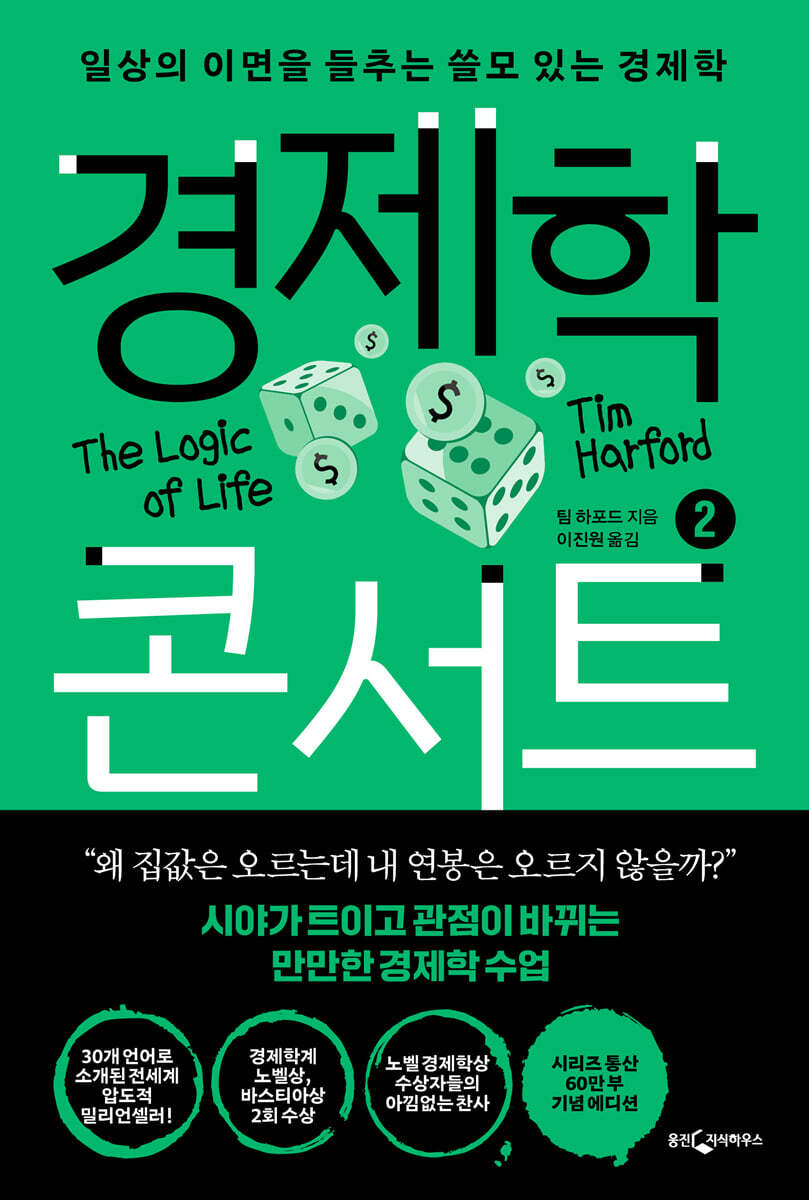
Economics Concert 2
 |
Description
Book Introduction
“Why are house prices rising but my salary not?” An easy economics class that will open your eyes and change your perspective. Tim Harport's popular economics textbook is back! ***** An overwhelming million-seller worldwide, introduced in 30 languages! ***** Winner of the Nobel Prize in Economics and the Bastiat Prize twice ***** Generous praise from Nobel Prize winners in economics ***** Series 600,000 copies commemorative edition The second book in the "Economics Concert" series, which has received enthusiastic support from Nobel Prize winners and other prominent economists since its publication and is considered to have opened the door to the Korean economics textbook market, has been redesigned and is now available to readers to commemorate the series' total sales of 600,000 copies in 2023. Published following "Economics Concert 1," "Economics Concert 2" illuminates our daily lives even more fully through the framework of economics. “Why do successful women marry ordinary men?”, “Why do strange candidates get elected?”, “Why do incompetent bosses receive high salaries?”, etc. These everyday phenomena that everyone has wondered about at least once are analyzed sharply through the eyes of an economist. This book clearly explains difficult and complex economic theories, from rational choice and discrimination theory to spillover and game theory, politics and economic growth issues, so that even beginners can fully understand them, demonstrating just how useful economics is to our lives. This book, which wittily unravels how economics dominates our lives, will help readers make more rational choices in an irrational world. |
- You can preview some of the book's contents.
Preview
index
Recommendation
Prologue: Every choice has a reason.
CHAPTER 1 Smart Sex Chosen by Wise People _ Rational Choice Theory
Are teenagers perverts or geniuses? / How to deal with risky sex / Thinking rationally / Rationality vs. selfishness / Daniel Kahneman's choice lab / The endowment effect / Animal rationality / The correlation between parking violations and teenage birth rates / AIDS instead of money? / Awaken your rational mind.
CHAPTER 2: Can Life Be Predicted Like a Game? _Game Theory
Las Vegas Poker Genius / Cheating, Deception, and Reading Your Opponents / 'Fluffing' is Legitimate / Genius in Theory, a Fool in Practice / Game Theory in Practice / Nothing Gets More Thrilling Than This / The Difference Between Experienced and Inexperienced / Remember 'Focus' / Excuses for Addicts / The Birth of Neuroeconomics / How to Rationally Overcome Addiction / The Most Useful Game Theory
CHAPTER 3 Why Great Women Marry Ordinary Men - The Law of One Thing and One Price
Things to know when dating / Wedding shopping / Men's value, women's value / Why are gold misses unpopular? / When men go to jail, women go to college / Birth control pills are driving up tuition / Why men earn money, and women do housework / Smart women decide to divorce / The economics of divorce
CHAPTER 4 Why Idle Bosses Get Paid More - Tournament Theory
The Absurdity of Office Scenes / Freakonomics' Incentives / Does Performance-Based Pay Really Boost Performance? / Why Performance-Based Compensation Isn't Applied / Surviving the Office Tournament / What Determines a CEO's Salary / The Difference Between a CEO and a Low-Level Employee / The Hidden Secret of Stock Options / Money Is Secretly Leaving My Pocket
CHAPTER 5: DETERMINING WHERE BIAS LIVES _ THE CHESSBOARD MODEL
There are clear lines where we live / The chessboard model / Is my neighborhood safe? / Murder in broad daylight / The dangers of high-rise apartment complexes / How to revitalize your neighborhood / Rich neighborhoods, poor neighborhoods / Will moving to a good neighborhood change your life?
CHAPTER 6: The Tragic Reality Caused by Rational Choices: Rational Discrimination
Discrimination is not a crime / Rational racism / Fake resume experiments / Statistical discrimination and preference discrimination / Once disadvantaged, always disadvantaged? / Obama's 'pretending to be white' / Incentives to fight discrimination / People who overcome discrimination
CHAPTER 7: Why Urban Housing is Expensive _Spillover
Why you live in the city / What you get for free in big cities / What determines housing prices / The value of urban workers / The world is sharp / Cell phones, email, and city life / Find the best city / The pitfalls of disaster relief / Subsidize big cities
CHAPTER 8 Why Strange Candidates Get Elected_Politics and Election
My Precious Vote Changes the President? / Voters' Rational Ignorance / Small Gains for the Many vs. Large Gains for the Few / Extremely Selfish Choices / The Politics of Subsidies / A Corrupt Government / Negotiation Strategies for a Successful Revolution / Catching Up with the Glorious Revolution
CHAPTER 9 How Wealthy Countries Are Made _ Economic Growth
The Secret of Economic Growth / The Incredible Speed of Development / The Driving Force of the Industrial Revolution / Why Britain and the Netherlands Are Special / Are Rich Countries Well-Located? / The Impact of Malaria on the World Economy / The Superiority of the Division of Labor / Malthus's Wrong Choice
Prologue: Every choice has a reason.
CHAPTER 1 Smart Sex Chosen by Wise People _ Rational Choice Theory
Are teenagers perverts or geniuses? / How to deal with risky sex / Thinking rationally / Rationality vs. selfishness / Daniel Kahneman's choice lab / The endowment effect / Animal rationality / The correlation between parking violations and teenage birth rates / AIDS instead of money? / Awaken your rational mind.
CHAPTER 2: Can Life Be Predicted Like a Game? _Game Theory
Las Vegas Poker Genius / Cheating, Deception, and Reading Your Opponents / 'Fluffing' is Legitimate / Genius in Theory, a Fool in Practice / Game Theory in Practice / Nothing Gets More Thrilling Than This / The Difference Between Experienced and Inexperienced / Remember 'Focus' / Excuses for Addicts / The Birth of Neuroeconomics / How to Rationally Overcome Addiction / The Most Useful Game Theory
CHAPTER 3 Why Great Women Marry Ordinary Men - The Law of One Thing and One Price
Things to know when dating / Wedding shopping / Men's value, women's value / Why are gold misses unpopular? / When men go to jail, women go to college / Birth control pills are driving up tuition / Why men earn money, and women do housework / Smart women decide to divorce / The economics of divorce
CHAPTER 4 Why Idle Bosses Get Paid More - Tournament Theory
The Absurdity of Office Scenes / Freakonomics' Incentives / Does Performance-Based Pay Really Boost Performance? / Why Performance-Based Compensation Isn't Applied / Surviving the Office Tournament / What Determines a CEO's Salary / The Difference Between a CEO and a Low-Level Employee / The Hidden Secret of Stock Options / Money Is Secretly Leaving My Pocket
CHAPTER 5: DETERMINING WHERE BIAS LIVES _ THE CHESSBOARD MODEL
There are clear lines where we live / The chessboard model / Is my neighborhood safe? / Murder in broad daylight / The dangers of high-rise apartment complexes / How to revitalize your neighborhood / Rich neighborhoods, poor neighborhoods / Will moving to a good neighborhood change your life?
CHAPTER 6: The Tragic Reality Caused by Rational Choices: Rational Discrimination
Discrimination is not a crime / Rational racism / Fake resume experiments / Statistical discrimination and preference discrimination / Once disadvantaged, always disadvantaged? / Obama's 'pretending to be white' / Incentives to fight discrimination / People who overcome discrimination
CHAPTER 7: Why Urban Housing is Expensive _Spillover
Why you live in the city / What you get for free in big cities / What determines housing prices / The value of urban workers / The world is sharp / Cell phones, email, and city life / Find the best city / The pitfalls of disaster relief / Subsidize big cities
CHAPTER 8 Why Strange Candidates Get Elected_Politics and Election
My Precious Vote Changes the President? / Voters' Rational Ignorance / Small Gains for the Many vs. Large Gains for the Few / Extremely Selfish Choices / The Politics of Subsidies / A Corrupt Government / Negotiation Strategies for a Successful Revolution / Catching Up with the Glorious Revolution
CHAPTER 9 How Wealthy Countries Are Made _ Economic Growth
The Secret of Economic Growth / The Incredible Speed of Development / The Driving Force of the Industrial Revolution / Why Britain and the Netherlands Are Special / Are Rich Countries Well-Located? / The Impact of Malaria on the World Economy / The Superiority of the Division of Labor / Malthus's Wrong Choice
Detailed image

Into the book
In this book, I will argue the following facts:
First, rational behavior is much more widespread than we realize, and can appear in unexpected places, like the mind of a sexually curious teenager.
Second, economists' belief in rationality (the word "belief" seems appropriate) provides practical insights.
In fact, we cannot understand the world if we do not understand the rational choices that underlie our actions.
Drug addicts and teenage murderers can be rational too.
The phenomenon of urban sprawl and urban hollowing out, in which cities spread out in an uncontrolled manner, is also clearly rational.
So, are the endless meetings in the office and the bizarre injustices we experience during corporate life justifiable? Of course.
'Rational choice theory' is like an X-ray photograph that clearly reveals human life.
--- p.15~16, from “Prologue_Every choice has a good reason”
A recent study by researchers at Johns Hopkins Medical Center found that the number of young people between the ages of 12 and 24 who had engaged in oral sex more than doubled between 1994 and 2004.
…omitted… “What are the costs, benefits, and consequences of oral sex?” Perhaps the benefits are so obvious that it’s almost embarrassing to even explain them.
Especially for people who engage in oral sex.
On the other hand, the alternative to oral sex, regular intercourse, has become more expensive than in the past.
Because of the spread of AIDS.
HIV, the virus that causes AIDS, is much more likely to spread through regular sex than oral sex.
Many teenagers know that.
A recent study on sex education found that American children learn more about AIDS than about contraception.
--- p.22~23, from 「CHAPTER 1 Smart Sex Chosen by Wise People _ Rational Choice Theory」
Poker seems to be about psychology, not math.
Could there really be a rational strategy behind such tricks and counter-tricks—one that involves no attempt to read the opponent's mind or penetrate their psychology? Could pure mathematics explain such tricks? Von Neumann thought so.
Von Neumann's research in game theory reached its peak in 1944 with the publication of his book, "Game Theory and Economic Behavior," with Oskar Morgenstern.
--- p.78~79, from 「CHAPTER 2 Can life be predicted like a game_Game theory」
If women prefer wealthy men, as George Gershwin, evolutionary biologists, and Internet daters suggest, they should flock to places with a large number of wealthy men.
The city is a place that fits those conditions.
Men are not as interested in marrying wealthy women, so they are not as interested in cities as women.
When rents rise, men who are not good at earning money return to the countryside before women who are not good at earning money.
Or maybe you don't even think about entering the city in the first place.
This is what Lena Edlund of Columbia University argues.
Her argument is summarized as follows:
First, when looking at the male-to-female ratio, there are always fewer men in cities than in rural areas.
This phenomenon was observed in 44 of the 47 countries she surveyed (the remaining three countries had similar gender ratios in both urban and rural areas).
148~149, from “CHAPTER 3 Why do great women marry ordinary men? _The Law of One Thing and One Family”
But according to tournament theory, an $800 million salary doesn't necessarily motivate Eisner—to make that much extra money for Disney shareholders.
If this money actually motivated his subordinates to work hard and become the next Eisner, then it was worth it.
If Eisner's salary motivated Disney employees to make more than $800 million, then paying him $800 million might have been a reasonable decision for Disney shareholders, even if he spent all day with his feet up on the desk watching Tom and Jerry.
This illustrates an interesting aspect of tournament theory.
In other words, a CEO's salary may be unrelated to his performance.
From this perspective, the CEO is excluded from the productive flow.
Although they are merely 'symbolic figures' like queens, they are compensated more than those who do important work.
--- p.199~200, from 「CHAPTER 4 Why Idle Bosses Get Paid More_Tournament Theory」
Margaret and Sarah were attacked by a stranger in a crowded downtown area during rush hour.
But the two could not meet.
Fortunately, Sarah survived, but Margaret did not.
… Omitted… Sarah almost suffered the same fate as Margaret.
She, like Margaret, was attacked by a stranger.
But the place where she was attacked was not a secluded park.
Reginald Jones, who attacked her, used 15th Street in Washington, D.C. as the point of attack.
On a muggy July evening, people were outside, unable to bear the heat.
Some people wandered around the bars, restaurants and ice cream shops on 17th Street, while others headed to the Whole Foods supermarket.
…omitted… Jane Jacobs, who studied urban economics, argued that neighbors act as “eyes on the street” to protect us from crime, as evidenced by the cases of Sarah and Margaret.
--- p.233~236, from 「CHAPTER 5: Determining Where Prejudice Lives_Chessboard Model」
Their research team created 5,000 fake resumes by modifying contact information, addresses, and other information from resumes posted on job sites.
Some resumes have been made more attractive by adding things like part-time work experience, computer certifications, and military service records to create a more attractive 'quality resume'.
On the other hand, other resumes were ordinary and had no special touches.
The research team then randomly assigned names to the resumes.
Some resumes included Black names like Tyrone Jones and LaToya Washington.
Other resumes featured white names like Allison Walsh and Brendan Baker.
…omitted… The results were dismal.
People with white names were called for interviews 50 percent more often than people with black names.
In an experiment with such a large sample size (in a world without bias), the odds of this happening by chance are less than one in ten thousand.
Just as the fake employers in Pryor's experiment rejected applicants as soon as they saw the word "purple," the real employers also rejected applicants as soon as they saw a black name.
--- p.262~263, from 「CHAPTER 6: The Tragic Reality Brought About by Rational Choices_Rational Discrimination」
The more knowledge-intensive an industry is, the more it is concentrated in smaller areas.
Occupations that hire workers with specific skills also tend to be concentrated in the same area.
Economists examined more than 4,000 industrial innovations developed across the United States.
As a result, more than half of the cases occurred in three regions.
California, New York, New Jersey, and Massachusetts are hotbeds of innovation.
Most industries were concentrated there.
This concentration is even more pronounced in high-tech industries.
In the computer field, about half of the innovations took place in California.
In the pharmaceutical field, about half of all innovations occurred in New Jersey, a state with less than 3 percent of the U.S. population.
It's a really sharp world.
And the world will become more pointed.
--- p.309~310, from 「CHAPTER 7 Why are city houses expensive_Spillover」
One surprising fact: Since the likelihood of any vote affecting the outcome of an election is extremely low, there's little benefit to voting with sufficient information.
So why would anyone bother to get information about the candidates? Let's compare voting to buying a car.
If you bought a car because you thought it was safe and fuel-efficient, you could pay a dear price for that mistake.
On the other hand, if you elected George W. Bush because you mistakenly believed he would support same-sex marriage, you suffered no harm, despite that mistake, because your vote did not determine the outcome of the election.
…omitted… From a rational choice perspective, the typical voter is ignorant, that is, ‘rationally ignorant.’
--- p.340~341, from 「CHAPTER 8 Why Strange Candidates Get Elected_Politics and Choice」
“How did our ancestors wipe out the Neanderthals?” Neanderthals survived for over 200,000 years, even enduring the brutal cold of the last Ice Age.
They were large and strong, with large brains, but for some reason, they disappeared only a few thousand years after modern humans appeared in Europe about 40,000 years ago.
…omitted… Some paleontologists claim that Neanderthals used language and had the same intelligence as their rivals, Homo sapiens.
From a 'rational' view of history, it seems that Neanderthals did not practice 'division of labor'.
The value of division of labor has been explained previously.
Division of labor is widespread in modern society.
As I explained before, the cappuccino I always drink is made with many hands.
Without the people who developed electricity, steel casting, and the paper cup, as well as the miners who extracted the coal needed to produce electricity, the farmers who grew the coffee beans, and the dairy farmers who raised the milk cows, we wouldn't even be able to dream of a cappuccino.
First, rational behavior is much more widespread than we realize, and can appear in unexpected places, like the mind of a sexually curious teenager.
Second, economists' belief in rationality (the word "belief" seems appropriate) provides practical insights.
In fact, we cannot understand the world if we do not understand the rational choices that underlie our actions.
Drug addicts and teenage murderers can be rational too.
The phenomenon of urban sprawl and urban hollowing out, in which cities spread out in an uncontrolled manner, is also clearly rational.
So, are the endless meetings in the office and the bizarre injustices we experience during corporate life justifiable? Of course.
'Rational choice theory' is like an X-ray photograph that clearly reveals human life.
--- p.15~16, from “Prologue_Every choice has a good reason”
A recent study by researchers at Johns Hopkins Medical Center found that the number of young people between the ages of 12 and 24 who had engaged in oral sex more than doubled between 1994 and 2004.
…omitted… “What are the costs, benefits, and consequences of oral sex?” Perhaps the benefits are so obvious that it’s almost embarrassing to even explain them.
Especially for people who engage in oral sex.
On the other hand, the alternative to oral sex, regular intercourse, has become more expensive than in the past.
Because of the spread of AIDS.
HIV, the virus that causes AIDS, is much more likely to spread through regular sex than oral sex.
Many teenagers know that.
A recent study on sex education found that American children learn more about AIDS than about contraception.
--- p.22~23, from 「CHAPTER 1 Smart Sex Chosen by Wise People _ Rational Choice Theory」
Poker seems to be about psychology, not math.
Could there really be a rational strategy behind such tricks and counter-tricks—one that involves no attempt to read the opponent's mind or penetrate their psychology? Could pure mathematics explain such tricks? Von Neumann thought so.
Von Neumann's research in game theory reached its peak in 1944 with the publication of his book, "Game Theory and Economic Behavior," with Oskar Morgenstern.
--- p.78~79, from 「CHAPTER 2 Can life be predicted like a game_Game theory」
If women prefer wealthy men, as George Gershwin, evolutionary biologists, and Internet daters suggest, they should flock to places with a large number of wealthy men.
The city is a place that fits those conditions.
Men are not as interested in marrying wealthy women, so they are not as interested in cities as women.
When rents rise, men who are not good at earning money return to the countryside before women who are not good at earning money.
Or maybe you don't even think about entering the city in the first place.
This is what Lena Edlund of Columbia University argues.
Her argument is summarized as follows:
First, when looking at the male-to-female ratio, there are always fewer men in cities than in rural areas.
This phenomenon was observed in 44 of the 47 countries she surveyed (the remaining three countries had similar gender ratios in both urban and rural areas).
148~149, from “CHAPTER 3 Why do great women marry ordinary men? _The Law of One Thing and One Family”
But according to tournament theory, an $800 million salary doesn't necessarily motivate Eisner—to make that much extra money for Disney shareholders.
If this money actually motivated his subordinates to work hard and become the next Eisner, then it was worth it.
If Eisner's salary motivated Disney employees to make more than $800 million, then paying him $800 million might have been a reasonable decision for Disney shareholders, even if he spent all day with his feet up on the desk watching Tom and Jerry.
This illustrates an interesting aspect of tournament theory.
In other words, a CEO's salary may be unrelated to his performance.
From this perspective, the CEO is excluded from the productive flow.
Although they are merely 'symbolic figures' like queens, they are compensated more than those who do important work.
--- p.199~200, from 「CHAPTER 4 Why Idle Bosses Get Paid More_Tournament Theory」
Margaret and Sarah were attacked by a stranger in a crowded downtown area during rush hour.
But the two could not meet.
Fortunately, Sarah survived, but Margaret did not.
… Omitted… Sarah almost suffered the same fate as Margaret.
She, like Margaret, was attacked by a stranger.
But the place where she was attacked was not a secluded park.
Reginald Jones, who attacked her, used 15th Street in Washington, D.C. as the point of attack.
On a muggy July evening, people were outside, unable to bear the heat.
Some people wandered around the bars, restaurants and ice cream shops on 17th Street, while others headed to the Whole Foods supermarket.
…omitted… Jane Jacobs, who studied urban economics, argued that neighbors act as “eyes on the street” to protect us from crime, as evidenced by the cases of Sarah and Margaret.
--- p.233~236, from 「CHAPTER 5: Determining Where Prejudice Lives_Chessboard Model」
Their research team created 5,000 fake resumes by modifying contact information, addresses, and other information from resumes posted on job sites.
Some resumes have been made more attractive by adding things like part-time work experience, computer certifications, and military service records to create a more attractive 'quality resume'.
On the other hand, other resumes were ordinary and had no special touches.
The research team then randomly assigned names to the resumes.
Some resumes included Black names like Tyrone Jones and LaToya Washington.
Other resumes featured white names like Allison Walsh and Brendan Baker.
…omitted… The results were dismal.
People with white names were called for interviews 50 percent more often than people with black names.
In an experiment with such a large sample size (in a world without bias), the odds of this happening by chance are less than one in ten thousand.
Just as the fake employers in Pryor's experiment rejected applicants as soon as they saw the word "purple," the real employers also rejected applicants as soon as they saw a black name.
--- p.262~263, from 「CHAPTER 6: The Tragic Reality Brought About by Rational Choices_Rational Discrimination」
The more knowledge-intensive an industry is, the more it is concentrated in smaller areas.
Occupations that hire workers with specific skills also tend to be concentrated in the same area.
Economists examined more than 4,000 industrial innovations developed across the United States.
As a result, more than half of the cases occurred in three regions.
California, New York, New Jersey, and Massachusetts are hotbeds of innovation.
Most industries were concentrated there.
This concentration is even more pronounced in high-tech industries.
In the computer field, about half of the innovations took place in California.
In the pharmaceutical field, about half of all innovations occurred in New Jersey, a state with less than 3 percent of the U.S. population.
It's a really sharp world.
And the world will become more pointed.
--- p.309~310, from 「CHAPTER 7 Why are city houses expensive_Spillover」
One surprising fact: Since the likelihood of any vote affecting the outcome of an election is extremely low, there's little benefit to voting with sufficient information.
So why would anyone bother to get information about the candidates? Let's compare voting to buying a car.
If you bought a car because you thought it was safe and fuel-efficient, you could pay a dear price for that mistake.
On the other hand, if you elected George W. Bush because you mistakenly believed he would support same-sex marriage, you suffered no harm, despite that mistake, because your vote did not determine the outcome of the election.
…omitted… From a rational choice perspective, the typical voter is ignorant, that is, ‘rationally ignorant.’
--- p.340~341, from 「CHAPTER 8 Why Strange Candidates Get Elected_Politics and Choice」
“How did our ancestors wipe out the Neanderthals?” Neanderthals survived for over 200,000 years, even enduring the brutal cold of the last Ice Age.
They were large and strong, with large brains, but for some reason, they disappeared only a few thousand years after modern humans appeared in Europe about 40,000 years ago.
…omitted… Some paleontologists claim that Neanderthals used language and had the same intelligence as their rivals, Homo sapiens.
From a 'rational' view of history, it seems that Neanderthals did not practice 'division of labor'.
The value of division of labor has been explained previously.
Division of labor is widespread in modern society.
As I explained before, the cappuccino I always drink is made with many hands.
Without the people who developed electricity, steel casting, and the paper cup, as well as the miners who extracted the coal needed to produce electricity, the farmers who grew the coffee beans, and the dairy farmers who raised the milk cows, we wouldn't even be able to dream of a cappuccino.
--- p.396~397, from 「CHAPTER 9 How are wealthy countries created? --- p. Economic growth」
Publisher's Review
■ “Marriage, salary, house prices, sex… Economics is with us at every moment!”
The return of the "Economics Concert" series, which awakened the economic acumen of 600,000 readers.
Following the recovery (2022) of the first volume of the world-renowned million-seller 『Economics Concert』 series, which was praised as “the economics textbook for the entire nation” and selected as “Book of the Year” at the time of its publication in 2006, the recovery edition of the second volume, 『Economics Concert 2』, has arrived for readers.
"Economics Concert 2" covers more everyday and interesting topics than its predecessor, such as gender issues, company life and salaries, and better cities to live in.
“Why do successful women marry ordinary men?”, “Why do strange candidates get elected?”, “Why do incompetent bosses receive high salaries?”, etc. These everyday phenomena that everyone has wondered about at least once are analyzed sharply through the eyes of an economist.
Tim Harford, the author of this series and an economist who has been explaining the principles of economics in everyday life both on air and in the classroom, studied economics at Oxford University and worked as a writing advisor to senior economists at the International Finance Corporation at the World Bank.
He captivated 600,000 readers in South Korea by explaining difficult economic theories in an easy and enjoyable way throughout the "Economics Concert" series.
The book has received rave reviews from numerous economists and economic experts as well as general readers.
This book was recommended by Vice President Oh Geon-yeong (Shinhan Bank WM Group), Outside Director Hong Eun-joo (NH Investment & Securities), Professor Han Soon-goo (Department of Economics, Yonsei University), Nobel laureates in economics Gary Becker and Thomas Schelling, and Stephen Dubner, author of Freakonomics.
■ “Why do wonderful women marry ordinary men?”
- The correlation between the law of one thing and one price and marital patterns
Like the previous volume, Volume 2 also explains the main concepts of economics using everyday examples.
For example, Tim Harford explains the recent changes in marriage patterns through the 'Law of One Price'.
Here is a marriage supermarket with 20 single men and 20 single women.
If a man and a woman were to appear at the checkout counter as a pair and given $100, they would probably split it $50 each.
Then suddenly something happened to one man and there were 19 men and 20 women.
The woman left alone might only accept $40 out of $100.
Then other women will also say they will accept less money.
In the end, the man gets $99.99 and the woman gets only 1 cent.
The prices of goods sold in the same market at the same time are the same, which is called the 'law of one price'.
In the end, 19 women receive 1 cent, and the wedding supermarket closes. (p. 143)
This 'marriage supermarket' symbolically shows the current reality in our country.
According to Lena Edlund, there are more men and fewer women in rural areas, and more women and fewer men in cities.
This phenomenon was observed in 44 out of 47 countries, and the ratio of men to women in Washington, D.C. is 8 to 9 (p. 149). Therefore, smart, successful women in the city lower their standards and marry ordinary men, following the "law of one price."
■ “Is it because of me that the lazy boss gets paid so much?”
- The CEO's high salary can be explained by tournament theory.
This book also contains cases that any office worker would have wondered about.
Michael Eisner, CEO of Walt Disney, received $800 million (1.068 trillion won) from the company over 13 years.
In fact, Eisner might have worked hard even if he had been paid only $80 million.
Why did Disney shareholders pay him such a high salary? The answer lies in the "tournament theory."
Like any other sports tournament, there are tournaments held in offices.
Companies motivate employees who perform relatively well compared to others by giving them bonuses or promotions.
However, as you advance to a higher position, the opportunities for advancement become fewer and fewer, making promotion alone insufficient to motivate workers.
In this case, only a large salary will stimulate the desire to work.
So, as employees see their bosses getting paid more and more while doing less work, they feel compelled to work harder and harder to get promoted.
Ed Lazier, the proponent of this theory, said:
“The president’s salary motivates the vice president to work hard rather than the president himself.” (p. 198) This shows that the motivation of employees is involved in the high salaries of CEOs of companies, including Disney.
■ “The higher the apartment you live in, the more dangerous it becomes?”
- Urban crime rates and the utility of chessboard theory
Margaret Muller and Sarah Stepanek were talented young women, an artist and an economist respectively.
They were all attacked by assailants, but one survived and one did not.
Why? Margaret was jogging in a quiet Victoria Park around 8:30 in the morning.
She was found murdered in a secluded garden, stabbed 50 times, and her killer disappeared.
Meanwhile, Sarah lives in Washington, D.C., a city lined with shops.
I was attacked on 15th Street.
As it was dinner time, many people were out to beat the heat.
The assailant struck her face and stabbed her in the back and stomach as she passed by.
But as soon as the attack began, a passerby pushed the assailant away and others joined in.
Jane Jacobs, who studies urban economics, said that neighbors act as "eyes on the street" that protect us from crime, as seen in this example.
This is the chessboard theory.
According to Jacobs, when high-rise apartments are built, people's gaze is diverted from the street, making the street more dangerous (p. 237). In fact, the taller the apartments, the more crime there is, regardless of whether the complex is public or private.
For every floor we add to the height of our buildings, our risk of being mugged or having our car stolen goes up by 2.5 percent.
In this way, this book clearly explains difficult and complex economic theories, from rational choice and discrimination theory to spillover and game theory, politics and economic growth issues, so that even beginners can fully understand them, proving just how useful economics is to our lives.
For anyone who has found economics difficult, wants to master it in a short period of time, or wants to make smarter, more economical choices than others, there is no book more appropriate than the "Economics Concert" series.
The return of the "Economics Concert" series, which awakened the economic acumen of 600,000 readers.
Following the recovery (2022) of the first volume of the world-renowned million-seller 『Economics Concert』 series, which was praised as “the economics textbook for the entire nation” and selected as “Book of the Year” at the time of its publication in 2006, the recovery edition of the second volume, 『Economics Concert 2』, has arrived for readers.
"Economics Concert 2" covers more everyday and interesting topics than its predecessor, such as gender issues, company life and salaries, and better cities to live in.
“Why do successful women marry ordinary men?”, “Why do strange candidates get elected?”, “Why do incompetent bosses receive high salaries?”, etc. These everyday phenomena that everyone has wondered about at least once are analyzed sharply through the eyes of an economist.
Tim Harford, the author of this series and an economist who has been explaining the principles of economics in everyday life both on air and in the classroom, studied economics at Oxford University and worked as a writing advisor to senior economists at the International Finance Corporation at the World Bank.
He captivated 600,000 readers in South Korea by explaining difficult economic theories in an easy and enjoyable way throughout the "Economics Concert" series.
The book has received rave reviews from numerous economists and economic experts as well as general readers.
This book was recommended by Vice President Oh Geon-yeong (Shinhan Bank WM Group), Outside Director Hong Eun-joo (NH Investment & Securities), Professor Han Soon-goo (Department of Economics, Yonsei University), Nobel laureates in economics Gary Becker and Thomas Schelling, and Stephen Dubner, author of Freakonomics.
■ “Why do wonderful women marry ordinary men?”
- The correlation between the law of one thing and one price and marital patterns
Like the previous volume, Volume 2 also explains the main concepts of economics using everyday examples.
For example, Tim Harford explains the recent changes in marriage patterns through the 'Law of One Price'.
Here is a marriage supermarket with 20 single men and 20 single women.
If a man and a woman were to appear at the checkout counter as a pair and given $100, they would probably split it $50 each.
Then suddenly something happened to one man and there were 19 men and 20 women.
The woman left alone might only accept $40 out of $100.
Then other women will also say they will accept less money.
In the end, the man gets $99.99 and the woman gets only 1 cent.
The prices of goods sold in the same market at the same time are the same, which is called the 'law of one price'.
In the end, 19 women receive 1 cent, and the wedding supermarket closes. (p. 143)
This 'marriage supermarket' symbolically shows the current reality in our country.
According to Lena Edlund, there are more men and fewer women in rural areas, and more women and fewer men in cities.
This phenomenon was observed in 44 out of 47 countries, and the ratio of men to women in Washington, D.C. is 8 to 9 (p. 149). Therefore, smart, successful women in the city lower their standards and marry ordinary men, following the "law of one price."
■ “Is it because of me that the lazy boss gets paid so much?”
- The CEO's high salary can be explained by tournament theory.
This book also contains cases that any office worker would have wondered about.
Michael Eisner, CEO of Walt Disney, received $800 million (1.068 trillion won) from the company over 13 years.
In fact, Eisner might have worked hard even if he had been paid only $80 million.
Why did Disney shareholders pay him such a high salary? The answer lies in the "tournament theory."
Like any other sports tournament, there are tournaments held in offices.
Companies motivate employees who perform relatively well compared to others by giving them bonuses or promotions.
However, as you advance to a higher position, the opportunities for advancement become fewer and fewer, making promotion alone insufficient to motivate workers.
In this case, only a large salary will stimulate the desire to work.
So, as employees see their bosses getting paid more and more while doing less work, they feel compelled to work harder and harder to get promoted.
Ed Lazier, the proponent of this theory, said:
“The president’s salary motivates the vice president to work hard rather than the president himself.” (p. 198) This shows that the motivation of employees is involved in the high salaries of CEOs of companies, including Disney.
■ “The higher the apartment you live in, the more dangerous it becomes?”
- Urban crime rates and the utility of chessboard theory
Margaret Muller and Sarah Stepanek were talented young women, an artist and an economist respectively.
They were all attacked by assailants, but one survived and one did not.
Why? Margaret was jogging in a quiet Victoria Park around 8:30 in the morning.
She was found murdered in a secluded garden, stabbed 50 times, and her killer disappeared.
Meanwhile, Sarah lives in Washington, D.C., a city lined with shops.
I was attacked on 15th Street.
As it was dinner time, many people were out to beat the heat.
The assailant struck her face and stabbed her in the back and stomach as she passed by.
But as soon as the attack began, a passerby pushed the assailant away and others joined in.
Jane Jacobs, who studies urban economics, said that neighbors act as "eyes on the street" that protect us from crime, as seen in this example.
This is the chessboard theory.
According to Jacobs, when high-rise apartments are built, people's gaze is diverted from the street, making the street more dangerous (p. 237). In fact, the taller the apartments, the more crime there is, regardless of whether the complex is public or private.
For every floor we add to the height of our buildings, our risk of being mugged or having our car stolen goes up by 2.5 percent.
In this way, this book clearly explains difficult and complex economic theories, from rational choice and discrimination theory to spillover and game theory, politics and economic growth issues, so that even beginners can fully understand them, proving just how useful economics is to our lives.
For anyone who has found economics difficult, wants to master it in a short period of time, or wants to make smarter, more economical choices than others, there is no book more appropriate than the "Economics Concert" series.
GOODS SPECIFICS
- Date of issue: September 8, 2023
- Page count, weight, size: 408 pages | 556g | 145*215*20mm
- ISBN13: 9788901275147
- ISBN10: 8901275147
You may also like
카테고리
korean


korean

![GQ KOREA Mark (Monthly): December [2025]](http://librairie.coreenne.fr/cdn/shop/files/8ef265dbbfbf186523ed75ba7319009d.jpg?v=1765340328&width=3840)


