

John Maxwell's Immutable Laws of Leadership
 |
Description
Book Introduction
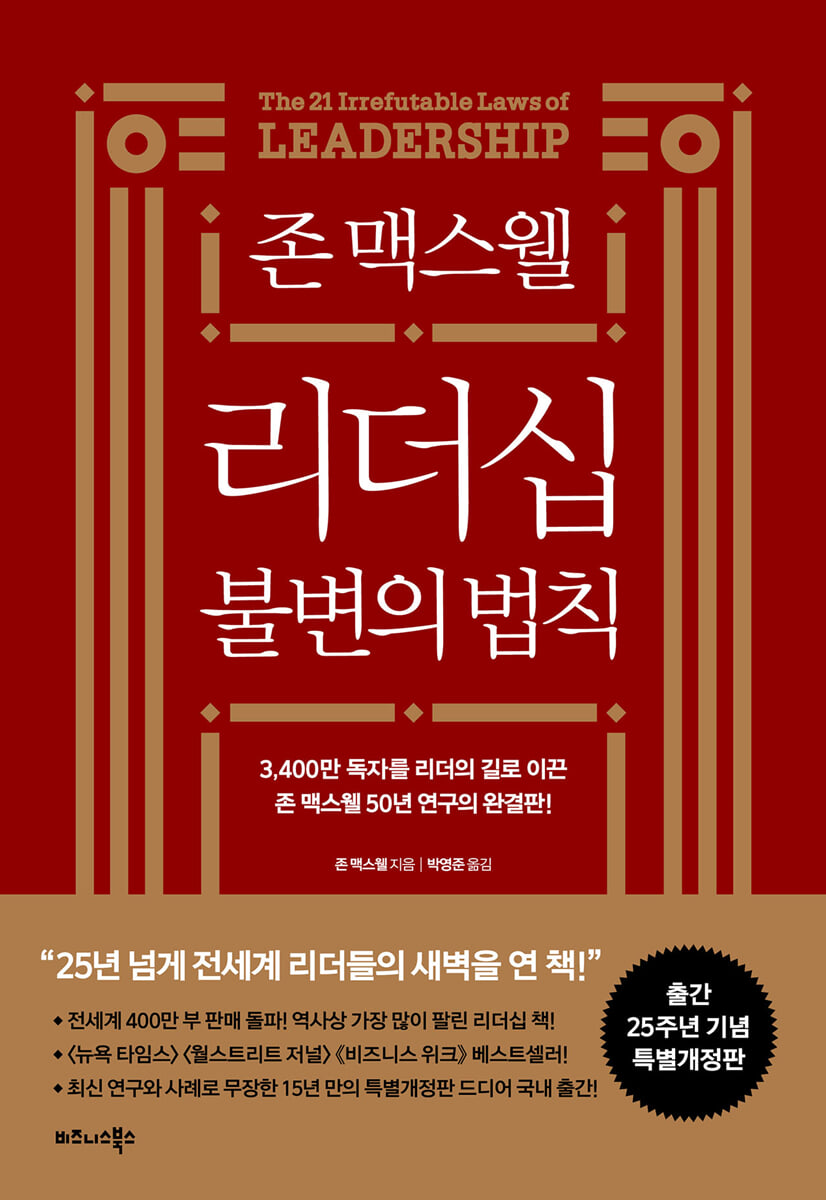
“John Maxwell’s Laws of Leadership “Absolutely not frozen in time!” The unparalleled classic in leadership returns, upgraded with deeper insights! An immortal masterpiece, meticulously crafted line by line by John Maxwell himself!! With over 4 million copies sold worldwide, the "best-selling leadership book of all time"! The legendary classic, "John Maxwell's 25th Anniversary," is now available in a special revised edition. This book, which has maintained its position as an unrivaled million-seller in the leadership field for 25 years, is the culmination of John Maxwell's 50 years of leadership research and is a masterpiece that encapsulates the leadership know-how he has developed and personally practiced throughout his life. John Maxwell meticulously reviewed every word and expression for this special revised edition, updating it with the latest case studies and research. In this book, John Maxwell clearly defines the complex concept of 'leadership' and concisely presents key guidelines for becoming an outstanding leader. In addition, it covers 'everything about leadership' through various case studies, from the principles of leadership to the values that form the basis of life and effective methods of practicing leadership. And by systematizing the contents into 21 laws, from the 'Law of Limits' and the 'Law of Influence' to the last 'Law of Legacy', it helps anyone easily experience and learn leadership. Additionally, the book includes a "practice manual" to help leaders apply the rules to their own situations. You can identify your leadership strengths and weaknesses through the appendix, “Leadership Immutable Laws Diagnostic Table.” These two tools will help you diagnose your current state and develop your leadership in a direction that suits you. You don't have to learn each rule like memorizing a difficult formula. You can simply read this book and try the practices John Maxwell suggests. Then, before you know it, you will find yourself embodying leadership and becoming a better leader. |
- You can preview some of the book's contents.
Preview
index
Recommended Reading│John Maxwell's Leadership Laws: Deeper and More Sophisticated _Stephen Covey
Acknowledgements
Introduction│The Laws of Leadership Don't Change Over Time
Chapter 1: The Law of the Lid
Leadership competencies determine the limits of success.
Chapter 2: The Law of Influence
The true measure of leadership is influence.
Chapter 3: The Law of Process
Leadership isn't developed overnight.
Chapter 4: The Law of Navigation
Only the leader can set the course
Chapter 5: The Law of Addition
Leaders add value to people through service.
Chapter 6: The Law of Solid Ground
The fundamental foundation of leadership is trust.
Chapter 7: The Law of Respect
People follow leaders who are stronger than themselves.
Chapter 8: The Law of Intuition
Leaders intuitively spot opportunities for success.
Chapter 9: The Law of Magnetism
Leadership determines who gathers around the leader.
Chapter 10: The Law of Connection
A leader must first move people's hearts.
Chapter 11: The Law of the Inner Circle
A leader's strength comes from the people around him.
Chapter 12: The Law of Empowerment
Only self-respecting leaders delegate authority.
Chapter 13: The Law of the Picture
People follow leaders they want to emulate.
Chapter 14: The Law of Buy-In
People accept leaders before they accept vision.
Chapter 15: The Law of Victory
A leader unconditionally leads the organization to victory.
Chapter 16: The Law of the Big Momentum
Momentum is the turning point that separates a leader's success and failure.
Chapter 17: The Law of Priorities
Great leaders know what's more important.
Chapter 18: The Law of Sacrifice
Only leaders who endure sacrifice will reach the top.
Chapter 19: The Law of Timing
A leader must know exactly when to exercise leadership.
Chapter 20: The Law of Explosive Growth
Leaders who want to grow their organizations must develop other leaders.
Chapter 21: The Law of Legacy
Great leaders leave behind successors in the world.
Conclusion│Success and failure depend solely on leadership.
Appendix│Leadership Immutable Laws Diagnostic Table
annotation
Acknowledgements
Introduction│The Laws of Leadership Don't Change Over Time
Chapter 1: The Law of the Lid
Leadership competencies determine the limits of success.
Chapter 2: The Law of Influence
The true measure of leadership is influence.
Chapter 3: The Law of Process
Leadership isn't developed overnight.
Chapter 4: The Law of Navigation
Only the leader can set the course
Chapter 5: The Law of Addition
Leaders add value to people through service.
Chapter 6: The Law of Solid Ground
The fundamental foundation of leadership is trust.
Chapter 7: The Law of Respect
People follow leaders who are stronger than themselves.
Chapter 8: The Law of Intuition
Leaders intuitively spot opportunities for success.
Chapter 9: The Law of Magnetism
Leadership determines who gathers around the leader.
Chapter 10: The Law of Connection
A leader must first move people's hearts.
Chapter 11: The Law of the Inner Circle
A leader's strength comes from the people around him.
Chapter 12: The Law of Empowerment
Only self-respecting leaders delegate authority.
Chapter 13: The Law of the Picture
People follow leaders they want to emulate.
Chapter 14: The Law of Buy-In
People accept leaders before they accept vision.
Chapter 15: The Law of Victory
A leader unconditionally leads the organization to victory.
Chapter 16: The Law of the Big Momentum
Momentum is the turning point that separates a leader's success and failure.
Chapter 17: The Law of Priorities
Great leaders know what's more important.
Chapter 18: The Law of Sacrifice
Only leaders who endure sacrifice will reach the top.
Chapter 19: The Law of Timing
A leader must know exactly when to exercise leadership.
Chapter 20: The Law of Explosive Growth
Leaders who want to grow their organizations must develop other leaders.
Chapter 21: The Law of Legacy
Great leaders leave behind successors in the world.
Conclusion│Success and failure depend solely on leadership.
Appendix│Leadership Immutable Laws Diagnostic Table
annotation
Detailed image
Into the book
I believe that the door to success is open to everyone.
And I think people who are good at leading people can achieve greater success.
The higher you climb, the greater the need for leadership becomes.
To achieve greater results, you need greater influence.
No matter what you try, it is your ability to lead people that determines your limits.
---From "Chapter 1: The Law of Limits"
The best navigators know that many people follow and rely on them, so they postpone expressing their emotions and focus on dealing with the problem.
What's the secret to achieving that? First, clearly define success and stick to it.
For example, I define success in two aspects: internal and external.
My inner success is when those closest to me love and respect me.
I can feel a sense of stability and trust through this.
And external success is realizing your purpose in life, growing to your full potential, and helping others.
These two definitions help me think in a balanced way whenever I encounter a problem.
---From Chapter 4, Laws of Navigation
The way a leader sees things is different from the way ordinary people see things.
Leaders judge everything through their ‘leadership perspective’ (Leadership Bias).
What does this mean? When people talk about productivity issues, leaders often assume the cause may be a lack of leadership.
When people discover cash flow problems, leaders often attribute the problem to poor leadership.
When investors celebrate last quarter's success, leaders already know that good leadership decisions made it possible.
---From Chapter 8, The Law of Intuition
Successful leaders follow and rely on The Law of the Inner Circle.
Because we know that the people closest to us determine our level of success.
When we see people around us who are naturally gifted and thus have achieved great success in their fields, it's tempting to believe that their success was due to their talent alone.
But that's not the case.
No one can achieve such great success alone.
No leader can succeed alone; those closest to the leader determine their level of success.
In other words, the leader's 'inner circle' makes the difference.
---From Chapter 11, The Law of the Inner Circle
Mandela described himself as “an ordinary man who became a leader thanks to extraordinary circumstances.”
5 But he is an extraordinary man who became a leader thanks to his excellent character and dedication to victory.
Mandela found a way to win.
This is what a leader should do for those who follow him.
The best leaders stand firm in the face of daunting challenges and do everything within their power to bring victory to their people.
---From Chapter 15, The Law of Victory
Success cannot be achieved by simply reading the situation and deciding what to do.
To lead an organization, department, or team to victory, you must pay special attention to timing.
Success can only come from doing the right thing at the right time.
Otherwise, you will pay a high price.
No leader is free from the law of timing.
---From Chapter 19, The Law of Timing
Leaders who leave a great legacy for future generations have a different approach.
They look further into the future, into the era in which their descendants will live.
Elton Trueblood, author, educator, and theologian, wrote:
“We are only now beginning to understand the motivation of those who plant trees, knowing full well that they will never have the opportunity to rest under their shade in their lifetime.” The best leaders lead today, yet always keep tomorrow in mind, investing in leaders who will carry on and further develop their legacy.
Why should this be so? Because a leader's long-term value is measured by succession.
That is the law of inheritance.
And I think people who are good at leading people can achieve greater success.
The higher you climb, the greater the need for leadership becomes.
To achieve greater results, you need greater influence.
No matter what you try, it is your ability to lead people that determines your limits.
---From "Chapter 1: The Law of Limits"
The best navigators know that many people follow and rely on them, so they postpone expressing their emotions and focus on dealing with the problem.
What's the secret to achieving that? First, clearly define success and stick to it.
For example, I define success in two aspects: internal and external.
My inner success is when those closest to me love and respect me.
I can feel a sense of stability and trust through this.
And external success is realizing your purpose in life, growing to your full potential, and helping others.
These two definitions help me think in a balanced way whenever I encounter a problem.
---From Chapter 4, Laws of Navigation
The way a leader sees things is different from the way ordinary people see things.
Leaders judge everything through their ‘leadership perspective’ (Leadership Bias).
What does this mean? When people talk about productivity issues, leaders often assume the cause may be a lack of leadership.
When people discover cash flow problems, leaders often attribute the problem to poor leadership.
When investors celebrate last quarter's success, leaders already know that good leadership decisions made it possible.
---From Chapter 8, The Law of Intuition
Successful leaders follow and rely on The Law of the Inner Circle.
Because we know that the people closest to us determine our level of success.
When we see people around us who are naturally gifted and thus have achieved great success in their fields, it's tempting to believe that their success was due to their talent alone.
But that's not the case.
No one can achieve such great success alone.
No leader can succeed alone; those closest to the leader determine their level of success.
In other words, the leader's 'inner circle' makes the difference.
---From Chapter 11, The Law of the Inner Circle
Mandela described himself as “an ordinary man who became a leader thanks to extraordinary circumstances.”
5 But he is an extraordinary man who became a leader thanks to his excellent character and dedication to victory.
Mandela found a way to win.
This is what a leader should do for those who follow him.
The best leaders stand firm in the face of daunting challenges and do everything within their power to bring victory to their people.
---From Chapter 15, The Law of Victory
Success cannot be achieved by simply reading the situation and deciding what to do.
To lead an organization, department, or team to victory, you must pay special attention to timing.
Success can only come from doing the right thing at the right time.
Otherwise, you will pay a high price.
No leader is free from the law of timing.
---From Chapter 19, The Law of Timing
Leaders who leave a great legacy for future generations have a different approach.
They look further into the future, into the era in which their descendants will live.
Elton Trueblood, author, educator, and theologian, wrote:
“We are only now beginning to understand the motivation of those who plant trees, knowing full well that they will never have the opportunity to rest under their shade in their lifetime.” The best leaders lead today, yet always keep tomorrow in mind, investing in leaders who will carry on and further develop their legacy.
Why should this be so? Because a leader's long-term value is measured by succession.
That is the law of inheritance.
---From Chapter 21, The Law of Inheritance
Publisher's Review
The best-selling leadership book in human history!
A masterpiece by John Maxwell, the "leadership guru" who has trained 6 million leaders!
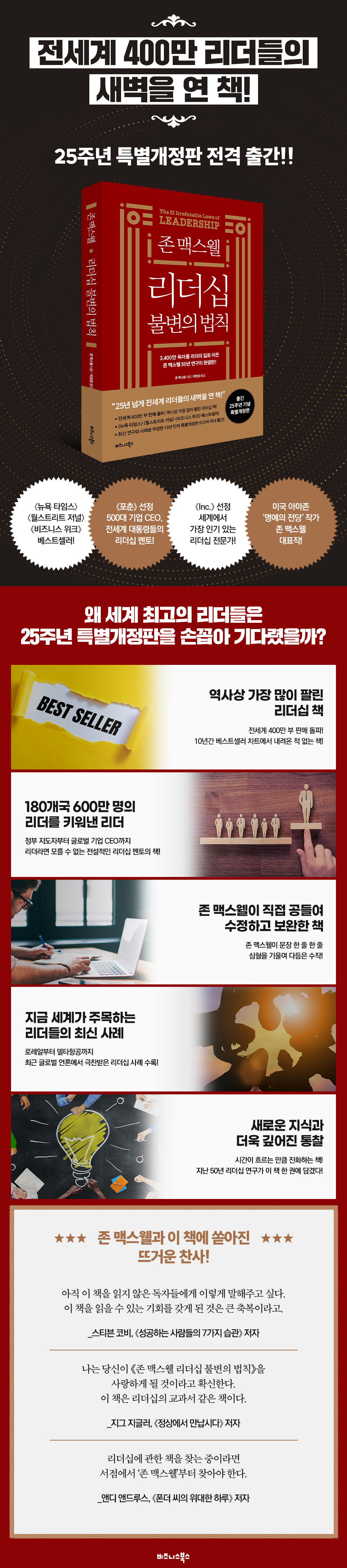
"John Maxwell's 40 Immutable Laws of Leadership" is a classic in the field of leadership, an international bestseller with over 4 million copies sold, and its author, John Maxwell, is a leading authority in the field of leadership.
For over 50 years, he has trained over 6 million people, including executives of global companies and government leaders, to become great leaders.
His reputation as a 'leader who develops leaders' is already widely known to domestic readers.
This book clearly summarizes his lifelong leadership know-how.
Not only was it selected as a bestseller by global media outlets such as [The New York Times], [The Wall Street Journal], and [Business Week], but celebrities such as Stephen Covey and Zig Ziglar also praised it as “the greatest leadership book,” validating its authority and value.
It remained an Amazon leadership bestseller for ten years after its publication, and John Maxwell was inducted into the Amazon Hall of Fame in recognition of its influence.
Since then, it has been recognized as the first book that leaders put in their bookshelves, and has been steadily selling, becoming a true bestseller.
There's a reason why this book has been loved for so long.
First of all, the topic of 'leadership' was not treated in a complicated way.
We clearly explain only the core guidelines and principles, and make these core guidelines easily accessible through examples of success and failure of famous leaders.
By examining why the McDonald brothers, who created one of the world's most famous brands, faced limitations in their success and how Steve Jobs' "leadership intuition" contributed to making Apple what it is today, you will naturally come to understand the right direction for leadership.
In addition to simply listing claims and principles, we have also included practical manuals throughout the text to make them easy to apply in real life.
However, as times change, the content needs to be further supplemented and refined.
Marking the 25th anniversary of the original publication, John Maxwell has added a variety of cutting-edge cases and research to keep pace with the changing times, providing deeper insights and perspectives in this special revised edition.
The rules have become more sophisticated, the examples more plentiful, and the book reflects the culture of modern organizations so well that even the next generation of leaders who are encountering it for the first time can immediately apply it to their own situations.
A great message that has never faded in 25 years!
Leadership is still leadership, and the laws of leadership are eternal!
Leadership today is becoming increasingly complex.
Times are changing rapidly, a new generation is emerging, and we are entering a time of chaos.
At a time when leading and working with people is more challenging than ever, not only businesses and governments, but also families, communities, and all organizations are desperately seeking leaders who are truly leaders.
So, you might wonder, shouldn't the rules a leader must adhere to be different from those of 25 years ago?
However, John Maxwell firmly states that the laws of leadership remain constant even as time passes and eras change.
The leader's goals and virtues are also the same as before.
Because the subject led by the leader has not changed.
A leader is someone who leads people, grows through them, and runs with them toward the goal of success.
This fact has remained unchanged since the first edition of this book was published 25 years ago.
Over the past 50 years of teaching leadership, I've consistently told people, "Everything in the world rises and falls based on leadership."
The more you strive to accomplish more in life, the more you will realize that great leadership is what makes the difference in your success.
The success or failure of anything that has anything to do with people depends solely on leadership.
_From the 'Concluding Remarks'
Therefore, any leader must deeply engrave the rules presented in this book into his heart and follow them.
If you haven't yet encountered this book, if you haven't yet encountered the immutable laws and the messages that live within them, then you still have endless opportunities for growth.
Open this book right now and use each law as a tool to achieve your dreams and add value to the lives of others.
If you pick up one rule, you will become a slightly better leader.
And if you master all 21 tools, you will become a great leader who will naturally follow your lead.
A masterpiece by John Maxwell, the "leadership guru" who has trained 6 million leaders!
"John Maxwell's 40 Immutable Laws of Leadership" is a classic in the field of leadership, an international bestseller with over 4 million copies sold, and its author, John Maxwell, is a leading authority in the field of leadership.
For over 50 years, he has trained over 6 million people, including executives of global companies and government leaders, to become great leaders.
His reputation as a 'leader who develops leaders' is already widely known to domestic readers.
This book clearly summarizes his lifelong leadership know-how.
Not only was it selected as a bestseller by global media outlets such as [The New York Times], [The Wall Street Journal], and [Business Week], but celebrities such as Stephen Covey and Zig Ziglar also praised it as “the greatest leadership book,” validating its authority and value.
It remained an Amazon leadership bestseller for ten years after its publication, and John Maxwell was inducted into the Amazon Hall of Fame in recognition of its influence.
Since then, it has been recognized as the first book that leaders put in their bookshelves, and has been steadily selling, becoming a true bestseller.
There's a reason why this book has been loved for so long.
First of all, the topic of 'leadership' was not treated in a complicated way.
We clearly explain only the core guidelines and principles, and make these core guidelines easily accessible through examples of success and failure of famous leaders.
By examining why the McDonald brothers, who created one of the world's most famous brands, faced limitations in their success and how Steve Jobs' "leadership intuition" contributed to making Apple what it is today, you will naturally come to understand the right direction for leadership.
In addition to simply listing claims and principles, we have also included practical manuals throughout the text to make them easy to apply in real life.
However, as times change, the content needs to be further supplemented and refined.
Marking the 25th anniversary of the original publication, John Maxwell has added a variety of cutting-edge cases and research to keep pace with the changing times, providing deeper insights and perspectives in this special revised edition.
The rules have become more sophisticated, the examples more plentiful, and the book reflects the culture of modern organizations so well that even the next generation of leaders who are encountering it for the first time can immediately apply it to their own situations.
A great message that has never faded in 25 years!
Leadership is still leadership, and the laws of leadership are eternal!
Leadership today is becoming increasingly complex.
Times are changing rapidly, a new generation is emerging, and we are entering a time of chaos.
At a time when leading and working with people is more challenging than ever, not only businesses and governments, but also families, communities, and all organizations are desperately seeking leaders who are truly leaders.
So, you might wonder, shouldn't the rules a leader must adhere to be different from those of 25 years ago?
However, John Maxwell firmly states that the laws of leadership remain constant even as time passes and eras change.
The leader's goals and virtues are also the same as before.
Because the subject led by the leader has not changed.
A leader is someone who leads people, grows through them, and runs with them toward the goal of success.
This fact has remained unchanged since the first edition of this book was published 25 years ago.
Over the past 50 years of teaching leadership, I've consistently told people, "Everything in the world rises and falls based on leadership."
The more you strive to accomplish more in life, the more you will realize that great leadership is what makes the difference in your success.
The success or failure of anything that has anything to do with people depends solely on leadership.
_From the 'Concluding Remarks'
Therefore, any leader must deeply engrave the rules presented in this book into his heart and follow them.
If you haven't yet encountered this book, if you haven't yet encountered the immutable laws and the messages that live within them, then you still have endless opportunities for growth.
Open this book right now and use each law as a tool to achieve your dreams and add value to the lives of others.
If you pick up one rule, you will become a slightly better leader.
And if you master all 21 tools, you will become a great leader who will naturally follow your lead.
GOODS SPECIFICS
- Date of issue: February 21, 2023
- Page count, weight, size: 400 pages | 652g | 162*235*23mm
- ISBN13: 9791162543283
- ISBN10: 1162543280
You may also like
카테고리
korean


korean

![GQ KOREA Mark (Monthly): December [2025]](http://librairie.coreenne.fr/cdn/shop/files/8ef265dbbfbf186523ed75ba7319009d.jpg?v=1765340328&width=3840)


