

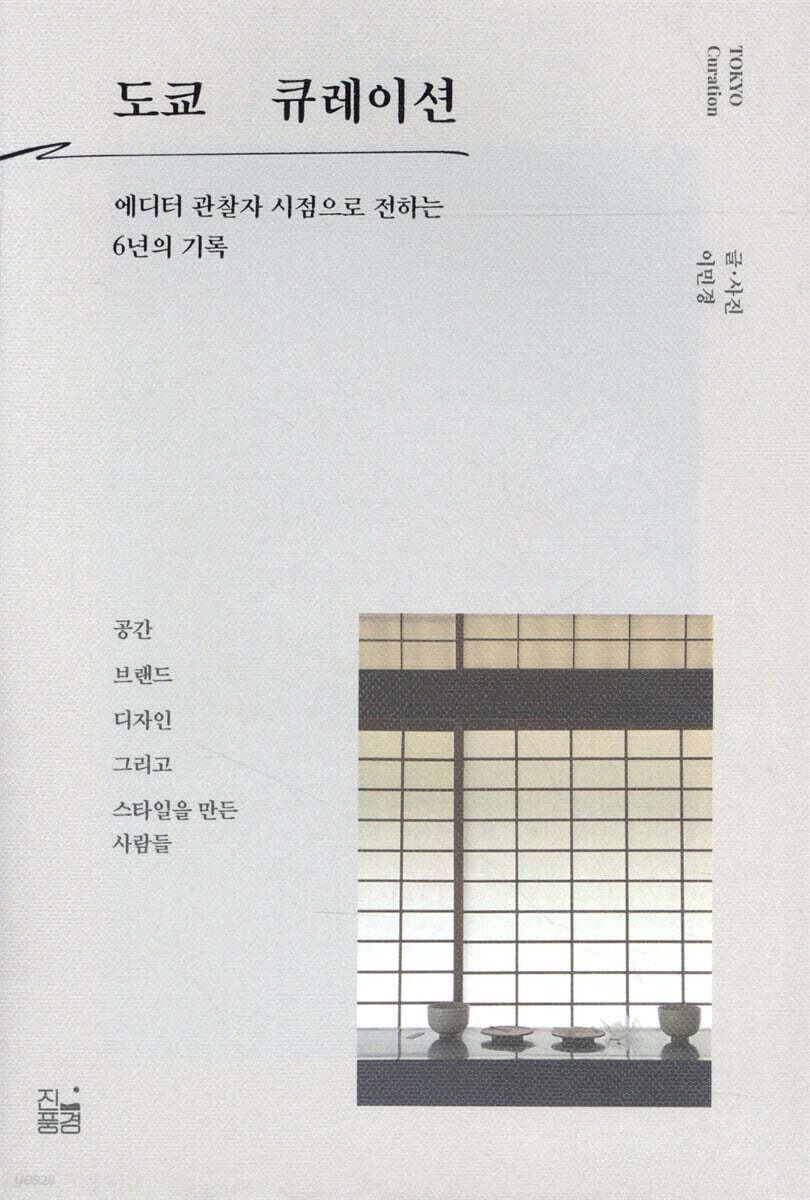
Tokyo Curation
 |
Description
Book Introduction
Space Brand Design
And the people who created the style
This book is not a travel book.
"Tokyo Curation" is a journey to experience the brand Tokyo itself.
The author, who had worked as a fashion editor for a magazine for a long time and then moved to the marketing department of Hyundai Card, ended up living in Tokyo one day.
Suddenly, I was faced with the reality of survival, not a tourist destination like Tokyo.
The first sentence, "There are views that can only be seen when you go inside," is the message the author delivers as he begins the story, and it becomes the point at which we observe the city.
As an editor who has witnessed the birth and death of brands more closely than anyone else, and as someone who has lived in Tokyo for six years, I have captured the light and shadow of local life in Tokyo with a balanced perspective.
The moments of Japan seen through the editor's prism will ultimately become a valid inspiration for us wherever we are.
'Tokyo Curation' is the ability to live flexibly while maintaining our own tastes amidst the waves of information.
And the people who created the style
This book is not a travel book.
"Tokyo Curation" is a journey to experience the brand Tokyo itself.
The author, who had worked as a fashion editor for a magazine for a long time and then moved to the marketing department of Hyundai Card, ended up living in Tokyo one day.
Suddenly, I was faced with the reality of survival, not a tourist destination like Tokyo.
The first sentence, "There are views that can only be seen when you go inside," is the message the author delivers as he begins the story, and it becomes the point at which we observe the city.
As an editor who has witnessed the birth and death of brands more closely than anyone else, and as someone who has lived in Tokyo for six years, I have captured the light and shadow of local life in Tokyo with a balanced perspective.
The moments of Japan seen through the editor's prism will ultimately become a valid inspiration for us wherever we are.
'Tokyo Curation' is the ability to live flexibly while maintaining our own tastes amidst the waves of information.
- You can preview some of the book's contents.
Preview
index
one.
Forms of urban space and culture
Modern Zen (Horyuji Museum)
Quietly Flowing Landscape (Pavilion Tokyo 2021)
Haruki Murakami Reading Library (International Literature Museum)
Another Universe (Shunkaen Bonsai Museum)
Time to Listen to My Soul (Asakura Sculpture Museum)
A museum without art (Setagaya Museum of Art)
How to Connect History (Okura Hotel)
The Stone Pagoda That Could Not Return Home (Okura Housekeeper)
Art that looks forward to the future more than the past (National Museum of Modern Art)
An exhibition that penetrates the essence (Tokyo Station Gallery)
Joseon White Porcelain Exhibition in Tokyo (Japan Folk Crafts Museum)
Future Design Inspiration (2121 Design Site)
Mirror of Seasons and Dreams, Flowers (Haiiro Ookami & Nishibeppu Store)
A place that offers a different atmosphere (Green Springs)
Japanese-style 'Jean-Michel Basquiat' exhibition (Mori Art Museum)
Other Resolutions by Japanese Architects
The Meaning of Public Space (Musashino Place)
two.
Light Brands and Shops
Creating Culture (Jikonka)
Antique Cactus (Kusamura, Tokyo)
A shop that shines with its own color (In a Station)
Things I Convince (Art & Science)
Beauty that never fades (Paget)
The heart of Tokyo's select shops (Shibone)
The New Value of Old Things (D&Department Tokyo)
A lifestyle created by tension and relaxation (Hakujitsu)
The Future of Edit Shops (Kashika)
The power to make the invisible visible (Aurari)
Hints for a Better Life (Food for Sort)
Tomorrow's Grocery Shop (Etrip Soil)
Orphaned Atelier (Mizusai)
A collection of exciting items (Hibiya Central Market)
Desire for Taste (Anatomyca)
Order and Speed in a Quiet Space (10 Ten)
The Beauty of Use (Fresh Service Headquarters)
Poetry written by hand and imagination (Mina Perhonen)
Fairytale Forest (Mina Perhonen Elaba I·II)
The bookstore I love
Favorite Souvenirs
three.
Scenery of Tokyo daily life
What is classic to me?
The continued utility of vintage and antiques
Spring, cherry blossoms
Paper Map, Invitation to the Heart
Chairs that resemble nature
Everyday Omotenashi
The heart of tea ceremony
Ikebana
Things I thought about while doing Kintsugi
Japanese rhythm
The aesthetics of imperfection
Reading the air
Japanese cuteness
Regrets of these days
The power to turn (somewhat uncomfortable) messages into art
The Two Faces of Ginza
Kimono, a culture of self-preservation
The romance of a music festival
Not asserting
Looking at the children here
Separate yet together, crew culture
A realization from the weather
Essentials you'll only know after living
The Beauty of Cleaning
four.
A real local restaurant
A bowl of stubborn ramen (Bigiya Ramen)
Food that shines like a star (Eskis)
When alcohol flows smoothly (natural wine)
A New World of Coffee (Coffee Mameya Kakeru)
My Own Silence (Kabuki)
First Lee (Pass)
Soul Food of Memories (Donkatsu)
The Artery of Japanese Food (Soba)
Summer Opening and Closing Ritual (Dasin Soan)
Shojo (Shojo Cafe) We Love
Simple and fairytale-like (Saber)
A taste I miss (Western food)
The Classic Omelet Rice (Kitchen Punch)
Snack Bar for Adults (Berg)
My favorite sushi in Tokyo (Sushi Tou)
A taste you can feel without saying anything (468)
Tempura and Grandpa (Miyakawa)
A place where time remains unchanged (Kissaten)
Jazz Kitsa (Jazz Olympus!) that only I know
The Efforts of a Bowl of Kaisendon (Tsujihan)
Conquering the depth of curry flavor that everyone knows
A place that provides a moment of ecstasy (old store)
Affectionate Sandwich (Hamanoya Parlor)
Yakizakana of the Heart (Uotake)
One meal enough (Totoya)
five.
A conversation with the creators who created human style
As we begin the interview
This is Enough (Osamu Saruyama)
Attitude Creates Culture (Chihiro Maruyama)
The Quiet Light Drawn by Glass (Yoshimi Taniguchi)
Italian Omakase Symphony (Toshiji Tomori)
Omotenashi-like sincerity (Mizuyo Yoshida)
Uncalculated Freedom (Keisuke Nakamura)
What Jazz Means to the Japanese (Katsumasa Kusunoe)
The Landscape Maker (Shinichiro Nakahara)
A Designer's Dream (Kurogouchi Maiko)
BEYOND Tokyo A trip from Tokyo
The name 'Classic Hotel' (Fujiya Hotel)
A work of art created by nature (Enoura Rain Gauge Station)
Osamu Dazai's Room (Kiungak)
Where the past and present coexist (Ink Gallery)
The House I'll Be In (Starnet)
The Beauty of Declining Time (in memory of Shoji Hamada)
Mashiko Sankokan Museum
Thinking about Architecture While Eating Udon (Houtou Fudo)
A Peaceful Microcosm (Ebam Eva Yamanashi)
Memories of Karuizawa
Conversations with Stones (Isamu Noguchi Garden Museum)
The back of Kamakura (Meigetsuin)
Living Architecture (Mizuni and Water Garden)
A dazzling season in Tokyo for you
Forms of urban space and culture
Modern Zen (Horyuji Museum)
Quietly Flowing Landscape (Pavilion Tokyo 2021)
Haruki Murakami Reading Library (International Literature Museum)
Another Universe (Shunkaen Bonsai Museum)
Time to Listen to My Soul (Asakura Sculpture Museum)
A museum without art (Setagaya Museum of Art)
How to Connect History (Okura Hotel)
The Stone Pagoda That Could Not Return Home (Okura Housekeeper)
Art that looks forward to the future more than the past (National Museum of Modern Art)
An exhibition that penetrates the essence (Tokyo Station Gallery)
Joseon White Porcelain Exhibition in Tokyo (Japan Folk Crafts Museum)
Future Design Inspiration (2121 Design Site)
Mirror of Seasons and Dreams, Flowers (Haiiro Ookami & Nishibeppu Store)
A place that offers a different atmosphere (Green Springs)
Japanese-style 'Jean-Michel Basquiat' exhibition (Mori Art Museum)
Other Resolutions by Japanese Architects
The Meaning of Public Space (Musashino Place)
two.
Light Brands and Shops
Creating Culture (Jikonka)
Antique Cactus (Kusamura, Tokyo)
A shop that shines with its own color (In a Station)
Things I Convince (Art & Science)
Beauty that never fades (Paget)
The heart of Tokyo's select shops (Shibone)
The New Value of Old Things (D&Department Tokyo)
A lifestyle created by tension and relaxation (Hakujitsu)
The Future of Edit Shops (Kashika)
The power to make the invisible visible (Aurari)
Hints for a Better Life (Food for Sort)
Tomorrow's Grocery Shop (Etrip Soil)
Orphaned Atelier (Mizusai)
A collection of exciting items (Hibiya Central Market)
Desire for Taste (Anatomyca)
Order and Speed in a Quiet Space (10 Ten)
The Beauty of Use (Fresh Service Headquarters)
Poetry written by hand and imagination (Mina Perhonen)
Fairytale Forest (Mina Perhonen Elaba I·II)
The bookstore I love
Favorite Souvenirs
three.
Scenery of Tokyo daily life
What is classic to me?
The continued utility of vintage and antiques
Spring, cherry blossoms
Paper Map, Invitation to the Heart
Chairs that resemble nature
Everyday Omotenashi
The heart of tea ceremony
Ikebana
Things I thought about while doing Kintsugi
Japanese rhythm
The aesthetics of imperfection
Reading the air
Japanese cuteness
Regrets of these days
The power to turn (somewhat uncomfortable) messages into art
The Two Faces of Ginza
Kimono, a culture of self-preservation
The romance of a music festival
Not asserting
Looking at the children here
Separate yet together, crew culture
A realization from the weather
Essentials you'll only know after living
The Beauty of Cleaning
four.
A real local restaurant
A bowl of stubborn ramen (Bigiya Ramen)
Food that shines like a star (Eskis)
When alcohol flows smoothly (natural wine)
A New World of Coffee (Coffee Mameya Kakeru)
My Own Silence (Kabuki)
First Lee (Pass)
Soul Food of Memories (Donkatsu)
The Artery of Japanese Food (Soba)
Summer Opening and Closing Ritual (Dasin Soan)
Shojo (Shojo Cafe) We Love
Simple and fairytale-like (Saber)
A taste I miss (Western food)
The Classic Omelet Rice (Kitchen Punch)
Snack Bar for Adults (Berg)
My favorite sushi in Tokyo (Sushi Tou)
A taste you can feel without saying anything (468)
Tempura and Grandpa (Miyakawa)
A place where time remains unchanged (Kissaten)
Jazz Kitsa (Jazz Olympus!) that only I know
The Efforts of a Bowl of Kaisendon (Tsujihan)
Conquering the depth of curry flavor that everyone knows
A place that provides a moment of ecstasy (old store)
Affectionate Sandwich (Hamanoya Parlor)
Yakizakana of the Heart (Uotake)
One meal enough (Totoya)
five.
A conversation with the creators who created human style
As we begin the interview
This is Enough (Osamu Saruyama)
Attitude Creates Culture (Chihiro Maruyama)
The Quiet Light Drawn by Glass (Yoshimi Taniguchi)
Italian Omakase Symphony (Toshiji Tomori)
Omotenashi-like sincerity (Mizuyo Yoshida)
Uncalculated Freedom (Keisuke Nakamura)
What Jazz Means to the Japanese (Katsumasa Kusunoe)
The Landscape Maker (Shinichiro Nakahara)
A Designer's Dream (Kurogouchi Maiko)
BEYOND Tokyo A trip from Tokyo
The name 'Classic Hotel' (Fujiya Hotel)
A work of art created by nature (Enoura Rain Gauge Station)
Osamu Dazai's Room (Kiungak)
Where the past and present coexist (Ink Gallery)
The House I'll Be In (Starnet)
The Beauty of Declining Time (in memory of Shoji Hamada)
Mashiko Sankokan Museum
Thinking about Architecture While Eating Udon (Houtou Fudo)
A Peaceful Microcosm (Ebam Eva Yamanashi)
Memories of Karuizawa
Conversations with Stones (Isamu Noguchi Garden Museum)
The back of Kamakura (Meigetsuin)
Living Architecture (Mizuni and Water Garden)
A dazzling season in Tokyo for you
Detailed image
.jpg)
Into the book
--- p.34
Haruki Murakami, who loves music, has a more vivid rhythm in his writing than any other writing.
Maybe it's his musical writing that I admire him.
--- p.34
As soon as I passed through the wide open front door, as if entering someone's home, what greeted me was a garden filled with bonsai trees.
As if mocking my age of only a few decades, the figure that had survived and endured on this Earth for hundreds of years seemed to possess a divine spirit that no words could dare to express.
Each of those majestic and elegant figures towering toward the sky was a world of its own, a universe in itself.
--- p.37
It is a very strange experience to face an art museum as a completely empty white space with all the artwork removed.
It was as unfamiliar as the face of an actor with no makeup on, or as unfamiliar as a city center on a weekday with no people in sight.
It takes great courage, both for those who allow it and for those who see it.
But sometimes you have to change direction completely to see things that weren't there before.
This is why a change in thinking is necessary.
--- p.48
It may not be a good idea to just smash everything.
It's strange that retro is booming and everything old is revered just because it's old.
However, I think that the landscape of our country, which developed rapidly after the war, has its own unique character that cannot be found anywhere else.
Even the apartments of the 1980s, which are often considered dull and lacking in individuality, can be transformed into our own proud heritage, depending on how they are interpreted and evolved.
I hold onto a little hope.
--- p.86
Tadao Ando, who works primarily with exposed concrete, is adept at making his buildings stand out from their surroundings.
Kengo Kuma, a generation after Tadao Ando, on the other hand, pursues architecture that is as inconspicuous as possible.
It is an architecture that hopes to blend into the environment and become a part of it.
--- p.55
two.
light
At the very center, cacti, each lit by its own light like the main characters on stage, exude a quiet presence.
I stopped for a moment without realizing it at the sight of such an unfamiliar sight for the first time.
It was a dazzling and mysterious sight, like encountering jewelry displayed in a showcase in the middle of Ginza.
Somehow, the cactus felt more wonderful than jewelry because it was a breathing living thing with a beginning and an end.
--- p.108
I wonder what kind of shop would shine with its own unique color in it, looking at In a Station.
Expressing your own style in a complete yet gentle way without being swayed by trends.
Maintaining a strong yet flexible belief that is unshaken by the waves.
It's not just a silk shop story.
There are times when I don't even want to turn on social media because of the overflow of information.
It's not that it's boring because everything is similar, but rather that the sea of information sometimes feels merciless.
--- p.113
Art and Science, filled with objects that have passed her demanding persuasion, will be the definition of the question, "What is good consumption in this age of overflowing goods?"
The products she introduces are certainly not greatly influenced by trends or fashions, so the more you use them, the more they develop a vintage feel and provide long-lasting satisfaction.
In my case, it was a navy suede bag I bought a few years ago.
I can understand it well.
--- p.118
The process of 'rescue', in which abandoned items that once represented the world's senses are redesigned through their eyes, always leaves a deep impression.
--- p.129
They say there's nothing new in the world, but I believe that if people who are good at different fields come together and try something fun, they can create something new.
If such movements can inject interesting color and vitality into a stagnant city, what art in everyday life could be more meaningful?
--- p.151
Perhaps today's true innovation comes from continually overcoming established limitations, like hurdles.
The thrill of accidentally visiting a market in an unfamiliar place is one of the unplanned joys of travel.
--- p.160
The reason why Fresh Service is more special to me is because it pursues the direction of ‘sustainability.’
If you like a product, it will lead you to repurchase it at any time in the future.
I believe that it is a consideration that represents our desire to continue using good things, and an attitude that truly understands and practices the meaning of 'use's beauty.
--- p.171
Tokyo's antique markets are very similar to the Japanese people.
The market is not just a place where old things are displayed.
A place to gather inspiration, share stories about the objects and things that have passed by, and gaze into the passing of time.
Then, if something catches my eye, I return to my seat, fiddle with it, and think about it for a while before finally picking it up and going home together.
--- p.199
Cherry blossoms symbolize spring and the beginning, but they also symbolize the nature of life, such as regeneration and finiteness.
This is because it has the property of blooming brilliantly for a short period of just two weeks and then disappearing like a fleeting dream.
This magnificent but short lifespan reminds us of the truth that our lives are not long at all.
So, I think it teaches us the lesson that we should see and enjoy the best things in this life as much as possible, and that we too should cultivate our own lives beautifully.
--- p.203
This map, which clearly took time and effort to create in collaboration with local community groups and small business owners, contains something that Google Maps doesn't.
It is pride in one's own shop and a special affection and love for the village where one opened the shop.
It is a reflection of the common wish that not only my own store, but also the store next to me and our town prosper together.
--- p.208
Omotenashi is not just about sincerity.
It is something that is built up step by step on top of a fundamental attitude toward one's work.
The reason why omotenashi has become a representative service of Japan is because it is expressed by adding the true and sincere heart of 'sincerity' to this sincerity.
It's easy to say, but we know how difficult it is to work with all your heart every moment.
--- p.217
Embracing and willingly accepting our flaws and imperfections by emphasizing them rather than hiding them, which are broken, blemished, and scattered here and there.
I thought that might be the spirit of Kintsugi and Japanese wabi-sabi.
--- p.230
It takes enough time.
It cannot be helped that it is even more difficult because time alone is not enough.
This is Japanese time, and this is how people live here.
So don't rush or rush too much.
I'll let my mind relax a little.
Then, one day, I might find myself following the Japanese trend.
--- p.232
If we look closely at the reasons why there are so many solid brands throughout Japan, we can see that this crew culture has had a significant influence.
A culture of constantly refining one's position and advancing while uniting 'separately, yet together'.
In the end, it's about living well together.
--- p.266
These days, stores with this kind of atmosphere are especially common in Tokyo.
A sophisticated yet casual French bistro.
In the open kitchen, chefs are busy preparing food, and when you sit at the bar, you sometimes make eye contact with the owner and have a quick chat.
--- p.295
When I return to Korea someday, the food I will miss and think of the most will not be sushi or kaiseki, but tonkatsu.
This means that there is a significant difference in level between this dish and Korean pork cutlet, but how can we explain the taste and texture of the meat?
--- p.297
Omelette rice tells us the truth that what looks simple is actually more difficult.
The simpler the material, the less likely it is that the skill will be obscured or hidden.
--- p.322
The charm of Kitsaten is that it feels like I am inside a landscape in an old frame.
In a world where everything is changing rapidly, there are days when I wish there were some things that would remain constant, and I visit my local Kitsaten.
--- p.335
His designs incorporate all the elements that represent modern Japanese design today.
Its small size fits perfectly in one hand, its refined shape that is angular yet somewhat rounded, and its aesthetic feel reminiscent of a lyrical still life painting are all there.
If you decorate your table with these dishes, all the food that fills your daily life will be upgraded to the realm of art.
--- p.401
She explained why Japan is a country of details, and even mentioned the word "sincerity."
This was a story that every designer I met told me without fail.
Here I must add one thing.
That would be the kind of sincerity that is 'omotenashi' and that knows how to consider the other person first.
--- p.422
He emphasized movement until the end of the interview.
He told me that if I live each day with curiosity and work hard at what I'm given, the next thing will come, and that it's a natural flow.
I believe that there is an invisible thread in the world that watches over and connects everything I do with all my heart.
So, just go with the flow, like water or waves, and adapt to the situation.
Haruki Murakami, who loves music, has a more vivid rhythm in his writing than any other writing.
Maybe it's his musical writing that I admire him.
--- p.34
As soon as I passed through the wide open front door, as if entering someone's home, what greeted me was a garden filled with bonsai trees.
As if mocking my age of only a few decades, the figure that had survived and endured on this Earth for hundreds of years seemed to possess a divine spirit that no words could dare to express.
Each of those majestic and elegant figures towering toward the sky was a world of its own, a universe in itself.
--- p.37
It is a very strange experience to face an art museum as a completely empty white space with all the artwork removed.
It was as unfamiliar as the face of an actor with no makeup on, or as unfamiliar as a city center on a weekday with no people in sight.
It takes great courage, both for those who allow it and for those who see it.
But sometimes you have to change direction completely to see things that weren't there before.
This is why a change in thinking is necessary.
--- p.48
It may not be a good idea to just smash everything.
It's strange that retro is booming and everything old is revered just because it's old.
However, I think that the landscape of our country, which developed rapidly after the war, has its own unique character that cannot be found anywhere else.
Even the apartments of the 1980s, which are often considered dull and lacking in individuality, can be transformed into our own proud heritage, depending on how they are interpreted and evolved.
I hold onto a little hope.
--- p.86
Tadao Ando, who works primarily with exposed concrete, is adept at making his buildings stand out from their surroundings.
Kengo Kuma, a generation after Tadao Ando, on the other hand, pursues architecture that is as inconspicuous as possible.
It is an architecture that hopes to blend into the environment and become a part of it.
--- p.55
two.
light
At the very center, cacti, each lit by its own light like the main characters on stage, exude a quiet presence.
I stopped for a moment without realizing it at the sight of such an unfamiliar sight for the first time.
It was a dazzling and mysterious sight, like encountering jewelry displayed in a showcase in the middle of Ginza.
Somehow, the cactus felt more wonderful than jewelry because it was a breathing living thing with a beginning and an end.
--- p.108
I wonder what kind of shop would shine with its own unique color in it, looking at In a Station.
Expressing your own style in a complete yet gentle way without being swayed by trends.
Maintaining a strong yet flexible belief that is unshaken by the waves.
It's not just a silk shop story.
There are times when I don't even want to turn on social media because of the overflow of information.
It's not that it's boring because everything is similar, but rather that the sea of information sometimes feels merciless.
--- p.113
Art and Science, filled with objects that have passed her demanding persuasion, will be the definition of the question, "What is good consumption in this age of overflowing goods?"
The products she introduces are certainly not greatly influenced by trends or fashions, so the more you use them, the more they develop a vintage feel and provide long-lasting satisfaction.
In my case, it was a navy suede bag I bought a few years ago.
I can understand it well.
--- p.118
The process of 'rescue', in which abandoned items that once represented the world's senses are redesigned through their eyes, always leaves a deep impression.
--- p.129
They say there's nothing new in the world, but I believe that if people who are good at different fields come together and try something fun, they can create something new.
If such movements can inject interesting color and vitality into a stagnant city, what art in everyday life could be more meaningful?
--- p.151
Perhaps today's true innovation comes from continually overcoming established limitations, like hurdles.
The thrill of accidentally visiting a market in an unfamiliar place is one of the unplanned joys of travel.
--- p.160
The reason why Fresh Service is more special to me is because it pursues the direction of ‘sustainability.’
If you like a product, it will lead you to repurchase it at any time in the future.
I believe that it is a consideration that represents our desire to continue using good things, and an attitude that truly understands and practices the meaning of 'use's beauty.
--- p.171
Tokyo's antique markets are very similar to the Japanese people.
The market is not just a place where old things are displayed.
A place to gather inspiration, share stories about the objects and things that have passed by, and gaze into the passing of time.
Then, if something catches my eye, I return to my seat, fiddle with it, and think about it for a while before finally picking it up and going home together.
--- p.199
Cherry blossoms symbolize spring and the beginning, but they also symbolize the nature of life, such as regeneration and finiteness.
This is because it has the property of blooming brilliantly for a short period of just two weeks and then disappearing like a fleeting dream.
This magnificent but short lifespan reminds us of the truth that our lives are not long at all.
So, I think it teaches us the lesson that we should see and enjoy the best things in this life as much as possible, and that we too should cultivate our own lives beautifully.
--- p.203
This map, which clearly took time and effort to create in collaboration with local community groups and small business owners, contains something that Google Maps doesn't.
It is pride in one's own shop and a special affection and love for the village where one opened the shop.
It is a reflection of the common wish that not only my own store, but also the store next to me and our town prosper together.
--- p.208
Omotenashi is not just about sincerity.
It is something that is built up step by step on top of a fundamental attitude toward one's work.
The reason why omotenashi has become a representative service of Japan is because it is expressed by adding the true and sincere heart of 'sincerity' to this sincerity.
It's easy to say, but we know how difficult it is to work with all your heart every moment.
--- p.217
Embracing and willingly accepting our flaws and imperfections by emphasizing them rather than hiding them, which are broken, blemished, and scattered here and there.
I thought that might be the spirit of Kintsugi and Japanese wabi-sabi.
--- p.230
It takes enough time.
It cannot be helped that it is even more difficult because time alone is not enough.
This is Japanese time, and this is how people live here.
So don't rush or rush too much.
I'll let my mind relax a little.
Then, one day, I might find myself following the Japanese trend.
--- p.232
If we look closely at the reasons why there are so many solid brands throughout Japan, we can see that this crew culture has had a significant influence.
A culture of constantly refining one's position and advancing while uniting 'separately, yet together'.
In the end, it's about living well together.
--- p.266
These days, stores with this kind of atmosphere are especially common in Tokyo.
A sophisticated yet casual French bistro.
In the open kitchen, chefs are busy preparing food, and when you sit at the bar, you sometimes make eye contact with the owner and have a quick chat.
--- p.295
When I return to Korea someday, the food I will miss and think of the most will not be sushi or kaiseki, but tonkatsu.
This means that there is a significant difference in level between this dish and Korean pork cutlet, but how can we explain the taste and texture of the meat?
--- p.297
Omelette rice tells us the truth that what looks simple is actually more difficult.
The simpler the material, the less likely it is that the skill will be obscured or hidden.
--- p.322
The charm of Kitsaten is that it feels like I am inside a landscape in an old frame.
In a world where everything is changing rapidly, there are days when I wish there were some things that would remain constant, and I visit my local Kitsaten.
--- p.335
His designs incorporate all the elements that represent modern Japanese design today.
Its small size fits perfectly in one hand, its refined shape that is angular yet somewhat rounded, and its aesthetic feel reminiscent of a lyrical still life painting are all there.
If you decorate your table with these dishes, all the food that fills your daily life will be upgraded to the realm of art.
--- p.401
She explained why Japan is a country of details, and even mentioned the word "sincerity."
This was a story that every designer I met told me without fail.
Here I must add one thing.
That would be the kind of sincerity that is 'omotenashi' and that knows how to consider the other person first.
--- p.422
He emphasized movement until the end of the interview.
He told me that if I live each day with curiosity and work hard at what I'm given, the next thing will come, and that it's a natural flow.
I believe that there is an invisible thread in the world that watches over and connects everything I do with all my heart.
So, just go with the flow, like water or waves, and adapt to the situation.
--- p.450
Publisher's Review
A journey to experience the brand called Tokyo
And conversations with the people who create the landscape
In these times, when countless brands rise and fall, and the very word "lifestyle" itself becomes overly consumed, this book allows us to reflect on its fundamental meaning through conversations with creatives who experience the brand called Tokyo and are shaping today's culture.
It's not about just pursuing and liking superficial cool, but about building a spiritual foundation.
The beginning of your lifestyle may start right there.
So why start in a city like Tokyo? In this day and age, more important than debating who started something first or what has originality is recognizing its value first, continually cultivating it, and branding it.
What Japan is really good at is branding.
It's a scary power.
So, for those who plan and create content and think about branding, Tokyo is a city like a living organism that you should stay in more often and for a longer period of time.
Tokyo is attractive to those who are simply interested in Japan, or even to those who want to put aside the reality in front of them and escape somewhere right away.
The unique atmosphere, the moving atmosphere, and the feeling of something good make me head back to that city.
This book is about reading that kind of 'Tokyo air'.
This book features stories of spaces and brand design encountered in the editor's Tokyo life, not through the eyes of a tourist, but through vivid interviews with creators who move Japan forward.
[Chapter 1.
Form], [Chapter 2.
The space and content of [Light] are [Chapter 3] of Tokyo residents.
[Chapter 4.] Everyday stories that make up the [landscape].
Taste], and [Chapter 5.
Each of the five chapters of the story, which leads to [People], is a Tokyo travelogue that helps with the detailed thematic travel, and is also a record of the author's communication that has gradually expanded through the trial and error of meeting new people.
Recently, Tokyo has seen a surge in the number of new hotels, cultural complexes, cafes, and shops, creating a new challenge of sorting out the good from the bad.
This book provides insight for our journey that is about to begin again.
Even if you have to postpone your trip to Tokyo for a while, the reason you should read this book is because, between the delicate and pleasant sentences, it has the power to make you reflect on your own attitude toward work and life.
The author, a Tokyo resident, has dedicated himself to documenting six years of experience cultivating our aesthetic sense, and this experience also extends to providing inspiration for our own city.
As the author says, taste is a byproduct of the environment surrounding me, and it eventually shines with its own unique color.
"Tokyo Curation" fills us with the desire to travel there right now, while also inviting us to embark on a unique journey from the space we currently inhabit.
The journey of this book
1. Form: Culture created by urban content and nature
It contains galleries, art museums, parks, hotels, and public facilities that make up the city's content, so you can experience them as if you were taking a stroll.
The space the author encountered with his eyes and heart conveys a pleasant stimulation of everyday life and is also rediscovered as a way to view our landscape.
The exhibition of "Joseon White Porcelain" in Tokyo, an art museum that witnesses the unique Japanese idea of taking anything and making it into something uniquely their own, and the story of the stone pagoda at the Okura Museum of Art, come to us like voices that offer an opportunity to look back on our own things.
2 Light: Items and shops that shine with your taste
One of the reasons we can't forget Tokyo is because, even in small shops, we can encounter an impressive atmosphere that transcends the products themselves.
It's more than just purchasing items; it's about interacting with the staff and sharing the feel and atmosphere of the space where someone's collection is displayed.
The author called the moment of experiencing the shop in this way 'ventilation of the mind.'
'It's not a select shop just because it has beautiful items.
The reason why the art director's philosophy and the form in which it is expressed are important is because they are ultimately the key elements that create the unique and absolute taste and atmosphere of a space. As the sentence 'Objects are connected to the human spirit' suggests, the real reason why objects are important in our daily lives is because of the philosophy they convey.
In the shop that the author introduces, which shines with his own unique colors, I hope you will encounter not only the sense of the items but also the philosophy and insight that goes beyond them.
3 Scenes: Everyday Life as a Tokyo Resident
This is the story of the author living in Tokyo and creating [landscape].
In the rhythm of daily life, the spirit of omotenashi, the spirit of tea ceremony as a ritual of caring for people, kintsugi, which finds perfection in imperfection, and how to read their hearts that exist like air without being expressed, he tells us from experience about cultural keywords that we seem to understand but do not when we talk about Japan.
The story of ikebana, which began as the author's struggle to enter a certain aspect of Japanese society, conveys the time it took to become part of the rhythm of Tokyo.
Just as the time spent pondering over ikebana flower materials progresses to a time of resolution, Japanese time requires waiting.
4 Taste: A real restaurant only locals go to
The author reveals the authentic local restaurants that he truly cherishes.
This is a place where you can experience not only the taste but also the hard core ingrained in the DNA of the Japanese people, the unique Japanese weapon that delves into each region and style differently even when dealing with the same country's cuisine, and the chef's sincerity towards food, Omotenashi.
5 People: Creators Creating Tokyo Now
The final journey in Tokyo leads to the story of the people who create culture.
Ultimately, it's people at the end of everything, and your trip to Tokyo will be remembered for the people who shaped the city's landscape.
The author reveals conversations he had with the creators who created the brand called Tokyo.
It is a philosophy that can be contained in the communication between people, something that cannot be fully explained through knowledge and manuals about Japan.
And after chapter 5.
[BEYOND Tokyo], where nature unfolds like a work of art beyond Tokyo.
Don't miss the [Dazzling Seasons of Tokyo for You], a series of letters written with sincerity by the actual author, who sent a final letter to the readers.
Our journey will begin again.
And conversations with the people who create the landscape
In these times, when countless brands rise and fall, and the very word "lifestyle" itself becomes overly consumed, this book allows us to reflect on its fundamental meaning through conversations with creatives who experience the brand called Tokyo and are shaping today's culture.
It's not about just pursuing and liking superficial cool, but about building a spiritual foundation.
The beginning of your lifestyle may start right there.
So why start in a city like Tokyo? In this day and age, more important than debating who started something first or what has originality is recognizing its value first, continually cultivating it, and branding it.
What Japan is really good at is branding.
It's a scary power.
So, for those who plan and create content and think about branding, Tokyo is a city like a living organism that you should stay in more often and for a longer period of time.
Tokyo is attractive to those who are simply interested in Japan, or even to those who want to put aside the reality in front of them and escape somewhere right away.
The unique atmosphere, the moving atmosphere, and the feeling of something good make me head back to that city.
This book is about reading that kind of 'Tokyo air'.
This book features stories of spaces and brand design encountered in the editor's Tokyo life, not through the eyes of a tourist, but through vivid interviews with creators who move Japan forward.
[Chapter 1.
Form], [Chapter 2.
The space and content of [Light] are [Chapter 3] of Tokyo residents.
[Chapter 4.] Everyday stories that make up the [landscape].
Taste], and [Chapter 5.
Each of the five chapters of the story, which leads to [People], is a Tokyo travelogue that helps with the detailed thematic travel, and is also a record of the author's communication that has gradually expanded through the trial and error of meeting new people.
Recently, Tokyo has seen a surge in the number of new hotels, cultural complexes, cafes, and shops, creating a new challenge of sorting out the good from the bad.
This book provides insight for our journey that is about to begin again.
Even if you have to postpone your trip to Tokyo for a while, the reason you should read this book is because, between the delicate and pleasant sentences, it has the power to make you reflect on your own attitude toward work and life.
The author, a Tokyo resident, has dedicated himself to documenting six years of experience cultivating our aesthetic sense, and this experience also extends to providing inspiration for our own city.
As the author says, taste is a byproduct of the environment surrounding me, and it eventually shines with its own unique color.
"Tokyo Curation" fills us with the desire to travel there right now, while also inviting us to embark on a unique journey from the space we currently inhabit.
The journey of this book
1. Form: Culture created by urban content and nature
It contains galleries, art museums, parks, hotels, and public facilities that make up the city's content, so you can experience them as if you were taking a stroll.
The space the author encountered with his eyes and heart conveys a pleasant stimulation of everyday life and is also rediscovered as a way to view our landscape.
The exhibition of "Joseon White Porcelain" in Tokyo, an art museum that witnesses the unique Japanese idea of taking anything and making it into something uniquely their own, and the story of the stone pagoda at the Okura Museum of Art, come to us like voices that offer an opportunity to look back on our own things.
2 Light: Items and shops that shine with your taste
One of the reasons we can't forget Tokyo is because, even in small shops, we can encounter an impressive atmosphere that transcends the products themselves.
It's more than just purchasing items; it's about interacting with the staff and sharing the feel and atmosphere of the space where someone's collection is displayed.
The author called the moment of experiencing the shop in this way 'ventilation of the mind.'
'It's not a select shop just because it has beautiful items.
The reason why the art director's philosophy and the form in which it is expressed are important is because they are ultimately the key elements that create the unique and absolute taste and atmosphere of a space. As the sentence 'Objects are connected to the human spirit' suggests, the real reason why objects are important in our daily lives is because of the philosophy they convey.
In the shop that the author introduces, which shines with his own unique colors, I hope you will encounter not only the sense of the items but also the philosophy and insight that goes beyond them.
3 Scenes: Everyday Life as a Tokyo Resident
This is the story of the author living in Tokyo and creating [landscape].
In the rhythm of daily life, the spirit of omotenashi, the spirit of tea ceremony as a ritual of caring for people, kintsugi, which finds perfection in imperfection, and how to read their hearts that exist like air without being expressed, he tells us from experience about cultural keywords that we seem to understand but do not when we talk about Japan.
The story of ikebana, which began as the author's struggle to enter a certain aspect of Japanese society, conveys the time it took to become part of the rhythm of Tokyo.
Just as the time spent pondering over ikebana flower materials progresses to a time of resolution, Japanese time requires waiting.
4 Taste: A real restaurant only locals go to
The author reveals the authentic local restaurants that he truly cherishes.
This is a place where you can experience not only the taste but also the hard core ingrained in the DNA of the Japanese people, the unique Japanese weapon that delves into each region and style differently even when dealing with the same country's cuisine, and the chef's sincerity towards food, Omotenashi.
5 People: Creators Creating Tokyo Now
The final journey in Tokyo leads to the story of the people who create culture.
Ultimately, it's people at the end of everything, and your trip to Tokyo will be remembered for the people who shaped the city's landscape.
The author reveals conversations he had with the creators who created the brand called Tokyo.
It is a philosophy that can be contained in the communication between people, something that cannot be fully explained through knowledge and manuals about Japan.
And after chapter 5.
[BEYOND Tokyo], where nature unfolds like a work of art beyond Tokyo.
Don't miss the [Dazzling Seasons of Tokyo for You], a series of letters written with sincerity by the actual author, who sent a final letter to the readers.
Our journey will begin again.
GOODS SPECIFICS
- Date of issue: July 1, 2022
- Page count, weight, size: 532 pages | 784g | 140*205*35mm
- ISBN13: 9791197915277
- ISBN10: 1197915273
You may also like
카테고리
korean


korean

![GQ KOREA Mark (Monthly): December [2025]](http://librairie.coreenne.fr/cdn/shop/files/8ef265dbbfbf186523ed75ba7319009d.jpg?v=1765340328&width=3840)


