

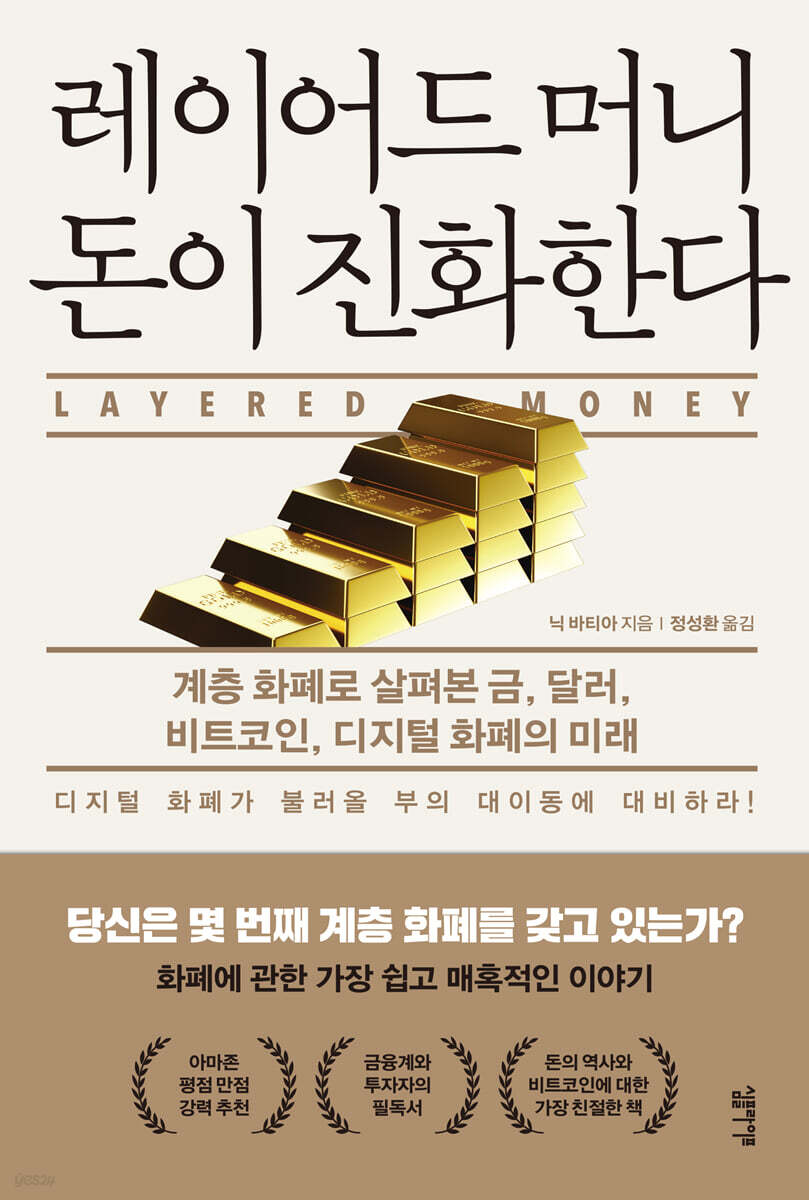
Layered Money: Money Evolves
 |
Description
Book Introduction
A history of money and an introduction to Bitcoin, offering a glimpse into the history and future of money.
'What will we spend our money on in the future?'
'Will my assets be safe in the future?'
A concise introduction to the history of currency and a primer on Bitcoin.
How was today's monetary system created? How long will the dollar-centric monetary system last? What currency will replace the dollar? Can we truly create a monetary system independent of state power? What is the future of Bitcoin and digital currency?
A book that provides clear answers to these questions has been published and is creating a buzz.
[Layered Money, Money Evolves], which became an Amazon bestseller by word of mouth as soon as it was published and is being published in countries around the world, is a book that helps the public easily understand the monetary system and redefine its concepts by examining the history of money through a groundbreaking and original framework called 'Layered Money'.
The author, an American financial expert and educator, said, “Until now, the workings of the monetary system have been the domain of experts.
“Now we need to break out of their league and create a way that is easily accessible and understandable to everyone,” he said, explaining his intentions for writing.
[Layered Money, Money Evolves] clearly shows how the monetary system was created and changed, from the time when humans first used coins to gold, silver, the dollar, and now Bitcoin, through the lens of 'layered structure'.
The book also explains the inevitability of Bitcoin's emergence, as well as its concepts, structure, and role.
Following this journey, we can grasp at a glance the needs for which the currency and system we use were created and operated, and the structural problems they face.
Through this book, readers will gain a new understanding of how money is a "hierarchical system" and develop the insight to appropriately respond to the enormous changes of the times that lie ahead.
'What will we spend our money on in the future?'
'Will my assets be safe in the future?'
A concise introduction to the history of currency and a primer on Bitcoin.
How was today's monetary system created? How long will the dollar-centric monetary system last? What currency will replace the dollar? Can we truly create a monetary system independent of state power? What is the future of Bitcoin and digital currency?
A book that provides clear answers to these questions has been published and is creating a buzz.
[Layered Money, Money Evolves], which became an Amazon bestseller by word of mouth as soon as it was published and is being published in countries around the world, is a book that helps the public easily understand the monetary system and redefine its concepts by examining the history of money through a groundbreaking and original framework called 'Layered Money'.
The author, an American financial expert and educator, said, “Until now, the workings of the monetary system have been the domain of experts.
“Now we need to break out of their league and create a way that is easily accessible and understandable to everyone,” he said, explaining his intentions for writing.
[Layered Money, Money Evolves] clearly shows how the monetary system was created and changed, from the time when humans first used coins to gold, silver, the dollar, and now Bitcoin, through the lens of 'layered structure'.
The book also explains the inevitability of Bitcoin's emergence, as well as its concepts, structure, and role.
Following this journey, we can grasp at a glance the needs for which the currency and system we use were created and operated, and the structural problems they face.
Through this book, readers will gain a new understanding of how money is a "hierarchical system" and develop the insight to appropriately respond to the enormous changes of the times that lie ahead.
- You can preview some of the book's contents.
Preview
index
- On the publication of the Korean version
- Preface
Part 1: The History of Early Currency and the Emergence of Hierarchical Currency
- 1 gold florin
- Chapter 2: The emergence of hierarchical currency
The Development of Second-tier Currency and the Crisis of the Dollar System
- Chapter 3 Central Bank
- Chapter 4: The U.S. Federal Reserve System
- Chapter 5: Gold leaving
Chapter 6: The Dollar System in Crisis
Part 3: Finding an Alternative - Bitcoin
Chapter 7: The Monetary Renaissance
- Chapter 8: Bitcoin's Hierarchical Structure
- Chapter 9 Central Bank Digital Currency
- Chapter 10 Freedom of Currency Choice
- References
- Preface
Part 1: The History of Early Currency and the Emergence of Hierarchical Currency
- 1 gold florin
- Chapter 2: The emergence of hierarchical currency
The Development of Second-tier Currency and the Crisis of the Dollar System
- Chapter 3 Central Bank
- Chapter 4: The U.S. Federal Reserve System
- Chapter 5: Gold leaving
Chapter 6: The Dollar System in Crisis
Part 3: Finding an Alternative - Bitcoin
Chapter 7: The Monetary Renaissance
- Chapter 8: Bitcoin's Hierarchical Structure
- Chapter 9 Central Bank Digital Currency
- Chapter 10 Freedom of Currency Choice
- References
Detailed image
.jpg)
Into the book
There are countless maps in the world that help us understand the terrain and topography.
But there is still no map that shows the geography of money.
Through this book, I aim to map the financial system through the ages and envision what the digital currency of the future might look like.
--- p.9
Why did I use the somewhat unfamiliar concept of 'class'?
Key players in the international monetary system are already announcing their vision for the future of digital currency.
Therefore, we need to quickly find ways to analyze the changes.
The problem is that it is difficult to derive an easy and clear method when confined to the framework of mainstream economics terminology.
This is why I chose the framework of a hierarchical system.
Because this is the most effective and clear way to conceptualize the changes that will occur in the financial system.
--- p.12
The exceptional stability of the gold florin alone did not drive the monetary innovations of the Renaissance.
The popularity of the gold florin over the centuries coincided with rapid advances in mathematics, accounting, and banking that profoundly transformed the human experience of money.
--- p.27
The final piece of the puzzle that led to the successful emergence of a modern financial market in Antwerp was the invention of the promissory note.
Previously, financial market transactions were sporadic, occurring randomly on a quarterly basis, but the advent of promissory notes made continuous transactions possible in the financial markets.
Promissory notes were another form of credit security issued by bankers on the Antwerp Exchange to settle outstanding balances, a new type of second-tier currency.
--- p.52
Second, with the emergence of hierarchical currencies, state power began to move to seize key positions in the monetary hierarchy.
In particular, state power entered the monetary pyramid structure as the Bank of Amsterdam and the Bank of England in the 17th and 18th centuries granted the government unprecedented authority over monetary matters.
These governments and their new central banks have deprived people of their right to freedom of choice in their currency by legally mandating the use of only second-tier currencies issued by their governments.
--- p.59
This chapter breaks down the three-tiered Federal Reserve dollar pyramid, and the next chapter explores how the Federal Reserve and the U.S. government boldly removed gold from the first-tier currency.
Finally, I want to address why the international monetary system has been in such a deep quagmire since 2007 and why calls for a global currency reset are growing louder by the day.
--- p.84
From a hierarchical monetary perspective, virtually no part of today's dollar pyramid relies on the safety net of liquidity provided by the Federal Reserve.
Since 2007, the dollar pyramid has been so imploded that the Fed has had no choice but to bandage the entire facade.
In this chapter, we'll explore how the Federal Reserve became the world's only money lender.
--- p.115
Bitcoin can no longer be dismissed as an extra-institutional, worthless currency.
Rather, we should examine why Bitcoin has garnered so much attention and market value.
Despite gold having a thousand years of head start, Bitcoin has already captured 6% of the entire gold market capitalization in just 12 years.
--- p.146
What makes Bitcoin comparable to gold, the most proven monetary asset in the history of human civilization? The answer lies in Bitcoin's protocol rules.
The Bitcoin blockchain essentially describes a record of transactions that is kept simultaneously by all peers within the network.
--- p.149
Bitcoin is the first truly alternative currency to be presented to a human society that has long considered the use of its own currency a matter of natural law. It has established itself as an irreversible trend, with users exceeding 100 million worldwide.
Let us now roughly outline how the future of money might unfold in the context of hierarchical money.
(Omitted) The era of using only the currency of the country you live in is no longer here.
No other currency has yet demonstrated the same level of corruption resistance as Bitcoin.
--- p.217
But there is still no map that shows the geography of money.
Through this book, I aim to map the financial system through the ages and envision what the digital currency of the future might look like.
--- p.9
Why did I use the somewhat unfamiliar concept of 'class'?
Key players in the international monetary system are already announcing their vision for the future of digital currency.
Therefore, we need to quickly find ways to analyze the changes.
The problem is that it is difficult to derive an easy and clear method when confined to the framework of mainstream economics terminology.
This is why I chose the framework of a hierarchical system.
Because this is the most effective and clear way to conceptualize the changes that will occur in the financial system.
--- p.12
The exceptional stability of the gold florin alone did not drive the monetary innovations of the Renaissance.
The popularity of the gold florin over the centuries coincided with rapid advances in mathematics, accounting, and banking that profoundly transformed the human experience of money.
--- p.27
The final piece of the puzzle that led to the successful emergence of a modern financial market in Antwerp was the invention of the promissory note.
Previously, financial market transactions were sporadic, occurring randomly on a quarterly basis, but the advent of promissory notes made continuous transactions possible in the financial markets.
Promissory notes were another form of credit security issued by bankers on the Antwerp Exchange to settle outstanding balances, a new type of second-tier currency.
--- p.52
Second, with the emergence of hierarchical currencies, state power began to move to seize key positions in the monetary hierarchy.
In particular, state power entered the monetary pyramid structure as the Bank of Amsterdam and the Bank of England in the 17th and 18th centuries granted the government unprecedented authority over monetary matters.
These governments and their new central banks have deprived people of their right to freedom of choice in their currency by legally mandating the use of only second-tier currencies issued by their governments.
--- p.59
This chapter breaks down the three-tiered Federal Reserve dollar pyramid, and the next chapter explores how the Federal Reserve and the U.S. government boldly removed gold from the first-tier currency.
Finally, I want to address why the international monetary system has been in such a deep quagmire since 2007 and why calls for a global currency reset are growing louder by the day.
--- p.84
From a hierarchical monetary perspective, virtually no part of today's dollar pyramid relies on the safety net of liquidity provided by the Federal Reserve.
Since 2007, the dollar pyramid has been so imploded that the Fed has had no choice but to bandage the entire facade.
In this chapter, we'll explore how the Federal Reserve became the world's only money lender.
--- p.115
Bitcoin can no longer be dismissed as an extra-institutional, worthless currency.
Rather, we should examine why Bitcoin has garnered so much attention and market value.
Despite gold having a thousand years of head start, Bitcoin has already captured 6% of the entire gold market capitalization in just 12 years.
--- p.146
What makes Bitcoin comparable to gold, the most proven monetary asset in the history of human civilization? The answer lies in Bitcoin's protocol rules.
The Bitcoin blockchain essentially describes a record of transactions that is kept simultaneously by all peers within the network.
--- p.149
Bitcoin is the first truly alternative currency to be presented to a human society that has long considered the use of its own currency a matter of natural law. It has established itself as an irreversible trend, with users exceeding 100 million worldwide.
Let us now roughly outline how the future of money might unfold in the context of hierarchical money.
(Omitted) The era of using only the currency of the country you live in is no longer here.
No other currency has yet demonstrated the same level of corruption resistance as Bitcoin.
--- p.217
--- p.217
Publisher's Review
◆ The complexly intertwined landscape of currency is visible at a glance.
◆ The easiest and most fascinating story about money
The author explains that 'the modern world is a vertically structured monetary system centered around the dollar, with banks creating currency through the magic of double-entry bookkeeping', and illuminates the history of monetary development from the appearance of the gold florin in the 12th century, through bills of exchange, bank notes, the gold standard, and the current fiat money, and explains the process by which central banks were created, from the Dutch Bank to the Bank of England, and now the US Federal Reserve, to dominate the system and establish themselves as the core axis.
By examining the process of monetary development in this way, he argues that the monetary system is not developed according to the intentions or plans of a few brilliant economists or national powers, but rather is derived from the evolutionary nature of humanity striving to solve the challenges of the times. He also argues that a new monetary system centered around Bitcoin will replace the dollar system, which is in crisis.
◆ The Easiest Bitcoin Introduction
Will Bitcoin truly change the fate of the monetary system? Will it coexist with national currencies, or will it replace them? What will the fate of Bitcoin investors and non-investors be?
This book also provides direct information and inspiration for these questions.
The book details the tectonic shift in global monetary perception triggered by the emergence of Bitcoin, and how Bitcoin can become a trustworthy global currency, drawing on scientific, social, and historical evidence.
Furthermore, it explains why Bitcoin should not be dismissed as an extra-institutional, worthless currency, and why it continues to garner significant attention and market value despite numerous controversies.
The author's proposed "hierarchy" allows us to determine Bitcoin's position within the currency pyramid and its future value.
It will provide valuable insights and information to readers who want to learn more and gain confidence in Bitcoin, especially those who still hold a critical view of it.
What currency will replace the dollar? Prepare for the wealth transfer brought about by digital currency.
◆ What tier currency do you have?
Money is like the lifeblood of the economy, a key element that makes society work.
The current dollar system, which emerged in 1971 by dethroning gold, has a DNA that inherently seeks to mass-produce currency, and has continuously printed money for the past 50 years, driving the world into a swamp of astronomical debt.
This system of mass monetary production structurally expands the wealth of a small elite with easy access to finance, deepening the contradictions in the economic structure.
The limitations of the current monetary system, which is based on U.S. Treasury bonds, were already evident in the financial crisis triggered by the Lehman Brothers collapse in 2008.
While the crisis is being prolonged by blowing the bubble into a bigger bubble, there is also a growing social desire to find a new monetary system to replace the dollar-centered unipolar system.
The international monetary system, which began with these aspirations, stands at a crossroads of unprecedented change.
How can individuals, faced with uncertain choices, read the times and adapt to change?
Understanding the monetary system is fundamental to understanding how the world we live in operates.
This book will help readers understand the dynamics of today's financial system and how central bank digital currencies (CBDCs) and cryptocurrencies will interact in the future.
Furthermore, you can understand which currency your assets are based on and respond appropriately.
This book is a must-read for not only individual investors, but also financial professionals, policymakers, and everyone in the relevant industry.
It is very easy and intuitive, making it perfect even for beginners who have no interest in economics or finance.
Let's unfold the map of "hierarchical currency" and explore how the world is changing, breaking free from the old habits of the already outdated financial system.
GOODS SPECIFICS
- Publication date: November 22, 2021
- Page count, weight, size: 228 pages | 380g | 145*215*20mm
- ISBN13: 9791186757758
- ISBN10: 1186757752
You may also like
카테고리
korean


korean

![GQ KOREA Mark (Monthly): December [2025]](http://librairie.coreenne.fr/cdn/shop/files/8ef265dbbfbf186523ed75ba7319009d.jpg?v=1765340328&width=3840)


