

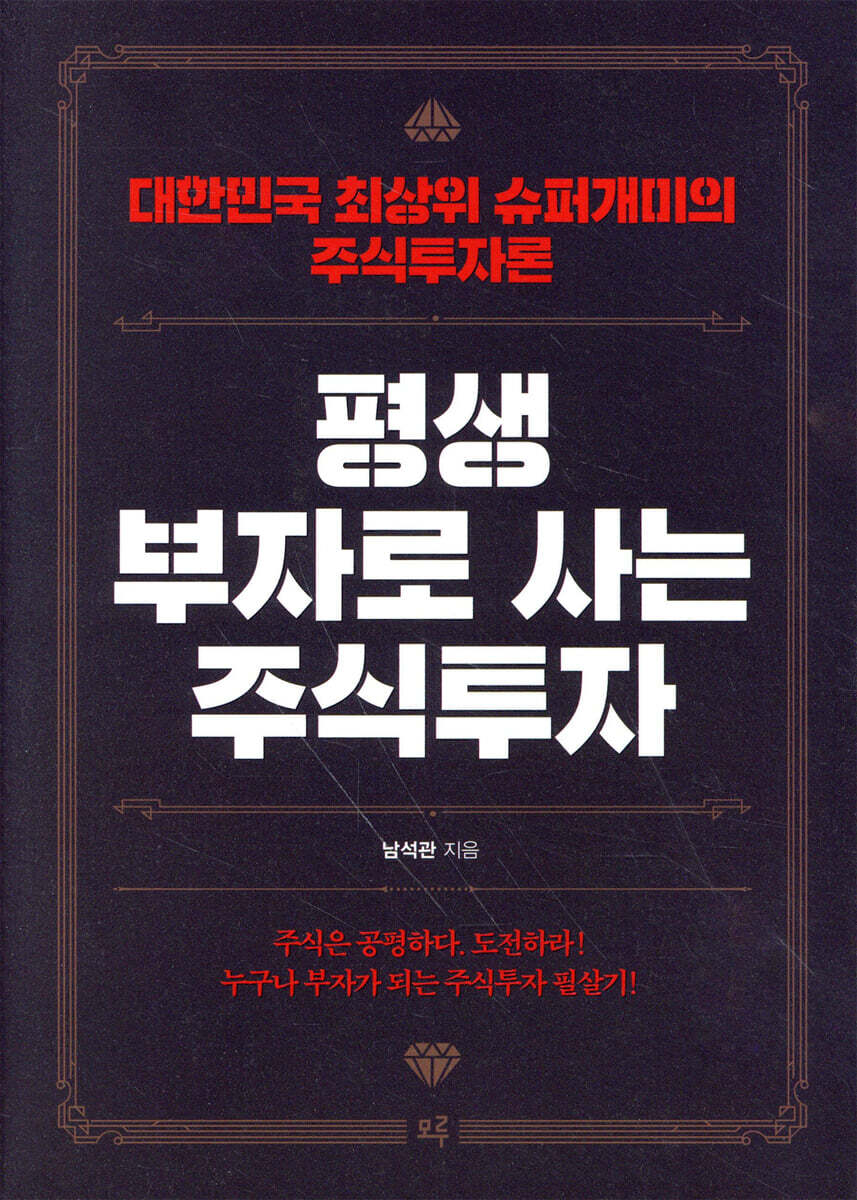
Stock investment to live a life of wealth
 |
Description
Book Introduction
Why You Should Heed the Advice of Stock Investing Experts The stock investment craze that began in 2020, despite the COVID-19 pandemic, ushered in an era where the KOSPI reached 3,000 points, a milestone that seemed far away, and the number of stock accounts reached 37 million. In the midst of all this, the entry of numerous novice investors, also known as 'ju-rin-i', into the stock market is also very welcome news. But on the other hand, concerns and worries come first. This is because there is a lot that investors need to know before investing in stocks. What message does author Nam Seok-kwan, one of Korea's unrivaled professional investment experts, want to convey to investors today? This book is [Stock Investment Theory] by Nam Seok-gwan, the 'legend of professional investment, super ant' who has lived as a full-time investor for 20 years and achieved unprecedented returns without losing a single year. Twenty years ago, the author started investing in stocks with a seed capital of 10 million won and multiplied his wealth thousands of times, joining the ranks of the wealthy. We need to look back on our stock investment habits through the author's "Profitable Stock Investment Know-How," also known as the "Super Ant." The author reveals his "secrets to stock investment success" in a comprehensive yet accessible format, not only for beginner investors just starting out in the stock market, but also for those with years of investment experience but who have yet to generate significant returns. While stock stories introduced by a few YouTube channels with hundreds of thousands of subscribers or advice and recommendations from self-proclaimed stock experts can be helpful for investment, the ultimate goal and outcome of stock investment is to generate profits. In our country, no professional stock investor has yet achieved such phenomenal and unprecedented returns as the author. Therefore, those of you who are interested in stock investment should pay attention to the author's "story of profitable stock investment." The author strongly emphasizes, "Anyone can become rich through stock investment, just like I did!" However, several conditions must be met. - Pay attention to the news and the mega trends that are driving the times! - Technical analysis, more important than financial statements, is having investment principles! - Make it a routine by repeatedly practicing two or more profitable models! - Become an investor who wins the battle with yourself, not the market! Now, I would like to share with you, my readers, the secrets of success of the super ant, who has achieved near-miraculous returns every year for 20 years as a full-time investor. And put the successful stock investment know-how revealed by our country's best professional investor into practice in your investments. I hope it applies. Of course, stock investing is not easy, but it is not as difficult as you might think. In the end, stock investment is difficult because you don't know, but easy when you do know! |
- You can preview some of the book's contents.
Preview
index
Introduction
Chapter 1: A World Where Crisis and Opportunity Coexist
01 The stock market is another world / 02 The emergence of the hidden danger of COVID-19 / 03 The desire for new things / 04 The platform that dominates daily life / 05 The fall of Exxon Mobil that ignored change / 06 The era of the new normal / 07 Crises that come from time to time / 08 Pandemics and syndemics / 09 The power to withstand crises, stock investment / 10 More diverse investment targets / 11 Special features of overseas stocks in ETFs / 12 Major ETF products in the US / 13 Stock investment in ordinary daily life / 14 The advantages and charm of stock investment / 15 Things to keep in mind when investing in stocks
Chapter 2: Stock Investment to Live Rich for Life
01 Stock investment that created economic independence / 02 People living with financial illiteracy / 03 Dreaming of becoming rich / 04 The power to achieve dreams, putting principles into practice / 05 10 million won in seed money / 06 The story of golden spoons and dirt spoons / 07 How to survive in the low interest rate era / 08 My thoughts on value stocks / 09 My own definition of blue chip stocks / 10 Undervalued blue chip stocks? / 11 About value stocks and growth stocks / 12 How to target theme stocks / 13 Theory of the four seasons of the stock market / 14 The relationship between the Korean and US stock markets / 15 The US Federal Reserve's monetary policy / 16 The secret to making profits, creating an investment strategy / 17 There is more than just one profit model
Chapter 3: Getting Rich Through Practical Stock Investment
01 Buy in advance when it's cheap, preemptive buying / 02 Utilizing time series analysis / 03 Sometimes, an appropriate bet is necessary / 04 Don't be afraid of information asymmetry / 05 'Delayed reaction effect of information' theory / 06 Investment using 'Delayed reaction effect of information' / 07 Relationship between the size of paper newspaper news and returns / 08 Have a flexible investment view, not a biased one / 09 Market-leading stocks in mid- to long-term investment and short-term investment / 10 Buying and selling in mid- to long-term investment / 11 Portfolio that yields large profits in mid- to long-term investment / 12 Risks of mid- to long-term investment / 13 Compounding effects that are difficult to expect from short-term investment / 14 Buying in short-term investment / 15 Short-term investment in a bull market / 17 Nicknamed 'Legend of professional investment' / 18 Reflecting on your own investment habits / 19 Full-time investors should have more than one profit model / 20 There is no need to trade stocks every day / 21 Go to A, not B To survive, secure cash! / 22 Achieving stock investment independence / 22 Last-chance investment theory / 23 Advice for working investors
Chapter 4: The Puzzle of Success Every Investor Needs to Know
01 People who hit the jackpot with stock investment and people who lost everything / 02 Stock investment and behavioral economics / 03 The trap of blind faith in investment experience / 04 'Investment routine' that brings in money / 05 The devil's whispers that shake investors / 06 A fight with yourself, not the market / 07 Introduction to risk / 08 Systematic risk / 09 Unsystematic risk / 10 When optimism overflows, it's the peak, when fear overwhelms, it's the bottom / 11 Risks to take when investing in stocks / 12 Portfolio composition / 13 Developing focus on money / 14 Account management for professional investors / 15 Continuous goal setting and mid-term checks / 16 Asset protection strategies and account diversification / 17 Seemingly ordinary, but special secrets / 18 My thoughts on money
Outgoing post
Chapter 1: A World Where Crisis and Opportunity Coexist
01 The stock market is another world / 02 The emergence of the hidden danger of COVID-19 / 03 The desire for new things / 04 The platform that dominates daily life / 05 The fall of Exxon Mobil that ignored change / 06 The era of the new normal / 07 Crises that come from time to time / 08 Pandemics and syndemics / 09 The power to withstand crises, stock investment / 10 More diverse investment targets / 11 Special features of overseas stocks in ETFs / 12 Major ETF products in the US / 13 Stock investment in ordinary daily life / 14 The advantages and charm of stock investment / 15 Things to keep in mind when investing in stocks
Chapter 2: Stock Investment to Live Rich for Life
01 Stock investment that created economic independence / 02 People living with financial illiteracy / 03 Dreaming of becoming rich / 04 The power to achieve dreams, putting principles into practice / 05 10 million won in seed money / 06 The story of golden spoons and dirt spoons / 07 How to survive in the low interest rate era / 08 My thoughts on value stocks / 09 My own definition of blue chip stocks / 10 Undervalued blue chip stocks? / 11 About value stocks and growth stocks / 12 How to target theme stocks / 13 Theory of the four seasons of the stock market / 14 The relationship between the Korean and US stock markets / 15 The US Federal Reserve's monetary policy / 16 The secret to making profits, creating an investment strategy / 17 There is more than just one profit model
Chapter 3: Getting Rich Through Practical Stock Investment
01 Buy in advance when it's cheap, preemptive buying / 02 Utilizing time series analysis / 03 Sometimes, an appropriate bet is necessary / 04 Don't be afraid of information asymmetry / 05 'Delayed reaction effect of information' theory / 06 Investment using 'Delayed reaction effect of information' / 07 Relationship between the size of paper newspaper news and returns / 08 Have a flexible investment view, not a biased one / 09 Market-leading stocks in mid- to long-term investment and short-term investment / 10 Buying and selling in mid- to long-term investment / 11 Portfolio that yields large profits in mid- to long-term investment / 12 Risks of mid- to long-term investment / 13 Compounding effects that are difficult to expect from short-term investment / 14 Buying in short-term investment / 15 Short-term investment in a bull market / 17 Nicknamed 'Legend of professional investment' / 18 Reflecting on your own investment habits / 19 Full-time investors should have more than one profit model / 20 There is no need to trade stocks every day / 21 Go to A, not B To survive, secure cash! / 22 Achieving stock investment independence / 22 Last-chance investment theory / 23 Advice for working investors
Chapter 4: The Puzzle of Success Every Investor Needs to Know
01 People who hit the jackpot with stock investment and people who lost everything / 02 Stock investment and behavioral economics / 03 The trap of blind faith in investment experience / 04 'Investment routine' that brings in money / 05 The devil's whispers that shake investors / 06 A fight with yourself, not the market / 07 Introduction to risk / 08 Systematic risk / 09 Unsystematic risk / 10 When optimism overflows, it's the peak, when fear overwhelms, it's the bottom / 11 Risks to take when investing in stocks / 12 Portfolio composition / 13 Developing focus on money / 14 Account management for professional investors / 15 Continuous goal setting and mid-term checks / 16 Asset protection strategies and account diversification / 17 Seemingly ordinary, but special secrets / 18 My thoughts on money
Outgoing post
Into the book
Let's go back to the story of Naver and Kakao.
The reason these companies are called platform companies representing our country is because countless people flock to the spaces created by Naver and Kakao.
People create new cultures in that virtual space, and sometimes even create added value that exceeds expectations.
If you are a seller, you should sell your goods in a place where many people gather to sell more.
For consumers, the more variety of items they want to buy, the wider the range of rational purchasing choices they have.
This supply and demand are balancing within the new platform market, and in response, the proliferation of platforms is growing day by day.
Especially as we enter the IT era, the influence of platforms is increasingly expanding.
We live in a world dominated by platforms, to the point where it's difficult to conduct economic and social activities without going through platforms like Naver, Kakao, Google, and Amazon.
--- Page 32, from 'Platforms that Rule Everyday Life'
Whether you make a profit or a loss, you should think of your initial stock investment experience as a lesson in the basics.
Sometimes you may make a profit, and sometimes you may experience a loss, but you should not be overjoyed or depressed by the results, but rather take them as an experience.
A relaxed attitude and psychological stability are also essential virtues for stock investors.
And as I've emphasized before, it's also important to look at how the world will change and what companies or trends are currently leading the world.
And there is one more important thing.
If you are currently investing in stocks, even if you are only trading one stock, you should not blindly and thoughtlessly follow what others say.
Whether it's a lot or a little, it's right to invest hard-earned money and protect it, and to make decisions based solely on my own judgment.
Can you really trust the information someone gives you? Most stories like, "Invest in this or that stock because it's good," are close to empty.
Especially for professional investors, it is necessary to have a fierce mindset, as if you are practically risking your life when investing.
The family may be in financial difficulty
It's a desperate state of mind.
--- Page 42, from 'The New Normal Era'
The life of a modern person living with financial illiteracy is the worst.
It might be understandable for someone who doesn't know anything about stocks, but there are some stock investors who are financially illiterate.
I am not talking about the impact of interest rates, exchange rates, or sensitive financial policies on the stock market.
Surprisingly, they don't even know how much they have invested in which stocks, and they are indifferent to calculating the returns on the money invested in the fund.
Some of my acquaintances are upset because they put money into a fund, forgot about it, and then liquidated it after suffering a loss of -40%.
Some people, though few, say they don't even know where or how much of their money is, and these cases are examples of poor money management that can be considered financial illiteracy.
--- Page 82, from 'People Living with Financial Illiteracy'
Stock investors have many options.
People broadly divide investments into mid- to long-term and short-term investments.
Especially in the case of short-term investments, you should consider that the money invested during the investment period is not strictly your own money.
If you have made a profit from a short-term investment, it becomes your real money only when you stop investing for a while and cash it out and hold it in your hand.
To make money not only in short-term but also in mid- to long-term investments, I check every time I make a profit, take a break for a while, and then reinvest.
In my case, the overall investment amount has increased, so I manage some of the money for mid- to long-term investments and some for short-term investments.
For accounts that I consider my own money, I invest primarily in absolutely safe stocks. Although the rate of return is slow, I consider this account my own because it shows stable results regardless of market conditions.
As I disclosed my profitable account a few years ago, many of you may know that the account started with 200 million won and grew to over 2 billion won in 3-4 years, and now it is well over 3 billion won.
These accounts prioritize stability, so their yields tend to be lower, but even so, they are nothing compared to the interest rates paid by banks these days.
--- Pages 95-96, from 'How to Invest My Real Money'
"Is Samsung Electronics stock a blue chip?" I have two answers to this question.
'It's a blue chip stock.'
'It's not a blue chip stock.'
If you think about it from a common sense perspective, Samsung Electronics stock is obviously a blue chip stock.
However, if we truly want to call Samsung Electronics stock a blue chip, we should do so after experiencing subjective earnings rather than relying on common sense.
If I bought Samsung Electronics stock at 100,000 won and sold it at 80,000 won at a loss, can I truly say that the stock is a good investment? No matter how good the company's size, performance, or dividends, if I invested in it and suffered losses, it's definitely not a good investment from an investor's perspective.
In reality, stocks that provide profits to investors are considered blue chip stocks.
To be a good stock for investors, it must not incur losses and provide stable profits.
That is the standard of excellence.
--- Pages 107-108, from 'My own definition of blue chip stocks'
In fact, for several years now, funds and investors pursuing traditional value investing have been receiving investment reports that either underperformed the market or fell far short of expectations.
That doesn't mean you should invest in just any stock.
Investing in stocks that are overvalued compared to their corporate value carries risks, so value investing is the practice. However, this means that there are limitations to determining the value of a stock solely based on PER or PBR.
I think it is problematic to use the same valuation method from the 'analog era' in the 'digital era' when evaluating corporate value.
Traditional value investing, which focuses on financial statements, fails to capture the value of intangible assets such as a company's intellectual property rights, brand value, management premium, and future growth potential.
I hope that in the future, ordinary individual investors will be free from the burden of pouring their heart and soul into finding undervalued stocks.
Analyzing a company's fair value and identifying undervalued companies is actually the job of securities analysts.
--- Page 111, from 'Undervalued Blue Chip Stocks'
There are two criteria for the United States to raise interest rates.
One is the inflation rate, and the other is the employment index.
Interest rates are adjusted based on these two factors, and sometimes a friend of mine asks me, "Is it okay to invest in dollars?"
From the American perspective, if you were the President of the United States, I would ask you whether you would prefer the dollar to be expensive or cheap.
From the US perspective, if the dollar is expensive, exports will become difficult, so naturally, the value of the dollar will fall as a policy.
In this way, fluctuations in the dollar price are closely related to all imported and exported goods.
It may seem like it has nothing to do with us, but the global economy is interconnected and dominates every aspect of our lives.
Investing in stocks requires a lot of study, whether you want it or not.
There is absolutely no reason to be complacent or happy about buying a stock that looks good at a pretty good price.
Whether it was luck or skill, if you've made a profit from stock investing, it's natural to want to do better.
So, I look for various news and, as mentioned above, I also look into the US stock market, which I would not normally pay attention to.
--- Page 130, 'The Federal Reserve's Monetary Policy
Time series analysis is closely related to preemptive buying.
Therefore, I would like to clarify in advance that I have borrowed the term time series analysis to easily explain preemptive buying.
In real-world investing, it would be helpful to understand this as the idea of predicting the ripple effects that will unfold over time when an event or situation occurs and purchasing stocks that match that prediction in advance.
The COVID-19 pandemic, which is still plaguing us, can be summarized as follows.
At the beginning of the COVID-19 crisis, in the early stages of the disease outbreak, no one could have predicted that the disease would spread globally.
In the stock market, stocks related to masks, where demand has increased rapidly, showed a brief upward trend.
However, as time passed and the situation deteriorated into a pandemic requiring an international response, stocks related to diagnostic kits for diagnosing COVID-19 showed a significant increase of around 10 times.
If we can predict the impact of such an event in advance, we can reap huge profits.
Of course, there may be limits to an individual's ability or range of predictions to predict the outcome of such events.
Another example is the issue of technological development in the ICT field.
We've been hearing about electric cars for a long time.
However, stock prices of companies such as Samsung SDI and LG Chem have risen significantly as of November 2020, and their stock prices continue to hit all-time highs.
--- Pages 150-151, from 'Using Time Series Analysis'
There are plenty of opportunities to profit from stocks that have surged due to news or issues, even after they have undergone a subsequent correction (decline).
It is about making a profit by buying after a sharp rise and adjustment, taking advantage of information that has already passed.
This is also one of the strategies that people are not familiar with.
Most regular investors believe they are always out of information, but I think that's a stereotype.
Even at this time, many investors are eager to find advanced information that only they know about.
I believe that knowing this information will lead to success in stock investing.
But let's think about it carefully.
There is no reason for me to receive high-level information that no one else knows about, and the likelihood of that happening is low.
A sound and realistic way of thinking is to make a profit by faithfully and appropriately utilizing past and open information.
I'd like you to look back and see if any of the so-called advanced information was ever really helpful.
Most, if not all, of the so-called advanced information would have been false.
If you want to make rational investments, you must not be fooled by false information hidden behind the name of advanced information.
--- Page 157, from 'Don't be afraid of information asymmetry'
The theory that refutes the efficient market hypothesis is the 'delayed reaction effect of information.'
A typical example is the 'delayed reaction of stock prices to earnings announcements.'
The 'delayed reaction effect of stock prices to earnings announcements' refers to 'the phenomenon in which the stock prices of companies that announce earnings higher than market expectations drift upward for a considerable period after the announcement, recording accumulated excess returns.'
Let's say a company records an unexpected earnings surprise.
In this case, according to the efficient market hypothesis, this information should be immediately reflected in prices.
But that's not the case in the real stock market.
On the day that earnings surprise news is announced, we can see many companies whose stock prices continue to rise even after the initial rise.
This also applies to good news announcements.
--- Pages 160-161, from 'Theory of Information Delayed Reaction Effect'
Hanjin Shipping faded into history! While times change and new beneficiaries emerge, like contactless services, some industries, like shipping, struggle to navigate the turbulent times.
Therefore, it is appropriate to invest in stocks by thoroughly examining the trends of the new era through objective information.
However, investors participating in the stock market are slow to accept new things, and even when the index rises, they may suffer large losses.
In behavioral economics, this is called "conservatism bias," meaning that investors are reluctant to change their thoughts and beliefs and do not respond quickly to new trends.
In behavioral economics, stereotypes are a phenomenon in which people distort information by being caught up in the initial idea they had when setting a reference point.
In terms of stocks, the purchase price becomes the reference point.
--- Page 243, from 'The Trap of Blind Faith in Investment Experience'
When the investment amount is small, approaching it with too long-term investment concepts can slow down the growth of your money.
If you are investing with a small amount of money, you should first invest in a direction with a high probability of your money growing quickly.
First, money must be collected.
One of the most common questions I hear from investors is:
I have won awards in real investment competitions more than five times.
People are curious about which stocks I bought and made a profit from.
Whenever I get asked this question, I tell myself that I've rarely bought more than two stocks with a 100 million won investment.
So, it is a strategy to select one or two stocks that seem promising and invest heavily in them to achieve results.
This strategy has clear pros and cons.
The advantage is that you can maximize your profits or benefit from compound interest by not investing in too many stocks.
However, the downside is that it is risky.
Since you only buy one or two stocks, you could easily suffer a huge loss.
The reason these companies are called platform companies representing our country is because countless people flock to the spaces created by Naver and Kakao.
People create new cultures in that virtual space, and sometimes even create added value that exceeds expectations.
If you are a seller, you should sell your goods in a place where many people gather to sell more.
For consumers, the more variety of items they want to buy, the wider the range of rational purchasing choices they have.
This supply and demand are balancing within the new platform market, and in response, the proliferation of platforms is growing day by day.
Especially as we enter the IT era, the influence of platforms is increasingly expanding.
We live in a world dominated by platforms, to the point where it's difficult to conduct economic and social activities without going through platforms like Naver, Kakao, Google, and Amazon.
--- Page 32, from 'Platforms that Rule Everyday Life'
Whether you make a profit or a loss, you should think of your initial stock investment experience as a lesson in the basics.
Sometimes you may make a profit, and sometimes you may experience a loss, but you should not be overjoyed or depressed by the results, but rather take them as an experience.
A relaxed attitude and psychological stability are also essential virtues for stock investors.
And as I've emphasized before, it's also important to look at how the world will change and what companies or trends are currently leading the world.
And there is one more important thing.
If you are currently investing in stocks, even if you are only trading one stock, you should not blindly and thoughtlessly follow what others say.
Whether it's a lot or a little, it's right to invest hard-earned money and protect it, and to make decisions based solely on my own judgment.
Can you really trust the information someone gives you? Most stories like, "Invest in this or that stock because it's good," are close to empty.
Especially for professional investors, it is necessary to have a fierce mindset, as if you are practically risking your life when investing.
The family may be in financial difficulty
It's a desperate state of mind.
--- Page 42, from 'The New Normal Era'
The life of a modern person living with financial illiteracy is the worst.
It might be understandable for someone who doesn't know anything about stocks, but there are some stock investors who are financially illiterate.
I am not talking about the impact of interest rates, exchange rates, or sensitive financial policies on the stock market.
Surprisingly, they don't even know how much they have invested in which stocks, and they are indifferent to calculating the returns on the money invested in the fund.
Some of my acquaintances are upset because they put money into a fund, forgot about it, and then liquidated it after suffering a loss of -40%.
Some people, though few, say they don't even know where or how much of their money is, and these cases are examples of poor money management that can be considered financial illiteracy.
--- Page 82, from 'People Living with Financial Illiteracy'
Stock investors have many options.
People broadly divide investments into mid- to long-term and short-term investments.
Especially in the case of short-term investments, you should consider that the money invested during the investment period is not strictly your own money.
If you have made a profit from a short-term investment, it becomes your real money only when you stop investing for a while and cash it out and hold it in your hand.
To make money not only in short-term but also in mid- to long-term investments, I check every time I make a profit, take a break for a while, and then reinvest.
In my case, the overall investment amount has increased, so I manage some of the money for mid- to long-term investments and some for short-term investments.
For accounts that I consider my own money, I invest primarily in absolutely safe stocks. Although the rate of return is slow, I consider this account my own because it shows stable results regardless of market conditions.
As I disclosed my profitable account a few years ago, many of you may know that the account started with 200 million won and grew to over 2 billion won in 3-4 years, and now it is well over 3 billion won.
These accounts prioritize stability, so their yields tend to be lower, but even so, they are nothing compared to the interest rates paid by banks these days.
--- Pages 95-96, from 'How to Invest My Real Money'
"Is Samsung Electronics stock a blue chip?" I have two answers to this question.
'It's a blue chip stock.'
'It's not a blue chip stock.'
If you think about it from a common sense perspective, Samsung Electronics stock is obviously a blue chip stock.
However, if we truly want to call Samsung Electronics stock a blue chip, we should do so after experiencing subjective earnings rather than relying on common sense.
If I bought Samsung Electronics stock at 100,000 won and sold it at 80,000 won at a loss, can I truly say that the stock is a good investment? No matter how good the company's size, performance, or dividends, if I invested in it and suffered losses, it's definitely not a good investment from an investor's perspective.
In reality, stocks that provide profits to investors are considered blue chip stocks.
To be a good stock for investors, it must not incur losses and provide stable profits.
That is the standard of excellence.
--- Pages 107-108, from 'My own definition of blue chip stocks'
In fact, for several years now, funds and investors pursuing traditional value investing have been receiving investment reports that either underperformed the market or fell far short of expectations.
That doesn't mean you should invest in just any stock.
Investing in stocks that are overvalued compared to their corporate value carries risks, so value investing is the practice. However, this means that there are limitations to determining the value of a stock solely based on PER or PBR.
I think it is problematic to use the same valuation method from the 'analog era' in the 'digital era' when evaluating corporate value.
Traditional value investing, which focuses on financial statements, fails to capture the value of intangible assets such as a company's intellectual property rights, brand value, management premium, and future growth potential.
I hope that in the future, ordinary individual investors will be free from the burden of pouring their heart and soul into finding undervalued stocks.
Analyzing a company's fair value and identifying undervalued companies is actually the job of securities analysts.
--- Page 111, from 'Undervalued Blue Chip Stocks'
There are two criteria for the United States to raise interest rates.
One is the inflation rate, and the other is the employment index.
Interest rates are adjusted based on these two factors, and sometimes a friend of mine asks me, "Is it okay to invest in dollars?"
From the American perspective, if you were the President of the United States, I would ask you whether you would prefer the dollar to be expensive or cheap.
From the US perspective, if the dollar is expensive, exports will become difficult, so naturally, the value of the dollar will fall as a policy.
In this way, fluctuations in the dollar price are closely related to all imported and exported goods.
It may seem like it has nothing to do with us, but the global economy is interconnected and dominates every aspect of our lives.
Investing in stocks requires a lot of study, whether you want it or not.
There is absolutely no reason to be complacent or happy about buying a stock that looks good at a pretty good price.
Whether it was luck or skill, if you've made a profit from stock investing, it's natural to want to do better.
So, I look for various news and, as mentioned above, I also look into the US stock market, which I would not normally pay attention to.
--- Page 130, 'The Federal Reserve's Monetary Policy
Time series analysis is closely related to preemptive buying.
Therefore, I would like to clarify in advance that I have borrowed the term time series analysis to easily explain preemptive buying.
In real-world investing, it would be helpful to understand this as the idea of predicting the ripple effects that will unfold over time when an event or situation occurs and purchasing stocks that match that prediction in advance.
The COVID-19 pandemic, which is still plaguing us, can be summarized as follows.
At the beginning of the COVID-19 crisis, in the early stages of the disease outbreak, no one could have predicted that the disease would spread globally.
In the stock market, stocks related to masks, where demand has increased rapidly, showed a brief upward trend.
However, as time passed and the situation deteriorated into a pandemic requiring an international response, stocks related to diagnostic kits for diagnosing COVID-19 showed a significant increase of around 10 times.
If we can predict the impact of such an event in advance, we can reap huge profits.
Of course, there may be limits to an individual's ability or range of predictions to predict the outcome of such events.
Another example is the issue of technological development in the ICT field.
We've been hearing about electric cars for a long time.
However, stock prices of companies such as Samsung SDI and LG Chem have risen significantly as of November 2020, and their stock prices continue to hit all-time highs.
--- Pages 150-151, from 'Using Time Series Analysis'
There are plenty of opportunities to profit from stocks that have surged due to news or issues, even after they have undergone a subsequent correction (decline).
It is about making a profit by buying after a sharp rise and adjustment, taking advantage of information that has already passed.
This is also one of the strategies that people are not familiar with.
Most regular investors believe they are always out of information, but I think that's a stereotype.
Even at this time, many investors are eager to find advanced information that only they know about.
I believe that knowing this information will lead to success in stock investing.
But let's think about it carefully.
There is no reason for me to receive high-level information that no one else knows about, and the likelihood of that happening is low.
A sound and realistic way of thinking is to make a profit by faithfully and appropriately utilizing past and open information.
I'd like you to look back and see if any of the so-called advanced information was ever really helpful.
Most, if not all, of the so-called advanced information would have been false.
If you want to make rational investments, you must not be fooled by false information hidden behind the name of advanced information.
--- Page 157, from 'Don't be afraid of information asymmetry'
The theory that refutes the efficient market hypothesis is the 'delayed reaction effect of information.'
A typical example is the 'delayed reaction of stock prices to earnings announcements.'
The 'delayed reaction effect of stock prices to earnings announcements' refers to 'the phenomenon in which the stock prices of companies that announce earnings higher than market expectations drift upward for a considerable period after the announcement, recording accumulated excess returns.'
Let's say a company records an unexpected earnings surprise.
In this case, according to the efficient market hypothesis, this information should be immediately reflected in prices.
But that's not the case in the real stock market.
On the day that earnings surprise news is announced, we can see many companies whose stock prices continue to rise even after the initial rise.
This also applies to good news announcements.
--- Pages 160-161, from 'Theory of Information Delayed Reaction Effect'
Hanjin Shipping faded into history! While times change and new beneficiaries emerge, like contactless services, some industries, like shipping, struggle to navigate the turbulent times.
Therefore, it is appropriate to invest in stocks by thoroughly examining the trends of the new era through objective information.
However, investors participating in the stock market are slow to accept new things, and even when the index rises, they may suffer large losses.
In behavioral economics, this is called "conservatism bias," meaning that investors are reluctant to change their thoughts and beliefs and do not respond quickly to new trends.
In behavioral economics, stereotypes are a phenomenon in which people distort information by being caught up in the initial idea they had when setting a reference point.
In terms of stocks, the purchase price becomes the reference point.
--- Page 243, from 'The Trap of Blind Faith in Investment Experience'
When the investment amount is small, approaching it with too long-term investment concepts can slow down the growth of your money.
If you are investing with a small amount of money, you should first invest in a direction with a high probability of your money growing quickly.
First, money must be collected.
One of the most common questions I hear from investors is:
I have won awards in real investment competitions more than five times.
People are curious about which stocks I bought and made a profit from.
Whenever I get asked this question, I tell myself that I've rarely bought more than two stocks with a 100 million won investment.
So, it is a strategy to select one or two stocks that seem promising and invest heavily in them to achieve results.
This strategy has clear pros and cons.
The advantage is that you can maximize your profits or benefit from compound interest by not investing in too many stocks.
However, the downside is that it is risky.
Since you only buy one or two stocks, you could easily suffer a huge loss.
--- Page 279, from 'Building Focus on Money'
Publisher's Review
What is the reason and background for publicly disclosing your earnings, and what are your unique investment secrets?
Author Nam Seok-kwan says the thing he's most confident about in the world is stock investing! A few years ago, he became the first Korean "super ant" to reveal his stock account profits through a broadcast and book, leaving people jaw-dropping.
For example, it is common for him to earn profits of 2 billion won after 3 years and 3 billion won after 5 years with an investment of 100 million won.
Indeed, he deserves to be called the 'legend of professional investment.'
Why did the author reveal some of his profits to the public? And does he really have some special investment secrets that no one else knows?
“There are many people who have made a lot of money through stock investment.
But it's hard to find someone who actually made a profit.
Most people just brag about making a lot of money.
I remember the warm, hopeful eyes of those who listened to my stories during lectures and broadcasts, taking notes.
This is the first time I've made my account public to give people who are listening to my story some confidence.
I wanted to motivate people to invest in stocks not just by talking, but by showing them the profits I have actually earned through my own efforts.
I wanted to show that anyone can become rich through stock investment like me if they study hard and put in the effort.”
“Also, many people ask me about special stock investment secrets or techniques. It’s not really a special secret, but if I had to say something, it’s this.
It's really important to carefully analyze and observe the companies that lead the stock market and the trends that drive social change.
In my experience, profit opportunities come into view when you study like that.
It's important to remember that even during the COVID-19 pandemic, which has been a difficult time for everyone, "untact-related stocks" have made a lot of money.
Unlike in the past, the stock market now operates within a rational and common-sense framework.
In a rational market, irrational investment behaviors will not work.
“My secret to investing is having principles and putting them into practice.”
The era of Young-Geul Investment, the Donghak Ant craze, and 37 million stock accounts!
Investing through savings accounts with low interest rates or real estate with strict regulations and large amounts of money is unrealistic.
In that case, the hidden card for financial investment that remains for us is stock investment.
Investments that draw out even the soul, the Donghak ants who stand against the massive capital of institutions and foreigners, and the countless investors of all ages and genders flowing into the stock market provide vitality to the stock market.
However, I am concerned that there are still many irrational investment behaviors that are closer to speculation than sound investment, and that seek to make a fortune overnight instead of rational and reasonable investment.
What are Super Ant's thoughts on this and his opinion on stock investment?
“It’s a world where it’s getting harder and harder to make money as the years go by.
Considering the reality that we can't survive a single day without money, we need to find new ways to make money.
I have been investing in stocks for a long time.
Since I've made a lot of money from this, I think stock investing is a pretty good alternative.
Based on my experience alone, I believe that it is possible to become rich through stock investment.
Of course, it is common in the stock market to deceive investors with false information and sweet words.
In particular, when internal and external circumstances arise that investors cannot control, investment sentiment may be shaken.
Sometimes, you have to learn to console yourself when you're fighting a lonely battle, unable to make important buy or sell decisions.
As a professional investor, you must overcome the many challenges that face you on your own.
It's a lonely fight.
But even with these difficulties, stock investing is still quite attractive.
Of course, your chances of success increase when you create your own investment principles, stick to them, and learn to discipline yourself.”
What investment know-how would you like to share with existing investors, including 'Joo-rin-i'?
The purpose of people investing in stocks is to make money by reaping profits.
A large income can help you achieve financial independence.
For stock investment to be an attractive investment vehicle, it must generate consistent returns regardless of market conditions.
The author has invested in stocks for 20 years, reaping incredible profits every year, and reveals the fundamental principles and know-how of stock investment that he has discovered on his own.
“The story I want to tell through this book is, in a word, ‘the nature of stock investment.’
You need to understand the nature and characteristics of stock investment to be able to plan and prepare.
But if you think about it, there isn't much difference between what I taught 10 years ago and what I'm talking about now.
The essence of stock investment—making investment decisions after determining when to buy or sell stocks with promising future prospects—remains the same today as it was then.
The so-called "special techniques or strategies that others don't know" that people emphasize on various broadcasts are actually just information that anyone can easily obtain.
So, all that's left is 'study'! In particular, studying the world's trends is the only way to survive in the stock market."
“Also, as I mentioned before, instead of revealing my investment secrets or techniques that others don’t know, I honestly revealed in the book my various profitable experiences.
In fact, even if I wanted to write about some secret investment method, there is no such thing, so there is nothing to write about.
Of course, it can be made up as a lie.
But I don't want to do that.
Because plausible lies are quickly exposed, and unremarkable truths last a long time.
However, we must carefully observe the changes in the world, boldly cut out bad investment habits, and systematize (routine) profitable experiences by repeating them.
Also, stock investment maximizes profits when it is shifted from short-term to mid- to long-term investment.
Unfortunately, most people who leave the stock market after investing only in short-term investments lose money and give up.
Of course, you can't avoid short-term trading in the early stages of stock investing, but you need a strategy to make profits and hold on until you move on to mid- to long-term investing.
The book includes this as well:
If you start by learning well and make a full-time career out of stock investment, you can live a life of financial freedom.
“Also, the lack of retirement is one of the charms of full-time investing.”
The author, who has been investing in stocks for 35 years, reveals the essence and properties of stocks in this book without reservation.
Also, stock books are usually full of complicated graphs and formulas, but this book excludes these as much as possible and introduces the 'essence and properties of stock investment that can make anyone rich' in an easy-to-understand way.
A legendary professional investor who built a fortune starting with just 10 million won! Contrary to expectations, he achieved this through sensible and rational investing, constant study of finance and economics, constant adherence to investment principles, and intense self-management.
It's easy to see why so many people recognize and respect him as a model individual investor.
If you're curious about the author's [Stock Investment Theory], which enabled him to generate unprecedented profits, you'll find the answer in this book.
Author Nam Seok-kwan says the thing he's most confident about in the world is stock investing! A few years ago, he became the first Korean "super ant" to reveal his stock account profits through a broadcast and book, leaving people jaw-dropping.
For example, it is common for him to earn profits of 2 billion won after 3 years and 3 billion won after 5 years with an investment of 100 million won.
Indeed, he deserves to be called the 'legend of professional investment.'
Why did the author reveal some of his profits to the public? And does he really have some special investment secrets that no one else knows?
“There are many people who have made a lot of money through stock investment.
But it's hard to find someone who actually made a profit.
Most people just brag about making a lot of money.
I remember the warm, hopeful eyes of those who listened to my stories during lectures and broadcasts, taking notes.
This is the first time I've made my account public to give people who are listening to my story some confidence.
I wanted to motivate people to invest in stocks not just by talking, but by showing them the profits I have actually earned through my own efforts.
I wanted to show that anyone can become rich through stock investment like me if they study hard and put in the effort.”
“Also, many people ask me about special stock investment secrets or techniques. It’s not really a special secret, but if I had to say something, it’s this.
It's really important to carefully analyze and observe the companies that lead the stock market and the trends that drive social change.
In my experience, profit opportunities come into view when you study like that.
It's important to remember that even during the COVID-19 pandemic, which has been a difficult time for everyone, "untact-related stocks" have made a lot of money.
Unlike in the past, the stock market now operates within a rational and common-sense framework.
In a rational market, irrational investment behaviors will not work.
“My secret to investing is having principles and putting them into practice.”
The era of Young-Geul Investment, the Donghak Ant craze, and 37 million stock accounts!
Investing through savings accounts with low interest rates or real estate with strict regulations and large amounts of money is unrealistic.
In that case, the hidden card for financial investment that remains for us is stock investment.
Investments that draw out even the soul, the Donghak ants who stand against the massive capital of institutions and foreigners, and the countless investors of all ages and genders flowing into the stock market provide vitality to the stock market.
However, I am concerned that there are still many irrational investment behaviors that are closer to speculation than sound investment, and that seek to make a fortune overnight instead of rational and reasonable investment.
What are Super Ant's thoughts on this and his opinion on stock investment?
“It’s a world where it’s getting harder and harder to make money as the years go by.
Considering the reality that we can't survive a single day without money, we need to find new ways to make money.
I have been investing in stocks for a long time.
Since I've made a lot of money from this, I think stock investing is a pretty good alternative.
Based on my experience alone, I believe that it is possible to become rich through stock investment.
Of course, it is common in the stock market to deceive investors with false information and sweet words.
In particular, when internal and external circumstances arise that investors cannot control, investment sentiment may be shaken.
Sometimes, you have to learn to console yourself when you're fighting a lonely battle, unable to make important buy or sell decisions.
As a professional investor, you must overcome the many challenges that face you on your own.
It's a lonely fight.
But even with these difficulties, stock investing is still quite attractive.
Of course, your chances of success increase when you create your own investment principles, stick to them, and learn to discipline yourself.”
What investment know-how would you like to share with existing investors, including 'Joo-rin-i'?
The purpose of people investing in stocks is to make money by reaping profits.
A large income can help you achieve financial independence.
For stock investment to be an attractive investment vehicle, it must generate consistent returns regardless of market conditions.
The author has invested in stocks for 20 years, reaping incredible profits every year, and reveals the fundamental principles and know-how of stock investment that he has discovered on his own.
“The story I want to tell through this book is, in a word, ‘the nature of stock investment.’
You need to understand the nature and characteristics of stock investment to be able to plan and prepare.
But if you think about it, there isn't much difference between what I taught 10 years ago and what I'm talking about now.
The essence of stock investment—making investment decisions after determining when to buy or sell stocks with promising future prospects—remains the same today as it was then.
The so-called "special techniques or strategies that others don't know" that people emphasize on various broadcasts are actually just information that anyone can easily obtain.
So, all that's left is 'study'! In particular, studying the world's trends is the only way to survive in the stock market."
“Also, as I mentioned before, instead of revealing my investment secrets or techniques that others don’t know, I honestly revealed in the book my various profitable experiences.
In fact, even if I wanted to write about some secret investment method, there is no such thing, so there is nothing to write about.
Of course, it can be made up as a lie.
But I don't want to do that.
Because plausible lies are quickly exposed, and unremarkable truths last a long time.
However, we must carefully observe the changes in the world, boldly cut out bad investment habits, and systematize (routine) profitable experiences by repeating them.
Also, stock investment maximizes profits when it is shifted from short-term to mid- to long-term investment.
Unfortunately, most people who leave the stock market after investing only in short-term investments lose money and give up.
Of course, you can't avoid short-term trading in the early stages of stock investing, but you need a strategy to make profits and hold on until you move on to mid- to long-term investing.
The book includes this as well:
If you start by learning well and make a full-time career out of stock investment, you can live a life of financial freedom.
“Also, the lack of retirement is one of the charms of full-time investing.”
The author, who has been investing in stocks for 35 years, reveals the essence and properties of stocks in this book without reservation.
Also, stock books are usually full of complicated graphs and formulas, but this book excludes these as much as possible and introduces the 'essence and properties of stock investment that can make anyone rich' in an easy-to-understand way.
A legendary professional investor who built a fortune starting with just 10 million won! Contrary to expectations, he achieved this through sensible and rational investing, constant study of finance and economics, constant adherence to investment principles, and intense self-management.
It's easy to see why so many people recognize and respect him as a model individual investor.
If you're curious about the author's [Stock Investment Theory], which enabled him to generate unprecedented profits, you'll find the answer in this book.
GOODS SPECIFICS
- Publication date: January 20, 2021
- Page count, weight, size: 300 pages | 532g | 153*215*20mm
- ISBN13: 9791197001918
- ISBN10: 1197001913
You may also like
카테고리
korean


korean

![GQ KOREA Mark (Monthly): December [2025]](http://librairie.coreenne.fr/cdn/shop/files/8ef265dbbfbf186523ed75ba7319009d.jpg?v=1765340328&width=3840)


