

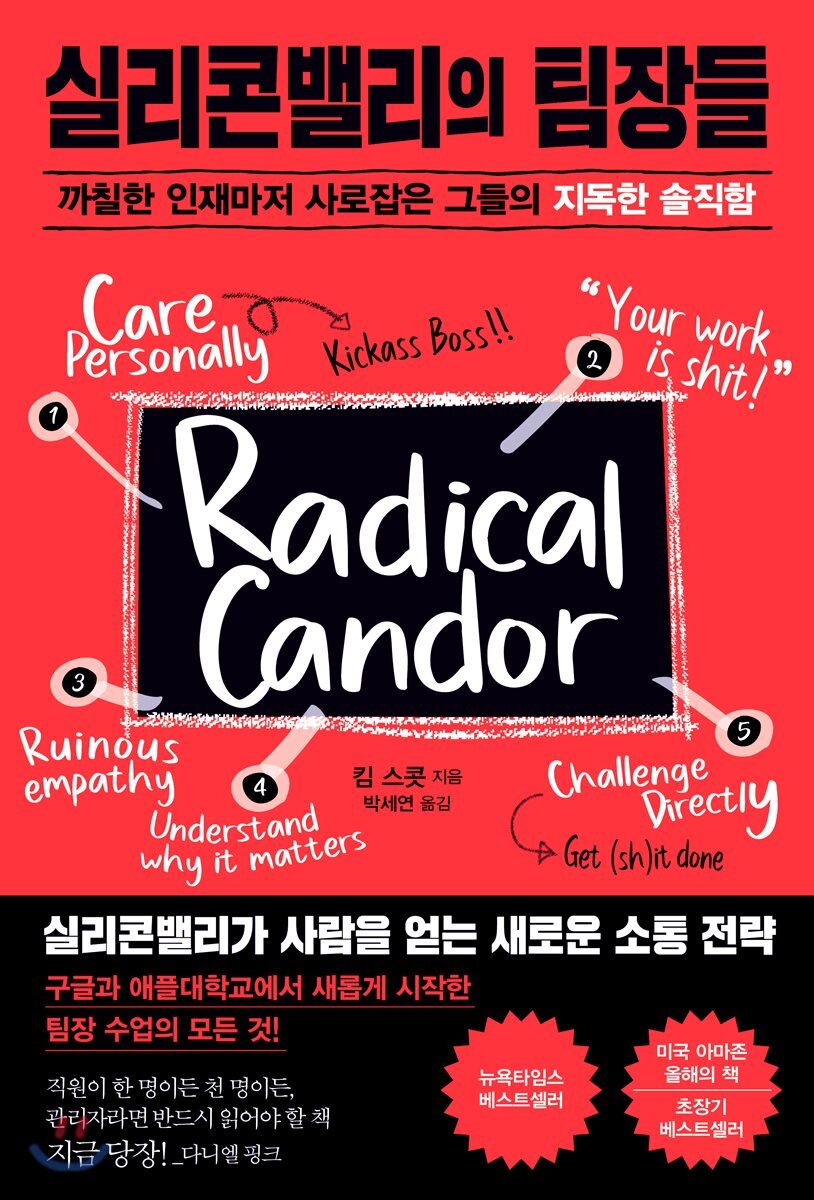
Team leaders in Silicon Valley
 |
Description
Book Introduction
- A word from MD
-
Honesty speaks volumes to the new generation.Team leaders in Silicon Valley who welcome team members born in the 1990s are currently studying new communication strategies.
The workplace human relations theory they focused on was "complete honesty!" It suggests ways to build honest relationships, resolve conflicts, and achieve success in various situations, from hiring and firing to performance-based compensation.
June 11, 2019. Economics and Management PD Park Jeong-yoon
Silicon Valley's New Communication Strategy for Reaching People
Silicon Valley is a great place to study the relationship between team leaders and their teams because of the fierce competition for talent.
Silicon Valley talent can leave at any time if they feel dissatisfied or if they feel their potential is being wasted.
If you don't like your team leader, just quit.
Still, many companies are lining up to hire him.
For this reason, Silicon Valley companies face real pressure to build good relationships between team leaders and their team members.
Just because it's Silicon Valley doesn't mean the scope of relationships is particularly broad.
Even Google founder Larry Page can't connect with more people on a deeper level than we can.
However, the type of relationship that managers have with their managers has a significant impact on the relationships that managers have with their employees, which has a huge impact on Google's performance.
These ripple effects create or destroy positive organizational culture.
Even if relationships don't expand, culture does.
This book corrects our prejudices about 'relationships'.
Because the key to being a great team leader, whether at Apple or anywhere on Earth, is good relationships.
And the term that best describes the essence of relationships is the original title of this book, 'Radical Candor.'
This book is divided into two parts. In Part 1, the author, who has led several organizations including Google and Apple, explains the core concepts he has learned from 25 years of experience.
Being a great team leader is hard work for everyone.
Even those who have achieved seemingly amazing success are no exception.
Readers will find comfort in recalling their own experiences through the author's case studies presented in Part 1.
Part 2 is a practical guide on relationships, advice, teams, and performance, exploring several tools and techniques to immediately implement the ideas in Part 1.
We'll cover everything from how to conduct one-on-one meetings to how to solve problems differently based on gender, how to reward employees based on their individual growth trajectories, and a step-by-step approach to building completely honest relationships with your subordinates—from hiring to firing.
This will allow you to fulfill the team leader's core role of 'helping the team achieve results.'
Silicon Valley is a great place to study the relationship between team leaders and their teams because of the fierce competition for talent.
Silicon Valley talent can leave at any time if they feel dissatisfied or if they feel their potential is being wasted.
If you don't like your team leader, just quit.
Still, many companies are lining up to hire him.
For this reason, Silicon Valley companies face real pressure to build good relationships between team leaders and their team members.
Just because it's Silicon Valley doesn't mean the scope of relationships is particularly broad.
Even Google founder Larry Page can't connect with more people on a deeper level than we can.
However, the type of relationship that managers have with their managers has a significant impact on the relationships that managers have with their employees, which has a huge impact on Google's performance.
These ripple effects create or destroy positive organizational culture.
Even if relationships don't expand, culture does.
This book corrects our prejudices about 'relationships'.
Because the key to being a great team leader, whether at Apple or anywhere on Earth, is good relationships.
And the term that best describes the essence of relationships is the original title of this book, 'Radical Candor.'
This book is divided into two parts. In Part 1, the author, who has led several organizations including Google and Apple, explains the core concepts he has learned from 25 years of experience.
Being a great team leader is hard work for everyone.
Even those who have achieved seemingly amazing success are no exception.
Readers will find comfort in recalling their own experiences through the author's case studies presented in Part 1.
Part 2 is a practical guide on relationships, advice, teams, and performance, exploring several tools and techniques to immediately implement the ideas in Part 1.
We'll cover everything from how to conduct one-on-one meetings to how to solve problems differently based on gender, how to reward employees based on their individual growth trajectories, and a step-by-step approach to building completely honest relationships with your subordinates—from hiring to firing.
This will allow you to fulfill the team leader's core role of 'helping the team achieve results.'
- You can preview some of the book's contents.
Preview
index
Preface: What Makes Silicon Valley Team Leaders Different?
Part 1: Silicon Valley's New Human Relations Theory: Being Brutally, Completely Honest!
Chapter 1: They Know Complete Honesty: A Look Inside the Boss-Employee Relationship
The best bosses are masters of emotional labor.
The best bosses do three things well.
It's a matter of relationships, not management or power.
What is complete honesty?
Personal Interest: The First Element of Complete Honesty
Direct Confrontation: The Second Element of Complete Honesty
Not being completely honest
Complete honesty works in every organization.
Chapter 2: What Makes Their Feedback Different: A Culture of Open Communication Built on Praise and Intellect
“'Hmm' sounds stupid”
Feedback Type Quadrant
1.
Complete honesty
2.
unpleasant attack
3.
deliberate falsehood
4.
Destructive empathy
Moving to the 'Complete Honesty' Quadrant
"Your work sucks!": The fine line between 'nasty attack' and 'complete honesty'
"Hey, the zipper's open": A practice for optimal communication.
Chapter 3: How They Motivate: Supporting Team Members on a Growth Trajectory
How to manage team members' ambitions
How to manage team member growth
What's important to your team members, and why?
Whose job is it to find meaning in work?
1.
Top performing team members
2.
Team members who perform well and grow slowly
3.
High-performing and rapidly growing team members
4.
How to manage an average team member
5.
Team members who perform poorly and grow negatively
6.
Team members who are underperforming and growing rapidly
There are no eternal labels
Chapter 4 They Never Give Direction: When Commands and Directions Are Not Needed
Google commands don't work
Even Steve Jobs didn't give instructions.
The art of performing tasks without giving instructions
1.
Listening: Giving the Silent a Voice
2.
Organize: Select, Remove, and Highlight
3.
Discussion: People and ideas shine through friction and noise.
4.
Decision: Let go of your ego and decide objectively.
5.
Persuasion: Unite the Power of Your Team
6.
Execution: Minimize cooperation tax as much as possible.
7.
Learning: Learning from Failure
Part 2: How Silicon Valley Leaders Work: New Communication Skills
Chapter 5: The Art of Relationships: Building Trust with Your Team Members
Stay centered: I need to stand up straight so I can help others.
Why can't I work freely at work?
Skills for building solidarity in the workplace
Boundaries are to be respected, not ignored.
Chapter 6: Conditions for Effective Advice: How to Give and Receive Praise, Criticism, and Encouragement
Request immediate advice
Point it out to your boss naturally
Create a system that points out
Give advice immediately
Tips for evaluating immediate advice
Complete honesty starting with your boss
Consider gender when giving advice
How to Make Formal Performance Appraisals Smooth
I don't listen to gossip
Create an environment where team members encourage each other.
Skip-the-Level Meeting
Chapter 7: The Secrets of a Growing Team: How to Beat Burnout and Boredom
Career conversations with team members
Growth Management for Team Members
Hiring: Principles for Finding Talent Without Fail
Firing: The Principles of Maintaining Relationships Without Mistakes
Promotion: The Principles of Fairly Managing Organizational Power
Reward the Rockstars: Don't Give All the Glory to the Superstars
Avoiding micromanagement and absentee management
Chapter 8: Of Course, Performance: How to Get Things Done, Faster, Together
1.
One-on-one meetings: A chance to build a solid personal connection.
2.
Management Meetings: A Key Step to Boosting Team Productivity
3.
Time to think: Set aside time to think and stick to it.
4.
Key discussion meeting: a time for discussion, not final decisions.
5.
Key Decision-Making Meetings: Leave Your Ego at the Door and Enter
6.
Plenary meeting: a meeting in which everyone attends
7.
Meeting-Free Time: Set aside time to get work done.
8.
Kanban Board: See work activities and workflows at a glance.
9.
Walking around: How to quickly spot minor problems
The team leader is the team culture.
Beginning the Conclusion
main
Part 1: Silicon Valley's New Human Relations Theory: Being Brutally, Completely Honest!
Chapter 1: They Know Complete Honesty: A Look Inside the Boss-Employee Relationship
The best bosses are masters of emotional labor.
The best bosses do three things well.
It's a matter of relationships, not management or power.
What is complete honesty?
Personal Interest: The First Element of Complete Honesty
Direct Confrontation: The Second Element of Complete Honesty
Not being completely honest
Complete honesty works in every organization.
Chapter 2: What Makes Their Feedback Different: A Culture of Open Communication Built on Praise and Intellect
“'Hmm' sounds stupid”
Feedback Type Quadrant
1.
Complete honesty
2.
unpleasant attack
3.
deliberate falsehood
4.
Destructive empathy
Moving to the 'Complete Honesty' Quadrant
"Your work sucks!": The fine line between 'nasty attack' and 'complete honesty'
"Hey, the zipper's open": A practice for optimal communication.
Chapter 3: How They Motivate: Supporting Team Members on a Growth Trajectory
How to manage team members' ambitions
How to manage team member growth
What's important to your team members, and why?
Whose job is it to find meaning in work?
1.
Top performing team members
2.
Team members who perform well and grow slowly
3.
High-performing and rapidly growing team members
4.
How to manage an average team member
5.
Team members who perform poorly and grow negatively
6.
Team members who are underperforming and growing rapidly
There are no eternal labels
Chapter 4 They Never Give Direction: When Commands and Directions Are Not Needed
Google commands don't work
Even Steve Jobs didn't give instructions.
The art of performing tasks without giving instructions
1.
Listening: Giving the Silent a Voice
2.
Organize: Select, Remove, and Highlight
3.
Discussion: People and ideas shine through friction and noise.
4.
Decision: Let go of your ego and decide objectively.
5.
Persuasion: Unite the Power of Your Team
6.
Execution: Minimize cooperation tax as much as possible.
7.
Learning: Learning from Failure
Part 2: How Silicon Valley Leaders Work: New Communication Skills
Chapter 5: The Art of Relationships: Building Trust with Your Team Members
Stay centered: I need to stand up straight so I can help others.
Why can't I work freely at work?
Skills for building solidarity in the workplace
Boundaries are to be respected, not ignored.
Chapter 6: Conditions for Effective Advice: How to Give and Receive Praise, Criticism, and Encouragement
Request immediate advice
Point it out to your boss naturally
Create a system that points out
Give advice immediately
Tips for evaluating immediate advice
Complete honesty starting with your boss
Consider gender when giving advice
How to Make Formal Performance Appraisals Smooth
I don't listen to gossip
Create an environment where team members encourage each other.
Skip-the-Level Meeting
Chapter 7: The Secrets of a Growing Team: How to Beat Burnout and Boredom
Career conversations with team members
Growth Management for Team Members
Hiring: Principles for Finding Talent Without Fail
Firing: The Principles of Maintaining Relationships Without Mistakes
Promotion: The Principles of Fairly Managing Organizational Power
Reward the Rockstars: Don't Give All the Glory to the Superstars
Avoiding micromanagement and absentee management
Chapter 8: Of Course, Performance: How to Get Things Done, Faster, Together
1.
One-on-one meetings: A chance to build a solid personal connection.
2.
Management Meetings: A Key Step to Boosting Team Productivity
3.
Time to think: Set aside time to think and stick to it.
4.
Key discussion meeting: a time for discussion, not final decisions.
5.
Key Decision-Making Meetings: Leave Your Ego at the Door and Enter
6.
Plenary meeting: a meeting in which everyone attends
7.
Meeting-Free Time: Set aside time to get work done.
8.
Kanban Board: See work activities and workflows at a glance.
9.
Walking around: How to quickly spot minor problems
The team leader is the team culture.
Beginning the Conclusion
main
Detailed image
Into the book
Professor Tedlow explained Apple University's mission as follows:
“To resist being dragged down into organizational mediocrity.” One key task in achieving that mission was the creation of a new lecture program called “Managing at Apple.”
Apple offered me the opportunity to design and deliver the course, and I readily accepted.
While "Apple Management" was originally intended for managers, Apple executives saw it as a valuable resource for first-time team leaders as well.
Even though the course wasn't required, I was struggling to keep up with the demand.
During my time at Apple, over 3,500 employees took the course, and many gave it positive reviews.
--- p.14
There is a fable in Russia:
A situation arose where a person had to cut off a dog's tail.
The owner loved his dog so much that he cut off an inch of his hair every day.
He wanted to somehow ease the suffering of his beloved dog by cutting off its tail little by little.
In the end, he caused more pain to his beloved dog.
We shouldn't be this kind of boss! --- p.81
Imagine you have a team member named 'Peggy'.
Her work performance is poor and shows no signs of improving.
It seems like it's even getting worse.
So, should we fire them right now? There's no right answer to this question.
However, we can think about three questions:
Did you give Peggy completely honest advice? Does she understand exactly how her performance impacts the team? Did she seek advice from others? --- p.135
Still, the worst-case scenario hasn't unfolded yet for Jessica.
At some point, Jessica started giving up direct confrontation and started refraining from giving 'harsh' feedback.
Although she improved her personal favorability by modifying her behavior, her work efficiency ended up declining.
Instead of abandoning the complete honesty that was unfairly attacked as a nasty attack, Jessica's feedback now veers into the destructive empathy or deliberately false quadrant.
This means a significant loss of competence as a manager.
Jessica now has to contend with gender bias as well as performance issues.
This will make it difficult to advance in your career.
Forced to choose between increasing her popularity and achieving professional success, Jessica ultimately concludes that it's not a fight worth enduring the crippling pain of.
And then I decide to quit my job.
--- p.286
When personal development plans focus too narrowly on promotion, getting-to-know-you conversations can end up with employees worried that they're not taking their current jobs seriously, and companies worried that it'll send employees the message that they should leave the organization.
“To resist being dragged down into organizational mediocrity.” One key task in achieving that mission was the creation of a new lecture program called “Managing at Apple.”
Apple offered me the opportunity to design and deliver the course, and I readily accepted.
While "Apple Management" was originally intended for managers, Apple executives saw it as a valuable resource for first-time team leaders as well.
Even though the course wasn't required, I was struggling to keep up with the demand.
During my time at Apple, over 3,500 employees took the course, and many gave it positive reviews.
--- p.14
There is a fable in Russia:
A situation arose where a person had to cut off a dog's tail.
The owner loved his dog so much that he cut off an inch of his hair every day.
He wanted to somehow ease the suffering of his beloved dog by cutting off its tail little by little.
In the end, he caused more pain to his beloved dog.
We shouldn't be this kind of boss! --- p.81
Imagine you have a team member named 'Peggy'.
Her work performance is poor and shows no signs of improving.
It seems like it's even getting worse.
So, should we fire them right now? There's no right answer to this question.
However, we can think about three questions:
Did you give Peggy completely honest advice? Does she understand exactly how her performance impacts the team? Did she seek advice from others? --- p.135
Still, the worst-case scenario hasn't unfolded yet for Jessica.
At some point, Jessica started giving up direct confrontation and started refraining from giving 'harsh' feedback.
Although she improved her personal favorability by modifying her behavior, her work efficiency ended up declining.
Instead of abandoning the complete honesty that was unfairly attacked as a nasty attack, Jessica's feedback now veers into the destructive empathy or deliberately false quadrant.
This means a significant loss of competence as a manager.
Jessica now has to contend with gender bias as well as performance issues.
This will make it difficult to advance in your career.
Forced to choose between increasing her popularity and achieving professional success, Jessica ultimately concludes that it's not a fight worth enduring the crippling pain of.
And then I decide to quit my job.
--- p.286
When personal development plans focus too narrowly on promotion, getting-to-know-you conversations can end up with employees worried that they're not taking their current jobs seriously, and companies worried that it'll send employees the message that they should leave the organization.
--- p.324
Publisher's Review
A must-read for managers, whether they manage one or a thousand employees.
Right now! _Daniel Pink
Everything You Need to Know About the New Team Leader Classes Launched by Google and Apple University
“If you postpone your criticism with the excuse that you don’t know how,
“You are an irresponsible team leader who ruins your subordinates!”
Kim Scott, who managed 700 employees at Google for eight years and then moved to Apple University to develop a management training program, has captured the new communication methods that are popular among new leaders in Silicon Valley in "Leading the Team."
The book begins by recounting the author's personal experiences.
When the author founded the company with the goal of creating an organization where everyone works happily, an employee named Bob joined the company.
Bob was a likable character who brightened up the office atmosphere.
He was the best employee I've ever had - kind, funny, considerate, and always willing to help his coworkers.
But his work was a mess from day one.
He too, as he reported the results of his work, looked visibly embarrassed and sorry.
Instead of pointing out his shortcomings, the author took it upon himself to supplement his work.
At first, only the author did this, but as the months passed, the rest of the staff also had to work overtime to support Bob's work.
Eventually, the author called Bob in and told him he was fired, and with a look of shock on his face, Bob said this.
"Why didn't you tell me sooner? That I was doing something wrong…"
The world's best companies
How to manage talent
Ordinary office workers either naturally gain positions as they build their careers, or they get promoted by taking tests according to company regulations.
However, as soon as he gets promoted, he faces an unexpected problem and is at a loss.
'I finally got promoted, but I don't know how to treat my teammates.'
Many people worry that they may not be as good at managing employees as they are at actually getting the job done.
He even begins to doubt whether he is ruining his teammates' future.
It's not easy to point out team members who lack work skills.
It is uncomfortable for oneself to hurt the feelings of others.
I also hate it when my team members see me as a bad team leader.
But autonomy and neglect are completely different things.
When you get promoted to manager, you inevitably have to say some tough things.
So Steve Jobs also said this.
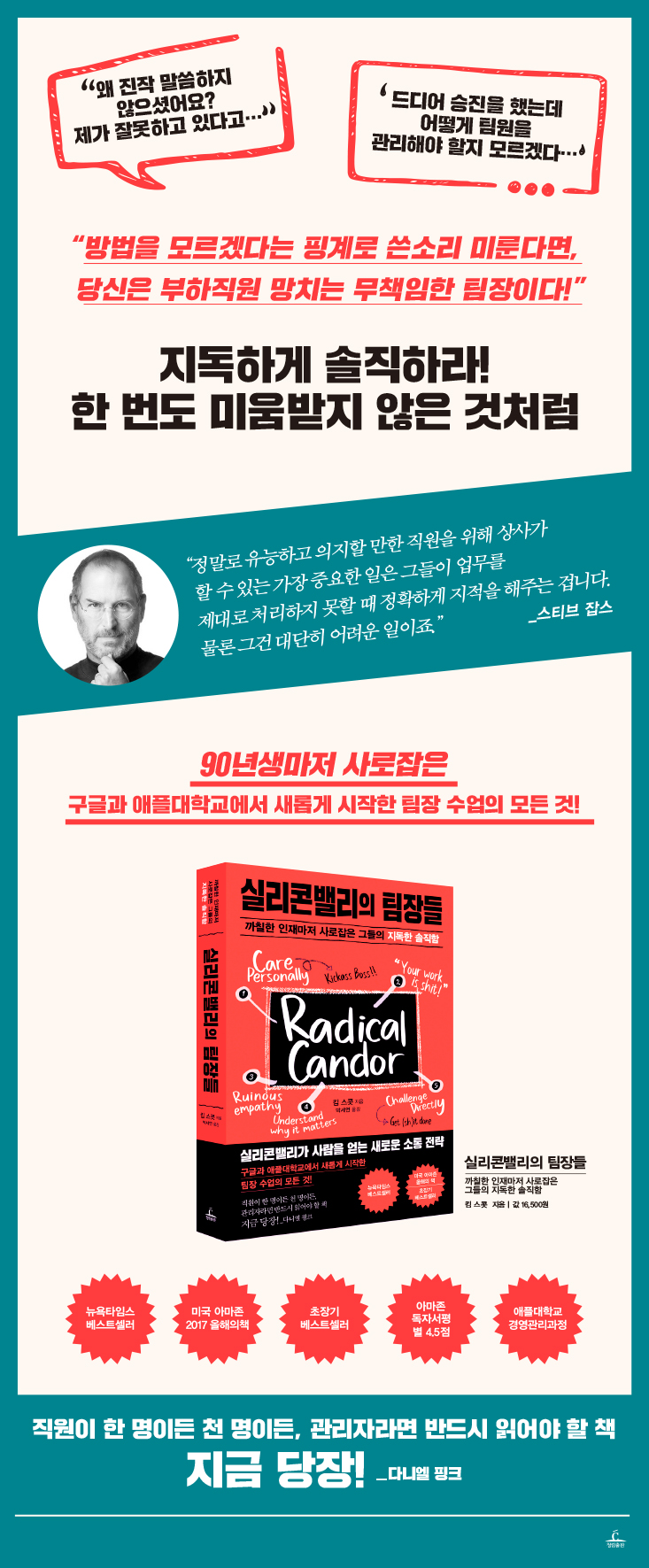
“The most important thing a manager can do for a truly competent and dependable employee is to point out when they are not performing their job well.
We must speak clearly and transparently.
So we need to get it back on track.
Of course, that is a very difficult task.”
Even those born in the 90s were captivated
Complete honesty is
There are two factors that work positively between a team leader and his team members.
One is 'Care Personally', which refers to a deep personal relationship that goes beyond a business relationship.
It's not enough to just pay attention to your employees' work.
You must be yourself and give personal attention to every employee.
Another is 'Challenge Directly', an effort to provide feedback to employees when their performance is good or bad.
Delivering tough feedback, handling difficult role assignments within the team, and setting high performance standards are all clearly team leaders' jobs.
Most team leaders face many difficulties in this process.
Giving negative feedback to employees can be especially difficult.
However, making the effort to deliver tough feedback is the best way for a team leader to show that they care about their team members personally.
Good advice consists of two elements: personal interest and direct confrontation.
The combination of these two is complete honesty.
If you understand exactly what happens when you fail in one or both of these areas, you can always correct the mistakes and get back to the ideal team leader-team relationship.
_Where are you now among the four feedback types?
· Personal interest ○, direct confrontation ○ = complete honesty
If you are a team leader or someone in authority, speaking up is not a matter of authority, it is a matter of moral responsibility.
Just say it! Complete honesty only works when you convey that you're personally interested and that your direct confrontation stems from good intentions.
· Personal interest ×, direct confrontation ○ = unpleasant attack
Many team leaders unconsciously ignore their team members or view them as inferior to themselves.
If you make a point without personal interest, the other person will perceive it as an unpleasant attack rather than advice.
Ironically, when complete honesty is impossible, a nasty attack can be the next best option.
· Personal interest ○, direct confrontation × = destructive empathy
Destructive empathy accounts for a significant portion of management mistakes.
We try to avoid conflict and psychological discomfort at work as much as possible.
The author's case, where he delayed pointing out Bob's mistake and ended up getting fired, also falls into this category.
When a work environment takes hold where team leaders prioritize kindness over correcting team members to maintain good relationships, performance improvement becomes difficult.
· Personal interest ×, direct confrontation × = deliberate falsehood
Intentional lies do not reflect the speaker's sincerity.
For example, it is like this.
'The presentation was a mess, but once he says he likes it, he'll love it.
It's more convenient than pointing out the problem.
'I guess I'll have to leave the next presentation to someone else.'
When confronted with someone who is consumed by anger or displeasure, most people retreat into what is called "destructive empathy."
Others remain in 'nasty attacks' to protect themselves from emotional attacks.
Even well-intentioned people sometimes lose interest and move on to 'deliberate lies'.
Now that you know where you fall within these four categories in your relationships with your teammates, you know how to move toward "complete honesty."
The answer is to take a personal interest and confront it directly.
Be brutally honest!
As if I've never been hated
This book is divided into two parts. In Part 1, the author, who has led several organizations including Google and Apple, explains the core concepts he has learned from 25 years of experience.
Being a great team leader is hard work for everyone.
Even those who have achieved seemingly amazing success are no exception.
Readers will find comfort in recalling their own experiences through the author's case studies presented in Part 1.
Part 2 is a practical guide on relationships, advice, teams, and performance, exploring several tools and techniques to immediately implement the ideas in Part 1.
We'll cover everything from how to conduct one-on-one meetings to how to solve problems differently based on gender, how to reward employees based on their individual growth trajectories, and a step-by-step approach to building completely honest relationships with your subordinates—from hiring to firing.
This will allow you to fulfill the team leader's core role of 'helping the team achieve results.'
No matter how friendly the environment, a team leader cannot help but feel lonely at times.
The team leader feels guilty about his own incompetence and suffers from an obsession to do better than everyone else.
So it's not easy to ask for help.
But there is no perfect team leader in the world.
A team leader must have the courage to be disliked while showing deep concern for his team members.
If you can tolerate these facts, your team members can also become great managers.
When people understand what a great team leader is and what it's like to work with a great team leader, they will naturally grow into great team leaders.
He will pass on what he has learned from you to his subordinates.
The answer to becoming a great team leader that everyone admires without necessarily giving up your humanity is in this book.
Right now! _Daniel Pink
Everything You Need to Know About the New Team Leader Classes Launched by Google and Apple University
“If you postpone your criticism with the excuse that you don’t know how,
“You are an irresponsible team leader who ruins your subordinates!”
Kim Scott, who managed 700 employees at Google for eight years and then moved to Apple University to develop a management training program, has captured the new communication methods that are popular among new leaders in Silicon Valley in "Leading the Team."
The book begins by recounting the author's personal experiences.
When the author founded the company with the goal of creating an organization where everyone works happily, an employee named Bob joined the company.
Bob was a likable character who brightened up the office atmosphere.
He was the best employee I've ever had - kind, funny, considerate, and always willing to help his coworkers.
But his work was a mess from day one.
He too, as he reported the results of his work, looked visibly embarrassed and sorry.
Instead of pointing out his shortcomings, the author took it upon himself to supplement his work.
At first, only the author did this, but as the months passed, the rest of the staff also had to work overtime to support Bob's work.
Eventually, the author called Bob in and told him he was fired, and with a look of shock on his face, Bob said this.
"Why didn't you tell me sooner? That I was doing something wrong…"
The world's best companies
How to manage talent
Ordinary office workers either naturally gain positions as they build their careers, or they get promoted by taking tests according to company regulations.
However, as soon as he gets promoted, he faces an unexpected problem and is at a loss.
'I finally got promoted, but I don't know how to treat my teammates.'
Many people worry that they may not be as good at managing employees as they are at actually getting the job done.
He even begins to doubt whether he is ruining his teammates' future.
It's not easy to point out team members who lack work skills.
It is uncomfortable for oneself to hurt the feelings of others.
I also hate it when my team members see me as a bad team leader.
But autonomy and neglect are completely different things.
When you get promoted to manager, you inevitably have to say some tough things.
So Steve Jobs also said this.
“The most important thing a manager can do for a truly competent and dependable employee is to point out when they are not performing their job well.
We must speak clearly and transparently.
So we need to get it back on track.
Of course, that is a very difficult task.”
Even those born in the 90s were captivated
Complete honesty is
There are two factors that work positively between a team leader and his team members.
One is 'Care Personally', which refers to a deep personal relationship that goes beyond a business relationship.
It's not enough to just pay attention to your employees' work.
You must be yourself and give personal attention to every employee.
Another is 'Challenge Directly', an effort to provide feedback to employees when their performance is good or bad.
Delivering tough feedback, handling difficult role assignments within the team, and setting high performance standards are all clearly team leaders' jobs.
Most team leaders face many difficulties in this process.
Giving negative feedback to employees can be especially difficult.
However, making the effort to deliver tough feedback is the best way for a team leader to show that they care about their team members personally.
Good advice consists of two elements: personal interest and direct confrontation.
The combination of these two is complete honesty.
If you understand exactly what happens when you fail in one or both of these areas, you can always correct the mistakes and get back to the ideal team leader-team relationship.
_Where are you now among the four feedback types?
· Personal interest ○, direct confrontation ○ = complete honesty
If you are a team leader or someone in authority, speaking up is not a matter of authority, it is a matter of moral responsibility.
Just say it! Complete honesty only works when you convey that you're personally interested and that your direct confrontation stems from good intentions.
· Personal interest ×, direct confrontation ○ = unpleasant attack
Many team leaders unconsciously ignore their team members or view them as inferior to themselves.
If you make a point without personal interest, the other person will perceive it as an unpleasant attack rather than advice.
Ironically, when complete honesty is impossible, a nasty attack can be the next best option.
· Personal interest ○, direct confrontation × = destructive empathy
Destructive empathy accounts for a significant portion of management mistakes.
We try to avoid conflict and psychological discomfort at work as much as possible.
The author's case, where he delayed pointing out Bob's mistake and ended up getting fired, also falls into this category.
When a work environment takes hold where team leaders prioritize kindness over correcting team members to maintain good relationships, performance improvement becomes difficult.
· Personal interest ×, direct confrontation × = deliberate falsehood
Intentional lies do not reflect the speaker's sincerity.
For example, it is like this.
'The presentation was a mess, but once he says he likes it, he'll love it.
It's more convenient than pointing out the problem.
'I guess I'll have to leave the next presentation to someone else.'
When confronted with someone who is consumed by anger or displeasure, most people retreat into what is called "destructive empathy."
Others remain in 'nasty attacks' to protect themselves from emotional attacks.
Even well-intentioned people sometimes lose interest and move on to 'deliberate lies'.
Now that you know where you fall within these four categories in your relationships with your teammates, you know how to move toward "complete honesty."
The answer is to take a personal interest and confront it directly.
Be brutally honest!
As if I've never been hated
This book is divided into two parts. In Part 1, the author, who has led several organizations including Google and Apple, explains the core concepts he has learned from 25 years of experience.
Being a great team leader is hard work for everyone.
Even those who have achieved seemingly amazing success are no exception.
Readers will find comfort in recalling their own experiences through the author's case studies presented in Part 1.
Part 2 is a practical guide on relationships, advice, teams, and performance, exploring several tools and techniques to immediately implement the ideas in Part 1.
We'll cover everything from how to conduct one-on-one meetings to how to solve problems differently based on gender, how to reward employees based on their individual growth trajectories, and a step-by-step approach to building completely honest relationships with your subordinates—from hiring to firing.
This will allow you to fulfill the team leader's core role of 'helping the team achieve results.'
No matter how friendly the environment, a team leader cannot help but feel lonely at times.
The team leader feels guilty about his own incompetence and suffers from an obsession to do better than everyone else.
So it's not easy to ask for help.
But there is no perfect team leader in the world.
A team leader must have the courage to be disliked while showing deep concern for his team members.
If you can tolerate these facts, your team members can also become great managers.
When people understand what a great team leader is and what it's like to work with a great team leader, they will naturally grow into great team leaders.
He will pass on what he has learned from you to his subordinates.
The answer to becoming a great team leader that everyone admires without necessarily giving up your humanity is in this book.
GOODS SPECIFICS
- Date of publication: June 28, 2019
- Page count, weight, size: 408 pages | 727g | 152*224*25mm
- ISBN13: 9788935212828
- ISBN10: 8935212822
You may also like
카테고리
korean


korean

![GQ KOREA Mark (Monthly): December [2025]](http://librairie.coreenne.fr/cdn/shop/files/8ef265dbbfbf186523ed75ba7319009d.jpg?v=1765340328&width=3840)


