

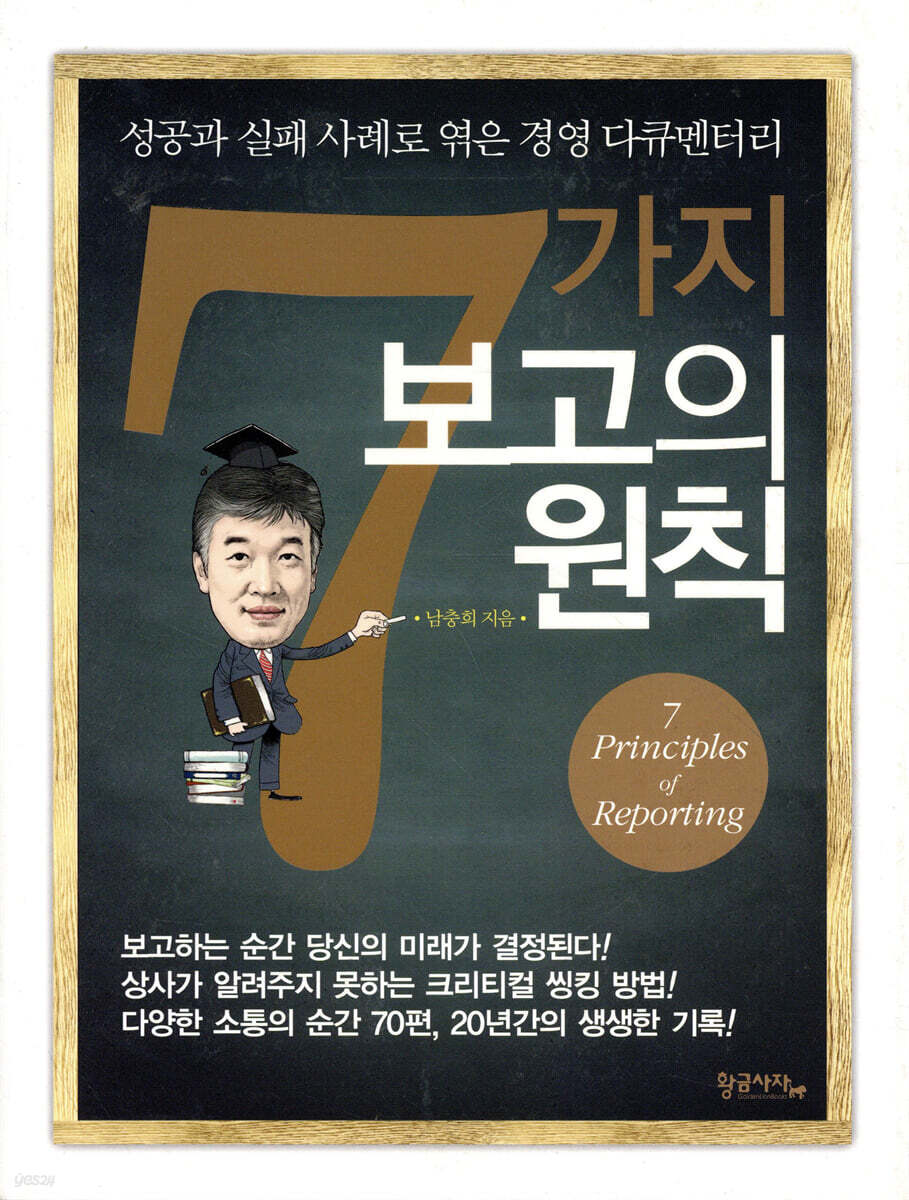
Seven Principles of Reporting
 |
Description
Book Introduction
The moment of reporting is the moment of truth
The moment you report, your future is decided.
What do successful people at work have in common? It's not just their accomplishments that matter.
They are people with particularly outstanding communication skills.
Among senior executives at Fortune 500 companies, 97.7% believe that communication skills were a critical factor in their success.
Communication skills are more important than anything else within an organization.
There is something at the forefront of these communication skills.
That is the 'report' that this book is talking about.
Reporting is a daily task.
And it is a decisive factor that determines the relationship with the boss.
The results of the report determine heaven and hell.
Reporting is a valuable skill that improves our quality of life at work.
But it is true that we have overlooked this.
Reporting is not only a culmination of our creativity, analytical skills, and judgment, but also a measure of our communication skills, strategic abilities, leadership, external relations skills, and expertise.
In other words, the moment of reporting is the moment to specifically express your achievements and comprehensive capabilities.
This book vividly captures various moments of communication, primarily reporting moments between superiors and subordinates, through 70 case studies of 133 people, and explains the seven principles of reporting.
The seven reporting principles presented by the author are the principle of customer orientation, the principle of structural thinking, the principle of parenthetical expression, the principle of future orientation, the principle of suggestion, the principle of proactivity, and the principle of caution. If you can report while adhering to these principles, you will be able to become a talented person with communication skills in the workplace.
The moment you report, your future is decided.
What do successful people at work have in common? It's not just their accomplishments that matter.
They are people with particularly outstanding communication skills.
Among senior executives at Fortune 500 companies, 97.7% believe that communication skills were a critical factor in their success.
Communication skills are more important than anything else within an organization.
There is something at the forefront of these communication skills.
That is the 'report' that this book is talking about.
Reporting is a daily task.
And it is a decisive factor that determines the relationship with the boss.
The results of the report determine heaven and hell.
Reporting is a valuable skill that improves our quality of life at work.
But it is true that we have overlooked this.
Reporting is not only a culmination of our creativity, analytical skills, and judgment, but also a measure of our communication skills, strategic abilities, leadership, external relations skills, and expertise.
In other words, the moment of reporting is the moment to specifically express your achievements and comprehensive capabilities.
This book vividly captures various moments of communication, primarily reporting moments between superiors and subordinates, through 70 case studies of 133 people, and explains the seven principles of reporting.
The seven reporting principles presented by the author are the principle of customer orientation, the principle of structural thinking, the principle of parenthetical expression, the principle of future orientation, the principle of suggestion, the principle of proactivity, and the principle of caution. If you can report while adhering to these principles, you will be able to become a talented person with communication skills in the workplace.
- You can preview some of the book's contents.
Preview
index
Recommendation
At the beginning of the book
Acknowledgements
Team Leader Kim is the head of the headquarters' young daughter?
The Whisper of a Pretty Princess
Ugly Duckling's Double Play
Team Leader Kim is not the director's young daughter.
Seven Principles of Reporting
Reporting Principle 1: Customer Orientation
A great but failed diaper
Are there only smart customers and bosses in this world?
Meeting the group president in a dream
The Infinite Challenge of Customer Analysis as Seen in "Dae Jang Geum"
What do you want to leave in the president's mind?
machine gunners and snipers
Tiger's Customer Analysis Brainstorming
Bombed ceiling and worst case scenario
I've done everything you asked.
But are direct supervisors really the only customers?
Conclusion/Time to Think
Principle 2 of Reporting: The Principle of Structured Thinking
Development into descriptive, reductive, and schematic
When and what type of report should you use?
Nicole Kidman's first, second, and third
Three Trustworthiness Factors in Structural Thinking
Why You Should Go Shopping: The 3x3 Structure
Good news and bad news
Conclusion/Time to Think
Principle 3 of Reporting: The Principle of Parentheses
Why is the double bracket rule?
In short, what's the point?
This is what I'm telling you to do!
Three Habits of 'Tying Your Hair'
Extracting the key points from a sentence or paragraph
Finding an argument in a single diagrammatic slide
Slide Report? Developing Visual Aids
Understanding the core of complex issues
Elevator Report Training
Conclusion/Time to Think
Principle 4 of Reporting: The Principle of Forward-Looking
How the Site Manager Uses Coffee Cups
Future orientation in planning
Control? Future orientation in coordination
Future orientation in strategy formulation
Future orientation for personal growth
Conclusion/Time to Think
Principle 5 of Reporting: The Principle of Suggestion
"What should I do?" is the act of murdering a superior.
Manager Y, who can't think for himself
Manager P only dances when the rhythm is right
Why can't I express my opinion?
Autonomy and creativity
Professionalism
Blending into the organizational culture? Or sacrificing?
Conclusion/Time to Think
Principle 6 of Reporting: The Principle of Proactivity
Actively interpret your boss's instructions.
Actively develop your boss's instructions
Report proactively
A head-to-head debate between a superior and a subordinate
At least don't lose your boss's trust.
In fact, the boss is someone you don't want to meet.
But be proactive and seek out your boss.
Conclusion/Time to Think
Principle 7 of Reporting: The Principle of Care
The dangers of unyielding assertiveness
There is no democratic organization in this world.
The dangers of being opinion-driven
Dangerous number two
Passivity that arises from the dangers of positivity
Actively soliciting opinions from subordinates
Caution when reporting to your superiors
Conclusion/Time to Think
Conclusion: The Home Run Swan
ugly duckling in hell
The flight of the swan
Home run hitting swan
Concluding the book
References
At the beginning of the book
Acknowledgements
Team Leader Kim is the head of the headquarters' young daughter?
The Whisper of a Pretty Princess
Ugly Duckling's Double Play
Team Leader Kim is not the director's young daughter.
Seven Principles of Reporting
Reporting Principle 1: Customer Orientation
A great but failed diaper
Are there only smart customers and bosses in this world?
Meeting the group president in a dream
The Infinite Challenge of Customer Analysis as Seen in "Dae Jang Geum"
What do you want to leave in the president's mind?
machine gunners and snipers
Tiger's Customer Analysis Brainstorming
Bombed ceiling and worst case scenario
I've done everything you asked.
But are direct supervisors really the only customers?
Conclusion/Time to Think
Principle 2 of Reporting: The Principle of Structured Thinking
Development into descriptive, reductive, and schematic
When and what type of report should you use?
Nicole Kidman's first, second, and third
Three Trustworthiness Factors in Structural Thinking
Why You Should Go Shopping: The 3x3 Structure
Good news and bad news
Conclusion/Time to Think
Principle 3 of Reporting: The Principle of Parentheses
Why is the double bracket rule?
In short, what's the point?
This is what I'm telling you to do!
Three Habits of 'Tying Your Hair'
Extracting the key points from a sentence or paragraph
Finding an argument in a single diagrammatic slide
Slide Report? Developing Visual Aids
Understanding the core of complex issues
Elevator Report Training
Conclusion/Time to Think
Principle 4 of Reporting: The Principle of Forward-Looking
How the Site Manager Uses Coffee Cups
Future orientation in planning
Control? Future orientation in coordination
Future orientation in strategy formulation
Future orientation for personal growth
Conclusion/Time to Think
Principle 5 of Reporting: The Principle of Suggestion
"What should I do?" is the act of murdering a superior.
Manager Y, who can't think for himself
Manager P only dances when the rhythm is right
Why can't I express my opinion?
Autonomy and creativity
Professionalism
Blending into the organizational culture? Or sacrificing?
Conclusion/Time to Think
Principle 6 of Reporting: The Principle of Proactivity
Actively interpret your boss's instructions.
Actively develop your boss's instructions
Report proactively
A head-to-head debate between a superior and a subordinate
At least don't lose your boss's trust.
In fact, the boss is someone you don't want to meet.
But be proactive and seek out your boss.
Conclusion/Time to Think
Principle 7 of Reporting: The Principle of Care
The dangers of unyielding assertiveness
There is no democratic organization in this world.
The dangers of being opinion-driven
Dangerous number two
Passivity that arises from the dangers of positivity
Actively soliciting opinions from subordinates
Caution when reporting to your superiors
Conclusion/Time to Think
Conclusion: The Home Run Swan
ugly duckling in hell
The flight of the swan
Home run hitting swan
Concluding the book
References
Detailed image

Into the book
Until now, we have not systematically studied communication within organizations, especially the most critical reporting.
Actually, I rarely think about it seriously.
Reporting is a crucial skill for promotion.
It's a task that we do every day.
It is a key factor that determines your relationship with your superiors.
The results of the report determine heaven and hell.
Reporting is a valuable skill that can improve your quality of life at work. ---p.17
“What exactly is your report trying to leave in the client’s mind?” Ask this question to the person creating the report, or even to the person who completed it.
Nine out of ten people can't answer readily.
In customer orientation, 'hitting the points' is important.
Accuracy is the lifeblood of customer-centric principles. (p. 56)
The boss absolutely, absolutely does not like long reports.
We need to extract the main points.
The key points in terms of phenomenon, cause, result, and countermeasures must be extracted.
And among them, we must select the most important core.
Among those key points, report the conclusion first, excluding the introduction and main body. ---p.69
Just remember one thing.
Your boss is out of his mind right now.
It's hard to maintain patience.
I hate tension.
So report it in two parts.
State the main point and conclusion first.
At least have the ability to do so. ---p.143
Let's put ourselves in the CEO's shoes.
How wonderful is a forward-looking report? It's even better when it incorporates strategic judgment.
Employees who constantly strive to make strategic decisions with an eye toward the future in all matters will undoubtedly succeed. ---p.155
The core of the report is suggestion.
Check yourself before you report.
Did I really think about it and boldly put forward that thought?
Don't avoid it.
Reporting is a tool for my growth.
There is a way.
These include recognizing the challenges of autonomy and creativity, reading professional literature, maintaining a sense of calling, and maintaining sensitivity to organizational culture. ---p.205
The boss's instructions are not perfect.
Go out and seek it out.
Ask a question.
So, develop your boss's instructions.
Only this kind of proactiveness can help the boss.
The boss fundamentally appreciates the initiative of such subordinates. ---p.218
The danger of assertiveness arises when you report to your direct supervisor (e.g., your CEO) and to the person above that supervisor (e.g., the chairman).
It's easy to get excited because it's a rare opportunity.
So it is easy to overlook the existence of the direct supervisor (president).
Actually, I rarely think about it seriously.
Reporting is a crucial skill for promotion.
It's a task that we do every day.
It is a key factor that determines your relationship with your superiors.
The results of the report determine heaven and hell.
Reporting is a valuable skill that can improve your quality of life at work. ---p.17
“What exactly is your report trying to leave in the client’s mind?” Ask this question to the person creating the report, or even to the person who completed it.
Nine out of ten people can't answer readily.
In customer orientation, 'hitting the points' is important.
Accuracy is the lifeblood of customer-centric principles. (p. 56)
The boss absolutely, absolutely does not like long reports.
We need to extract the main points.
The key points in terms of phenomenon, cause, result, and countermeasures must be extracted.
And among them, we must select the most important core.
Among those key points, report the conclusion first, excluding the introduction and main body. ---p.69
Just remember one thing.
Your boss is out of his mind right now.
It's hard to maintain patience.
I hate tension.
So report it in two parts.
State the main point and conclusion first.
At least have the ability to do so. ---p.143
Let's put ourselves in the CEO's shoes.
How wonderful is a forward-looking report? It's even better when it incorporates strategic judgment.
Employees who constantly strive to make strategic decisions with an eye toward the future in all matters will undoubtedly succeed. ---p.155
The core of the report is suggestion.
Check yourself before you report.
Did I really think about it and boldly put forward that thought?
Don't avoid it.
Reporting is a tool for my growth.
There is a way.
These include recognizing the challenges of autonomy and creativity, reading professional literature, maintaining a sense of calling, and maintaining sensitivity to organizational culture. ---p.205
The boss's instructions are not perfect.
Go out and seek it out.
Ask a question.
So, develop your boss's instructions.
Only this kind of proactiveness can help the boss.
The boss fundamentally appreciates the initiative of such subordinates. ---p.218
The danger of assertiveness arises when you report to your direct supervisor (e.g., your CEO) and to the person above that supervisor (e.g., the chairman).
It's easy to get excited because it's a rare opportunity.
So it is easy to overlook the existence of the direct supervisor (president).
---p.272
Publisher's Review
Domestic and international universities, large corporations, research institutes, governments, public corporations, academic societies…
Vivid business case studies directly experienced by the author over 20 years!
When the 9 o'clock news signal music comes on on Sunday evening, office workers feel depressed.
I desperately hope Monday morning never comes.
The reason is almost always the boss's fault.
A recent survey found that 6 out of 10 office workers admit to experiencing severe stress from their superiors.
If you have a quirky, hot-tempered, and incompetent boss, you will really want to resign.
However, this is not something that can be solved by blindly avoiding your boss or changing jobs.
We need to find a solution.
The point is that the common skill that successful professionals possess is communication skills.
97.7% of senior executives at Fortune 500 companies believe that communication skills were a critical factor in their success.
"What are the top 10 qualities and skills executives seek in their employees?" In this survey, the unwavering top answer for over a decade was communication skills. (From page 17)
The author, Dr. Nam Chung-hee, explores the same themes, drawing on management case studies gleaned from his 20-plus years of experience as a professor at Stanford University, researching and teaching innovation. He also served as an advisor to the chairman of Ssangyong Group, Deputy Mayor for Political Affairs and Economic Advisor to the Mayor of Busan, CEO and President of Centum City, President and Head of the Urban Development Division at SK Telecom, and adjunct professor at KAIST.
In this book, he focuses on reporting, which accounts for most of the communication within an organization.
Most of the work that office workers do every day is preparing and reporting reports.
The moment of reporting to one's superior is the moment when (1) the reporter's thinking power, i.e. creativity, analysis, and judgment, (2) communication skills, and (3) strategic abilities, leadership, external negotiation skills, and expertise are evaluated. It is the 'moment of truth' that separates the heaven blessed with recognition from the hell filled with stress.
Reporting skills are a key competency that determines your relationship with your superiors.
So, the report determines not only the promotion but also the quality of the daily life of the worker.
Whether a workplace is heaven or hell is determined by the communication skills of reporting.
Principles of reporting that have been verified and supported by readers' participation
This book, which advocates "principles" by providing footnotes to approximately 50 related domestic and foreign papers and books, is characterized by its vividness.
Focusing on the realities of management and administration, the camera vividly captures 70 diverse communication moments involving 133 people, primarily reporting moments between superiors and subordinates.
It's like watching a documentary film.
Looking at the 'Recommendation' and 'Acknowledgements', the author's process of creating the book is also innovative.
After completing the first draft, Dr. Nam Chung-hee had some 200 CEOs, professors, journalists, businessmen, college students, and housewives read it, and analyzed the various feedback and survey results from about 70 of them to completely rewrite the book.
In this three-stage revision and supplementation process, only the cases and theories that passed the diversity test, which is the lifeblood of the 'principle', were preserved.
Principles of reporting and critical thinking methods drawn from moments of communication!
The principle of customer orientation emphasizes first of all paying attention to the target of the report.
It means to be sensitive to the circumstances and situations that the person receiving the report is in.
For example, the CEO has a lot to think about.
Sometimes I'm not in a normal psychological state.
He often gets caught up in anger, even swearing to himself.
My body always hurts here and there.
So, the boss absolutely, absolutely does not like long reports.
If so, you should summarize the key points and report briefly.
The principle of structural thinking is to think in three dimensions before reporting.
That is, look far ahead, look wide to the left and right, and look deeply.
This requires skills such as stating your argument first, using short sentences, finding the right words, and distinguishing between cause and effect when writing a report.
The principle of double-headed expression is to state the main point or conclusion first.
This means that you should explain the reasons and basis for reaching the conclusion.
Even if a boss or CEO doesn't move his body, his mind is always busy.
The author also emphasizes the need to use parentheses to ensure the completeness of the report.
Because the boss or supervisor may have to go out soon, or a guest may come and stop reporting at any time.
The principle of future orientation is to include 'thoughts and plans for the future' in all reports.
The methods for this are, first, future-oriented planning, second, future-oriented control and coordination, third, future-oriented strategy formulation, fourth, reflection and growth through review after reporting, and fifth, learning by predicting and comparing reports from benchmarking targets or role models.
The principle of suggestion is that it is a report containing the will to do something and how to do it.
A report that ends with just a status description is the worst thing from a superior's perspective.
This is because a passive attitude of only waiting for instructions and directions lacks creativity and autonomy.
If you create a thick report but don't have a how-to, you're just an amateur.
The important things in the principle of proactiveness are, first, the proactiveness to accept the superior's request as an 'instruction', no matter what form it takes, no matter how trivial or hidden it is; second, the proactiveness to further develop the superior's imperfect instructions; third, the proactiveness in the act of reporting itself; and fourth, the proactiveness to frequently visit the superior to ask questions and discuss throughout the entire work process.
The principle of caution presents various examples of cases in which excessive aggressiveness can be detrimental.
This is because it is problematic if the proactive expression of intent is perceived as a ‘challenge’ and ‘betrayal’ of the superior.
This is the wisdom that office workers should have when expressing opinions in front of their superiors.
You have to be especially careful in public places.
Especially if you are the number two person in an organization, it is important to avoid being seen as challenging your superior's leadership, authority, and final decision-making authority.
Vivid business case studies directly experienced by the author over 20 years!
When the 9 o'clock news signal music comes on on Sunday evening, office workers feel depressed.
I desperately hope Monday morning never comes.
The reason is almost always the boss's fault.
A recent survey found that 6 out of 10 office workers admit to experiencing severe stress from their superiors.
If you have a quirky, hot-tempered, and incompetent boss, you will really want to resign.
However, this is not something that can be solved by blindly avoiding your boss or changing jobs.
We need to find a solution.
The point is that the common skill that successful professionals possess is communication skills.
97.7% of senior executives at Fortune 500 companies believe that communication skills were a critical factor in their success.
"What are the top 10 qualities and skills executives seek in their employees?" In this survey, the unwavering top answer for over a decade was communication skills. (From page 17)
The author, Dr. Nam Chung-hee, explores the same themes, drawing on management case studies gleaned from his 20-plus years of experience as a professor at Stanford University, researching and teaching innovation. He also served as an advisor to the chairman of Ssangyong Group, Deputy Mayor for Political Affairs and Economic Advisor to the Mayor of Busan, CEO and President of Centum City, President and Head of the Urban Development Division at SK Telecom, and adjunct professor at KAIST.
In this book, he focuses on reporting, which accounts for most of the communication within an organization.
Most of the work that office workers do every day is preparing and reporting reports.
The moment of reporting to one's superior is the moment when (1) the reporter's thinking power, i.e. creativity, analysis, and judgment, (2) communication skills, and (3) strategic abilities, leadership, external negotiation skills, and expertise are evaluated. It is the 'moment of truth' that separates the heaven blessed with recognition from the hell filled with stress.
Reporting skills are a key competency that determines your relationship with your superiors.
So, the report determines not only the promotion but also the quality of the daily life of the worker.
Whether a workplace is heaven or hell is determined by the communication skills of reporting.
Principles of reporting that have been verified and supported by readers' participation
This book, which advocates "principles" by providing footnotes to approximately 50 related domestic and foreign papers and books, is characterized by its vividness.
Focusing on the realities of management and administration, the camera vividly captures 70 diverse communication moments involving 133 people, primarily reporting moments between superiors and subordinates.
It's like watching a documentary film.
Looking at the 'Recommendation' and 'Acknowledgements', the author's process of creating the book is also innovative.
After completing the first draft, Dr. Nam Chung-hee had some 200 CEOs, professors, journalists, businessmen, college students, and housewives read it, and analyzed the various feedback and survey results from about 70 of them to completely rewrite the book.
In this three-stage revision and supplementation process, only the cases and theories that passed the diversity test, which is the lifeblood of the 'principle', were preserved.
Principles of reporting and critical thinking methods drawn from moments of communication!
The principle of customer orientation emphasizes first of all paying attention to the target of the report.
It means to be sensitive to the circumstances and situations that the person receiving the report is in.
For example, the CEO has a lot to think about.
Sometimes I'm not in a normal psychological state.
He often gets caught up in anger, even swearing to himself.
My body always hurts here and there.
So, the boss absolutely, absolutely does not like long reports.
If so, you should summarize the key points and report briefly.
The principle of structural thinking is to think in three dimensions before reporting.
That is, look far ahead, look wide to the left and right, and look deeply.
This requires skills such as stating your argument first, using short sentences, finding the right words, and distinguishing between cause and effect when writing a report.
The principle of double-headed expression is to state the main point or conclusion first.
This means that you should explain the reasons and basis for reaching the conclusion.
Even if a boss or CEO doesn't move his body, his mind is always busy.
The author also emphasizes the need to use parentheses to ensure the completeness of the report.
Because the boss or supervisor may have to go out soon, or a guest may come and stop reporting at any time.
The principle of future orientation is to include 'thoughts and plans for the future' in all reports.
The methods for this are, first, future-oriented planning, second, future-oriented control and coordination, third, future-oriented strategy formulation, fourth, reflection and growth through review after reporting, and fifth, learning by predicting and comparing reports from benchmarking targets or role models.
The principle of suggestion is that it is a report containing the will to do something and how to do it.
A report that ends with just a status description is the worst thing from a superior's perspective.
This is because a passive attitude of only waiting for instructions and directions lacks creativity and autonomy.
If you create a thick report but don't have a how-to, you're just an amateur.
The important things in the principle of proactiveness are, first, the proactiveness to accept the superior's request as an 'instruction', no matter what form it takes, no matter how trivial or hidden it is; second, the proactiveness to further develop the superior's imperfect instructions; third, the proactiveness in the act of reporting itself; and fourth, the proactiveness to frequently visit the superior to ask questions and discuss throughout the entire work process.
The principle of caution presents various examples of cases in which excessive aggressiveness can be detrimental.
This is because it is problematic if the proactive expression of intent is perceived as a ‘challenge’ and ‘betrayal’ of the superior.
This is the wisdom that office workers should have when expressing opinions in front of their superiors.
You have to be especially careful in public places.
Especially if you are the number two person in an organization, it is important to avoid being seen as challenging your superior's leadership, authority, and final decision-making authority.
GOODS SPECIFICS
- Publication date: November 25, 2011
- Page count, weight, size: 294 pages | 604g | 185*244*20mm
- ISBN13: 9788997287000
- ISBN10: 8997287001
You may also like
카테고리
korean


korean

![GQ KOREA Mark (Monthly): December [2025]](http://librairie.coreenne.fr/cdn/shop/files/8ef265dbbfbf186523ed75ba7319009d.jpg?v=1765340328&width=3840)


