

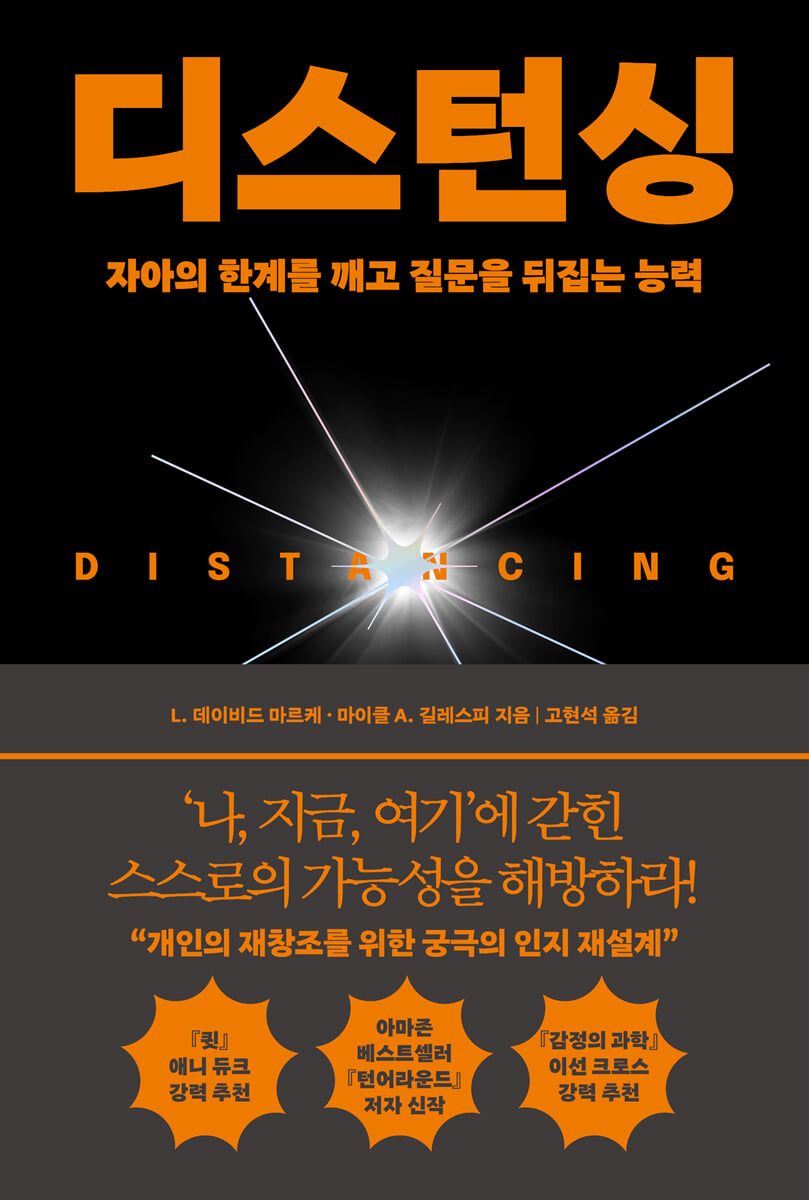
Distancing
 |
Description
Book Introduction
“If you were from the future, what choice would you make today?”
Free your own potential trapped in 'me, now, here'!
Distancing: The ability to break through the shell of the ego and ask precise questions
“A masterpiece, clearly written with in-depth research!”
Highly recommended by world-renowned psychologist Ethan Cross
Be yourself, be here now, live in this moment.
Today's zeitgeist regards this as an ideal value that must be pursued.
But we often get stuck in the 'here and now'.
At a crucial moment, I make a decision that my future self would have stopped me from making.
If you make these choices repeatedly, your life will go down the wrong path and you will never reach your destination.
This 'self-absorbed state' is a closed emotional state that reinforces existing thoughts by narrowing, blocking, and distorting our vision.
This state biases our decision-making toward pleasing our ego, paralyzes our ability to make objective comparisons, and satisfies our need to defend ourselves.
The problem is that 'self-absorption' is the default human state.
No one deceives himself more than he deceives himself.
"Distancing" contains a simple yet revolutionary formula for "cognitive redesign" to solve this problem.
L.A., a legendary commander and world-renowned leadership thinker who transformed a nuclear submarine from the lowest-rated to the best ship in the U.S. Navy.
Michael A., who has been suggesting change strategies for individuals and companies based on David Marquet and organizational psychology.
Professor Gillespie's in-depth research has yielded a powerful solution.
Distancing is a psychological distancing technique that breaks away from unconscious self-immersion.
It is a technique for instantly reframing one's perspective on oneself and situations, and is broadly divided into three practical methods.
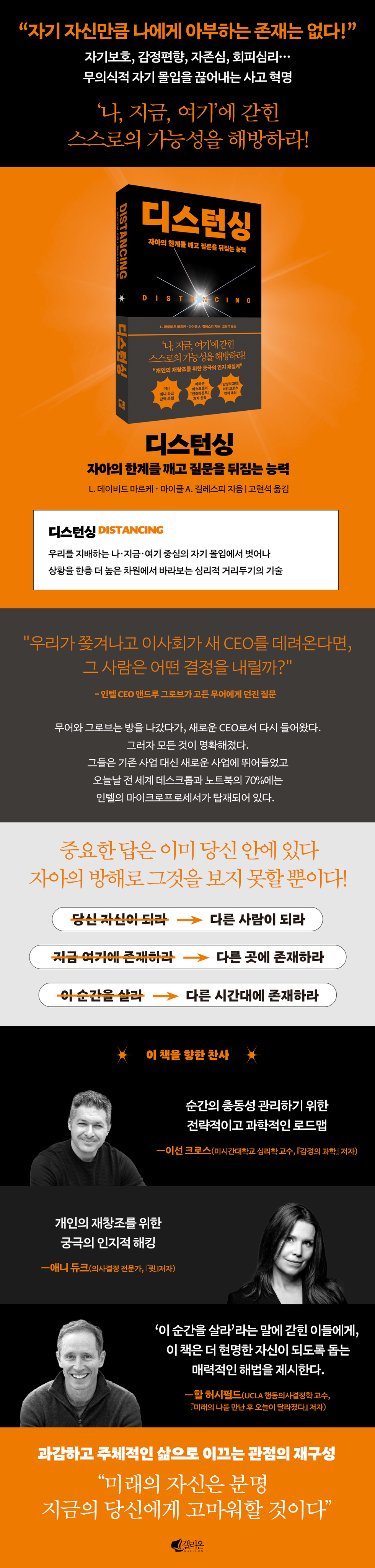
'Become someone else, be somewhere else, be in a different time zone.'
Distancing helps us move beyond bias, avoidance, and self-defense to make decisions that are ultimately aligned with our long-term life goals.
Ultimately, this book is a practical guide to help each of us live in dialogue with our future selves.
If you don't want to disappoint your future self, keep this book by your side and refer to it often.
We will help you not to lose what is most important in any moment of crisis.
Free your own potential trapped in 'me, now, here'!
Distancing: The ability to break through the shell of the ego and ask precise questions
“A masterpiece, clearly written with in-depth research!”
Highly recommended by world-renowned psychologist Ethan Cross
Be yourself, be here now, live in this moment.
Today's zeitgeist regards this as an ideal value that must be pursued.
But we often get stuck in the 'here and now'.
At a crucial moment, I make a decision that my future self would have stopped me from making.
If you make these choices repeatedly, your life will go down the wrong path and you will never reach your destination.
This 'self-absorbed state' is a closed emotional state that reinforces existing thoughts by narrowing, blocking, and distorting our vision.
This state biases our decision-making toward pleasing our ego, paralyzes our ability to make objective comparisons, and satisfies our need to defend ourselves.
The problem is that 'self-absorption' is the default human state.
No one deceives himself more than he deceives himself.
"Distancing" contains a simple yet revolutionary formula for "cognitive redesign" to solve this problem.
L.A., a legendary commander and world-renowned leadership thinker who transformed a nuclear submarine from the lowest-rated to the best ship in the U.S. Navy.
Michael A., who has been suggesting change strategies for individuals and companies based on David Marquet and organizational psychology.
Professor Gillespie's in-depth research has yielded a powerful solution.
Distancing is a psychological distancing technique that breaks away from unconscious self-immersion.
It is a technique for instantly reframing one's perspective on oneself and situations, and is broadly divided into three practical methods.
'Become someone else, be somewhere else, be in a different time zone.'
Distancing helps us move beyond bias, avoidance, and self-defense to make decisions that are ultimately aligned with our long-term life goals.
Ultimately, this book is a practical guide to help each of us live in dialogue with our future selves.
If you don't want to disappoint your future self, keep this book by your side and refer to it often.
We will help you not to lose what is most important in any moment of crisis.
- You can preview some of the book's contents.
Preview
index
Entering
PART 1 Two Perspectives
Chapter 1 Self-Immersion
Me, myself and ego
self-preservation instinct
'I am the center of the world' is the default.
Deliberately escape from self-absorption.
Chapter 2: Distance from yourself
Perspective Reframing
If you distance yourself, you'll see the answer.
See more clearly what you already know
A neutral observer's point of view
PART2 Become someone else
Chapter 3 Become a Coach
Sometimes ignorance is bliss
The way you see yourself and the way you see others
Use personas
Think in a foreign language
Choose your coach's look
*How to become a coach
Chapter 4: Speak Like a Coach
Switch from first person to third person
How to Increase Performance and Reduce Anxiety
The effects of social distancing can be felt physically.
Writing a diary using illustration
Call yourself 'you'
*How to talk like a coach
PART 3 Be somewhere else
Chapter 5: Go up to the balcony
Negotiating on the balcony
Look like a fly on the wall
What would I see if I observed you?
Replay effect
The key is not you
Accept feedback through social distancing
*How to get up to the balcony
Chapter 6: See the Big Picture
The power to reveal what matters most
Imagine being in another place
Will I change the world or will I move?
Don't just go away, go higher
*How to see the big picture
PART 4 Exist in a different time zone
Chapter 7 Become Your Future Self
The night me always beats the morning me
A life without regrets
Don't underestimate the future
Why do you procrastinate?
Become your future self
three time zones
*How to become your future self
Chapter 8 Take a moment to pause
The value of stopping
Make it possible to stop
Be aware of the situation
Request a stop
Determine the level of social distancing
*How to have a pause
In conclusion
Acknowledgements
main
References
PART 1 Two Perspectives
Chapter 1 Self-Immersion
Me, myself and ego
self-preservation instinct
'I am the center of the world' is the default.
Deliberately escape from self-absorption.
Chapter 2: Distance from yourself
Perspective Reframing
If you distance yourself, you'll see the answer.
See more clearly what you already know
A neutral observer's point of view
PART2 Become someone else
Chapter 3 Become a Coach
Sometimes ignorance is bliss
The way you see yourself and the way you see others
Use personas
Think in a foreign language
Choose your coach's look
*How to become a coach
Chapter 4: Speak Like a Coach
Switch from first person to third person
How to Increase Performance and Reduce Anxiety
The effects of social distancing can be felt physically.
Writing a diary using illustration
Call yourself 'you'
*How to talk like a coach
PART 3 Be somewhere else
Chapter 5: Go up to the balcony
Negotiating on the balcony
Look like a fly on the wall
What would I see if I observed you?
Replay effect
The key is not you
Accept feedback through social distancing
*How to get up to the balcony
Chapter 6: See the Big Picture
The power to reveal what matters most
Imagine being in another place
Will I change the world or will I move?
Don't just go away, go higher
*How to see the big picture
PART 4 Exist in a different time zone
Chapter 7 Become Your Future Self
The night me always beats the morning me
A life without regrets
Don't underestimate the future
Why do you procrastinate?
Become your future self
three time zones
*How to become your future self
Chapter 8 Take a moment to pause
The value of stopping
Make it possible to stop
Be aware of the situation
Request a stop
Determine the level of social distancing
*How to have a pause
In conclusion
Acknowledgements
main
References
Detailed image
Into the book
Self-absorption is our default state of seeing the world.
Although self-absorption is not the same as ego, ego responses such as defensiveness, self-consciousness, and fixation on image are more pronounced in a state of self-absorption.
The relationship between self-absorption and ego is like the relationship between oxygen and fire.
The more intense the self-absorption (oxygen), the more intensely the ego (fire) burns.
Therefore, to reduce ego reactions, oxygen must be cut off.
This happens naturally when you come out of a state of self-absorption.
--- p.18, from “Introduction”
Just as Moore and Grove imagined themselves through the eyes of their successors, we too can create distance from ourselves through imagination.
This is called psychological distance.
The scientific principle at work here is based on construal level theory (CLT).
This theory explains the way we think about things, that is, the patterns by which we interpret the meaning of things.
At a lower level of interpretation, specific ideas about how to do something and details are formed.
On the other hand, at a higher level of interpretation, abstract ideas are formed about principles and what to do, whether to do something or not, and why something should be done.
--- p.57~58, from “If you keep your distance, you will see the answer”
If the state of self-immersion is one in which we have the perspective of 'myself here and now,' we can take on the coach's perspective through self-distancing, spatial distancing, and temporal distancing.
Become someone else.
Be somewhere else.
Exist in a different time zone.
First, becoming a coach means I am no longer me.
It's about becoming a different person.
This activates psychological distance and allows you to see things from the perspective of a neutral observer.
Second, when we become coaches, we exist somewhere else.
The coach is not in the middle of the field, but is physically located off the field, away from the field.
There, we can see ourselves as a player in a complex environment with numerous intertwined elements.
Third, coaches can travel to different time zones.
This is the process of activating our inner time traveler.
We can evaluate our past actions and future choices more clearly.
The key is what to do next.
--- p.67, from “The Neutral Observer’s Point of View”
The researchers found that when we use the second-person pronoun "you" in our self-talk, we are mimicking the countless encouraging voices we hear from trusted authority figures like parents, teachers, and coaches.
“You can do it.” “You’re ready.” Imitating these words of encouragement increases compliance and the likelihood that plans will be executed.
This suggests an additional benefit of making decisions as a coach and then returning to your position and implementing that advice.
Once you (the coach) decide what you need to do, you (your true self) will have a natural desire to live up to the coach's expectations when you put that plan into action.
Now, you are not only working for yourself, but also for your coach.
--- p.123~124, from “Call Yourself ‘You’”
When we distance ourselves from our future selves, we become more aware of the ideals we truly desire and cherish in life, rather than the everyday realities and practical considerations.
This changes what factors we consider when weighing our options and how we weigh each factor.
By changing the reference point of time, we can escape the 'time discount' bias that attracts us to the present moment.
As time passes, immediate constraints become less important and even less noticeable.
When we no longer feel those limitations, what remains is our ideal self.
This self usually embodies a better version of ourselves than we do now, and it allows us to escape the pressing issues of everyday life, the compromises, concessions, and self-justifications, and focus on what truly matters.
--- p.182~183, from “Become Your Future Self”
When our body screams, “Act now,” we feel as if this moment is everything.
An overwhelming sense comes over me that everything depends solely on the present moment.
But unless you're really about to be hit by a bus right now, that urgency is artificial.
And it's never beneficial.
Like a numbing poison, this false sense of urgency impairs the functioning of the cerebral cortex, fooling us into thinking we're still thinking clearly.
But if we can recognize our own signals, we can more quickly turn to 'coach' and blow the whistle to call a timeout or have a chance to calm ourselves down and regroup.
Although self-absorption is not the same as ego, ego responses such as defensiveness, self-consciousness, and fixation on image are more pronounced in a state of self-absorption.
The relationship between self-absorption and ego is like the relationship between oxygen and fire.
The more intense the self-absorption (oxygen), the more intensely the ego (fire) burns.
Therefore, to reduce ego reactions, oxygen must be cut off.
This happens naturally when you come out of a state of self-absorption.
--- p.18, from “Introduction”
Just as Moore and Grove imagined themselves through the eyes of their successors, we too can create distance from ourselves through imagination.
This is called psychological distance.
The scientific principle at work here is based on construal level theory (CLT).
This theory explains the way we think about things, that is, the patterns by which we interpret the meaning of things.
At a lower level of interpretation, specific ideas about how to do something and details are formed.
On the other hand, at a higher level of interpretation, abstract ideas are formed about principles and what to do, whether to do something or not, and why something should be done.
--- p.57~58, from “If you keep your distance, you will see the answer”
If the state of self-immersion is one in which we have the perspective of 'myself here and now,' we can take on the coach's perspective through self-distancing, spatial distancing, and temporal distancing.
Become someone else.
Be somewhere else.
Exist in a different time zone.
First, becoming a coach means I am no longer me.
It's about becoming a different person.
This activates psychological distance and allows you to see things from the perspective of a neutral observer.
Second, when we become coaches, we exist somewhere else.
The coach is not in the middle of the field, but is physically located off the field, away from the field.
There, we can see ourselves as a player in a complex environment with numerous intertwined elements.
Third, coaches can travel to different time zones.
This is the process of activating our inner time traveler.
We can evaluate our past actions and future choices more clearly.
The key is what to do next.
--- p.67, from “The Neutral Observer’s Point of View”
The researchers found that when we use the second-person pronoun "you" in our self-talk, we are mimicking the countless encouraging voices we hear from trusted authority figures like parents, teachers, and coaches.
“You can do it.” “You’re ready.” Imitating these words of encouragement increases compliance and the likelihood that plans will be executed.
This suggests an additional benefit of making decisions as a coach and then returning to your position and implementing that advice.
Once you (the coach) decide what you need to do, you (your true self) will have a natural desire to live up to the coach's expectations when you put that plan into action.
Now, you are not only working for yourself, but also for your coach.
--- p.123~124, from “Call Yourself ‘You’”
When we distance ourselves from our future selves, we become more aware of the ideals we truly desire and cherish in life, rather than the everyday realities and practical considerations.
This changes what factors we consider when weighing our options and how we weigh each factor.
By changing the reference point of time, we can escape the 'time discount' bias that attracts us to the present moment.
As time passes, immediate constraints become less important and even less noticeable.
When we no longer feel those limitations, what remains is our ideal self.
This self usually embodies a better version of ourselves than we do now, and it allows us to escape the pressing issues of everyday life, the compromises, concessions, and self-justifications, and focus on what truly matters.
--- p.182~183, from “Become Your Future Self”
When our body screams, “Act now,” we feel as if this moment is everything.
An overwhelming sense comes over me that everything depends solely on the present moment.
But unless you're really about to be hit by a bus right now, that urgency is artificial.
And it's never beneficial.
Like a numbing poison, this false sense of urgency impairs the functioning of the cerebral cortex, fooling us into thinking we're still thinking clearly.
But if we can recognize our own signals, we can more quickly turn to 'coach' and blow the whistle to call a timeout or have a chance to calm ourselves down and regroup.
--- p.234, from “Recognize the Situation”
Publisher's Review
“Escape from yourself deliberately!”
The art of psychological distancing to break the cycle of wrong choices
Intel's 1985 annual report began like this:
“It was a dismal year for Intel and the entire semiconductor industry.” Intel’s mainstay business, memory chip production, was in decline.
Gordon Moore and Andrew Grove, who had been building the company together since its founding, had a decision to make.
Should the company stick to memory chip production or pivot to focus on microprocessor manufacturing?
Moore and Grove had been discussing the matter for a year but were unable to reach a conclusion.
Memory chips were the history and heart of Intel.
I just couldn't give up.
Then one day Grove asked a question.
“If we were kicked out and a new CEO came in, what decisions would he or she make?” The moment that question was asked, the situation looked completely different.
They left the room and came back as the new CEO.
And I made a decision.
Everyone knows the rest of the story.
Today, 70% of desktops and laptops worldwide are powered by Intel microprocessors.
Be yourself, be here now, live in this moment.
Today's zeitgeist regards this as an ideal value that must be pursued.
But we often get stuck in the 'here and now'.
At a crucial moment, I make a decision that my future self would have tried to stop me from making.
If you make these choices repeatedly, your life will go down the wrong path and you will never reach your destination.
This 'self-absorbed state' is a closed emotional state that reinforces existing thoughts by narrowing, blocking, and distorting our vision.
This state biases our decision-making toward pleasing our ego, paralyzes our ability to make objective comparisons, and satisfies our need to defend ourselves.
The problem is that 'self-absorption' is the default human state.
No one deceives himself more than he deceives himself.
"Distancing" offers concrete guidance on how to break free from the ego trap that engulfs us in such crucial moments and gain a transcendent perspective.
Like Moore and Grove, who went out and came back as their successors, by learning to distance ourselves, we can free ourselves from our emotions, biases, defensiveness, and narcissism, and see the situation from a higher, clearer perspective.
“Will you compromise what is possible, or challenge what is desirable?”
A restructuring of perspectives that leads to a bold and proactive life
Self-absorption is our default state, which distorts our perspective on reality and leads to poor decision-making.
Self-absorption and ego are like oxygen and fire.
The more intense the self-absorption (oxygen), the more intensely the ego (fire) burns.
To reduce ego responses such as defensiveness, biased self-consciousness, and obsession with pride, we must cut off oxygen.
"Distance" contains a simple yet revolutionary formula for "cognitive redesign" to solve this problem.
L.A., a legendary commander and world-renowned leadership thinker who transformed a nuclear submarine from the lowest-rated to the best ship in the U.S. Navy.
Michael A., who has been suggesting change strategies for individuals and companies based on David Marquet and organizational psychology.
Professor Gillespie's in-depth research has yielded a powerful solution.
Distancing is a psychological distancing technique that breaks away from unconscious self-immersion.
By instantly reframing one's perspective on oneself and the situation, the book explains its effectiveness through various scientific studies and case studies, and presents a variety of practical methods along with three major directions.
● Become someone else
● Be somewhere else
● Exist in a different time zone
First, accept the other person's perspective and become that person.
When you become a neutral observer, you can break free from self-absorption and activate an external perspective.
Second, imagine yourself in a different place.
When you broaden your perspective and look at yourself from a distance, you begin to see yourself as part of a larger context.
Third, go back to another point in time and ask yourself, ‘What should I have done right now?’
These three techniques will instantly shift your perspective and allow you to look at the problem from a completely different angle.
This is the starting point where you can finally design your own life.
Above all, this book serves as a practical guide to help each of us live in dialogue with our future selves.
In a state of self-absorption, our ego remains at the practical self, but in a state of detachment, it moves closer to the ideal self.
That is, it makes us deeply understand which decisions best support our own ultimate values.
As we gain distance, our thinking expands, and we are able to make decisions based on desirability rather than feasibility.
Distancing helps you move beyond bias, avoidance, and self-defense to make decisions that are ultimately aligned with your long-term life goals.
“The important answers are already within you.”
Break free from 'now, here, me' and liberate your own potential!
Ultimately, aren't we incapable of escaping from ourselves? Of course we are.
But you can escape the vicious cycle of rationalizing past decisions or avoiding difficult situations.
Because everyone has imagination.
We can always choose to step out of our 'here and now' and look at the world.
Everyone has at least once experienced trying to pull themselves together in a stressful situation.
It's the moment when you're about to make an important announcement, match, or decision, and you repeat to yourself, "You can do it," or "OO, wake up," as if you were calling out the voice of a coach, teacher, or parent in your mind.
Attempting to look at yourself and speak to someone in the second or third person is also a distancing technique.
Or you can imagine looking down on your situation from a high place.
Then, as if by magic, the tension will be released and you will become a little bolder.
Learning to distance yourself in this way is not just self-soothing, but a powerful tool that can lead you to better choices and practices in life.
And this book is full of tools you can use right away.
Self-absorption is not an extreme state, it is a normal state.
Just as we are not conscious of our breathing, we spend most of our time in a state of natural self-absorption.
But there are times when we consciously focus on our breathing, such as when we exercise, do yoga, or meditate.
Even if it's just a few moments a day, if these moments accumulate, at some point your daily life will change.
Likewise, by consciously and continuously activating the state of 'distancing', our lives can be fundamentally transformed.
Change begins with recognizing our self-defense mechanisms.
The moment you look at yourself objectively, without avoiding uncomfortable truths, you can listen to the wisest voice.
The important answers are already within you.
The art of psychological distancing to break the cycle of wrong choices
Intel's 1985 annual report began like this:
“It was a dismal year for Intel and the entire semiconductor industry.” Intel’s mainstay business, memory chip production, was in decline.
Gordon Moore and Andrew Grove, who had been building the company together since its founding, had a decision to make.
Should the company stick to memory chip production or pivot to focus on microprocessor manufacturing?
Moore and Grove had been discussing the matter for a year but were unable to reach a conclusion.
Memory chips were the history and heart of Intel.
I just couldn't give up.
Then one day Grove asked a question.
“If we were kicked out and a new CEO came in, what decisions would he or she make?” The moment that question was asked, the situation looked completely different.
They left the room and came back as the new CEO.
And I made a decision.
Everyone knows the rest of the story.
Today, 70% of desktops and laptops worldwide are powered by Intel microprocessors.
Be yourself, be here now, live in this moment.
Today's zeitgeist regards this as an ideal value that must be pursued.
But we often get stuck in the 'here and now'.
At a crucial moment, I make a decision that my future self would have tried to stop me from making.
If you make these choices repeatedly, your life will go down the wrong path and you will never reach your destination.
This 'self-absorbed state' is a closed emotional state that reinforces existing thoughts by narrowing, blocking, and distorting our vision.
This state biases our decision-making toward pleasing our ego, paralyzes our ability to make objective comparisons, and satisfies our need to defend ourselves.
The problem is that 'self-absorption' is the default human state.
No one deceives himself more than he deceives himself.
"Distancing" offers concrete guidance on how to break free from the ego trap that engulfs us in such crucial moments and gain a transcendent perspective.
Like Moore and Grove, who went out and came back as their successors, by learning to distance ourselves, we can free ourselves from our emotions, biases, defensiveness, and narcissism, and see the situation from a higher, clearer perspective.
“Will you compromise what is possible, or challenge what is desirable?”
A restructuring of perspectives that leads to a bold and proactive life
Self-absorption is our default state, which distorts our perspective on reality and leads to poor decision-making.
Self-absorption and ego are like oxygen and fire.
The more intense the self-absorption (oxygen), the more intensely the ego (fire) burns.
To reduce ego responses such as defensiveness, biased self-consciousness, and obsession with pride, we must cut off oxygen.
"Distance" contains a simple yet revolutionary formula for "cognitive redesign" to solve this problem.
L.A., a legendary commander and world-renowned leadership thinker who transformed a nuclear submarine from the lowest-rated to the best ship in the U.S. Navy.
Michael A., who has been suggesting change strategies for individuals and companies based on David Marquet and organizational psychology.
Professor Gillespie's in-depth research has yielded a powerful solution.
Distancing is a psychological distancing technique that breaks away from unconscious self-immersion.
By instantly reframing one's perspective on oneself and the situation, the book explains its effectiveness through various scientific studies and case studies, and presents a variety of practical methods along with three major directions.
● Become someone else
● Be somewhere else
● Exist in a different time zone
First, accept the other person's perspective and become that person.
When you become a neutral observer, you can break free from self-absorption and activate an external perspective.
Second, imagine yourself in a different place.
When you broaden your perspective and look at yourself from a distance, you begin to see yourself as part of a larger context.
Third, go back to another point in time and ask yourself, ‘What should I have done right now?’
These three techniques will instantly shift your perspective and allow you to look at the problem from a completely different angle.
This is the starting point where you can finally design your own life.
Above all, this book serves as a practical guide to help each of us live in dialogue with our future selves.
In a state of self-absorption, our ego remains at the practical self, but in a state of detachment, it moves closer to the ideal self.
That is, it makes us deeply understand which decisions best support our own ultimate values.
As we gain distance, our thinking expands, and we are able to make decisions based on desirability rather than feasibility.
Distancing helps you move beyond bias, avoidance, and self-defense to make decisions that are ultimately aligned with your long-term life goals.
“The important answers are already within you.”
Break free from 'now, here, me' and liberate your own potential!
Ultimately, aren't we incapable of escaping from ourselves? Of course we are.
But you can escape the vicious cycle of rationalizing past decisions or avoiding difficult situations.
Because everyone has imagination.
We can always choose to step out of our 'here and now' and look at the world.
Everyone has at least once experienced trying to pull themselves together in a stressful situation.
It's the moment when you're about to make an important announcement, match, or decision, and you repeat to yourself, "You can do it," or "OO, wake up," as if you were calling out the voice of a coach, teacher, or parent in your mind.
Attempting to look at yourself and speak to someone in the second or third person is also a distancing technique.
Or you can imagine looking down on your situation from a high place.
Then, as if by magic, the tension will be released and you will become a little bolder.
Learning to distance yourself in this way is not just self-soothing, but a powerful tool that can lead you to better choices and practices in life.
And this book is full of tools you can use right away.
Self-absorption is not an extreme state, it is a normal state.
Just as we are not conscious of our breathing, we spend most of our time in a state of natural self-absorption.
But there are times when we consciously focus on our breathing, such as when we exercise, do yoga, or meditate.
Even if it's just a few moments a day, if these moments accumulate, at some point your daily life will change.
Likewise, by consciously and continuously activating the state of 'distancing', our lives can be fundamentally transformed.
Change begins with recognizing our self-defense mechanisms.
The moment you look at yourself objectively, without avoiding uncomfortable truths, you can listen to the wisest voice.
The important answers are already within you.
GOODS SPECIFICS
- Date of issue: September 24, 2025
- Page count, weight, size: 272 pages | 466g | 145*215*17mm
- ISBN13: 9788901297385
- ISBN10: 8901297388
You may also like
카테고리
korean


korean

![GQ KOREA Mark (Monthly): December [2025]](http://librairie.coreenne.fr/cdn/shop/files/8ef265dbbfbf186523ed75ba7319009d.jpg?v=1765340328&width=3840)


