

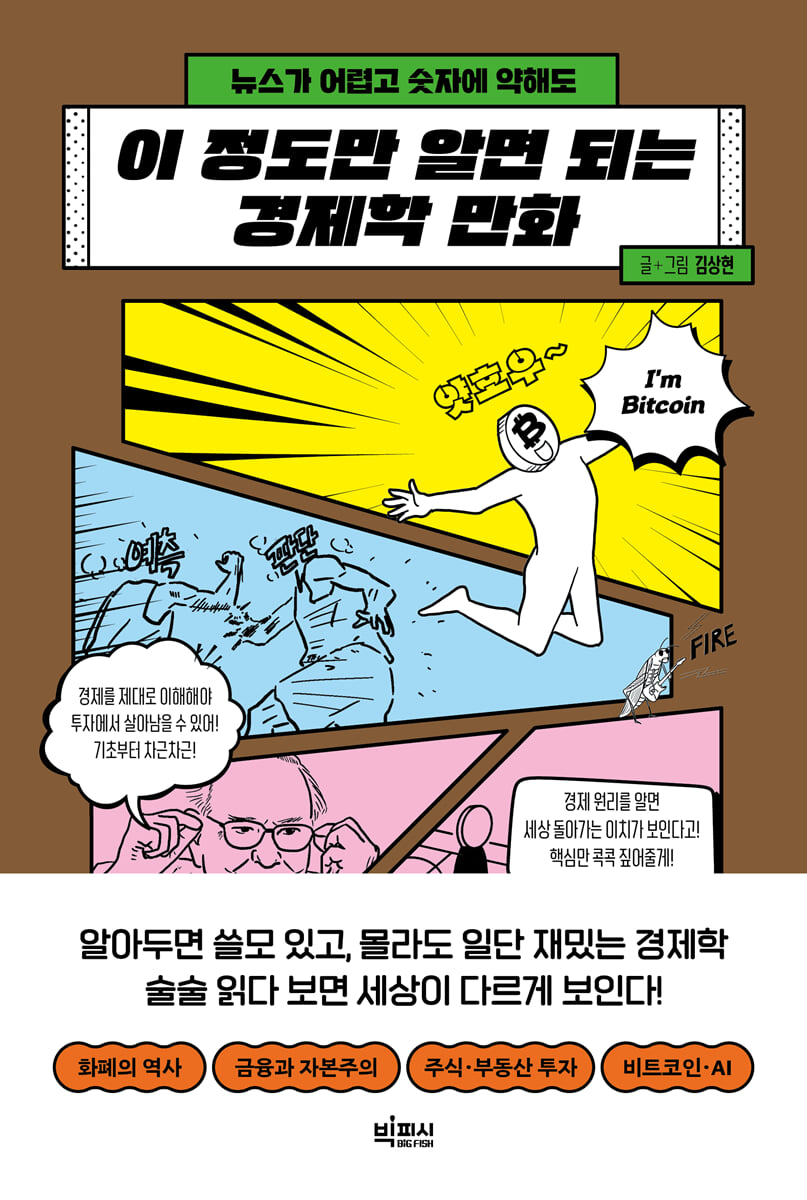
This is all you need to know about economics comics
 |
Description
Book Introduction
My head hurts just from watching economic news
An economics comic that even 'economics illiterate' can read with a smile!
Stocks, housing prices, AI... Everyone seems to know about these things, but I feel like I'm the only one who doesn't know anything.
So, when I try to read some economic news, I get scared because of the unfamiliar terms and difficult graphs, which creates the preconceived notion that economics is difficult.
For those people, "Economics Comics You Just Need to Know" contains, as the title suggests, the minimum economic knowledge needed right now in one volume.
From real-world issues like inflation, housing prices, stocks, and real estate to cutting-edge economic issues like Bitcoin, K-pop, fake news, and AI.
“Is this also economics?” It clearly answers questions that people are curious about but have never been able to easily explain.
From those who subscribe to economic newsletters but don't understand them and just let them pile up in their inbox, to those who find economic news to be a foreign language, to those who get a headache just looking at numbers like various economic indicators or statistics, to those who blindly buy stocks that their friends buy, to high school students who want to study economics knowledge in a fun way before taking the 'Finance and Economic Life' course, if you want to approach economics in an easy way, open this book right now.
An economics comic that even 'economics illiterate' can read with a smile!
Stocks, housing prices, AI... Everyone seems to know about these things, but I feel like I'm the only one who doesn't know anything.
So, when I try to read some economic news, I get scared because of the unfamiliar terms and difficult graphs, which creates the preconceived notion that economics is difficult.
For those people, "Economics Comics You Just Need to Know" contains, as the title suggests, the minimum economic knowledge needed right now in one volume.
From real-world issues like inflation, housing prices, stocks, and real estate to cutting-edge economic issues like Bitcoin, K-pop, fake news, and AI.
“Is this also economics?” It clearly answers questions that people are curious about but have never been able to easily explain.
From those who subscribe to economic newsletters but don't understand them and just let them pile up in their inbox, to those who find economic news to be a foreign language, to those who get a headache just looking at numbers like various economic indicators or statistics, to those who blindly buy stocks that their friends buy, to high school students who want to study economics knowledge in a fun way before taking the 'Finance and Economic Life' course, if you want to approach economics in an easy way, open this book right now.
- You can preview some of the book's contents.
Preview
index
Prologue: Economics is a powerful tool for understanding the world.
PART 01.
Is this also economics?
Episode 1.
Revenge is my power… or is it the power of society?
_Why do people seek revenge even when they suffer losses?
[Background knowledge to read when you want to look smart] Are humans selfish and rational beings?
Episode 2.
I worked hard to get hired, but I want to quit.
_Why do people want to do meaningful work?
_Who will do what the market doesn't do?
Episode 3.
Economic Principles in the Nagging to Study
_Why do some parents discipline their children more strictly?
[Background Reading for Those Who Want to Look Smart] Study Secrets Revealed by Economics
PART 02.
Is economics essential to becoming rich?
Episode 4.
The 3 Steps to Failure for Beginner Investors
_Why do we lose our minds when it comes to stocks?
[Background Reading for Those Who Want to Look Smart] A Psychologist Who Won the Nobel Prize in Economics
Episode 5.
The easiest way to make money with stocks
How to create a successful stock portfolio?
_How do I find the right investment method for me?
Episode 6.
Squid game? No, real estate game.
Why is real estate sensitive to interest rates?
_Can the lease system continue to exist?
Episode 7.
How about getting Albabee in coins?
_Can Bitcoin become money?
PART 03.
Is there economics hidden in popular culture?
Episode 8.
The formula for success for global K-pop stars
_Why do only a few become stars as the market grows?
[Background Reading for Those Who Want to Look Smart] The Partners and Rivals That Drive the Economy
Episode 9.
I want to be an influencer, but my followers aren't growing.
_Why do famous people become famous more easily?
Episode 10.
People want to hear fake news?
_Will truth or lies win in the news market?
_Why do political news consumers only believe what they want to believe?
PART 04.
Predicting the future with economics?
Episode 11. In the AI era, what will humans do for a living?
Can humans and AI coexist?
_Does data belong to the company or to the consumer?
Episode 12.
Blue Marble is an unfair game to begin with.
_Why are we poor even though we work hard?
_One solution to the economic rent problem
Episode 13.
Does raising the minimum wage really increase unemployment?
_How will the minimum wage affect the market?
[Background Reading for Those Who Want to Look Smart] Why Experiments Are Necessary in Economics
Episode 14.
Does anyone know why the world is so unequal?
_Why do only the rich continue to get richer?
_What is the difference between the truly rich and the high-income earners?
References
PART 01.
Is this also economics?
Episode 1.
Revenge is my power… or is it the power of society?
_Why do people seek revenge even when they suffer losses?
[Background knowledge to read when you want to look smart] Are humans selfish and rational beings?
Episode 2.
I worked hard to get hired, but I want to quit.
_Why do people want to do meaningful work?
_Who will do what the market doesn't do?
Episode 3.
Economic Principles in the Nagging to Study
_Why do some parents discipline their children more strictly?
[Background Reading for Those Who Want to Look Smart] Study Secrets Revealed by Economics
PART 02.
Is economics essential to becoming rich?
Episode 4.
The 3 Steps to Failure for Beginner Investors
_Why do we lose our minds when it comes to stocks?
[Background Reading for Those Who Want to Look Smart] A Psychologist Who Won the Nobel Prize in Economics
Episode 5.
The easiest way to make money with stocks
How to create a successful stock portfolio?
_How do I find the right investment method for me?
Episode 6.
Squid game? No, real estate game.
Why is real estate sensitive to interest rates?
_Can the lease system continue to exist?
Episode 7.
How about getting Albabee in coins?
_Can Bitcoin become money?
PART 03.
Is there economics hidden in popular culture?
Episode 8.
The formula for success for global K-pop stars
_Why do only a few become stars as the market grows?
[Background Reading for Those Who Want to Look Smart] The Partners and Rivals That Drive the Economy
Episode 9.
I want to be an influencer, but my followers aren't growing.
_Why do famous people become famous more easily?
Episode 10.
People want to hear fake news?
_Will truth or lies win in the news market?
_Why do political news consumers only believe what they want to believe?
PART 04.
Predicting the future with economics?
Episode 11. In the AI era, what will humans do for a living?
Can humans and AI coexist?
_Does data belong to the company or to the consumer?
Episode 12.
Blue Marble is an unfair game to begin with.
_Why are we poor even though we work hard?
_One solution to the economic rent problem
Episode 13.
Does raising the minimum wage really increase unemployment?
_How will the minimum wage affect the market?
[Background Reading for Those Who Want to Look Smart] Why Experiments Are Necessary in Economics
Episode 14.
Does anyone know why the world is so unequal?
_Why do only the rich continue to get richer?
_What is the difference between the truly rich and the high-income earners?
References
Detailed image

Into the book
From an economic perspective, saying something to someone who isn't wearing a mask is quite energy-intensive, and it's something no selfish, rational person would do.
But people in our country were different.
Wasn't it thanks to those who pointed out to those who weren't wearing masks, even wasting their energy, that we were able to overcome COVID-19 so successfully?
--- p.25, from “Why do people seek revenge even when they suffer losses?”
The two economists found that economic structure affects parent-child relationships.
As the wage gap between those who graduated from good universities and those who did not grows, parents are educating their children more strictly to send them to good universities.
They also expressed concern that children of wealthier parents, who can provide more support, are more likely to go to good universities.
That economic inequality can be passed down.
--- p.54-55, from “Why do some parents educate their children more strictly?”
Will housing prices rise or fall in the future? Like most asset markets, it's difficult to predict how the real estate market will perform.
There are various reasons, but 'self-fulfilling expectations' are one of the reasons that make it difficult to predict housing prices.
For example, if many people expect house prices to rise in the future, they will try to buy a house when the price is a little lower.
So, as more people start to buy homes, home prices actually go up.
It doesn't matter how those expectations were formed in the first place.
It could be an unfounded expectation.
--- p.101-102, from “Why is real estate sensitive to interest rates?”
Economists Matthew Zenzkow and Jesse Shapiro analyzed political news reported by major U.S. daily newspapers.
And we found that a newspaper's political bias (conservative, liberal, centrist) is driven more by its readers than by its owners.
This means that market competition can reduce information distortion on the supply side of news providers.
However, if the demand side wants to distort the news, the distortion of the news can become more severe in order to survive in the market.
--- p.163, from “Will truth or lies win in the news market?”
If AI technology that replaces humans continues to be developed, many people will lose their jobs.
But what if we put humans at the center and developed and utilized AI technologies that complement them? Perhaps this would lead to even greater productivity for the human workforce.
If labor productivity improves, more jobs may be created.
So, Azemoglu and Johnson emphasize:
The path of technological development is not a one-way street, so we cannot just sit back and watch.
He said that more people need to be interested and discuss what kind of AI technology will be developed and used in the future.
But people in our country were different.
Wasn't it thanks to those who pointed out to those who weren't wearing masks, even wasting their energy, that we were able to overcome COVID-19 so successfully?
--- p.25, from “Why do people seek revenge even when they suffer losses?”
The two economists found that economic structure affects parent-child relationships.
As the wage gap between those who graduated from good universities and those who did not grows, parents are educating their children more strictly to send them to good universities.
They also expressed concern that children of wealthier parents, who can provide more support, are more likely to go to good universities.
That economic inequality can be passed down.
--- p.54-55, from “Why do some parents educate their children more strictly?”
Will housing prices rise or fall in the future? Like most asset markets, it's difficult to predict how the real estate market will perform.
There are various reasons, but 'self-fulfilling expectations' are one of the reasons that make it difficult to predict housing prices.
For example, if many people expect house prices to rise in the future, they will try to buy a house when the price is a little lower.
So, as more people start to buy homes, home prices actually go up.
It doesn't matter how those expectations were formed in the first place.
It could be an unfounded expectation.
--- p.101-102, from “Why is real estate sensitive to interest rates?”
Economists Matthew Zenzkow and Jesse Shapiro analyzed political news reported by major U.S. daily newspapers.
And we found that a newspaper's political bias (conservative, liberal, centrist) is driven more by its readers than by its owners.
This means that market competition can reduce information distortion on the supply side of news providers.
However, if the demand side wants to distort the news, the distortion of the news can become more severe in order to survive in the market.
--- p.163, from “Will truth or lies win in the news market?”
If AI technology that replaces humans continues to be developed, many people will lose their jobs.
But what if we put humans at the center and developed and utilized AI technologies that complement them? Perhaps this would lead to even greater productivity for the human workforce.
If labor productivity improves, more jobs may be created.
So, Azemoglu and Johnson emphasize:
The path of technological development is not a one-way street, so we cannot just sit back and watch.
He said that more people need to be interested and discuss what kind of AI technology will be developed and used in the future.
--- p.180, from “Can Humans and AI Coexist?”
Publisher's Review
For those of us who are still having a difficult time economically
Contains only the minimum economic knowledge you need to know right now!
People who find news difficult, people who are afraid of numbers
An easy-to-read economics comic
? The law of supply and demand determines my salary?
Why is real estate so sensitive to interest rates?
What do money-making stock portfolios have in common?
Will Bitcoin eventually become a currency? What is the essence of currency?
Stocks, housing prices, AI... Everyone seems to know about these things, but I feel like I'm the only one who doesn't know anything.
So, when I try to read some economic news, I get scared because of the unfamiliar terms and difficult graphs, which creates the preconceived notion that economics is difficult.
I feel like I'll just lose money if I start investing in stocks or Bitcoin like everyone else, and when I see news about rising house prices, I wonder why I should study economics since I probably won't own a house there anyway.
But economics is more than just a way to make money wisely; it's a necessary discipline for understanding what's happening around us and making better choices in our lives.
As the title suggests, "Economics Comics You Just Need to Know" is a book that contains the minimum economic knowledge you need right now.
This book was written by Professor Sang-Hyeon Kim, who has been loved for his economics comics serialized on social media. He has selected economic knowledge needed today from his comics and has written stories that could not be included in the comics in an easy-to-understand way.
From practical issues like inflation, housing prices, stocks, and real estate to the latest economic issues like Bitcoin, K-pop, fake news, and AI, it provides clear answers to questions you've been curious about but haven't had easy answers to.
“Oh, this was economics too?”
Once you understand economics, you will see a deeper and wider world!
It's easy to think of economics as a vague, difficult discipline that deals with money.
If you think about it, economics is close to our daily lives.
This book, which addresses the questions most relevant to our daily lives from an economic perspective, is divided into four chapters.
Chapter 1 covers everyday economics to understand the problems of making a living, such as why prices keep rising and housing prices are skyrocketing.
Chapter 2 provides the basic knowledge for a smart financial life, including the stock investment secrets of successful people and the future of Bitcoin.
Chapter 3 tells the fascinating economic stories hidden in popular culture, such as why we are easily deceived by fake news and the secrets to K-pop's success.
Chapter 4 introduces economic approaches to creating a better world, including scenarios where AI and humans can coexist and considerations for alleviating social inequality.
In particular, this book covers a wide range of economic research by prominent economists.
From Richard Thaler, known as the 'father of behavioral economics', to Thomas Piketty, who studied wealth inequality.
As you read the stories of economists, moving between comics and text, you will naturally begin to understand the flow of economics.
In addition, for readers who want to understand economics more deeply, we provide a separate section called 'Background Knowledge to Read When You Want to Look Smart', which is filled with economic common sense that will make you look like you know it.
Economics doesn't get any easier than this.
Now is the time to start studying economics!
After reading this book, you'll find that economic news feels less unfamiliar and you'll be able to confidently join in conversations around you.
From those who subscribe to economic newsletters but don't understand them when they read them, to those who find economic news to be a foreign language, to those who get a headache just looking at numbers like various economic indicators or statistics, to those who blindly buy stocks following their friends, to high school students who want to learn economics in a fun way before taking the "Finance and Economic Life" course.
Anyone who wants to learn economics in an easy way should open this book.
Economics, which once felt difficult and unfamiliar, will become a window through which you can view the world in a new way.
Contains only the minimum economic knowledge you need to know right now!
People who find news difficult, people who are afraid of numbers
An easy-to-read economics comic
? The law of supply and demand determines my salary?
Why is real estate so sensitive to interest rates?
What do money-making stock portfolios have in common?
Will Bitcoin eventually become a currency? What is the essence of currency?
Stocks, housing prices, AI... Everyone seems to know about these things, but I feel like I'm the only one who doesn't know anything.
So, when I try to read some economic news, I get scared because of the unfamiliar terms and difficult graphs, which creates the preconceived notion that economics is difficult.
I feel like I'll just lose money if I start investing in stocks or Bitcoin like everyone else, and when I see news about rising house prices, I wonder why I should study economics since I probably won't own a house there anyway.
But economics is more than just a way to make money wisely; it's a necessary discipline for understanding what's happening around us and making better choices in our lives.
As the title suggests, "Economics Comics You Just Need to Know" is a book that contains the minimum economic knowledge you need right now.
This book was written by Professor Sang-Hyeon Kim, who has been loved for his economics comics serialized on social media. He has selected economic knowledge needed today from his comics and has written stories that could not be included in the comics in an easy-to-understand way.
From practical issues like inflation, housing prices, stocks, and real estate to the latest economic issues like Bitcoin, K-pop, fake news, and AI, it provides clear answers to questions you've been curious about but haven't had easy answers to.
“Oh, this was economics too?”
Once you understand economics, you will see a deeper and wider world!
It's easy to think of economics as a vague, difficult discipline that deals with money.
If you think about it, economics is close to our daily lives.
This book, which addresses the questions most relevant to our daily lives from an economic perspective, is divided into four chapters.
Chapter 1 covers everyday economics to understand the problems of making a living, such as why prices keep rising and housing prices are skyrocketing.
Chapter 2 provides the basic knowledge for a smart financial life, including the stock investment secrets of successful people and the future of Bitcoin.
Chapter 3 tells the fascinating economic stories hidden in popular culture, such as why we are easily deceived by fake news and the secrets to K-pop's success.
Chapter 4 introduces economic approaches to creating a better world, including scenarios where AI and humans can coexist and considerations for alleviating social inequality.
In particular, this book covers a wide range of economic research by prominent economists.
From Richard Thaler, known as the 'father of behavioral economics', to Thomas Piketty, who studied wealth inequality.
As you read the stories of economists, moving between comics and text, you will naturally begin to understand the flow of economics.
In addition, for readers who want to understand economics more deeply, we provide a separate section called 'Background Knowledge to Read When You Want to Look Smart', which is filled with economic common sense that will make you look like you know it.
Economics doesn't get any easier than this.
Now is the time to start studying economics!
After reading this book, you'll find that economic news feels less unfamiliar and you'll be able to confidently join in conversations around you.
From those who subscribe to economic newsletters but don't understand them when they read them, to those who find economic news to be a foreign language, to those who get a headache just looking at numbers like various economic indicators or statistics, to those who blindly buy stocks following their friends, to high school students who want to learn economics in a fun way before taking the "Finance and Economic Life" course.
Anyone who wants to learn economics in an easy way should open this book.
Economics, which once felt difficult and unfamiliar, will become a window through which you can view the world in a new way.
GOODS SPECIFICS
- Date of issue: September 29, 2025
- Page count, weight, size: 244 pages | 364g | 148*220*16mm
- ISBN13: 9791199401068
- ISBN10: 1199401064
You may also like
카테고리
korean


korean

![GQ KOREA Mark (Monthly): December [2025]](http://librairie.coreenne.fr/cdn/shop/files/8ef265dbbfbf186523ed75ba7319009d.jpg?v=1765340328&width=3840)


