

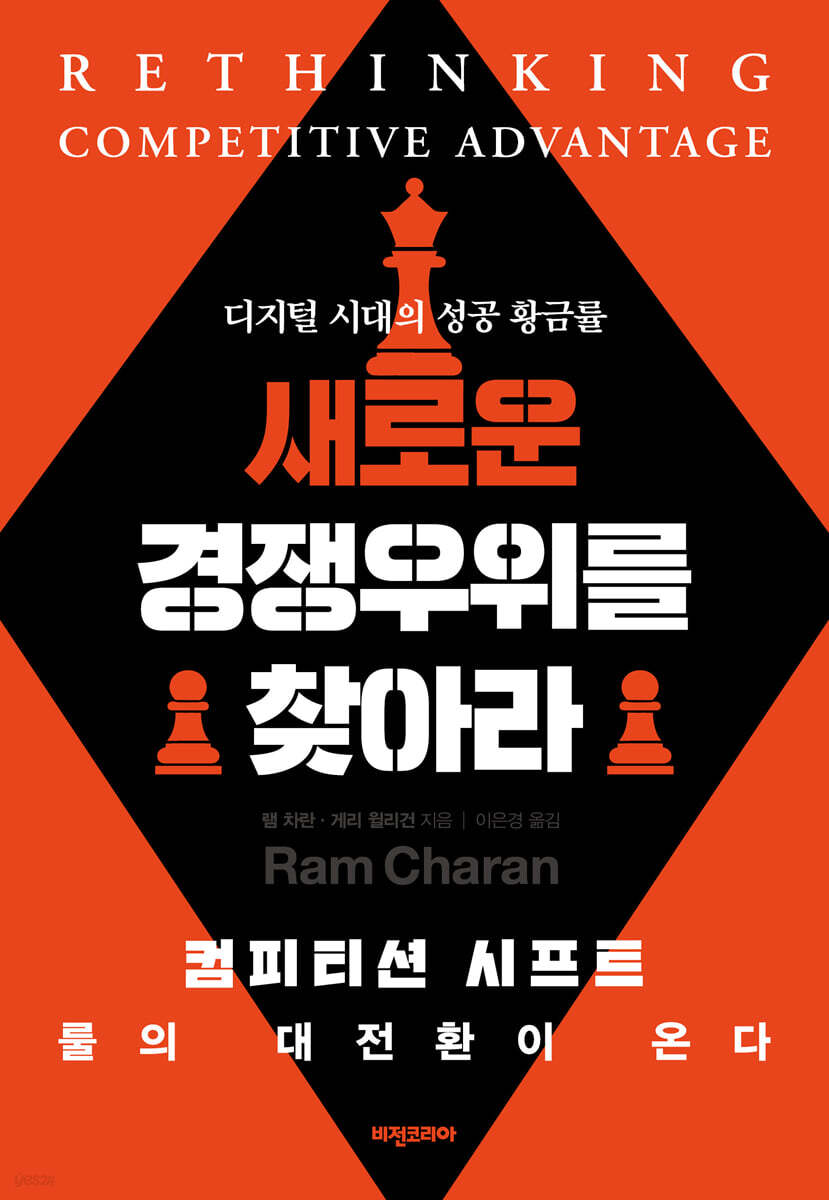
Find new competitive advantages
 |
Description
Book Introduction
The Golden Rule of Success in the Digital Age
“The greatest competitive advantage lies in the minds of our customers!”
The corporate environment is rapidly changing due to the acceleration of digital transformation and the COVID-19 pandemic.
While companies like Amazon and Tesla quickly adapted to rapid change and generated more profits through it, many others failed to join this trend, falling behind in competition or even disappearing from the business ecosystem.
We have entered an era where high market share or company size are no longer competitive factors.
Competitive advantage in the digital age depends on understanding consumer needs even before they are realized and creating tremendous value for shareholders.
The best digital companies are platform-based, focused on customer data, inviting third parties into their ecosystems to drive competition, and envisioning personalized customer experiences in markets 100 or 1,000 times larger than today.
In his book Rethinking Competitive Advantage, Harvard business guru and bestselling author Ram Charan, after observing digital giants for years, identifies new rules for creating competitive advantage.
In this book, he announces that the rules of competition between companies are undergoing a major shift, and introduces the secrets to success of giant digital companies and the new competitive advantages that traditional companies must possess to keep up with them in the digital transformation era.
“The greatest competitive advantage lies in the minds of our customers!”
The corporate environment is rapidly changing due to the acceleration of digital transformation and the COVID-19 pandemic.
While companies like Amazon and Tesla quickly adapted to rapid change and generated more profits through it, many others failed to join this trend, falling behind in competition or even disappearing from the business ecosystem.
We have entered an era where high market share or company size are no longer competitive factors.
Competitive advantage in the digital age depends on understanding consumer needs even before they are realized and creating tremendous value for shareholders.
The best digital companies are platform-based, focused on customer data, inviting third parties into their ecosystems to drive competition, and envisioning personalized customer experiences in markets 100 or 1,000 times larger than today.
In his book Rethinking Competitive Advantage, Harvard business guru and bestselling author Ram Charan, after observing digital giants for years, identifies new rules for creating competitive advantage.
In this book, he announces that the rules of competition between companies are undergoing a major shift, and introduces the secrets to success of giant digital companies and the new competitive advantages that traditional companies must possess to keep up with them in the digital transformation era.
- You can preview some of the book's contents.
Preview
index
Introduction: The New Rules of the Digital Age
Chapter 1: Why Digital Giants Win
Chapter 2: New World, New Rules
Chapter 3: The 10x, 100x, and 1000x Market
Chapter 4: Digital Platform-Centric Business
Chapter 5: Value Creation Ecosystem
Chapter 6: Revenue Structure for the Digital Age
Chapter 7: Team-centered instead of complex organizations
Chapter 8: Leaders Creating the Future
Chapter 9: Rethinking Competitive Advantage
Acknowledgements
Appendix: Are You Ready to Compete in the Digital Age?
Chapter 1: Why Digital Giants Win
Chapter 2: New World, New Rules
Chapter 3: The 10x, 100x, and 1000x Market
Chapter 4: Digital Platform-Centric Business
Chapter 5: Value Creation Ecosystem
Chapter 6: Revenue Structure for the Digital Age
Chapter 7: Team-centered instead of complex organizations
Chapter 8: Leaders Creating the Future
Chapter 9: Rethinking Competitive Advantage
Acknowledgements
Appendix: Are You Ready to Compete in the Digital Age?
Detailed image

Into the book
Competitive advantage comes as much from what a company does as from what it has.
For example, how to recognize the consumer experience, select leaders, organize work, make money, as well as building ecosystems, accessing data, and raising funds.
Once you have a source of competitive advantage, traditional companies simply cannot catch up.
Because the competitive advantage is deeply rooted in exponential growth and an action-oriented culture, more data means better consumer insights, and bigger scale means more cash.
By making better predictions, we can increase customer satisfaction at a lower cost, which in turn increases revenue and cash gross margin, leading to better innovation and service for consumers.
--- p.8, from “Introduction_ New Rules of the Digital Age”
The content that subscribers can choose to watch is produced by other companies and licensed under a contract.
Traditional companies that collected royalties had satisfactory profit and loss statements.
They increased their revenue and income with the content they had already created.
But what Netflix got from licensing deals in its early years was far more valuable.
It was a future with very promising prospects.
The expanded catalog attracted existing subscribers and attracted new ones.
Netflix's growth curve has been steep and its cash flow has increased.
Hastings expects that over time, some ecosystem partners will expire their licensing agreements and at some point, they will jump into the streaming market themselves.
To continue growing its catalog, Netflix began investing in original content in 2009.
The company analyzed people's viewing preferences and decided what kind of stories to produce and which actors to cast.
--- p.23-24, from “Chapter 1_ Why Digital Giants Win”
Previously, changes appeared to be gradual.
So companies would spend weeks or months analyzing the competitive environment and developing strategies that they believed would remain effective for at least several years.
But today, a change that borders on transformation is occurring on a large scale.
Every company needs to be able to recognize what might render their best-laid plans useless tomorrow and quickly change course.
If you stay too long in the narrow view of core competencies, you will suffer a major blow as you will not be able to develop the new capabilities you need.
Netflix and Hulu were early adopters of streaming capabilities.
Disney, Apple, Amazon, and WarnerMedia had such capabilities years later.
Fox stalled to build its streaming capabilities and then sold its film assets to Disney to avoid financial losses.
--- p.46-47, from “Chapter 2_ New World, New Rules”
Unless a company makes or sells products directly to consumers, few companies will spend time and money trying to understand their consumers.
But at that point, you have to take action right away.
There is a huge opportunity in that area where companies are very vulnerable.
It is also a place where consumer complaints fester and everyday problems go unnoticed.
This is how businesses and leaders can tap into consumer frustrations and gain insights into what motivates them through honest conversations on social media.
Consumers are the ultimate source of ideas that can drive exponential growth over the years.
--- p.61-65, from “Chapter 3 _ 10x, 100x, 1,000x Market”
Ecosystems are never permanent.
As the world moves at such a breakneck pace, technological change continues to accelerate, consumer expectations continue to evolve, and finding new partnerships and shedding old ones has become routine.
Additionally, successful ecosystem partners are more likely to be approached by other companies or ecosystems, so it's important to continue to maintain existing relationships.
As revenue pools evolve, maintaining a balanced ecosystem across data and revenue is an ongoing challenge.
But the most important task is to envision the entire ecosystem.
The questions are: what kind of experience will it provide to consumers, how will partners enhance each other's capabilities, and how will success be measured and shared.
--- p.141-142, from “Chapter 5 _ Value Creation Ecosystem”
Amazon invests cash whenever it expands its consumer experience in new areas or pioneers new territories.
Amazon's pattern is to fund one or more large-scale, multifaceted experiments.
Experiments that continue to show promise receive additional funding.
As Bezos quickly acknowledged, while there have been failures, successes have generated massive cash flows that can fuel further experimentation and potentially huge rewards.
Amazon's cash gross profit is expected to increase from approximately $60 billion in 2017 to $160 billion in 2021.
This is a scale that allows it to invest sufficient funds in its own chip manufacturing division, quantum computers, or other potential new initiatives.
Aggressively pursuing growth, digital giants are quick to divest from unprofitable areas and reallocate cash to more promising ones.
Rapid change is second nature to them.
By focusing on consumers and testing new ideas early, you avoid wasting resources on products or services that customers won't pay for.
--- p.156-157, from “Chapter 6_ Revenue Structure for the Digital Age”
Digital giants expect their employees to be idea generators, problem solvers, team players, and learners.
At Netflix, for example, the expectations for salaried employees are different from those found at Fortune 500 companies.
They clearly state their expectations in the following words:
“Someone who creates new ideas that prove useful,” “Someone who inspires others with a thirst for excellence,” “Someone who puts aside stubbornness to find the best idea,” and “Someone who learns quickly and enthusiastically.”
These characteristics are recurring themes in the digital world.
These are topics that have a decisive impact on employment, and repeating them frequently shapes the culture.
--- p.199-200, from “Chapter 7_Team-centered instead of complex organization”
They have the mental capacity to think in terms of 10x or 100x, the ability to imagine future spaces that don't exist, and the confidence to overcome any obstacle.
They know their customers well, are customer-focused, and have the imagination and vision to envision the end-to-end customer experience and the future space at scale.
We're also exploring how revenue structures and the company's ecosystem can collaborate in new and sustainable ways.
They make big bets amid Wall Street's skepticism and skepticism, willing to take early profits and cash losses because they have a clear picture of how things will unfold.
They are confident that they can build an ecosystem on a massive scale and that every market they enter has the potential to expand.
For example, how to recognize the consumer experience, select leaders, organize work, make money, as well as building ecosystems, accessing data, and raising funds.
Once you have a source of competitive advantage, traditional companies simply cannot catch up.
Because the competitive advantage is deeply rooted in exponential growth and an action-oriented culture, more data means better consumer insights, and bigger scale means more cash.
By making better predictions, we can increase customer satisfaction at a lower cost, which in turn increases revenue and cash gross margin, leading to better innovation and service for consumers.
--- p.8, from “Introduction_ New Rules of the Digital Age”
The content that subscribers can choose to watch is produced by other companies and licensed under a contract.
Traditional companies that collected royalties had satisfactory profit and loss statements.
They increased their revenue and income with the content they had already created.
But what Netflix got from licensing deals in its early years was far more valuable.
It was a future with very promising prospects.
The expanded catalog attracted existing subscribers and attracted new ones.
Netflix's growth curve has been steep and its cash flow has increased.
Hastings expects that over time, some ecosystem partners will expire their licensing agreements and at some point, they will jump into the streaming market themselves.
To continue growing its catalog, Netflix began investing in original content in 2009.
The company analyzed people's viewing preferences and decided what kind of stories to produce and which actors to cast.
--- p.23-24, from “Chapter 1_ Why Digital Giants Win”
Previously, changes appeared to be gradual.
So companies would spend weeks or months analyzing the competitive environment and developing strategies that they believed would remain effective for at least several years.
But today, a change that borders on transformation is occurring on a large scale.
Every company needs to be able to recognize what might render their best-laid plans useless tomorrow and quickly change course.
If you stay too long in the narrow view of core competencies, you will suffer a major blow as you will not be able to develop the new capabilities you need.
Netflix and Hulu were early adopters of streaming capabilities.
Disney, Apple, Amazon, and WarnerMedia had such capabilities years later.
Fox stalled to build its streaming capabilities and then sold its film assets to Disney to avoid financial losses.
--- p.46-47, from “Chapter 2_ New World, New Rules”
Unless a company makes or sells products directly to consumers, few companies will spend time and money trying to understand their consumers.
But at that point, you have to take action right away.
There is a huge opportunity in that area where companies are very vulnerable.
It is also a place where consumer complaints fester and everyday problems go unnoticed.
This is how businesses and leaders can tap into consumer frustrations and gain insights into what motivates them through honest conversations on social media.
Consumers are the ultimate source of ideas that can drive exponential growth over the years.
--- p.61-65, from “Chapter 3 _ 10x, 100x, 1,000x Market”
Ecosystems are never permanent.
As the world moves at such a breakneck pace, technological change continues to accelerate, consumer expectations continue to evolve, and finding new partnerships and shedding old ones has become routine.
Additionally, successful ecosystem partners are more likely to be approached by other companies or ecosystems, so it's important to continue to maintain existing relationships.
As revenue pools evolve, maintaining a balanced ecosystem across data and revenue is an ongoing challenge.
But the most important task is to envision the entire ecosystem.
The questions are: what kind of experience will it provide to consumers, how will partners enhance each other's capabilities, and how will success be measured and shared.
--- p.141-142, from “Chapter 5 _ Value Creation Ecosystem”
Amazon invests cash whenever it expands its consumer experience in new areas or pioneers new territories.
Amazon's pattern is to fund one or more large-scale, multifaceted experiments.
Experiments that continue to show promise receive additional funding.
As Bezos quickly acknowledged, while there have been failures, successes have generated massive cash flows that can fuel further experimentation and potentially huge rewards.
Amazon's cash gross profit is expected to increase from approximately $60 billion in 2017 to $160 billion in 2021.
This is a scale that allows it to invest sufficient funds in its own chip manufacturing division, quantum computers, or other potential new initiatives.
Aggressively pursuing growth, digital giants are quick to divest from unprofitable areas and reallocate cash to more promising ones.
Rapid change is second nature to them.
By focusing on consumers and testing new ideas early, you avoid wasting resources on products or services that customers won't pay for.
--- p.156-157, from “Chapter 6_ Revenue Structure for the Digital Age”
Digital giants expect their employees to be idea generators, problem solvers, team players, and learners.
At Netflix, for example, the expectations for salaried employees are different from those found at Fortune 500 companies.
They clearly state their expectations in the following words:
“Someone who creates new ideas that prove useful,” “Someone who inspires others with a thirst for excellence,” “Someone who puts aside stubbornness to find the best idea,” and “Someone who learns quickly and enthusiastically.”
These characteristics are recurring themes in the digital world.
These are topics that have a decisive impact on employment, and repeating them frequently shapes the culture.
--- p.199-200, from “Chapter 7_Team-centered instead of complex organization”
They have the mental capacity to think in terms of 10x or 100x, the ability to imagine future spaces that don't exist, and the confidence to overcome any obstacle.
They know their customers well, are customer-focused, and have the imagination and vision to envision the end-to-end customer experience and the future space at scale.
We're also exploring how revenue structures and the company's ecosystem can collaborate in new and sustainable ways.
They make big bets amid Wall Street's skepticism and skepticism, willing to take early profits and cash losses because they have a clear picture of how things will unfold.
They are confident that they can build an ecosystem on a massive scale and that every market they enter has the potential to expand.
--- p.215-216, from “Chapter 8: Leaders Creating the Future”
Publisher's Review
Harvard business guru Ram Charan says
A New Competitive Advantage in the Digital Age
In the 1970s, when multimillion-dollar giant computers processed corporate information, Bill Gates envisioned a world where every office desk and every home had a personal computer.
He believed it would be a huge market.
Netflix has exponentially expanded and redefined the entertainment landscape, from movies shown in theaters and on cable TV to content streamed anytime, anywhere, and even globally across a wide range of devices.
In a competitive environment where digital giants are challenging each other, "first mover advantage" and "winner takes all" don't work.
While first movers may be able to expand quickly, whatever large market they create will inevitably be entered by other latecomers, and the winners don't really take everything.
At least not forever.
Singapore's DBS Bank has become the "world's leading digital bank," competing with Amazon and Alibaba, while Shopify and Flipkart are emerging as rivals in Amazon's monopoly on e-commerce.
Microsoft and Adobe, traditional software companies, shifted their focus from selling to corporate customers to providing end-user services. Honeywell, an aircraft parts manufacturer, transformed into a biotechnology platform provider. Walmart successfully digitized through aggressive M&A and bold investments.
The greatest power of digital platforms lies in their ability to support entirely new and diverse revenue models.
Amazon Web Services (AWS), which was originally used to support third-party sellers on Amazon's own marketplace, has now become the company's most profitable division, eventually attracting the likes of Google, Microsoft, Alibaba, and IBM.
Uber, Lyft, Didi Chuxing, and other digital companies provide products and services based on complex calculations that are virtually impossible to handle without algorithms.
Through the same digital platform, they are expanding into new services and revenue streams, such as food delivery.
Rethinking Competitive Advantage
Competitive advantage in the digital age goes to those who build ecosystems or networks that leverage digital technologies for the benefit of consumers, opening up multiple revenue streams.
The most powerful ecosystems create network effects where all participants—customers, partners, and businesses—benefit and collectively generate explosive revenue.
But ecosystems are never permanent.
As the world moves at such a breakneck pace, technological change continues to accelerate, consumer expectations continue to evolve, and finding new partnerships and shedding old ones has become routine.
The threat isn't individual companies, but the ecosystems they build. BMW and Mercedes, traditional auto industry rivals, have shifted from adversaries to partners, and director Steven Spielberg, who argued over Netflix's Oscar win in 2019, finally agreed to make exclusive films with Netflix in June 2021.
Successful organizations recognize that consumer tastes and expectations are constantly evolving, and they embrace the fact that the technologies that underpin their revenue models are also evolving.
New sources of competitive advantage will emerge, and the competitive landscape will continue to shift.
In the digital age, where a fundamental shift in rules is occurring, traditional companies must continuously reexamine and refine their competitive edge by understanding the minds of consumers (customers) and improving or redesigning the end-to-end experience.
6 Competitive Advantages of Successful Digital Companies
Rule 1: Imagine personalized customer experiences in a market that's 100x or 1,000x larger.
Rule 2: Algorithms and data are essential competitive weapons.
Rule 3 The winner-take-all society is over.
Collaborate and compete in the ecosystem
Rule 4: Create a revenue structure that generates massive cash flow.
Rule 5: Equip your organization with a social engine that can move with agility.
Rule 6: Find a leader who can lead in the digital age.
A New Competitive Advantage in the Digital Age
In the 1970s, when multimillion-dollar giant computers processed corporate information, Bill Gates envisioned a world where every office desk and every home had a personal computer.
He believed it would be a huge market.
Netflix has exponentially expanded and redefined the entertainment landscape, from movies shown in theaters and on cable TV to content streamed anytime, anywhere, and even globally across a wide range of devices.
In a competitive environment where digital giants are challenging each other, "first mover advantage" and "winner takes all" don't work.
While first movers may be able to expand quickly, whatever large market they create will inevitably be entered by other latecomers, and the winners don't really take everything.
At least not forever.
Singapore's DBS Bank has become the "world's leading digital bank," competing with Amazon and Alibaba, while Shopify and Flipkart are emerging as rivals in Amazon's monopoly on e-commerce.
Microsoft and Adobe, traditional software companies, shifted their focus from selling to corporate customers to providing end-user services. Honeywell, an aircraft parts manufacturer, transformed into a biotechnology platform provider. Walmart successfully digitized through aggressive M&A and bold investments.
The greatest power of digital platforms lies in their ability to support entirely new and diverse revenue models.
Amazon Web Services (AWS), which was originally used to support third-party sellers on Amazon's own marketplace, has now become the company's most profitable division, eventually attracting the likes of Google, Microsoft, Alibaba, and IBM.
Uber, Lyft, Didi Chuxing, and other digital companies provide products and services based on complex calculations that are virtually impossible to handle without algorithms.
Through the same digital platform, they are expanding into new services and revenue streams, such as food delivery.
Rethinking Competitive Advantage
Competitive advantage in the digital age goes to those who build ecosystems or networks that leverage digital technologies for the benefit of consumers, opening up multiple revenue streams.
The most powerful ecosystems create network effects where all participants—customers, partners, and businesses—benefit and collectively generate explosive revenue.
But ecosystems are never permanent.
As the world moves at such a breakneck pace, technological change continues to accelerate, consumer expectations continue to evolve, and finding new partnerships and shedding old ones has become routine.
The threat isn't individual companies, but the ecosystems they build. BMW and Mercedes, traditional auto industry rivals, have shifted from adversaries to partners, and director Steven Spielberg, who argued over Netflix's Oscar win in 2019, finally agreed to make exclusive films with Netflix in June 2021.
Successful organizations recognize that consumer tastes and expectations are constantly evolving, and they embrace the fact that the technologies that underpin their revenue models are also evolving.
New sources of competitive advantage will emerge, and the competitive landscape will continue to shift.
In the digital age, where a fundamental shift in rules is occurring, traditional companies must continuously reexamine and refine their competitive edge by understanding the minds of consumers (customers) and improving or redesigning the end-to-end experience.
6 Competitive Advantages of Successful Digital Companies
Rule 1: Imagine personalized customer experiences in a market that's 100x or 1,000x larger.
Rule 2: Algorithms and data are essential competitive weapons.
Rule 3 The winner-take-all society is over.
Collaborate and compete in the ecosystem
Rule 4: Create a revenue structure that generates massive cash flow.
Rule 5: Equip your organization with a social engine that can move with agility.
Rule 6: Find a leader who can lead in the digital age.
GOODS SPECIFICS
- Date of issue: September 12, 2025
- Format: Hardcover book binding method guide
- Page count, weight, size: 336 pages | 570g | 148*210*30mm
- ISBN13: 9788963222301
- ISBN10: 8963222306
You may also like
카테고리
korean


korean

![GQ KOREA Mark (Monthly): December [2025]](http://librairie.coreenne.fr/cdn/shop/files/8ef265dbbfbf186523ed75ba7319009d.jpg?v=1765340328&width=3840)


