

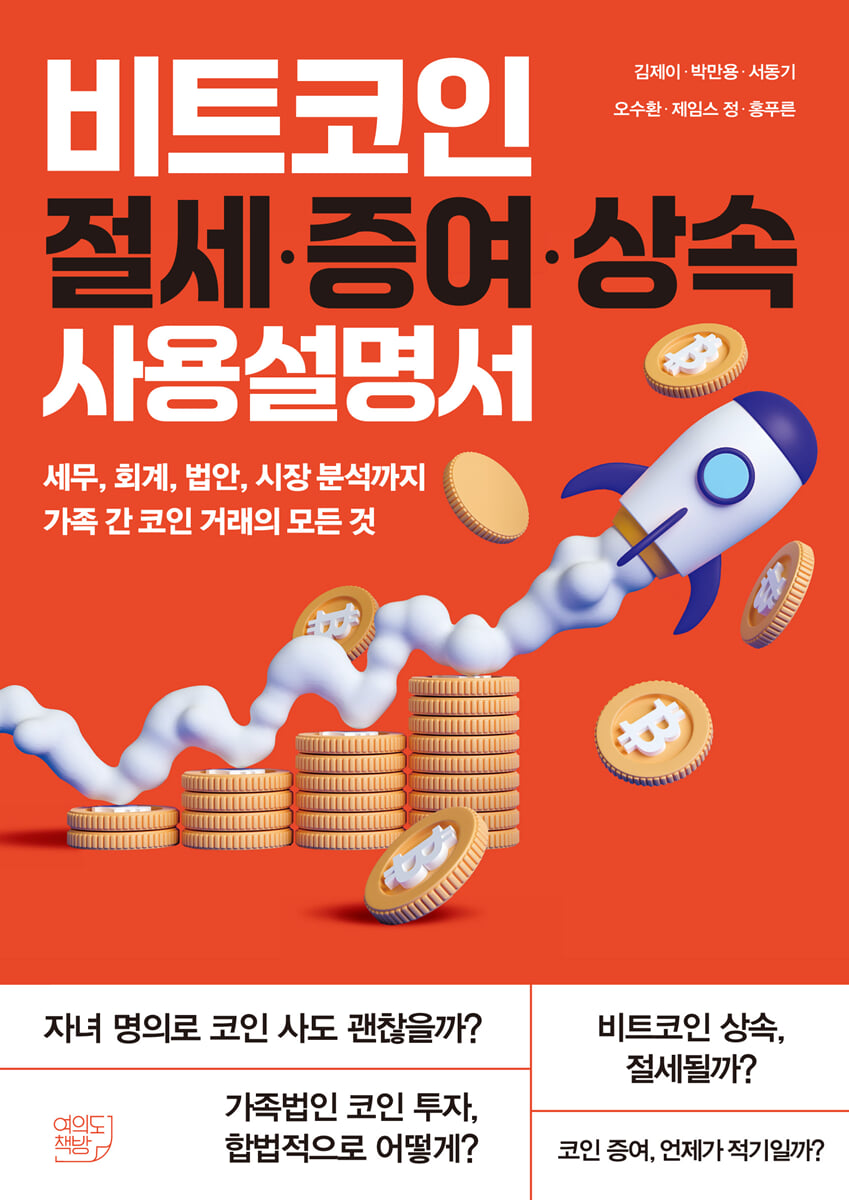
Bitcoin Tax Savings, Gifts, and Inheritance User Guide
 |
Description
Book Introduction
The most up-to-date manual for safe and stable family virtual asset trading.
"Rich Dad's Tax-Saving Strategy: The Laws of Bitcoin Inheritance and Gifting"
Tax, accounting, legal, and media experts offer family tax strategies for coin investment.
In the era of 10 million coin investors, the art of inheritance and gifting is a losing proposition.
Now that virtual assets, led by Bitcoin, have become a part of the real economy, more investors and wealthy individuals than ever before are facing new challenges: "coin donations" and "coin inheritance."
Amidst growing concerns about tax savings related to practical coin investment, such as "Is it okay to buy coins in my child's name?" and "Can I invest in coins as a family corporation?", a book has been published that provides clear answers to all of these questions.
This is a practical guidebook, "Bitcoin Tax Savings, Gifts, and Inheritance User Manual," which comprehensively covers tax saving, gifting, and inheritance issues related to virtual assets.
"Rich Dad's Tax-Saving Strategy: The Laws of Bitcoin Inheritance and Gifting"
Tax, accounting, legal, and media experts offer family tax strategies for coin investment.
In the era of 10 million coin investors, the art of inheritance and gifting is a losing proposition.
Now that virtual assets, led by Bitcoin, have become a part of the real economy, more investors and wealthy individuals than ever before are facing new challenges: "coin donations" and "coin inheritance."
Amidst growing concerns about tax savings related to practical coin investment, such as "Is it okay to buy coins in my child's name?" and "Can I invest in coins as a family corporation?", a book has been published that provides clear answers to all of these questions.
This is a practical guidebook, "Bitcoin Tax Savings, Gifts, and Inheritance User Manual," which comprehensively covers tax saving, gifting, and inheritance issues related to virtual assets.
- You can preview some of the book's contents.
Preview
index
prolog
Digital asset investors are looking for ways to wisely gift, inherit, and save on taxes with their coins.
Part 1: Bitcoin's Asset Value
1-1 Does Bitcoin really have asset value like gold?
How to get 1-2 Bitcoins
Part 2: The Legal Nature of Bitcoin Assets
2-1 Definition of Bitcoin in Domestic Law
2-2 Regulatory policies for virtual assets such as Bitcoin and their inclusion in institutional assets
2-3 A ruling that reveals the legal status of Bitcoin
2-4 Legal Conditions You Must Know When Investing, Inheriting, or Gifting Bitcoin
Part 3: Everything About Coin Inheritance and Gifting
3-1 Taxes: Knowing the Right Thing to Make Money
3-2 Taxation of Financial Income
3-3 What is acquisition tax?
3-4 Tax rates on domestic and foreign stocks
3-5 Foreign and domestic ETF tax rates
3-6 Financial Investment Income Tax
3-7 What is inheritance and gift?
3-8 How to Report Gift Tax and Inheritance Tax
3-9 Even if you borrow from family, you have to pay interest.
Save taxes through 3-10 deductions
3-11 Gift Tax Saving Strategies
3-12 Virtual Assets, Bitcoin Taxes are like this
Part 4: Corporate Accounting: Bitcoin and Its Tax Savings
4-1 Our company buys Bitcoin.
4-2 Case Study of a Global Company Holding Bitcoin: MicroStrategy
4-3 Innovation or Fickleness: Tesla's Bitcoin Experiment
4-4 Bitcoin is the currency of the internet: Block's ecosystem strategy
4-5 Leading Stablecoin: Tether
4-6 Largest Bitcoin Holding Company in Korea: Dunamu
4-7 Game company that developed virtual assets: Wemade
4-8 Other examples of holdings in listed companies
4-9 Listed Companies' Virtual Asset Accounting and Information Disclosure Obligations
4-10 Benefits of Investing in Virtual Assets
4-11 Problems and risks arising from virtual asset investment
4-12 How to invest in small businesses?
4-13 Why Companies Have a Hard Time Investing
Steps for Corporate Bitcoin Investment
4-15 How Corporations Buy Bitcoin
4-16 How Corporations Invest in Virtual Asset ETFs
4-17 A Look at the Overseas Virtual Asset ETF Market
4-18 Corporation Virtual Asset Fund Investment Act
4-19 Countries that use Bitcoin as currency
4-20 Other countries considering introducing virtual assets
Part 5: The Origin of Bitcoin
5-1 The Birth of Bitcoin
5-2 "Crypto Winter," the season when all coins freeze
5-3 Bitcoin is becoming a financial commodity
Bitcoin in the Trump Era
Part 6 Coin Exchange User Manual
6-1 How to open a domestic exchange account
6-2 How to transfer funds purchased through an exchange to a personal wallet
6-3 How to Invest in Financial Products
Digital asset investors are looking for ways to wisely gift, inherit, and save on taxes with their coins.
Part 1: Bitcoin's Asset Value
1-1 Does Bitcoin really have asset value like gold?
How to get 1-2 Bitcoins
Part 2: The Legal Nature of Bitcoin Assets
2-1 Definition of Bitcoin in Domestic Law
2-2 Regulatory policies for virtual assets such as Bitcoin and their inclusion in institutional assets
2-3 A ruling that reveals the legal status of Bitcoin
2-4 Legal Conditions You Must Know When Investing, Inheriting, or Gifting Bitcoin
Part 3: Everything About Coin Inheritance and Gifting
3-1 Taxes: Knowing the Right Thing to Make Money
3-2 Taxation of Financial Income
3-3 What is acquisition tax?
3-4 Tax rates on domestic and foreign stocks
3-5 Foreign and domestic ETF tax rates
3-6 Financial Investment Income Tax
3-7 What is inheritance and gift?
3-8 How to Report Gift Tax and Inheritance Tax
3-9 Even if you borrow from family, you have to pay interest.
Save taxes through 3-10 deductions
3-11 Gift Tax Saving Strategies
3-12 Virtual Assets, Bitcoin Taxes are like this
Part 4: Corporate Accounting: Bitcoin and Its Tax Savings
4-1 Our company buys Bitcoin.
4-2 Case Study of a Global Company Holding Bitcoin: MicroStrategy
4-3 Innovation or Fickleness: Tesla's Bitcoin Experiment
4-4 Bitcoin is the currency of the internet: Block's ecosystem strategy
4-5 Leading Stablecoin: Tether
4-6 Largest Bitcoin Holding Company in Korea: Dunamu
4-7 Game company that developed virtual assets: Wemade
4-8 Other examples of holdings in listed companies
4-9 Listed Companies' Virtual Asset Accounting and Information Disclosure Obligations
4-10 Benefits of Investing in Virtual Assets
4-11 Problems and risks arising from virtual asset investment
4-12 How to invest in small businesses?
4-13 Why Companies Have a Hard Time Investing
Steps for Corporate Bitcoin Investment
4-15 How Corporations Buy Bitcoin
4-16 How Corporations Invest in Virtual Asset ETFs
4-17 A Look at the Overseas Virtual Asset ETF Market
4-18 Corporation Virtual Asset Fund Investment Act
4-19 Countries that use Bitcoin as currency
4-20 Other countries considering introducing virtual assets
Part 5: The Origin of Bitcoin
5-1 The Birth of Bitcoin
5-2 "Crypto Winter," the season when all coins freeze
5-3 Bitcoin is becoming a financial commodity
Bitcoin in the Trump Era
Part 6 Coin Exchange User Manual
6-1 How to open a domestic exchange account
6-2 How to transfer funds purchased through an exchange to a personal wallet
6-3 How to Invest in Financial Products
Detailed image

Into the book
[If you had to choose just one asset to pass on to your children, what would it be?]
The reason gold has value is because of its rarity, as mentioned earlier.
The reason gold prices are rising also applies to Bitcoin.
Bitcoin is just 'digital' added to this.
Bitcoin is a number (Digit).
But bank balances are actually just numbers.
It's already more common to transfer numbers to a credit card or banking app than to pull out a Shin Saimdang bill.
Bitcoin has the properties of traditional gold plus digital properties.
Historically, Bitcoin and gold are likely to follow similar trajectories.
Gold is currently priced at $2,800 per ounce in the international market.
It's the highest price ever.
Why does the price of gold rise? Why do people buy gold that doesn't respond to caress? Gold's rise stems from fear.
--- p.28
[Bitcoin Legalization]
The definition of virtual assets is very broad.
Since it includes all currently listed and unlisted coins, we can consider all coins we know as virtual assets.
In particular, all coins listed on exchanges such as Upbit are virtual assets protected by law.
NFTs (Non-fungible tokens) vary depending on the type, but are generally interpreted as not being included in ‘virtual assets’ under the Virtual Asset User Protection Act.
Additionally, although it has not yet been issued, if the Bank of Korea issues a CBDC (Central Bank Digital Currency), that CBDC will be a national currency and therefore not a virtual asset.
The laws that explicitly state the term "virtual asset" include the Act on Virtual Asset User Numbers, etc. (abbreviated as the Virtual Asset User Protection Act), the Act on Reporting and Use of Specific Financial Transaction Information (abbreviated as the Special Financial Transaction Information Act), the Income Tax Act, and the Local Tax Act.
You can see that it is mainly listed in laws related to property.
It is relatively recent that virtual assets, including Bitcoin, have been reflected in the law.
--- pp.46~47
[Inheritance Tax and Gift Tax Act and Income Tax Act]
Currently, if we buy and sell Bitcoin and make a profit from the price difference, we do not pay any income tax.
The reason is that Bitcoin is not listed anywhere in the Income Tax Act.
The recent agreement between the ruling and opposition parties in the National Assembly to postpone taxation on virtual asset price gains until 2027 was made possible by the agreement to postpone the inclusion of virtual asset income in “other income” under Article 21 of the Income Tax Act until 2027.
That is, at this point in time, Bitcoin is not 'enumerated' in the Income Tax Act, so it cannot be taxed.
This is enumerationism.
On the other hand, the Gift Tax Act does not list them one by one like the Income Tax Act.
The Inheritance Tax Act adopts a comprehensive principle and applies to all properties with property value without exception.
--- pp.63~64
[Bitcoin Inheritance Case]
Let me introduce a case where I actually handled a virtual asset inheritance case.
There was an incident where a mother who had deposited approximately 800 million won in Bitcoin and Ethereum in a virtual asset exchange in the United States suddenly died.
However, the company that operated the virtual asset exchange filed for bankruptcy in the U.S. Delaware Bankruptcy Court and was in the process of being sold.
The heirs found out too late that their mother had been storing virtual assets on the exchange, after the reporting period had passed.
At this time, on behalf of the children who had the right to receive virtual assets, the court proceeded with the 'post-deadline filing procedure' in the U.S. bankruptcy court, and explained the reason for not filing within the deadline. The court paid the Bitcoin and Ethereum deposited by the mother to the heirs, and the inheritance tax was also accurately calculated.
This was possible because the exchange complies with the bankruptcy and succession laws of the U.S. Delaware court.
Most small investors will store their Bitcoins on exchanges, which are centralized administrative entities and therefore subject to legal consequences related to inheritance, both domestically and internationally, unless there are special circumstances such as bankruptcy.
This is because centralized exchanges are subject to local laws, including inheritance laws.
The reason gold has value is because of its rarity, as mentioned earlier.
The reason gold prices are rising also applies to Bitcoin.
Bitcoin is just 'digital' added to this.
Bitcoin is a number (Digit).
But bank balances are actually just numbers.
It's already more common to transfer numbers to a credit card or banking app than to pull out a Shin Saimdang bill.
Bitcoin has the properties of traditional gold plus digital properties.
Historically, Bitcoin and gold are likely to follow similar trajectories.
Gold is currently priced at $2,800 per ounce in the international market.
It's the highest price ever.
Why does the price of gold rise? Why do people buy gold that doesn't respond to caress? Gold's rise stems from fear.
--- p.28
[Bitcoin Legalization]
The definition of virtual assets is very broad.
Since it includes all currently listed and unlisted coins, we can consider all coins we know as virtual assets.
In particular, all coins listed on exchanges such as Upbit are virtual assets protected by law.
NFTs (Non-fungible tokens) vary depending on the type, but are generally interpreted as not being included in ‘virtual assets’ under the Virtual Asset User Protection Act.
Additionally, although it has not yet been issued, if the Bank of Korea issues a CBDC (Central Bank Digital Currency), that CBDC will be a national currency and therefore not a virtual asset.
The laws that explicitly state the term "virtual asset" include the Act on Virtual Asset User Numbers, etc. (abbreviated as the Virtual Asset User Protection Act), the Act on Reporting and Use of Specific Financial Transaction Information (abbreviated as the Special Financial Transaction Information Act), the Income Tax Act, and the Local Tax Act.
You can see that it is mainly listed in laws related to property.
It is relatively recent that virtual assets, including Bitcoin, have been reflected in the law.
--- pp.46~47
[Inheritance Tax and Gift Tax Act and Income Tax Act]
Currently, if we buy and sell Bitcoin and make a profit from the price difference, we do not pay any income tax.
The reason is that Bitcoin is not listed anywhere in the Income Tax Act.
The recent agreement between the ruling and opposition parties in the National Assembly to postpone taxation on virtual asset price gains until 2027 was made possible by the agreement to postpone the inclusion of virtual asset income in “other income” under Article 21 of the Income Tax Act until 2027.
That is, at this point in time, Bitcoin is not 'enumerated' in the Income Tax Act, so it cannot be taxed.
This is enumerationism.
On the other hand, the Gift Tax Act does not list them one by one like the Income Tax Act.
The Inheritance Tax Act adopts a comprehensive principle and applies to all properties with property value without exception.
--- pp.63~64
[Bitcoin Inheritance Case]
Let me introduce a case where I actually handled a virtual asset inheritance case.
There was an incident where a mother who had deposited approximately 800 million won in Bitcoin and Ethereum in a virtual asset exchange in the United States suddenly died.
However, the company that operated the virtual asset exchange filed for bankruptcy in the U.S. Delaware Bankruptcy Court and was in the process of being sold.
The heirs found out too late that their mother had been storing virtual assets on the exchange, after the reporting period had passed.
At this time, on behalf of the children who had the right to receive virtual assets, the court proceeded with the 'post-deadline filing procedure' in the U.S. bankruptcy court, and explained the reason for not filing within the deadline. The court paid the Bitcoin and Ethereum deposited by the mother to the heirs, and the inheritance tax was also accurately calculated.
This was possible because the exchange complies with the bankruptcy and succession laws of the U.S. Delaware court.
Most small investors will store their Bitcoins on exchanges, which are centralized administrative entities and therefore subject to legal consequences related to inheritance, both domestically and internationally, unless there are special circumstances such as bankruptcy.
This is because centralized exchanges are subject to local laws, including inheritance laws.
--- pp.66~67
Publisher's Review
Bitcoin: Become the master of your future money by preparing for inheritance and tax savings.
A comprehensive guide to tax-saving gift and inheritance, from legislation to accounting, taxation, and market analysis.
As virtual assets become increasingly integrated with the real economy, tax and legal issues surrounding the inheritance and gifting of Bitcoin between family members have emerged as practical challenges.
However, many investors still find it difficult to get a clear answer to the question, “When and how should I prepare for gifts and inheritance?”
The greatest strength of "Bitcoin Tax Savings, Gifting, and Inheritance User Manual," which compiles the know-how acquired in the field by experts in finance, taxation, law, and media, lies in the expertise and reliability of the authors in each field.
The government has postponed the virtual asset taxation, which was originally planned to be implemented in 2025, by two years and plans to implement it from January 1, 2027.
Investors who felt relatively less burdened by the profits earned from the transfer and lending of virtual assets compared to other assets, and wealthy individuals who sought to utilize this gap for tax savings, can no longer afford to postpone studying methods for gifting and inheriting coins.
Before leaving it to others, such as "Why don't you just find a tax accountant?" or "Why don't you just hand it over to a law firm?", I recommend this book to familiarize yourself with basic knowledge and understanding of this issue.
This book, written by authors who provide the latest and most accurate information on the virtual asset market and who solve virtual asset tax savings, gifting, and inheritance issues on a daily basis, provides readers with a three-dimensional perspective encompassing market analysis, taxation, accounting, and legal perspectives.
Coin trading between family members, legal tax saving strategies in one book
Must-Read Before Virtual Asset Taxation Takes Effect on January 1, 2027
The book consists of six parts in total.
Part 1, "The Asset Value of Bitcoin," and Part 2, "The Legal Nature of Bitcoin Assets," begin with the fundamental question, "Why Bitcoin?"
This article analyzes Bitcoin's asset value as "digital gold," clarifying the legal status of virtual assets through domestic and international laws and actual case law, providing a solid foundation for discussion.
Part 3, "All About Coin Inheritance and Gifting," the core of this book, focuses on specific tax-saving strategies for individual investors.
Beyond simple tax calculations, we've maximized practicality by presenting advanced tax-saving tips that can be applied immediately in practice, including gifts through generational separation, gifting with burdens, and considerations for financial transactions between family members, along with real-life examples.
Part 4, "Corporate Accounting: Bitcoin and Tax Savings," analyzes the case studies of global companies like Strategy (MicroStrategy) and Tesla, as well as the accounting practices of domestic listed companies like Dunamu and Wemade.
Furthermore, it provides essential guidance to business executives by presenting practical methods for small corporations or family businesses with limited financial resources to legally invest in virtual assets through OTC transactions or ETFs.
Finally, Part 5, "The Origin of Bitcoin," and Part 6, "Coin Exchange User Guide," provide a look into the future through the birth and history of Bitcoin and the latest market trends, such as ETF approval. They also guide readers through everything from opening an actual exchange account to using a personal wallet, helping them move beyond theoretical learning and into actual investment action.
The rich have already started giving away coins.
Bitcoin-powered wealth inheritance strategies revealed directly by field experts.
This book presents ways to use Bitcoin beyond mere investment assets to become a "legitimate and efficient means of transferring family wealth."
Beginning with the legal nature and value of virtual assets, to the inheritance and gift tax savings strategies that individual investors are most curious about, and even to investment methods utilizing family corporations and corporate accounting, this book systematically covers all tax, accounting, and legal issues related to coin trading.
Therefore, it will be the 'best coin asset user manual leading the future of money' for ▲those who are curious about the future outlook of Bitcoin investment ▲those who are concerned about inheritance and gifting of coins they own ▲all investors who are looking for new tax-saving strategies using virtual assets.
A comprehensive guide to tax-saving gift and inheritance, from legislation to accounting, taxation, and market analysis.
As virtual assets become increasingly integrated with the real economy, tax and legal issues surrounding the inheritance and gifting of Bitcoin between family members have emerged as practical challenges.
However, many investors still find it difficult to get a clear answer to the question, “When and how should I prepare for gifts and inheritance?”
The greatest strength of "Bitcoin Tax Savings, Gifting, and Inheritance User Manual," which compiles the know-how acquired in the field by experts in finance, taxation, law, and media, lies in the expertise and reliability of the authors in each field.
The government has postponed the virtual asset taxation, which was originally planned to be implemented in 2025, by two years and plans to implement it from January 1, 2027.
Investors who felt relatively less burdened by the profits earned from the transfer and lending of virtual assets compared to other assets, and wealthy individuals who sought to utilize this gap for tax savings, can no longer afford to postpone studying methods for gifting and inheriting coins.
Before leaving it to others, such as "Why don't you just find a tax accountant?" or "Why don't you just hand it over to a law firm?", I recommend this book to familiarize yourself with basic knowledge and understanding of this issue.
This book, written by authors who provide the latest and most accurate information on the virtual asset market and who solve virtual asset tax savings, gifting, and inheritance issues on a daily basis, provides readers with a three-dimensional perspective encompassing market analysis, taxation, accounting, and legal perspectives.
Coin trading between family members, legal tax saving strategies in one book
Must-Read Before Virtual Asset Taxation Takes Effect on January 1, 2027
The book consists of six parts in total.
Part 1, "The Asset Value of Bitcoin," and Part 2, "The Legal Nature of Bitcoin Assets," begin with the fundamental question, "Why Bitcoin?"
This article analyzes Bitcoin's asset value as "digital gold," clarifying the legal status of virtual assets through domestic and international laws and actual case law, providing a solid foundation for discussion.
Part 3, "All About Coin Inheritance and Gifting," the core of this book, focuses on specific tax-saving strategies for individual investors.
Beyond simple tax calculations, we've maximized practicality by presenting advanced tax-saving tips that can be applied immediately in practice, including gifts through generational separation, gifting with burdens, and considerations for financial transactions between family members, along with real-life examples.
Part 4, "Corporate Accounting: Bitcoin and Tax Savings," analyzes the case studies of global companies like Strategy (MicroStrategy) and Tesla, as well as the accounting practices of domestic listed companies like Dunamu and Wemade.
Furthermore, it provides essential guidance to business executives by presenting practical methods for small corporations or family businesses with limited financial resources to legally invest in virtual assets through OTC transactions or ETFs.
Finally, Part 5, "The Origin of Bitcoin," and Part 6, "Coin Exchange User Guide," provide a look into the future through the birth and history of Bitcoin and the latest market trends, such as ETF approval. They also guide readers through everything from opening an actual exchange account to using a personal wallet, helping them move beyond theoretical learning and into actual investment action.
The rich have already started giving away coins.
Bitcoin-powered wealth inheritance strategies revealed directly by field experts.
This book presents ways to use Bitcoin beyond mere investment assets to become a "legitimate and efficient means of transferring family wealth."
Beginning with the legal nature and value of virtual assets, to the inheritance and gift tax savings strategies that individual investors are most curious about, and even to investment methods utilizing family corporations and corporate accounting, this book systematically covers all tax, accounting, and legal issues related to coin trading.
Therefore, it will be the 'best coin asset user manual leading the future of money' for ▲those who are curious about the future outlook of Bitcoin investment ▲those who are concerned about inheritance and gifting of coins they own ▲all investors who are looking for new tax-saving strategies using virtual assets.
GOODS SPECIFICS
- Date of issue: September 23, 2025
- Page count, weight, size: 332 pages | 145*205*30mm
- ISBN13: 9791199442214
- ISBN10: 1199442216
You may also like
카테고리
korean


korean

![GQ KOREA Mark (Monthly): December [2025]](http://librairie.coreenne.fr/cdn/shop/files/8ef265dbbfbf186523ed75ba7319009d.jpg?v=1765340328&width=3840)


