

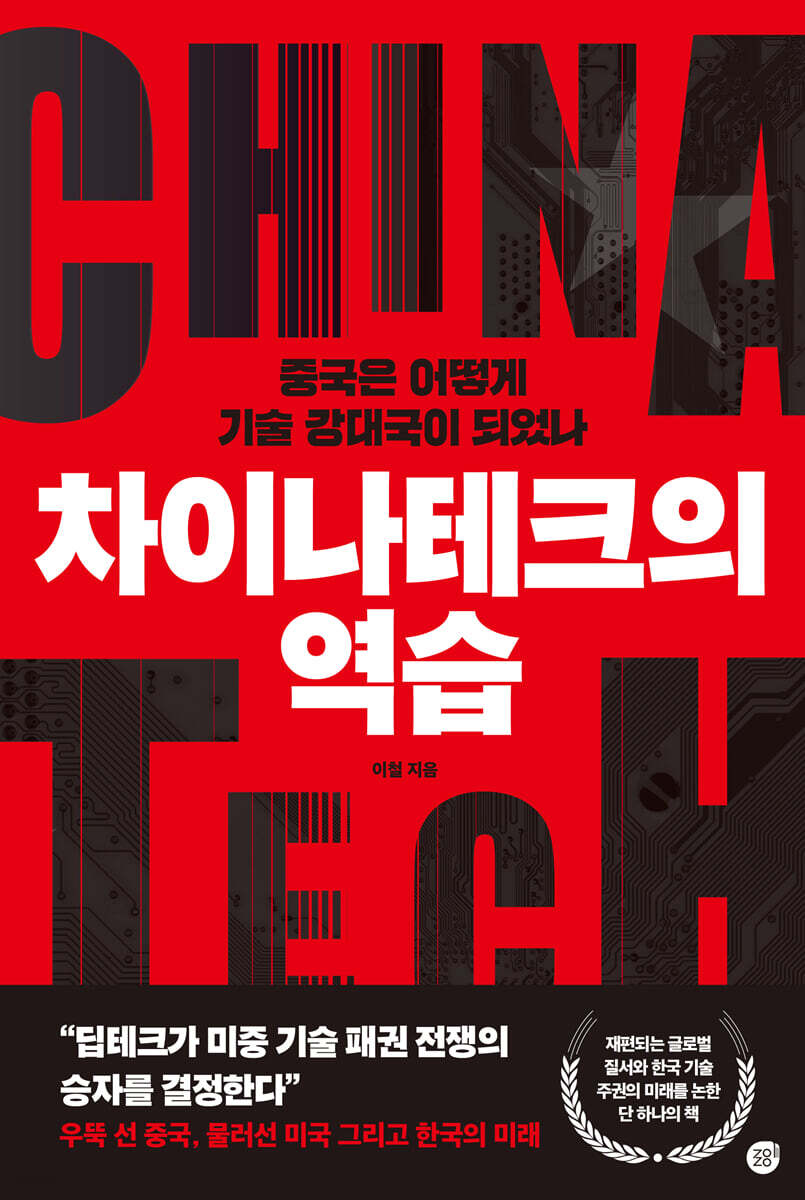
China Tech's Counterattack
 |
Description
Book Introduction
China, which has emerged as a new technological superpower,
And the United States, which seeks to maintain its position as the existing hegemon
Discussing the future of Korea's technological sovereignty in a reorganizing global order!
China, which we once considered a technologically backward country, has now emerged as a scientific and technological powerhouse, on par with the United States, the traditional global technological hegemon.
In many fields, it even surpasses the United States and holds the title of world number one.
On the other hand, according to the '2024 Technology Level Assessment' conducted by the Ministry of Science and ICT of Korea, we have been overtaken by China in key science and technology fields.
Moreover, China is surpassing us in various indicators that can be used to evaluate the level of science and technology, such as the number of paper citations and the number of scientific and technological publications, and is competing with the United States for first and second place.
The problem is that China's rise in science and technology could threaten Korea's security and industrial survival.
The book that was born out of this awareness of the problem is 『China Tech's Counterattack』.
The author defines the US-China hegemony war not as a simple trade dispute or industrial conflict, but as a war over "technological sovereignty."
Technological sovereignty is defined as the ability to secure national strategic resources independently without external reliance. Failure to secure technological sovereignty in the Deep Tech sector could ultimately lead to a technological vassal state, threatening even national sovereignty.
"China Tech's Counterattack" analyzes China's strategies for securing technological hegemony through various cases and data, focusing on AI, energy, secondary batteries and hydrogen, military and space, communications and computing, life sciences and bio, and semiconductors and materials, which are key keywords in the US-China technological hegemony war.
The author criticizes South Korea's underestimation of China's rise, warning that if we do not develop a strategy to secure technological sovereignty now, our very security and industrial existence could soon be shaken.
It also highlights the importance of technological security for Korean society, which is unable to face the rise of China, and suggests a response strategy that we must prepare.
"China Tech's Counterattack" is a must-read warning and strategy book for Korea to survive the technological hegemony race.
And the United States, which seeks to maintain its position as the existing hegemon
Discussing the future of Korea's technological sovereignty in a reorganizing global order!
China, which we once considered a technologically backward country, has now emerged as a scientific and technological powerhouse, on par with the United States, the traditional global technological hegemon.
In many fields, it even surpasses the United States and holds the title of world number one.
On the other hand, according to the '2024 Technology Level Assessment' conducted by the Ministry of Science and ICT of Korea, we have been overtaken by China in key science and technology fields.
Moreover, China is surpassing us in various indicators that can be used to evaluate the level of science and technology, such as the number of paper citations and the number of scientific and technological publications, and is competing with the United States for first and second place.
The problem is that China's rise in science and technology could threaten Korea's security and industrial survival.
The book that was born out of this awareness of the problem is 『China Tech's Counterattack』.
The author defines the US-China hegemony war not as a simple trade dispute or industrial conflict, but as a war over "technological sovereignty."
Technological sovereignty is defined as the ability to secure national strategic resources independently without external reliance. Failure to secure technological sovereignty in the Deep Tech sector could ultimately lead to a technological vassal state, threatening even national sovereignty.
"China Tech's Counterattack" analyzes China's strategies for securing technological hegemony through various cases and data, focusing on AI, energy, secondary batteries and hydrogen, military and space, communications and computing, life sciences and bio, and semiconductors and materials, which are key keywords in the US-China technological hegemony war.
The author criticizes South Korea's underestimation of China's rise, warning that if we do not develop a strategy to secure technological sovereignty now, our very security and industrial existence could soon be shaken.
It also highlights the importance of technological security for Korean society, which is unable to face the rise of China, and suggests a response strategy that we must prepare.
"China Tech's Counterattack" is a must-read warning and strategy book for Korea to survive the technological hegemony race.
- You can preview some of the book's contents.
Preview
index
Prologue: China has overtaken us in science and technology. Have we missed our chance?
Chapter 1: The Era Where Technological Sovereignty Determines National Sovereignty
A new problem before us
US-China conflict and cross-strait war
The existence of a plan
Deep Tech: Shaping the Future of the US and China
Chapter 2: AI: The Front Line of the Technological Sovereignty War
AI as a weapon of information and prediction
DeepSec Moment: China's AI Counterattack
Autonomous driving and security technologies
AI is transforming into a means of systemic competition.
China's Response Strategy in the Age of AI Warfare
China manages data as a key national resource
Chapter 3: Energy Technology Development for Exhibition Systems
China's energy security is focused on 'oil substitution'
Electric vehicles: The key to replacing oil
All efforts to phase out petroleum
Nuclear Power: A Transitional Solution
Chapter 4: Secondary Battery Technology: A Byproduct of Energy Security
Secondary batteries and ESS
Dongsu Seosan, Seojeon Dongsong
Hydrogen, an alternative to electric power transport
Chapter 5 Military-Civil Fusion Technology and Space Strategy
Technology expanding from civilian to military
A2/AD strategy and long-range projection technology
Aircraft and hypersonic technology
Stealth Technology Workshop
All-out war of aerial technology
Chapter 6: Communication Technologies with Different Appearances and Insides
Full-scale communication warfare
The information and communications war unfolding everywhere
China's New Strategy: The Next Generation Internet
The Quantum Computing Supremacy War
Chapter 7: Life Sciences as a Strategy: China's Biotechnology
Technological Sovereignty for Life
Food Security and Genetic Technology
Land reform to increase food production
Change the weather and control the environment
Increasing food production efficiency through technology
From synthetic biology to gene therapy
Current State of Biomedical Technology
Brain-computer interface technology
Chapter 8: Strategic Investment in Semiconductor and Materials Technology
Semiconductors, the heart of cutting-edge technology
China's semiconductor technology at the forefront of the technological sovereignty struggle.
Emerging Strategy: Natural Resources
In the end, basic skills are important.
Chapter 9: Why We Should Pay Attention to Chinese Science and Technology
Why We Should Pay Attention to China
Korea's crisis revealed in technology level assessment
The potential of China's science and technology
China's science and technology achieved through the structuring of capital investment
Why Science and Technology Talent Are Flocking to China
Epilogue: The Current State of Our Science and Technology and the Nature of the Crisis
Chapter 1: The Era Where Technological Sovereignty Determines National Sovereignty
A new problem before us
US-China conflict and cross-strait war
The existence of a plan
Deep Tech: Shaping the Future of the US and China
Chapter 2: AI: The Front Line of the Technological Sovereignty War
AI as a weapon of information and prediction
DeepSec Moment: China's AI Counterattack
Autonomous driving and security technologies
AI is transforming into a means of systemic competition.
China's Response Strategy in the Age of AI Warfare
China manages data as a key national resource
Chapter 3: Energy Technology Development for Exhibition Systems
China's energy security is focused on 'oil substitution'
Electric vehicles: The key to replacing oil
All efforts to phase out petroleum
Nuclear Power: A Transitional Solution
Chapter 4: Secondary Battery Technology: A Byproduct of Energy Security
Secondary batteries and ESS
Dongsu Seosan, Seojeon Dongsong
Hydrogen, an alternative to electric power transport
Chapter 5 Military-Civil Fusion Technology and Space Strategy
Technology expanding from civilian to military
A2/AD strategy and long-range projection technology
Aircraft and hypersonic technology
Stealth Technology Workshop
All-out war of aerial technology
Chapter 6: Communication Technologies with Different Appearances and Insides
Full-scale communication warfare
The information and communications war unfolding everywhere
China's New Strategy: The Next Generation Internet
The Quantum Computing Supremacy War
Chapter 7: Life Sciences as a Strategy: China's Biotechnology
Technological Sovereignty for Life
Food Security and Genetic Technology
Land reform to increase food production
Change the weather and control the environment
Increasing food production efficiency through technology
From synthetic biology to gene therapy
Current State of Biomedical Technology
Brain-computer interface technology
Chapter 8: Strategic Investment in Semiconductor and Materials Technology
Semiconductors, the heart of cutting-edge technology
China's semiconductor technology at the forefront of the technological sovereignty struggle.
Emerging Strategy: Natural Resources
In the end, basic skills are important.
Chapter 9: Why We Should Pay Attention to Chinese Science and Technology
Why We Should Pay Attention to China
Korea's crisis revealed in technology level assessment
The potential of China's science and technology
China's science and technology achieved through the structuring of capital investment
Why Science and Technology Talent Are Flocking to China
Epilogue: The Current State of Our Science and Technology and the Nature of the Crisis
Detailed image

Into the book
In my view, Chinese society as a whole clearly recognizes that 'securing its own technological capabilities is the only way to overcome sanctions.'
This consensus is driving China to focus more on developing AI technology under a "nationwide framework."
When I think of the tens of millions of Chinese science and engineering students whose hearts burn with the desire to contribute to their nation and people through technology, I can vaguely see where the future might lead.
--- p.51
For example, if a country seeks to expand its AI facilities, its power infrastructure must also be expanded accordingly.
To expand power infrastructure, a comprehensive energy strategy must be developed that encompasses the sources of power, including oil, coal, gas, solar, wind, hydro, and nuclear power.
If even some of these energy sources are dependent on foreign sources, they will inevitably be closely linked to national supply chain strategies and import/export strategies.
--- p.70~71
It is a fact that Hyundai Motor Company, a Korean company, is one of the companies with the world's best hydrogen energy technology.
As the hydrogen energy industry is struggling domestically, Hyundai Motor Company is also exploring market opportunities by entering China.
However, with Hyundai Motor Company's hydrogen technology designated as a national strategic technology, it appears that it will face certain restrictions on its ability to freely conduct business in China.
This situation clearly demonstrates how our country's failure to establish a clear national strategy while responding to global competition significantly impacts global geopolitics and the activities of our companies.
--- p.128~129
I remember hearing somewhere a while ago that our country was leading the way in 4G and 5G.
Perhaps that was a thing of the last century.
We are no longer an information and communications powerhouse.
It is time for us to be acutely aware of our position in the global science and technology ecosystem.
--- p.202
Quantum computing technology has the potential to defeat all encryption technologies developed to date.
Because of this, the country that secures it first will have the ability to hack not only the financial security systems but also the military secrets of other countries.
That's why the United States and China are putting all their efforts into this technology.
--- p.208
Today's science and technology are not simply technologies; they are core elements directly related to our survival and destiny.
And since semiconductors are mostly involved in real-life implementation of these technologies, it is no exaggeration to say that semiconductors are the 'infrastructure' of modern science and technology.
--- p.258
Looking at industrial technology, China increased its R&D investment by a whopping 3,299% from 1996 to 2020.
It's not a typo.
In other words, it increased by 3,299% over 24 years.
As a result, China's Patent Cooperation Treaty (PCT) international intellectual property applications have ranked first in the world for five consecutive years.
--- p.287
We should not simply assume that China is investing large amounts of capital in science and technology.
China is designing its own structure for capital investment, recovery, and reinvestment, thereby systematizing a virtuous investment cycle.
This consensus is driving China to focus more on developing AI technology under a "nationwide framework."
When I think of the tens of millions of Chinese science and engineering students whose hearts burn with the desire to contribute to their nation and people through technology, I can vaguely see where the future might lead.
--- p.51
For example, if a country seeks to expand its AI facilities, its power infrastructure must also be expanded accordingly.
To expand power infrastructure, a comprehensive energy strategy must be developed that encompasses the sources of power, including oil, coal, gas, solar, wind, hydro, and nuclear power.
If even some of these energy sources are dependent on foreign sources, they will inevitably be closely linked to national supply chain strategies and import/export strategies.
--- p.70~71
It is a fact that Hyundai Motor Company, a Korean company, is one of the companies with the world's best hydrogen energy technology.
As the hydrogen energy industry is struggling domestically, Hyundai Motor Company is also exploring market opportunities by entering China.
However, with Hyundai Motor Company's hydrogen technology designated as a national strategic technology, it appears that it will face certain restrictions on its ability to freely conduct business in China.
This situation clearly demonstrates how our country's failure to establish a clear national strategy while responding to global competition significantly impacts global geopolitics and the activities of our companies.
--- p.128~129
I remember hearing somewhere a while ago that our country was leading the way in 4G and 5G.
Perhaps that was a thing of the last century.
We are no longer an information and communications powerhouse.
It is time for us to be acutely aware of our position in the global science and technology ecosystem.
--- p.202
Quantum computing technology has the potential to defeat all encryption technologies developed to date.
Because of this, the country that secures it first will have the ability to hack not only the financial security systems but also the military secrets of other countries.
That's why the United States and China are putting all their efforts into this technology.
--- p.208
Today's science and technology are not simply technologies; they are core elements directly related to our survival and destiny.
And since semiconductors are mostly involved in real-life implementation of these technologies, it is no exaggeration to say that semiconductors are the 'infrastructure' of modern science and technology.
--- p.258
Looking at industrial technology, China increased its R&D investment by a whopping 3,299% from 1996 to 2020.
It's not a typo.
In other words, it increased by 3,299% over 24 years.
As a result, China's Patent Cooperation Treaty (PCT) international intellectual property applications have ranked first in the world for five consecutive years.
--- p.287
We should not simply assume that China is investing large amounts of capital in science and technology.
China is designing its own structure for capital investment, recovery, and reinvestment, thereby systematizing a virtuous investment cycle.
--- p.298
Publisher's Review
In an era where technological sovereignty is national sovereignty
If we don't prepare now, we won't be able to protect our security and industry!
Dr. Lee Chul's new book, "China Tech's Counterattack," which discusses the present and future of Korea, the United States, and China with a focus on technological sovereignty, has been published.
Dr. Lee Cheol is a recognized leading China expert, having held various key positions in Chinese branches of Korean companies and Chinese companies. He is also an expert on Chinese industry and current affairs, having worked on numerous Chinese government agency projects.
In this book, the author argues that we should be alarmed by China's science and technology, which has reached a level equal to or, in some fields, surpassing that of the United States, the traditional global technological hegemon.
In the past, we underestimated China's level of science and technology because of our experience with low-quality, low-cost "Made in China." However, China has pursued scientific and technological development broadly and deeply across all areas, and has already surpassed Korea's level of science and technology in most fields.
Looking at industrial technology alone, China is investing on a massive scale at the national level, increasing its R&D investment by a staggering 3,299% between 1996 and 2020.
We live in an era where technological sovereignty is the foundation of all national capabilities, including military, economic, and diplomatic capabilities.
Technological sovereignty, the ability to procure technologies essential to national strategic resources, will ultimately determine national sovereignty.
AI, such as ChatGPT and autonomous driving, are in fact directly linked to military and security technologies and are used as tools for system competition.
If we fail to face reality and strive to secure technological sovereignty, and if we fail to provide national support for the development of science and engineering, our future will be nothing but regression.
I hope this book will help us realize the reality before it's too late and establish a strategy for our country's science and technology survival amidst the US-China competition as soon as possible.
If we don't prepare now, we won't be able to protect our security and industry!
Dr. Lee Chul's new book, "China Tech's Counterattack," which discusses the present and future of Korea, the United States, and China with a focus on technological sovereignty, has been published.
Dr. Lee Cheol is a recognized leading China expert, having held various key positions in Chinese branches of Korean companies and Chinese companies. He is also an expert on Chinese industry and current affairs, having worked on numerous Chinese government agency projects.
In this book, the author argues that we should be alarmed by China's science and technology, which has reached a level equal to or, in some fields, surpassing that of the United States, the traditional global technological hegemon.
In the past, we underestimated China's level of science and technology because of our experience with low-quality, low-cost "Made in China." However, China has pursued scientific and technological development broadly and deeply across all areas, and has already surpassed Korea's level of science and technology in most fields.
Looking at industrial technology alone, China is investing on a massive scale at the national level, increasing its R&D investment by a staggering 3,299% between 1996 and 2020.
We live in an era where technological sovereignty is the foundation of all national capabilities, including military, economic, and diplomatic capabilities.
Technological sovereignty, the ability to procure technologies essential to national strategic resources, will ultimately determine national sovereignty.
AI, such as ChatGPT and autonomous driving, are in fact directly linked to military and security technologies and are used as tools for system competition.
If we fail to face reality and strive to secure technological sovereignty, and if we fail to provide national support for the development of science and engineering, our future will be nothing but regression.
I hope this book will help us realize the reality before it's too late and establish a strategy for our country's science and technology survival amidst the US-China competition as soon as possible.
GOODS SPECIFICS
- Date of issue: September 10, 2025
- Page count, weight, size: 312 pages | 548g | 152*225*18mm
- ISBN13: 9791194508403
- ISBN10: 1194508405
You may also like
카테고리
korean


korean

![ELLE 엘르 스페셜 에디션 A형 : 12월 [2025]](http://librairie.coreenne.fr/cdn/shop/files/b8e27a3de6c9538896439686c6b0e8fb.jpg?v=1766436872&width=3840)


