

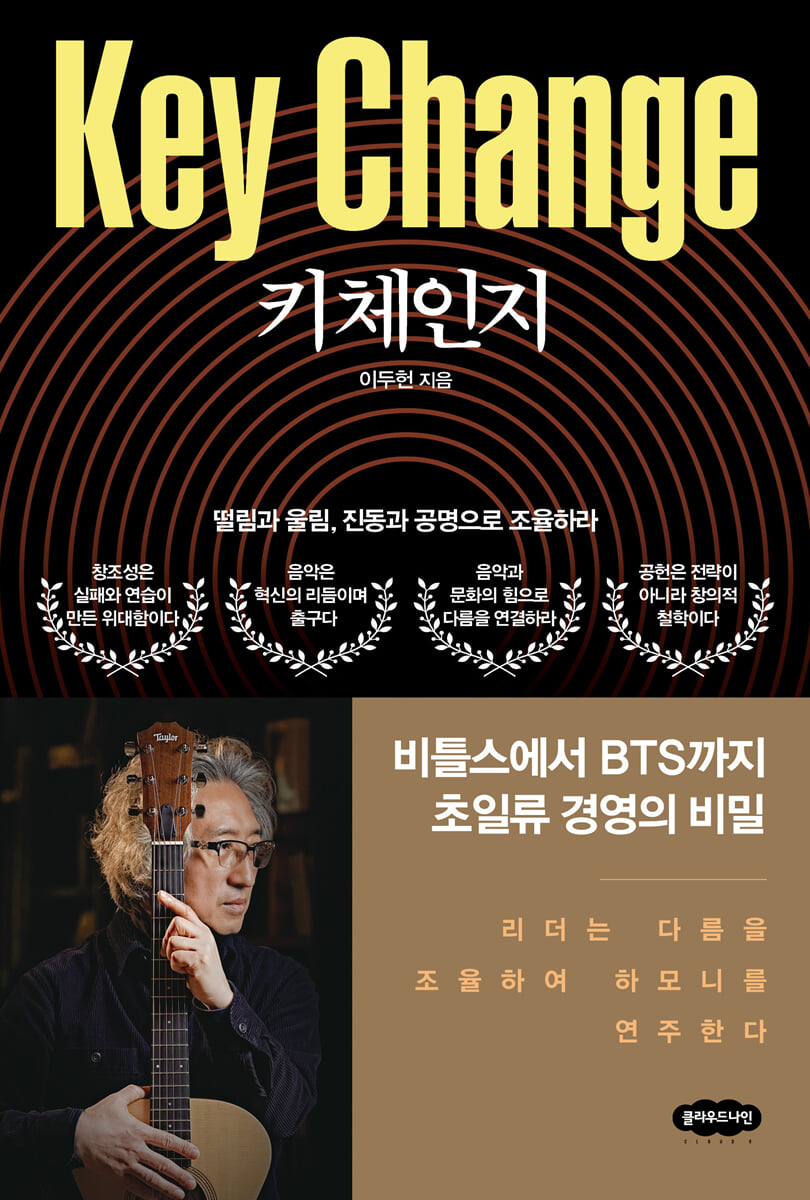
Key change
 |
Description
Book Introduction
As soft as music, yet as sharp as philosophy!
A Sense of Work Guide for Every Businessperson
Through the lens of music
We guide individuals and organizations to find their own voice!
This book is about the 'philosophy of music' and 'philosophy of work' discovered by Lee Du-heon, who has a unique background as the leader of the band 'Five Fingers', a popular music musician and producer loved for hit songs such as 'Balloon' and 'Red Roses on Wednesday', a university professor, and a corporate lecturer, through his musical life.
He reexamines the essence of work through the structure and principles of music.
It means to do things as if you were playing a game, not alone but together, not without emotion but with resonance.
Terms like 'tune', 'rest', 'improvisation', 'chorus', 'harmony', and 'encore' are not limited to music.
This applies to work, people, and life.
This book looks at all these concepts through the lens of music and invites each of us to find our own sound.
This book will offer fresh perspectives and insights to leaders seeking to improve their organizations, employees exhausted by work and emotionally and energetically drained, HR managers and managers contemplating how to infuse creativity and emotion into their organizations, and humanities readers seeking a fresh understanding of the nature of work through art and philosophy.
This book is a 'guide to regaining a sense of work.'
Each chapter, such as ‘Work like a duet,’ ‘Time for a rest,’ ‘Find your own key,’ and ‘Control your emotions,’ is a musical term and at the same time a keyword necessary for work and life.
And within those keywords are real business cases, stories of famous musicians, and the author's own stage experience.
Above all, the greatest virtue of this book is that it is as gentle as music, yet as sharp as philosophy.
Music creates flow through rhythm and resonance through the breathing between performers.
The same goes for leadership.
Ultimately, organizational change and growth come from coordination, not command.
This is a book that speaks of the 'art of tuning' in the language of music.
This is a book I quietly hold in my hands when I need to change the rhythm of the path I am walking on, when I want to re-tune the scale of my life.
And by the time you turn the last page, you will already have a very small but definite inner music playing in your ears.
The author says:
“Music and work, leadership and management, performance and organization are essentially similar.”
A Sense of Work Guide for Every Businessperson
Through the lens of music
We guide individuals and organizations to find their own voice!
This book is about the 'philosophy of music' and 'philosophy of work' discovered by Lee Du-heon, who has a unique background as the leader of the band 'Five Fingers', a popular music musician and producer loved for hit songs such as 'Balloon' and 'Red Roses on Wednesday', a university professor, and a corporate lecturer, through his musical life.
He reexamines the essence of work through the structure and principles of music.
It means to do things as if you were playing a game, not alone but together, not without emotion but with resonance.
Terms like 'tune', 'rest', 'improvisation', 'chorus', 'harmony', and 'encore' are not limited to music.
This applies to work, people, and life.
This book looks at all these concepts through the lens of music and invites each of us to find our own sound.
This book will offer fresh perspectives and insights to leaders seeking to improve their organizations, employees exhausted by work and emotionally and energetically drained, HR managers and managers contemplating how to infuse creativity and emotion into their organizations, and humanities readers seeking a fresh understanding of the nature of work through art and philosophy.
This book is a 'guide to regaining a sense of work.'
Each chapter, such as ‘Work like a duet,’ ‘Time for a rest,’ ‘Find your own key,’ and ‘Control your emotions,’ is a musical term and at the same time a keyword necessary for work and life.
And within those keywords are real business cases, stories of famous musicians, and the author's own stage experience.
Above all, the greatest virtue of this book is that it is as gentle as music, yet as sharp as philosophy.
Music creates flow through rhythm and resonance through the breathing between performers.
The same goes for leadership.
Ultimately, organizational change and growth come from coordination, not command.
This is a book that speaks of the 'art of tuning' in the language of music.
This is a book I quietly hold in my hands when I need to change the rhythm of the path I am walking on, when I want to re-tune the scale of my life.
And by the time you turn the last page, you will already have a very small but definite inner music playing in your ears.
The author says:
“Music and work, leadership and management, performance and organization are essentially similar.”
- You can preview some of the book's contents.
Preview
index
Recommendation
Finding Management Insights in Music
Seong In-hee, former CEO and President of Samsung Fine Chemicals and current advisor at Samsung Global Research
A musician's eye that sees through the essence of management
Hwang In-gyu, former head of the Incheon District Prosecutors' Office's Bucheon Branch and current chairman of CNCT Energy
The Philosophy of Vibration and Resonance
Han Seung-hwan, former CEO and President of Samsung C&T Resort Division and current CEO of Samsung Life Public Welfare Foundation
The shared essence of music, life, and business
-Kim Hyung-seok, composer and producer
A management guidebook that's as enjoyable to read as music and coffee.
Seo Jeong-min, Culture and Sports Editor, Hankyoreh
Introduction: There is a rhythm of innovation in music.
Chapter 1: First-Class Leadership in Music
1.
The Secret to Harmony Management Found in Duet
The aesthetics of heterogeneous combinations, duets/brand duets, collaborations that transcend boundaries, harmonious division of roles, Simon & Garfunkel, harmony management, the future of collaboration
2.
Leadership in Communication that Coordinates Differences
The Power of Communication to Fill the Gap / Leadership Without Command / Time for Relationships Built on Trust / Between Improvisation and Conflict: The Art of Coordination / Why Emotional Contracts Matter / Creating Experiences Together
3.
The essence of strategy, people
Field Sense and Organizational Warmth / Field-Born Leadership / Experience-Based Learning / Understanding and Companionship
4.
The power of accumulation
Late start, solid success / Attitude is a mirror of persistence / Internalization of endurance
5.
Parents, the Archetype of Leadership
Leadership of Empathy and Connection / Capitalizing on Failure / Growth is the Result of Learning
Chapter 2: The Invisible Helper: The Power of Organization
1.
The value of a true helper
The Invisible Hero of Success / The Unruly Leader / Lee Jeong-seon, Unconditional Devotion / Jo Dong-ik, Encountering the Essence of Music / The Essence of Art: Attitudes Toward Righteousness / A Teacher's Creative Self-Education / Quiet Devotion, the Foundation of Success
2.
Inspiration of creative organizations
Creativity within constraints / Coherent brand narrative / Musical and psychological training systems / Cyclical co-creation systems
3.
Talent Management and Synergy
Collective capacity and synergy / Potential-focused talent discovery / Risk, a stage for creative challenges / Sustainability, a foundation for subsequent growth
4.
The qualifications of a first-class band
The Essence of Tuning / 6 Keys to Band Success
5.
Quiet Innovation, Market Change
Customer-centric innovation / Differentiation strategy based on quality and trust / Systematization and sustainability of beliefs
Chapter 3: Conditions for Creativity
1.
The link between accumulation and innovation
The Circular Structure of Creative Capabilities / Competitive Advantage and the Rearrangement of Internal Assets / Transforming the Organization Beyond the Individual / The Value of Differentiation / Accumulation-Based Innovation / Organizational Evolution and Systematization of Accumulation
2.
Accumulation and Failure, the Power of Creation
The Other Side of Failure and Success / Growth Through Failure / Path Dependency and Change / Failure-Based Learning and Organizational Culture
3.
Strangeness, the beginning of greatness
A masterpiece of unfamiliarity and unconventionality / The delusion and impossibility of innovation / Detail and perfection / Differentiation and authenticity
4.
First, the prelude to a leap forward
Primacy Effects and First Power / Planned Serendipity and Growth / Self-Efficacy and the Growth Mindset
5.
Practice, a declaration of possibility
Practice that creates results / The power of quality repetition / The power of facilitators and feedback / Practice, the time that shapes me
6.
Inspiration and Pain, a Double Path
Moments of Oppression and Inspiration / Resilience and Growth / Organizational Members Who Communicate Without Alcohol
Chapter 4: Sustainable Love, Timeless Values
1.
The scent of sustainability
Old objects, music, and memories of existence / The aesthetics of sufficiency and the value of slowness / Traces of time and comfort / The aura of a lasting existence
2.
The realm of craftsmanship
The Intersection of Art and Science / The Power of Brand Consistency
3.
The power of fair competition
The Eighth Army Stage: The Legacy of Meritocracy / Structure of Compensation and Growth / Procedural Fairness / K-Pop Evaluation System
4.
Cultural Leadership
Fashion and Music, Symbols of Identity / Madonna, the Expansion of Creativity / Brands: An Exchange of Emotions and Meaning / Brands and the Zeitgeist
5.
Resilience Fandom
The Power of K-Pop Fandom Organization and Resilience / The Evolution of Global Business Models / The Platform Economy and Brand Worldviews
6.
The intersection of uphill and downhill
Summit arrogance and the strategy of descent / Crisis warning signs and self-management / Resilience at turning points / Conditions for sustainable growth
7.
Sustainable contribution
Social Responsibility and ESG / Authentic Contribution / Creating Shared Value / Building Long-Term Trust
Chapter 5: Music and Innovation, Time and Philosophy
1.
The aesthetics of time, innovation of sincerity
Humanity's Enjoyment of Cooking and Music / Meaningful Slowness / The Value of Waiting / Accumulation and Depth / The Philosophy of Honesty
2.
Small stage, great innovation
A Stage for Experimentation, a Small Theater / A Density of Emotions / A Stage for Authenticity / Sustainable Arts Management
3.
Disney, Creative Systems
The Power of Character Assets / Execution-Based Creativity / Putting Vision into Practice / Combining Brand and Emotion / Experience Design and Organizational Culture / The Power of Execution to Complete Creativity / Balancing Fantasy and Reality
4.
Music Beyond Culture
The Rhythm of the Human Inner Self / The Essence of Music and Culture / The Foundation of Creative Thinking / Emotional Intelligence and Empathy / The Art of Collective Intelligence
5.
Amateurism, the essence of creation
Anonymous possibilities / self-directed learning / cognitive flexibility / open innovation / collective intelligence and networks
Chapter 6: Music, Culture, Diversity, Inclusion, and Innovation
1.
Fork, Resistance and Differentiation
The Language of Romance and Reality / Dissent and Innovation / Managing Differences and Survival / A Culture of Inclusion and Synergy / Authenticity and the Source of Diversity
2.
Women Beyond the Boundaries
The Two Faces of a Diva / Female Leaders Find Their Way Within / Women Walk in Their Own Name
3.
Human resonance, the symbol of the guitar
The Origin and Evolution of the Guitar / Craftsmanship and Innovation / Brands and Tradition / People-Centered Brands
4.
Rhythm, the beating of the heart
The drums of liberation and healing / The sound of drums playing a narrative / The rhythm of liberation / Rhythm and healing power
5.
History changed by coffee
The fluid of change, the center of the senses / The stage of culture and revolution / The catalyst of creativity and productivity
6.
Leisure, a source of creativity and innovation
Hobbies and Creativity / Bridging Generations and Borders / Insights from Managers and Artists / Psychological Capital and the Value of Rest
References
Finding Management Insights in Music
Seong In-hee, former CEO and President of Samsung Fine Chemicals and current advisor at Samsung Global Research
A musician's eye that sees through the essence of management
Hwang In-gyu, former head of the Incheon District Prosecutors' Office's Bucheon Branch and current chairman of CNCT Energy
The Philosophy of Vibration and Resonance
Han Seung-hwan, former CEO and President of Samsung C&T Resort Division and current CEO of Samsung Life Public Welfare Foundation
The shared essence of music, life, and business
-Kim Hyung-seok, composer and producer
A management guidebook that's as enjoyable to read as music and coffee.
Seo Jeong-min, Culture and Sports Editor, Hankyoreh
Introduction: There is a rhythm of innovation in music.
Chapter 1: First-Class Leadership in Music
1.
The Secret to Harmony Management Found in Duet
The aesthetics of heterogeneous combinations, duets/brand duets, collaborations that transcend boundaries, harmonious division of roles, Simon & Garfunkel, harmony management, the future of collaboration
2.
Leadership in Communication that Coordinates Differences
The Power of Communication to Fill the Gap / Leadership Without Command / Time for Relationships Built on Trust / Between Improvisation and Conflict: The Art of Coordination / Why Emotional Contracts Matter / Creating Experiences Together
3.
The essence of strategy, people
Field Sense and Organizational Warmth / Field-Born Leadership / Experience-Based Learning / Understanding and Companionship
4.
The power of accumulation
Late start, solid success / Attitude is a mirror of persistence / Internalization of endurance
5.
Parents, the Archetype of Leadership
Leadership of Empathy and Connection / Capitalizing on Failure / Growth is the Result of Learning
Chapter 2: The Invisible Helper: The Power of Organization
1.
The value of a true helper
The Invisible Hero of Success / The Unruly Leader / Lee Jeong-seon, Unconditional Devotion / Jo Dong-ik, Encountering the Essence of Music / The Essence of Art: Attitudes Toward Righteousness / A Teacher's Creative Self-Education / Quiet Devotion, the Foundation of Success
2.
Inspiration of creative organizations
Creativity within constraints / Coherent brand narrative / Musical and psychological training systems / Cyclical co-creation systems
3.
Talent Management and Synergy
Collective capacity and synergy / Potential-focused talent discovery / Risk, a stage for creative challenges / Sustainability, a foundation for subsequent growth
4.
The qualifications of a first-class band
The Essence of Tuning / 6 Keys to Band Success
5.
Quiet Innovation, Market Change
Customer-centric innovation / Differentiation strategy based on quality and trust / Systematization and sustainability of beliefs
Chapter 3: Conditions for Creativity
1.
The link between accumulation and innovation
The Circular Structure of Creative Capabilities / Competitive Advantage and the Rearrangement of Internal Assets / Transforming the Organization Beyond the Individual / The Value of Differentiation / Accumulation-Based Innovation / Organizational Evolution and Systematization of Accumulation
2.
Accumulation and Failure, the Power of Creation
The Other Side of Failure and Success / Growth Through Failure / Path Dependency and Change / Failure-Based Learning and Organizational Culture
3.
Strangeness, the beginning of greatness
A masterpiece of unfamiliarity and unconventionality / The delusion and impossibility of innovation / Detail and perfection / Differentiation and authenticity
4.
First, the prelude to a leap forward
Primacy Effects and First Power / Planned Serendipity and Growth / Self-Efficacy and the Growth Mindset
5.
Practice, a declaration of possibility
Practice that creates results / The power of quality repetition / The power of facilitators and feedback / Practice, the time that shapes me
6.
Inspiration and Pain, a Double Path
Moments of Oppression and Inspiration / Resilience and Growth / Organizational Members Who Communicate Without Alcohol
Chapter 4: Sustainable Love, Timeless Values
1.
The scent of sustainability
Old objects, music, and memories of existence / The aesthetics of sufficiency and the value of slowness / Traces of time and comfort / The aura of a lasting existence
2.
The realm of craftsmanship
The Intersection of Art and Science / The Power of Brand Consistency
3.
The power of fair competition
The Eighth Army Stage: The Legacy of Meritocracy / Structure of Compensation and Growth / Procedural Fairness / K-Pop Evaluation System
4.
Cultural Leadership
Fashion and Music, Symbols of Identity / Madonna, the Expansion of Creativity / Brands: An Exchange of Emotions and Meaning / Brands and the Zeitgeist
5.
Resilience Fandom
The Power of K-Pop Fandom Organization and Resilience / The Evolution of Global Business Models / The Platform Economy and Brand Worldviews
6.
The intersection of uphill and downhill
Summit arrogance and the strategy of descent / Crisis warning signs and self-management / Resilience at turning points / Conditions for sustainable growth
7.
Sustainable contribution
Social Responsibility and ESG / Authentic Contribution / Creating Shared Value / Building Long-Term Trust
Chapter 5: Music and Innovation, Time and Philosophy
1.
The aesthetics of time, innovation of sincerity
Humanity's Enjoyment of Cooking and Music / Meaningful Slowness / The Value of Waiting / Accumulation and Depth / The Philosophy of Honesty
2.
Small stage, great innovation
A Stage for Experimentation, a Small Theater / A Density of Emotions / A Stage for Authenticity / Sustainable Arts Management
3.
Disney, Creative Systems
The Power of Character Assets / Execution-Based Creativity / Putting Vision into Practice / Combining Brand and Emotion / Experience Design and Organizational Culture / The Power of Execution to Complete Creativity / Balancing Fantasy and Reality
4.
Music Beyond Culture
The Rhythm of the Human Inner Self / The Essence of Music and Culture / The Foundation of Creative Thinking / Emotional Intelligence and Empathy / The Art of Collective Intelligence
5.
Amateurism, the essence of creation
Anonymous possibilities / self-directed learning / cognitive flexibility / open innovation / collective intelligence and networks
Chapter 6: Music, Culture, Diversity, Inclusion, and Innovation
1.
Fork, Resistance and Differentiation
The Language of Romance and Reality / Dissent and Innovation / Managing Differences and Survival / A Culture of Inclusion and Synergy / Authenticity and the Source of Diversity
2.
Women Beyond the Boundaries
The Two Faces of a Diva / Female Leaders Find Their Way Within / Women Walk in Their Own Name
3.
Human resonance, the symbol of the guitar
The Origin and Evolution of the Guitar / Craftsmanship and Innovation / Brands and Tradition / People-Centered Brands
4.
Rhythm, the beating of the heart
The drums of liberation and healing / The sound of drums playing a narrative / The rhythm of liberation / Rhythm and healing power
5.
History changed by coffee
The fluid of change, the center of the senses / The stage of culture and revolution / The catalyst of creativity and productivity
6.
Leisure, a source of creativity and innovation
Hobbies and Creativity / Bridging Generations and Borders / Insights from Managers and Artists / Psychological Capital and the Value of Rest
References
Into the book
One of the great things about a duet is the chemistry that occurs when two people with different tones and personalities meet.
The unexpected combination of Im Jae-beom with his rough, takseong, Park Jung-hyun with her clear high notes, Michael Jackson with his beautiful voice, and Paul McCartney with his unique nasal tone creates a new musical emotion.
This is also connected to the concept of 'complementary teamwork' in organizational theory.
British management theorist Meredith Belbin argued that the effectiveness of teamwork comes not from the similarities of members, but from the harmonious composition of different roles and strengths.
The heterogeneity of the duet is not a disadvantage, but rather a source of tension and emotional latitude.
"Under Pressure," a 1981 collaboration between Queen and David Bowie, is a prime example of a successful collaboration between two different groups.
--- p.24~25
Bob Dylan, the first musician in 116 years to win the Nobel Prize in Literature, released a total of 17 studio albums during this period, from his debut album in 1962 to the album 『Desire』 released in 1976.
But it only took about 90 days to make all these albums.
The musicians who participated in his album arrived at the recording studio with no prior information about the new music, and completed the music in a short period of time by exchanging ideas with each other in an improvisational manner.
Dylan respected the performers' autonomy and interpretation, and expanded the vitality of music through the energy created from that gap.
Bob Dylan's production method follows the process of a song being 'born' through repeated experimentation and intuitive flow, without being bound by a pre-structured framework.
This is similar to the concept of 'Improvisational Creativity' presented by Keith Sawyer, a psychology professor at the University of Washington, in his book 'Group Genius'.
He believed that great creations arise not from meticulously controlled planning, but from spontaneous order.
Dylan's music is a prime example of this kind of spontaneous creation.
He drew energy and innovation from unorganized improvisation and conflict.
--- p.38
Hardaway didn't accept his son's disability as fate.
“My son can’t see, but he can hear the world,” she said, believing in and supporting her son’s auditory sensitivity.
When Stevie Wonder was banging on a pot to keep time at the age of three, most parents would have dismissed it as a joke, but Hardaway saw his musical potential.
After that, she introduced her son to the harmonica, drums, and piano in that order.
Stevie Wonder began playing the organ in church at the age of eight.
Stevie Wonder expanded the universe of the sense of hearing through his mother's warm empathy and keen sense of emotion, connecting with an audience of hundreds of millions around the world.
His music goes beyond simple melody and functions as a language that interprets and heals emotions.
If it weren't for Lula Mae Hardaway, the name Stevie Wonder wouldn't exist in music history.
He left behind songs dedicated to his mother, "You Are the Sunshine of My Life" and "I'm Your Baby Tonight," and "Shelter In the Rain," a song expressing his deep longing for his mother after she passed away.
--- p.61
Business and music are similar.
Behind each performer on stage, there are countless assistants, including tuners, technicians, producers, and staff.
Just as their invisible collaboration completes the music, the company's performance also shines through the unseen harmony of these individuals.
“My job is to get people to the top,” said Captain Lou Whittaker, the first American to conquer Everest in 1984.
This reminds us that today, countless 'invisible helpers' are the foundation of true success.
The Beatles' producer George Martin even recorded the band's early albums himself to complement the band's lack of keyboard skills.
And he played a crucial role in expanding the artistry of the Beatles' music through string arrangements and orchestrations in "Yesterday," "Eleanor Rigby," "Strawberry Fields Forever," and "A Day in the Life."
But he did not boast of his assistance.
He chose to remain simply as the background to the music the Beatles created and the foundation for their success.
--- p.73
In 1993, I was already a professional musician who had sold over a million records.
However, longing for better skills, he decided to study abroad at Berklee College of Music in Boston.
My arrogance of thinking, "What can I learn in America?" was shattered in an improvisation class in my first semester.
There I relearned about the essence of music and life.
A practice room without a single window in the basement of the music school building.
Six unfamiliar foreign students were each fiddling with their instruments, avoiding eye contact with each other.
The old professor, who seemed to still have a hangover from the previous day, covered the window with black paper and turned off the lights.
A single word was heard in the darkness.
“Let's play.”
There were no instructions or sheet music.
The performance, which began in the darkness where one could not see ahead, continued as if each note was exploring the other.
A single note on the contrabass becomes a chord on the piano, which then flows delicately and organically to the guitar, drums, and saxophone.
Dozens of minutes passed, and the professor left the classroom without saying a word, leaving behind the still darkness.
For the next month, we played 'together' in the dark during every class.
At some point, each sound ceased to clash and instead harmonized, and they increasingly sensed and reacted to each other's flow.
A month later, our class was rated as the fastest-growing and most advanced improvisation band.
In that darkness, I came to understand from the beginning, 'What is a band?'
The unexpected combination of Im Jae-beom with his rough, takseong, Park Jung-hyun with her clear high notes, Michael Jackson with his beautiful voice, and Paul McCartney with his unique nasal tone creates a new musical emotion.
This is also connected to the concept of 'complementary teamwork' in organizational theory.
British management theorist Meredith Belbin argued that the effectiveness of teamwork comes not from the similarities of members, but from the harmonious composition of different roles and strengths.
The heterogeneity of the duet is not a disadvantage, but rather a source of tension and emotional latitude.
"Under Pressure," a 1981 collaboration between Queen and David Bowie, is a prime example of a successful collaboration between two different groups.
--- p.24~25
Bob Dylan, the first musician in 116 years to win the Nobel Prize in Literature, released a total of 17 studio albums during this period, from his debut album in 1962 to the album 『Desire』 released in 1976.
But it only took about 90 days to make all these albums.
The musicians who participated in his album arrived at the recording studio with no prior information about the new music, and completed the music in a short period of time by exchanging ideas with each other in an improvisational manner.
Dylan respected the performers' autonomy and interpretation, and expanded the vitality of music through the energy created from that gap.
Bob Dylan's production method follows the process of a song being 'born' through repeated experimentation and intuitive flow, without being bound by a pre-structured framework.
This is similar to the concept of 'Improvisational Creativity' presented by Keith Sawyer, a psychology professor at the University of Washington, in his book 'Group Genius'.
He believed that great creations arise not from meticulously controlled planning, but from spontaneous order.
Dylan's music is a prime example of this kind of spontaneous creation.
He drew energy and innovation from unorganized improvisation and conflict.
--- p.38
Hardaway didn't accept his son's disability as fate.
“My son can’t see, but he can hear the world,” she said, believing in and supporting her son’s auditory sensitivity.
When Stevie Wonder was banging on a pot to keep time at the age of three, most parents would have dismissed it as a joke, but Hardaway saw his musical potential.
After that, she introduced her son to the harmonica, drums, and piano in that order.
Stevie Wonder began playing the organ in church at the age of eight.
Stevie Wonder expanded the universe of the sense of hearing through his mother's warm empathy and keen sense of emotion, connecting with an audience of hundreds of millions around the world.
His music goes beyond simple melody and functions as a language that interprets and heals emotions.
If it weren't for Lula Mae Hardaway, the name Stevie Wonder wouldn't exist in music history.
He left behind songs dedicated to his mother, "You Are the Sunshine of My Life" and "I'm Your Baby Tonight," and "Shelter In the Rain," a song expressing his deep longing for his mother after she passed away.
--- p.61
Business and music are similar.
Behind each performer on stage, there are countless assistants, including tuners, technicians, producers, and staff.
Just as their invisible collaboration completes the music, the company's performance also shines through the unseen harmony of these individuals.
“My job is to get people to the top,” said Captain Lou Whittaker, the first American to conquer Everest in 1984.
This reminds us that today, countless 'invisible helpers' are the foundation of true success.
The Beatles' producer George Martin even recorded the band's early albums himself to complement the band's lack of keyboard skills.
And he played a crucial role in expanding the artistry of the Beatles' music through string arrangements and orchestrations in "Yesterday," "Eleanor Rigby," "Strawberry Fields Forever," and "A Day in the Life."
But he did not boast of his assistance.
He chose to remain simply as the background to the music the Beatles created and the foundation for their success.
--- p.73
In 1993, I was already a professional musician who had sold over a million records.
However, longing for better skills, he decided to study abroad at Berklee College of Music in Boston.
My arrogance of thinking, "What can I learn in America?" was shattered in an improvisation class in my first semester.
There I relearned about the essence of music and life.
A practice room without a single window in the basement of the music school building.
Six unfamiliar foreign students were each fiddling with their instruments, avoiding eye contact with each other.
The old professor, who seemed to still have a hangover from the previous day, covered the window with black paper and turned off the lights.
A single word was heard in the darkness.
“Let's play.”
There were no instructions or sheet music.
The performance, which began in the darkness where one could not see ahead, continued as if each note was exploring the other.
A single note on the contrabass becomes a chord on the piano, which then flows delicately and organically to the guitar, drums, and saxophone.
Dozens of minutes passed, and the professor left the classroom without saying a word, leaving behind the still darkness.
For the next month, we played 'together' in the dark during every class.
At some point, each sound ceased to clash and instead harmonized, and they increasingly sensed and reacted to each other's flow.
A month later, our class was rated as the fastest-growing and most advanced improvisation band.
In that darkness, I came to understand from the beginning, 'What is a band?'
--- p.91~92
Publisher's Review
Key change, the moment when the music changes key!
We need such key moments of change in our lives and organizations.
This book is a humanities book and a record of self-reflection that quietly captures the insights into life, work, and management that the author, Professor Lee Du-heon, has realized while on the road with music for over 30 years.
The process of going through countless trials and errors, the agony of leadership, and then reaching the essence of life through music was expressed in the musical language of 'Key Change'.
The title of the book, 'Key Change', refers to the moment in music when the key changes.
It is a point where the familiar flow changes and emotional tension and release intersect.
The change often leads to a new heightened emotion, a reversal of mood.
We need such a 'key change' in our lives and organizations as well.
Because change is not a break, but an ascent within the flow, and not a conflict, but a new harmony.
Also, what is most needed for today's leaders and workers is to 'find their own key and courageously make the transition.'
That's when you start asking yourself questions.
It poses fundamental questions like, "Can you redefine your work?" "Are the current organizations and leadership stuck in dissonance?" "Does it have a resonance that moves people's hearts?" "When the music ends, does it leave a lingering impression on the audience's faces?" with the same gentleness and sincerity as music.
Ultimately, this book is a philosophy of leadership written in the language of a musician and a book on the art of living performed from the perspective of a leader.
It offers a warm and refined resonance to all those lost between music and management, between emotion and strategy.
A philosophy that changes the rhythm of music and management
Manage like music, play like management!
Leaders ask when the rhythm of work is off and the organization's coordination is broken.
"What needs to change now?" This book carefully offers the secret answers that music provides to everyone who faces that question.
He doesn't consume music as a mere metaphor.
He draws principles of organizational management, human relations, change, and leadership from the harmony of classical music, the improvisation of jazz, and the structure of popular music.
Just as music evokes emotions through balance and imbalance, focus and liberation, so too should organizations move people's hearts through rhythm and harmony.
Brings various music terms and concepts into management keywords.
All concepts are connected to leadership moments the author personally encountered in real-world corporate settings.
When morale needed to be raised, when the team was feeling lethargic, when the organizational culture was fragmented, he used his musical sense to find rhythm.
Author Lee Du-heon says that what a leader needs is not 'direction' or 'control', but 'the ability to listen to emotions.'
The most important thing in music is listening well.
He emphasizes that a leader who can sense dissonances among team members and listen to their subtle tremors can be a true conductor of an ensemble.
His management philosophy is more of a curve than a straight line, and more of a melody than words.
We pursue delicate sensibilities rather than cool strategies, and sustainable resonance rather than quick results.
As the book progresses, the message deepens.
He confesses that 'music is ultimately a journey towards oneself'.
Through music, we learn the courage to break free from the framework of other people's opinions and evaluations and the organization's performance and ask ourselves what we truly want, what we are good at, and what we want to do.
And he says that the process is equally valid not only for managers but also for everyone living today.
Structure of this book
The author of this book started giving lectures to employees of the Samsung Human Resources Development Center by chance at the wine bar he was running in 2007. Since then, for 17 years, he has been developing and delivering content that integrates music and management through lectures to CEOs and employees of major companies such as Samsung Group, SK, LG, Lotte, and Hyundai Card.
This book is the result of 17 years of work and consists of six chapters.
Chapter 1 deals with first-class leadership in music.
It reveals the core elements of leadership that can be discovered in moments of musical performance.
A leader must be attentive and centered, yet maintain a subtle balance that allows all members to have a voice.
A leader, not as a 'leader' but as a 'goer', must grasp the overall flow like a conductor and help the team achieve harmony.
The author says, based on his own performance experience, that a leader is 'the one who listens best' and 'the one who tunes himself for the harmony of the whole.'
Just as in music, in organizations, leaders must build relationships based on empathy rather than command, and practice leadership based on trust.
Chapter 2 deals with the invisible helper, the power of organization.
Explores the essence of organization and teamwork through the structure and collaboration of a music band.
A great performer alone cannot create a perfect performance, and true music is completed when there are 'invisible assistants'.
The author focuses on the silent dedication of those outside of music, such as mixing engineers, stage directors, and managers.
Likewise, companies emphasize that the contributions of hidden contributors create organizational performance.
He explains that the core of teamwork is 'the harmony created by instruments of different tones meeting each other', and that leadership that connects diverse talents grows an organization.
Chapter 3 deals with the conditions for creativity.
Creativity and innovation come not from something completely new, but from the ability to see and connect existing things in a new way.
This chapter explains how creativity is expressed through the processes of improvisation, arrangement, and composition.
Music allows for variation and transformation even within a set framework.
This is a principle of creative thinking that can be applied in organizations as well.
The author argues that we need to go beyond rules and conduct grounded experiments.
He also emphasizes that an organizational culture that embraces failure and mistakes without fearing 'uncertainty' fosters creativity.
Chapter 4 deals with sustainable love and timeless values.
The author reflects on his own musical journey and speaks of the importance of maintaining personal identity and authenticity.
If music is not simply a technique but a product of living emotions and relationships, then people-centered values also create sustainability in organizations.
The attitude of loving music more than money or fame, and the effort to find 'the sound I believe in' without being swayed by trends, are equally applicable to businesses.
The message is that a brand's identity, an entrepreneur's philosophy, and an organization's culture must ultimately begin with 'sincerity.'
Chapter 5 delves into the meaning of time and philosophy, discussing music and innovation.
Innovation is not a matter of speed, but rather a matter of 'choosing the right rhythm', he explains through a sense of musical time.
The author quotes the saying, “All sounds resonate only when there is a pause,” and says that organizations also need time to rest, pause, and reflect in order to become deeper.
In music, rhythm is not simply tempo, but the art of structure and breathing.
Likewise, in management, ‘timing’ is more important than ‘speed.’
Innovation becomes possible when we can listen to and interpret existing trends, and sometimes intentionally attempt a 'key change'.
The sense of time in music is strategic thinking.
Chapter 6 addresses inclusion and innovation through music cultural diversity.
It speaks of the values of diversity and inclusion through the world of music that transcends genres and borders.
Just as different music styles and cultures intersect to create new trends, it is important for organizations to have members with different backgrounds and values working together in harmony.
In particular, he emphasizes that the ability to acknowledge and accept 'differences' through music is the starting point of true innovation.
A leader must not be confined to his own way, but must respond to the diverse voices of the world with open ears and an open mind.
We need such key moments of change in our lives and organizations.
This book is a humanities book and a record of self-reflection that quietly captures the insights into life, work, and management that the author, Professor Lee Du-heon, has realized while on the road with music for over 30 years.
The process of going through countless trials and errors, the agony of leadership, and then reaching the essence of life through music was expressed in the musical language of 'Key Change'.
The title of the book, 'Key Change', refers to the moment in music when the key changes.
It is a point where the familiar flow changes and emotional tension and release intersect.
The change often leads to a new heightened emotion, a reversal of mood.
We need such a 'key change' in our lives and organizations as well.
Because change is not a break, but an ascent within the flow, and not a conflict, but a new harmony.
Also, what is most needed for today's leaders and workers is to 'find their own key and courageously make the transition.'
That's when you start asking yourself questions.
It poses fundamental questions like, "Can you redefine your work?" "Are the current organizations and leadership stuck in dissonance?" "Does it have a resonance that moves people's hearts?" "When the music ends, does it leave a lingering impression on the audience's faces?" with the same gentleness and sincerity as music.
Ultimately, this book is a philosophy of leadership written in the language of a musician and a book on the art of living performed from the perspective of a leader.
It offers a warm and refined resonance to all those lost between music and management, between emotion and strategy.
A philosophy that changes the rhythm of music and management
Manage like music, play like management!
Leaders ask when the rhythm of work is off and the organization's coordination is broken.
"What needs to change now?" This book carefully offers the secret answers that music provides to everyone who faces that question.
He doesn't consume music as a mere metaphor.
He draws principles of organizational management, human relations, change, and leadership from the harmony of classical music, the improvisation of jazz, and the structure of popular music.
Just as music evokes emotions through balance and imbalance, focus and liberation, so too should organizations move people's hearts through rhythm and harmony.
Brings various music terms and concepts into management keywords.
All concepts are connected to leadership moments the author personally encountered in real-world corporate settings.
When morale needed to be raised, when the team was feeling lethargic, when the organizational culture was fragmented, he used his musical sense to find rhythm.
Author Lee Du-heon says that what a leader needs is not 'direction' or 'control', but 'the ability to listen to emotions.'
The most important thing in music is listening well.
He emphasizes that a leader who can sense dissonances among team members and listen to their subtle tremors can be a true conductor of an ensemble.
His management philosophy is more of a curve than a straight line, and more of a melody than words.
We pursue delicate sensibilities rather than cool strategies, and sustainable resonance rather than quick results.
As the book progresses, the message deepens.
He confesses that 'music is ultimately a journey towards oneself'.
Through music, we learn the courage to break free from the framework of other people's opinions and evaluations and the organization's performance and ask ourselves what we truly want, what we are good at, and what we want to do.
And he says that the process is equally valid not only for managers but also for everyone living today.
Structure of this book
The author of this book started giving lectures to employees of the Samsung Human Resources Development Center by chance at the wine bar he was running in 2007. Since then, for 17 years, he has been developing and delivering content that integrates music and management through lectures to CEOs and employees of major companies such as Samsung Group, SK, LG, Lotte, and Hyundai Card.
This book is the result of 17 years of work and consists of six chapters.
Chapter 1 deals with first-class leadership in music.
It reveals the core elements of leadership that can be discovered in moments of musical performance.
A leader must be attentive and centered, yet maintain a subtle balance that allows all members to have a voice.
A leader, not as a 'leader' but as a 'goer', must grasp the overall flow like a conductor and help the team achieve harmony.
The author says, based on his own performance experience, that a leader is 'the one who listens best' and 'the one who tunes himself for the harmony of the whole.'
Just as in music, in organizations, leaders must build relationships based on empathy rather than command, and practice leadership based on trust.
Chapter 2 deals with the invisible helper, the power of organization.
Explores the essence of organization and teamwork through the structure and collaboration of a music band.
A great performer alone cannot create a perfect performance, and true music is completed when there are 'invisible assistants'.
The author focuses on the silent dedication of those outside of music, such as mixing engineers, stage directors, and managers.
Likewise, companies emphasize that the contributions of hidden contributors create organizational performance.
He explains that the core of teamwork is 'the harmony created by instruments of different tones meeting each other', and that leadership that connects diverse talents grows an organization.
Chapter 3 deals with the conditions for creativity.
Creativity and innovation come not from something completely new, but from the ability to see and connect existing things in a new way.
This chapter explains how creativity is expressed through the processes of improvisation, arrangement, and composition.
Music allows for variation and transformation even within a set framework.
This is a principle of creative thinking that can be applied in organizations as well.
The author argues that we need to go beyond rules and conduct grounded experiments.
He also emphasizes that an organizational culture that embraces failure and mistakes without fearing 'uncertainty' fosters creativity.
Chapter 4 deals with sustainable love and timeless values.
The author reflects on his own musical journey and speaks of the importance of maintaining personal identity and authenticity.
If music is not simply a technique but a product of living emotions and relationships, then people-centered values also create sustainability in organizations.
The attitude of loving music more than money or fame, and the effort to find 'the sound I believe in' without being swayed by trends, are equally applicable to businesses.
The message is that a brand's identity, an entrepreneur's philosophy, and an organization's culture must ultimately begin with 'sincerity.'
Chapter 5 delves into the meaning of time and philosophy, discussing music and innovation.
Innovation is not a matter of speed, but rather a matter of 'choosing the right rhythm', he explains through a sense of musical time.
The author quotes the saying, “All sounds resonate only when there is a pause,” and says that organizations also need time to rest, pause, and reflect in order to become deeper.
In music, rhythm is not simply tempo, but the art of structure and breathing.
Likewise, in management, ‘timing’ is more important than ‘speed.’
Innovation becomes possible when we can listen to and interpret existing trends, and sometimes intentionally attempt a 'key change'.
The sense of time in music is strategic thinking.
Chapter 6 addresses inclusion and innovation through music cultural diversity.
It speaks of the values of diversity and inclusion through the world of music that transcends genres and borders.
Just as different music styles and cultures intersect to create new trends, it is important for organizations to have members with different backgrounds and values working together in harmony.
In particular, he emphasizes that the ability to acknowledge and accept 'differences' through music is the starting point of true innovation.
A leader must not be confined to his own way, but must respond to the diverse voices of the world with open ears and an open mind.
GOODS SPECIFICS
- Date of issue: August 18, 2025
- Page count, weight, size: 308 pages | 152*225*30mm
- ISBN13: 9791194534358
- ISBN10: 119453435X
You may also like
카테고리
korean


korean

![GQ KOREA Mark (Monthly): December [2025]](http://librairie.coreenne.fr/cdn/shop/files/8ef265dbbfbf186523ed75ba7319009d.jpg?v=1765340328&width=3840)


